
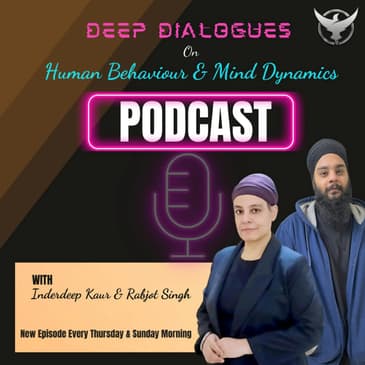

"Unlock Your Potential: Delve into the 10 Forces of Emotion (Part 1)"
Embark on a transformative journey in the next episode of Deep Dialogues as we uncover the ten emotions of power – from anger and hurt to disappointment and loneliness. In this first part of a two-part series, we explore the profound messages conveyed by each emotion and delve into practical solutions for navigating them. Prepare to be enlightened as we unravel the complexities of these emotions and discover the hidden wisdom they hold. Whether you're seeking clarity, healing, or empowerment, this episode promises invaluable insights to help you harness the power within. Don't miss out on this enlightening discussion that lays the foundation for profound personal growth and transformation.
[00:00:00] First of all I am really really sorry for ghosting you all for last 2 weeks.
[00:00:05] I got caught up in the tide of life so I had to learn to surf.
[00:00:10] Anyways, today's topic is nothing less than a treasure.
[00:00:13] Today I'm going to give you 10 Emotions of Power.
[00:00:17] I'm going to tell you the negative emotions first then it's counter emotion of power.
[00:00:23] So there's gonna be a long one and enjoyable too.
[00:00:27] So get popcorn, get something to drink and we are going in a treasure hunt today.
[00:00:33] So for those who don't know me, I'm Rabjot Singh an automobile ingenium by profession
[00:00:38] and owner of Singh Automots Academy
[00:00:41] and I'm on a mission to help people live a life of emotional and financial freedom
[00:00:46] and this podcast is one of my ways to do it.
[00:00:48] This is episode 13 of 75 episodes challenge in which I am building a community of emotional and financially free individuals.
[00:00:57] So let's get into it.
[00:00:58] I suggest you to listen to this episode again and again
[00:01:02] so that when the actual moment of crisis arrives, you will know what you are feeling.
[00:01:07] I will also say that knowing about these emotions right now
[00:01:10] will not lead you to emotional mastery right away.
[00:01:13] Of course like any other skill you have to keep practicing it.
[00:01:17] So the first emotion is the feeling of discomfort.
[00:01:21] Uncomfortable emotions don't have a tremendous amount of intensity
[00:01:25] but they do bother us and create the nagging sensation that things are not quite right.
[00:01:31] The message basically discomfort wants to give you is through boredom,
[00:01:36] patience, unease distress or mild embarrassment
[00:01:40] are all giving you a simple message that something is not quite right.
[00:01:44] Maybe the way you are perceiving things is off
[00:01:48] or the actions you are taking are not producing the results you want.
[00:01:52] The solution is dealing with emotions of discomfort is quite simple.
[00:01:57] Clarify what do you want and refine your actions.
[00:02:01] Try a slightly different approach and see if you can't immediately change the way you are feeling about
[00:02:07] or maybe change the quality of results you are producing
[00:02:12] like all emotions if not dealt with uncomfortable feelings will intensify.
[00:02:18] Discomfort is somewhat painful but the anticipation of possible emotional pain
[00:02:23] is much more intense than the discomfort you might be feeling right now in the moment.
[00:02:29] You need to remember that our imagination can make things 10 times more intense
[00:02:34] than anything we could ever experience in our real life.
[00:02:38] In fact in chess and martial arts it is often said that the threat of the attack is more dangerous than the attack itself.
[00:02:47] When we begin to anticipate pain especially intense level of it
[00:02:52] often we begin to develop the emotion of fear which happens to be the second negative emotion of today.
[00:02:59] Fearful emotions include everything from low levels of concern and apprehension to intense worry,
[00:03:06] anxiety, fright and even terror.
[00:03:09] Fear serves a purpose and its message is very simple.
[00:03:13] The message is fear is simply the anticipation that something's going to happen soon needs to be prepared for.
[00:03:22] In other words, the simple boycott motto be prepared.
[00:03:26] We need either to prepare to cope with the situation or do something to change it.
[00:03:32] The tragedy is that most people try to deny their fear or value in it.
[00:03:38] Neither of these approaches is respecting the message that fear is trying to deliver.
[00:03:44] So it will continue to pursue you as it tries to get the message across.
[00:03:50] You don't want to surrender to fear and amplify it by starting to think of the worst could happen
[00:03:56] nor do you want to pretend it's not there.
[00:03:59] The solution is review what you are feeling fearful about
[00:04:03] and evaluate what you must do to prepare yourself mentally.
[00:04:09] Figure out what actions you need to take in order to deal with the situation in the best possible way.
[00:04:15] Sometimes we have done all the preparation we could for something.
[00:04:20] There's nothing else we can do but we still sit around in fear.
[00:04:24] This is the point where you must use the antidote to fear.
[00:04:28] You must make a decision to have faith.
[00:04:31] Knowing you have done all you can to prepare for whatever you are fearing from
[00:04:37] and that most fear in life rarely come to fruition.
[00:04:42] The next emotion we are discussing about is hurt.
[00:04:46] If there is any one emotion that seems to dominate human relationships,
[00:04:51] both personal and professional, it's the emotion of hurt.
[00:04:54] Feelings of hurt are usually generated by a sense of loss.
[00:04:59] When people are hurt, they often lash out on others.
[00:05:03] We need to hear the real message that hurt gives
[00:05:07] and the message is hurt gives us a signal that we have an expectation
[00:05:13] that has not been met many times
[00:05:16] and this feeling arise as a result
[00:05:18] that we expected somebody to keep their word and they didn't.
[00:05:22] Even if you didn't tell them your expectation
[00:05:25] that for example they are not meant to share something with others
[00:05:29] and you feel a loss of intimacy or maybe loss of trust
[00:05:34] and then you feel like you are getting hurt.
[00:05:37] The solution to this is realize that in reality you may not have lost anything.
[00:05:43] Maybe what you need to lose is the false perception
[00:05:46] that this person is trying to wound or hurt you
[00:05:51] and they don't really realize the impact of the actions they are having on your life.
[00:05:55] Secondly, take a moment and reevaluate the situation as yourself.
[00:06:00] Is there anything lost here or am I just judging the situation too soon or too harshly?
[00:06:06] Third solution is that you can help yourself get out of this sense of hurt
[00:06:12] too elegantly and too appropriately just by communicating your sense of loss to the other person.
[00:06:18] For example, if I say to someone that the other day XYZ thing happened
[00:06:23] and I don't really care but I felt a sense of loss.
[00:06:28] So can you clarify what really happened and that's it done.
[00:06:32] Communication is the best thing you can do to avoid any negative emotion
[00:06:37] especially hurt so that your relationships will go on for a long period of time until eternity.
[00:06:43] However, if hurt is not dealt with it often becomes amplified
[00:06:48] and turns into anger which happens to be our fourth emotion.
[00:06:53] Angry emotions include everything from being mildly irritated to being anger, resentful, furious or even enraged.
[00:07:03] The message of anger is that an important rule or standard that you hold for your life has been violated
[00:07:10] by someone else or even by you.
[00:07:12] When you get the message of anger you need to understand that you can literally change this emotion in a moment.
[00:07:20] The solution is to realize that you may have misinterpreted the situation completely
[00:07:26] and that your anger about this person breaking your rules is completely wrong.
[00:07:31] Maybe based on the fact that they don't know what is most important to you
[00:07:37] and when they realize it they might not violate the standard again.
[00:07:42] Ask yourself more empowering question in a long run.
[00:07:46] Is it true about this person that they really care if I get angry or not
[00:07:52] if they are breaking this rule or not and you'll get your answer immediately.
[00:07:56] Ask yourself what can I learn from this
[00:07:59] and how can I communicate the importance of these standards I hold for myself
[00:08:05] to this person in a way that causes them to want to help me and not violate my standard again in the future.
[00:08:12] For example, if you are angry then change your perception.
[00:08:15] Maybe this person really don't know your rules.
[00:08:18] Change your perception that you didn't effectively communicate the real need
[00:08:24] or change your behavior.
[00:08:26] Simply tell them that you don't want them to share some XYZ to someone else
[00:08:31] that it's really important to you.
[00:08:32] For many people consistent anger or failure to be able to meet the standards and rules
[00:08:39] lead to frustration which happens to be our fifth emotion of today.
[00:08:44] Frustration can come from many avenues.
[00:08:47] Anytime we feel like we are surrounded by roadblocks in our life
[00:08:52] where we are continuously putting out effort but not receiving rewards
[00:08:56] we tend to feel the emotion of frustration.
[00:08:59] The message of frustration is an exciting signal to be honest.
[00:09:03] It means that your brain believe you could be doing better than you currently are
[00:09:09] and what's better than this?
[00:09:10] You just realize that you have more capability to do.
[00:09:14] Frustration is very different than disappointment
[00:09:17] which is the feeling that something you want in your life but you will never get it.
[00:09:22] By contrast, frustration is a very positive sign.
[00:09:25] It means that the solution to your problem is within your range
[00:09:30] but what you are currently doing isn't working.
[00:09:33] So what you need to do is change your approach in order to achieve your goal.
[00:09:38] It signals for you to become more flexible how to deal with your frustration.
[00:09:44] The solution is simple.
[00:09:45] Realize that frustration is your friend and brainstorm new ways
[00:09:50] to get a result how you can flex your approach
[00:09:53] and get some input on how to deal with the situation.
[00:09:57] Find the role model someone who has found a way already
[00:10:01] to get to the result where you want to be and that's it.
[00:10:04] Frustration is gone.
[00:10:06] Get fascinated by what you can learn that could help you handle this challenge
[00:10:12] not only today but in the future in a way that it consumes less time and energy
[00:10:17] and actually creates joy.
[00:10:19] Much more devastating than frustration however is the feeling of disappointment
[00:10:25] which is our next negative emotion.
[00:10:27] This can be a very destructive emotion if you don't deal with it quickly.
[00:10:32] Disappointment is the devastating feeling of being let down
[00:10:37] or that you are going to miss out on something forever.
[00:10:41] Anything that makes you feel sad or defeated as a result of expecting more
[00:10:46] then you get disappointed.
[00:10:47] The message disappointment gives you is that an expectation you had for a goal
[00:10:52] you are really going for is probably not going to happen.
[00:10:56] So it's time to change your expectation make them more appropriate for this situation
[00:11:02] and to take action and set on to achieve a new goal immediately
[00:11:07] and that is the solution too.
[00:11:08] It is immediately figuring out something you can learn from this situation
[00:11:13] that could help you in the future to achieve the very thing
[00:11:17] you were after in the first place
[00:11:19] and something you can do immediately to make progress towards
[00:11:23] that you may be misjudging too soon
[00:11:26] and things you are disappointed on are mostly temporary challenges.
[00:11:31] You need to remember that God's delays are not God's denies.
[00:11:36] People often set themselves up for disappointment by having completely unrealistic expectations.
[00:11:42] If you go out today and plant a tree
[00:11:44] you can't come back tomorrow and expect it to become a tree.
[00:11:49] Oh, I guess I went wrong there.
[00:11:51] Yeah. Anyway, you got the point, right?
[00:11:53] A fourth major solution to dealing with disappointment
[00:11:56] is to realize that a situation isn't over yet
[00:12:00] and develop more patience completely to reevaluate
[00:12:04] what you truly want and begin to develop an even more effective plan
[00:12:10] for achieving it.
[00:12:11] The most powerful antidote to the emotion of disappointment
[00:12:15] is cultivating an attitude of positive expectancy
[00:12:19] about what will happen in the future regardless of what has occurred in the past.
[00:12:25] Ultimate disappointment is usually expressed in the emotion of guilt
[00:12:30] which happens to be a seventh emotion for today.
[00:12:33] The emotions of guilt, regret and remorse
[00:12:35] are among the emotions human beings do most to avoid in life
[00:12:40] and this is valuable.
[00:12:42] They are painful emotions for us
[00:12:43] but they serve a valuable function
[00:12:46] one which becomes apparent once we hear the message.
[00:12:50] The message, guilt will tell you that you have violated one of your own highest standard
[00:12:57] and that you must do something immediately
[00:13:01] to ensure that you are not doing this violation of the standard again in the future.
[00:13:07] If you recall in my previous episodes
[00:13:09] I have said it repeatedly that if you link enough pain to a behavior
[00:13:14] the person will eventually change
[00:13:17] and the strongest leverage is the pain we can give to ourselves.
[00:13:21] Guilt is the ultimate leverage for many people in changing their behavior.
[00:13:26] However, some people try to deal with their guilt by denying and suppressing it.
[00:13:31] Unfortunately this never really works.
[00:13:34] Guilt does not go away
[00:13:37] it only comes back stronger.
[00:13:39] The other extreme is to surrender to it and valor in guilt
[00:13:43] where we just begin to accept the pain and experience learned helplessness.
[00:13:48] This is not the purpose of guilt
[00:13:50] it's designed again to drive us to action, to create a change.
[00:13:55] People always fail to understand this
[00:13:58] and often feel so remorseful about something they once did
[00:14:02] that they allow themselves to feel inferior for the rest of their life.
[00:14:07] This is not the message of guilt.
[00:14:09] It's there to make sure you either avoid behaviors out of your certainty
[00:14:13] or if you have already violated your standard
[00:14:17] it's there to induce pain to get yourself to recommit to the standard once again.
[00:14:23] The solution is to acknowledge that you have in fact violated a critical standard
[00:14:28] you hold for yourself.
[00:14:30] Absolutely, commit yourself to making sure
[00:14:33] that this behavior will never happen again in the future.
[00:14:36] Some people manage to beat themselves up mentally and emotionally
[00:14:41] because they're constantly feeling to meet standard
[00:14:44] they hold for themselves virtually in every area of their life
[00:14:48] and as a result most of these people experience the feeling of inadequacy.
[00:14:54] The feeling of unworthiness occurs any time we feel
[00:14:58] we can't do something we should be able to do.
[00:15:02] The challenge of course is often we have a completely unfair rule
[00:15:07] for determining whether we are inadequate or not.
[00:15:11] First understand the message inadequacy is giving you.
[00:15:15] The message is that you don't presently have the level of skill
[00:15:20] necessary for the task in hand.
[00:15:22] It's telling you that you need more information understanding
[00:15:27] strategies, tools and confidence.
[00:15:30] The solution is very simple.
[00:15:32] Simply ask yourself,
[00:15:34] is this really an appropriate emotion for me to feel in the situation
[00:15:39] or am I really inadequate or do I have to change the way I'm perceiving things?
[00:15:44] If your feeling is justified,
[00:15:46] the message of inadequacy is that you need to find a way to do something better
[00:15:52] than you have done it before.
[00:15:55] I remember when I used to like someone
[00:15:58] she was preparing for a huge government exam
[00:16:00] and she always felt inadequate about herself
[00:16:04] that she used to always say me
[00:16:07] that in the dream of hers is ever gonna get come into reality
[00:16:12] or am I ever going to crack this exam or whatever
[00:16:16] and she's feeling an emotion of inadequacy at that moment.
[00:16:21] She does not have the skill strategies and information
[00:16:24] to crack that exam.
[00:16:26] When you feel a feeling of inadequacy,
[00:16:28] you often compare your dream to be as unrealistic.
[00:16:33] But let me tell you that whenever you feel inadequate,
[00:16:37] appreciate the encouragement to improve.
[00:16:40] Remind yourself that you are not perfect.
[00:16:43] You can begin to feel adequate the moment you decide to commit yourself
[00:16:48] to constant and never ending improvement in your area
[00:16:52] or whatever area you want to.
[00:16:54] The emotion is critical because when someone feels inadequate,
[00:16:58] they tend to fall in the trap of learned helplessness.
[00:17:03] They begin to see the problem as being a permanent one.
[00:17:06] They tell themselves no greater lie
[00:17:09] one could ever tell yourself that you are inadequate.
[00:17:13] You may be untrained, you may be unskilled
[00:17:16] in a particular area but you are never inadequate.
[00:17:20] I cannot emphasize more on that.
[00:17:23] The greatness in anything is within you even now.
[00:17:26] When you begin to feel that problems are permanent or pervasive
[00:17:31] or we have more things to deal with than we can possibly imagine,
[00:17:36] we tend to succumb to the emotions of overload and overwhelm.
[00:17:41] Grief, depression and helplessness are nearly expressions
[00:17:45] of feeling overloaded or overwhelmed.
[00:17:48] Grief happens when you feel like there is no empowering meaning
[00:17:53] for something that has happened or that your life is being negatively impacted
[00:18:00] by people's events or forces that are outside of your control.
[00:18:04] People in this state being overwhelmed and often begin to feel that
[00:18:09] nothing can change in the situation
[00:18:11] that the problem is too big, too permanent, pervasive and personal.
[00:18:16] People go into these emotional states whenever they perceive their world in a way
[00:18:21] that make them feel like there is more going on than they can possibly deal with.
[00:18:27] That the pace, amount or intensity or sensation seems overwhelming.
[00:18:33] The message of being overwhelmed is that you need to re-evaluate
[00:18:38] what most important to you in the situation.
[00:18:41] The reason you are overloaded is that you are trying to deal with too many things at once
[00:18:46] and you are trying to change everything overnight.
[00:18:50] The feeling of being overloaded or overwhelmed disrupts and destroys more people's life
[00:18:56] than just about any other emotion.
[00:18:59] The solution is that decide out of all the things you are dealing with in your life
[00:19:05] what's the absolute most important thing for you to focus on.
[00:19:10] Second is now write down all the things that are most important to you
[00:19:17] to accomplish and put them in an order of priority.
[00:19:20] Just putting them down on paper will allow you to begin to feel a sense of control over what's going on.
[00:19:28] Tackle the first thing going on on your list and continue to take action until you have mastered it.
[00:19:35] When you feel that it's appropriate to start letting go of an overwhelming emotion like grief,
[00:19:41] start focusing on what you can control and realize that there must be some empowering meaning to it
[00:19:48] even though you can't comprehend it yet.
[00:19:50] Probably the emotion that people fear the most however is the feeling of disconnection.
[00:19:57] Also known as loneliness and this is the last emotion and the 10th negative emotion I am discussing with you.
[00:20:05] Anything that makes you feel alone apart, separate from others falls in this category.
[00:20:12] Have you ever felt lonely?
[00:20:14] I don't think there is anybody alive who hasn't.
[00:20:17] The message of loneliness is that you need a connection with people.
[00:20:21] Now here I am not telling you that it means a sexual connection or an instant intimacy.
[00:20:28] They feel often frustrated because when they do have intimacy they still feel lonely.
[00:20:33] The solution to this is very simple.
[00:20:36] It is to realize that you can reach out and make connection immediately
[00:20:41] and you must realize that there are caring people everywhere.
[00:20:45] Identify what kind of connection you do need.
[00:20:49] Do you need an intimate connection?
[00:20:51] Maybe you just need some basic friendship.
[00:20:54] What's great about being lonely is I mean I really care about people.
[00:20:59] I love to be with them.
[00:21:00] I need to find out what connection I need with somebody right now
[00:21:05] and then I take the action immediately and make that happen.
[00:21:10] Loneliness gives you clarity about what relationships you want in your life at that moment.
[00:21:17] After that take immediate action to reach out to connect with someone.
[00:21:22] So there's your list for 10 action signals or emotions
[00:21:27] To fully utilize these 10 emotions which I have given you
[00:21:31] you must remember to review it several times
[00:21:35] and with each repetition look for positive messages that each emotion is giving you
[00:21:42] as well as the solutions you can use in the future.
[00:21:45] Almost all negative emotions have their basis in these 10 categories
[00:21:50] and some are hybrid of it.
[00:21:52] But you can deal with any emotion in the way we have discussed in this episode
[00:21:57] by going through the steps of getting curious and discovering the empowering meanings
[00:22:02] it offers you.
[00:22:03] You think of your mind as a garden to ensure a good harvest
[00:22:07] is to plant seeds like love, warmth, appreciation
[00:22:11] instead of seeds like disappointment, anger and fear.
[00:22:15] Begin to think that these emotions as weeds in your garden.
[00:22:19] A weed is a call to action isn't it?
[00:22:23] It says that you have got to do something
[00:22:26] or else it will ruin the whole garden which happens to be your mind.
[00:22:30] I have decided to make the episode in two parts
[00:22:32] as in the other episode I'm going to tell you the 10 opposites of these negative emotions
[00:22:39] which will cultivate your mind as a beautiful garden.
[00:22:42] I'm going to release that episode tomorrow itself
[00:22:45] so that we can get the complete hold of all those 10 emotions of power.
[00:22:50] So right now with this episode your key takeaways is all the negative emotions
[00:22:56] which are called to actions in your life, their message and the solution.
[00:23:01] So if you are facing any of these emotions right now
[00:23:04] you know what to do.
[00:23:06] Listen to this episode several times and write them up.
[00:23:10] Keep it with you at all the time so that the moment of crisis comes
[00:23:14] you don't have to listen to my episode again and again.
[00:23:17] You will have just a paper where everything is written down.
[00:23:20] I will not say I don't feel these emotions
[00:23:24] but now I know how to handle these emotions just by looking at their solutions.
[00:23:30] And you can do that too.
[00:23:32] We are humans, we always feel something at some moment of time
[00:23:37] but we have to release all the negative emotions as quickly as possible
[00:23:41] so that we can enjoy life and be happy in it
[00:23:45] except new people, except love, except every good thing in our life
[00:23:49] and take it as a blessing and be thankful to the ultimate universe of God.
[00:23:54] Thank you for today.
[00:23:55] Thank you for bearing with me till now.
[00:23:57] I know this is a long episode and I'm really grateful that you have listened to me.
[00:24:04] Thank you.
[00:24:04] This is Rabjot Singh, your host.
[00:24:07] Take care and keep being awesome.