
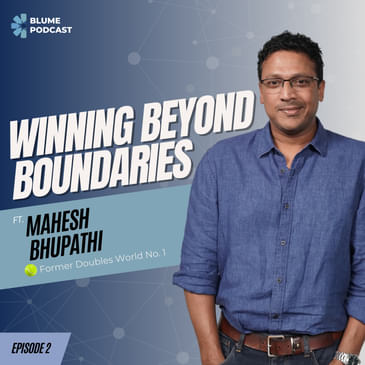

Guest: Mahesh Bhupathi, Tennis Grand Slam Champion and Entrepreneur
Host: Karthik Reddy, Co-founder of Blume Ventures
This episode provides insights into what it takes to achieve global success and excel on the world stage. Mahesh shares his journey from a young tennis prodigy to a Grand Slam champion, offering valuable lessons applicable to both sports and business. His experiences and perspectives on talent development, overcoming challenges, and transitioning to entrepreneurship provide inspiration and practical advice for anyone aiming to win beyond boundaries.
Key Topics:
Mahesh's early years and his father's influence on his tennis career
The journey to becoming a Grand Slam champion
Partnership with Leander Paes and dynamics of doubles tennis
Memorable Olympic experiences and dealing with tough losses
Physical and mental discipline required for a long-lasting tennis career
Transition from professional tennis to entrepreneurship
Founding and growth of Globosport
Insights on talent spotting and development in tennis
The state of Indian tennis and challenges in building a robust ecosystem
Parallels between sports and entrepreneurship
Advice for aspiring tennis players and young entrepreneurs
Current focus on sports management
#MaheshBhupathi #Tennis #IndianTennis #LeanderPaes #Olympics #GrandSlam #FrenchOpen #Wimbledon #USOpen #AustralianOpen
Timestamps
[00:00:00] - Introduction
[03:17] - Mahesh talks about his early tennis beginnings and his father's influence.
[05:25] - Discussion on the importance of family support in sports careers.
[06:59] - Mahesh recounts his first visit to Wimbledon at age 12.
[11:58] - The story of Mahesh's first Grand Slam win in mixed doubles at the 1997 French Open.
[16:03] - Mahesh discusses his partnership with Leander Paes.
[18:49] - Insights into why the ‘Indian Express’ clicked and how they overcame challenges
[21:23] - Discussion of the 2004 Athens Olympics match against Federer and Allegro
[24:52] - Mahesh talks about recovering from tough losses, particularly the Athens Olympics bronze medal match
[28:22] - Discussion on maintaining physical and mental discipline over a long career
[31:10] - The importance of continuous learning and improvement in tennis
[33:19] - Mahesh shares insights on coach-player relationships
[36:30] - Discussion on the right time to retire
[38:48] - Mahesh talks about starting Globosport and his business endeavours.
[41:39] - Insights into spotting tennis talent and the state of Indian tennis.
[45:41] - Discussion on developing a system for nurturing tennis talent in India.
[49:05] - Rapid-fire questions
[00:00:00] [SPEAKER_00]: I think some teams need a lot of communication. I think ours didn't. I think because we knew our ability on the tennis court. As soon as that switch turned on, you know, things were going to be different.
[00:00:13] [SPEAKER_00]: 2001 when we won the French, I don't think it was seeded, right? In 99 when we won, we were one of the top four seeds. In 2001, we were not seeded. So but we knew that it didn't matter, right?
[00:00:23] [SPEAKER_00]: Nobody wanted to play us. It was a feeling we had, right? And that's why no matter how much we played on tour or we didn't when we got together at the Olympics or we played a random tournament, it was just an automatic button that we had to find a way to switch.
[00:00:43] [SPEAKER_03]: Today we have the privilege of hosting a great legend of Indian sport. A man who has not only conquered the world of tennis but also made a significant impact beyond the court. Our guest is none other than Mahesh Bhupathi, one half of the famed Indian Express of Indian tennis.
[00:00:58] [SPEAKER_03]: In a nation starved of sporting success in the mid to late 90s beyond cricket, Mahesh and Leander became global champions. Mahesh won an astounding 12 Grand Slams between his mixed doubles career and his men's doubles, a lot of them with Leander.
[00:01:15] [SPEAKER_03]: And that marked the beginnings of what India could achieve on the global stage in tennis.
[00:01:21] [SPEAKER_03]: Mahesh's impact extends well beyond the tennis court. He's a trailblazer in he's built a global sports management company, nurturing Indian talent both in tennis and outside of tennis.
[00:01:33] [SPEAKER_03]: He's recently tied up with a large corporate to get more into sports franchise building. That's what he does today beyond coaching his 12 year old daughter.
[00:01:45] [SPEAKER_03]: And he's trying to make a significant impact through various philanthropies in the country.
[00:01:49] [SPEAKER_03]: From his early days as a young tennis prodigy, today as a mentor and a business owner Mahesh Bhupathi's story is one of passion, perseverance and grit and relentless pursuit of excellence.
[00:02:00] [SPEAKER_03]: In today's podcast I'm most interested in teasing out the similarities between winning at a global level at sport and building and nurturing and running a startup at a global level.
[00:02:11] [SPEAKER_03]: That was the theme for this year's podcast, winning beyond boundaries.
[00:02:17] [SPEAKER_03]: We champion that at Bloom Day and we want all of our guests for the season to actually speak a lot about what it takes to win on the global stage.
[00:02:27] [SPEAKER_03]: And tennis and what Mahesh has done are probably one of the best examples of what we've seen in Indian sport.
[00:02:33] [SPEAKER_03]: Mahesh, welcome to the show.
[00:02:37] [SPEAKER_03]: I thought we can start Mahesh with a little bit of, you know, parts of your history around what does it mean to be a part of like the genetic lottery so to speak.
[00:02:52] [SPEAKER_03]: We all are relatively privileged as when we grew up in the 80s and 90s.
[00:02:58] [SPEAKER_03]: And I know your father was an avid spokesman and took you training where you lived in the Middle East.
[00:03:08] [SPEAKER_03]: So walk us through a little bit of that history on how all of this unfolded.
[00:03:12] [SPEAKER_03]: How did Mahesh Bhupathi become the, what are the beginnings of the tennis story?
[00:03:17] [SPEAKER_00]: Yeah, so talking about genetic history, right, my dad used to be a tennis player.
[00:03:24] [SPEAKER_00]: He was, let's say, ranked as high as number six during Ramanathan Krishna's era.
[00:03:30] [SPEAKER_00]: And at that time the depth of Indian tennis was pretty high, right?
[00:03:33] [SPEAKER_00]: You had Krishnan, Mukherjee, Lal, you had Anand Amritra, Chashi Menon.
[00:03:37] [SPEAKER_00]: So he was a pretty high quality tennis player from the Indian perspective.
[00:03:42] [SPEAKER_00]: Unfortunately, he had a car accident and broke his hand, which, you know, at that time with the rehab and the surgeries compared to today, it was career ending for him.
[00:03:53] [SPEAKER_00]: So he pretty much decided then and there that his first born was going to be a tennis player.
[00:03:58] [SPEAKER_00]: Okay.
[00:03:59] [SPEAKER_00]: Regardless of it was male or female.
[00:04:01] [SPEAKER_00]: So, you know, when you talk about kind of single minded focus slash obsession, it came at that level.
[00:04:11] [SPEAKER_00]: My mum still tells the story about how he insisted that, you know, she come to tennis matches when I was in the stomach.
[00:04:19] [SPEAKER_00]: So I could kind of hear the sound of the ball.
[00:04:23] [SPEAKER_00]: And so it was that level of obsession.
[00:04:28] [SPEAKER_00]: You know, the racket was, let's say a badminton racket was thrown into my hand because the tennis racket was too heavy when I was three years old.
[00:04:36] [SPEAKER_00]: So I could start swinging it and followed him to the tennis courts where it became a daily routine to the point where it became my own obsession one day as well.
[00:04:47] [SPEAKER_00]: So I think that was that was the history of the genetics.
[00:04:51] [SPEAKER_03]: Fantastic.
[00:04:52] [SPEAKER_03]: I had no idea of that part of the story.
[00:04:55] [SPEAKER_03]: And, you know, it's always fascinating to hear the origin stories.
[00:04:58] [SPEAKER_03]: And, you know, clearly here there was both nature and nurture involved as you look at younger talent and people who you know, you coach, you oversee.
[00:05:10] [SPEAKER_03]: Do you see that's an important part of building greatness if you want to be one of the world's best in anything?
[00:05:17] [SPEAKER_03]: Is it important to, you know, know that you have to build this right balance of nature was very early in the child's life?
[00:05:25] [SPEAKER_00]: Yeah, I think unless you're able to do that within your own ecosystem today, I think sport is so frightfully competitive and difficult to succeed in that it's impossible.
[00:05:38] [SPEAKER_00]: I mean, even, you know, for example, Sanya, if you take her example, her dad was a Ranji level cricket player.
[00:05:46] [SPEAKER_00]: Right.
[00:05:47] [SPEAKER_00]: And knew nothing about tennis.
[00:05:50] [SPEAKER_00]: But when he saw how much Sanya enjoyed it and the fact that, you know, she was she had something in her, you know, he made it his obsession, which converted into the family's obsession.
[00:06:02] [SPEAKER_00]: Because, you know, you would see the whole family, including the younger sister and the mom always at tournaments.
[00:06:07] [SPEAKER_00]: Someone had to travel with her all the time.
[00:06:09] [SPEAKER_00]: So unless it gets it's a full, full hearted process.
[00:06:14] [SPEAKER_03]: And it's a family obsession.
[00:06:15] [SPEAKER_03]: It has to become.
[00:06:16] [SPEAKER_03]: It has to be because you're too young to be able to do all this.
[00:06:19] [SPEAKER_00]: Yeah, it's impossible.
[00:06:20] [SPEAKER_00]: I mean, mentally.
[00:06:22] [SPEAKER_00]: And, you know, my daughter is playing tennis today and, you know, I have two different hats, three, three, four different hats when it comes to her tennis.
[00:06:29] [SPEAKER_00]: And as a father, it's it's it's painful to watch the pain, the hours in the heat.
[00:06:37] [SPEAKER_00]: Yeah.
[00:06:37] [SPEAKER_00]: And it's you know, but it has to be done if you want the gratification.
[00:06:42] [SPEAKER_03]: Yeah.
[00:06:42] [SPEAKER_03]: And I think you were like there's a story of you being in Wimbledon watching match at the age of 12.
[00:06:50] [SPEAKER_03]: Was that a part of the training or is it just like the joy of like seeing what is possible?
[00:06:55] [SPEAKER_03]: What did that moment feel like if that memory still lingers in your mind?
[00:06:58] [SPEAKER_00]: Yeah, I think it was a bit of both.
[00:07:00] [SPEAKER_00]: I think from my father's point of view, you know, he wanted me to see what could lie in front of me if the work was put in right.
[00:07:13] [SPEAKER_00]: And I still remember the day that we stood in line and bought tickets to go in after six o'clock because there are people coming out at six.
[00:07:22] [SPEAKER_00]: They they leave their tickets and if you resell them, it goes to charity.
[00:07:26] [SPEAKER_00]: So we stood in line, bought tickets and when we ran in, I still remember my reaction, the excitement.
[00:07:33] [SPEAKER_00]: And because of the UK summer, we got three, four hours of tennis in that day.
[00:07:38] [SPEAKER_00]: And yeah, I think that's when it turned for me.
[00:07:41] [SPEAKER_00]: Right.
[00:07:41] [SPEAKER_00]: I wanted to play there one day.
[00:07:43] [SPEAKER_02]: Yeah.
[00:07:44] [SPEAKER_00]: And again, everything I learned from my dad, I'm installing trying to install luckily for me at a different level with my daughter.
[00:07:52] [SPEAKER_00]: I took her to the Wimbledon final in the women's last year.
[00:07:54] [SPEAKER_00]: Lovely.
[00:07:54] [SPEAKER_00]: You know, to see if it can ignite some juices.
[00:07:57] [SPEAKER_00]: Right.
[00:07:58] [SPEAKER_00]: But I think this is part of the process.
[00:08:00] [SPEAKER_00]: This is part of the process.
[00:08:01] [SPEAKER_03]: No, and I think one important point takeaway for me is as you look at young founders, for example,
[00:08:07] [SPEAKER_03]: if they truly want to build on a world stage, they have to get exposed to it.
[00:08:11] [SPEAKER_03]: And while we have a phenomenal startup ecosystem out here, a lot of the kids are not exposed yet.
[00:08:16] [SPEAKER_03]: And it's important to go see what's out there.
[00:08:18] [SPEAKER_03]: And, you know, that's why we create these like almost religious trips to the valley,
[00:08:24] [SPEAKER_03]: because you have to go and see what is possible.
[00:08:27] [SPEAKER_03]: And it sounds very similar.
[00:08:29] [SPEAKER_03]: Before, I mean, I would love to get into specific sort of match instances,
[00:08:34] [SPEAKER_03]: but before I get there, clearly, were you part of the bat thing in Chennai?
[00:08:42] [SPEAKER_00]: No, I think my dad and Vijay played a decent amount of doubles together.
[00:08:46] [SPEAKER_00]: And Vijay asked my dad to send me, but my dad refused.
[00:08:50] [SPEAKER_00]: OK.
[00:08:50] [SPEAKER_00]: Because he was in control of my tennis and he didn't want me to go into an ecosystem
[00:08:54] [SPEAKER_00]: where there were, I think, 12 boys.
[00:08:57] [SPEAKER_00]: That's right.
[00:08:58] [SPEAKER_03]: That was the first batch in the late 80s.
[00:09:00] [SPEAKER_00]: Because he felt the attention would obviously go away, right?
[00:09:05] [SPEAKER_00]: Because Vijay was not going to be there.
[00:09:08] [SPEAKER_00]: And there were two foreign coaches.
[00:09:09] [SPEAKER_00]: So my dad wasn't comfortable.
[00:09:11] [SPEAKER_03]: And so your rise in Indian ranks obviously happened.
[00:09:17] [SPEAKER_03]: What makes a transition to becoming a global player?
[00:09:20] [SPEAKER_03]: So you start playing the global circuit.
[00:09:23] [SPEAKER_03]: What was the differences you found when you got out of this comfort zone of Chennai?
[00:09:27] [SPEAKER_03]: You were living in Chennai at that point?
[00:09:29] [SPEAKER_00]: So we were, yeah, I was born in Chennai, but when I was seven, my dad got transferred.
[00:09:32] [SPEAKER_00]: He was with Standard Chartered.
[00:09:33] [SPEAKER_00]: So he got transferred to Dubai.
[00:09:34] [SPEAKER_03]: OK.
[00:09:35] [SPEAKER_00]: So I spent most of my childhood in the Gulf.
[00:09:38] [SPEAKER_03]: OK.
[00:09:38] [SPEAKER_03]: OK.
[00:09:39] [SPEAKER_03]: And so you were already acclimatized in that sense?
[00:09:43] [SPEAKER_00]: Yeah, acclimatized.
[00:09:44] [SPEAKER_00]: I mean, I wouldn't take it as a positive because there were no tennis players in the Gulf
[00:09:47] [SPEAKER_00]: at that time.
[00:09:47] [SPEAKER_00]: I think my dad and me were literally the only two people with a racket.
[00:09:51] [SPEAKER_00]: So, you know, there was no competition for me.
[00:09:55] [SPEAKER_00]: In the summer, I used to come to India to compete.
[00:09:58] [SPEAKER_00]: But otherwise, you know, unfortunately, 11 months a year, there were no tournaments
[00:10:02] [SPEAKER_00]: in Dubai at that time.
[00:10:05] [SPEAKER_00]: Which was challenging, right?
[00:10:07] [SPEAKER_00]: Today you see the kids and juniors.
[00:10:08] [SPEAKER_00]: You've got to compete at least once a month to understand how to win,
[00:10:12] [SPEAKER_00]: to learn from losses and so on and so forth.
[00:10:15] [SPEAKER_00]: But at that time, I was able to kind of figure it out without that.
[00:10:18] [SPEAKER_03]: And when did that turn?
[00:10:19] [SPEAKER_03]: So at what age did you have to like actually push yourself to get into that
[00:10:24] [SPEAKER_03]: international circuit?
[00:10:25] [SPEAKER_00]: So it didn't really turn for me.
[00:10:26] [SPEAKER_00]: I think one of the main reasons was because of the lack of competition, right?
[00:10:30] [SPEAKER_00]: I was not a very good junior.
[00:10:32] [SPEAKER_00]: I was never in the top 10 in India either.
[00:10:35] [SPEAKER_00]: But, you know, it's a big, big, vast difference between junior tennis and
[00:10:39] [SPEAKER_00]: men's tennis, right?
[00:10:40] [SPEAKER_00]: I mean, the way some of the juniors play, they only play to win.
[00:10:45] [SPEAKER_00]: They don't play the right kind of style.
[00:10:46] [SPEAKER_00]: And my father was very anal about, you know, being an aggressive tennis
[00:10:50] [SPEAKER_00]: player, not worrying about the results in juniors.
[00:10:54] [SPEAKER_00]: So I could never really crack the Indian junior circuit.
[00:10:58] [SPEAKER_00]: But, you know, when it came for the transition, then, you know, all the
[00:11:03] [SPEAKER_00]: Gyan, so as to say that my dad gave me actually came true because the
[00:11:08] [SPEAKER_00]: aggressive style kind of transition in the men's game.
[00:11:11] [SPEAKER_00]: Whereas all those kids who beat me, you know, had to go to college
[00:11:15] [SPEAKER_00]: and now are working a desk job.
[00:11:20] [SPEAKER_03]: So, you know, I think I wanted to walk you through a few examples,
[00:11:24] [SPEAKER_03]: like, you know, so first sort of doubles title that we won.
[00:11:29] [SPEAKER_03]: At least our research suggests that, you know, 1997 French Open,
[00:11:33] [SPEAKER_03]: you won with a Japanese woman, Rika Hiraaki, you know,
[00:11:39] [SPEAKER_03]: and at that point became the first Indian tennis player to win a
[00:11:42] [SPEAKER_03]: Grand Slam.
[00:11:43] [SPEAKER_03]: And you were still looking for a partner.
[00:11:45] [SPEAKER_03]: So maybe, you know, how does one go find the equivalent of a co-
[00:11:51] [SPEAKER_03]: founder in the middle of a tournament?
[00:11:53] [SPEAKER_03]: And how do you make that work?
[00:11:57] [SPEAKER_00]: It was pure luck, to be honest.
[00:11:59] [SPEAKER_00]: I mean, 1997 was my first full year on the tour.
[00:12:04] [SPEAKER_00]: Coming into the French Open, probably my second Grand Slam of my life.
[00:12:09] [SPEAKER_00]: I had never played mixed doubles in my life and I was ranked 55
[00:12:13] [SPEAKER_00]: in the world.
[00:12:14] [SPEAKER_00]: And I still remember my coach, Enrico said to me the morning,
[00:12:18] [SPEAKER_00]: there's a sign-in deadline for mixed doubles.
[00:12:21] [SPEAKER_00]: He said, bro, why don't you sign in for mixed doubles?
[00:12:24] [SPEAKER_00]: You know, it's a couple of grand extra if you get in and you
[00:12:28] [SPEAKER_00]: get accommodation per diem, right?
[00:12:31] [SPEAKER_00]: So I said sure.
[00:12:32] [SPEAKER_00]: So we went to the mixed doubles sign-in and all the top players
[00:12:36] [SPEAKER_00]: had signed in.
[00:12:37] [SPEAKER_00]: I was 55 in the world.
[00:12:38] [SPEAKER_00]: I put my name down there, Mahesh Bhubhuti, 55, ranking, looking.
[00:12:43] [SPEAKER_00]: And I had a practice court at two o'clock and the deadline
[00:12:46] [SPEAKER_00]: was at two.
[00:12:47] [SPEAKER_00]: So Enrico said, why don't you go and warm up?
[00:12:51] [SPEAKER_00]: I'll stay here and see if anybody comes in, wants to play
[00:12:54] [SPEAKER_00]: with you.
[00:12:55] [SPEAKER_00]: So apparently, you know, five minutes to two, this girl comes
[00:12:59] [SPEAKER_00]: in and you know how polite Japanese are.
[00:13:03] [SPEAKER_00]: So Enrico kind of ambushes her because that's his style.
[00:13:07] [SPEAKER_00]: And she's 26 in the world, right?
[00:13:10] [SPEAKER_00]: And she's actually four foot 11.
[00:13:12] [SPEAKER_00]: And Enrico says, would you like to play with Mahesh?
[00:13:14] [SPEAKER_00]: And he asked to show him a photo, show her a photo of me
[00:13:18] [SPEAKER_00]: because nobody knew me on tour at that time.
[00:13:20] [SPEAKER_00]: So she had no choice either.
[00:13:23] [SPEAKER_00]: We were the last team to get in.
[00:13:24] [SPEAKER_00]: On the sign in, right?
[00:13:26] [SPEAKER_00]: I think we were like 80 combined and the cutoff was us.
[00:13:30] [SPEAKER_00]: So he comes running to the tennis court and says, you know,
[00:13:33] [SPEAKER_00]: we made another two grand this week.
[00:13:35] [SPEAKER_00]: And that was the excitement of the day.
[00:13:39] [SPEAKER_00]: I still remember we played our first match and we were down
[00:13:43] [SPEAKER_00]: three match points with a man serving.
[00:13:46] [SPEAKER_00]: And I came up, we found a way to win it.
[00:13:49] [SPEAKER_00]: And I came off the court and Enrico said, you're the
[00:13:51] [SPEAKER_00]: worst mixed doubles player I've ever seen in my life
[00:13:53] [SPEAKER_00]: because you hit every ball to the man instead of trying
[00:13:55] [SPEAKER_00]: to exploit the weakness on the court.
[00:13:59] [SPEAKER_00]: But like I said, it's pure luck.
[00:14:00] [SPEAKER_00]: We got better with every match and then we got into a zone.
[00:14:03] [SPEAKER_00]: I think we beat the fourth, the second and the
[00:14:05] [SPEAKER_00]: first seeds in the last three matches.
[00:14:07] [SPEAKER_00]: Amazing. Lovely story.
[00:14:09] [SPEAKER_03]: And so one, as you keep going up these pinnacles,
[00:14:14] [SPEAKER_03]: now that you've won, I guess you've conquered that
[00:14:17] [SPEAKER_03]: sort of barrier in your head.
[00:14:18] [SPEAKER_03]: Of course I can be a grand slam champion.
[00:14:20] [SPEAKER_03]: But how is it any different from playing other
[00:14:23] [SPEAKER_03]: tournaments on the top?
[00:14:25] [SPEAKER_03]: The grand slams, the stage is much bigger.
[00:14:27] [SPEAKER_03]: A lot more people watching.
[00:14:28] [SPEAKER_03]: I get that.
[00:14:29] [SPEAKER_03]: But as a player, we can never put ourselves in your
[00:14:31] [SPEAKER_03]: shoes.
[00:14:31] [SPEAKER_03]: But what does that pressure feel like?
[00:14:33] [SPEAKER_03]: What's different in a grand slam?
[00:14:36] [SPEAKER_00]: So I think the pressure I felt in 97 from years later
[00:14:40] [SPEAKER_00]: was very different because 97, it was like, you know,
[00:14:43] [SPEAKER_00]: every match was a little better paycheck and there
[00:14:47] [SPEAKER_00]: was actually no pressure.
[00:14:48] [SPEAKER_00]: And it was just funny to watch all the top seeds
[00:14:50] [SPEAKER_00]: trying to figure out who these people were.
[00:14:53] [SPEAKER_00]: But so, you know, we enjoyed just beating up
[00:14:56] [SPEAKER_00]: on them.
[00:14:58] [SPEAKER_00]: But then, you know, when we became the team
[00:15:02] [SPEAKER_00]: that people were challenging to beat all the
[00:15:03] [SPEAKER_00]: time, then you had to have plan A, plan B,
[00:15:08] [SPEAKER_00]: plan C because you were there to win every
[00:15:11] [SPEAKER_00]: tournament.
[00:15:12] [SPEAKER_00]: You were not there to get the paycheck.
[00:15:15] [SPEAKER_03]: And, you know, of course, your partnership with
[00:15:18] [SPEAKER_03]: Leander is kind of legendary.
[00:15:21] [SPEAKER_03]: How did that start?
[00:15:23] [SPEAKER_03]: No interview can be complete without a little
[00:15:26] [SPEAKER_03]: bit of that history.
[00:15:27] [SPEAKER_03]: And you won three doubles titles with
[00:15:29] [SPEAKER_03]: Leander, including the French and Wimbledon
[00:15:31] [SPEAKER_03]: just in 99.
[00:15:33] [SPEAKER_03]: And suddenly you peak to becoming the number
[00:15:35] [SPEAKER_03]: one player in the world.
[00:15:38] [SPEAKER_03]: So maybe a little bit of color on what worked
[00:15:41] [SPEAKER_03]: in that partnership.
[00:15:42] [SPEAKER_03]: How did it start?
[00:15:45] [SPEAKER_03]: And, you know, that's a classic like co-founded
[00:15:47] [SPEAKER_03]: journey.
[00:15:48] [SPEAKER_03]: So you discover each other and you live to live
[00:15:51] [SPEAKER_03]: with each other for like 10 years.
[00:15:53] [SPEAKER_03]: You probably know each other better than even
[00:15:54] [SPEAKER_03]: your respective others or girlfriends or spouses
[00:15:59] [SPEAKER_03]: at that point in time.
[00:16:00] [SPEAKER_03]: How did that feel like?
[00:16:02] [SPEAKER_03]: Any lessons for the partnerships?
[00:16:03] [SPEAKER_00]: Yeah, so I was like I said, I wasn't a very
[00:16:06] [SPEAKER_00]: good junior.
[00:16:06] [SPEAKER_00]: So I used my tennis to take a tennis
[00:16:09] [SPEAKER_00]: scholarship.
[00:16:09] [SPEAKER_00]: And I went to the University of Mississippi,
[00:16:11] [SPEAKER_00]: which is a very big tennis school.
[00:16:14] [SPEAKER_00]: And I think I was doing well in the college
[00:16:17] [SPEAKER_00]: scene.
[00:16:17] [SPEAKER_00]: So news had trickled down to India like,
[00:16:19] [SPEAKER_00]: you know, there's this Indian kid there who
[00:16:21] [SPEAKER_00]: is winning matches and I got invited to
[00:16:24] [SPEAKER_00]: play to be part of the Davis Cup squad,
[00:16:28] [SPEAKER_00]: which I think 1994 September we played
[00:16:31] [SPEAKER_00]: South Africa in Jaipur.
[00:16:33] [SPEAKER_00]: I didn't make the team, but I was the
[00:16:34] [SPEAKER_00]: fifth member.
[00:16:35] [SPEAKER_00]: Maybe I made the team, but I didn't play.
[00:16:37] [SPEAKER_00]: So, you know, that was my first real
[00:16:41] [SPEAKER_00]: interaction tennis wise, right?
[00:16:43] [SPEAKER_00]: With all the players on the team and
[00:16:46] [SPEAKER_00]: there was a lot of chatter.
[00:16:48] [SPEAKER_00]: So later that year,
[00:16:50] [SPEAKER_00]: I had taken the fall off to play
[00:16:52] [SPEAKER_00]: some tournaments.
[00:16:53] [SPEAKER_00]: I went to Jakarta for a challenger
[00:16:56] [SPEAKER_00]: to play singles qualifying.
[00:16:58] [SPEAKER_00]: And I remember Leander was in the draw.
[00:17:00] [SPEAKER_00]: He was the second seed of the singles.
[00:17:03] [SPEAKER_00]: I was in, I had just qualified for
[00:17:04] [SPEAKER_00]: the singles.
[00:17:05] [SPEAKER_00]: I was in the hotel lobby.
[00:17:07] [SPEAKER_00]: He walked in and he came straight up
[00:17:09] [SPEAKER_00]: to me, obviously greeted me because
[00:17:10] [SPEAKER_00]: we were the only two Indians there.
[00:17:12] [SPEAKER_00]: And he said, listen, I was supposed
[00:17:14] [SPEAKER_00]: to play with Shuzo Matsuoka here,
[00:17:16] [SPEAKER_00]: but he just pulled out.
[00:17:18] [SPEAKER_00]: Would you like to play doubles?
[00:17:22] [SPEAKER_00]: And, you know, I'm, so Leander
[00:17:24] [SPEAKER_00]: already all the heroics of the,
[00:17:27] [SPEAKER_00]: you know, Olympics with Ramesh and
[00:17:29] [SPEAKER_00]: Davis Cup in Frejus.
[00:17:31] [SPEAKER_00]: So for me, you know, he was like,
[00:17:32] [SPEAKER_00]: you know, I'm trying to play
[00:17:34] [SPEAKER_00]: pretty cool and,
[00:17:37] [SPEAKER_00]: you know, not react.
[00:17:38] [SPEAKER_00]: But, and he said
[00:17:40] [SPEAKER_00]: the one thing that stood out to me
[00:17:42] [SPEAKER_00]: immediately, he said, listen,
[00:17:44] [SPEAKER_00]: the only reason I'm asking you
[00:17:44] [SPEAKER_00]: to play is because I think
[00:17:45] [SPEAKER_00]: we can win the tournament.
[00:17:46] [SPEAKER_00]: Otherwise I wouldn't waste my time.
[00:17:49] [SPEAKER_00]: Which, you know, someone can
[00:17:50] [SPEAKER_00]: construe his arrogance,
[00:17:51] [SPEAKER_00]: but as you get to know Leander,
[00:17:52] [SPEAKER_00]: you know his mindset.
[00:17:55] [SPEAKER_00]: So yeah, obviously I said yes.
[00:17:58] [SPEAKER_00]: And yeah, we, you know,
[00:18:00] [SPEAKER_00]: immediately we won almost
[00:18:02] [SPEAKER_00]: every challenge that we played.
[00:18:04] [SPEAKER_00]: Right? So, I mean, we evolved from
[00:18:06] [SPEAKER_00]: that tournament in Jakarta.
[00:18:10] [SPEAKER_03]: Amazing.
[00:18:10] [SPEAKER_03]: And that led to like, you know,
[00:18:13] [SPEAKER_03]: a lot of memorable wins,
[00:18:15] [SPEAKER_03]: some like, you know,
[00:18:15] [SPEAKER_03]: really tough defeats,
[00:18:18] [SPEAKER_03]: highs and lows.
[00:18:20] [SPEAKER_03]: How do you, how do you sort of
[00:18:23] [SPEAKER_03]: help each other go through
[00:18:24] [SPEAKER_03]: those sort of lows when
[00:18:26] [SPEAKER_03]: you're a team?
[00:18:27] [SPEAKER_03]: And is it,
[00:18:29] [SPEAKER_03]: because your different personalities
[00:18:30] [SPEAKER_03]: helps or how do you like
[00:18:33] [SPEAKER_03]: pull yourself back up and say,
[00:18:35] [SPEAKER_03]: hey, you know, the next
[00:18:36] [SPEAKER_03]: tournament is down the corner.
[00:18:37] [SPEAKER_03]: We're going to win that.
[00:18:39] [SPEAKER_03]: Just curious to try and understand
[00:18:40] [SPEAKER_03]: the, you know, at the pinnacle
[00:18:42] [SPEAKER_03]: of the sport, what the mindset
[00:18:44] [SPEAKER_03]: feels like when you're down
[00:18:45] [SPEAKER_03]: from a tough feeling.
[00:18:47] [SPEAKER_00]: Yeah, I think some,
[00:18:49] [SPEAKER_00]: I think some, let's say teams
[00:18:51] [SPEAKER_00]: need a lot of communication.
[00:18:52] [SPEAKER_00]: I think ours didn't.
[00:18:54] [SPEAKER_00]: I think because we knew
[00:18:58] [SPEAKER_00]: our ability on the tennis court
[00:19:00] [SPEAKER_00]: as a team.
[00:19:03] [SPEAKER_00]: And when we were going
[00:19:05] [SPEAKER_00]: through patches where we were not
[00:19:06] [SPEAKER_00]: winning matches, both of us knew.
[00:19:09] [SPEAKER_00]: I mean, the coaches would be
[00:19:11] [SPEAKER_00]: talking a lot, trying to do
[00:19:12] [SPEAKER_00]: a lot of the tennis court,
[00:19:13] [SPEAKER_00]: but both of us knew
[00:19:15] [SPEAKER_00]: as soon as we clicked,
[00:19:18] [SPEAKER_00]: I mean, maybe one of us was feeling
[00:19:20] [SPEAKER_00]: low on confidence.
[00:19:21] [SPEAKER_00]: The other, both of us were feeling
[00:19:23] [SPEAKER_00]: low on confidence at times.
[00:19:24] [SPEAKER_00]: We were just losing to teams.
[00:19:25] [SPEAKER_00]: We didn't have to,
[00:19:26] [SPEAKER_00]: but we knew that as soon as
[00:19:28] [SPEAKER_00]: that switch turned on,
[00:19:30] [SPEAKER_00]: you know, things were going
[00:19:31] [SPEAKER_00]: to be different, right?
[00:19:31] [SPEAKER_00]: Like in 2002 or 2001
[00:19:35] [SPEAKER_00]: when we won the French,
[00:19:36] [SPEAKER_00]: I don't think we were seeded.
[00:19:37] [SPEAKER_00]: Right.
[00:19:37] [SPEAKER_00]: In 99 when we won,
[00:19:39] [SPEAKER_00]: we were one of the top
[00:19:39] [SPEAKER_00]: four seeds.
[00:19:40] [SPEAKER_00]: In 2001, we were not seeded.
[00:19:42] [SPEAKER_00]: So, but we knew
[00:19:43] [SPEAKER_00]: that it didn't matter, right?
[00:19:44] [SPEAKER_00]: Everyone, nobody wanted
[00:19:45] [SPEAKER_00]: to play us.
[00:19:47] [SPEAKER_00]: Even in 2011, when we came
[00:19:48] [SPEAKER_00]: back, nobody wanted to play us.
[00:19:50] [SPEAKER_00]: It was not a fun team
[00:19:51] [SPEAKER_00]: to play against.
[00:19:52] [SPEAKER_00]: We were not seeded.
[00:19:53] [SPEAKER_00]: And, you know, we knew
[00:19:54] [SPEAKER_00]: as soon as, it was
[00:19:55] [SPEAKER_00]: the feeling we had, right?
[00:19:56] [SPEAKER_00]: And that's why no matter
[00:19:58] [SPEAKER_00]: how much we played on tour
[00:19:59] [SPEAKER_00]: or we didn't when we got
[00:20:01] [SPEAKER_00]: together at the Olympics
[00:20:02] [SPEAKER_00]: or we played a random
[00:20:02] [SPEAKER_00]: tournament, it was just
[00:20:04] [SPEAKER_00]: an automatic button
[00:20:05] [SPEAKER_00]: that we had to find
[00:20:06] [SPEAKER_00]: a way to switch on.
[00:20:08] [SPEAKER_03]: Was it, what, 12 years?
[00:20:09] [SPEAKER_03]: 15 years, the partnership?
[00:20:10] [SPEAKER_03]: No, it was 96 to about 2011.
[00:20:15] [SPEAKER_00]: So 15 years.
[00:20:16] [SPEAKER_00]: Awesome.
[00:20:17] [SPEAKER_03]: And so two matches
[00:20:18] [SPEAKER_03]: that, you know, again,
[00:20:20] [SPEAKER_03]: we dug up.
[00:20:21] [SPEAKER_03]: One was, you know,
[00:20:22] [SPEAKER_03]: this Athens Olympic
[00:20:23] [SPEAKER_03]: match where you played
[00:20:26] [SPEAKER_03]: Federer and Yves Allegro.
[00:20:28] [SPEAKER_03]: You won the first set,
[00:20:30] [SPEAKER_03]: you know, in the second
[00:20:31] [SPEAKER_03]: set tiebreak.
[00:20:33] [SPEAKER_03]: You end up going
[00:20:34] [SPEAKER_03]: and winning that.
[00:20:36] [SPEAKER_03]: And, you know,
[00:20:36] [SPEAKER_03]: and Federer has just come,
[00:20:38] [SPEAKER_03]: come back, come from like
[00:20:40] [SPEAKER_03]: a tough loss to a check
[00:20:41] [SPEAKER_03]: player.
[00:20:42] [SPEAKER_03]: So he had a lot of
[00:20:43] [SPEAKER_03]: a lot at stake when he
[00:20:44] [SPEAKER_03]: came to play you guys.
[00:20:48] And
[00:20:48] [SPEAKER_03]: you folks had started
[00:20:49] [SPEAKER_03]: by winning against
[00:20:50] [SPEAKER_03]: Andy Doddick and Marty
[00:20:51] [SPEAKER_03]: Fish who were like
[00:20:52] [SPEAKER_03]: I think, you know,
[00:20:54] [SPEAKER_03]: pretty, pretty big
[00:20:54] [SPEAKER_03]: at that point of time.
[00:20:57] [SPEAKER_03]: And so,
[00:20:58] [SPEAKER_03]: when you look at,
[00:21:00] [SPEAKER_03]: when you,
[00:21:00] [SPEAKER_03]: when you get down to
[00:21:02] [SPEAKER_03]: especially tie breaks,
[00:21:03] [SPEAKER_03]: which is like
[00:21:04] [SPEAKER_03]: the toughest,
[00:21:06] [SPEAKER_03]: even to watch
[00:21:07] [SPEAKER_03]: leave alone play
[00:21:09] [SPEAKER_03]: and that too
[00:21:10] [SPEAKER_03]: I don't know whether
[00:21:11] [SPEAKER_03]: Federer was as big as he is
[00:21:12] [SPEAKER_03]: he became eventually,
[00:21:14] [SPEAKER_03]: but what,
[00:21:15] [SPEAKER_03]: what do you
[00:21:16] [SPEAKER_03]: what are you thinking about
[00:21:17] [SPEAKER_03]: from a point to point
[00:21:18] [SPEAKER_03]: perspective
[00:21:19] [SPEAKER_03]: during a tiebreak?
[00:21:20] [SPEAKER_03]: Is it any different
[00:21:21] [SPEAKER_03]: from playing the rest of the set
[00:21:22] [SPEAKER_03]: and the rest of the match?
[00:21:23] [SPEAKER_00]: The tiebreak is always
[00:21:24] [SPEAKER_00]: yeah, I mean
[00:21:26] [SPEAKER_00]: it's a different amount
[00:21:27] [SPEAKER_00]: different kind of pressure
[00:21:28] [SPEAKER_00]: you have to play
[00:21:30] [SPEAKER_00]: the scoreboard
[00:21:31] [SPEAKER_00]: a little tighter
[00:21:32] [SPEAKER_00]: than the regular set.
[00:21:34] [SPEAKER_00]: But, you know,
[00:21:35] [SPEAKER_00]: when we're playing
[00:21:36] [SPEAKER_00]: players like that,
[00:21:36] [SPEAKER_00]: there's no margin for error, right?
[00:21:38] [SPEAKER_00]: I still remember
[00:21:38] [SPEAKER_00]: when we saw the draw
[00:21:39] [SPEAKER_00]: we had Rodick and Federer
[00:21:41] [SPEAKER_00]: back-to-back
[00:21:42] [SPEAKER_00]: but
[00:21:43] [SPEAKER_00]: we were in the first set
[00:21:44] [SPEAKER_00]: and against Rodick
[00:21:45] [SPEAKER_00]: and Fish also was a tiebreaker.
[00:21:47] [SPEAKER_00]: And I still remember
[00:21:48] [SPEAKER_00]: I had to serve
[00:21:49] [SPEAKER_00]: five-all
[00:21:50] [SPEAKER_00]: against Rodick
[00:21:51] [SPEAKER_00]: in the first set
[00:21:52] [SPEAKER_00]: and I had to serve
[00:21:52] [SPEAKER_00]: in the tiebreaker
[00:21:52] [SPEAKER_00]: second serve
[00:21:53] [SPEAKER_00]: and, you know,
[00:21:54] [SPEAKER_00]: if you put
[00:21:55] [SPEAKER_00]: if you put a
[00:21:57] [SPEAKER_00]: 85%
[00:21:58] [SPEAKER_00]: second serve
[00:21:59] [SPEAKER_00]: in
[00:21:59] [SPEAKER_00]: 90
[00:22:00] [SPEAKER_00]: most of the time
[00:22:02] [SPEAKER_00]: with Mahesh
[00:22:02] [SPEAKER_00]: kicking a second serve
[00:22:03] [SPEAKER_00]: and Leander at the net
[00:22:05] [SPEAKER_00]: you felt good
[00:22:06] [SPEAKER_00]: about winning the point
[00:22:06] [SPEAKER_00]: but with Andy Rodick
[00:22:08] [SPEAKER_00]: I hit the second serve
[00:22:09] [SPEAKER_00]: that hit the back of the line
[00:22:10] [SPEAKER_00]: right?
[00:22:11] [SPEAKER_00]: Because I had to
[00:22:12] [SPEAKER_00]: otherwise, you know,
[00:22:13] [SPEAKER_00]: he's a world-class champion
[00:22:14] [SPEAKER_00]: and he was going to make me suffer
[00:22:16] [SPEAKER_00]: and it was the same
[00:22:17] [SPEAKER_00]: with, you know, Roger
[00:22:17] [SPEAKER_00]: we had no
[00:22:18] [SPEAKER_00]: we took Roger out of the match
[00:22:19] [SPEAKER_00]: right?
[00:22:20] [SPEAKER_00]: We did not have
[00:22:21] [SPEAKER_00]: we did not hit one ball
[00:22:22] [SPEAKER_00]: that we didn't have to
[00:22:23] [SPEAKER_00]: to him
[00:22:24] [SPEAKER_00]: we just
[00:22:25] [SPEAKER_00]: we attacked his opponent
[00:22:27] [SPEAKER_00]: relentlessly
[00:22:27] [SPEAKER_00]: where literally
[00:22:28] [SPEAKER_00]: the guy wanted to cry
[00:22:29] [SPEAKER_00]: so we had to, you know
[00:22:31] [SPEAKER_00]: that's the way doubles works
[00:22:35] [SPEAKER_03]: pretty much
[00:22:37] [SPEAKER_03]: since you brought
[00:22:38] [SPEAKER_03]: this story
[00:22:39] [SPEAKER_03]: of the French Open
[00:22:41] [SPEAKER_03]: mixed doubles
[00:22:41] [SPEAKER_03]: your first mixed doubles encounter
[00:22:43] [SPEAKER_03]: as mixed doubles
[00:22:44] [SPEAKER_03]: evolved in your
[00:22:45] [SPEAKER_03]: repertoire
[00:22:46] [SPEAKER_03]: did you
[00:22:47] [SPEAKER_03]: did you become
[00:22:48] [SPEAKER_03]: you know
[00:22:50] [SPEAKER_03]: a little bit more
[00:22:52] [SPEAKER_03]: attacking towards
[00:22:52] [SPEAKER_03]: the weaker player
[00:22:53] [SPEAKER_03]: and that
[00:22:53] [SPEAKER_03]: yeah, yeah
[00:22:54] [SPEAKER_00]: after that match
[00:22:55] [SPEAKER_00]: I became relentless
[00:22:56] [SPEAKER_00]: I think I'm the only guy
[00:22:58] [SPEAKER_00]: in the world
[00:22:58] [SPEAKER_00]: who's won a Grand Slam
[00:22:59] [SPEAKER_00]: with seven different partners
[00:23:00] [SPEAKER_00]: in mixed
[00:23:03] [SPEAKER_00]: I just
[00:23:04] [SPEAKER_00]: became relentless after that
[00:23:07] [SPEAKER_03]: and since you brought that up
[00:23:08] [SPEAKER_03]: it was a question I had for later
[00:23:09] [SPEAKER_03]: but
[00:23:10] [SPEAKER_03]: since it's in the flow
[00:23:13] [SPEAKER_03]: when you work with different partners
[00:23:16] [SPEAKER_03]: how long
[00:23:17] [SPEAKER_03]: and how quick
[00:23:17] [SPEAKER_03]: is that adaptation
[00:23:18] [SPEAKER_03]: and what
[00:23:19] [SPEAKER_03]: what does each partner
[00:23:20] [SPEAKER_03]: you know, demand of
[00:23:21] [SPEAKER_03]: you
[00:23:22] [SPEAKER_03]: is it easy to adapt
[00:23:23] [SPEAKER_03]: when it comes to
[00:23:24] [SPEAKER_03]: doubles because
[00:23:25] [SPEAKER_03]: players get into the groove
[00:23:26] [SPEAKER_03]: within the first game
[00:23:27] [SPEAKER_03]: and then you keep
[00:23:28] [SPEAKER_00]: yeah
[00:23:28] [SPEAKER_00]: it's normally not very easy
[00:23:30] [SPEAKER_00]: to adapt
[00:23:30] [SPEAKER_00]: but I was
[00:23:31] [SPEAKER_00]: my game style
[00:23:32] [SPEAKER_00]: so obviously
[00:23:33] [SPEAKER_00]: I had to always find
[00:23:34] [SPEAKER_00]: someone who was good
[00:23:35] [SPEAKER_00]: on the forehand side
[00:23:35] [SPEAKER_00]: because backhand was my forte
[00:23:37] [SPEAKER_00]: but
[00:23:38] [SPEAKER_00]: my game style
[00:23:39] [SPEAKER_00]: was the solid
[00:23:40] [SPEAKER_00]: you know
[00:23:41] [SPEAKER_00]: I would make my serves
[00:23:42] [SPEAKER_00]: I would make my returns
[00:23:43] [SPEAKER_00]: so I would always need someone
[00:23:44] [SPEAKER_00]: who was
[00:23:45] [SPEAKER_00]: a little bit of a playmaker
[00:23:46] [SPEAKER_00]: you know, Leander was a shot maker
[00:23:48] [SPEAKER_00]: Todd Woodbridge was a shot maker
[00:23:50] [SPEAKER_00]: Mark Nose
[00:23:51] [SPEAKER_00]: even my mixed partners
[00:23:52] [SPEAKER_00]: I mean, Sanya
[00:23:53] [SPEAKER_00]: was a shot maker
[00:23:54] [SPEAKER_00]: Piers, Hingis
[00:23:55] [SPEAKER_00]: all the girls I won with
[00:23:56] [SPEAKER_00]: so I would
[00:23:58] [SPEAKER_00]: keep it stable
[00:23:59] [SPEAKER_00]: I was not going to do anything
[00:24:00] [SPEAKER_00]: too fancy
[00:24:01] [SPEAKER_00]: and then when the time came
[00:24:03] [SPEAKER_00]: their shots
[00:24:03] [SPEAKER_00]: and my stability
[00:24:04] [SPEAKER_00]: would normally
[00:24:05] [SPEAKER_00]: get us across the line
[00:24:07] [SPEAKER_03]: Awesome
[00:24:08] [SPEAKER_03]: Awesome
[00:24:09] [SPEAKER_03]: and then
[00:24:10] [SPEAKER_03]: in the same Athens
[00:24:12] [SPEAKER_03]: tournament
[00:24:12] [SPEAKER_03]: obviously we were hoping
[00:24:14] [SPEAKER_03]: to bring us a medal
[00:24:15] [SPEAKER_03]: and came very close
[00:24:16] [SPEAKER_03]: bronze medal match
[00:24:18] [SPEAKER_03]: final set
[00:24:19] [SPEAKER_03]: goes all the way to like
[00:24:20] [SPEAKER_03]: 16-14
[00:24:22] [SPEAKER_03]: happens obviously
[00:24:24] [SPEAKER_03]: in sport all the time
[00:24:26] [SPEAKER_03]: and I know
[00:24:27] [SPEAKER_03]: you touched upon it
[00:24:28] [SPEAKER_03]: but
[00:24:29] [SPEAKER_03]: how does a team
[00:24:30] [SPEAKER_03]: recover from
[00:24:31] [SPEAKER_03]: something like that
[00:24:32] [SPEAKER_03]: say, get back
[00:24:33] [SPEAKER_03]: to the next day
[00:24:34] [SPEAKER_03]: how long does
[00:24:35] [SPEAKER_03]: a disappointment last
[00:24:36] [SPEAKER_03]: and what does it take
[00:24:37] [SPEAKER_03]: to overcome that
[00:24:37] [SPEAKER_03]: because again
[00:24:38] [SPEAKER_03]: in startups we see this
[00:24:39] [SPEAKER_03]: all the time
[00:24:40] [SPEAKER_03]: in a 10 year journey
[00:24:41] [SPEAKER_03]: you're going to see
[00:24:42] [SPEAKER_03]: spectacular
[00:24:44] [SPEAKER_03]: collapses
[00:24:45] [SPEAKER_03]: on a weekly
[00:24:47] [SPEAKER_03]: monthly basis
[00:24:49] [SPEAKER_03]: so just any
[00:24:49] [SPEAKER_03]: cues
[00:24:50] [SPEAKER_03]: for startup founders
[00:24:52] [SPEAKER_00]: it's
[00:24:54] [SPEAKER_00]: very hard to compare
[00:24:56] [SPEAKER_00]: an Olympic
[00:24:57] [SPEAKER_00]: losing out on an Olympic
[00:24:58] [SPEAKER_00]: medal with a
[00:24:59] [SPEAKER_00]: startup kind of lull
[00:25:01] [SPEAKER_00]: but you don't recover
[00:25:02] [SPEAKER_00]: from that
[00:25:03] [SPEAKER_00]: you don't recover
[00:25:04] [SPEAKER_00]: that's something you don't
[00:25:05] [SPEAKER_00]: recover from
[00:25:05] [SPEAKER_00]: because
[00:25:06] [SPEAKER_00]: when you saw the draw
[00:25:08] [SPEAKER_00]: in Athens
[00:25:10] [SPEAKER_00]: like I said
[00:25:11] [SPEAKER_00]: we had Rodick
[00:25:12] [SPEAKER_00]: followed by Federer
[00:25:13] [SPEAKER_00]: followed by the third
[00:25:14] [SPEAKER_00]: seeds from Zimbabwe
[00:25:15] [SPEAKER_00]: Black and Aliyeh
[00:25:16] [SPEAKER_00]: and when we
[00:25:17] [SPEAKER_00]: beat them
[00:25:17] [SPEAKER_00]: we were playing
[00:25:18] [SPEAKER_00]: high quality tennis
[00:25:19] [SPEAKER_00]: and we got to the
[00:25:20] [SPEAKER_00]: semi-finals
[00:25:21] [SPEAKER_00]: I remember
[00:25:21] [SPEAKER_00]: the other three teams
[00:25:23] [SPEAKER_00]: were Kiefer, Schuttler
[00:25:25] [SPEAKER_00]: Lubicic, Ancic
[00:25:27] [SPEAKER_00]: and Masu
[00:25:28] [SPEAKER_00]: and Gonzalez
[00:25:30] [SPEAKER_00]: were all
[00:25:31] [SPEAKER_00]: six
[00:25:31] [SPEAKER_00]: high quality singles
[00:25:32] [SPEAKER_00]: players
[00:25:33] [SPEAKER_00]: so we automatically
[00:25:34] [SPEAKER_00]: from not being
[00:25:35] [SPEAKER_00]: the favorites
[00:25:36] [SPEAKER_00]: became the favorites
[00:25:36] [SPEAKER_00]: to win the gold
[00:25:38] [SPEAKER_00]: and
[00:25:40] [SPEAKER_00]: you know
[00:25:41] [SPEAKER_00]: and we knew it
[00:25:42] [SPEAKER_00]: right?
[00:25:42] [SPEAKER_00]: this was our
[00:25:43] [SPEAKER_00]: shot to win the gold
[00:25:45] [SPEAKER_00]: we were there to win
[00:25:45] [SPEAKER_00]: the gold
[00:25:46] [SPEAKER_00]: we were not there
[00:25:46] [SPEAKER_00]: to win the bronze
[00:25:48] [SPEAKER_00]: and
[00:25:48] [SPEAKER_00]: in the morning
[00:25:50] [SPEAKER_00]: of the match
[00:25:51] [SPEAKER_00]: semi-final against
[00:25:52] [SPEAKER_00]: Schuttler and Kiefer
[00:25:55] [SPEAKER_00]: we warmed up
[00:25:56] [SPEAKER_00]: it was a great
[00:25:56] [SPEAKER_00]: warmup
[00:25:57] [SPEAKER_00]: and we were expecting
[00:25:58] [SPEAKER_00]: when we walked onto
[00:25:59] [SPEAKER_00]: the court
[00:26:00] [SPEAKER_00]: obviously we were expecting
[00:26:01] [SPEAKER_00]: a lot of India support
[00:26:01] [SPEAKER_00]: because by now
[00:26:02] [SPEAKER_00]: the media had picked up
[00:26:04] [SPEAKER_00]: the opportunity
[00:26:04] [SPEAKER_00]: and everybody
[00:26:05] [SPEAKER_00]: at the games village
[00:26:07] [SPEAKER_00]: was talking about
[00:26:09] [SPEAKER_00]: what they were
[00:26:11] [SPEAKER_00]: expecting from us
[00:26:12] [SPEAKER_00]: and we walked onto
[00:26:13] [SPEAKER_00]: the court
[00:26:14] [SPEAKER_00]: and there were
[00:26:15] [SPEAKER_00]: at least
[00:26:16] [SPEAKER_00]: four or five thousand
[00:26:18] [SPEAKER_00]: Germans
[00:26:18] [SPEAKER_00]: that welcomed us
[00:26:20] [SPEAKER_00]: with a huge scream
[00:26:21] [SPEAKER_00]: which I think was the first
[00:26:23] [SPEAKER_00]: jolt to the heart
[00:26:25] [SPEAKER_00]: and then
[00:26:27] [SPEAKER_00]: pressure took over
[00:26:29] [SPEAKER_00]: Nicolas Kiefer
[00:26:30] [SPEAKER_00]: who is not
[00:26:30] [SPEAKER_00]: the most sportsman
[00:26:32] [SPEAKER_00]: the biggest sportsman
[00:26:33] [SPEAKER_00]: on the court
[00:26:33] [SPEAKER_00]: started getting
[00:26:34] [SPEAKER_00]: under Leander's skin
[00:26:35] [SPEAKER_00]: and it just snowballed
[00:26:37] [SPEAKER_00]: into a disastrous
[00:26:38] [SPEAKER_00]: match for us
[00:26:38] [SPEAKER_00]: and after that match
[00:26:40] [SPEAKER_00]: we had the day off
[00:26:42] [SPEAKER_00]: the next day
[00:26:43] [SPEAKER_00]: and everyone knew
[00:26:44] [SPEAKER_00]: they could see it
[00:26:45] [SPEAKER_00]: both our families
[00:26:46] [SPEAKER_00]: got special permission
[00:26:47] [SPEAKER_00]: to come to the games village
[00:26:48] [SPEAKER_00]: they came to spend the day
[00:26:49] [SPEAKER_00]: we didn't want to see anybody
[00:26:50] [SPEAKER_00]: we just wanted to be left alone
[00:26:53] [SPEAKER_00]: and
[00:26:54] [SPEAKER_00]: I think that affected
[00:26:56] [SPEAKER_00]: the bronze medal match also
[00:26:57] [SPEAKER_00]: because deep down inside
[00:26:58] [SPEAKER_00]: I mean
[00:27:01] [SPEAKER_00]: we fought hard
[00:27:02] [SPEAKER_00]: but
[00:27:03] [SPEAKER_00]: it was still not
[00:27:04] [SPEAKER_00]: going to be a win
[00:27:04] [SPEAKER_00]: if we won that match
[00:27:06] [SPEAKER_03]: We did speak about
[00:27:08] [SPEAKER_03]: winning with so many partners
[00:27:09] [SPEAKER_03]: any funny stories
[00:27:11] [SPEAKER_03]: of how you navigate
[00:27:12] [SPEAKER_03]: sort of cultural differences
[00:27:16] [SPEAKER_03]: everyone is from
[00:27:17] [SPEAKER_03]: a different country
[00:27:18] [SPEAKER_03]: does that come in the way
[00:27:21] [SPEAKER_00]: No, it's always a positive
[00:27:22] [SPEAKER_00]: I guess you learn
[00:27:23] [SPEAKER_00]: a lot about
[00:27:25] [SPEAKER_00]: different cultures
[00:27:26] [SPEAKER_00]: different cuisines
[00:27:29] [SPEAKER_00]: words in different languages
[00:27:31] [SPEAKER_00]: that you could use
[00:27:32] [SPEAKER_00]: on the court
[00:27:32] [SPEAKER_00]: with your partners
[00:27:34] [SPEAKER_00]: a lot of good
[00:27:36] [SPEAKER_00]: international stories
[00:27:38] [SPEAKER_03]: Awesome
[00:27:40] [SPEAKER_03]: You won your first
[00:27:42] [SPEAKER_03]: Grand Slam
[00:27:42] [SPEAKER_03]: as we recounted in 97
[00:27:44] [SPEAKER_03]: last one in 2012
[00:27:46] [SPEAKER_03]: 15 years
[00:27:48] [SPEAKER_03]: not easy
[00:27:49] [SPEAKER_03]: for any sport to be
[00:27:51] [SPEAKER_03]: on top of a game
[00:27:52] [SPEAKER_03]: for that long
[00:27:53] [SPEAKER_03]: I know the men's champions
[00:27:55] [SPEAKER_03]: over the last 20 years
[00:27:56] [SPEAKER_03]: have shown their
[00:27:58] [SPEAKER_03]: made from an entirely different
[00:28:01] [SPEAKER_03]: gene
[00:28:02] [SPEAKER_03]: but you kind of preceded
[00:28:04] [SPEAKER_03]: that in some sense
[00:28:05] [SPEAKER_03]: in doubles at least
[00:28:06] [SPEAKER_03]: how do you
[00:28:08] [SPEAKER_03]: what kind of discipline
[00:28:11] [SPEAKER_03]: do you need to keep
[00:28:12] [SPEAKER_03]: doing that for that
[00:28:14] [SPEAKER_03]: length of time
[00:28:15] [SPEAKER_03]: we talked about your training
[00:28:16] [SPEAKER_03]: and then suddenly
[00:28:17] [SPEAKER_03]: you've arrived at the world scene
[00:28:19] [SPEAKER_03]: but you've got to sustain this
[00:28:20] [SPEAKER_03]: for two decades almost
[00:28:22] [SPEAKER_00]: It's a painful process
[00:28:24] [SPEAKER_00]: a lot of people
[00:28:25] [SPEAKER_00]: don't see what happens
[00:28:26] [SPEAKER_00]: behind the scenes
[00:28:27] [SPEAKER_00]: from the physical work
[00:28:30] [SPEAKER_00]: to be able to do this
[00:28:32] [SPEAKER_00]: and more importantly
[00:28:33] [SPEAKER_00]: the recovery work
[00:28:34] [SPEAKER_00]: on a daily basis
[00:28:35] [SPEAKER_00]: that includes the stretching
[00:28:37] [SPEAKER_00]: and the massage
[00:28:38] [SPEAKER_00]: and the ice baths
[00:28:39] [SPEAKER_00]: that allow you to get back
[00:28:42] [SPEAKER_00]: on the court the next day
[00:28:43] [SPEAKER_00]: and perform
[00:28:44] [SPEAKER_00]: It's a long process
[00:28:45] [SPEAKER_00]: it was probably more painful for me
[00:28:47] [SPEAKER_00]: because in those 15 years
[00:28:56] [SPEAKER_00]: it's part and parcel of the sport
[00:28:58] [SPEAKER_00]: tennis is such a physical sport
[00:29:00] [SPEAKER_00]: and today you see
[00:29:01] [SPEAKER_00]: both Alcaraz and Sinner
[00:29:03] [SPEAKER_00]: who are competing for the title
[00:29:05] [SPEAKER_00]: in Paris
[00:29:06] [SPEAKER_00]: have been injured the last 3-4 weeks
[00:29:07] [SPEAKER_00]: and our bodies are not built for that
[00:29:11] [SPEAKER_03]: putting them through
[00:29:13] [SPEAKER_03]: unrealistic expectations
[00:29:16] [SPEAKER_03]: so that's the physical aspect
[00:29:18] [SPEAKER_03]: so the mental aspect
[00:29:19] [SPEAKER_03]: I know you spoke about
[00:29:21] [SPEAKER_03]: overcoming disappointments
[00:29:23] [SPEAKER_03]: picking up
[00:29:26] [SPEAKER_03]: and getting to the next tournament
[00:29:28] [SPEAKER_03]: can't be that easy either
[00:29:29] [SPEAKER_03]: it's probably equally challenging
[00:29:31] [SPEAKER_03]: in most solo sports
[00:29:35] [SPEAKER_03]: or even with one team member
[00:29:37] [SPEAKER_03]: you're still playing a lot
[00:29:39] [SPEAKER_03]: on the court
[00:29:42] [SPEAKER_03]: between your ears
[00:29:43] [SPEAKER_03]: and your head
[00:29:44] [SPEAKER_03]: how do you allow others
[00:29:46] [SPEAKER_03]: to come and influence that
[00:29:47] [SPEAKER_03]: like your dad was a phenomenal coach
[00:29:49] [SPEAKER_03]: as you grew up
[00:29:51] [SPEAKER_03]: but how do you find people
[00:29:55] [SPEAKER_03]: who can assist you
[00:29:55] [SPEAKER_03]: because I'm sure that's also super tough
[00:29:58] [SPEAKER_03]: part of the journey
[00:29:59] [SPEAKER_00]: it's extremely important
[00:30:00] [SPEAKER_00]: to surround yourself with people
[00:30:02] [SPEAKER_00]: who believe in what you want to do
[00:30:06] [SPEAKER_00]: and where you want to get to
[00:30:08] [SPEAKER_00]: regardless of the challenges
[00:30:10] [SPEAKER_00]: or the hurdles that come along the way
[00:30:14] [SPEAKER_00]: and it's the nature of the world
[00:30:15] [SPEAKER_00]: to constantly give Gyan
[00:30:18] [SPEAKER_00]: and you have to stay focused
[00:30:21] [SPEAKER_00]: and a big part of it is
[00:30:23] [SPEAKER_00]: how much you love it
[00:30:25] [SPEAKER_00]: how much passion you have
[00:30:27] [SPEAKER_00]: I was just talking to someone
[00:30:28] [SPEAKER_00]: my wife yesterday
[00:30:29] [SPEAKER_00]: about these four great champions
[00:30:32] [SPEAKER_00]: which we call the big four
[00:30:34] [SPEAKER_00]: they are all sadly
[00:30:36] [SPEAKER_00]: going to hobble away from the sport
[00:30:38] [SPEAKER_00]: Roger had surgery
[00:30:40] [SPEAKER_00]: Rafaz had surgery
[00:30:41] [SPEAKER_00]: Novak got a torn meniscus
[00:30:44] [SPEAKER_00]: Andy has a steel hip
[00:30:47] [SPEAKER_00]: and Pete Sampras won the US Open
[00:30:49] [SPEAKER_00]: and called it quits
[00:30:50] [SPEAKER_00]: so we can't fault these four guys
[00:30:55] [SPEAKER_00]: because they are not doing it for the money
[00:30:56] [SPEAKER_00]: I promise you they all have enough money
[00:30:58] [SPEAKER_00]: because it's just an obsession
[00:30:59] [SPEAKER_00]: to compete at the highest level
[00:31:01] [SPEAKER_00]: and be at these big tournaments
[00:31:04] [SPEAKER_00]: that's part and parcel of it
[00:31:05] [SPEAKER_00]: if you're not obsessed
[00:31:06] [SPEAKER_00]: I don't believe you're not going to make it
[00:31:08] [SPEAKER_00]: at the highest level in anything
[00:31:09] [SPEAKER_03]: it has become so competitive now globally
[00:31:13] [SPEAKER_03]: at every level
[00:31:15] [SPEAKER_03]: at every sport
[00:31:15] [SPEAKER_03]: it was not like the 80s
[00:31:17] [SPEAKER_03]: where a lot of countries and players
[00:31:19] [SPEAKER_03]: didn't have the resources
[00:31:25] [SPEAKER_03]: and there was one reference
[00:31:27] [SPEAKER_03]: that we came across
[00:31:29] [SPEAKER_03]: where somebody asks Fedra's coach
[00:31:32] [SPEAKER_03]: in the book
[00:31:33] [SPEAKER_03]: what can you teach Fedra
[00:31:36] [SPEAKER_03]: and
[00:31:38] [SPEAKER_03]: he knows everything already
[00:31:40] [SPEAKER_03]: and then he says something
[00:31:42] [SPEAKER_03]: kind of interesting
[00:31:43] [SPEAKER_03]: which says
[00:31:44] [SPEAKER_03]: even for him sometimes it's important
[00:31:46] [SPEAKER_03]: to keep listening to the best lessons
[00:31:49] [SPEAKER_03]: keep low to hit the ball
[00:31:53] [SPEAKER_03]: because it's in your mind
[00:31:55] [SPEAKER_03]: it's not in motion
[00:31:55] [SPEAKER_03]: but you need to be reminded
[00:31:56] [SPEAKER_03]: how important has it been for you
[00:31:59] [SPEAKER_03]: in your journey
[00:31:59] [SPEAKER_03]: to have your coach come and remind you
[00:32:02] [SPEAKER_03]: of don't forget all these key aspects
[00:32:05] [SPEAKER_03]: and how many times have you found
[00:32:06] [SPEAKER_03]: that even as good as you were
[00:32:09] [SPEAKER_03]: you needed to be retooled
[00:32:12] [SPEAKER_03]: every year or every few years
[00:32:14] [SPEAKER_00]: it was every day
[00:32:15] [SPEAKER_00]: I had arguably one of the better backhands on tour
[00:32:19] [SPEAKER_00]: when it came to return
[00:32:20] [SPEAKER_00]: but I still hit 30-40 of them
[00:32:23] [SPEAKER_00]: every day in practice regardless
[00:32:26] [SPEAKER_00]: if you're not at it
[00:32:29] [SPEAKER_00]: building on your strengths
[00:32:31] [SPEAKER_00]: and working on your weaknesses
[00:32:34] [SPEAKER_00]: there is no chance to get better
[00:32:37] [SPEAKER_00]: it's just a mindset
[00:32:38] [SPEAKER_00]: you hear these kids talk today
[00:32:40] [SPEAKER_00]: like Yannick Sinha is the new number one in the world
[00:32:43] [SPEAKER_00]: every interview he says
[00:32:44] [SPEAKER_00]: after he won the Australian Open
[00:32:45] [SPEAKER_00]: he says I'm learning every day
[00:32:47] [SPEAKER_00]: and that's the scary thing
[00:32:49] [SPEAKER_00]: because people who don't understand it
[00:32:53] [SPEAKER_00]: they don't actually fact
[00:32:53] [SPEAKER_00]: he's not there to win two grand stams
[00:32:56] [SPEAKER_00]: he's there to take on Novak's record
[00:32:59] [SPEAKER_00]: that's how these kids think
[00:33:00] [SPEAKER_00]: and he probably believes he can
[00:33:02] [SPEAKER_00]: in the next 10-15 years
[00:33:03] [SPEAKER_03]: that's incredible
[00:33:05] [SPEAKER_03]: and what is a good
[00:33:11] [SPEAKER_03]: sort of coach-mentee relationship
[00:33:14] [SPEAKER_03]: like what are the big takeaways for you
[00:33:15] [SPEAKER_03]: what have you enjoyed most about
[00:33:17] [SPEAKER_03]: working with good coaches
[00:33:18] [SPEAKER_00]: so I think it has to be
[00:33:21] [SPEAKER_00]: a comfort level
[00:33:22] [SPEAKER_00]: to be able to absorb what he tells you
[00:33:26] [SPEAKER_00]: I think the coach needs to understand
[00:33:28] [SPEAKER_00]: the right time
[00:33:29] [SPEAKER_00]: to talk about
[00:33:31] [SPEAKER_00]: whatever he wants to give the Gyan
[00:33:33] [SPEAKER_00]: I think he has to be able to pick his moments
[00:33:36] [SPEAKER_00]: he has to be able to
[00:33:37] [SPEAKER_00]: take feedback from the player
[00:33:39] [SPEAKER_00]: as well
[00:33:41] [SPEAKER_00]: I've obviously worked with a lot of coaches
[00:33:44] [SPEAKER_00]: some just
[00:33:46] [SPEAKER_00]: don't pick the right moment
[00:33:48] [SPEAKER_00]: especially after a loss
[00:33:49] [SPEAKER_00]: it's a very personal relationship
[00:33:52] [SPEAKER_00]: and understanding the player
[00:33:53] [SPEAKER_00]: is a big part of it
[00:33:55] [SPEAKER_00]: sometimes you have a bad loss
[00:33:56] [SPEAKER_00]: you don't even want to talk till the next morning breakfast
[00:33:59] [SPEAKER_00]: just leave me alone
[00:34:00] [SPEAKER_00]: let me stew in my own juices
[00:34:02] [SPEAKER_00]: we'll chat tomorrow
[00:34:05] [SPEAKER_00]: so the coach needs to understand all that
[00:34:07] [SPEAKER_03]: is there a favorite you want to name
[00:34:11] [SPEAKER_00]: no, luckily all my coaches
[00:34:13] [SPEAKER_00]: were friends of mine
[00:34:15] [SPEAKER_00]: so they knew me well enough
[00:34:18] [SPEAKER_00]: to kind of
[00:34:20] [SPEAKER_00]: I was friends first
[00:34:22] [SPEAKER_00]: and I brought them on to help me with my tennis
[00:34:24] [SPEAKER_00]: the one coach who definitely made a difference
[00:34:26] [SPEAKER_00]: to our game was Bob Carmichael
[00:34:29] [SPEAKER_00]: who worked very closely with Leander and me
[00:34:32] [SPEAKER_00]: on our doubles
[00:34:33] [SPEAKER_00]: he was an Australian X-Doubles legend
[00:34:36] [SPEAKER_00]: and he definitely made an impact
[00:34:39] [SPEAKER_00]: we were raw
[00:34:41] [SPEAKER_00]: and we had the tools
[00:34:42] [SPEAKER_00]: but how he put the whole piece together
[00:34:44] [SPEAKER_00]: Bob was instrumental in that
[00:34:47] [SPEAKER_03]: you talked about
[00:34:48] [SPEAKER_03]: use the word friend
[00:34:50] [SPEAKER_03]: in a sport like tennis
[00:34:52] [SPEAKER_03]: do you think that's a necessary ingredient
[00:34:55] [SPEAKER_03]: or just you got lucky
[00:34:57] [SPEAKER_03]: is it better to be
[00:35:01] [SPEAKER_03]: truly a soulmate
[00:35:03] [SPEAKER_03]: but a good friend
[00:35:04] [SPEAKER_03]: who understands the person as a friend
[00:35:05] [SPEAKER_00]: it's not a prerequisite
[00:35:07] [SPEAKER_00]: but in tennis I think you need somebody around
[00:35:09] [SPEAKER_00]: who is a friend
[00:35:10] [SPEAKER_00]: if your coach is lucky
[00:35:13] [SPEAKER_00]: but if your coach is not a friend
[00:35:17] [SPEAKER_00]: it's a lonely business
[00:35:19] [SPEAKER_00]: you're travelling 35-40 weeks a year
[00:35:22] [SPEAKER_00]: if you don't have a parent or friend around
[00:35:25] [SPEAKER_00]: apart from your support system
[00:35:26] [SPEAKER_00]: which is your coach, your physio, your trainer
[00:35:29] [SPEAKER_00]: then you could lose it mentally very quickly
[00:35:32] [SPEAKER_03]: when we ask because of late
[00:35:34] [SPEAKER_03]: you do notice on the stands
[00:35:36] [SPEAKER_03]: there is that friend
[00:35:38] [SPEAKER_03]: along with the coach and the wife
[00:35:40] [SPEAKER_03]: if there is one
[00:35:42] [SPEAKER_03]: similarly even if you see
[00:35:44] [SPEAKER_03]: Drive to Survive on Netflix
[00:35:47] [SPEAKER_03]: most of the drivers have one of those
[00:35:50] [SPEAKER_03]: very lonely otherwise
[00:35:52] [SPEAKER_03]: it's tough
[00:35:54] [SPEAKER_03]: I'm going to
[00:35:56] [SPEAKER_03]: probably try to
[00:35:58] [SPEAKER_03]: bring a natural transition to
[00:36:01] [SPEAKER_03]: what drove the decision eventually
[00:36:04] [SPEAKER_03]: how much do you punish yourself
[00:36:05] [SPEAKER_03]: when you know it's time to hang up your boots
[00:36:09] [SPEAKER_03]: and
[00:36:10] [SPEAKER_03]: to turn like a new chapter
[00:36:11] [SPEAKER_03]: so what was the thinking around then
[00:36:14] [SPEAKER_03]: did you know what you were going to do after
[00:36:16] [SPEAKER_03]: or you just want to take some time off
[00:36:17] [SPEAKER_03]: what was the point where you decided
[00:36:19] [SPEAKER_03]: I'm done with playing tennis
[00:36:21] [SPEAKER_03]: at a competitive level
[00:36:23] [SPEAKER_03]: and what can I do with
[00:36:24] [SPEAKER_03]: all the skills I've got
[00:36:26] [SPEAKER_03]: and we'll come to a little bit of your business story
[00:36:29] [SPEAKER_00]: so I think that's a personal choice
[00:36:31] [SPEAKER_00]: which as an athlete
[00:36:33] [SPEAKER_00]: who has been through it
[00:36:34] [SPEAKER_00]: you can never fault anyone
[00:36:35] [SPEAKER_00]: and I don't think there is ever a right or wrong time
[00:36:38] [SPEAKER_00]: I think a lot of players
[00:36:41] [SPEAKER_00]: at the top
[00:36:42] [SPEAKER_00]: who have played the highest level
[00:36:46] [SPEAKER_00]: they can compete at the highest level
[00:36:47] [SPEAKER_00]: and consistently
[00:36:49] [SPEAKER_00]: if you ask me today
[00:36:51] [SPEAKER_00]: with a couple of months of practice
[00:36:52] [SPEAKER_00]: can I play one good match
[00:36:54] [SPEAKER_00]: probably
[00:36:55] [SPEAKER_00]: can I play two good matches in two days
[00:36:57] [SPEAKER_00]: no chance
[00:36:57] [SPEAKER_00]: because the next day my body will not get out of bed
[00:37:00] [SPEAKER_00]: so you want to compete at the level
[00:37:02] [SPEAKER_00]: that you are comfortable with consistently
[00:37:05] [SPEAKER_00]: once it goes downhill
[00:37:06] [SPEAKER_00]: I think a lot of players stick around
[00:37:08] [SPEAKER_00]: because they have no options
[00:37:11] [SPEAKER_00]: unfortunately
[00:37:16] [SPEAKER_00]: the sporting
[00:37:16] [SPEAKER_00]: the tennis ecosystem
[00:37:18] [SPEAKER_00]: either as a coach or a mentor
[00:37:21] [SPEAKER_00]: or a commentator
[00:37:23] [SPEAKER_00]: and it is what it is
[00:37:24] [SPEAKER_00]: today, sportsmen across the world
[00:37:27] [SPEAKER_00]: there is a lack of education
[00:37:30] [SPEAKER_00]: because
[00:37:32] [SPEAKER_00]: you cannot do both
[00:37:34] [SPEAKER_00]: when you are in
[00:37:35] [SPEAKER_00]: 12, 13, 14
[00:37:36] [SPEAKER_00]: if you are not putting 6 hours a day
[00:37:38] [SPEAKER_00]: into your sport
[00:37:39] [SPEAKER_00]: you cannot be a global champion
[00:37:43] [SPEAKER_00]: so the school suffers
[00:37:46] [SPEAKER_00]: and there are very few
[00:37:46] [SPEAKER_00]: players like Mario Ancic
[00:37:48] [SPEAKER_00]: who beat us at the Olympics
[00:37:50] [SPEAKER_00]: he went to college
[00:37:52] [SPEAKER_00]: and got his law degree after
[00:37:54] [SPEAKER_00]: he had an injury
[00:37:55] [SPEAKER_00]: and today he is working at Morgan Stanley
[00:37:57] [SPEAKER_00]: in New York
[00:37:58] [SPEAKER_00]: so that is your only option
[00:38:02] [SPEAKER_00]: if you want to get into the real world
[00:38:03] [SPEAKER_00]: otherwise you have to stay in the tennis ecosystem
[00:38:05] [SPEAKER_00]: because you do not know better
[00:38:06] [SPEAKER_00]: today I am part of a certain business ecosystem
[00:38:10] [SPEAKER_00]: I have no clue on how to
[00:38:14] [SPEAKER_00]: run an excel sheet
[00:38:16] [SPEAKER_00]: I have to ask people to come and sit with me
[00:38:17] [SPEAKER_00]: and I am telling them what to do with the numbers
[00:38:19] [SPEAKER_00]: and they will have to help me build the sheet
[00:38:20] [SPEAKER_00]: it is what it is
[00:38:22] [SPEAKER_00]: but knowing when the right time is
[00:38:24] [SPEAKER_00]: is a very personal choice
[00:38:27] [SPEAKER_03]: and
[00:38:30] [SPEAKER_03]: you know
[00:38:31] [SPEAKER_03]: the idea of
[00:38:34] [SPEAKER_03]: what to do
[00:38:37] [SPEAKER_03]: post tennis
[00:38:39] [SPEAKER_03]: what were your natural choice sets at that point
[00:38:41] [SPEAKER_03]: and what drove you to start global sports
[00:38:46] [SPEAKER_03]: and how did you start out
[00:38:46] [SPEAKER_03]: that is your natural next venture
[00:38:48] [SPEAKER_00]: I started global sports
[00:38:50] [SPEAKER_00]: 10 years before I retired
[00:38:52] [SPEAKER_00]: which
[00:38:54] [SPEAKER_00]: I am happy about
[00:38:55] [SPEAKER_00]: some say it was a mistake
[00:38:56] [SPEAKER_00]: but when Leander and me were number one in the world
[00:39:00] [SPEAKER_00]: we were just so poorly managed in this country
[00:39:04] [SPEAKER_00]: as someone who would manage us as a team
[00:39:07] [SPEAKER_00]: and I was obviously
[00:39:09] [SPEAKER_00]: traveling all the time
[00:39:10] [SPEAKER_00]: so I was seeing how IMG was doing it
[00:39:12] [SPEAKER_00]: or Octagon was doing it
[00:39:16] [SPEAKER_00]: and it was just a
[00:39:17] [SPEAKER_00]: humongous void here
[00:39:18] [SPEAKER_00]: IMG was present in India
[00:39:19] [SPEAKER_00]: but they were not managing any talent
[00:39:21] [SPEAKER_00]: so that is when I said
[00:39:24] [SPEAKER_00]: we need to do something
[00:39:26] [SPEAKER_00]: and in 3-4 years
[00:39:28] [SPEAKER_00]: we became the biggest agency in the country
[00:39:29] [SPEAKER_00]: only I think there was lack of choice
[00:39:31] [SPEAKER_00]: we signed Saif, we signed Sanya
[00:39:33] [SPEAKER_00]: next thing you knew
[00:39:34] [SPEAKER_00]: we had everyone from Ranbir Kapoor
[00:39:36] [SPEAKER_00]: to Ratritik, to Ajay
[00:39:37] [SPEAKER_00]: everybody was on our roster
[00:39:40] [SPEAKER_03]: and are you happy with how that business has grown
[00:39:46] [SPEAKER_00]: and I was
[00:39:46] [SPEAKER_00]: I was obviously playing professional tennis
[00:39:51] [SPEAKER_00]: and
[00:39:53] [SPEAKER_00]: let's say I
[00:39:55] [SPEAKER_00]: incorporated the business and the idea
[00:39:56] [SPEAKER_00]: but I did not have the time
[00:39:58] [SPEAKER_00]: to build my relationships with the talent
[00:39:59] [SPEAKER_00]: and that was definitely not something
[00:40:02] [SPEAKER_00]: anyway
[00:40:03] [SPEAKER_00]: part of my repertoire if I was here
[00:40:05] [SPEAKER_00]: all these offshoots you see
[00:40:07] [SPEAKER_00]: Collective, who are still all my friends
[00:40:11] [SPEAKER_00]: Cornerstone
[00:40:12] [SPEAKER_00]: they are all kind of offshoots of Globosport
[00:40:14] [SPEAKER_00]: and
[00:40:15] [SPEAKER_00]: they went on to build their own wealth
[00:40:17] [SPEAKER_00]: which I can't fault them for
[00:40:18] [SPEAKER_00]: but today the business is doing well in the country
[00:40:22] [SPEAKER_03]: and what keeps you busy today
[00:40:24] [SPEAKER_03]: other than making your daughter
[00:40:26] [SPEAKER_03]: a future champ
[00:40:27] [SPEAKER_00]: yeah that's definitely
[00:40:29] [SPEAKER_00]: I don't know about future champ
[00:40:32] [SPEAKER_00]: but I am giving her all the tools
[00:40:33] [SPEAKER_00]: everything else is up to her
[00:40:35] [SPEAKER_00]: but yeah
[00:40:37] [SPEAKER_00]: I am working with a group
[00:40:39] [SPEAKER_00]: called APL Apollo in Delhi
[00:40:42] [SPEAKER_00]: helping them build a bit of a sports and entertainment ecosystem
[00:40:45] [SPEAKER_00]: and
[00:40:46] [SPEAKER_00]: yeah I am enjoying it
[00:40:48] [SPEAKER_00]: but we are based in Dubai now
[00:40:50] [SPEAKER_00]: so I travel to India once a month
[00:40:52] [SPEAKER_00]: but other than that
[00:40:54] [SPEAKER_00]: her tennis is a prime focus
[00:40:56] [SPEAKER_03]: and if you
[00:40:58] [SPEAKER_03]: do you work
[00:40:59] [SPEAKER_03]: apart from APL Apollo
[00:41:00] [SPEAKER_03]: do you like work
[00:41:02] [SPEAKER_03]: beyond your daughter
[00:41:04] [SPEAKER_03]: do you coach other talent
[00:41:07] [SPEAKER_00]: no sadly I don't have the patience for it
[00:41:12] [SPEAKER_00]: or the stomach for it either
[00:41:13] [SPEAKER_00]: because it's so difficult
[00:41:15] [SPEAKER_00]: and you know
[00:41:16] [SPEAKER_00]: we have a small brand of tennis academies
[00:41:19] [SPEAKER_00]: around India
[00:41:20] [SPEAKER_00]: 5 or 6
[00:41:20] [SPEAKER_00]: even today if I make a visit
[00:41:23] [SPEAKER_00]: first question the parent ask me
[00:41:24] [SPEAKER_00]: when is my kid going to win the national championship
[00:41:28] [SPEAKER_00]: some of them even say
[00:41:29] [SPEAKER_00]: when is he going to play Wimbledon
[00:41:30] [SPEAKER_00]: they don't get it
[00:41:32] [SPEAKER_00]: the complexities around it
[00:41:34] [SPEAKER_00]: so I just stick to what I can do
[00:41:37] [SPEAKER_00]: within my ecosystem
[00:41:41] [SPEAKER_03]: so I think you are a very upcoming star like Sumit Nagar
[00:41:44] [SPEAKER_03]: how does
[00:41:45] [SPEAKER_03]: to take a step back
[00:41:46] [SPEAKER_03]: when you think about
[00:41:49] [SPEAKER_03]: I think these are all intertwined questions
[00:41:51] [SPEAKER_03]: but when you look at Indian talent today
[00:41:54] [SPEAKER_03]: has anything
[00:41:55] [SPEAKER_03]: changed from the 80s
[00:41:57] [SPEAKER_03]: is it just sheer numbers
[00:41:58] [SPEAKER_03]: or is the infrastructure
[00:42:00] [SPEAKER_03]: the quality, the knowledge
[00:42:02] [SPEAKER_03]: the preparedness
[00:42:03] [SPEAKER_03]: is it much better
[00:42:04] [SPEAKER_03]: and I know every country is probably doing this
[00:42:06] [SPEAKER_03]: the Eastern European countries
[00:42:08] [SPEAKER_03]: so the scale of competition is not going to diminish
[00:42:11] [SPEAKER_03]: but do we have a better shot
[00:42:13] [SPEAKER_03]: when you look at Indian talent
[00:42:14] [SPEAKER_03]: and Indian tennis today
[00:42:17] [SPEAKER_03]: and from your lens
[00:42:19] [SPEAKER_03]: I know you are not a scout
[00:42:21] [SPEAKER_03]: you are not doing this professionally
[00:42:22] [SPEAKER_03]: but I am trying to always draw analogies
[00:42:24] [SPEAKER_03]: to my world in the startup world
[00:42:26] [SPEAKER_03]: how do you spot or know
[00:42:28] [SPEAKER_03]: that hey there is a spark here
[00:42:31] [SPEAKER_03]: and this could be
[00:42:33] [SPEAKER_03]: a future Wimbledon champion
[00:42:34] [SPEAKER_03]: or a girl or boy
[00:42:36] [SPEAKER_03]: or have a shot at it
[00:42:38] [SPEAKER_03]: and when you look back
[00:42:39] [SPEAKER_03]: at your own development
[00:42:42] [SPEAKER_03]: is there something that you can correlate
[00:42:44] [SPEAKER_03]: to the way you and Leander
[00:42:46] [SPEAKER_03]: grew up as tennis players
[00:42:49] [SPEAKER_03]: and are there any sort of pattern matching
[00:42:51] [SPEAKER_03]: that can be done at all
[00:42:52] [SPEAKER_00]: yeah I think coaching is very different from mentoring
[00:42:56] [SPEAKER_00]: and I think you will agree with me
[00:42:58] [SPEAKER_00]: when I say that
[00:42:59] [SPEAKER_00]: you sit across the table
[00:43:00] [SPEAKER_00]: and listen to someone make a pitch
[00:43:04] [SPEAKER_00]: and then you get the idea
[00:43:04] [SPEAKER_00]: or he is trying to blow smoke
[00:43:07] [SPEAKER_00]: that's correct
[00:43:08] [SPEAKER_00]: so when I met Sumit
[00:43:12] [SPEAKER_00]: when he was 11 years old
[00:43:14] [SPEAKER_00]: I was there
[00:43:16] [SPEAKER_00]: on these tennis courts
[00:43:18] [SPEAKER_00]: looking at hundreds of kids
[00:43:20] [SPEAKER_00]: trying to single out
[00:43:23] [SPEAKER_00]: some talented ones
[00:43:24] [SPEAKER_00]: and I had a team of coaches with me
[00:43:27] [SPEAKER_00]: who were all ex-Davis players doing it
[00:43:29] [SPEAKER_00]: and I remember we didn't pick him
[00:43:31] [SPEAKER_00]: and he tugged at my shirt
[00:43:34] [SPEAKER_00]: and he says please watch me play
[00:43:36] [SPEAKER_00]: and I watched him play for 2 minutes
[00:43:38] [SPEAKER_00]: and I saw his forehand
[00:43:40] [SPEAKER_00]: which was at 11
[00:43:41] [SPEAKER_00]: which had something that 11 year old should not have
[00:43:46] [SPEAKER_00]: in his forehand
[00:43:47] [SPEAKER_00]: so then immediately I kind of
[00:43:50] [SPEAKER_00]: brought him into the fold
[00:43:51] [SPEAKER_00]: you know he had
[00:43:53] [SPEAKER_00]: his family absolutely had no money
[00:43:55] [SPEAKER_00]: to play tennis
[00:43:57] [SPEAKER_00]: if they were going to pursue it
[00:44:00] [SPEAKER_00]: so that's when
[00:44:02] [SPEAKER_00]: my role was to make sure
[00:44:04] [SPEAKER_00]: he had the right access
[00:44:06] [SPEAKER_00]: to the right coaches
[00:44:06] [SPEAKER_00]: and the way to fund it
[00:44:08] [SPEAKER_00]: which luckily for him we were able to do
[00:44:11] [SPEAKER_00]: he's also been through
[00:44:13] [SPEAKER_00]: his couple of surgeries
[00:44:14] [SPEAKER_00]: but he's finally in the top 100
[00:44:17] [SPEAKER_00]: can a kid become a champion
[00:44:20] [SPEAKER_00]: that's a very wide definition
[00:44:23] [SPEAKER_00]: I mean a lot of it depends on their heart
[00:44:25] [SPEAKER_00]: and head
[00:44:26] [SPEAKER_00]: once they get there
[00:44:27] [SPEAKER_00]: getting them to the Grand Slams
[00:44:30] [SPEAKER_00]: I think there is a process
[00:44:32] [SPEAKER_00]: that's where we can do that
[00:44:33] [SPEAKER_00]: but how deep they go
[00:44:35] [SPEAKER_00]: is all dependent on their heart and head
[00:44:37] [SPEAKER_00]: can they manage the pressure
[00:44:40] [SPEAKER_00]: so Sumit for example beat
[00:44:42] [SPEAKER_00]: this guy called Matteo Arnaldi
[00:44:43] [SPEAKER_00]: at the Monte Carlo Open
[00:44:46] [SPEAKER_00]: Arnaldi was in the 4th round
[00:44:47] [SPEAKER_00]: in the French Open
[00:44:48] [SPEAKER_00]: so can you deal with a big stage
[00:44:52] [SPEAKER_00]: that's a big part of it
[00:44:56] [SPEAKER_00]: and no to answer your question
[00:44:58] [SPEAKER_00]: about Indian tennis
[00:44:59] [SPEAKER_00]: there is no ecosystem here
[00:45:01] [SPEAKER_00]: so unless we have
[00:45:03] [SPEAKER_00]: medicals every 10-15 years
[00:45:05] [SPEAKER_00]: they will never be champions coming out of India
[00:45:07] [SPEAKER_03]: and what can change that
[00:45:08] [SPEAKER_03]: I know in the past we used to try
[00:45:10] [SPEAKER_03]: and see if we can send
[00:45:11] [SPEAKER_03]: the best kids at least
[00:45:13] [SPEAKER_03]: fictionally we used to assume
[00:45:15] [SPEAKER_03]: that you can send them to
[00:45:16] [SPEAKER_03]: the equivalent of the Nick Bolletterie Academy
[00:45:18] [SPEAKER_03]: and I'm sure there are 10 new ones like that
[00:45:21] [SPEAKER_03]: and even when
[00:45:24] [SPEAKER_03]: Bindra won the gold
[00:45:25] [SPEAKER_03]: it was obviously
[00:45:29] [SPEAKER_03]: a big step forward
[00:45:30] [SPEAKER_03]: to build world class facilities
[00:45:32] [SPEAKER_03]: is that the best way out
[00:45:34] [SPEAKER_03]: to spot talent
[00:45:36] [SPEAKER_03]: and give them a shot
[00:45:37] [SPEAKER_03]: between 12-13, 15-16
[00:45:39] [SPEAKER_03]: and send them to a global stage
[00:45:41] [SPEAKER_00]: honestly that's a misconception
[00:45:44] [SPEAKER_00]: so Abhinav
[00:45:45] [SPEAKER_00]: already had something in him
[00:45:46] [SPEAKER_00]: he was supported by the
[00:45:48] [SPEAKER_00]: Lakshmi Mittal's Champions Trust
[00:45:50] [SPEAKER_00]: and he was training in Germany
[00:45:52] [SPEAKER_00]: but if you want to build a system
[00:45:54] [SPEAKER_00]: in tennis
[00:45:59] [SPEAKER_00]: you have to be 10 years old
[00:46:00] [SPEAKER_00]: and from those 1000
[00:46:02] [SPEAKER_00]: who are playing with the green dot ball
[00:46:03] [SPEAKER_00]: you will pick 400
[00:46:05] [SPEAKER_00]: who will move to yellow ball
[00:46:07] [SPEAKER_00]: you will pick 200
[00:46:08] [SPEAKER_00]: at 12 and then that will become 100
[00:46:11] [SPEAKER_00]: and then you will have like Spain
[00:46:12] [SPEAKER_00]: 15 like France
[00:46:14] [SPEAKER_00]: 15 in the top 100 every year
[00:46:16] [SPEAKER_00]: that's the system
[00:46:18] [SPEAKER_00]: if a corporate comes in
[00:46:20] [SPEAKER_00]: and says Mahesh
[00:46:21] [SPEAKER_00]: pick the best 12 year olds
[00:46:22] [SPEAKER_00]: let me send them to Bolletterie
[00:46:29] [SPEAKER_00]: all the ones who went to Bolletterie
[00:46:31] [SPEAKER_00]: went to tennis scholarships around America
[00:46:33] [SPEAKER_00]: and today they have jobs
[00:46:34] [SPEAKER_00]: it's good for the kids
[00:46:36] [SPEAKER_00]: but if you're building champions
[00:46:37] [SPEAKER_00]: we got to start at 10
[00:46:38] [SPEAKER_00]: we got to have north zone, east zone, west zone, south zone
[00:46:41] [SPEAKER_00]: there has to be a system
[00:46:43] [SPEAKER_00]: which happens in these countries
[00:46:44] [SPEAKER_00]: that's why all these countries
[00:46:45] [SPEAKER_00]: have a constant churn
[00:46:48] [SPEAKER_03]: and you seem to have like a plan in your head
[00:46:50] [SPEAKER_03]: I have a plan in my head
[00:46:52] [SPEAKER_00]: and I kind of tried it
[00:46:54] [SPEAKER_00]: it's frustrating
[00:46:59] [SPEAKER_00]: because it's
[00:47:00] [SPEAKER_00]: A, it needs capital
[00:47:03] [SPEAKER_00]: B, there are enough people
[00:47:06] [SPEAKER_00]: in the wrong places of power
[00:47:08] [SPEAKER_00]: in the sport
[00:47:09] [SPEAKER_00]: across sport in India
[00:47:11] [SPEAKER_00]: who just don't do anything
[00:47:14] [SPEAKER_00]: and don't want others to do anything
[00:47:15] [SPEAKER_00]: which is sad
[00:47:18] [SPEAKER_00]: BCCI have an amazing system
[00:47:20] [SPEAKER_00]: because they're private
[00:47:21] [SPEAKER_00]: they've got capital
[00:47:23] [SPEAKER_00]: and you see the depth
[00:47:24] [SPEAKER_00]: we can feel three teams at the World Cup
[00:47:27] [SPEAKER_00]: and all could probably be in the semis
[00:47:31] [SPEAKER_00]: that's the depth of consumer we have here
[00:47:35] [SPEAKER_00]: we just, we have the numbers
[00:47:36] [SPEAKER_00]: why is China always 1, 2, 3 at the Olympics?
[00:47:39] [SPEAKER_00]: they have the numbers, they have the system
[00:47:41] [SPEAKER_00]: we can do it
[00:47:42] [SPEAKER_00]: but we always step back
[00:47:45] [SPEAKER_00]: and say listen India has other problems
[00:47:47] [SPEAKER_00]: of poverty and electricity
[00:47:48] [SPEAKER_00]: and water and food which is true
[00:47:50] [SPEAKER_00]: but if we want to ever become a serious sporting nation
[00:47:54] [SPEAKER_00]: we got to put the muscle behind it
[00:47:56] [SPEAKER_03]: so Mahesh, thanks again for a wonderful conversation
[00:48:00] [SPEAKER_03]: as I want to reiterate
[00:48:02] [SPEAKER_03]: the idea today was to highlight
[00:48:04] [SPEAKER_03]: one of India's sporting giants
[00:48:07] [SPEAKER_03]: who has shown what it means to win beyond boundaries
[00:48:10] [SPEAKER_03]: I think India across all fields
[00:48:13] [SPEAKER_03]: like you mentioned right at the end
[00:48:16] [SPEAKER_03]: has this complex of
[00:48:18] [SPEAKER_03]: can we become world beaters
[00:48:20] [SPEAKER_03]: we've done it in cricket
[00:48:22] [SPEAKER_03]: we've done it in some parts of Bollywood
[00:48:25] [SPEAKER_03]: by exporting our culture
[00:48:27] [SPEAKER_03]: and winning big globally
[00:48:29] [SPEAKER_03]: we've had some doyens of sports
[00:48:31] [SPEAKER_03]: who won Olympic medals
[00:48:32] [SPEAKER_03]: who won Grand Slams
[00:48:34] [SPEAKER_03]: so we hope that this team becomes commonplace
[00:48:39] [SPEAKER_03]: when we meet 15-20 years later
[00:48:42] [SPEAKER_03]: sharing a drink
[00:48:43] [SPEAKER_03]: we have lot more stories of these to be proud of
[00:48:46] [SPEAKER_03]: so thanks again
[00:48:48] [SPEAKER_03]: to end I just wanted to have rapid fire questions
[00:48:52] [SPEAKER_03]: just to get a sense of
[00:48:55] [SPEAKER_03]: you know
[00:48:56] [SPEAKER_03]: some quick reactions on
[00:48:58] [SPEAKER_03]: your sort of tennis history
[00:48:59] [SPEAKER_03]: and weaving a little bit of the start-up people system in
[00:49:02] [SPEAKER_03]: your toughest Grand Slam victory
[00:49:06] [SPEAKER_00]: Wimbledon 99
[00:49:07] [SPEAKER_03]: any reasons because you
[00:49:09] [SPEAKER_00]: well I think both the quarter final
[00:49:12] [SPEAKER_00]: and semi-final were five set matches
[00:49:14] [SPEAKER_00]: I was injured
[00:49:15] [SPEAKER_00]: which I hurt myself in the third round
[00:49:17] [SPEAKER_00]: so I was playing with heavily strapped thigh
[00:49:19] [SPEAKER_00]: so in the quarter final
[00:49:21] [SPEAKER_00]: we came back from two sets to love down
[00:49:25] [SPEAKER_00]: against a very tough team
[00:49:26] [SPEAKER_00]: who we lost in the US Open final too
[00:49:29] [SPEAKER_00]: and even in the Wimbledon final
[00:49:30] [SPEAKER_00]: we were down a set
[00:49:32] [SPEAKER_00]: so fantastic miracle
[00:49:34] [SPEAKER_03]: and your best on court partner other than
[00:49:37] [SPEAKER_03]: Leander who you've played a lot with
[00:49:40] [SPEAKER_00]: tough
[00:49:41] [SPEAKER_00]: I'm gonna have to go with
[00:49:45] [SPEAKER_00]: Martina Hingis
[00:49:46] [SPEAKER_00]: yeah
[00:49:46] [SPEAKER_00]: she had an understanding of the doubles game
[00:49:48] [SPEAKER_00]: that I'd never
[00:49:50] [SPEAKER_00]: I haven't even seen with men
[00:49:52] [SPEAKER_03]: and you won once with her
[00:49:55] [SPEAKER_00]: once
[00:49:57] [SPEAKER_03]: favorite men and women singles players of all time
[00:50:01] [SPEAKER_03]: men would be Roger Federer
[00:50:03] [SPEAKER_00]: women's Teffi Graf
[00:50:06] [SPEAKER_00]: do you run into these people by the way
[00:50:08] [SPEAKER_00]: yeah all the time
[00:50:12] [SPEAKER_03]: and your advice to young Indian tennis players
[00:50:15] [SPEAKER_00]: you know don't feel shy to kind of dream big
[00:50:18] [SPEAKER_00]: I think
[00:50:19] [SPEAKER_00]: a lot of kids today
[00:50:22] [SPEAKER_00]: want to be national champions
[00:50:24] [SPEAKER_00]: a lot of parents today
[00:50:25] [SPEAKER_00]: want to send their kids to college
[00:50:27] [SPEAKER_00]: with the tennis scholarship
[00:50:28] [SPEAKER_00]: but I think we have proven time and time again
[00:50:32] [SPEAKER_00]: not only doubles or mixed doubles
[00:50:34] [SPEAKER_00]: but today's Sumit competing
[00:50:36] [SPEAKER_00]: in the main draw of Grand Stamps
[00:50:37] [SPEAKER_00]: that we can be there
[00:50:38] [SPEAKER_00]: you've got to be in it to win it
[00:50:40] [SPEAKER_00]: so the first job is to get in there
[00:50:47] [SPEAKER_03]: and if there's
[00:50:48] [SPEAKER_03]: I know it's difficult
[00:50:49] [SPEAKER_03]: to identify a word or a phrase
[00:50:51] [SPEAKER_03]: but if there was one trait
[00:50:53] [SPEAKER_03]: that separated the winners from the rest
[00:50:54] [SPEAKER_03]: what would that be
[00:50:55] [SPEAKER_00]: I think discipline
[00:50:57] [SPEAKER_03]: we can hear that a lot
[00:51:01] [SPEAKER_03]: you've played the role of
[00:51:03] [SPEAKER_03]: startup founder in multiple avatars
[00:51:08] [SPEAKER_03]: would it be fair to say
[00:51:10] [SPEAKER_03]: all of this is translatable
[00:51:14] [SPEAKER_03]: into building a long-term
[00:51:15] [SPEAKER_03]: long-lasting company as well
[00:51:16] [SPEAKER_00]: yes I think everything
[00:51:18] [SPEAKER_00]: I think that's why I encourage parents
[00:51:20] [SPEAKER_00]: to put their kids into sport
[00:51:22] [SPEAKER_00]: even if they're not going professionally
[00:51:24] [SPEAKER_00]: the competition
[00:51:26] [SPEAKER_00]: how to deal with losses
[00:51:27] [SPEAKER_00]: how to react to winning
[00:51:29] [SPEAKER_00]: how to figure out
[00:51:33] [SPEAKER_00]: when things are not going well on the court
[00:51:35] [SPEAKER_00]: solutions
[00:51:36] [SPEAKER_00]: to win the match
[00:51:37] [SPEAKER_00]: it just teaches you a lot
[00:51:39] [SPEAKER_00]: the exposure
[00:51:40] [SPEAKER_00]: the ability to
[00:51:45] [SPEAKER_00]: talk to them after the match
[00:51:47] [SPEAKER_00]: because you play them again in the next tournament
[00:51:49] [SPEAKER_00]: there's a lot of things that sport can teach you
[00:51:51] [SPEAKER_00]: that goes well in the business world
[00:51:53] [SPEAKER_03]: fantastic
[00:51:54] [SPEAKER_03]: thanks for wonderful lessons
[00:51:56] [SPEAKER_03]: great conversation
[00:51:57] [SPEAKER_03]: and inspiring another generation of tennis players
[00:52:00] [SPEAKER_03]: not that you don't do it
[00:52:02] [SPEAKER_03]: in many ways
[00:52:02] [SPEAKER_03]: but I hope this conversation reaches a lot more years
[00:52:06] [SPEAKER_03]: thank you
[00:52:07] [SPEAKER_03]: we thank IDFC First Bank
[00:52:09] [SPEAKER_03]: for being our annual partner
[00:52:10] [SPEAKER_03]: IDFC First Bank is deeply engaged
[00:52:15] [SPEAKER_03]: in supporting innovation and entrepreneurship
[00:52:16] [SPEAKER_03]: has made them a valuable partner
[00:52:18] [SPEAKER_03]: in the growth journey of numerous start-ups
[00:52:20] [SPEAKER_03]: including many many bloom portfolio companies
[00:52:23] [SPEAKER_03]: this partnership helps us in a mission
[00:52:25] [SPEAKER_03]: to back the next generation of revolutionary founders in India