
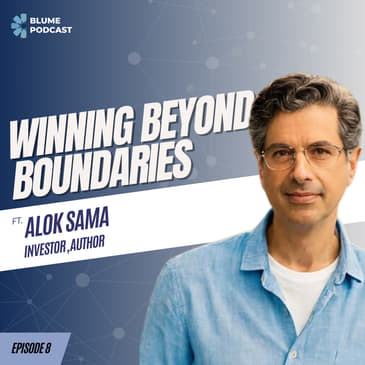

Join us for Episode 8 of Season 3 of the Blume Podcast - Winning Beyond Boundaries, featuring Alok Sama, former President and CFO of SoftBank
Group International in conversation with Karthik Reddy of Blume Ventures.
In this fascinating conversation, Alok shares insights from his remarkable journey across global finance and technology, including orchestrating some of the largest deals in tech history, like the $59B Sprint-T-Mobile merger and SoftBank's $34B acquisition of ARM.
Drawing from his recent book "The Money Trap: Lost Illusions Inside the Tech Bubble," Alok offers a candid look at working alongside Masayoshi Son during SoftBank's most volatile period, unpacks three decades of experience in investment banking and VC, and shares valuable lessons on navigating complex global deals.
From his early days in Delhi to shaping Morgan Stanley's TMT practice in Asia-Pac and eventually becoming one of Masa Son's closest advisors, Alok's story is a masterclass in understanding global markets and tech ambition. Currently a senior advisor at Warburg Pincus, he continues to influence the intersection of technology and finance.
Key topics discussed:
- The journey from Delhi to global finance
- Behind-the-scenes of major tech deals
- Working with Masayoshi Son
- The future of technology and AI
- India's evolving tech ecosystem
- Lessons from a career in global dealmaking
Timestamps:
0:00 - Introduction and early SoftBank days
1:05 - Welcome and guest introduction
2:54 - Growing up in Delhi and early influences
6:42 - Indian influences and cricket passion
9:46 - Journey into mathematics and finance
15:33 - Serendipity in career choices
20:57 - Writing "The Money Trap"
24:01 - Morgan Stanley years and global deals
31:05 - Understanding mega-deals
38:40 - Masayoshi Son's unique qualities
41:49 - Vision Fund and investment strategy
47:57 - Future of technology and AI
54:19 - India's startup ecosystem
1:03:12 - Current role at Warburg Pincus
1:05:03 - Rapid fire questions
This episode is brought to you by IDFC First Bank, a committed partner to India's startup community. IDFC First Bank continues to foster innovation and support entrepreneurship, playing a crucial role in the growth journey of numerous startups, including many Blume portfolio companies.
#BlumePodcast #TechInvestment #StartupIndia #VentureCapital #SoftBank #GlobalFinance #Leadership #MasayoshiSon #TechDeals #InvestmentBanking #IndianStartups #GlobalTech #Innovation #Entrepreneurship #BusinessLeadership #VCFunding #TechnologyInvestment #DigitalTransformation #StartupGrowth #MergersAndAcquisitions #TechIndustry #BusinessStrategy #InvestorInsights #FutureOfTech #AITechnology #IndianTech
[00:00:00] Particularly in that 5 or 6 year period when I was associated with SoftBank, so much happened, right?
[00:00:06] I mean, there was this complex, larger than life character.
[00:00:10] This was a period of peak volatility for him in terms of, you know, early days when he was taking off with, say, with Alibaba going public and then the Vision Fund.
[00:00:20] And then obviously the subsequent come down, some very interesting events in my personal life, losing both my parents.
[00:00:28] And then this bizarre thing with this smear campaign.
[00:00:33] A lot of people have made the comment that there's a sense that, Alok, you know, you're kind of in a kind of bewildered state through this entire book.
[00:00:41] You know, kind of what is going on? What is happening to me?
[00:00:43] I said, look, I mean, this is a really interesting story.
[00:00:45] It kind of lends itself to something approaching a, if not a thriller, certainly a novel with a lot to unpack.
[00:00:54] Welcome to another episode of the third season of The Bloom Podcast.
[00:01:08] The theme, as all of you know, this year has been Winning Beyond Boundaries.
[00:01:12] And today we're joined by an incredible example of that across global finance and technology, Alok Sama.
[00:01:19] Alok Sama is the former president and CFO of SoftBank Group International, chief strategy officer of the SoftBank Group, when he moved on from there.
[00:01:28] But while he was there, Alok orchestrated some of tech's largest deals, the $59 billion sprint and T-Mobile merger, landmark $34 billion acquisition of Arm by SoftBank.
[00:01:39] And he was one of Masa San's closest advisors during that period.
[00:01:43] And what alerted us to this episode is, of course, Alok's phenomenal tell-all book, The Money Trap.
[00:01:52] Subtitled is even more ominous, Lost Illusions Inside the Tech Bubble.
[00:01:55] We're going to ask Alok what that means.
[00:01:56] And Alok unpacks like three decades of his career, investment banking, VC, across New York, London, Hong Kong.
[00:02:05] And then, you know, he started with shaping Morgan Stanley's TMT practice in AsiaPak and then led to multiple, multi-billion dollar deals at SoftBank.
[00:02:13] And his journey is very reflective of a masterful understanding of global markets and tech innovation being at the cusp of it.
[00:02:21] Currently, Alok is a senior advisor to Warburg Pinkers.
[00:02:25] Of course, he continues to influence the intersection of tech and finance like he always has.
[00:02:29] And today, the idea is to dive a little bit into his experiences, insights, get some lessons from, you know,
[00:02:36] navigating some of these complex deals and sort of extracting a lot of the nuggets from that book.
[00:02:43] If you haven't read it, of course, I recommend to pick it up at your nearest, you know, Amazon or airport or wherever.
[00:02:50] Welcome to the podcast, Alok. Thanks for agreeing to do this.
[00:02:53] Thanks, Kaltik. I'm looking forward to this.
[00:02:56] Super. So I think, Alok, I always like to let the audience get to know our guests a little bit.
[00:03:03] So some amount of, you know, background about growing up in Delhi.
[00:03:09] And then I know you moved and became sort of a global purvey of finance and a role model for a lot of Indians who want to do that.
[00:03:16] But a lot of people don't know your dad was a Padma Shri as well for his research on liver diseases, actually.
[00:03:24] And you were the eldest brother, if I recall right.
[00:03:27] Yes.
[00:03:28] And so what did that mean for you? Did they want you to become a doctor?
[00:03:32] Did they push you in that direction?
[00:03:34] Very different years in the 70s, 80s in India, right?
[00:03:37] Everything that we relate to from back then was very stereotypical.
[00:03:41] And here you were in a highly sort of intellectual academic environment.
[00:03:46] What prompted you to make the choices that pushed you to undergrad in math and then MBA, etc.?
[00:03:51] Oh, wow. Okay.
[00:03:54] That's a lot to impact.
[00:03:55] No, that's like the first 20 years of my life.
[00:03:58] No, that's like putting the framework on who Alok Sama was.
[00:04:00] No, no, no.
[00:04:02] Look, I mean, for the first 21 years of my life, I barely stepped outside Delhi.
[00:04:07] And that's not an exaggeration.
[00:04:09] So that's certainly where my heart is.
[00:04:13] My parents met when my father was teaching.
[00:04:16] He was a lecturer at the Old India Institute of Medical Sciences, and my mother was a medical student.
[00:04:22] And my early days growing up, you know, it was on the campus of the Old India Institute of Medical Sciences.
[00:04:31] And, you know, you kind of graduated as you went from lecturer to assistant professor.
[00:04:37] You went from E-type housing to D-type government housing, etc.
[00:04:40] So it was, you know, from my perspective, it was, you know, kind of by Indian standards, it would be middle class, you know, kind of on a modest government salary.
[00:04:51] But from my perspective, certainly happy days, happy memories.
[00:04:55] I wouldn't describe the environment as intellectual.
[00:04:59] It was certainly academic.
[00:05:02] And there's a difference in as much as, you know, my father wasn't watching Satyajit read films or reading Rabindranath Tagore.
[00:05:08] He was just a hands-on scientist.
[00:05:11] And but certainly that created a, you know, if not academic pressure, certainly an academic environment.
[00:05:19] My mother was a doctor, too.
[00:05:20] She was doing her.
[00:05:21] She took a break when she had, after she had me to have my brother, Vivek.
[00:05:27] But certainly you saw that commitment to academic, to learning.
[00:05:31] And that was very much part of our Indian ethos anyway.
[00:05:36] I never felt any pressure to be a doctor.
[00:05:41] But I think expectation is kind of more the word, particularly a little later in life.
[00:05:46] My father broke away from the Old India Institute and became a very successful kind of private practitioner.
[00:05:53] And then later on went on to be chairman of Ganga Ram Hospital, et cetera.
[00:05:57] And so it was more expectation.
[00:06:00] And when I didn't do it, perhaps my brother felt a little bit more pressure.
[00:06:04] And he ended up being a doctor.
[00:06:06] But look, I have happy memories of growing up.
[00:06:09] And, you know, my parents just gave me so much.
[00:06:12] I just have nothing but gratitude and nothing but gratitude towards Delhi and towards India.
[00:06:19] And it's no accident that I've come back and revisited, retouched, you know, kind of touched down on India so many times that Morgan Stanley, you know, kind of one of the things you didn't mention, probably my happiest memory as a banker was setting up Morgan Stanley's business in India, investment banking business in the mid-90s.
[00:06:37] And those have always been kind of very, you know, kind of kept me in touch with India in a very meaningful way.
[00:06:42] Speaking of India, I think two big influences that, you know, you mentioned in the book as well.
[00:06:47] One is a fanboy of Amita Bachchan.
[00:06:51] Second is you love cricket all around.
[00:06:54] A lot of love for cricket.
[00:06:56] I know you've traveled far and wide after that.
[00:07:00] Yeah.
[00:07:00] Are those, you know, are those still big loves for you?
[00:07:05] Does everything Indian pull you back to, you know, to your roots of growing up out here?
[00:07:10] And then what else about India has fundamentally influenced who you are in a global landscape?
[00:07:16] I'm just, you know.
[00:07:17] Yeah.
[00:07:17] Look, I mean, what is it about India?
[00:07:19] Yeah.
[00:07:19] When you, when you, when you, it's, it's, it's, it's almost Delhi more than India.
[00:07:23] I mean, I go to Mumbai.
[00:07:24] I've been to Bangla.
[00:07:26] Literally, I've been to once, if you can believe in the last, like probably twice, actually, in the last, all my life, actually, you know, kind of, even Mumbai.
[00:07:35] I was there a few weeks ago.
[00:07:36] It's like a bit of a foreign country.
[00:07:38] So, to me, India is very much about Delhi.
[00:07:41] And it's, it's, it's, that's where my roots are.
[00:07:43] That's where I feel the most rooted.
[00:07:45] Amitabh Bachchan.
[00:07:46] Amitabh Bachchan, St. Eastwood growing up.
[00:07:48] I mean, these are my idols.
[00:07:50] Not, you know, kind of, I wouldn't say they shaped me in a meaningful way, but, you know, perhaps certainly a desire to be, you know, kind of that, that, that cool, poker face, ironic.
[00:08:02] You know, that personality I've always found very appealing, very aspirational.
[00:08:07] It's not what I am, but, but it certainly made an impression.
[00:08:11] Cricket, I mean, literally, that's the one sport I, I don't play, but I follow religiously, wherever I am.
[00:08:20] In terms of watching, I don't play cricket.
[00:08:22] My first love is golf as a sport to play, but to certainly to watch is cricket number one.
[00:08:27] Okay.
[00:08:29] And, you know, we, we, when we talk to entrepreneurs, we try to, it's very difficult to discern in one or two meetings, but like most of us, I think when we make certain choices in life, it's all about figuring out how much of this had to do with their nature versus being like your, your genetic pool versus how you were nurtured, like growing up.
[00:08:49] And, you know, I don't know how mathematics happened for you.
[00:08:53] And I know you talked about your obsession in your early years about Fermat's last theorem.
[00:08:58] I know it eventually got solved, but like, how did the fascination emerge?
[00:09:02] And then how do these things influence, you know, you, as you think through career choices and say, why do I want to become one of the world's best bankers or, you know, your strategy role in soft bank?
[00:09:14] And I'm just trying to, you know, also speak to youngsters who are beginning in their career.
[00:09:20] Most of our listeners are entrepreneurial, venture-backed sort of company employees or founders.
[00:09:27] And, you know, they always come to for advice on careers and how they're being shaped, you know, post-college.
[00:09:34] Yeah.
[00:09:34] And it's very difficult to sort of, for them to relate to what each one of us has gone through.
[00:09:39] I think, I know it's been a long time, but would love to sort of do a little bit of flashback and see how do those things, how did they influence you?
[00:09:46] Yeah.
[00:09:47] It's a really interesting thing to unpack, Karthik.
[00:09:51] And I'm not sure what I'm going to say is going to be useful to anyone, you know, kind of young and aspiring.
[00:09:56] But I kind of think my life, there's a lot of serendipity in a kind of a series of mostly fortunate accidents because, yes, you're right.
[00:10:06] I studied mathematics, but even that was a bit of an accident.
[00:10:09] It's actually a really interesting story.
[00:10:11] I mean, I, in high school, math came easy to me.
[00:10:15] I was good at.
[00:10:16] But, but equally, I used to read obsessively and my best subject was in parallel could just as well be in English literature.
[00:10:27] Right.
[00:10:28] But doing something arty was never an option from a, you know, again, it's a very patriarchal success.
[00:10:36] That society, India still is, I guess.
[00:10:37] But, you know, for a guy to be studying English literature, which is like, I mean, how are you going to go out and, you know, kind of studying art?
[00:10:43] How are you going to go out and make a living?
[00:10:44] Right.
[00:10:45] And I, going abroad, going to the U.S. at the undergraduate level wasn't an option.
[00:10:55] My father became, by Indian standards, wealthy later in life.
[00:10:58] But at that point, it really wasn't an option.
[00:11:01] And so I applied to St. Stephen's College.
[00:11:04] And my preferred subject was actually economics, which is the most prestigious course.
[00:11:09] And I went into the interview.
[00:11:11] You mentioned the Amitabh Bachchan influence.
[00:11:13] This is kind of comical.
[00:11:14] I mean, I had this ridiculous, long, flowing hair, kind of coiff, modeled after Amitabh Bachchan.
[00:11:20] And Mr. Rajpal, who's the principal of St. Stephen's College, in my interview, I sat down.
[00:11:26] And the first question, St. Stephen's College was unique in that it was the only college that actually interviewed you.
[00:11:30] I think they, I don't know if they still do.
[00:11:32] But I sat down.
[00:11:33] And the first thing he asked me was in this very kind of, God bless him, may he rest in peace, but, you know, this very pompous, kind of fake, almost English accent, you know, kind of young man, you know, tell me about your hairstyle.
[00:11:49] Where do you get your hairstyle?
[00:11:51] And it kind of went downhill from there.
[00:11:54] And that sort of Amitabh Bachchan, that hairstyle impersonation kind of got me into trouble.
[00:12:00] And even though my marks were terrific, I mean, they were really good, I was rejected.
[00:12:07] And I'd also applied to mathematics.
[00:12:10] And my mathematics interview was completely different.
[00:12:13] They just asked me to solve calculus problems, which I did like, you know, breezily in a heartbeat.
[00:12:20] And so that's how I ended up studying mathematics.
[00:12:23] And, you know, kind of always, I was always a problem solver.
[00:12:27] And, yeah, I mean, kind of things like Fermat's last theorem, kind of the, you know, obsessively digging into things like that was something I was really into.
[00:12:36] And then, by the way, finance was, I don't think I've ever really met anyone.
[00:12:42] I certainly wasn't one of those people who, like, aspired to be a banker or wanted to be a banker, let alone the world's greatest banker or whatever.
[00:12:51] I'd never heard of Morgan Stanley.
[00:12:53] I had a very peripheral knowledge of what banking was all about anyway, right?
[00:12:57] I mean, you know, back then, people who had a bent towards finance or commerce kind of wanted to become chartered accountants, right?
[00:13:06] Or the most aspiration you got was, you know, maybe you go work for Citibank one day, right?
[00:13:12] That was kind of a big deal at the time.
[00:13:15] And I described this in the book.
[00:13:18] It was a pivotal moment in my life.
[00:13:20] My father introduced me to someone who he believed was a mathematician, and he sort of was.
[00:13:26] And this gentleman, Dr. Shiv Gupta, turned out to be a professor at the Wharton School.
[00:13:31] He taught operations research and statistics.
[00:13:33] And he's the one who's kind of said, you should think about, I'd never heard of Wharton.
[00:13:38] You should think about doing an MBA.
[00:13:40] And, again, he wasn't specifically focused on finance, but he kind of dangled in salary numbers like you could be making $40,000, $50,000 a year, which sounded like an astronomical amount of money.
[00:13:54] And he really helped out and, you know, kind of told me a little bit about actually the first time I heard of the GMAT was from a friend of mine, someone who most of your listeners, and I'm sure you know, Sanjeev Bhikshanani.
[00:14:08] He was with me in college.
[00:14:10] And in our badge, he was with me in school too, by the way.
[00:14:12] He was one of the first people who actually did the GMAT.
[00:14:14] And he did really well.
[00:14:16] And then I remember Sanjeev telling me, he says, you know, look, you should do this too.
[00:14:20] And maybe your father can – his parents couldn't afford to send them.
[00:14:23] He said, maybe your father can afford to kind of pull this together for you.
[00:14:27] So that's how, you know, kind of he guided me on the GMAT.
[00:14:30] That's how going to the U.S. came about.
[00:14:33] And, again, Morgan Stanley was serendipitous.
[00:14:38] I just – it had – it was a very waspy firm.
[00:14:43] At the time, there was, as I recall, only one Indian managing director who I met with, and he took a liking to me.
[00:14:50] And that's how I ended up at Morgan Stanley and kind of worked my way upwards.
[00:14:55] So it is – there's not a whole lot you could take away from that because it really was, and I mean it, it was a series of accidents.
[00:15:04] Once again, South Bank, I describe this in the book.
[00:15:07] I mean, I'm on holiday with a good friend, Nikesh Arora, still a very close friend.
[00:15:11] And he sprang this on me, and he happened to be entering South Bank in a very senior role where he was supposed to succeed, Son Son.
[00:15:20] And he asked me to kind of come along for the ride.
[00:15:22] And that, once again, was not something I was looking for or seeking and was, once again, a mostly fortunate accident.
[00:15:31] Awesome.
[00:15:32] No, I think there's a small – there's a small sort of – feels like there's a philosophical lesson to it.
[00:15:37] And what happens in the current world, I speak, is we have reached the other end of the spectrum where I don't think people are mentally sort of, you know,
[00:15:48] preparing themselves to fall into these serendipitous events.
[00:15:52] Yeah.
[00:15:52] And they actually want everything to be more programmatic, right?
[00:15:55] Yeah.
[00:15:55] Because we are now overloaded with information, opportunities.
[00:15:59] Yeah.
[00:15:59] What was a unique set of circumstances that led to this meeting with the professor or these relationships?
[00:16:06] Yeah.
[00:16:06] Today are all, you know, being engineered through thousands of counselors trying to send you to the right school.
[00:16:13] Yeah.
[00:16:13] You know, there's income levels which allow you to go to those schools.
[00:16:17] Yeah.
[00:16:17] So basically, what we experienced in the 70s, 80s, 90s, sadly, I think is lost on the current agenda.
[00:16:23] Yeah.
[00:16:23] No, no, I think actually, Karthik, you're absolutely right to flag that.
[00:16:26] And I do, as you might recall, in the book, talk about, in fact, in the epilogue, I talk about in this bizarre incident where I'm meeting with two Mossad spies, two agents.
[00:16:38] Yeah.
[00:16:39] I do talk about, you know, the idea of control being an illusion, which I firmly believe in because, you know, I think the one thing you can't lose sight of is, you know, a certain level of,
[00:16:50] don't just step back and hang out on a beach and smoke weed and expect things to happen, right?
[00:16:54] I mean, it's not that straightforward.
[00:16:56] There are some people who have been fortunate enough to do that.
[00:16:59] Maybe if you bought Bitcoin when it was worth pennies and you get lucky.
[00:17:03] But, you know, you can't count on that, right?
[00:17:05] I mean, a certain level of motivation, a certain level of commitment.
[00:17:08] And that kind of comes from a family where you see your parents, your family, people around you, your students thriving, working hard.
[00:17:18] But at a certain level, you know, one of the things that's been incredibly refreshing for me spending time in India, spending time in India very recently,
[00:17:28] is this kind of drive to learn for social mobility.
[00:17:32] It's just so powerful in India that you don't ever want to lose that.
[00:17:36] But beyond that, just appreciate that there's only so much you can control.
[00:17:41] In fact, there's probably very little you can control.
[00:17:43] Yeah, great lesson in that.
[00:17:45] I think I'm going to take a slight deviation, go to the book and then come back to those, you know, the set of serendipitous events
[00:17:53] and maybe one or two fun anecdotes about each one of those eras before we move to the double click into SoftBank.
[00:18:02] You know, is the book like an outcome of all of this love for literature?
[00:18:07] And I know you went in sort of refreshed yourself with some sort of creative writing inputs from some of the greats in New York.
[00:18:16] Yeah.
[00:18:16] Was it a manifestation of all of those years of unfulfilled desire to actually?
[00:18:21] I know you read voraciously, but I don't know if you enjoyed writing and the book came from unmet need over these 30 years or so.
[00:18:30] No, I think that's absolutely, I could never say it better.
[00:18:34] It really was an unfulfilled ambition.
[00:18:37] I did want to write and I did a master's degree, which sounds like a bizarre thing to do, but it was a phenomenal experience for me.
[00:18:44] I did get a master's degree in creative writing from NYU.
[00:18:50] You know, at age 58.
[00:18:51] This was how recently?
[00:18:51] I don't know.
[00:18:52] At age 58.
[00:18:54] So it was, you know, kind of in some respects, you know, kind of a brave thing to do.
[00:19:00] Sort of being in a classroom with a bunch of 28.
[00:19:04] Average age was 28, typically female, very left wing.
[00:19:08] But it was kind of a surreal and in the nicest possible way experience.
[00:19:14] But I did want to write, I did want to write this specific book.
[00:19:18] I experimented with many different things, fiction, writing short stories.
[00:19:23] But, you know, kind of what I realized that what I'd been through in that, particularly in that five or six year period when I was associated with SoftBank is so much happened.
[00:19:37] Right.
[00:19:37] I mean, there was this complex, larger than life character.
[00:19:42] And this was a period of peak volatility for him in terms of, you know, early days when he was taking off with taking off again, I should say, with Alibaba going public and then the Vision Fund.
[00:19:54] And then obviously the subsequent come down, kind of being part of all of that, witnessing all of that, some very interesting events in my personal life, losing both my parents.
[00:20:07] It was, you know, it was a reawakening of sorts.
[00:20:11] And then this bizarre thing with this smear campaign and thrown into a world where a lot of people have made the comment that there's a sense that, look, you know, you're kind of in a kind of bewildered state through this entire book.
[00:20:29] You know, kind of what is going on?
[00:20:31] What is happening to me?
[00:20:32] And it just, and I'm talking about the smear campaign specifically, the idea that there's so much of an effort, someone spending millions of dollars to get me out of a job that I never really saw in the first place.
[00:20:43] And I said, look, I mean, this is a really interesting story.
[00:20:46] And it kind of lends itself to something approaching a, if not a thriller, certainly a novel with a lot to unpack.
[00:20:55] So that's how the book came about.
[00:20:57] I think the two, three things, again, goes back to Truth is Strange and then Fiction.
[00:21:01] So you said, my father with fiction, there's enough here to sound like it.
[00:21:06] Yeah, exactly.
[00:21:06] Exactly.
[00:21:07] And the fact that it's all real makes it even, you know, makes it all the more interesting.
[00:21:11] Second is, I think, you know, a lot of people have told me first books are almost predominantly autobiographical or a manifestation of self in some way.
[00:21:20] And this is as autobiographical as it can be.
[00:21:23] And I think this second, this third wave of, or second wave of Masa and like, you know, this post GFC wave of what the internet, consumer internet slash, you know, tech world was going through was sort of a unique phase.
[00:21:36] And I'm glad the lens on the biggest, you know, drama around that division fund somehow gets uncovered.
[00:21:44] If I may ask you, if it's not outside the realms of confidentiality.
[00:21:48] Yeah.
[00:21:50] Did you have to get like a tick mark from SoftBank to sort of proofread this and publish this?
[00:21:57] Well, I mean, I certainly, it's the right to flag this, Karthik.
[00:22:01] I mean, you know, when you leave in a senior executive role, you sign an NDA and there's certain degree of accountability that you have.
[00:22:09] And I was very careful to make sure I went through a, you know, a very prominent New York lawyer, go through a rigorous legal review.
[00:22:17] But even beyond the legal review, I think books were, you know, kind of outright tell-alls.
[00:22:23] I actually don't like it when people describe the book as a tell-all because that kind of sounds like, you know, it's cheapening the relationship and the respect I have for Masa.
[00:22:33] I agree, I agree.
[00:22:34] There's a lot, there's so much I could have said about his private life and his relationships or, you know, with his wife or his daughters or whatever.
[00:22:43] But I didn't want to go there.
[00:22:45] You know, that's just not, you know.
[00:22:45] Of course not.
[00:22:46] You respect the relationship too much.
[00:22:47] You respect, I mean, I kind of, I was careful to keep the limits in terms of how much I see.
[00:22:53] I say about his home in Tokyo, his home in California, I say again, because he had hundreds of meetings, you know, kind of that's what, that was his office too.
[00:23:02] So I've been, you know, I had to be careful about navigating that in terms of respecting someone I care about and respect, you know, his privacy a little bit.
[00:23:11] Absolutely.
[00:23:12] And so there's certainly an element of that.
[00:23:15] Super.
[00:23:16] Super.
[00:23:16] So I think, you know, I'm just going to try and pick on one or two elements of each part of that, like, you know, longish career.
[00:23:24] Yeah.
[00:23:24] There was one fun anecdote or episode you seem to have when you were trying to explain derivatives to Dick Cheney back in the 90s.
[00:23:34] Yeah.
[00:23:35] You know, like, and what was that conversation like?
[00:23:39] And like, what is it, what is it, what is dealing with government tax or governmental sources at that scale?
[00:23:45] I mean, you could, you could come up with another anecdote.
[00:23:48] You could probably dealt with dozens of these through your soft bank days as well.
[00:23:52] But, you know, I find it, I, by the way, chaired the Indian Venture Capital and Alternative Asset Association.
[00:24:01] Oh, really?
[00:24:01] Okay.
[00:24:01] Yeah.
[00:24:02] Yeah.
[00:24:02] And yeah, I just rolled off that role in, in March this year.
[00:24:06] And, and it was daunting to, you know, to imagine that the small VC can't take it.
[00:24:12] But the reason everyone pushed me to the fore is because Indian homegrown venture capital was not represented much.
[00:24:18] So I said, like, if I don't take it, then they would say we offered it to you or we wanted you to take it and you didn't.
[00:24:24] So I did.
[00:24:25] And that means ministerial conversations, cabinet secretary conversations.
[00:24:29] And like, it's, it's kind of like what you described in a way, but I would love to hear some fun anecdotes on what it feels like in the U.S., for example.
[00:24:38] Yeah.
[00:24:39] I mean, I, I mean, it's, I did spend too much time on my Morgan Stanley years in the book because you kind of lose focus, if you know what I'm doing.
[00:24:48] There could have been so many other incidents, you know, bizarrely.
[00:24:51] We were, when President Suharto was overthrown in Indonesia, we were in there, in the middle of gunfire, you know, kind of literally the town, the city, Jakarta, exploding, pitching a privatization deal.
[00:25:04] I mean, that really surreal experience.
[00:25:06] So we had to be a state department, U.S.
[00:25:09] State Department, because I happened to be with a bunch of Americans, including the chairman of Morgan Stanley Asia.
[00:25:14] We had to be rescued in the middle of that.
[00:25:16] Lots of bizarre incidents.
[00:25:18] Cheney was one of those surreal incidences.
[00:25:20] He wasn't in government at the time, right?
[00:25:22] I mean, you know, so he was, he was there as a private citizen.
[00:25:27] He was on the board of Morgan Stanley.
[00:25:31] And the reason we ended up talking about derivatives is he was also on the board of Procter & Gamble.
[00:25:37] And at the time, in the early 90s, derivatives were rocking the world, you know, kind of.
[00:25:43] It is, it's the world.
[00:25:46] Corporate America was playing with financial derivatives and Procter & Gamble Company in an attempt to, overzealous attempt to hedge and perhaps manage their earnings.
[00:25:57] And the company had just announced a hefty, I think, I think the number was a couple of hundred million dollar loss.
[00:26:04] And Dick was on the board.
[00:26:06] And, you know, kind of as a board member, he didn't have accountability, but he'd seen all this happen.
[00:26:12] And he just wanted to, he was a recent entrant to Morgan Stanley.
[00:26:15] He just kind of wanted to unpack in a lot of detail.
[00:26:18] He's a very smart guy.
[00:26:19] You know, kind of probing, kind of unpacked that.
[00:26:21] I just thought it was like a surreal conversation.
[00:26:24] Here I am sitting with Dick Cheney and spending three days with him.
[00:26:28] And he's telling me about, you know, the, you know, taking out Saddam Hussein.
[00:26:33] What do you do?
[00:26:34] Like fire missiles and the CIA dude to take him out while he's watering his plants.
[00:26:38] I mean, literally, he's talking about this in a very matter-of-fact way.
[00:26:41] And I'm explaining derivatives to him.
[00:26:45] And we're eating like idlis and dosas and sambar at the hotel.
[00:26:49] It was like, it was truly bizarre.
[00:26:52] Yeah.
[00:26:52] It sounds surreal indeed.
[00:26:54] And so, you know, the, coincidentally, talking about derivatives, by the way, that was my first job in American Express.
[00:27:01] Oh, was it?
[00:27:02] That's actually where they put me in that division.
[00:27:05] And strangely enough, it's one of those fields that I think is the only thing that got applied from classroom right into the job.
[00:27:12] Like no other thing that I've learned in life.
[00:27:15] So, and I think I recall this specific incident because it was fresh.
[00:27:19] My first job was 96.
[00:27:21] So this was a case study, I think, on what can go wrong.
[00:27:24] Yeah.
[00:27:26] On Nikesh himself, I know he's doing wonderfully as CEO of Polo Alter Networks.
[00:27:33] Yes, yeah.
[00:27:34] And he's, it seems like a very special relationship.
[00:27:39] And both of you, so maybe a little bit on what made both of you click, like, you know, and is it important when you're navigating as a sort of an immigrant into these global markets to have a sort of set of people you can trust like this and bounce things off and use a sounding board, especially if you're trying to rise to the upper echelons.
[00:28:04] We also, I'm using as a proxy of someone who's risen to like, you know, the top of the sort of stack in global organizations, which is now everybody reads about them and so many Indians are doing well.
[00:28:18] And we haven't had someone like that on our podcast.
[00:28:21] So I'm deliberately double clicking on what does it take for you to sort of imbibe both networks, lean on people like Nikesh and then, you know, grow together as peers in a foreign country initially.
[00:28:40] Of course, now you get naturalized, but it's easier on kids who are naturalized by birth.
[00:28:46] But like, how are immigrants like you cracking it, you know, in global markets?
[00:28:51] Yeah.
[00:28:51] So the point about networks actually is really, really important because as I don't specifically touch on that, but I think I alluded to this in my, in the discussion we had in terms of events, significant events in my life.
[00:29:09] You know, how did I end up at the Wharton School?
[00:29:11] Well, it was an Indian immigrant professor at the Wharton School.
[00:29:14] How did I end up at Morgan Stanley and yet another Indian immigrant managing director?
[00:29:21] You know, Bengali gentleman, Bidjit Sen was his name.
[00:29:24] God bless him.
[00:29:25] He's still out there.
[00:29:26] And then, you know, how did I end up at South Bank?
[00:29:30] I mean, that was my relationship primarily with Nikesh.
[00:29:33] And I think the, how did we connect now initially?
[00:29:37] And I described my first meeting with Nikesh.
[00:29:38] The first point of connection is actually the fact that both of us from Delhi.
[00:29:42] Now, Nikesh's father was in the Air Force, so he'd moved around quite a bit.
[00:29:46] In my case, it was exclusively Delhi.
[00:29:48] But still, I mean, you know, he'd finished his schooling in Delhi.
[00:29:51] That was a point of connection.
[00:29:53] And Delhi is, now his wife is also from Delhi.
[00:29:58] So you're very strong next.
[00:30:00] So we had that in common.
[00:30:01] And then, you know, with Nikesh, it was also a case of he is, and I don't say this lightly,
[00:30:12] analytically, his ability to process.
[00:30:14] He's going to leave by himself.
[00:30:16] Never seen anything like it.
[00:30:18] And I'm coming from a position where I've dealt with, worked with closely with really,
[00:30:23] really smart people.
[00:30:24] It was one of those dynamics where if you're in a room with him and you're keeping pace
[00:30:28] with him, you can kind of give yourself a pat on the back.
[00:30:30] And strangely enough, I, you know, there were, Nick and Nikesh himself, I think we'll concede
[00:30:37] this, that there were times when I not only kept pace with him, but, you know, once in a while,
[00:30:42] I would actually be a step ahead of him.
[00:30:45] And for his part, I'd like to think he thought that was pretty cool, too.
[00:30:49] So that was a pretty fundamental piece of, fundamental reason why we got along.
[00:30:59] And that was a lot of where our connection came from.
[00:31:03] So I think what I'm going to do now is switch gears, Alok, to, you know, obviously the meat
[00:31:11] of the book itself and, and, you know, the bulk of, you know, your last long gig in life,
[00:31:19] which is, of course, SoftBank.
[00:31:21] SoftBank, yeah.
[00:31:21] And, and, and the Mercurial Massa song behind that, behind that brand.
[00:31:29] You know, you spoke of like multiple mega deals that you were a part of, right?
[00:31:35] And when, when you, when, what is the difference between those early days that let's say, of
[00:31:40] course, you've done mega deals even through Morgan Stanley, but what are the sort of, what
[00:31:46] makes mega deals happen?
[00:31:48] Is it about just classic capitalism incentives?
[00:31:52] Or is it about people?
[00:31:53] Is it about egos?
[00:31:55] You know, people make it seem as if, you know, M&A is, for example, in venture, we think
[00:32:00] about, oh, you can, one exit option is M&A and it's just thrown out there literally
[00:32:06] out there as if, you know, somebody can just go and get an M&A done.
[00:32:09] And from a founder perspective, from an investor perspective, you know, have you, have you sort
[00:32:15] of observed when these happen?
[00:32:18] Why do they happen?
[00:32:18] What's the magic behind?
[00:32:20] Yeah.
[00:32:20] I mean, there's, there's no magic.
[00:32:22] I mean, yeah, Karthik, I mean, you kind of, this is, this is standard MBA curriculum.
[00:32:26] You know, there's courses in M&A and why deals happen and horizontal mergers and vertical
[00:32:32] mergers and, you know, all of that stuff.
[00:32:35] And you look at the deals that I've been involved in, you know, in my, in my stint at
[00:32:42] SoftBank, I mean, the Sprint and T-Mobile merger, it was a case of, you know, two companies
[00:32:50] needed to get together to create a viable competitor.
[00:32:53] It was literally as simple as that.
[00:32:56] I mean, very big on synergies, right?
[00:33:00] I mean, that was a big part of the value driver because you could, the savings on overheads,
[00:33:06] network costs, marketing costs, distribution stores, monumental, monumental numbers and
[00:33:11] those synergies are still unfolding.
[00:33:14] So that's one kind of merger, right?
[00:33:17] I mean, it's consolidation in an industry where there's too much competition and to create,
[00:33:23] to be viable, there needs to be consolidation.
[00:33:25] And the other big deal in my SoftBank days, completely different kind of deal, no synergies
[00:33:33] whatsoever.
[00:33:33] That's a uniquely Massa Sun deal.
[00:33:35] That deal was a giant bet on technology and a vision of the future.
[00:33:48] I think the world will unfold in a different way.
[00:33:56] And I can tweak and even transform this business model to create value, right?
[00:34:00] And that's a really bold deal to do because you pay this hefty premium, the market doesn't
[00:34:08] get it or the market doesn't believe it, right?
[00:34:10] And when we did that deal, when SoftBank did that deal, it's one of those kind of rare cases
[00:34:16] where markets are perfectly efficient, right?
[00:34:18] So we paid this hefty premium above market value and the market value of SoftBank declined by
[00:34:23] the exact amount of that premium.
[00:34:25] Those deals are really, really difficult to justify, particularly in the context of a
[00:34:34] public company.
[00:34:35] So look, I mean, different kinds of deals.
[00:34:38] Deals happen for very different reasons.
[00:34:40] Companies want to become conglomerates, diversify.
[00:34:43] That's usually not a great reason.
[00:34:45] One being a kind of seeking growth, deploying excess cash flow.
[00:34:49] Those are not the best kind of deals to do.
[00:34:51] The best kind of deals are actually along the lines of T-Mobile and Sprint with this strategic
[00:34:59] necessity.
[00:35:00] There's tons of room to create value because there's lots of synergies.
[00:35:04] There's complementarity.
[00:35:06] Sprint had it on a spectrum.
[00:35:09] T-Mobile had an amazing marketing team.
[00:35:13] They did a marketing-oriented management team, I should say.
[00:35:16] They built a band, which is terrific, very popular among millennials.
[00:35:22] So lots of synergies, lots of complementarity.
[00:35:25] Those kinds of deals are very different, unique, rare win-wins.
[00:35:29] Deals like Tom are very tough to pull out.
[00:35:31] The onus is completely on you to actually go in there and justify.
[00:35:36] And God bless Master Son.
[00:35:38] I mean, how he's pulled that off, his mind runs.
[00:35:40] Yeah.
[00:35:42] No, I think, again, valuable lessons, even though they're at maybe 100th the scale of
[00:35:47] what you folks were doing.
[00:35:49] Just this Monday, we were on a call with the board around such an opportunity.
[00:35:54] And you're absolutely right.
[00:35:55] I think all sides need to understand every dimension of why you would even attempt an M&A.
[00:36:01] And I think you sort of adeptly walked us through at least a couple of examples from
[00:36:06] a 30,000-foot view.
[00:36:07] So thanks for that.
[00:36:08] And then, of course, the man behind it and these one-off crazy bets.
[00:36:12] Let's shift gears to Master Son.
[00:36:15] By the way, just coming back to, I mean, I do want to, I think, not necessarily a lot of
[00:36:20] the deals I was involved in.
[00:36:21] But I think in the world of technology, this notion of should I sell, shouldn't I sell is
[00:36:27] actually a really interesting one to unpack, right?
[00:36:30] I mean, you know, it is.
[00:36:31] You know the history as well as I do.
[00:36:32] You look at the number of times the Mark Zuckerberg, you know, potentially had the opportunity to
[00:36:39] sell out.
[00:36:40] And he didn't.
[00:36:41] You know, kind of, he held out.
[00:36:43] And you look at some of the deals he did, even when they seemed outrageous.
[00:36:47] WhatsApp is the ultimate example.
[00:36:49] 19 billion for WhatsApp.
[00:36:51] What is the guy thinking, right?
[00:36:52] I mean, it turned out to be a phenomenal deal.
[00:36:54] So that, I think...
[00:36:56] Insta, even better probably.
[00:36:58] Yes, yeah, exactly.
[00:36:59] Insta, even better, right?
[00:37:00] I mean, you know, brilliant in terms of predicting, hedging its future in terms of where social
[00:37:06] networks were headed, which is visual, mobile, kind of, you know, you've got to make judgments
[00:37:14] about how habits will evolve, how networks will evolve, right?
[00:37:17] So bold strategic deals.
[00:37:19] But equally, kind of that self-belief that, no, you know, kind of billion dollars is not
[00:37:24] enough.
[00:37:24] Two billion dollars is not enough.
[00:37:26] I think I'm onto something and it's huge.
[00:37:27] Or spending 19 billion dollars, I can justify.
[00:37:30] Because what I'm after is what's a trillion.
[00:37:32] Yeah.
[00:37:33] No, that and I think the self-belief that you can arguably and almost always perhaps build
[00:37:40] it even much better than who's going to acquire it, right?
[00:37:43] Because I think there's a founder...
[00:37:45] I mean, of course, there's, you know, the whole blog about founder mode and manager mode.
[00:37:50] Yeah.
[00:37:50] But apart from that distinction, I think as long as the vision...
[00:37:55] You can stretch the vision much further.
[00:37:57] It probably belongs with you.
[00:37:58] But founders go through these, like, real lows where they do contemplate that.
[00:38:02] Elon probably sold or tried to sell every one of his businesses and came very close,
[00:38:07] probably within 10 or 20% of deal value.
[00:38:10] And, you know, the planet might have been different for the kind of decisions he would have made.
[00:38:14] Yeah.
[00:38:14] If they Google had bought him up.
[00:38:16] But, you know, the founders do, in my experience, the huge...
[00:38:21] Masa is a great example.
[00:38:23] You know, call it this crazy factor, which is a big thing he looks for.
[00:38:27] You know, that kind of consummate hunter living in the future mentality.
[00:38:33] Yeah.
[00:38:34] And if you look at the greats out there, and I put Elon Musk in there, they have that quality.
[00:38:38] That's really, really rare.
[00:38:40] Yeah.
[00:38:40] Yeah.
[00:38:41] No, I mean, he himself is a little bit of that.
[00:38:43] So, I think he definitely...
[00:38:44] Yes, absolutely.
[00:38:45] Of course he is.
[00:38:45] Of course he is.
[00:38:46] Yes.
[00:38:46] Who doesn't manifest that is not meeting the bar.
[00:38:49] Absolutely.
[00:38:50] Absolutely.
[00:38:50] And when he sees that in someone like, you know, Bhavish, for example, a little bit of that.
[00:38:54] And, you know, he kind of egos on it.
[00:38:56] Yeah.
[00:38:57] And, you know, you obviously take us back to a little bit of his story as a kid and sort of influencing even his dad's decisions.
[00:39:06] Yeah.
[00:39:07] Some insights, common sense insights very early in, you know, the freemium model.
[00:39:13] The coffee shop.
[00:39:14] It's an amazing story, isn't it?
[00:39:15] It's an amazing story.
[00:39:16] Yeah.
[00:39:16] But, you know, apart from that, like, what, I mean, anecdotally or otherwise, what do you think makes masa masa?
[00:39:25] Like, why aren't there more masas out there?
[00:39:27] Yeah.
[00:39:28] Look, I mean, I think the, it's a bit of a cliched interpretation, but, you know, adversity and being at the, you know, being Korean in Japan is, you know, I don't know, the Indian closest would be, I guess, being, I'd like to think things are a lot better.
[00:39:46] But being kind of at the absolute bottom end of the car system, being an untouchable.
[00:39:50] I mean, it was literally, it was that ugly, right?
[00:39:53] You know, you had to, there was only so much you could do until what kind of job you could get, you know, kind of your status, you couldn't vote.
[00:40:02] It was really, really nasty in every way.
[00:40:06] And I have to believe that made an impact.
[00:40:09] And he saw his father's struggles as an entrepreneur.
[00:40:14] And once again, the resilience, for example, his father, what he had to go through and constantly reinvent himself.
[00:40:21] I mean, I talk a little bit about the evolution of his business model.
[00:40:25] And, you know, being thoughtful, being resilient.
[00:40:29] So a lot of that, I think, came from his father and from his early roots.
[00:40:33] But, you know, that crazy factor, the ability to kind of see the future, that's unique.
[00:40:41] I don't know where he got that from.
[00:40:42] That did not come from his father.
[00:40:44] And that, to me, is a wow.
[00:40:48] I don't think anyone can learn that.
[00:40:50] Yeah.
[00:40:51] It's just not a legitimate aspiration.
[00:40:54] I know.
[00:40:55] And the recent Jensen Huang video is hilarious, right?
[00:40:58] Where Jensen first tells the whole audience that this man has pretty much called every decade-long evolution a generation.
[00:41:07] And I make that point in my book.
[00:41:09] So if it was a one-off thing, yeah, okay, he got lucky.
[00:41:13] Got lucky, yeah.
[00:41:14] And when people talk about Marsha Sun, One Hit Wonder, Alibaba, bullshit, right?
[00:41:19] I mean, you know, it is – you look at –
[00:41:22] He called them.
[00:41:22] Yeah, he called them all.
[00:41:23] You know, you talk about the PC revolution, the origins of the company, distributor of Microsoft software in Japan.
[00:41:29] Call that mobile – the internet, right?
[00:41:31] Call that.
[00:41:32] Became the richest man in the world.
[00:41:34] Call that.
[00:41:34] Now, he's not a trader.
[00:41:36] He didn't cash out of the top of the market.
[00:41:37] But he certainly got the technology then right, right?
[00:41:40] Likewise, when it comes to mobile phones, smartphones taking over the world, he called that, right?
[00:41:46] That AI, he was talking about that 10 years ago.
[00:41:49] Yeah.
[00:41:50] Even his misses are things that he called, actually.
[00:41:53] So he came close to doing the deal with Facebook.
[00:41:55] He obviously bought into Nvidia, probably sold it a little early.
[00:41:59] And that's when he puts his head on Jensen's shoulder.
[00:42:02] Yeah.
[00:42:02] Look, Nvidia is interesting.
[00:42:04] Look, I mean, I was there at the time.
[00:42:06] We did the numbers.
[00:42:07] You know, I ran the numbers.
[00:42:08] And, you know, kind of even made judgments as to if he had to buy Nvidia.
[00:42:13] I mean, don't buy – I'm not talking about buying the stock.
[00:42:15] I'm talking about buying the company.
[00:42:17] With a controlled premium, it would have cost us $83 billion.
[00:42:20] I just vividly remember that number.
[00:42:21] And talking to Masai and basically saying,
[00:42:24] Sunsan, absolutely, let's go for it.
[00:42:25] This makes so much sense.
[00:42:26] Because this was Masai at its best, right?
[00:42:29] Calling a technology friend and saying, okay, the stock's expensive,
[00:42:31] but market doesn't get how big this is going to become.
[00:42:34] But, again, the obstacle there was, yeah, no way CFIUS kind of flipped.
[00:42:39] The idea of CFIUS being the Committee for Foreign Investment in the United States
[00:42:42] would allow a foreigner, even though it's a benign kind of Japanese foreigner,
[00:42:48] to take control of an asset like Nvidia.
[00:42:51] So you end up buying a public stake, less than 5%.
[00:42:54] And since it was a 5% stake, a public stake bought on a leverage basis
[00:42:59] and bought in a fund which was itself levered.
[00:43:02] But, you know, when you make four or five times your money,
[00:43:05] the impulse is always going to be like, okay, let's just cash.
[00:43:07] You know exactly what I'm talking about.
[00:43:09] There's an accountability to your LPs.
[00:43:11] You can't just tell them.
[00:43:12] It takes a lot of courage to tell them, you know what?
[00:43:14] Even though I'm up 4% or 5% and I could cash in today
[00:43:18] and send the cash to you, I'm going to sit on it for another 10 years.
[00:43:22] That does not happen in a fund context.
[00:43:24] A lot of people in your business are now kind of going through that
[00:43:28] and creating these different funds, longer term, et cetera.
[00:43:31] It's a very interesting dynamic thing in a venture fund.
[00:43:34] Yeah, exactly.
[00:43:36] And I'm just curious about your personal view.
[00:43:38] Like, you know, you're like, you know,
[00:43:43] I look at a lot of the analogies you made towards some of these things
[00:43:46] are not really tech businesses.
[00:43:48] They're internet-enabled traditional business models.
[00:43:50] You should apply similar multiples to them.
[00:43:52] And, you know, now when you're out of, like, you know,
[00:43:56] a step removed from all that mayhem for 10 years,
[00:44:00] where have you landed in the sense that on two fronts?
[00:44:04] One is I know that belief we share and I agree with you.
[00:44:08] That's how business model should be sort of evaluated.
[00:44:12] But when it comes to tech itself, one, apart from ideas that Massa might have instilled in you,
[00:44:20] like singularity and how you chase those kind of goals,
[00:44:24] what do you think of tech going forward?
[00:44:27] What do you see as the future?
[00:44:29] What excites you as both an investor and an observer of technology?
[00:44:35] And just the discussion we completed, if you had to advocate something,
[00:44:41] would you be one of those perpetuity vehicle folks who say,
[00:44:44] you should never let go of, like, really long-term directional trends for,
[00:44:49] maybe not perpetuity literally, but 15, 20 years,
[00:44:52] as opposed to trying to shop, like, flip them around in five, seven-year cycles?
[00:44:57] Yeah, look, I mean, I'd be the, in all humility, I will tell you,
[00:45:02] I mean, I've never been the one to get these big long-term bets right.
[00:45:07] I should have bought NVIDIA.
[00:45:08] Now, you know, when I was at South Bank, obviously couldn't
[00:45:10] because we were looking at buying the company.
[00:45:12] It would have been completely inappropriate.
[00:45:13] But, you know, every time I've looked at it,
[00:45:15] ah, it's become too expensive now.
[00:45:17] I'm like, you know, kind of kicked myself every year on a regular basis
[00:45:20] since when I've been completely on the spirit to buy.
[00:45:23] So it's really, really tough to get these bets right.
[00:45:28] And I certainly have not got this right.
[00:45:31] But coming to your point about, or your question about technology,
[00:45:37] I don't have a terribly original answer other than to say that when it comes to AI,
[00:45:41] I am a believer, certainly as a productivity tool at the enterprise level,
[00:45:47] it is nothing short of transformational, you know, probably as big as the internet.
[00:45:55] You know, you go back to that online, every company is an internet company.
[00:45:58] In that sense, every company is an AI company.
[00:46:02] And I mean that from the perspective of, you know, kind of,
[00:46:05] and by the way, that's a reason to be bullish on stocks generally,
[00:46:10] because leveraging AI, you know, can be expensive,
[00:46:14] the costs associated with it, but those are going to come down in terms of processing energy
[00:46:18] as more supply comes online at some point.
[00:46:20] There may well be too much supply, just as there was with the telecom build-out.
[00:46:25] But to deploy AI as a productivity tool and as a potential for margin expansion
[00:46:34] is a good reason to be bullish on enterprises across the board.
[00:46:38] Now, what does that mean in terms of investable propositions?
[00:46:43] It's not that straightforward.
[00:46:46] You know, we talked about my friend Sanjeev, you know, his team, InfoEdge,
[00:46:50] introduced me to this company called Giani, which is doing some interesting stuff
[00:46:55] in terms of voice-based AI platform that originates, collects loans.
[00:47:01] Yeah, there's a lot of, and then they, on a fee basis,
[00:47:07] that's a platform that's used by people in the financial services business.
[00:47:10] But over time, you know, those companies, financial services companies,
[00:47:14] they're all going to have to have that capability.
[00:47:16] Maybe there's companies that create enterprise-focused business models
[00:47:20] that become really profitable.
[00:47:23] I think there is that opportunity.
[00:47:25] Jury's out as to what happens at the individual level,
[00:47:31] at the consumer level, right?
[00:47:32] I haven't seen evidence of compelling business models, you know,
[00:47:38] kind of what happened with Web 2.0 when you had four 5G networks
[00:47:43] and then models like Uber, et cetera, that social media generally evolving forms
[00:47:49] of social media.
[00:47:50] It's just not obvious what that's going to be, but you've got to watch that space.
[00:47:54] I think there'll be some interesting opportunities there as well.
[00:47:57] And the second part, like if you were advising us as like a, I mean, I know,
[00:48:02] I don't control, like you said, we're not much in control of our,
[00:48:05] we have to talk to our LPs, convince them, sell this vision.
[00:48:09] Even a MASA couldn't sell the vision, of course, albeit at a different scale
[00:48:12] to people around the world that the vision fund should meet a certain set
[00:48:17] of objectives.
[00:48:18] But, you know, is this like, I know you talked about the time machine strategy
[00:48:24] of MASA, like if you can double click on that for the audience.
[00:48:27] Yeah.
[00:48:27] Is this what he means by, you know, being able to play the long game
[00:48:32] and as a fund manager, is that what I should aspire to,
[00:48:35] to sort of devise a strategy which allows me to hold these really,
[00:48:39] like almost the strategy itself should be like akin to this time machine strategy.
[00:48:44] Well, yeah, let's unpack the time machine strategy
[00:48:47] because I think we're talking about two different things.
[00:48:50] One, you're talking about kind of the actual fund strategy
[00:48:53] that gets into your obligations to your LPs.
[00:48:57] And, you know, at the end of the day, your business model,
[00:48:59] you have a customer-client relationship, your client is your LP.
[00:49:03] And if the LP's horizon is, okay, there needs to be a J-curve
[00:49:08] and I'm investing with a certain set of expectations
[00:49:11] as to when I'm expecting money back, that's what you sign up to,
[00:49:14] that's what you've got to deliver on, right?
[00:49:16] So, you know, it is, you know, again, we touched on this
[00:49:19] in terms of permanent capital vehicles, longer-term vehicles that you could create.
[00:49:24] But until you have that, you're locked into that model.
[00:49:26] That's what, for better or worse, that's what you signed up for.
[00:49:29] You're stuck with it, right?
[00:49:31] You could distribute stock to investors
[00:49:33] and they could do what they want with it if a company goes public,
[00:49:36] which is what we see in the United States.
[00:49:38] The time machine strategy is very different
[00:49:40] and it's very straightforward and incredibly powerful in India
[00:49:45] and incredibly powerful, certainly in my lifetime,
[00:49:49] probably in yours and most people listening, right?
[00:49:51] And what Masa is talking about is something I was talking about.
[00:49:54] It's very straightforward.
[00:49:55] No magic in this.
[00:49:56] It's not like Einstein in, you know, time travel or whatever.
[00:49:58] It's as simple as you look at disruptive models that have worked,
[00:50:04] whether it's transportation or fintech,
[00:50:07] and you transport them to emerging markets like India
[00:50:10] and with modest tweaks, it should work.
[00:50:13] And I've argued, Masa's argued, and I think it's absolutely spot on,
[00:50:18] that when you don't have legacy infrastructure,
[00:50:22] retail in India is a great example, right?
[00:50:24] You have a transition ongoing macro trend
[00:50:28] that's going to continue in the U.S.,
[00:50:30] which is less of the shopping mall culture,
[00:50:34] more of shopping online.
[00:50:35] That's where the world is moving, right?
[00:50:38] Even the AI models, you know, kind of moving towards,
[00:50:41] you know, kind of an e-commerce capability.
[00:50:43] That's where the world is moving.
[00:50:45] In India, you never had that shopping mall culture.
[00:50:47] I mean, a handful of shopping malls,
[00:50:49] maybe Delhi, Mumbai, other places,
[00:50:50] but so there's nothing to disrupt, right?
[00:50:53] You don't have that much of a public transportation infrastructure
[00:50:56] in most Indian cities.
[00:50:57] They're trying to build it out,
[00:50:58] but the need for, you know,
[00:51:02] an Uber-like alternative, it's natural, right?
[00:51:06] I mean, there's much, even more of an argument
[00:51:08] for a bhavis to do what he's doing
[00:51:10] with electric cars, electric scooters, or whatever.
[00:51:13] So that is a secular trend
[00:51:16] that's there to stay for the next 10, 20, 30 years.
[00:51:20] All you did in India, you know,
[00:51:22] don't get too funky about deep tech
[00:51:25] or new technologies or biotech,
[00:51:27] which are inherently very, very risky.
[00:51:29] These are all, as long as you're getting in
[00:51:31] with the right set of entrepreneurs
[00:51:32] at sensible valuations,
[00:51:34] you just got to ride that.
[00:51:36] Awesome.
[00:51:37] No, since you brought them up
[00:51:38] and I was going to cut over to,
[00:51:39] from Masa's,
[00:51:41] Masa as an individual
[00:51:43] to what he enabled for the Indian ecosystem.
[00:51:46] I mean, he was probably the boldest investor.
[00:51:48] Yes.
[00:51:48] Other than, Tiger set it off,
[00:51:51] but I think he layered.
[00:51:52] Well, Tiger kind of jumped on the bandwagon
[00:51:54] much later, I think.
[00:51:55] Tiger was, I think, more kind of 21 globally.
[00:51:59] You know, kind of they got into that
[00:52:00] spray and pray mode.
[00:52:02] Small disagreement because I wrote my,
[00:52:05] in my first year,
[00:52:07] I wrote like a quarterly,
[00:52:09] one of our quarterly updates
[00:52:10] was actually a tribute to Leaf Excel.
[00:52:12] Oh, you're right.
[00:52:13] This is true.
[00:52:14] One name was a plan.
[00:52:15] Okay, well, good.
[00:52:15] I got a lot of time for it.
[00:52:16] I did spend some time with Lee.
[00:52:18] But you're absolutely right.
[00:52:20] Point well taken.
[00:52:20] I don't know this conversation.
[00:52:21] Point well taken.
[00:52:21] It was a funky anecdote.
[00:52:23] He wasn't trying money
[00:52:23] on the same scale as Masa,
[00:52:25] but you're absolutely right.
[00:52:25] No, no, no.
[00:52:26] Remotely.
[00:52:26] So this is the anecdote
[00:52:28] if Lee ever listens to this episode.
[00:52:30] Yeah.
[00:52:30] So I'm on the phone with Lee
[00:52:32] or I'm meeting him in New York.
[00:52:33] Yeah.
[00:52:33] And this is the month
[00:52:34] where Masa has cut both the checks
[00:52:36] into Snapdeal and Ola.
[00:52:38] Yeah.
[00:52:38] Yeah.
[00:52:39] And Lee says,
[00:52:40] this guy just wrote more money
[00:52:41] in this month
[00:52:42] than I've written
[00:52:43] for the last eight years.
[00:52:44] There you go.
[00:52:44] There you go.
[00:52:46] And so he's like,
[00:52:48] what do I make of this?
[00:52:50] And then he's like,
[00:52:50] obviously I need to ally with him.
[00:52:52] And of course,
[00:52:53] Lee tried that
[00:52:54] with even Flipkart
[00:52:55] being brought into Masa's table.
[00:52:57] So I was,
[00:52:58] I was front,
[00:52:59] I was bang in the middle of that.
[00:53:01] So I was working
[00:53:03] with Lee,
[00:53:04] with Conal,
[00:53:06] trying to engineer that,
[00:53:08] persuade the Snapdeal
[00:53:09] to come along for the ride.
[00:53:11] God bless them.
[00:53:11] I mean,
[00:53:12] you know,
[00:53:12] they could have walked away
[00:53:13] with that promise them,
[00:53:15] you know,
[00:53:15] gave them a really,
[00:53:16] really sweet deal
[00:53:17] in terms of money
[00:53:18] they could take it out.
[00:53:19] But they went in
[00:53:20] and they've been like,
[00:53:20] it's great to see them
[00:53:21] be as successful as they have.
[00:53:23] But yeah,
[00:53:23] you're right.
[00:53:24] I mean,
[00:53:24] it was,
[00:53:25] Lee recognized
[00:53:26] that you needed to have
[00:53:27] that Masa capital cannon
[00:53:28] behind Flipkart.
[00:53:30] Yeah.
[00:53:30] And,
[00:53:31] you know,
[00:53:31] you've seen tons of founders
[00:53:33] in different parts of the world
[00:53:34] and the very best in the US.
[00:53:37] And you've now obviously run,
[00:53:39] I mean,
[00:53:39] Adam Neumann is a different camp
[00:53:41] altogether
[00:53:41] on that spectrum.
[00:53:43] But even when it comes
[00:53:45] to like,
[00:53:45] you know,
[00:53:46] Bavish
[00:53:46] and the whole ton of folks
[00:53:48] who,
[00:53:48] you know,
[00:53:48] SoftBank backed in India,
[00:53:51] compared to global
[00:53:53] entrepreneurs
[00:53:54] do you see
[00:53:55] us having an edge
[00:53:56] or there are certain areas
[00:53:57] that we need to work on,
[00:53:58] number one.
[00:53:59] And I know you took a break
[00:54:01] from that
[00:54:01] and came back this year
[00:54:02] and spent a bunch of time.
[00:54:03] I don't know if you had a chance
[00:54:05] to engage with a lot of entrepreneurs
[00:54:06] and what do you think
[00:54:07] has changed
[00:54:08] in these five,
[00:54:09] seven years?
[00:54:09] Are we,
[00:54:09] are we,
[00:54:10] same time machine strategy,
[00:54:12] are we taking an entrepreneurial,
[00:54:13] you know,
[00:54:14] cohort itself
[00:54:15] and taking them
[00:54:16] to a different level
[00:54:17] in India
[00:54:17] or do you believe
[00:54:18] there's still time to do that?
[00:54:19] No,
[00:54:19] I think,
[00:54:20] look,
[00:54:20] I mean,
[00:54:20] I think it's the same set of factors
[00:54:21] and I mean that as a positive,
[00:54:23] not as a put down
[00:54:24] because I just think
[00:54:25] that you've got,
[00:54:27] you've got,
[00:54:27] you don't even need to disrupt,
[00:54:29] you've got the digital transformation,
[00:54:30] it's not even a transformation,
[00:54:32] it's growth
[00:54:32] and it's growth
[00:54:33] powered by,
[00:54:34] increasingly by technology
[00:54:36] in a growing economy.
[00:54:38] it's just such an extraordinary macro trend.
[00:54:41] You've got a government
[00:54:43] that at a minimum
[00:54:44] is not in your way.
[00:54:46] You've got a global VC system
[00:54:51] that is behind India,
[00:54:54] collateral beneficiary
[00:54:55] of people being disillusioned
[00:54:57] with China
[00:54:58] and it's kind of flirtations,
[00:54:59] you know,
[00:55:00] kind of going a little bit backward
[00:55:02] in terms of,
[00:55:03] in terms of even fundamentally
[00:55:05] kind of promoting,
[00:55:06] you know,
[00:55:06] capitalist type,
[00:55:07] you know,
[00:55:07] kind of growth model,
[00:55:10] right?
[00:55:10] I mean,
[00:55:10] you know,
[00:55:10] you saw what happened
[00:55:11] with Jack Marsh,
[00:55:12] made a lot of people really wary,
[00:55:13] saw what happened with Didi,
[00:55:15] India's been a beneficiary of that.
[00:55:17] I tell you what,
[00:55:18] I was really blown away by,
[00:55:20] this is getting off pace
[00:55:22] and it goes beyond just technology
[00:55:23] and I talked to this
[00:55:25] about a number of people
[00:55:27] and this is more related
[00:55:28] to the reception to the book
[00:55:31] and I think actually is
[00:55:33] India's greatest strength
[00:55:35] and something to be proud of,
[00:55:36] which is this obsession
[00:55:38] with Gyan,
[00:55:40] knowledge,
[00:55:41] in every form.
[00:55:43] I've seen that phone at me
[00:55:45] in ways that just blown my mind.
[00:55:48] It's like every word I write,
[00:55:51] people want to understand,
[00:55:53] what did you mean by that?
[00:55:55] You know,
[00:55:55] I've heard someone say this
[00:55:56] but I've never heard someone
[00:55:58] say it like this.
[00:55:59] Can you please explain
[00:56:00] what that means?
[00:56:01] Just a very sincere desire
[00:56:04] for self-improvement,
[00:56:06] for social mobility.
[00:56:07] It's extraordinary.
[00:56:09] I don't see that in the US.
[00:56:11] I don't see that anywhere
[00:56:13] to be quite honest.
[00:56:14] It's very,
[00:56:15] very cool.
[00:56:16] And actually there's
[00:56:17] an interesting follow-on question
[00:56:19] to that and maybe,
[00:56:20] I don't know what chances
[00:56:21] you give us
[00:56:22] as a country.
[00:56:24] But, you know,
[00:56:25] for the first time,
[00:56:26] for the very first time,
[00:56:27] you know,
[00:56:28] other than IT services
[00:56:29] and manufacturing,
[00:56:30] traditional industries
[00:56:31] where Indians have
[00:56:32] actually transcended borders
[00:56:34] and built for global markets,
[00:56:36] we're beginning to see
[00:56:37] that kind of courage
[00:56:38] come into
[00:56:39] even things like
[00:56:40] consumer internet
[00:56:41] and SaaS,
[00:56:42] of course,
[00:56:43] software,
[00:56:44] and even hardware,
[00:56:45] for example.
[00:56:46] So we have some
[00:56:47] in our portfolio.
[00:56:48] I have a request
[00:56:49] to you as well
[00:56:50] on this ultra-human
[00:56:51] ethereal machines,
[00:56:52] grey orange,
[00:56:53] et cetera.
[00:56:55] And do you think
[00:56:56] they have a chance,
[00:56:57] like what would your odds
[00:56:58] be,
[00:56:59] odds that you would give
[00:57:00] on us building
[00:57:01] phenomenal global companies
[00:57:02] from here,
[00:57:03] which even China
[00:57:04] has done a few,
[00:57:05] but like in this generation
[00:57:06] of, you know,
[00:57:07] the post-internet world.
[00:57:09] But is it possible
[00:57:11] for India to actually
[00:57:13] win on that count
[00:57:14] as well,
[00:57:15] do you think?
[00:57:15] Well,
[00:57:16] I mean,
[00:57:17] I kind of question
[00:57:18] the legitimacy
[00:57:21] of that question,
[00:57:22] which is,
[00:57:22] do you want to be global
[00:57:23] just for the sake
[00:57:25] of being global?
[00:57:26] Because you're dealing
[00:57:26] with India itself
[00:57:28] is a giant market,
[00:57:31] right?
[00:57:31] If you want to make,
[00:57:32] one advantage
[00:57:33] you do have
[00:57:34] if you've grown up
[00:57:35] in India
[00:57:37] is you are operating
[00:57:38] in one of the most
[00:57:40] cost-sensitive markets
[00:57:41] in the world.
[00:57:42] The Indian consumer
[00:57:43] is the most constant.
[00:57:44] So if you found a way
[00:57:45] to make money,
[00:57:46] you should be able
[00:57:47] to transport that
[00:57:48] elsewhere,
[00:57:49] right?
[00:57:51] One of the entrepreneurs,
[00:57:52] different generation
[00:57:53] who I'm quite close to
[00:57:54] and I've had a mentoring
[00:57:55] relationship with him
[00:57:56] as,
[00:57:57] I mean,
[00:57:57] him mentoring me
[00:57:58] is Sunil Mittal,
[00:57:59] right?
[00:58:00] I mean,
[00:58:00] and Bharti is a classic case
[00:58:02] of you're operating
[00:58:03] in India
[00:58:03] where your ARPUs
[00:58:05] are a fraction
[00:58:06] of ARPUs
[00:58:07] in,
[00:58:08] you know,
[00:58:09] your revenue
[00:58:09] from China
[00:58:10] Northern Africa,
[00:58:12] right?
[00:58:12] I mean,
[00:58:12] think about that.
[00:58:13] It's mind-blowing,
[00:58:14] right?
[00:58:14] And they've been
[00:58:16] profitable
[00:58:16] and phenomenally successful
[00:58:18] and there are
[00:58:19] a number of things
[00:58:20] that they did
[00:58:21] that were pioneering
[00:58:22] in terms of
[00:58:23] what they did
[00:58:23] with their network,
[00:58:24] the early relationships
[00:58:25] with Ericsson
[00:58:26] and how you can
[00:58:27] take some of that
[00:58:28] knowledge
[00:58:29] and transport that
[00:58:30] to the Western world.
[00:58:31] You know,
[00:58:31] when he looked at BT,
[00:58:32] for example,
[00:58:33] I very strongly
[00:58:34] encouraged him
[00:58:35] to do that.
[00:58:36] Now,
[00:58:36] he doesn't have
[00:58:36] a controlling interest
[00:58:37] there,
[00:58:37] but I would wager
[00:58:38] that if exactly
[00:58:40] as this happened
[00:58:41] with the Tata's
[00:58:43] and with the steel
[00:58:44] and the auto industry
[00:58:45] in the UK,
[00:58:46] if Sunil was running BT,
[00:58:48] it would be a better,
[00:58:48] probably more profitable
[00:58:49] company.
[00:58:50] So there's certainly
[00:58:51] room to do that
[00:58:52] in terms of transporting
[00:58:53] kind of management skills
[00:58:55] honed in India
[00:58:56] to the Western world.
[00:58:58] Technology,
[00:58:59] you've got to
[00:59:00] come up with,
[00:59:01] you know,
[00:59:02] I'm trying to think
[00:59:03] of models,
[00:59:03] emerging market models.
[00:59:05] TikTok is a great example,
[00:59:07] but TikTok
[00:59:08] is that rare case
[00:59:10] of a company
[00:59:11] and Sunsan,
[00:59:12] to his credit,
[00:59:14] was very early
[00:59:15] in identifying
[00:59:16] the addictive power
[00:59:18] of the AI algorithms
[00:59:21] that TikTok use.
[00:59:22] That's their secret sauce,
[00:59:23] right?
[00:59:24] That's correct.
[00:59:24] You know,
[00:59:24] they kind of get inside
[00:59:25] your head,
[00:59:26] warmed inside your brain
[00:59:27] and they get you hooked,
[00:59:28] right?
[00:59:28] It's not particularly healthy,
[00:59:30] but from a commercial
[00:59:31] perspective,
[00:59:32] they did that.
[00:59:33] And if you want to go
[00:59:35] global in the world
[00:59:36] of technology,
[00:59:37] that's a very high bar
[00:59:39] to come up with
[00:59:39] something like that.
[00:59:40] I haven't seen evidence
[00:59:41] of that in India,
[00:59:42] but I'd be
[00:59:45] willing to be surprised
[00:59:47] in the most positive way
[00:59:48] if that happens.
[00:59:49] I just haven't seen that.
[00:59:50] I wish for it to happen
[00:59:51] as well.
[00:59:51] I agree with you.
[00:59:52] It's not a proven thing
[00:59:53] at all.
[00:59:54] I think that a lot of people
[00:59:55] are humming into that zone,
[00:59:57] but it's a very big ask.
[00:59:58] I know we touched
[00:59:59] a lot about
[01:00:01] your views on where
[01:00:02] you think tech is going.
[01:00:03] We are up on the hour,
[01:00:05] so, you know,
[01:00:05] want to maybe move
[01:00:06] to a little bit
[01:00:07] of rapid fire questions,
[01:00:08] but a couple of
[01:00:12] questions around
[01:00:13] your new avatar.
[01:00:14] So what's keeping
[01:00:15] you excited
[01:00:16] nowadays?
[01:00:17] How's this,
[01:00:18] what's the war bug role,
[01:00:19] you know,
[01:00:20] likely to look like
[01:00:21] for the next half a decade
[01:00:23] or decade?
[01:00:24] And by the way,
[01:00:25] coincidentally,
[01:00:27] bizarrely,
[01:00:28] I ran into both Dan
[01:00:30] and of course,
[01:00:30] we know Vishal in India.
[01:00:32] So essentially,
[01:00:33] we know,
[01:00:33] you know,
[01:00:34] half of like
[01:00:34] the war bug leadership.
[01:00:35] I mean,
[01:00:36] Dan and me
[01:00:36] went to business school
[01:00:37] together.
[01:00:37] Oh, is that right?
[01:00:38] All these years
[01:00:39] in Singapore
[01:00:40] at some event this year.
[01:00:41] And like,
[01:00:42] Dan told me his story
[01:00:42] was fascinating.
[01:00:43] So, you know,
[01:00:44] all folks,
[01:00:45] I happen to coincidentally
[01:00:46] know,
[01:00:47] but yeah.
[01:00:47] No,
[01:00:48] I mean,
[01:00:48] those guys are,
[01:00:49] my relationship
[01:00:50] goes back to Chip Kay.
[01:00:52] We were together
[01:00:53] in Hong Kong
[01:00:54] for a while
[01:00:55] and I've gotten to know
[01:00:56] the Mark Kolodny
[01:00:58] who's now co-heads
[01:00:59] the US business
[01:01:00] and heads
[01:01:00] the global technology business.
[01:01:02] You know,
[01:01:02] my issue with them
[01:01:04] and when I say issue,
[01:01:05] I mean this
[01:01:05] as a compliment to them
[01:01:06] is those guys
[01:01:07] are just so damn good
[01:01:08] when it comes
[01:01:09] to domain expertise
[01:01:10] that I find myself
[01:01:11] adding no value at all.
[01:01:15] And so,
[01:01:16] I love
[01:01:17] the association
[01:01:18] but candidly,
[01:01:20] it ends up being
[01:01:21] a case of
[01:01:22] purely from a selfish perspective
[01:01:24] me learning from them
[01:01:25] and I try and contribute
[01:01:26] when I can.
[01:01:28] Being very humble.
[01:01:30] No, no, no.
[01:01:30] But seriously,
[01:01:31] I mean,
[01:01:31] they're just absolutely terrific
[01:01:33] and their track record
[01:01:34] in investing in technology
[01:01:35] is absolutely awesome.
[01:01:37] And I don't just mean India.
[01:01:38] Vishal has got a,
[01:01:40] Vishal,
[01:01:40] Beraj,
[01:01:41] the whole team
[01:01:41] on the ground in India.
[01:01:42] They're terrific people
[01:01:43] and the global team
[01:01:44] is absolute top-notch too.
[01:01:47] So,
[01:01:48] yeah,
[01:01:48] I mean,
[01:01:48] I like that association
[01:01:49] but,
[01:01:51] you know,
[01:01:51] from my perspective,
[01:01:52] I am,
[01:01:53] I'm also associated
[01:01:54] with a small VC fund.
[01:01:56] It's only 70 million
[01:01:57] but they've done,
[01:01:58] God bless them,
[01:01:59] a couple of young men.
[01:02:01] Interestingly,
[01:02:02] both of Indian origin
[01:02:03] out of New York
[01:02:04] and LA
[01:02:05] and they've done spectacularly
[01:02:06] well,
[01:02:06] Valhalla Ventures.
[01:02:07] and they're doing some
[01:02:09] off-the-wall stuff
[01:02:10] in the world
[01:02:11] of deep tech
[01:02:12] ranging from
[01:02:13] psychedelics,
[01:02:14] you know,
[01:02:15] kind of LSD
[01:02:15] separating it out
[01:02:17] into the two
[01:02:17] kind of components
[01:02:18] that,
[01:02:19] into the,
[01:02:20] you know,
[01:02:20] kind of
[01:02:21] separating out
[01:02:22] the therapeutic component
[01:02:23] which is proven
[01:02:24] to have benefits
[01:02:25] for schizophrenia,
[01:02:26] PTSD,
[01:02:27] ranging from
[01:02:28] these like that
[01:02:29] to biometric guns.
[01:02:31] like Americans
[01:02:32] are going to use
[01:02:32] guns anyway
[01:02:33] so why not have
[01:02:34] biometric identification
[01:02:36] with guns
[01:02:37] and,
[01:02:38] you know,
[01:02:39] another deal
[01:02:39] in the satellite space
[01:02:40] so,
[01:02:40] you know,
[01:02:41] really interesting
[01:02:42] deep tech
[01:02:42] and,
[01:02:43] you know,
[01:02:43] kind of off-the-wall
[01:02:44] kind of deals.
[01:02:45] I do enjoy
[01:02:46] that interaction too
[01:02:47] but,
[01:02:48] you know,
[01:02:48] for me,
[01:02:49] I really do want
[01:02:49] to write more.
[01:02:51] You know,
[01:02:51] you know,
[01:02:53] two years
[01:02:53] in that,
[01:02:53] in that master's degree
[01:02:55] with the intention
[01:02:56] of writing
[01:02:57] and,
[01:02:58] you know,
[01:02:58] once I'm basically
[01:02:59] kind of done
[01:03:00] with the phase
[01:03:01] where you've written
[01:03:02] the book
[01:03:02] and you've got
[01:03:03] to invest
[01:03:03] in marketing it
[01:03:04] and,
[01:03:04] you know,
[01:03:04] have an obligation
[01:03:05] to the publisher
[01:03:06] to do that.
[01:03:07] Now,
[01:03:07] it's like,
[01:03:07] I'm really sinking
[01:03:08] my feet
[01:03:09] into the next
[01:03:09] writing project
[01:03:10] which I'm very much
[01:03:11] looking forward to.
[01:03:12] Amazing.
[01:03:13] No,
[01:03:13] I'm not saying
[01:03:13] this just to
[01:03:15] get you chuffed
[01:03:16] but,
[01:03:16] like,
[01:03:16] after the Phil Knight
[01:03:18] book,
[01:03:19] Nike,
[01:03:19] I think this was
[01:03:20] one of the most
[01:03:20] enjoyable books
[01:03:21] I read.
[01:03:22] Yeah,
[01:03:22] thank you.
[01:03:23] Thank you.
[01:03:23] And,
[01:03:24] so,
[01:03:24] before I let you go
[01:03:25] I'm just going to
[01:03:25] like quickly fire
[01:03:27] some rapid fire at you.
[01:03:28] Oh my God,
[01:03:28] amongst all of these,
[01:03:30] you know,
[01:03:31] myriad deals
[01:03:31] over these 30 plus years,
[01:03:33] most challenging deal.
[01:03:34] What did it teach you?
[01:03:36] It's got to be
[01:03:37] Sprint T-Mobile
[01:03:38] because it was,
[01:03:40] it was not just,
[01:03:41] I was in a quasi
[01:03:42] principal role.
[01:03:43] I wasn't just advising
[01:03:44] someone,
[01:03:44] there's a lot at stake.
[01:03:45] It was,
[01:03:48] you know,
[01:03:48] kind of almost existential
[01:03:49] in terms of that
[01:03:50] albatross
[01:03:51] hanging over
[01:03:52] Massa's head
[01:03:53] to deal with that company.
[01:03:54] And,
[01:03:54] you know,
[01:03:55] what it taught me
[01:03:55] at the end of the day,
[01:03:56] it's,
[01:03:56] deals are all about
[01:03:57] figuring out
[01:03:58] what's,
[01:03:58] what's crucially
[01:04:00] important to you.
[01:04:01] Were you willing
[01:04:01] to compromise on?
[01:04:02] What is the other side
[01:04:03] willing to compromise on?
[01:04:04] And,
[01:04:05] and once you know
[01:04:06] what the hot buttons are,
[01:04:07] you can never approach
[01:04:08] a complete win-win,
[01:04:09] but you can at least
[01:04:10] get to a point
[01:04:11] where both sides
[01:04:12] kind of get a piece
[01:04:13] of what's really,
[01:04:14] really important
[01:04:15] and what they've
[01:04:15] compromised on
[01:04:16] is what's sort of
[01:04:17] less important to them.
[01:04:18] That's always the key
[01:04:19] in any negotiation.
[01:04:20] So just kind of
[01:04:20] reinforce that
[01:04:21] and very happy
[01:04:23] to have brought
[01:04:24] that to a close
[01:04:25] and it's been
[01:04:25] obviously phenomenal
[01:04:26] for South Bend.
[01:04:28] Awesome.
[01:04:28] And I know
[01:04:30] mentors leave
[01:04:31] a little bit of them
[01:04:32] with you
[01:04:33] whenever you've had
[01:04:34] a long stint,
[01:04:35] but best piece of advice
[01:04:36] that of Massa's
[01:04:37] that stayed with you?
[01:04:39] In the world
[01:04:40] of technology,
[01:04:41] nothing he does
[01:04:41] that can never emulate.
[01:04:43] But one piece
[01:04:44] of advice
[01:04:45] at practice
[01:04:45] I take,
[01:04:46] I really take
[01:04:46] to heart is
[01:04:47] after you're 50,
[01:04:48] every time you pass
[01:04:49] the restroom,
[01:04:49] you just do it.
[01:04:52] That's amazing.
[01:04:53] It's really funny.
[01:04:54] Sounds so Massa.
[01:04:56] A technology trend
[01:04:57] that you wish
[01:04:58] you had bet on
[01:04:59] a little earlier.
[01:05:00] Oh man,
[01:05:01] I mean,
[01:05:01] ironic,
[01:05:02] but buying NVIDIA,
[01:05:04] AI,
[01:05:05] I mean,
[01:05:06] you know,
[01:05:06] I'm sitting by,
[01:05:07] it's just so ironic.
[01:05:08] I'm sitting by Massa's side.
[01:05:10] I see it,
[01:05:11] I believe in it,
[01:05:11] I still don't
[01:05:12] pull the trigger.
[01:05:14] One place in the world,
[01:05:15] given how chaotic
[01:05:17] or crazy your life
[01:05:18] has been in terms
[01:05:18] of where you move,
[01:05:19] where you truly feel
[01:05:20] like this is home.
[01:05:21] Oh,
[01:05:21] Delhi,
[01:05:22] always.
[01:05:23] Oh,
[01:05:23] wonderful to hear that.
[01:05:25] And coincidentally,
[01:05:26] as you know,
[01:05:26] I'm sitting there today.
[01:05:28] And a book
[01:05:30] that you go back to often?
[01:05:31] Do you reread books?
[01:05:34] Yeah,
[01:05:35] I mean,
[01:05:35] one of my favorite writers,
[01:05:37] big influence,
[01:05:38] Nabokov,
[01:05:38] he had this line,
[01:05:40] you never read a book,
[01:05:41] you only reread it,
[01:05:41] which I really believe in.
[01:05:43] But a book
[01:05:44] that has really influenced me,
[01:05:45] it's not an easy read,
[01:05:47] absolutely fascinating read,
[01:05:48] it's not a long read,
[01:05:49] is the German writer
[01:05:51] called W.G.
[01:05:53] Winfried Siebold,
[01:05:54] and the book
[01:05:54] is called
[01:05:55] Rings of Saturn.
[01:05:56] I think it's a real tribute
[01:05:57] to intellectual curiosity.
[01:05:59] I mean,
[01:05:59] I read that,
[01:06:00] I reread that,
[01:06:02] and,
[01:06:03] you know,
[01:06:03] there's just new
[01:06:04] depth to it.
[01:06:05] It's just really,
[01:06:06] really
[01:06:06] an amazing journey
[01:06:08] of the mind.
[01:06:08] And by the way,
[01:06:09] the number one quality
[01:06:10] I look for
[01:06:11] when I interview people,
[01:06:12] a lot of people
[01:06:13] in the investment business
[01:06:14] agree with that,
[01:06:15] I don't know if you do,
[01:06:16] is the number one
[01:06:17] standout quality
[01:06:18] is,
[01:06:19] you know,
[01:06:20] smarts,
[01:06:20] et cetera,
[01:06:21] you almost take for granted
[01:06:22] motivation is
[01:06:23] intellectual curiosity.
[01:06:24] And that book
[01:06:24] will be attributed to intellectual.
[01:06:26] Wherever you are,
[01:06:27] whatever you see,
[01:06:28] try and figure out
[01:06:29] what's behind this,
[01:06:30] what's the story behind this.
[01:06:31] Doubly so in venture capital,
[01:06:33] Because they're trying to rewrite
[01:06:34] business models altogether,
[01:06:35] right?
[01:06:36] Exactly.
[01:06:36] Anything conventional
[01:06:37] is almost out of the window.
[01:06:39] You know,
[01:06:39] absolutely.
[01:06:39] Thanks for that.
[01:06:41] And your favorite restaurant?
[01:06:45] Any...
[01:06:45] Yeah,
[01:06:46] it's actually
[01:06:46] a neighborhood restaurant
[01:06:47] in London.
[01:06:48] It's called
[01:06:49] Yashin Sushi.
[01:06:50] It is
[01:06:50] just terrific food,
[01:06:52] nothing fancy,
[01:06:53] and it's the best value
[01:06:54] for money meal
[01:06:55] anywhere in the world.
[01:06:56] Check it out next time.
[01:06:58] It's called
[01:06:58] Yashin Sushi?
[01:06:59] Yashin,
[01:07:00] yeah.
[01:07:00] Okay,
[01:07:01] Yashin Sushi.
[01:07:01] Okay.
[01:07:02] And finally,
[01:07:03] golf or cricket?
[01:07:05] To play golf
[01:07:06] to watch cricket.
[01:07:07] I thought as much.
[01:07:09] I was expecting that.
[01:07:10] Again,
[01:07:10] Alok,
[01:07:11] you've been a fantastic guest.
[01:07:12] Thank you.
[01:07:12] Really enjoyed the conversation.
[01:07:13] Thanks for being a sport
[01:07:13] and taking all of the questions.
[01:07:16] And,
[01:07:17] yeah,
[01:07:17] we wish you luck
[01:07:18] in this new gig
[01:07:20] at Warburg.
[01:07:20] We'd love to read
[01:07:21] your new books
[01:07:22] whenever they're out.
[01:07:24] And wish you more luck
[01:07:25] on that front.
[01:07:26] And hopefully,
[01:07:27] we'll catch up in person soon.
[01:07:28] No,
[01:07:28] likewise.
[01:07:29] I mean,
[01:07:29] it's amazing what you're doing.
[01:07:30] And,
[01:07:30] you know,
[01:07:31] in many ways,
[01:07:31] I'm envious.
[01:07:32] It's just a great,
[01:07:33] great time to be
[01:07:34] an investor in India.
[01:07:35] So let's stay in touch
[01:07:36] and I'd love to find ways
[01:07:37] to be helpful.
[01:07:38] Thanks,
[01:07:39] Alok.
[01:07:39] We thank IDFC First Bank
[01:07:41] for being our annual partner.
[01:07:43] IDFC First Bank
[01:07:43] is deeply engaged
[01:07:44] with the startup community
[01:07:45] in India.
[01:07:46] Their commitment
[01:07:47] to fostering innovation
[01:07:48] and supporting entrepreneurship
[01:07:49] has made them
[01:07:49] a valuable partner
[01:07:50] in the growth journey
[01:07:51] of numerous startups,
[01:07:52] including many,
[01:07:54] many Bloom portfolio companies.
[01:07:55] This partnership
[01:07:56] helps us in a mission
[01:07:57] to back the next generation
[01:07:59] of revolutionary founders
[01:08:00] in India.