
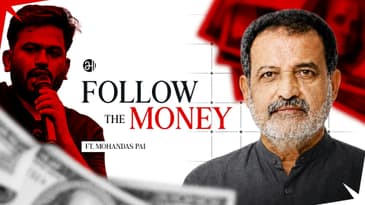

A closer look at one of the sharpest threads from our full conversation with Mohandas Pai. The complete episode - covering the Gen Z protests, the NEET crisis and India's youth unemployment story, along with everything below - is live here: https://youtu.be/hG48jHX7xks This cut focuses on the politics underneath it all: foreign funding, the Congress's search for direction, and what's actually broken in how India is governed. Pai opens with a hard line on foreign money in Indian civil society: no foreign funds for advocacy, no foreign funds for politics, and no exceptions for NGOs who want to influence Indian public life without raising money from Indians first. He questions the funding and online amplification behind recent protest movements, and argues India's FCRA framework - tightened originally under Indira Gandhi - exists precisely to prevent outside actors from shaping domestic politics and religious life. From there, the conversation turns to the Congress party's decline, with Pai arguing the party has failed to offer a real alternative to the government's delivery on basic needs - water, power, bank accounts, gas connections - and that without a clear agenda beyond cash guarantees, its Karnataka government under Siddaramaiah has little to show after three years. He makes the case for job creation over subsidies, using Karnataka's own numbers on jobs needed versus jobs delivered, and points to Bengaluru's recent civic turnaround as proof that leadership and accountability - not bigger budgets - are what change outcomes on the ground. The conversation closes on India's justice system: why the country has a fraction of the judges per capita that other democracies do, why delays in prosecuting corruption cases erode public trust, and what accountability would actually require. If you want the full context - including the NEET and jobs conversation that precedes this - the complete episode is linked above. ⏱️ TIMESTAMPS (00:00) - Foreign money in Indian advocacy and politics (01:46) - The case for India's FCRA law (04:37) - Foreign funding, NGOs & accountability (06:43) - Religious conversion, foreign money & the churches (09:04) - Tech platforms, bots & the funding behind recent protests (10:27) - "What is the alternative Congress is giving?" (11:14) - Modi's core achievement: ending deprivation, not poverty (12:51) - Why cash guarantees aren't a governing agenda (13:42) - Subsidies vs jobs: the real Karnataka numbers (16:30) - A jobs idea for a million people: private security (18:08) - Delimitation, representation & political incentives (18:35) - Bengaluru's turnaround: what changed under new leadership (19:10) - The colonial mindset still inside our institutions (20:15) - "Rulers, not the ruled": what Pai wants from politicians (21:15) - Why India doesn't have enough judges (22:01) - Justice delayed: corruption cases and accountability 🎙️ ABOUT THE GUEST T.V. Mohandas Pai is Chairman of Aarin Capital and 3one4 Capital, and Chairman of Manipal Global Education. He was CFO and a board member at Infosys, where he helped take the company to NASDAQ and instituted India's first broad-based employee stock option plan. He has served on the boards of SEBI and the NSE, co-founded the Akshaya Patra Foundation, and was awarded the Padma Shri in 2015. He remains one of India's most outspoken voices on education, employment and public policy. 🔗 CONNECT WITH MOHANDAS PAI X: https://x.com/TVMohandasPai LinkedIn: https://in.linkedin.com/in/mohandaspai ABOUT BHARATVAARTA Bharatvaarta is a platform for long-form conversations on India's politics, policy, economy and culture — the arguments that shape the country, heard in full and without the shouting. New episodes every week. Subscribe and hit 🔔 so you don't miss one. 💬 Where do you land on reservation reform? Tell us in the comments. Join this channel to get access to perks: https://www.youtube.com/channel/UCfBfBd-1kvCOPxVll8tBJ9Q/join
[00:00:00] We should not allow foreign money to come for advocacy. We should not allow foreign money to come for politics. All these NGOs, if they want to do advocacy, let them raise money from Indians. Don't tell me this cockroach just got 25 million for how can it happen in fact? How can it happen? Please tell me. They are all bots. Give me a break. They are all bots. They are all foreign money. Look at all the evangelicals, conversion vultures and all that. They openly try to convert people using foreign money.
[00:00:23] And you see many of the foreign organizations send money saying we will plant churches in India. We will do this. We are converting people. This is our target. This is happening. It is a battle for power. The Congress has lost out. See why is the Congress lost out? You tell me. What is the alternative the Congress is giving? There is no alternative. I don't see Rahul Gandhi telling us what will he do for this country. Our politicians should understand they are our representative, not our master. They must meet us, listen to us, ask us what we want and try to see whether it takes society forward.
[00:00:53] We want to enact the loss and make it worse. In the three years of Sidramaya, we did not see much progress. We only spoke about guarantee. Guarantee is not his personal guarantee. But this is absolutely important because when we talk about a demographic dividend and so on… Look, look, please tell me one thing. You think all our big companies don't know this? They are no better than you and me. They are facing the clients. They are running their business. They are no better than you and me, no?
[00:01:22] They are worrying. Are you worrying more than them? Their life is a stake. Am I right? Are you worrying? Are they worrying more than all the jokers who make loose comments in the media and other places? Come on. I mean respect industry. Industry knows what is happening. They are all bright people. They work with their clients. They are all global businesses. They know what they are doing. Right. So taking a small divergence from what we were talking about which is broadly education and employability.
[00:01:52] These protests coincided with the monsoon session in the parliament. And there were a couple of things in this parliament season that were under discussion. One is FCRA bill and deal limitation. Deal limitation we have already referenced in terms of increasing our MPs to about 850 and so on. It is overwhelmingly a net positive in my opinion because I think it gives adequate representation to everyone, right?
[00:02:17] Especially the urban folks who have been neglected. But why do you think there is opposition for something like this? See, the opposition is there for opposition because they want to beat the government down. FCRA, why is there an opposition? What is the FCRA new act saying? They are saying the money that you raise from overseas should be used for the purpose for which is legally allowed. Pro-salterization must not be allowed. It is illegal. They put it into the act. Why should anybody object?
[00:02:44] Then they said the overheads, the money you spend on yourself compared to the money should not be more than 20%. Earlier it was 50%. So all the people are using foreign money to live very well are getting affected. So they are creating trouble. Then they say anti-monitor. What is anti-monitor? It applies to everybody. What is minority and majority in that? It applies to everybody who gets anything. Why should all these minority institutions go after foreign money? When somebody abroad gives you money, they command what you do. There is so much of misuse of this money.
[00:03:13] Look at all the evangelicals, conversion, vultures and all that. They openly try to convert people using foreign money. Many of the foreign organizations send money saying, we will plant churches in India. We will do this. We are converting people. This is our target. This is happening. The Catholic Bishop Conference should understand all this and support this. Why are they protesting? And then, you know, there is a law saying that if you, the property which is used from this foreign money can be taken over by government if you lose a license for FCNRA.
[00:03:43] That is there in the earlier act. Except in this act, they created an institution which can do that. So why are they all bothered? Oh, they say it will be misused. Government will not take over. If government passed the order to take over, go to court. The court will protect you. Go to court. The right to go to court is always there. Whatever the law says, you can always go to court. Article 32 or 226 constitutional remedies are there. Do that. You understand? There is a political issue.
[00:04:12] Many of the church organizations find that they are getting hit because now they need transparency. They have to give full accounts. It is very lax earlier. They don't want accountability. They don't want the luxurious life and the real spending to be visible. Why are they hankering about foreign money? Why should George Soros send money to many of the NGOs in this country? Why should they do that? We should not allow foreign money to come for advocacy. We should not allow foreign money to come for politics.
[00:04:40] We should not allow foreign money to come to promote democracy. What do they have to do with our democracy? All these NGOs, if they want to do advocacy, let them raise money from Indians. Enough money in Indians. Indians spend 1 lakh crore plus as charity every year. They give a 1 lakh crore. There is a lot of money. Go to them and raise money. Pursue them to give them money. Many people are successful. Go do that. Why do you want to go beyond these foreigners? Why do you want to get foreign money?
[00:05:08] Because they control you and you are selling your soul. Many of them are selling their soul to foreigners for a few dollars. And the system has been corrupted. Many of the NGOs in Delhi are run by wives of bureaucrats. It has become a business. Many of the bureaucrats of retirement run NGOs. They all become a business. And remember one judge's wife, staying in the judge's quarter in Delhi, was running an NGO and the judge was very fond of opening the courts at 11 o'clock,
[00:05:35] 12 o'clock in the night to deliver some judgments, to act as a hero. So much of misuse of all this, correct? So much of misuse. And whenever this action is taken against some of these NGOs, who is opposing them? Highly paid lawyers. Who is paying money for that? You understand? Look at the extent of misuse. Misuse should stop. Why should foreign money come? You have no right to getting foreign money. There is no fundamental right. Let's understand it.
[00:06:06] It is a law that allows you. You have no right. Without the law, you have no right. You can't get foreign money. The law has been created. Parliament allows you to get. And this law was brought by Indira Gandhi. It was stiffened by Indira Gandhi. It was made tougher by Indira Gandhi. And no money should come for Indian politics. All countries control that. You must see the interview of Harish Salve with Annabh Goswami, which is very revealing. He says the people who write the check control you. So all the churches are being controlled by foreigners. Why are they protesting? I don't understand.
[00:06:35] The Catholic Bishops Association should support this. Because they are at the mercy of the evangelicals and radical organizations who are trying to convert people. Much of the people that take away are from the Catholics only. They don't understand. They are under attack by this evangelical church. The Catholic Church has lost out heavily in South America. They are lost out in other countries. The evangelicals are taking away all their followers. You understand? But people are also asking,
[00:07:05] where do we draw the line between, let's say, a genuine civilized dissent and something which could be… Because the opposition has lost all hope of coming to power. They take extreme steps. And the government should be tougher. The government is very afraid of being called undemocratic, fascist and all that because the leftist media and the leftist have got a large voice in the media. So they buckle down. Right. But the opposition also says that you can't have the same template answer to everything,
[00:07:32] saying that everything is under foreign influence or everything is… Argument in parliament, no. Go argue in parliament. Why do you prevent parliament from functioning? Parliament is the place for you to argue. What do these opposition say? It's anti-minority. That's stupid. How can it be anti-minority? It's applicable to everybody. It's not targeted to anybody. It's applicable to everybody. Correct? Hindu organizations, Christian organizations, Islamic organizations. How can it be anti-minority? Oh, government will take away property.
[00:08:02] How can anybody take away anybody's property in this country? There is a court. You can go to court. And these organizations have access to the best lawyers. You have seen them. So what is the fear? Oh, we have to give information. Give information. That's the obligation under the law. Correct? It has to be tightened up. We should not get foreign money, especially from people like George Soros, evangelical church coming into this country to ruin our polity. Remember, some four or five years back, there were advertisements on billboards. I converted to Christianity. I converted here. I am this.
[00:08:31] I saw the Lord coming in my dream. All kinds of stupid things were there. Remember? Huh? You saw that, no? Where is the money coming from here? Can we allow that? Let's be honest about it. No. And then they abuse other religions. All these conversion agents go abuse other religions. How can they abuse other religions? You understand? Right. So I think there is so much of misuse, it must be stopped and it is a good law to come. So what do you make of the influence of these platforms, these tech platforms like Meta and Google and so on?
[00:09:01] All these tech platforms sell their soul for a few dollars more. The global left and people of the Soros organization have mastered the art of pumping in money through bots and others on these tech platforms to amplify everything. Anything that happens, they can amplify it through bots. Don't tell me this cockroach just got 25 million fall. How can it happen in five days here? How can it happen here? Please tell me. They are all bots. They pump money into bot forms and they are all bots.
[00:09:28] And they say, oh, suddenly 25 people following this and that following. Give me a break. They are all bots. They are all falling in money. That's why I keep telling them publicly. Government of India should see where did the money come for one year for the farmer's agitation. Where did the money come for the cockroaches? Some guy, some caterer used to give biryani, giryani, free food every day. Where did he get the money? They must find out. Track the money and prosecute them.
[00:09:55] Remember in the US, that Singham organization, that guy who sold that ThoughtWorks or something who is now in Shanghai. He has been pumping money, giving to organizations. Congress is holding an inquiry. They will go after him. FBI is holding an inquiry. FBI will go after him. That's what it should do. You can't allow foreign capital to come and spoil your politics or create chaos in the country. Final question, sir. Do you think that these kind of things will intensify as we... It will intensify.
[00:10:24] It's a battle for power. It's a battle for power. The Congress has lost out. See, why has the Congress lost out? You tell me. What is the alternative the Congress is giving? Not offering a positive alternative. There is no alternative. I don't see Rahul Gandhi telling us what will he do for this country. Except say, Jitni Aambadi, Utni, this thing and all that. That makes no sense. That makes no sense. He's already there in education. He's already there in government jobs. What is the offering? He's not very clear what is he going to offer.
[00:10:54] Why should people vote for him as against Modi who has done so much? See, Modi has tackled the biggest challenge India has since independence. What is that? The poverty and deprivation of our people. We are a poor country. A lot of poverty and deprivation. All prime ministers in India's history tried to remove that. All of them. Inevitably. Because all politicians are good people. But they failed because they could not execute. Modi has been able to execute. Modi has made sure almost every person has the roof over the head, water in the tap, power in the switch,
[00:11:25] a gas stove, a bank account, money in the bank, a mobile phone, internet connection, food on the table, education for children, health insurance, etc. Correct? A toilet in the house. He made sure. He succeeded. So, the great majority of people don't have deprivation. They are still poor but deprivation is gone. Now, the children are doing well and aspirations have gone up. They should do that. They should offer. You understand?
[00:11:53] But I suppose the biggest risk is that there is an entire generation which is growing up with this as the baseline. They don't know what it was like earlier. But that's the right thing. Why are you saying the biggest risk? We must have better policy. Give them what they want and explain to them. Is that right? Look, I was part of the deprived generation. When I was growing up, there was no tap water. Enough tap water. Water. We should go to the well in the house and draw the water. There is no milk. Enough milk. The power is to shut off. Ration shops. Ration shops.
[00:12:23] No food. Give me a break. Not enough schools. Not enough colleges. Come on. All that is gone. It came too late. Why didn't the Congress do that? They are so corrupt. Modi did it. Now, they are losing power. Nobody is voting for them. They want to disrupt parliament. Do all kinds of dialogue. Create hatred. You know, go after Islamic appeasement. All kinds of mess they are doing. But why will people vote for them? There is no reason why people should vote for them. They must give an agenda. This is what we will do for you.
[00:12:51] Agenda is not doing kata-kata-kata-kata-kata. 7,000 rupees a month. 8,000 rupees. There is no money for that. That is not agenda. That is not an agenda. That is what? You talk to them. What will they do? Oh, it is only for 1 lakh people. Give me a break. Give me a break. 1 lakh people will do. The real poor. And then everybody's account will get kata-kata-kata. Remember in Bangalore, so many Muslim women from the slums went to GPO to open account, saying that if elections happen, Rahul Gandhi will do kata-kata-kata-kata will get money. Remember that? I used to see it when I used to walk to office.
[00:13:22] See, they must have an agenda. A positive agenda, what they will do. Right. Right, sir. And the agenda should be how are you going to create jobs? Not give subsidies. Jobs. Because jobs are permanent. Subsidies. This government is spending 60,000 crores on giving subsidies to people. Many of them would not deserve it. You think 1.3, 1.4 crore women need 2,000 rupees per month in the bank? They are not poor.
[00:13:49] You think 1 crore, 1.5 crore people require free power? I mean, in Malaysia, so many people are taking free power. I asked them, why are you taking free power? He said, we pay so much of tax, what do we get in return? At least this we are getting. Why should they get free power? Restricted to the poor people, what is the percent of poor in Karnataka? 10%, 20%, 15% is 5%. Give it to 20%. Give them. It's okay. You understand? Why are you giving the rest? As for the rest, invest in high education.
[00:14:18] In Karnataka, 60 to 70% of the faculty position in government calls are vacant. There is no faculty. They got guest lecturers. A very bad quality. Most of them. Remember 250 people were sacked for having a forged PhD. Remember? It came in the media in Karnataka. Come on, you can't do that. You are playing with the future of children. What kind of education will those people get? And then you say they don't get jobs. They are not qualified. They don't have skills.
[00:14:48] Run the state properly, no? Invest in high education. Invest in people. Invest in industry. Invest in infrastructure. Create jobs. So, if you don't have the agenda, you disturb parliament, create all kinds of aggrieved. They are saying create caste hatred. Create communal hatred. Why are you supporting these jihadi elements and others who are against this country? I don't understand. Why are you supporting that?
[00:15:15] Do you think Karnataka is especially at a risk considering it's one of the last few states that the Congress has, it treats it as a cash cow of sorts and so on? Yes. Because in that three years of Siddharamaya, we did not see much progress. He only spoke about guarantee, guarantee. It's not his personal money. Very easy to give away money. Guarantee, guarantee. People got that money. Now you think they'll vote for him? They say, what is next? Razal Om Swaham. Correct. What is permanent is a job. Not these small things.
[00:15:44] You understand? So, has he created jobs? No. He says, I'll give government jobs. How many government jobs will you give? Every year in Karnataka, 9 to 10 lakh people come up working age. We need 5 to 6 lakh jobs. Every year. In 5 years, we'll require 5 into 5, 25, 30 lakh jobs. And what is he saying? I'll give 30,000 jobs for it. Is it enough? What are they talking? What is Siddharamaya talking? Giving away free money. How many jobs has he created?
[00:16:14] That's what I keep telling our Chief Minister D.K. Shukumar. Focus on job creation. There are many good policies you can do. They don't cost too much of money. Talk about jobs. See, when Katha Subraman Naidu was IT minister and others, he had called us for jobs. I told him, one of the biggest jobs is in security. Private security. There are 90 lakh people working as private security guards all across India. 90 lakhs.
[00:16:44] Police are 22 lakhs. Can you believe it? 90 lakhs every year. 78 lakh people get jobs. I said, get young, good, strong people, semi-educated from North Karnataka. Put them in the police training academy for 45 days. Police have got training. Have a 45 days program for them. Give them food, get everything. Give them a certificate. And call all the agencies. Securities and hire these people. They'll hire them. They want people. They get 20-25 thousand rupees a month. Not bad. Instead of being on the street.
[00:17:14] Correct? Right. And then, because you train them and all that, they will be an addition to the police in case of any need. We need security. Do that. They don't want to do it. Nobody is applying their mind. They do some skill thing. They do some fashion gation. Knock off a lot of the money. Give it to all kinds of people. What is the output? They don't track all the skill to industry. Do they ever talk about how many jobs they created by the skill? No, Allah. They don't care. They put a politician leader there. They put some secretary there who doesn't want the job.
[00:17:44] Too focused on inputs and not so much focused on outcomes. Yes. Outcomes should be how many jobs. Seminars, schemes. I want our chief minister to tell us how many jobs he has created every three months. How many jobs have been created? Whether, not government alone. By his work, how many jobs have been created? How many people got employment? Right. That's the biggest thing. What else you need? Nobody talks about that.
[00:18:10] Well, hopefully, post-deal limitation, we have adequate representation and it becomes politically… See, political leadership… Because that political incentive is necessary. Political leadership have to be better. They must have better policy and execute better. See, MB Partill is doing a good job. Even DK Shukumar is doing a decent job. Look at Krishna today. Krishna Bhairagoda. What a good job he is doing. We had so many ministers of Bangalore. What did they do? I used to meet them and tell them, please clean up the city.
[00:18:41] How the… Clean Marbeka. Ayatun Norana. They are nothing. They forget. Look, Krishna is doing it. He has become very popular. Krishna Bhairagoda is cleaning up the city. He has become very popular. He is communicating. He is telling, we will make Bangalore a walking city. We will build good infrastructure. Quality of life. We will open parks. And now for 15th August, he is opening up Vidhan Soda. He is saying that the people come and enjoy Vidhan Soda. They shut down Vidhan Soda. When we are younger people, we used to go to Vidhan Soda for the weekend. We used to walk in. Now you can't walk in. I remember when I used to go to Vidhan Soda after the shutdown,
[00:19:11] I used to go in my chapel in the Kurta. The police said, Yaakwe, why have you come? Who are you? And next to me, one corrupt contractor will come in the merciless, bend the suit. They will salute him. And allow him. They won't allow me. Then I see some dogs going inside. I am worse than a dog. They treated me worse than a dog. The dog will go inside because the central court, the other 20 dogs are living there. I am telling you, it is not a joke. That is how they treat people. The police treat you as if everybody is a criminal.
[00:19:41] They are big people. They don't think they are there to protect people and do service. They treat you like a futile thing. You understand? The attitude should change. The same colonial mindset is there. Yes, that should change. Then the politicians should change the attitude of the law. Right. See, our politicians should understand they are our representatives, not our masters. We elect them to power, to rule on our behalf.
[00:20:06] They must meet us, listen to us, ask us what we want and try to see whether it takes society forward and enact the laws and make it work. They have to have good programs and talk to the bureaucrats to implement it. They can't ask bureaucrats to decide what their priorities and programs are because they have to decide. They are the rulers, not the bureaucrats. The bureaucrats have to do the work and the agenda decided by the political. They don't do it. They are the massive bureaucrats. The bureaucrats are the bureaucrats. The bureaucrats are the agala. How is it? Agala. What is the agala?
[00:20:35] You got to make it happen, man. You got to make it happen. You got to work at it like Krishna is doing. Krishna Bairagoda is a great leader. Look at the work he is doing. One man changed Bangalore in 30 days. Look at the metro, five years behind schedule. We had bad CEOs there. Now a new CEO, CK Jafar has come. He will transform it. Look at that peripheral road. We got Atik there. Atik is brilliant, good man. He will make the road happen in one and half, two years.
[00:21:03] Because DK is giving him all authority, all powers. So we need good leaders focusing on the right things. Then society will develop. And for the politicians to understand, they are elected by us. They must talk to us, listen to us, make it happen. And they must rule, not be ruled. Even in Delhi, they are getting ruled. Bureaucrats decide the rules in many of the things. Not in many of the ministries. See, I will give you the justice system.
[00:21:32] It takes 15-20 years for the course to decide. Why? India has got 20 judges for million population. We need 50. America has got more than 100. We don't have enough judges. Expand the judiciary. Let the central government have a scheme to give money to the state to expand the judiciary. I once told a chief minister, justice is very bad. You know what she told me? Move on. They all decide against the government. Why should I increase capacity?
[00:22:01] You understand? So it's very important for us to understand. Expand judiciary. Don't appeal for every small case. Half the cases are government cases in appeal. Give justice. If you are caught for corruption, it takes 20 years. No punishment. Lallu is out on bail. For how many years now he is out on bail? How can he be out on bail when he is supposed to be sentenced? Who is asking the questions? Where is justice?
[00:22:32] Right. Right, sir. Thank you so much for this interview. Thank you. As always, very candid conversation. Thank you. Hope to have you back again soon. Thank you very much. Thank you so much. Good to be here. Thank you. Thank you. Thank you.