
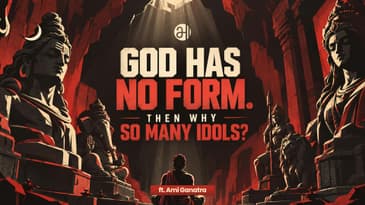
Who is a Hindu? And what does it really mean to be one?
Many of us grew up calling ourselves Hindu, but the deeper we look, the more questions emerge. Is Hinduism a religion or a way of life? How did the gods and deities we worship today evolve? And what ideas hold together such a diverse philosophical tradition?
In this conversation, Roshan Cariappa sits down with author Ami to explore the foundations of the Hindu worldview — from karma, rebirth and moksha to dharma, the cosmic order, questioning, pluralism and the evolution of Hindu deities.
The conversation also looks at how Vedic gods evolved over time, why personal forms of the divine became important, and what makes the Hindu worldview inherently plural and comfortable with different schools of thought.
This is a shorter version of the full conversation, bringing together some of the key questions and ideas from the original episode.
📚 CHAPTERS
(00:00) — Who Is a Hindu?
(02:25) — What Does It Mean to Be a Hindu?
(04:45) — Hindu vs Abrahamic Worldviews
(05:44) — Karma, Rebirth & Moksha
(08:00) — Why Sanatan Has Never Become Stagnant
(08:43) — Is Hinduism a Religion or a Way of Life?
(09:07) — Dharma & The Cosmic Order
(12:10) — Can Islam & Christianity Be Darshanas?
(14:48) — Why Questioning Matters
(15:27) — How Did Our Gods Evolve?
(16:52) — Why Ancient Humans Created Gods
(19:01) — From Vedic Gods to Personal Deities
(22:18) — How Local Deities Became Part of a Larger Tradition
(23:05) — Why Do We Worship Murtis?
(25:00) — How Ganesha's Form Evolved
(26:47) — What Makes the Hindu Worldview Different?
(28:33) — Why Hinduism Is Inherently Plural
(29:12) — Understanding a Nuanced Tradition
👉 If you found this conversation valuable, subscribe to Bharatvaarta.
We bring you serious, long-form discussions on civilisation, philosophy, and the ideas shaping India’s future.
🎧 Listen & Subscribe
Spotify → https://open.spotify.com/show/6tqY8tb...
Apple Podcasts → https://podcasts.apple.com/in/podcast...
X → https://x.com/bharatvaarta
Instagram → / bharatvaarta
⸻
👤 Guest — Ami Ganatra
Author | Researcher | Indian Knowledge Systems
X → https://x.com/6amiji
Instagram → / amig_insta
Tags:
hinduism, what is hinduism, hindu religion, hinduism facts, hinduism history, origin of hinduism, hinduism explain, sanatan, Ami Ganatra, Spiritual, Ramayan, hindu mythology, history, podcast, yuga, shlokas, shri ram and sita, mahabharat title song, hai katha sangram ki, mahabharat full song, karna mahabharat, duryodhan, bheem, draupadi, arjun, is hinduism a religion, indian spirituality, veda philosophy, darshan meaning, podcast india spirituality, karma and rebirth, hindu dharma
Get her book- https://www.amazon.in/Why-Are-We-This...
⸻
👤 Host — Roshan Cariappa
X → https://x.com/RoshanCariappa
Instagram → / carygottheblues
In this clip, we explore questions around what it means to be Hindu and the diverse interpretations of this ancient tradition. Ami Ganatra explains that understanding hinduism goes beyond a singular definition, encompassing a broad cultural identity and the concept of dharma. This discussion provides insight into the essence of Hindu religion and sanatan dharma, highlighting its multifaceted nature.
[00:00:00] Who is a Hindu? I think that is an extremely difficult question to answer very categorically. The term Hindu itself is not how our ancestors described us. One of the most critical aspects of Sanatana is that it has never become stagnant. It is not something that says, this is one book, you have to follow exactly this and nothing else.
[00:00:29] If it is so different, can Hinduism be called a religion? The idea of questioning is another thing which is not present in the Abrahamic worldview. Right? That broadness of mind is what I think the Abrahamic religions do not allow. I want to understand how did our Gods evolve? That is why we are secular. People need to understand this, that why we are not secular and plural because the constitution
[00:00:59] says it. We are secular and plural because we are Hindu. Namaste and welcome to a very special episode of Bharatvaarta. Many of us grow up calling ourselves Hindu, but what does it really mean? You know, we talk about many different Gods and Deities, but also talk about one ultimate reality. There is no one founder. There is no one exclusive book and so on and so forth.
[00:01:25] And the more you try and understand this, the more questions you are left with. To understand all of this, we have author Ami Ganatra who you've seen on Bharatvaarta earlier. She's written a wonderful book, Why Are We This Way? And if I were to, you know, describe it in corporate speak, it kind of lays out the landscape. You know, it's amazing. And it also roots you in our texts, in our shastras, right? And it literally explains why are we this way.
[00:01:54] So super excited to have you on the podcast. Ami, thank you and welcome back. Thank you so much. Always, always great to see you Roshan. And especially in this new studio for yours, it looks fantastic. Oh, awesome. Awesome. So we moved maybe about five or six months back. And yeah, since then people have noticed that the production quality has gone up and so on. So thank you so much. Very kind of you to mention it. Awesome. Ami, let me start with a very basic question, right?
[00:02:21] And perhaps I mean, I'll have a thousand threads to follow up on after that. Who is a Hindu? I think that is an extremely difficult question to answer very categorically, because everybody has very different ideas of what it is to be a Hindu. The term Hindu itself is not how our ancestors described us. The term Hindu is basically how the foreigners saw us.
[00:02:50] It's when there was exposure of this area, of this space, the land between the Himalayas and the Indian Ocean and the Arabian Sea now, that was called the land where the Hindus stayed, the Bharat Varsha. As we, we called ourselves the Bharat Varsha or it was called the Jambu Dweepa. But people, when people on the now what we call Middle East, but which is on the West side of us, when they saw us, they were like, yeah, people who lived on the other side of the Sindhu River.
[00:03:20] And they called, because the Sir, they couldn't pronounce the Sir, they called it Ha, it became Hindu. That's one theory. The other is like, if you go even to China today, they call us, call us Hindu, Hindu. Now, Hindu could also come from the Indus or the Sindhu Hindu. But some people also say that Hindu means the moon. So the people who come from the Chandravansha or something like that, that also could mean Hindu. But the Hindu, Sindhu, whatever, all that is called as Hindu.
[00:03:50] People who are not that, but who stay in this geography. So if you see some, one school of thought, they will say, everybody who is born on this land and who has grown in this culture or who has ancestors here, they're all called Hindus. That is what is generally believed. When the, first the Middle Eastern invasions happened and then the Christians came in. That's when the othering became even more that, oh, we are, these are Hindus
[00:04:17] and these are non-Hindus or we are Christians. We are Christians and they are Hindus. We are Muslims and they are Hindus. And that's when a lot of this discussion started happening is what does it mean to be a Hindu? I mean, I'm sure it was always happening, but what did it mean to be a Hindu? And from that perspective, if we see, then there are some very strong philosophical worldview differences between what we call the Sanatan and the Abrahamic worldview.
[00:04:45] In the Hindu worldview, there is no concept of only one God. God as in a personal deity. We have a lot of gods, so to say. The Upanishads, which come from the Vedic times, they'll say, oh, but all said and done, the Supreme Reality. They don't even call it God. They say the Supreme Reality, the Brahma Tattva is the same. That Brahma Tattva has no form, has no shape, nothing.
[00:05:12] But it is there from which everything came into which everything will go. So all the deities or all the Ishtas that you see are some form of that. And hence, within this cultural milieu, we had so many different gods. People believed in different gods and they lived very happily. The one thing which sort of binds this entire or sort of binds all the Sampradayas, all the Darsanas,
[00:05:40] all the world views within this Sanatan framework is the Karma Siddhanta. So even by Buddhists and Jayans, they may not believe in the authority of the Vedas, but they still believe in the Karma Siddhanta. The Karma Siddhanta is what you see in your life or what you get dealt with in your life is your responsibility. It depends on the karma that you did. One. Second, which also is common across all is Punarjanma.
[00:06:09] Punarjanma is reincarnation, rebirth. So we don't believe in one life. We don't say, okay, you take birth, you follow a certain God. And then if you follow that God, you get heaven all the time. You get liberated. We don't say that. We say that it is a Sansar Chakra. People take birth, people die, people take birth, people die. And to get that ultimate moksha, mukti. Mukti is when you are free of the rebirth cycle itself.
[00:06:35] So all these Darsanas also believe in the rebirth. And rebirth and Karma Siddhanta have to go together because you don't always get the phala, the outcome of your karma in the same life. So as long as there is a karma deficit, you will keep taking birth till all your karmas are burnt off. Right? That is the Karma Siddhanta, which both, which all the worldviews except the Charvak. So Charvak is what? Nirishwarwadi and Nastik. They don't believe in God.
[00:07:05] They don't believe in the Vedas. And they even don't believe in rebirth. But apart from that, all others, they believe in rebirth. They believe in the Karma Siddhanta. So to me, these two are fundamental to be called a Hindu. To have belief in this. Unless and until, of course, one says I'm a Charvak, which is also fine. We've also had a school of thought, which is very fatalistic. Aajivikas. They'll say that, oh, everything is predetermined and we have no agency. There are schools like that too.
[00:07:34] But by and large, what you would call a believing Hindu, be it even an Aasthik or a Nastik darshana would be Karma Siddhanta and the Punarjanma. By the way, I see it in the larger context. Apart from Karma Siddhanta and Punarjanma, one of the most critical aspects of Sanatan is that it has never become stagnant. It is not something which says, this is one book. You have to follow exactly this and nothing else.
[00:08:04] If you follow this, you are a Hindu. If you don't follow this, you're not a Hindu. If you follow this, you get Mukti. You don't follow this, you don't get Mukti. In terms of rules and regulations, it's never been that. We've actually had a very clear classification about rituals, about worldviews and about the codes of conduct. And the codes of conduct which come in the Smritis, everybody has always agreed that the rules which we work with each other will change with time.
[00:08:30] And that has allowed us to remain relevant even today when many other civilizations have been relegated to museums. If it is so different, can Hinduism be called a religion then in that case? Not religion in terms of we see religion today, right? Defined by a book, defined by one God. It is definitely not that. Religion would be a subset. That's why what do we say? So the Supreme Court said Hinduism is a way of life.
[00:08:59] It's not a religion, which is true. What we call it is Dharma. I will add another word to it, which is Rita. So Rita and Dharma. If we had to define Hinduism, it is a way of life which tries to live in accordance with Rita. Now, I should put a caveat here. I'm not saying today we live like that. I'm talking about the high philosophy of the purpose. Aspiration. Aspiration. Yeah, of course it's aspirational.
[00:09:28] And how the Rishis, our ancestors saw the world. So we have a concept of Rita. What is Rita? Rita is very simply put the cosmic order. The world exists because a lot of things have fallen into place. The sun is at a certain temperature. The distance of the earth from the sun is at a certain temperature. The revolution happens at a certain speed. The rotation happens at a certain speed. The moon is at a certain speed.
[00:09:55] If things didn't work that way, life would not be possible. Right? If there were no, if there was no water here, many other places might be fit for living, but there is no water there. Right? Hence you cannot live. The kind of the proportion of oxygen you should have wouldn't be there. So a lot of things have come together to make life possible, to make this Brahman as we see it possible. What is that?
[00:10:21] There are certain physical laws, certain cosmic laws, which work on all things, Jada and Chetan, living and non-living, which have made this possible. It is not that somebody sitting up there and saying, Aisa karo, Aisa karo. But it is just that. That is Rata. The cosmic order, the cosmic truth, which ensures that life goes on. That is Rata.
[00:10:50] Now, what is the purpose of all the stakeholders defined by Rata? To ensure that the Rata is upheld. In the sense, we live in a way that the cosmic order is not disturbed. We live in a way that the cosmic order sustains so that the life goes on. So the animals and the other beings are naturally playing their role without actively thinking about it.
[00:11:16] The only being which has that agency to think about what to do and not to do is us. Right? But we are a part of this nature. We are a part of this Prakriti, of this Sars cycle. How should then we live our lives? The principle that helps us understand how to live our lives so that this Rata, the Sansar Chakra goes on. That we continue to live our life upholding Rata.
[00:11:42] That is the other core of what we now call Sanatana. Right. Living in sync with the cosmic order. Why cannot Islam or Christianity be considered another Darshana? Right? I know you mentioned that, you know, they should consider other gods as well, perhaps, and so on and so forth. But is there a case to be made that Islam or Christianity can be another form of like a Darshana?
[00:12:10] Very honestly, we can. And I'll tell you why. I mean, we can. The thing is, will they want to be considered as a Darshana? Right? But for us, if you see even within the Vedanta, so we have different schools of thoughts, different schools of viewing the world, viewing the relationship between the individual and the Paramatma, understanding what creation is all about. Those are called Darshana, to see, to see the reality. Right?
[00:12:37] To see that relationship between us and the Pindar and the Brahman. That is called Darshana, the schools of thoughts, in which we have yoga, saankhya, vaishya shikha, jaya. We have Uttar Mimamsa and we have Apoorva Mimamsa. So the Uttar Mimamsa is what we call Vedanta. The Anta of Veda, which talks about philosophical stuff. Now that, in that, we have something called as Advaita. We have something called as Dvaita. Right? Now, what is Advaita?
[00:13:05] Advaita says, there is this ultimate reality, the Brahma Tattwa, and we are just that. Just that, we have forgotten that we are that Brahma Tattwa. And once the avidya, ignorance goes away, we will realize it. But there are some other parts, like the Vishishtra Advaita, Dvaita especially. Dvaita says, there is a God. The Brahma Tattwa is the God. They still consider it formless and stuff, but there is a God. And you are different from that. Okay. Not very different from how maybe Islam and Christianity see it.
[00:13:36] So yes, from that perspective, we can say, ha, it can be a Darshana. However, the biggest problem or rather the biggest differentiation between saying that, or rather for them to accept that they are a Darshana is that all our Darshana, all said and done. Okay.
[00:13:56] See the ultimate Bhagawan Tattwa, even if they give a form like Shiva, Vishnu, even if they give a form, they see that as a Nirguna Nirakar Brahma. Which they know that manifestation is for us to behold that Tattwa. Okay. And that Brahma Tattwa is not a vengeful God. The Brahma Tattwa is not saying this is the only way to live.
[00:14:22] The Brahma Tattwa is not saying that if you don't believe in this God, you will go to Narka. Advaitha and Advaitha might have difference of opinion on how to see God, how to approach God. There will be difference in some rituals and stuff. But they will not say that if you don't believe in mind, you don't have the right to live. It doesn't say that this is the only path and no other.
[00:14:48] That broadness of mind is what I think the Abrahamic religions do not allow. The idea of questioning is another thing which is not present in the Abrahamic worldview. Right? You question, that is a blasphemy. You raise a doubt, that is hearsay and blasphemy. We don't have that concept. We are allowed to question. And we are told, okay, you find out. That's why we have so much, right? We don't have one book.
[00:15:17] We have so many worldviews because that questioning was allowed. That is another big difference between the worldviews. I want to understand how did our gods evolve? What is the purpose of these gods and deities? And why do we not worship Indra or Agni or Varun like they were mentioned in the Rig Veda and so on? How did this evolution of gods happen to what we currently perceive as gods as well? So I'll share how I think about this.
[00:15:47] And that's how I started the book as well, a little bit. See, man initially lived in jungles. If we go by the theory of evolution and all that, they lived in jungles, not so civilized. Later on, because the man had brains, it had intellect, they started settling down, creating their own small societies and all of that. Agriculture started happening. It started with the discovery of fire, right? If there was no fire, no clearing would happen.
[00:16:16] If there was no fire, no cooking would happen. If there was no fire, survival itself was endangered. Because people were living in the forest at that time, whoever our Igdam old ancestors were, right? The fire changed everything. They started settling down. And over time, they observed the nature that a lot of their survival is dependent on the forces of nature, on rain, on the soil, on air, everything, right? If the rains didn't come on time, you couldn't survive.
[00:16:45] If the sunlight was not right, you didn't survive. The food wouldn't grow. All of that. So, think of it as how would that ancient brain see the world? It will think that, okay, I don't control them. They control me. Right? So, they are something which that nature is greater than me.
[00:17:08] And if I live in a way to show my gratitude, if I can appease those forces, then the reciprocity will happen. They observed nature, the reciprocity is happening everywhere. As we just discussed, the rata, right? They observed this rata and they figured that we are a part of the system. So, again, the difference in the world view, we were talking about Abrahamic versus us, is that nowhere do we say that human being is over everybody else.
[00:17:39] We don't say that the world is meant to be enjoyed by the humans. It is not that. We say the world is what it is. Human beings are a part of it. And not above it. And not everybody is meant to serve you. That is another big difference. Because that's how, that's how, that's what they observed. And most pagan religions are this, what they call pagan religions, right? So they saw that, okay, these, we survive because of this. Those forces which they observed in nature became anthropomorphized.
[00:18:08] Somebody they looked up to. Because the human mind cannot process abstract. We need a form. We need to give it certain form. And we will see the gods in our form. So then we had Indra, we had Surya, we had Vayu. We saw that there is some power which is ensuring the Rata goes on. What was that? They called it Varun. Today we think of Varun Dev as the oceans.
[00:18:33] But the initial conception, conception of Varun is that he ensures like Yamraj, is everything happening on time? Is the Rata being taken care of? All of that, like all the devatas are following the rules and stuff. That's how it started. Now, over time, when a civilization is prosperous, the same Maslow's hierarchy, in our world view, we think of it as the Panchakoshas. That if you have your survival instincts met, then what will happen?
[00:19:02] You will think about the next level. You will think about satisfying your emotions. You will think about satisfying your intellect. The Manomai and the Vijnanamai. So then they started observing, okay, what is this? How is it that the sun is rising when it rises? How is it that the rains come in a certain way? Yes, we think of it as Varun. But what is it that is making all of them do their jobs? Then this concept of there is a truth behind, above it, right?
[00:19:28] So if you see the Rig Veda as well, or any of the Vedas for that matter, you have what is the Karma Kanda part, which is for the ritual of doing the Yajna. The Vedas are essentially for doing the Yajna, for doing that ritual. What prayers to pray? Which God to invoke? What to ask? How to do it? Vedas deal with that part.
[00:19:49] While philosophers and rishis and intellectuals will think about those kinds of details, for the normal public, that is too much. For them, they want to live their life, right? The societies have grown now. They want to live their life. Not everybody can do the Yajna the way, because some of the Yajna became really, really elaborate. Not everybody can do it. But you still need that belief that okay, there is someone, someone you can reach out to in times of need.
[00:20:18] There is somebody who is taking care of all this. From that comes the idea of personal gods. So, you very nicely, not to say that it was a shift, immediate shift. Not to say that it was chronological. But some of these things might be happening in parallel. Right? So, a lot of those devatas, whose roles started making sense, like Vishnu Shiva. Vishnu Rudra, they are there in the Vedas as well. Okay.
[00:20:47] But their role becomes a lot more prominent over time, with the time of the Pauranic stories. Because when you have now devatas, the personal gods, the supreme gods, you also have their stories. You also want to teach values through the metaphors coming from those devatas. And hence, from Vedas, we move into the Pauranic stage. Now in the Pauranic stage, some devatas who were, let me not say secondary, but who were not supremely prime. Unlike Indra and Agni.
[00:21:17] Indra and Agni have the most suptas in the Rig Veda. Right. But coming to Yajurved, already Rudra becomes very prominent. And then over time, you have Rudra. You have Rudra who becomes Shiva as we see him today in the Pauranic times. We have Vishnu who becomes way more prominent and powerful coming to the Pauranic age. And we didn't discard Indra. We didn't discard the others. We just said they become secondary.
[00:21:43] Because they have to live according to how Vishnu and Shiva and everybody wants them to. So we've not discarded them. It is just an evolution of how we have seen them. The premise is lost. Yeah, because the ritual itself is not that prominent anymore for the mass. So that's how I see this evolution happening. And in the Indic worldview, we have had new gods being reinstated or found and Pran Pratishra,
[00:22:12] they have been sanctified over and over again. Lots of Devis that we know today were not there before. There could have been regional devatas, like we have the Dwar Palas in many places, or we have the Kula Devatas, or the local devatas. Right? There might have been a time when some of them were really very local. But over time, they got absorbed in the larger pantheon, got more stories, got connected to the larger civilization.
[00:22:40] Many other people got introduced to them, and they also became prominent. And then we say, oh, they are also just a form of Shiva or a form of Vishnu or a form of Devi. Right. So that's how, so what we see today is actually a churn and evolution of a belief system that has evolved, developed, adapted over thousands of years. The consecration of the murtis themselves is itself a later-day evolution.
[00:23:06] Because if you see the Vedic times, or if you see the Vedas, there is no concept of murti so to say, as we see it today. Right? Which means that was already an innovation, which was required at that time. Why? Because when the personal devatas came, we said it is a form of Brahman. Now, how do you imagine Brahman? Brahman is nirgund nirakar. It has no shape. It has no properties. Right? How do you, how do you even imagine that? A human mind is limited by its own limitations of senses.
[00:23:36] Right? In fact, in Bhagwat Geeta, Krishna actually explains this. Krishna says, so Arjun asks, Arjun wants to know that what is, once he's convinced that Krishna is Bhagawan and the Bhagawan will take care and all that. He's like, but some people say one should worship the nirgund nirakar, the one without a form shape, the Brahma Tattwa. Some say worship the sagon sakar, in the sense, the God with a form, the Bhagawan, the Ishwar with a form. This is basically the murti rupa or the dhyana rupa.
[00:24:04] A lot of the Paurani Granthas have a dhyana shloka with that. Right? Which tells you how to imagine the devata to focus on. That is like an anchor for us to start focusing on our mind into those aspects of devata. Because if they say focus on the abstract, where will we look? The mind will go everywhere. Right. So, Arjun says, which is better? And Krishna says, both are valid parts.
[00:24:30] However, the sagon sakar is easier for the human mind, given the limitations. So, he doesn't use the word limitation, but he says we are bound by our senses. Hence, the sagon sakar is more accessible to human beings like us. So, the consecration itself, the sanctification itself has happened over time. A lot of sanctifications, a lot of deities that we see today, are not always coming from there.
[00:24:59] Forms have changed. Shapes have changed. The idea has remained. For example, today we have Ganpati. Right? The form of Ganpati as we have today. The elephant with the elephant head and the body and all of that. But the quality is that Ganpati, the form we have today that has taken, you don't see that. Or rather the form we have is not really found in the Veda, so to say. Even if the word Ganpati is there. But the word Ganpati is not used for Ganesha as we know. Ganpati is the head of the Gana. Okay.
[00:25:29] Now, Shiva is called Ganpati. But also, there is what we call Brahmanaspati, who is also called Brahaspati, who is called the guru of the devatas. Like Indra, Varun, all of that. The guru of them, who is helping them, who is helping them resolve their issues, remove their obstacles. He is bringing Buddhi. Yeah? The qualities of that Brahmanaspati is Buddhi and all of that. You see, we don't have Brahmanaspati today in that form.
[00:25:56] But this remover of obstacle, Buddhi, all that we see in Ganesha. But the form is, of course, very ancient now. Very, very ancient now. But relatively less ancient than what the Vedic times are. Right? Right. You know, you talk about, you know, this intercultural exchange that you have with folks from other nationalities and other faiths and so on. I've had my own share, right?
[00:26:23] Having interacted with folks abroad and, you know, folks from other faiths and so on. How do you think it makes us as Hindus different? I'll answer that. But I also, you said something very beautiful. And I will go back to the first question you asked about who is a Hindu. I think a Hindu is the one who is a custodian, who accepts that he's a custodian of this vast knowledge and at least feels responsible to transmit as well. Coming to the second part, and that's a very important part.
[00:26:52] I think for me, what really matters is that the Hindu worldview is inherently plural. It is inherently inclusive. It is very comfortable with diversity because diversity is there. Unity is, the diversity is, the unity is inherent in the diversity. Right? So we are very comfortable with that diversity. We are very comfortable with questioning. We are very comfortable saying, okay, you are saying something.
[00:27:22] I don't agree, but that's okay. That doesn't mean I don't respect you. Right? That is there. And those are our strengths. We should not lose them just out of reaction to others who don't believe in this. But that also doesn't mean that we become sitting ducks for them to trample on us because we allow, because we are inclusive, because we allow freedom of thought. Right?
[00:27:51] That also shouldn't be there. So we have to be very clear what we stand for and also what the others are not and what we are not. I think that understanding is going to be extremely important. Swayambod and Shatrabod. Swayambod and Shatrabod. In terms of dealing with people within ourselves, because all that I said, I don't say that there are no people who, that we don't have any bigots amongst us. We very well do. Right? I'm not going to say we don't have misogynists amongst us. We do.
[00:28:20] We have loads and loads of castists. A little trigger and the castism comes out. All that is also there. But by and large, what is the worldview? That is inclusivity. That is pluralism. And that is why we are secular. People need to understand this. That why we are not secular and plural because the constitution says it. We are secular and plural because we are Hindu. The Hindu worldview is inherently plural and accepting. Right?
[00:28:50] That is our strength, but can also be our weakness. And we have to be mindful of that without losing the strength. Right. That's a wonderful note to end the podcast on. I made a conscious decision not to ask specific aspects of the book itself, because I didn't want it to become like a discussion which is centered around what is this and how is this. And so on and so forth. But what the book does is it just lays out this framework, right?
[00:29:19] Where you are able to situate yourself, irrespective of like where you are coming from, you know? And I think it's a helpful, I would say, starter pack to get started on, you know, how to understand this, you know, highly nuanced, highly sophisticated tradition that we have inherited. Right? And to that end, I think it has done a wonderful job. I mean, I really had a lot of fun reading this book, recognizing a few things that I thought I knew and so on and understanding a few more things about it. And of course, I mean, I'll be going back to it many, many times over.
[00:29:49] Yeah. Thank you so much. Thank you so much for this. Thank you so much for this. Please.