
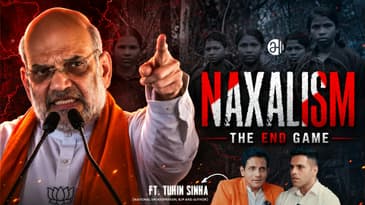

Every nation has a story, but some chapters are written in blood. For decades, India fought an enemy that didn't wear a uniform - an ideology that spread through forests, cities and silence, in one of the longest internal-security battles in the country's history. Roshan Cariappa sits down with Tuhin A. Sinha - BJP National Spokesperson, author of 14 books, and now the writer of a comprehensive new book "Naxal Terror Vanquished: The Long War against Maoism, and the Doctrine That Ended It." This book discusses how India confronted and pushed back Naxal terror. We've had Tuhin on the show before - last time, to talk delimitation, the women's reservation bill and the coalition arithmetic of the Monsoon Session. This time the conversation turns to something bigger and bloodier. His starting point is a memory gap: Gen Z and Gen Alpha never saw this threat at its peak, and the country readjusted so fast that few remember how bad it got. In 2010 alone, over a thousand people were killed in Naxal violence - 74 CRPF jawans ambushed at Dantewada, and the Gyaneshwari Express sabotaged in West Bengal, killing 150. This, he argues, was never a "socio-economic problem" - it was an out-and-out terror movement. From there the conversation traces the full arc: the origins in Naxalbari in 1967, the role of "urban Naxals" in supplying funds and arms, the Salwa Judum movement and the price its leaders paid, and the turnaround that followed - the convergence of security agencies across a seven-state Red Corridor, the surrender-and-rehabilitation policy, Operation Kagar's final push, and the development story behind it. Tuhin's central claim is a bold one: that Naxalism has been pushed to the brink of extinction. ⏱️ TIMESTAMPS 00:00 - The enemy that didn't wear a uniform 01:20 - Welcome back to Bharatvaarta 02:08 - How serious a threat was Naxalism, really? 03:06 - Dantewada & the Gyaneshwari Express: how deadly it got 04:36 - When a leader calls a Naxal his role model 05:10 - Where it began: Naxalbari, 1967 06:30 - How it evolved - students, Bihar & caste 08:05 - The UPA years: scrapping POTA & the NAC 08:36 - Salwa Judum, and the myth about tribal support 11:37 - Struck down: the fresh wave of violence & the leaders killed 12:54 - Why "socio-economic problem" was a fatal misreading 13:47 - Urban Naxals: the supply of funds and arms 17:52 - What this government did differently 20:26 - The surrender & rehabilitation policy 21:16 - Operation Kagar: the final phase 22:45 - Bastar Olympics & bringing fighters into the mainstream 24:46 - Development as the closing chapter: Modi for tribals 26:02 - Will Naxalism ever return? 📚 ABOUT THE GUEST Tuhin A. Sinha is a National Spokesperson of the Bharatiya Janata Party and one of India's most prolific authors, with 14 books spanning political thrillers, romance, non-fiction and historical narrative. Born in Jamshedpur and educated at Hindu College, Delhi University, he was a novelist and screenwriter before joining the BJP in 2014, becoming Mumbai unit spokesperson in 2016 and later National Spokesperson. His work includes a trilogy on India's unsung subaltern freedom fighters - The Legend of Birsa Munda, The Great Tribal Warriors of Bharat and Sido Kanhu - plus Modi's Northeast Story and Climate Action India. Earlier books include Of Love and Politics, The Edge of Desire, The Captain and Daddy. He co-authored India Aspires with Union Minister Nitin Gadkari and Mission Shenzhen with Clark Prasad, and writes columns for The Times of India and DNA. His latest book, examines the rise and fall of Naxal terror in India. 📖 Browse and buy all of Tuhin A. Sinha's books (authored & co-authored) on his official Amazon Author Page: 👉 https://www.amazon.in/stores/Tuhin-A.-Sinha/author/B008HTR2DY 🎙️ ABOUT BHARATVAARTA Bharatvaarta is a podcast on politics, policy and culture, focused on India. Hosted by Roshan Cariappa, it brings together academics, authors, entrepreneurs, technologists, policymakers and politicians for long-form conversations that don't fit into a nine-minute news segment. New episodes every week. 🔔 SUBSCRIBE: [Hit the bell icon] 🌐 Website: https://www.bharatvaarta.in 🐦 Twitter/X: @bharatvaarta 📸 Instagram: @bharatvaarta #TuhinSinha #BJP #Naxalism #NaxalTerror #Naxalbari #RedCorridor #InternalSecurity #AmitShah #NarendraModi #Chhattisgarh #Bastar #IndianPolitics #Bharatvaarta #PoliticalPodcast #maoistnews Join this channel to get access to perks: https://www.youtube.com/channel/UCfBfBd-1kvCOPxVll8tBJ9Q/join
[00:00:00] Every nation has a story, but some chapters are written in blood. For decades, India fought an enemy that didn't wear a uniform. An ideology that spread through forests, cities and silence. Thousands of lives, countless operations and one of the longest internal security battles in independent India's history.
[00:00:25] April and May, which is 16 years ago, on the 6th of April 2010, 74 CRPF jawans were killed in an ambush at Dantewara. And exactly 7 weeks later, on 28 May 2010, a railway track was sabotaged in the Midnapur district of West Bengal, leading to...
[00:00:47] And imagine the precision with which it was done. Barely minutes after it was sabotaged, two trains. One, the Havra Janeshwari Express, going from Havra to Mumbai, you know, crashed with a goods train leading to the death of 150 people. So that's how deadly Naxal Terror is. But how did it all begin? And why is India now calling it Naxalism?
[00:01:20] Namaste, Thuvin. Thank you so much for making the time and welcome to the Bharat Varta podcast. Namaste, Roshan. Absolute pleasure to be on your show. I remember, I think I recorded the first time for Bharat Varta in 2021 in the middle of the COVID crisis. And Ashish had done a show around my book, Mission Shingzan, co-authored book with Clark Prasad. So yes, it's been a long time and wonderful to be back on Bharat Varta.
[00:01:46] Yeah, thank you so much. I mean, I should say welcome back, right? So you've been on the podcast more than a couple of times. So this new book, right, on Naxal Terror and how the government has vanquished it, I think it's a phenomenal read. It's very comprehensive and it takes the policy lens as well, which I find really fascinating, right?
[00:02:10] But my pet peeve is that people don't recognize how much of a threat Naxalism was, right? You know, people have kind of readjusted to the baseline very quickly in the last 5-10 years. Can you give us a sense of how serious a threat Naxalism was? No, you're absolutely right. I think Gen Z and Gen Alpha haven't witnessed terrorism firsthand.
[00:02:38] So, you know, between 2004 and 2009, while on the one hand, our cities were ravished with bomb blasts from Pakistan-based terror groups executed in India by Indian Mujahideen. Simultaneously, many of these brutal terror attacks would take place in the hinterlands, which would not even get adequate coverage because obviously in cities, people were talking about the Pakistan-based terror groups attacking us.
[00:03:05] So, in 2010, April and May, which is 16 years ago, on the 6th of April 2010, 74 CRPF jawans were killed in an ambush at Dantewara.
[00:03:21] And exactly seven weeks later, on 28th May 2010, you know, a railway track was sabotaged in the Midnapur district of West Bengal, leading to, and imagine the precision with which it was done.
[00:03:37] And barely minutes after it was sabotaged, two trains, one, the Havra Janeshwari Express, going from Havra to Mumbai, you know, crashed with a good strain, leading to the death of 150 people. So, that's how deadly Naksal terror used to be.
[00:03:56] And then, of course, post that, we have visuals from JNU where, you know, some left loony students were celebrating the killings of CRPF jawans and possibly, you know, the trained victims also. So, you know, I mean, the country has come a long way, long, long way in the last 16 years.
[00:04:18] And obviously, the only thing which needs to be credited for this huge success where terrorism seems to have been eradicated, Naksal terror especially, is the willpower of Prime Minister Narendra Modi and the determination and the execution of Foreign Minister Amit Shah. So, yes, very strangely, you know, even as we speak today, one Congress MLA in Chhattisgarh, somebody by the name of Attal Shivastav,
[00:04:48] has made a statement that Hidma, one of the most dreaded Naksal terrorists, is his role model. In fact, I just gave a bite to INS condemning it. But then, you know, that's another part of the story, the soft approach of certain political parties which had emboldened Naksal terrorists and, you know, the homegrown Islamist terrorists in that era. Right. You also trace the history of Naksalism, right? I mean, from 1967 with Naksal Bari and so on.
[00:05:18] It's fascinating that this movement began as a consequence of, let's say, lack of development, lack of state capacity and so on. But it became such a violent uprising. And for me, personally, what was really shocking is there were parts of India that was off limits to people. Right. I myself have witnessed, you know, not being able to go to certain parts of India, right? Whether it was Raipur or certain parts of Jamshedpur or even down south as well.
[00:05:45] So, if you can very briefly explain this evolution, right? How did something like a protest against lack of development become a violent uprising? No, it was always meant to be a violent protest. Naksalism started on 3rd March 1967 in the Naksal Bari area. And obviously, three people were the brains behind it. Jangal, Santhal, Charu Mazamdar and Kanu Sanyal.
[00:06:14] It started on 3rd March primarily as a violent protest against the Zamindars, the land owners in that area. But over a period of time, the extreme left-leaning politicians in Bengal hijacked it. So, between 1969 to 1973, especially in those four years, it metamorphosed into a violent student protest against the system.
[00:06:40] And in fact, many, many bright young students lost their lives. Then over a period of time, you know, it moved in phases. There were phases when it took a violent turn, for example, in Bihar. The 1990s was particularly a very violent phase. You know, Naksals would rise up against the landowners in Bihar.
[00:07:06] That obviously led to a caste war, which, you know, I won't get much into in this podcast. But, you know, in Bihar, it was a violent protest against one particular community. Then in 2003, you know, that was a big turning point when two separate splinter groups, the People's War Group and Maoist Communist Center, got together to form the CPIM, which is a CPIM Leninist.
[00:07:39] CPIM, sorry, CPIM Maoist. But even prior to that, obviously, in 1969, they had formed CPIL, which is CPIM Leninist, which is the first time when it flared up for four years in West Bengal, leading to many, many hundreds of deaths and especially students losing their lives. Then in 2003, the two splinter groups got together to form CPIM Maoist.
[00:08:05] Now, that period coincided with the formation of the UPA government, which, for reasons best known to it, was particularly soft on all forms of terrorism. So, in fact, you know, one of the first decisions which the UPA government took in 2004 was to scrap POTA, which is Prevention of Terrorism Act, which had existed from way back in 1993.
[00:08:29] Then Sonia Gandhi filled up the, you know, she had a National Advisory Council, which she filled up with, again, left-leaning Marxist voices, whether it was Jean Dries, whether it was Aruna Roy, whether... Mandanai Sundar. Yes, Harsh Mandar. Now, simultaneously, in the same period, in 2005, a local leader from Chhaktisgarh, Mahindir Karma,
[00:08:56] launched a movement against Naksals by the name of Salwa Judum. Obviously, he had suffered, you know, Naksal violence firsthand. So, he wanted to organize tribals together and make tribals fight Naksals because one of the biggest myths surrounding the Naksal movement is that, you know, tribals supported it. Tribals were largely forced to, you know, support it because they had no other option.
[00:09:23] One, they had become vulnerable to indoctrination by certain thugs who were holding sway over their lives. And two, the government of the day also abandoned its responsibility towards those areas. You know, there is a term called tyranny of distance. The Congress very astutely employed it in the Northeast to justify the lack of development. So, for decades, the Northeast was virtually abandoned.
[00:09:52] You know, they purposely kept the Northeast away from important developmental projects. Why? Because they, the UPA or the Congress governments of the day would say that, you know, why bother about problems of the Northeast right now? We have enough of problems around us. So, you know, if the problems have existed, they can exist for 20 more years. We don't necessarily need to be bothered about it immediately. No, somewhere the same tyranny of distance approach was visible
[00:10:19] even when it came to Naksal impacted areas. So, instead of taking the Naksal indoctrination head on and making the basic, you know, basic facilities like water, electricity, education, schools available in the backward most districts, the Congress party conveniently abandoned those districts, which only emboldened the Naksal terrorists. So, when Salvat Judum was launched by Mahinder Karma,
[00:10:49] he was at that point of time the leader of opposition in the Chhattisgarh Assembly and the CM was a BJP CM, Dr. Raman Singh. So, you know, it is one of the, in one of the rare occasions, both the parties at the local level supported this movement. The movement was subsequently co-opted by the government. It became a government movement. And it led to reasonable success also. Obviously, you know, there were areas where excesses were reported,
[00:11:17] but that was, you know, I mean, in any movement, there are people who misuse that movement for their vested interest, which is what had happened in this case. But largely, that movement had led to a significant mobilization of tribals against Naksals, which is what, you know, was the need of the hour in a place like Chhattisgarh. Unfortunately, it was struck down. Salvat Judum was struck down in 2010 by the Supreme Court. The litigant was Meneka Guruswami,
[00:11:45] who was rewarded by TMC 15 years later when she became the Rajasubha member. However, the judge who passed that judgment, Sudarshan Reddy was rewarded by the Congress Party 15 years later when they made him their vice presidential candidate. I mean, not their vice presidential candidate, the vice presidential candidate for the country in 2025. Now, what happened post Salvat Judum being struck down was that, you know, there was a fresh wave of Naksal violence with a vengeance.
[00:12:15] And Naksals went after all of those leaders who were behind the brains behind Salvat Judum. So, Mahendra Karma was killed in an ambush, in the same ambush in 2013, Vidyachar and Shukla. One of the senior most Congress leaders of that era, who had also been a cabinet minister and a member of parliament, a Lok Sabha member of parliament multiple times, was also killed. So, you know, I mean, look at the irony of the situation.
[00:12:42] While at the local level, Congress workers were supporting Salvat Judum and fighting against Naksalism, the left-leaning Sonia Gandhi's NAC was actually, you know, kind of tacitly supporting the Naksal movement. And I think, you know, one of the core reasons for the failure of UPA government in combating Naksal violence was their worldview.
[00:13:12] I mean, they refused to see it as a terrorism issue. They would insist that it's a socioeconomic problem, which it has ceased to be. You know, I mean, when in a single year in 2010, 1,000 people are killed in Naksal violence, you can't call it a socioeconomic problem. It was an out-and-out terror movement starting 2004 with the merger of the two splinter groups and the formation of CPI Maoist.
[00:13:42] Its stated objective was waging a war against the country. And only a government which was in denial could have ignored that. Yeah, so, you know, one is the lack of political will, right, which you've explained really well. The other is the intellectual cover that some of these folks got, right? I mean, and you talk about urban Naksals here, and the phrase urban Naksals coming to mean a few of these folks, right? Whether it is Arundhati Roy or, you know, Ramchandra Guha,
[00:14:11] Gautam Navlaka, and so on and so forth, who actively wrote these op-eds and pieces in all of these magazines arguing precisely what you meant, right? I mean, which is, this is just a socioeconomic problem. It is a quote-unquote uprising and so on and so forth. Can you talk a little bit about the role of these folks and how it lent credence to this movement? So we, you know, now call these folks urban Naksals, which is the legitimate term. Even Prime Minister Modi has used that term. Andolan GVs in urban Naksals.
[00:14:41] Now, see, any movement, any extremist movement can be sustained only, number one, through supply of adequate financial funds and through supply of arms. And these urban Naksals sitting in Delhi and in, you know, these white-collar Naksals who would, you know, occupy our important positions in our educational institutions,
[00:15:09] were facilitating the supply of funds and arms and ammunition. Dr. Binayak Sen, for that matter, was a messenger. You know, he had made some 27 trips to one of the arrested. And there was evidence to prove that he was carrying, you know, a letter to the... He was the messenger from the Delhi, you know, the Delhi urban Naksals to the actual militant Naksals in the jails.
[00:15:37] Of course, I mean, the Naksals have a different story. That ecosystem has a different story about him. But primarily, it's the supply of arms which sustains the movement. So, in fact, you know, last week I was in Delhi and I met the CRP of DIG, Gyanendra Singh ji. In fact, he has spent 36 years in anti-insurgency operations.
[00:16:07] And he mentioned to me that any, you know, like even a loony character, even an insipid character can become a larger-than-life terrorist like Hidma only by virtue of the easy access and availability of the arms and ammunitions. And, you know, I mean, the kind of sophisticated arms and weapons that was available in the jungles, you know, often dug up inside the soil,
[00:16:36] often dug up behind trees. Many of these, some of these dreaded Naksals had satellite phones which some of our security agencies did not. And that is what explains the magnitude of the menace we were facing. So, imagine the precision which had gone into that train crash also. You know, within minutes of the sabotage of railway line, I mean, they knew exactly
[00:17:05] the movement of the trains. They knew exactly the movement of the CRP of Jawans in Tante Wada where they ambushed these Jawans. So, I think, you know, the magnitude of threat was enormous and the urban Naksals who we often tend to undermine, who the media tends to be very sympathetic towards, you know, saying, oh, they are only supporting an ideology. I mean, their role is way more insidious, way more deadly.
[00:17:35] And to my understanding and to my knowledge based on my research, they were, you know, crucial facilitators in the supply of funds and the supply of ammunition to the most dreaded Naksal terrorists. So, they were equal terrorists, I would say. Yeah, and, you know, you mentioned Dr. Binaya Ksen. Like, if you saw him on TV, he would come across as this benign person, you know, not someone who would support
[00:18:05] such a violent movement, right? And that was the kind of facade that some of these folks painted as well. Okay. The thing that really struck me about the book itself, right, is that it talks about a comprehensive policy framework to combat this issue, right? Which also talks about, you know, how complicated it had become, right? I mean, there were parts of, you know, what is known as the Red Corridor, which was off limits to the state itself, right?
[00:18:33] So, can you give us a sense of, you know, what are two or three things that we did differently under this government to, you know, as you say, vanquish Naksalism? So, number one was obviously, you know, setting a certain deadline, but obviously that deadline was made public only on 31st, 30th March, I think, 2025 by Home Minister Amit Shah on the floor of the House and Parliament. But obviously, the work was going on
[00:19:02] at least from 2020 to mid. So, one of the important things was convergence of, you know, convergence of the initiatives of different security agencies. You know, because if you look at the corridor, it span, it's, you know, it went right from Bihar to Andhra Pradesh, it included districts of Kadshiroli,
[00:19:32] in Maharashtra. Now, imagine six different states, six to seven different states. It included Andhra, it included Telangana, it included Orissa. Now, in this situation, to actually strike a convergence and a seamless convergence between security agencies and nodal points whereby there could be seamless sharing of information, I think that was the biggest challenge. which is where integrated, synergized approach
[00:20:00] at the central level played a very crucial role. So, in fact, you know, if you look at the hundred odd districts, they were also designed in such a way that, you know, somebody, a Naxal terrorist in Jharkhand would escape to a jungle in Andhra Pradesh from where it would be very difficult to trace them for years, which is what was happening. So, the convergence of, you know, intelligence,
[00:20:31] the convergence of operations was one of the biggest, was one of the biggest challenges and the second was the surrender policy. You know, many, many tend to underestimate the surrender policy. If thousand Naxal terrorists have been killed in the last three and a half years, more than four thousand have actually surrendered. You know, so, to ensure that the surrendered terrorists do not go back to it, I think that itself is a
[00:21:00] humongous operation which was quietly taking place with, you know, the vigilance to ensure that they do not, you know, openly communicate with the ones which are still active and somewhere ensuring that they don't go back to, you know, the militant Naxalism. And all of these things were happening simultaneously. Of course, after Home Minister Amit Shah made that statement in Lok Sabha
[00:21:30] in March 2025, that was a stage when, you know, more than 50% of the work was done. people So, if you, you know, in fact, there's one chapter which details Operation Kagar. You know, I mean, it's the going for the kill. So, it details about 10 to 12 deadly operations which took place one every month where the remaining terrorists, terrorists.
[00:22:00] And in fact, some of them were extremely deadly terrorists. The Hidma, for example, was killed in November 2025. Then, you know, starting April, May, every month there was one, you know, important encounter, a series of encounters rather, which led to the killings of at least, you know, 300 to 400 dreaded terrorists in only the last one year. So, it was a very comprehensive strategy. And, you know, like you have seen in the case of abrogation of Article 370, which was
[00:22:30] even tougher because it was executed in a very short span of time, unlike the anti-Nexal operations which had been unfolding for the last three years. So, Home Minister Amit Shah has a precision for handling insurgency. I mean, a foolproof approach where on the one hand, you know, the effort is to go after the deadly terrorists and on the other hand, to make way for surrenders and make way
[00:22:59] for rehabilitation of those who are ready to join the mainstream. And all of these things were happening simultaneously. For example, you know, the first edition of Bastar Olympics took place in 2024 December, which was still about 15 months away from the final deadline. But yes, a situation had been created where many of those who were on the fringe could see the transformation in the lives of those who had surrendered
[00:23:28] and joined the mainstream and were incentivized to join the mainstream. So, in fact, many of the participants in Bastar Olympics are ex-Nexals. Similarly, in Gatchiroli, which will see one of the best state-of-the-art steel plants in the next four to five years, many of those who will work over there, it will provide employment to one lakh people, many of those who will find employment would be ex-Nexals. So, I think, you know, like, I have been asked this question before, what if they go back,
[00:23:58] will the ideology dies? Well, an ideology never completely dies. We have seen that in the case of the case of SIMI. SIMI was banned in 2002. You know, eventually, parts of it metamorphosed into PFI, Indian Mujahideen and other groups. But that is where the challenge is and that is where I think as Home Minister Amit Shant, he's far better equipped than any Home Minister because, you know, of his hands-on approach, because of his
[00:24:28] perspicacity, attention for detail and eye for detail. So, I don't think Naxalism will ever get back on its feet. Also, because, like I mentioned, one of the key reasons was the government also simultaneously abandoning those areas. So, in fact, one of the chapters in the book is Modi for Tribals, which details how starting 2018, with the launch of the Aspirational Districts Program,
[00:24:58] 118 districts, tribal districts, mostly tribal districts, which are the most backwards. A special effort was made to ensure that the GDP, in fact, that's work in progress, eventually or hopefully in due course of time, we will see GDP being calculated in every district to make sure that every district keeps space with the more progressive districts. So, there has been a concerted effort to make sure that the vulnerabilities and the inadequacies
[00:25:27] which were making the tribal population vulnerable to indoctrination was addressed adequately. And I think that has been a very crucial game changer. If you look at most of the government schemes, whether it is Nal Se Jal, Jal Jeevan Mission, whether it is Swach Bharat Mission, obviously, most of the beneficiaries or a large number of beneficiaries have been tribals and many of these schemes have been executed
[00:25:56] to optimal levels in the hinterlands, in some of the most abandoned zones. So, I don't think there is any scope for the return of Naxalism, not that I can see in the next 20 years. And post that anyway, Marxism is on its way out. All of the development and welfare schemes were at such a low baseline right earlier. I mean, we're talking about roads, bridges, water,
[00:26:26] electricity and so on. And we've made giant strides on that over the last 10 years. So, that baseline certainly has improved to a dramatic extent, for sure. So, hopefully, we can close this chapter of Naxalism in India, at least for good. Thank you so much for being on Baratwal. Absolute pleasure. Absolute pleasure being here. Fascinating conversation. Thank you. Thank you. Namaste.