
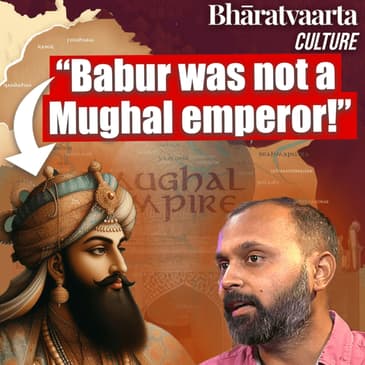
This episode of the Bharatvaarta podcast features a deep dive into the life and complex legacy of Babur, the founder of the Mughal Empire, with Aabhas Maldahiyar. Aabhas shares his transition from aspiring Marxist to a history enthusiast, inspired by his experiences at the Ajanta Caves and a scholarly environment fostered by his historian father. Aabhas explores Babur's unique background, tracing his lineage back to the secular Mongol empire and the Islamic Timurid empire, setting the stage for a nuanced discussion on Babur's early life, motivations, and the distinction of his invasion to Hindustan. The conversation extends to Babur's complex legacy, examining his personal traits, the dark periods of the Timurid era, and the impact of Timurid rule on India, including educational setbacks and conditions fostering British colonization. Through objective historiography and a reevaluation of Babur's contributions and characteristics, Abbas aims to provide a more nuanced understanding of India's past and the deep-seated influences on its historical trajectory, paving the way for forthcoming explorations of Persian influence and the broader context of European colonization.
Topics:
00:00 Introduction
00:25 The Unlikely Journey from Architecture to History Writing
03:22 A Marxist Lens on History and Personal Transformation
09:16 Discovering the Richness of Indian History Through Architecture
16:29 Challenging Historical Narratives and Embracing Rationality
33:54 The Role of Social Media and Literature in Shaping Historical Perspectives
39:38 Fostering a New Generation of Historians and Cultural Researchers
47:19 Exploring the Controversial Legacy of Babur and the Babri Incident
52:11 Unraveling Historical GDP Data and Mughal Misconceptions
57:39 Diving Deep into Babur's Life and Legacy
57:41 Babur's Early Struggles and the Chessboard King
01:04:12 Babur's Invasion of Hindustan: Motivations and Impact
01:09:32 The Complex Legacy of Babur and the Mughal Dynasty
01:27:21 Exploring Babur's Personal Life and Controversies
01:42:34 The Future of Historical Narratives and Sequels
[00:00:00] Namaste and welcome to another episode of the Bharatvaarta podcast. I am Roshan Karyapur.
[00:00:04] My guest today is Abbas Maldiar who is an architect by profession and a historian by choice.
[00:00:12] I speak to Abbas about his foreign history writing, his very interesting background as
[00:00:16] a committed Marxist and how that changed and what it will take for us to write history
[00:00:22] from a Bharatiya perspective. I also talked to him about his latest book,
[00:00:27] Babar the Chessboard King. We speak about how Babar was thrust on the throne at 11 years old
[00:00:33] and his conquest following that of Fargana, Kabul and of course his eventual entry into Hindustan
[00:00:40] then about the legacy and impact of Babar. If you think you know your history well
[00:00:46] this episode is going to shatter a lot of myths and perceptions around Babar.
[00:00:50] This was a fascinating conversation and I hope you like it.
[00:00:54] Welcome to the Bharatvaarta podcast. Thank you so much for making the time.
[00:00:57] Thank you and it's my pleasure to be on your show. I am looking forward to interact and chat
[00:01:02] with you on various things which you quizzed me for. I know we've been discussing this and
[00:01:07] so happy that you can finally make time for this. I feel like you have such an interesting
[00:01:12] background. We were just talking about being an architect and so on and so forth.
[00:01:18] Right. How did history writing happen? How did you discover history writing and what
[00:01:25] does that journey been like? So it's a very interesting journey. At least it's interesting
[00:01:30] for me. I don't know how people relate to it but because like any typical Bihari, I would call
[00:01:38] myself Bihari because that time it was not Jharkhand it was Bihar. So the first dream for
[00:01:45] Bihari is generally to be an IIT in. You get into an IIT or you crack the medicals
[00:01:52] or if nothing works out, please get your civil services. So there was no other way out and
[00:01:59] somehow even if your parents don't tell it, it is embedded in your mind looking at how the
[00:02:04] things transpire around you. So it was a case with me too but fortunately I am born to a
[00:02:12] historian as in my father is a historian and so beard that it was a small town where I was born
[00:02:21] Hazari Bagh in Jharkhand. And small towns have very interesting characters which you
[00:02:27] will not find in larger cities. So one such character is that the students do come for the
[00:02:34] extra classes as in because my father was a professor and but many students would not be able to make it
[00:02:43] to the classes because of other commitments which they have to do. Like small towns have very different
[00:02:48] nature as I already said that people have to do many other things apart from studies even at the
[00:02:52] younger age. So in the evenings they would come to my father to get further extra classes
[00:02:58] around history and my father deals with late medieval and early modern history.
[00:03:05] And he would talk about the British era, he would talk about what it meant to be like Mughal empire,
[00:03:13] what it was to the Indians and he would basically talk about the emperors Akbar,
[00:03:18] Babar not much about Babar and Humayun but certainly about Akbar, Jhangir Shah,
[00:03:24] Aurangzeb etc. and about Marathas and at times in passing he will give the references about the
[00:03:30] Guptas. So basically from childhood I had this thing around me, history was walking, history
[00:03:39] walked in and around with me and it so does happen that if you are inducted to some
[00:03:47] those ideas initially they always carry forward, they do happen with you keep happening. Say that
[00:03:55] somebody is having a background of his father or somebody else in the house belonging to fine art
[00:04:01] and it's quite obvious that fine art will become part and partial of his life even if he's not
[00:04:06] practicing he would like to carry collect the fine artworks curate something for his own house
[00:04:13] that connection is always there. So for me it was history and because it's quite an interesting
[00:04:19] background for me I consider myself to be a Marxist back then of course and now I'm an
[00:04:27] ex-Marxist so and you happen to become a Marxist because you feel that perhaps
[00:04:36] you will bring the revolution, you can bring the change. Yeah and it does happen that if you are
[00:04:46] born in a Hindu family the system is bit too open. It's that it just so fluidic at times there is
[00:04:55] I won't say there's a lack of discipline but perhaps this is nature of the system itself
[00:05:01] even if you do this it's fine, if you don't do this then also it's fine. There's not going to be
[00:05:07] somebody elderly in the house who will pester you all the time hey you didn't do this you must do this
[00:05:12] right there's not something called must do this and like other people who were aspiring for IIT
[00:05:21] dream science was my background and rationality automatically walks in in the mind of a Hindu
[00:05:29] because you know you are led to believe that perhaps all the traditions are superstitious.
[00:05:35] They have nothing good to offer in the society and they are the bunch of liars who tell you the
[00:05:41] lies about the idols and murtis etc and there's nothing out there in the religion except for
[00:05:47] ill practices whether it is about the casteism whether it's about the sattiprata and all those
[00:05:51] what the Marxists give you right that this is the problem of society so that was always there
[00:05:56] in the back of my mind and I was becoming a perfect fodder to be fed somewhere who would just
[00:06:04] you know end up becoming the result of that fodder coming out of somewhere would be that he
[00:06:09] would be a Marxist because the the objective of Marxism the prima facie is that you are supposed
[00:06:18] to be hating your culture and civilization to begin with you are supposed to be rationalist
[00:06:26] and to be rationalist you have to hate your civilization some I'm just telling you that
[00:06:30] how the dictate flows that's how it flows though it's though it's not the reality but these are
[00:06:35] the checklist that you keep on checking the box and you are right there on the way
[00:06:40] and I am already off from the tradition and I have joined an architecture school
[00:06:46] and the moment you get into architecture school this is a place where
[00:06:50] you are supposed to look into more and more for freedom of expression because you're supposed
[00:06:56] to create something which doesn't exist you have to imagine and imagination is all about
[00:07:01] freedom of expression and you are inducted into the ideas of the art movement say modernism
[00:07:09] postmodernism you read postmodernism you get to deconstructivism the ideas of derrida
[00:07:14] and all these guys fall into your line and if you have got interest in literature
[00:07:22] you will fall back to Marxism because this all ideas ultimately germinates from or comes from
[00:07:29] the idea of Marxism or the idea of rejecting or rejecting a tradition idea of seeing that
[00:07:35] what was in the past is wrong and we have to a kind of the or to start something new
[00:07:41] and so Marxism began to look like the vogue to me and then it will bring the change and that's when
[00:07:48] and because anybody who is dealing with any political movement say it Marxism or trying to
[00:07:54] be conservative or anything he or she will be connected with history and of course I had this
[00:07:59] pedigree already of of history because I heard the tales of history and I always saw the books
[00:08:07] of history on the bookshelves of my father so it always was there with me but now more and more
[00:08:13] the academic history began to superimpose over all the ideas what I had so it what I mean to say
[00:08:21] is that I am already believing that my tradition is wrong they were superstition they were
[00:08:28] anti women they were anti people who are low down in the hierarchy or something
[00:08:34] society was a very dark one and further on this layer of academic history was being put over
[00:08:41] whatever I was reading along with the Marxist lens so but there was an awakening and that awakening
[00:08:50] it happened somewhere down the line around 2012 or 13 and when that came in I began to look into
[00:08:57] the Indic traditions even more and the time if I can just stop here and ask you what was
[00:09:03] the trigger for you yeah so I already explained that how I had caught into the idea that Marxism
[00:09:10] can be the only solution and just to clarify to the people when even then I was quite patriotic
[00:09:18] because I felt that I have to follow Marxism because this is good for my country and every
[00:09:24] august 15 and jan 26 I would go out into the field and dig the earth to fix in the post where
[00:09:33] I will do the flag hosting so and a bsf camp was just seven kilometers away from my house
[00:09:40] and the guys would be marching in the morning and I will salute them so this was my childhood
[00:09:45] like and I felt that perhaps Marxism is the ritual I need to follow to bring good for
[00:09:51] the country but coming to the the trigger point I was working as a research assistant at a college
[00:10:02] and I had taken certain number of students to for a study trip and the trip was to Ajanta
[00:10:08] caves and the Elora caves and for the first time I witnessed the grandeur of the Elora caves
[00:10:15] and the moment I walked into it and I saw the Kailashna temple I was like wow because so far
[00:10:21] I had just drawn the sketches of Kailashna temple for 10 petty marks in history of architecture
[00:10:27] but I didn't knew that what this sketch actually looked like what it was like the details were
[00:10:34] mind-blowing it just I just couldn't imagine that what it is about that how can someone do
[00:10:40] the things at such a perfection right but that was still okay that okay you can do the grandeur
[00:10:47] and you can build giant structure with that means of detail something would have been there
[00:10:52] but what really was baffling was what I saw in Ajanta caves because Ajanta caves are
[00:11:00] the place where you have got paintings this is known for the paintings and most of the
[00:11:04] paintings are about jatakar tales and whatever but the paintings are there and the paintings
[00:11:09] are done in utmost elaboration they're very elaborate painting they're not just conceptual
[00:11:14] paintings there are a lot of details and they're inside the caves too and the caves are the places
[00:11:20] which are the dark places right you don't have a source of light so I and again the painting
[00:11:27] inside the caves two are very elaborate so I couldn't figure out how did they do this because
[00:11:33] without the light how can you do so only source of light back then was fire right or the sun rays
[00:11:40] and sun rays can't make it to that because it's a dark place of course it's a cave it was stupid
[00:11:44] to expect that the sunlight is entering and of course when you bring the fire it's again
[00:11:49] the problem because the colors which are used are organic they have been extracted from plants
[00:11:53] etc etc and any organic material when reacts with fire forms carbon right yeah so it
[00:12:01] would have just gone if they would have used fire as a source right for source of light
[00:12:07] so I'm just figuring out the guy couldn't answer me he didn't had satisfactory answer he just couldn't
[00:12:14] but in the evening we all along with the students I too met with professor this Monday who
[00:12:21] was an expert of that reason of architecture and it was a part of itinerary that we were
[00:12:27] supposed to meet professor this Monday but I did ask him this question that how did this work
[00:12:33] because I was still struggling to understand and what had and there was something which was
[00:12:41] real troubling me that this cave was unlike any other cave in general so in these caves you
[00:12:48] enter and then you step down there's a ditch large ditch inside and which normally doesn't happen
[00:12:55] in any other cave architecture normally it's either winter and it would be sloping up inside
[00:13:00] or it will almost flat and so there's it is exception if you see the ditch kind of a thing
[00:13:06] so I asked them as well why there was a ditch and how did they do the paintings
[00:13:10] is that to me that the ditches were there to do the paintings I say what do you mean to say
[00:13:16] then he had got a wooden model kept at his house of cross sectional model cross section is
[00:13:24] basically when you cut a building so that's a section of it cross section the similar thing so
[00:13:29] there was sectional model and where the ditch was already seen and what did he brought it he turned
[00:13:37] off all the light and he poured some water inside the the ditch proportion and then he brought a
[00:13:45] torch and the torch were directed in the direction of that water and suddenly the light reflected
[00:13:54] said that you know this ajanta cave is in form of a U in the plan it faces south at certain times
[00:14:01] sun is at a direction that by putting the water in those ditches those monks used to
[00:14:06] get the sun rays reflected inside and I was like wow because the guys whom I thought to be the
[00:14:12] superstitious one the ill-trades and whatnot were doing such a cool stuff they were like
[00:14:19] the you know they're using the so-called snills of reflection to generate light and do the paintings
[00:14:24] and that was a journey backward or I would say that that was a journey which would have happened
[00:14:31] say two decades back when I was three years old four five years old something like that but
[00:14:37] it did happen I began to read about the Buddhist literature and with Buddhist literature came
[00:14:44] the open inshats and it does happen that when you begin to read about religion
[00:14:48] history automatically walks in because you can't dissociate history and religion
[00:14:53] they all walk together because history is nothing but the tale of the culture of that place and
[00:15:00] religion is nothing but the reflectance of that culture if we try to be very honest about it
[00:15:05] without being politically correct religion is reflectance of the culture and vice versa
[00:15:10] so and so in the history began to came into me so and I began to look read about the
[00:15:20] the miracles in the sciences the advancement etc what we had made whether it was the field of
[00:15:25] mathematics or physics there are many things which we had done in the past
[00:15:29] so this all began to came to me and I was quite astonished that Indian past
[00:15:37] was certainly a very bright one it was certainly a place where because we have got a text which
[00:15:43] even talks about exchanges between the Greek philosophers and Indian philosophers so I'm sure
[00:15:48] that even if we make I will not make a very loud claim that everything emerged out of India
[00:15:54] but certainly I would say that even if it was emerging in Greece India to had its very
[00:16:00] sophisticated system if not advanced certainly on the parallel house how the Greeks were thinking
[00:16:06] or maybe better too but certainly we were not those kind of backward people as we have been
[00:16:11] projected as because the time when we were dealing with the universities of the on the part
[00:16:16] of the Ivy leagues etc the western world was still wearing the leather first and etc to make
[00:16:23] the living right so that's how they lived and their houses were so we were living in a very
[00:16:29] complex very civilized system back then so we were great of a great as a civilization
[00:16:36] and that began my journey into the history and that actually was a trigger point too so the both
[00:16:42] were very much related amazing so as a former soft Marxist myself I kind of relate to everything
[00:16:50] that you mentioned right because I think Marxism is so seductive in the in the sense that
[00:16:57] it offers this fast food answer to all the angst that you have as a teenage person right I mean
[00:17:03] and it's tend to externalize your grievances so to speak and want to tear down everything
[00:17:10] all old conventions and build something new bring in the revolution yeah but so glad that you
[00:17:17] know you could find your way back right we are more fortunate that that happened
[00:17:23] and your lens into history right I mean because you are an architect by you know profession training
[00:17:29] and so on right when you look at history I mean you should have a unique sense of that right I
[00:17:34] mean because you're not someone who is from the field in a conventional sense right I mean in
[00:17:40] the sense that you haven't studied like you know a typical bachelor's masters so on and so forth
[00:17:46] right and there is some you know there is some discussion on who is a historian right what does
[00:17:53] it take to be a historian right can anyone write history and if so I mean how should history be written
[00:17:59] so on and so forth I know that's like three or four questions rolled into one but I'd love to
[00:18:04] understand you know what credentials are necessary to be a historian right and you know
[00:18:12] how do you write history so again people may take an offense in this but
[00:18:19] any person who is quite objective is rational and his has got a scientific temperament
[00:18:26] and scientific temperament is also something which necessarily may not come to the guys
[00:18:30] who have a science background it can happen with anybody but these are the three basic
[00:18:36] characters that you have to be objective you have to be rational and you have to have
[00:18:40] scientific temperament of course you have to have some adore of the love for history as a subject
[00:18:46] to love for the past right so these four factors can drive anybody and they can bring up on the table
[00:18:55] what we call as history but the problem lies with the academic historiography is that like
[00:19:03] I will dive a bit into I will take a detour and I will relate it that how it works like
[00:19:11] architecture education too has gone through a lot of churning as in there was a period when
[00:19:16] there was a thought that whether we need to have physics chemistry mathematics as a main subject
[00:19:20] or not whether we'll just have mathematics and you know guy can be led to qualify
[00:19:25] to appear in the aptitude test of architecture there have been those churnings
[00:19:30] I have also seen I have seen practically seen that I won't take the name of the universities
[00:19:36] but I have seen it happening that people have discussed it over the lunch table in a staff
[00:19:42] meeting etc that let's remove the mathematics as subject because we don't have teachers
[00:19:47] right so the subjects because it happens so because architects in general have hatred for
[00:19:56] mathematics and the science I'm just trying to be as brutal and as honest as possible so
[00:20:02] even during the qualification exam right earlier in my period it used to be a IEEE
[00:20:09] CBC IEEE examination and there were separate B arch and in the separate B arch examination
[00:20:15] you would give the test of the mathematics and the aptitude test and many people who would
[00:20:20] make to the the NITs or any other place will either you know be very reluctant to know more about
[00:20:28] science perhaps they would have come here only because they hated the subject and that hatred
[00:20:34] even further carries forward when you get into the subject right you can see that
[00:20:39] you know there's a battle between the engineer and the architect all the time
[00:20:42] and of course and I do have a lot of respect for the engineers because they
[00:20:47] try to realize your dreams they are the core people and that's where many architects
[00:20:52] fail to relate to it and because architects live in their own bubble ego that we're the creators
[00:20:58] etc etc but it can't happen if engineers are not at your bay it's as simple as that so in the
[00:21:06] field of history too somehow the historiography as people tried to make it it was suited to
[00:21:12] the people who were doing it because there were no gatekeepers who were interested in
[00:21:20] making historiography happen to be an objective subject it was just that certain bunch of people
[00:21:25] say 10 20 or 30 who whatever their number would be they decided that this is the way we are gonna
[00:21:30] approach history and certain facts which have been stated this and they are the theories now
[00:21:35] so what facts get established because theory you have hypothesis you research on it and
[00:21:39] when you establish it becomes theory so like our envision theory it though there was no evidence for
[00:21:46] it but it was read as a theory from a long period and that's a premise that's a premise now you
[00:21:52] base your history on that that does a basic checklist the parameter and now you are gonna
[00:21:57] march ahead with it the basic parameter that Indian society was a casteist society and it
[00:22:02] was so ridiculous one that it oppressed everybody who was weaker right so these are the basic
[00:22:07] parameters based on which you do your historiography but what a rationalist minded to or what a scientific
[00:22:13] temperament to do is that say that okay fine I will nullify all of these things and I will
[00:22:18] try to relook at it from a perspective of someone who is trying to decipher that what
[00:22:26] happened in say 1500 BC maybe he will look at the genetic studies maybe then he will look at
[00:22:32] the archaeological evidences maybe he will look at any other inscription etc whatever would come
[00:22:40] through he will use the method of triangulation triangulation as in all the facts would be super
[00:22:46] imposed collateral and then you will come to a conclusion right they will not go ahead with
[00:22:52] a preconcept notion and this is how this supposed to be but unfortunately academic history
[00:22:58] historiography still happens that way with a set notion that this is how it happened
[00:23:03] like like Ashoka has been declared to have become Buddhist of Kalinga world this is a
[00:23:09] preset notion is still in the academic history though the primary sources denied so you pick any
[00:23:14] academic book you know though this has not been debunked even because this has always been a
[00:23:21] if you look the text of the history book I'm not referring to Pandit Javala Nehru's
[00:23:26] discovery of India let's keep it aside because that's of course there's some very incredible
[00:23:31] things in that too but the way the ancient India has been laid is a very problematic one
[00:23:38] but if we keep that aside any other book of academic interest uh non-academic interest in
[00:23:43] that era which were written purely to talk about Ashoka they're very clear that Ashoka was
[00:23:48] Buddhist even before the Kalinga war right but the moment it gets to the academic
[00:23:54] historiography of India there's a problem you see that Ashoka is becoming Buddhist after the Kalinga
[00:24:00] war so there is no enough triangulation there is no enough idea to inspect into it there is no
[00:24:09] enough conviction to really inspect history as it is you are just trying to produce pamphlet
[00:24:17] based on certain set of ideas which has been given to you so that's the reason why you see
[00:24:23] already refuted material surfacing again again a caravan posting same article every year that
[00:24:31] no Hindus destroyed Nalanda but any common sense or logic will just deny what they're trying to claim
[00:24:39] so in fact me as an architect it's not necessary that I would relate always related
[00:24:46] always with the buildings or urban planning etc but being a trained architect I have learned
[00:24:52] one thing that I don't even agree to a lot of architects because they also tend to choose a
[00:24:57] non-rational path because in as I said in a bubble of making concepts look beautiful and everything
[00:25:03] they do some very ridiculous stuff which will not happen that will exist only till the 3d renders
[00:25:09] and after that the real world is much more different right and so have the historians done
[00:25:15] the same mistake but I do see as an architect that I have to be rational it's okay even if
[00:25:22] say that I believed in something and it goes for a toss that now it's not correct so I will
[00:25:27] choose to reject that and I will accept the fact and any rational training pushes you for that
[00:25:33] so that has been quite easy for me and I won't say that it is a unique angle because this
[00:25:38] is how the angle needs to be towards a subject which is so important because
[00:25:43] you're trying to talk about certain historical figure who is not coming here to defend themselves
[00:25:49] right you're writing about them and then you can make all the bold claims and just because you are
[00:25:54] some PhD from some XYZ university so we are not going to take it under a face value rather we will
[00:26:01] ask the questions we'll ask your methodologies and that is what is happening and so maybe
[00:26:05] that many people would be not very happy me as an architect coming to do the historiography
[00:26:10] but perhaps I feel that I have chosen the path which all the historians should have chosen be rational
[00:26:16] be objective triangulate be it's okay if your preconception notion gets wrong
[00:26:23] yeah no I see that you know obviously there are so huge pushback on some of these presuppositions
[00:26:29] right I mean you know you mentioned the arian invasion theory or you know
[00:26:35] Ashoka's you know conversion to Buddhism was that before or after the Kalinga war and
[00:26:41] plenty of things post that as well right I mean and this has been led by you know the likes of
[00:26:48] Vikram Sampath you know Meenakshi Lekhiji of course has produced amazing work over the last
[00:26:53] 30 years we've had Sanjeev Sanyal on the podcast and plenty of others right I mean I do see that
[00:27:00] there's a pushback and this is from you know not necessarily professional historians like as in
[00:27:08] people who are you know would qualify as conventional historians like someone like
[00:27:14] Mr. Sanyal for example right I mean someone again like much like yourself he's also
[00:27:19] he's an urban planner right related professions not the same is what I understood
[00:27:24] in our conversation before this right right he's again looking at it from an outside in
[00:27:29] perspective but again being very rational about it looking at first so first sources primary sources
[00:27:36] looking at the scientific evidence so on and so forth and trying to make sense of this
[00:27:41] and counter these narratives right and there's been a huge outrage about this right I mean
[00:27:48] it's certainly not been easy because obviously like the vested interests have sort of cried
[00:27:53] foul about you know what this means and so on so anytime this whole rewriting history or something
[00:27:59] comes up right I mean there's a huge fuss and uproar about that right so what do you make of that
[00:28:06] so the problem lies that people are more concerned about what would happen to the papers they wrote
[00:28:13] in the past they're not concerned about what would happen to the soul of those people who have
[00:28:19] gone by the people of the past they're more worried about themselves like I'm sure that because
[00:28:26] we saw worker also believed in our innovation theory he did believe because that was a agreed notion
[00:28:34] back then but had it been alive today he'd have been happy to be said proven wrong and
[00:28:41] would have said that rather than they're not saying that he would have been happy to be
[00:28:45] proven wrong I should say that he had been happy to know that he was wrong he was one such guy who
[00:28:51] was a rationalist and who was ready to evolve himself he was ready to evolve his own community by
[00:28:57] large right so they would have been the happy people but the the certain folks who come from
[00:29:06] certain universities or who have been sitting there safeguarding the chairs of those professional
[00:29:11] historiography or academic historians they seem to be perturbed because
[00:29:18] see as I told earlier that when you begin to work with a certain checklist
[00:29:26] preset parameters that yes okay in 1500 BC Aryan came and initially invaded but later on they
[00:29:34] made it a migration someday it will become tourism etc what not I don't know what but
[00:29:40] they begin with that then comes your caste atrocities because the Aryans have come they
[00:29:46] have brought with them the Vedas and Vedas Purushukta is the source of the caste discrimination and
[00:29:53] many go even further to say that that's a source of racism which exists on the earth right when
[00:30:00] this whole thing of the black likes matter movement was picking up then they were not shy
[00:30:05] off to bring in the Vedas too into the picture they were not because India has nothing to do with
[00:30:11] what the whites are doing with the blacks or vice versa right I'm not trying to play trying to say
[00:30:17] that somebody is wrong or somebody's right but whatever is happening between the black and
[00:30:21] white or whatever has nothing to do with the Indians but they dragged Indians too into it
[00:30:26] and began to blame the Vedas and why this is happening because certain historians are giving
[00:30:32] fodder certain historians are giving all the the fuel which needs to ignite that fire right even if
[00:30:40] now somebody is saying that you know racism wouldn't have existed had Indians not been there or
[00:30:47] had they not practiced the ugly caste system right and so I'm not a caste atrocity denier I do
[00:30:55] believe that certainly something would have happened because if smoke is their fire certainly
[00:31:01] would have been there would be something for sure but it was certainly not the way they want to project
[00:31:06] it because there was a nature of society back then you talk about Egypt you talk about Iran you
[00:31:12] talk about any such place right there had been societal hierarchies where there had been certain
[00:31:20] operation it existed it was a basic human nature and I'm very sorry to tell to the people even
[00:31:25] Buddhism was not alien to it in fact during the Buddhism caste system got it got concretized
[00:31:32] and it's shown by the text and so we will not talk much about it today because this is not the
[00:31:38] subject of the day but surely if people are interested to know about it they can look into
[00:31:46] that what exactly was the caste structure during the Buddhist period too so a sect which you
[00:31:51] like to see as something which is which is a rebel against the caste system or something added
[00:31:57] it was actually talking about it and even more rigidly in fact it blames Brahmins for not
[00:32:05] marrying into their caste they're doing intercast marriages because they are now questioning
[00:32:09] the purity of the blood this is what the Buddhism Buddhism Buddhists are doing so again this
[00:32:15] is coming out from the text and I'm not here to blame Buddhism or the Buddhists for it neither I'm
[00:32:23] going to blame Hindus for anything or something neither I'm going to blame Jains for anything
[00:32:30] the ill practice at all something is there because the society of the Hindus or largely
[00:32:36] being called Hindus because all our Hindus in my eyes or the index system was always ever
[00:32:42] evolving because Sanatan is something which keeps evolving Sanatan doesn't mean that you're
[00:32:48] frozen in the time because time moves you adapt with the time you adapt with the system and
[00:32:54] that's how you evolve like how water flows it just takes the shape of the container in which
[00:32:59] you keep it in it's like a water water body so but they have been perturbed that somehow
[00:33:07] certain people are coming in who have nothing to do with academia nothing happens to me that
[00:33:14] you know what you can creep about me or you can creep about say Vikram Sampath you can
[00:33:19] creep about Sanjeev Sanyal and of course I'm too small in front of all those guys but
[00:33:24] you can creep about all of them but how can you take away other things professionally what
[00:33:31] they're doing because they don't come from their field at all right so it doesn't matter to them
[00:33:36] whatever you do you can't block their roads right they will keep doing what they're doing
[00:33:42] and that's certainly something which is troubling them because the whole case of the plagiarism
[00:33:47] which was put against Vikram Sampath that was so interesting actually because the guys who are
[00:33:52] blaming a plagiarism on Vikram Sampath say who was the lady in action or the trustee so
[00:33:59] the size of her books as in what she writes the biography is equal to the size of the citation
[00:34:05] what Vikram Sampath does so you know the bar has been raised so high now they have I'm sure that
[00:34:13] they have will have to find better ways to counter it because people don't take them seriously anymore
[00:34:17] too even in fun Habibi is coming out and saying that hey okay Mathura Ghashi was destroyed by
[00:34:22] orangia but it's known fact right yeah I mean uh and there's been more work like this right I
[00:34:29] mean every you know year we've seen a couple of books or more maybe two three others right
[00:34:35] challenging these presuppositions and that is so important for us to like counter this
[00:34:39] false narrative that's held sway in modern India right I mean thankfully that is happening
[00:34:45] at a more rapid pace I would say right but sometimes when I look at your you know
[00:34:49] Twitter timeline and so on I mean the kind of vicious trolling that happens right I mean
[00:34:55] it's just very sad to see you know for someone who is you know just trying to put some objective
[00:35:02] stuff out there how do you deal with this kind of stuff because I'm objective so I'm able to deal
[00:35:08] with it because see it's very simple that I do understand that people from all the sides
[00:35:15] carry certain emotions and I do respect it as well and that's why engage at times though
[00:35:20] people have told me not to engage and I'm trying not to engage anymore and
[00:35:23] there have been people like Amish will tell directly Vikram Sampath has told it several
[00:35:29] times no Abhas no no no only columns and books but Abhas being Abhas becomes a naughty boy and goes
[00:35:36] there and but still I'm improving and I'm telling to them as well that yes you though you complain
[00:35:43] but I'm improving I'm certainly improved guy I don't respond to the trolls but on the other
[00:35:50] side I too really respect the emotion because the respect is in this sense that either for
[00:35:59] or against pro or anti it's so beautiful that people are looking to express their emotion
[00:36:06] on something for which world was not Indian were Indian Indians were not ready to discuss even
[00:36:13] about at least a decade back or say two decades back history was the most ignored thing people were
[00:36:20] not at all interested of course we have the statistics with the books like that of Vikram
[00:36:26] Sampath selling 50 thousands and so on and on and more in fact and like how size work is selling
[00:36:32] right so we have seen the books which would have been inconsequential at least two decades
[00:36:39] back not because of the content the content is same same even if the content is similar maybe that
[00:36:45] people wouldn't have looked to engage that much social media has of course made that easier they're
[00:36:52] able to do it but it's good that they are doing I only hope that you know people don't have
[00:36:57] agendas because if you have got agenda then you will not even look to improvise upon yourself
[00:37:03] I was a Marxist but still I was a patriotic person so perhaps that's the reason why
[00:37:08] I could make a comeback and so I have a notion I believe that these guys also have
[00:37:16] they're very positive they want to do good for their country and that's why they want to troll
[00:37:20] anybody whom they feel that is not doing good for country so I don't feel angst I don't feel
[00:37:26] irritated but you feel bad at times that of course you will feel bad if you're being trolled
[00:37:32] and something and especially when you see when you something goes against your belief because
[00:37:37] what they are saying is against my belief in short right and of course I know that I have
[00:37:42] done my homework I have done certain research that's why I'm coming at it but I'm largely hurt not because
[00:37:48] of that but as I said earlier that people really take a lot of time to recover in someone hits
[00:37:53] your belief system or someone a belief system as in whatever you are believing in so they're
[00:37:58] questioning my belief for whatever I am putting across but it needs to go on and on and I'm sure
[00:38:04] that if they do read my work and they open their mind maybe that they will come to align with my views
[00:38:10] yeah no doubt about it but I would say I mean you should perhaps rank order the kind of people
[00:38:17] that you respond to right I mean only pick the ones who are truly worth it because some people are
[00:38:21] just like out there just you know just just trolling for trolling sake right yeah but you know
[00:38:28] it's comes back to that that I became a marxist only because I thought that
[00:38:34] so that insect perhaps had still not gone out of me solution still lives in you yeah it lives and
[00:38:43] perhaps it will die someday but it shouldn't die also this is what I feel that that keeps me going
[00:38:49] on and there are people who tell me that there are other people other side of people who say that
[00:38:53] okay and you know you write and everything but you should respond as well but no but it's my
[00:38:59] realization that for my own peace I should disassociate and this get dispassionate about
[00:39:06] Twitter or X what whatever it is right now because that can suddenly gives us heads likes
[00:39:12] and everything that's fine it you can feel good about that but we are here to
[00:39:18] do something substantial and the substantial thing would happen only through the books because
[00:39:25] Twitter became X tomorrow it may be zero as well I mean to say it may not exist who knows
[00:39:31] right but they are something like we are recording something right now and of course it will put
[00:39:38] across YouTube that's there even if YouTube is not their platform you have got that video
[00:39:43] it can go somewhere so it's not the YouTube what matters the content is what matters and content needs
[00:39:50] to be recorded in some way so if say X is gone where are going to be my content they need to be
[00:39:55] somewhere so then comes in the columns the articles the journals the papers the books
[00:40:01] the books are always going to be the vital thing for me yeah no I think the written word
[00:40:07] will never die right so long as we live I think I can come you know I can comfortably say that
[00:40:13] because obviously it's lindi right I mean it survived from the caves to you know from when paper was
[00:40:18] invented to now right when it's largely digital and so on so what do you think it'll take for
[00:40:25] us to develop a more conducive ecosystem for the likes of you to step in and start writing
[00:40:30] about our history because God knows we need more of this right I mean do you think maybe that you know
[00:40:38] some kind of a revamp of our of the way history is taught in schools do you think more of a focus on
[00:40:45] archaeology for example right I mean looking at things you know more from a scientific
[00:40:50] perspective that will help or do you think that people should make more movies on historical
[00:40:56] characters as you know we've seen in recent years and that will perhaps inspire a new generation or
[00:41:01] you know all of the above or something else so all these need to come into picture right because
[00:41:09] we are a wounded civilization yeah and we actually are the wounded one because of
[00:41:16] course we were the glorious civilization and I still have a belief that we have something
[00:41:23] in our pedigree because India happens to be land of extremities you have got extreme summers you
[00:41:29] have got extreme winters you have got extreme terrains you have got extreme flat plain lands
[00:41:37] so everything is a bit too extreme there you don't have anything where something meets in middle
[00:41:43] it's all extreme so we Indians have always grown looking at those extremities that if
[00:41:50] you look at a guy who's growing up there in the north he sees the most extreme of the winters
[00:41:56] it is most extreme of the summers and then still is there thriving and doing the best what he can
[00:42:02] so come to the north system belt there also the topographies what you see the
[00:42:07] but they have been made they have made the living and so we have been used to it
[00:42:12] so what so I always have had a belief that Indians can always bring more and more on
[00:42:20] table we have that potential and perhaps that's the reason why few people thought that
[00:42:27] India was the mother of civilization maybe for that reason and we are I'm sure gonna bring
[00:42:35] more and more literature into the place we are gonna bring a lot of movies in terms when
[00:42:41] I say movies I also include the video conversations what we have of course the audio versions of
[00:42:48] podcasts are there but this is gonna play a very vital role we are gonna have the discussions
[00:42:54] what people have during your travel that is gonna play a very important role as well
[00:43:00] you meet the people in the public transport if you ever share your thoughts and until
[00:43:05] unless it really becomes problematic one because I'm a guy who stands for absolute foe that is freedom
[00:43:11] of expression and I do visualize the world from that point of view that it's absolute freedom of
[00:43:17] expression you just express whatever you want to and I always give a benefited doubt to
[00:43:24] the thing which is called human being because we all are thriving or trying to be a human
[00:43:30] and while we are trying this I believe that everyone wants to contribute good so if there's a
[00:43:35] rational thought people will go up their ranks their beliefs and whatever is there besides it
[00:43:41] to take the part of the rationality what seems a sane idea they will choose it
[00:43:49] so it is bound to happen but of course the films will keep coming maybe in recent times we have
[00:43:54] seen a lot so people at times get emotional if some fact has been distorted but you know the facts
[00:44:00] can always be fixed there is no such thing that this is the final word you can always fix we make
[00:44:07] the drawings in architecture it's not that revisions cannot be made we make the revisions
[00:44:12] of drawing too though they are so important things which goes on to the side so revisions
[00:44:18] always have a scope but just because you saw an error and you stop making the drawings
[00:44:24] it will not work there can be errors there can be you can question the intent of the filmmaker
[00:44:29] you can question the integrity of the people but things will keep coming and you should we
[00:44:36] should encourage more and more those things to happen like say for example in fact Padma
[00:44:43] Vat was you know there were distortion of facts if I have to put it this way they were distortion
[00:44:49] but what that film did is that triggered a debate people came to know about Padma Vati
[00:44:56] right some ideas started brewing in their mind that what it would have been so people will
[00:45:00] at least flip through the Wikipedia page to start with right so any project even if it's
[00:45:06] showing something in a negative light it opens a scope for the people to look at it people to
[00:45:14] debate about it people to discuss about it and if there is a certain personality if he's a great one
[00:45:21] they will remain great they did not they don't need patronage of the guys like Avaz or you or
[00:45:26] any of us we have two small people in front of their personality so when you bring down
[00:45:31] hold their history in front of the people in objective sense they can choose but if they
[00:45:37] have done something really incredibly great like Shastrapati Shivaji Maharaj how we have a dirt you
[00:45:42] want to bring on them he will remain the Shastrapati Shivaji Maharaj because of the character
[00:45:48] what he owned the aura what he owned it will never change and the environment for this kind
[00:45:55] of writing etc needs to be better up and of course we are moving to do it better like I was
[00:46:01] one of the recipient of the fellowship given by RCS Foundation which was run by Asha Jadeja
[00:46:10] through the Mothwani Foundation so it was done in collaboration with Vikram Sampath.
[00:46:14] Vikram Sampath was a part of it he was a main mentor of the whole project so he chose
[00:46:20] seven of us to be the part of the scholarship as a pilot project and this book
[00:46:26] Babar is also result of that fellowship so we never had such kind of fellowship for writing
[00:46:34] which would be pro India especially or something which we can say that can support the idea of
[00:46:41] the nationalistic thought process. Now recently me and Vikram Sampath have come up with a new
[00:46:46] foundation FISCR Foundation for Indian Historical and Cultural Research where we are looking to
[00:46:55] bring on table the work based on the original manuscripts which are written in Pali Sanskrit
[00:47:00] etc we are looking to go back to the primary sources and produce the text best on that
[00:47:06] and we are going to give the fellowship to the people as well so things are being created
[00:47:12] what earlier it was only if you can creep about our system and society you can write something
[00:47:19] as an atrocity literature then you are going to get the fellowship but the things are changing
[00:47:25] there are a lot of private players like us who are trying to do something good and of course
[00:47:30] I have very less of a contribution to even FISCR the brilliant idea was of Vikram Sampath
[00:47:35] and I am just you know like I always call him as a drone a chatter of the system that he is like
[00:47:41] one that piece where we if we follow his footsteps and I am blessed to be always being guided by him
[00:47:49] and I believe that FISCR is going to bring a lot of change in the system. Awesome awesome yeah
[00:47:57] really looking forward to that yeah and you know since we spoke about all of this stuff I mean
[00:48:02] I would be remiss to mention Shri Rajeev Malhotra Ji as well we have had him on the podcast a couple
[00:48:07] of times as well so yeah do check out that episode also all right so let's get to the book I know
[00:48:14] that you know we have plenty to talk about and you know everything that you mentioned has opened
[00:48:18] up like many more rabbit holes in my head but I'm going to stay clear of that and come back
[00:48:22] to the book first of all congratulations on you know publishing this book and I hope you'll
[00:48:28] publish many more but I'm just curious right so why Babar you know what was the process of
[00:48:36] sort of piecing all of this together I mean my understanding is that everything we know from
[00:48:42] Babar mostly is from the Babarnama which is kind of like a diary kind of a thing right so
[00:48:49] so it'd be interesting like how you kind of put everything together and made it you know relevant
[00:48:55] yeah so the first part of the question that why Babar so see initially also I said that the child
[00:49:05] who's something which always drives you through and when I was four that's when the Babari incidents
[00:49:10] had happened the 6th December 1992 I was four years some months and back then when the smartphones
[00:49:19] had not overtaken the mind the psyche of the people now you can see the kids of four five six
[00:49:25] year old also swiping through the smartphones whatever they would be doing right so back then it was
[00:49:33] just the worst of the uncles the aunts and the people around you and of course grandfather
[00:49:40] grandmother and discussions around which carried forward with you which always
[00:49:48] became became like a shadow it always was there with you so when this Babari incidents happened
[00:49:54] it was talk of the town for us as in Hazari Bhagwalas because Hazari Bag is a very religiously
[00:50:01] sensitive place especially in the time of Ramnami so now recently people would have figured out that
[00:50:08] they something called Hanuman Dhwaj and all of 50 feet 60 feet side when Pran Prathishtha
[00:50:14] happened and people were sporting those kind of dhwaj etc but Hazari Bag is known to be
[00:50:20] have the competitions of the Hanuman Dhwaj during Ramnami's so people will come with 60 feet 40 feet
[00:50:28] very large large Ramnami dhwaj huge and in the processions when the processions will pass
[00:50:36] through certain area and the reason some stone building would happen and that's also the
[00:50:41] period when Charter Nauraatri is happening so Durga Visarjan is also happening during Dashami
[00:50:48] Naumi after that Naumi the Dashami is there so at times the stone building would happen if and on
[00:50:54] Pratima of Durga Mata so something would happen every Ramnami it was a band to come out
[00:50:59] during the Ramnami's for it was considered that if you are from a good family or something
[00:51:05] you will just not walk out because you know you know the miscreants or the trouble makers are
[00:51:10] there so with that involvement when the Babri was always a talk of the town because
[00:51:17] you will understand when people have always been seeing it where Ramnami is such a sensitive matter
[00:51:22] and of course because of the faith and also secondly because of the incidences what happens
[00:51:28] so it it grabbed a lot of attention and for next two years or something the local
[00:51:34] newspapers will keep talking about the Babri uncles will talk about it my grandmother would
[00:51:42] even talk about it what happened and so every time this will be there and of course me being
[00:51:50] already getting prepared to be the Marxist till the time I become seven eight or something
[00:51:55] I saw this incident as a problematic one and I had this that a mosque was demolished
[00:52:01] which was the ugliest thing which has happened in our history
[00:52:05] so Babri to me that period meant Babar and and of course my father gave the story of the Mughal
[00:52:14] emperors Akbar Humayun not to that extent and a TV series used to come back then
[00:52:21] and it was on Akbar Akbar the great or something I don't recall the name of the year
[00:52:26] but I would religiously watch it and this that's even the the introductory song which played
[00:52:34] was very secular one trying to mix Ram and everything so Akbar was entirely secularized
[00:52:40] in that serial and of course when the Marxist phase got into me and of course and NCIT books
[00:52:48] had already done their job I had believed that not before Akbar came into the picture
[00:52:56] Bharat was ever tied into one thread as in the first guy who gave us a kind of Bharat was
[00:53:04] Jhaapana Akbar so but when it so happened that and around five years back or so the
[00:53:13] TV debate got heated up where somewhere India today had actually put a meme where it said that
[00:53:21] during the Mughal period India GDP share was 25% and I was like okay and I cross-checked the source
[00:53:29] source was Angus Madison's so that source gave even more interesting data and then already
[00:53:35] India today has given the source of people on the two sides already in the fighting mode and
[00:53:39] you know this the he did this and many what's up university Gyan is coming from both the sides too
[00:53:46] and but I thought that let me go back to the source with their quoting Angus Madison
[00:53:52] and when I looked at the source I was baffled because in 1580 that source says that our
[00:54:01] GDP share was 25% 24 point something to be precise and in 1000 C or 1080 or 80,000 our GDP share was
[00:54:13] 28.7% in 180 or 1C or 81 our GDP share was 32.7% so 32% 28% 25% and our GDP share according to that
[00:54:28] source got below China drastically for the first time during the reign of Akbar the Great
[00:54:36] so that opened up a thing and I thought that I need to give more studies
[00:54:42] and the more and more I studied the facts which came up kept on baffling me and I was
[00:54:50] of course I was troubled because the image of the secular Mughals was falling apart
[00:54:55] the loose and everything was coming into my eyes because I was told that they came and they became
[00:55:00] one of us so the facts were the numbers were showing me something else and everything else
[00:55:06] was showing me something else so I did give a lot of lectures around because after I began
[00:55:12] to put the tweet I was called to deliver lectures etc that thanks to Mohandas Bhai he said that
[00:55:19] I was PPT banale make a PPT or what are you doing I did make a PPT and after the PPT he said PPT
[00:55:26] Hoga and now why not book and of course because Babri incidence was there in the mind and then
[00:55:32] because we related with Babar and then so so why not start a series of the book
[00:55:38] so when you are starting the series of the book of course the first one is Babar
[00:55:42] and when I looked at the sources the first source of course is the Babar now that's
[00:55:48] a primary text and when I refer to translation I could see that contradiction in the translations too
[00:55:54] some very fundamental contradictions like where it's kafeer in the portion so in a translation
[00:56:01] you will find that it's written as pagans and in bracket infidels so you can't replace kafeer
[00:56:08] by pagans it that means that you have already changed the idea together it's not against
[00:56:15] so in general the Babar now my saying about talking about kafeer which is derogatory term
[00:56:21] but it's being generalized as a pagan and then in bracket it's written infidel so instead of
[00:56:27] in pagan actually it should have been only infidel if you want so such kind of fundamental
[00:56:33] discrepancies which I found that some of the translation is saying something else etc etc
[00:56:38] so that made me think that and of course the Babar now my doesn't give you sense of
[00:56:43] the context because Babar Nama is more of a personal diary to Babar it's not an autobiography
[00:56:50] so a diary is something which Babar has written with utmost sincerity but it's something which
[00:56:55] is only to himself right he's recording everything what he is facing or what he's seeing but at
[00:57:03] the same time say that he's traveling in a reason say in Afghanistan I wanted the people to know
[00:57:09] the context of that reason that say that when he's in reason the juniors so what that tribe juniors
[00:57:15] about what is their past till how long they kept facing the Islamic invaders till how long did they
[00:57:24] resist what were the resistance process what is the past of every at the reasons what Babar
[00:57:29] crossed through and what is what is the context of whole geopolitics at the same time so I
[00:57:36] tried to cover all those things and somehow it was important to bring Babar's objective biography
[00:57:44] collaborating all this context some Indian perspectives to it as well which which I would
[00:57:51] say is the first work of its type so that's how I see this work not only as a unique one
[00:57:58] not to just praise it because I have done it so but I couldn't find any such literature on
[00:58:03] Babar either it's complete glorification of Babar which ideally it shouldn't be because he was not
[00:58:10] that great of a man as his glorified neither he was that much of a villain as he is so for
[00:58:17] Bharat Varshi certainly will remain villain for multiple reasons because the moment he
[00:58:21] enters into Bharat what he did is very disastrous there are many instances
[00:58:27] so that's how the book came into being right let's look at Babar's early life right and certainly I
[00:58:36] mean he doesn't have it easy right his father dies in is an in an accident right and he is thrust
[00:58:43] to take the throne at all of 11 years old and obviously you know given the circumstances
[00:58:50] people around him are plotting to kind of dethrone him and get a more pliable person
[00:58:55] in charge so they can have their way right and this is also the time when the Muslim
[00:59:00] empires are sort of in a decline right the Abbasid then and so on Spain is not Muslim around that
[00:59:06] time right and these are the circumstances in which he ascends the throne per se and you
[00:59:13] call him the chessboard king right because he keeps moving around yeah so you know he leaves
[00:59:18] Farghani goes to Samarkand loses Farghani again comes back again loses Samarkand and then
[00:59:24] you know he is homeless for a period of time yeah and he writes about this specifically in
[00:59:32] his Babar Nama also right and somehow he sets up a kingdom in Kabul and then moves to Hindustan
[00:59:40] right but this early period of Babar right what do you make of that I mean just the
[00:59:46] circumstances in which he was you know he was thrust upon right I mean they say you know
[00:59:52] people are a product of the circumstance as well right how do you characterize that
[00:59:58] so see Babar lost his father at the age of 11 and as I said earlier too that when you read
[01:00:07] about any historical character there's a lot of grays a lot of I mean to say that there are
[01:00:14] a lot of blacks and there's a lot of white and when you mix them it becomes gray right it's
[01:00:18] not all colors basically yeah so when I was reading about it that he has lost his father
[01:00:26] at just 11 year old and he's somewhere far off right he's not in the place when his father dies
[01:00:33] and still he has collected the memories of his father so beautifully the way he explains that
[01:00:39] how he looked like he has used a humor that about how the physique of his father was
[01:00:46] he's trying to and he's writing when his father has died so at times if we just try to relate
[01:00:53] with our current times that if we have lost somebody close by and someday we all meet
[01:00:59] together and we talk all the good about him or her right so Babar was doing exactly the same
[01:01:06] in his personal diary and while he is writing it he is facing all sort of adversaries
[01:01:14] he's not having a good time for sure because apart from having lost his father his uncle is
[01:01:22] conspiring our mother is trying to come back Mahmood is trying to come the two Mahmoods one
[01:01:28] one of them is uncle from a paternal side other from a maternal side
[01:01:33] the one on the mother side with a maternal side becomes a good guy later on who supports him
[01:01:38] a lot but it is in this period who is not who is also trying to capture the Fergana
[01:01:47] and everybody has eyes on it and that's when the one of the most important villain of this whole
[01:01:55] Babar's life Shaibani Khan also comes to the picture and Shaibani is a guy like
[01:02:01] Babar moves to Samarkand Shaibani comes there then Babar gets to know that you know he wants
[01:02:11] to turn away from there gets to know that Andhijan is having a trouble he will go to Andhijan
[01:02:16] Shaibani follows so and it goes on and on even later on Shaibani is looking to come to Kabul as well
[01:02:25] so the journey for Babar was all about trying to save himself for Shaibani to a great extent
[01:02:32] apart from initial rift with his cousins etc cousin uncle and own people so so that's the
[01:02:40] point it's more like a Tamil Tom and Jerry game that you know he's just trying to be somewhere
[01:02:47] and suddenly Shaibani will appear and he will again run off from there and so he is pretty
[01:02:52] scared from Shaibani Khan too and it is quite clearly expressed in Babar Nama so his movement
[01:03:00] from one place to other and not being so powerful as in one who plays the chess will know that a
[01:03:07] king of a chess board is all but powerful it's not at all powerful because he just can't do
[01:03:13] anything you can just move one house here one house there and the most powerful guy is the
[01:03:18] wazir or the Rani right or whatever with the name we may like to call it so many people call it queen
[01:03:26] many call it mantra or the wasir right he's also dependent on all his pawns the bakes etc because
[01:03:33] he's so young he can't do the things at his own and while he's dependent he's been betrayed
[01:03:38] also by many people because everybody is trying to bake their own bread right so he's facing
[01:03:45] the betrayal so while all these things are cooking up finally he gets his first territory
[01:03:52] or because he's homeless he's thrown less as well not only is thrown less is a homeless guy too
[01:03:57] so that's the reason why when he walked into his mama's or the uncle's place in Tashkent
[01:04:03] he's so delighted to walk onto the floors of the palace yeah because he has not seen palace
[01:04:09] since ages he has been living in tents so many times people will see that it's being said in a humor
[01:04:15] that Mughal store tent meh rathay of her you know the ancestor of agmar and all lived in the tent but
[01:04:21] that's true that's not humor babel spent most of his time in the tents because he didn't
[01:04:28] had an iteratory he was just moving from here and they are safeguarding this and staying there
[01:04:32] for a while and trying to beseech another fort so he's outside the fort camping there so
[01:04:39] for that reason he was called the chessport king and many got of an opinion that perhaps this is
[01:04:46] trying to glorify babor but anybody who has played the chess would know that you should be
[01:04:53] everything in a chess but the king right so it was quite an interesting read about babor
[01:05:02] especially his initial phases of life right so now he considers an invasion to hindistan right
[01:05:09] from Kabul because there's a trade route and and so on now at this point we're talking about the
[01:05:16] 15th century or so right we've already had invasions so we've had gori ghasni the the
[01:05:25] dynasty as well and so on the lo these are of course there right how is babor invading hindustan
[01:05:32] different from the previous invasions we faced and how is it kind of similar
[01:05:38] so one thing is very important in whole babor's tenure or in fact apart from tenure
[01:05:47] in fact his initiation to enter into hindustan the motivations so he was always motivated by
[01:05:57] taimur and that he wanted to fulfill the unfinished agenda of taimur
[01:06:03] taimur has got two agendas now it's up to the reader to make out that what that agenda would be
[01:06:10] and i did apply the method triangulation i will explain how to come to that which agenda he
[01:06:15] would have chosen now first agenda was to islamize the whole world because the prophet muhammad
[01:06:24] instructed to do it and this is what yazdi the biographer of taimur is saying that is the primary
[01:06:34] intention of taimur the second agenda was to establish a kingdom in al-hind which taimur
[01:06:41] failed to do babor keeps talking about the unfinished agenda of taimur which he wants to fulfill now it
[01:06:49] keeps it can keep keep readers guessing that whether it was about establishing a kingdom in
[01:06:55] hindustan or it was just about islamization of whole of the world of which india was just a part
[01:07:02] now it is answered by another motivation what babor explains he says that i am the third
[01:07:10] tramunthana invader in hindustan after prophet muhammad who will establish a kingdom so tramunthana
[01:07:18] invader or the tramunthana is basically the reason of the hilly region of afghanistan
[01:07:25] where he's trying to and the two guys whom whom he mentions are ghasni and gori so first is ghasni
[01:07:32] in his eyes second is the gori is the guy and the third is he so ghasni and gori are known for what
[01:07:40] they were the idol breakers so he's kind of following in their footsteps yeah and he declares it that
[01:07:46] first was ghasni and then he sees all these guys as inconsequential the khalji's and the lothis and
[01:07:52] which many times vikram sampat says and then people get annoyed that oh lothi were obsecure
[01:07:57] people as they are calling he they had such a big traitory and all but
[01:08:00] babor doesn't consider them's consequential so bhabar says that first was ghasni second was gori and
[01:08:07] third is me so now what this is gonna do is fulfill his act is necessarily gonna fulfill the agenda of
[01:08:17] taimur and i triangulate and i i'm i'm convinced that he wanted to not only invade hindustan
[01:08:24] or establish a and establish a kingdom but he also wanted to islamize right which becomes very clear
[01:08:32] in the acts which he would do in the days to come and of course the situation of hindustan was
[01:08:41] really much more better and he was really looking for a better kingdom what had happened that
[01:08:47] till 1509 as in till when the shai bani khan died he kept on threatening he was all
[01:08:52] threatening the Kabul so and of course he saw hindustan is on a great land with a lot of
[01:08:59] opportunities in terms of a lot of gold and silver flowing so you have got a lot of money
[01:09:05] you've got a people he has he said that who are great artisans and not only they are great
[01:09:09] artisans they are docile people who will just do what you want them to do and he mentions
[01:09:13] this all in bhabar nama so he sees that to build a great empire what you need you need people
[01:09:19] to build for you you need money resource everything so it's easily available like it's so easy to trade
[01:09:27] in hindustan establish an empire so why won't he come here so that necessarily uh is makes it
[01:09:35] quite unique because uh he is looking to to replicate the same thing what ghasni and gori
[01:09:42] had done but with the added layer of establishing a kingdom so perhaps i don't say that the
[01:09:48] khilji's didn't want it to slimmize but perhaps they didn't had the scale or the intent
[01:09:56] or the conviction to that intent what ghasni and gori had so you can't compare the islamists for
[01:10:02] sure that islamism is islamism at the end of the day but in bhabar's opinion those two guys were
[01:10:10] something kind of tells you what the person's motivations are when you compare his idols
[01:10:17] who he is trying to emulate basically so bhabar defeats ibrahim lodi and he sets up and kind of
[01:10:28] consolidates and now he is technically the first mughal ruler i mean the founder of the mughal
[01:10:38] dynasty but it's very interesting i mean you mentioned he is i mean on his mother's side
[01:10:45] he is actually related to gengis khan right but on his pattern aside he is actually
[01:10:52] related to thaymor right but he originally considers himself as a thaymorid right so i mean
[01:10:59] should we call it a mughal dynasty or yeah a tumult dynasty right it's very interesting that if a
[01:11:04] question is asked to you in examination of civil services even that who founded mughal empire
[01:11:10] then your answer has to be bhabar or else he will get zero marks or maybe negative if there's
[01:11:15] negative for the wrong answers right but so big but the truth be said that there was no empire
[01:11:21] called mughal empire to start with there was a mughalistan which was headed by the gengis khan
[01:11:26] and his people later on right apart and again here we have to clarify i think mughal is basically
[01:11:33] mongol and persian yeah yeah so not many people know that it's a corrupted form like
[01:11:40] turkuparsian language or they later on begin to call it as mughal right and what was the
[01:11:46] religious characteristic of the mongols yeah okay so i will dive a bit back into it at the time
[01:11:52] it will be important for people to know to make a distinction that gengis khan is a is a mongol
[01:12:00] right and changis and taimur both have common ancestor as in tumane khan tumane khan is say
[01:12:10] generation one changis is in generation five and generation ten is taimur so by ethnicity or by
[01:12:21] race they all are mongol mongols but taimur didn't consider himself to be mongol he was more
[01:12:31] aligning himself to the persian culture aligning to the persian culture means that
[01:12:38] so you have to first understand that what a mongol culture was about mongol culture was highly
[01:12:43] secular it so changis khan basically was secular killer so when i say secular killer it means
[01:12:50] that he killed everybody without asking that which religion you belong to and in fact he persecuted a
[01:12:57] lot of muslims because a lot of muslims were their enemies not because they were muslims so he was
[01:13:01] killing them just so happened that enemies were muslims it is proven by a fact that
[01:13:07] he was also given a title of defender religion with a certain set of muslims because he had
[01:13:12] protected them too so it white washes the point of view that he hated the muslims that way and
[01:13:19] he wanted to kill all of them but at the same time there was certain though his state was very secular
[01:13:26] and that anybody can practice any religion what they want to there was no state religion
[01:13:32] but still he had two restrictions on the muslims restriction was a there was been there will
[01:13:39] be no halal slaughter b there will be no sharia he necessarily meant that you can worship or
[01:13:47] pray to anybody you want to but you have to stick to the mongol culture and so mongol culture
[01:13:54] necessary means that you were supposed to follow the law of the mongols sharia nain chalega sharia
[01:14:00] can't work so i don't know whether it's a uniform civil code or whatever maybe like to see it as
[01:14:05] so there was something in which the law of a different culture will not work because
[01:14:13] what islam does is that it inheritates the culture from arabian idea because that necessarily it is
[01:14:21] and just to again clarify to the people that khan is not a muslim surname it's a regional
[01:14:27] surname so if anybody has a title or surname called khan it necessarily has nothing to do
[01:14:34] with islam but it has actually to do with the mongol reason people may not be knowing it
[01:14:40] because it may have run from the family line the khan to khan chala aya but actually it's not a religious
[01:14:47] surname so you have taken a surname of a central asia basically now these guys are secular
[01:14:56] taimur is religiously fanatic he wants to slimmize whole of the world as i explained earlier
[01:15:03] and he has two dreams a dream is to become the caliph or the caliph caliph is basically the person
[01:15:12] who heads the islamic reign and he also wants to become the khan khan is the chiften of the mongols
[01:15:21] he can't become the khan because he's not in the line of the changis other gangis
[01:15:27] and he can't become the caliph because it doesn't come from a particular family which
[01:15:31] becomes a caliph so what he does is that he propagates a mythology that i have been ordained by
[01:15:39] Allah that i am your prophet kind of a person and so and it happened in the middle ages that
[01:15:45] if a royal blood or somebody at higher ups propagates and it happened everywhere it happened
[01:15:49] in india too so that you just fall in the trap of a mythology which has been created
[01:15:55] so he is now seen as somebody as same as the prophet or something like that
[01:16:01] necessarily not exactly equal to prophet but something like that so that part is sorted to
[01:16:05] become someone like caliph second to become as powerful as the khan he marries into the
[01:16:12] house of the gangis khan and after marrying there he puts his puppet there and try begins
[01:16:19] to control those guys and at the same time he takes the title of amir and calls himself gurkhania
[01:16:28] gurkhania means son-in-law in mongol language and the empire what he establishes now what
[01:16:34] amir taimur establishes is called timurid gurkhania empire it's not mongol because
[01:16:40] mongol empire is pretty secular but by then the mongols have also converted to islam that's
[01:16:46] why taimur also is muslim right now so there has been conversion in fact conversion also had a very
[01:16:52] interesting history that it was a battle between the two grandsons of gangis khan so one is helagu khan
[01:17:04] and the second is the barqa khan they cross the source because barqa khan is a recent convert
[01:17:10] to islam he's converted by a sufi he's the first mongol guy to get converted into islam
[01:17:15] and he is quite pissed off to see that helagu khan is had destroyed islamic culture so the fall
[01:17:27] of bagdad has happened the bagdad has been sacked califa has been killed the and he's progressing
[01:17:33] further to misopotamia and all those reasons to further destroy and it's almost certain that the
[01:17:39] islamic reign will come into to end and people are petrified really the muslims are worried
[01:17:44] and that's when the helagu khan the barqa khan comes into picture and he says that how can brother do
[01:17:50] this and he talks to his father jochi jochi khan is the son of genghis and perhaps even to morke
[01:17:58] who is the other the brother who is hitting the golden horde this time of the khan's and
[01:18:04] they said i don't like what helagu khan is doing and then they they go into the battle
[01:18:10] in which helagu khan is defeated and had helagu khan not been defeated the fate of the islamic
[01:18:17] influence would have been much more different it people may not like to listen it but islam was
[01:18:22] using to exist back then and that stopped it would have stopped had this battle would have
[01:18:28] left a different consequence so i'm just giving this background so that people get to understand
[01:18:34] what mongol and the timurid etc means yeah yeah 13th century and this is when when all these things
[01:18:43] have happened now the persecution of christians become a regular phenomenon in the mongol traditions
[01:18:47] which was not the case earlier because helagu khan was a historian christian himself and so they
[01:18:54] practice different kind of religions different people but christians are facing very bad time
[01:18:59] and later on by the period of say and babar established empire which was nothing but timurid
[01:19:07] gurkhani empire 2.0 of course he didn't call it 2.2 but i'm just saying trying for the people's
[01:19:12] convenience i'm telling that this is what he did and he hates mughals mughals are the people
[01:19:18] who are from the lineage of so he says in babarnama that wherever the mughals or the
[01:19:23] mongols come there is unrest there's no peace there are troublemakers and he's abused them like
[01:19:30] anything so so you are calling them him to be the founder of our empire of those whom he abused
[01:19:38] so this doesn't fit right in the bill of the truth right right so how would your character is
[01:19:47] babar as a ruler i mean was there a lot of loot and plunder or you know did he settle down in
[01:19:54] india for good kind of embrace uh indians and indian culture uh so on and so forth
[01:20:02] yeah so what are the common misconceptions with respect to that and what is the truth
[01:20:07] so babar was certainly not one who became indian for sure because he had more ador and love
[01:20:15] for kabul for very obvious reason that i won't say that it was hate for india but it was love for
[01:20:22] kabul rather because kabul gave him the fame which no other place could because he first rises from
[01:20:30] racks to riches only in kabul so people can keep on imagining him as being shown in the film as
[01:20:37] some very wealthy guy and all those things and someone who is very powerful etc but he was
[01:20:42] chessboard king and he rose to the fame and to the glory and his golden period began only coming
[01:20:50] to kabul so that's the reason why he even wanted to be buried in kabul not that he hated india
[01:20:56] though there are certain texts where he has criticizing indian climate so criticizing
[01:21:00] indian climate etc or the people doesn't mean that he hates india in general or something it's
[01:21:06] it will be a bit too strong of a claim to make but he choose to be buried in kabul because he
[01:21:12] had certain thing for kabul and for anybody or any one of us we always have certain place for
[01:21:18] certain people we have certain place for certain places which have been responsible or who have
[01:21:25] been responsible for our rise there are certain things so what's with babar too there's nothing
[01:21:29] wrong in it but he certainly was not someone who became one of us or didn't loot he carried a lot
[01:21:40] of plunders to us bigistan the wealth was distributed to his bakes the wealth was distributed to his
[01:21:48] amiz and he has given all the account in babar nama that how much of gold how much of silver
[01:21:55] what made out of gold and silver have been taken what else he has taken he has given
[01:22:00] detailed account of it so plunder was really made and he was quite clear that you know he is
[01:22:07] made the distinctions that he is not gonna be somebody else but he's gonna be ghasni and gori
[01:22:14] 2.0 right so what ghasni and gori did they just did the persecution of hindus and destroyed our
[01:22:21] temples and took the plunders away as simple as that he did exactly the same thing he was
[01:22:29] following the same model and because we are talking about plunder and because the discussion
[01:22:35] is more about babar but i like to bring the notice of the people that plunder didn't stop there
[01:22:42] and that's the reason why what we spoke initially GDP per capita growth was negative i don't know
[01:22:49] whether spoke about it initially or not so GDP per capita growth of hindustan was negative
[01:22:58] growth rate was negative growth basically 1500 to 1820 it means that if you are boasting at one
[01:23:05] site that our GDP per GDP share was 25 percent and the growth was negative it actually reflects
[01:23:13] so negative of that green map which you always show us that this was the empire which made
[01:23:18] India a great one because the people were becoming poorer right so and it is also evident from the text
[01:23:25] and other incidents which happened back then like to bring to light one of those incidents is about
[01:23:31] the Taj first more to do with the Shah Jahan but it's important that people know about it
[01:23:37] because it broke my heart when i read about the Taj again people might be expecting that i'm
[01:23:42] gonna tell them the tale of thousands of hands being chopped off and all but no that's very
[01:23:47] far from truth we don't have any of Shah Jahan's love for Montaz Mahal yeah so but what it really
[01:23:53] so even my childhood like anybody of us would was that if you go to Delhi there was an obvious
[01:24:00] ritual that you have to go to Agra and have a pic from a Kodak camera of course click one of those
[01:24:07] yeah photographs yeah people many won't know that what kind of cameras used to exist back
[01:24:11] then right we don't had these cameras the type of cameras what we have today and but you have
[01:24:16] to be in front of Taj and that's what you're supposed to but when i began to honor the truth about
[01:24:23] on the whole empire and especially when i reached the section of Shah Jahan it's baffled to know that
[01:24:31] when the Taj was commissioned i will use it i'm commissioned because many people have a
[01:24:35] belief that it was already a structure existing so i have not gone through the primary sources
[01:24:42] i will not make a claim whether it was existing structure or not but it was certainly a structure
[01:24:46] which was commissioned whether it was working over the existing or not but something was commissioned
[01:24:52] as a musulian for Moom Taj so it was for cost of 4.18 silver silver coins so it means around
[01:25:06] 4 crores 18 lakh silver coins were used to commission this structure and this is happening in 1630s
[01:25:16] early 1630s when Surat Malwa and Deccan that in Gujarat and Dakshan Deccan is suffering from
[01:25:24] worst of the famine and around 7.4 million people have succumbed to death because of it
[01:25:31] and that famine interestingly was created by our lover boy Shah Jahan
[01:25:38] he did it and it becomes more problematic because what has happened that the the governors who are
[01:25:48] operating from these reasons have revolted against Shah Jahan and he doesn't likes it
[01:25:54] but these are the reasons which gives the maximum revenue to Shah Jahan Malwa for example is the most
[01:26:00] fertile belt and it gave him revenue of around 53 percent so i thought that how can i let it go
[01:26:07] if it doesn't belong to me it can't do you the people who have betrayed me and they have
[01:26:14] the rebels have joined hands with Adil Shahis who are enemies of Shah Jahan or the Mughal
[01:26:21] or Timurid Empire to be precise because there was no empire called Mughal Empire
[01:26:26] and so Shah Jahan sends his army which goes and ravishes the crops destroys the crops
[01:26:35] when the horses passed over the earth of the soil which is fertile it got barren for a certain
[01:26:40] period because when the horses run on it it is not fit to grow the crops again rain didn't
[01:26:46] happen and coupled with the lack of rain and the destruction of the crops we got a famine
[01:26:52] which led to a death of around 7.4 million people or around 75 lakh people and just to put in
[01:27:01] perspective the Marxist blim Churchill for the famine which he created in 1943 in Bengal
[01:27:10] which led to a death of around 3.4 3.5 million people around 4 million here the death toll is
[01:27:17] almost twice that number population certainly was proportionately very less compared to what we had
[01:27:24] in 1943 yet the Marxists like to see Churchill as the villain but they don't want to see Shah
[01:27:32] as a villain or a genocide maker right he also created a genocide by that and the and the
[01:27:40] feminist eyewitness accounts are so troubling because Peter Mundi who was eyewitness he says that
[01:27:47] the people are eating from the excreta of the dead so more and more what he has written it's
[01:27:54] troubling when you read about it so that's the legacy what Babar had left
[01:28:01] so it began somewhere and it didn't end in the right direction we can we know that what Orang
[01:28:06] Jeb did it was the worst of all but it's not that the great guy Shah Jahan the great
[01:28:12] architect was doing something beautiful right how was Babar as a person you know we've talked
[01:28:18] about him as a ruler you know certainly grew up in difficult times right he seems to have been a
[01:28:26] good poet as well right but what are some nuances about his individual character or his family life
[01:28:36] and him as a person some some new things that you discovered along the way there were a lot
[01:28:41] actually because Babar in general was a great poet for sure I will I will be an admirer of
[01:28:47] Babar for his poetry for sure and but again that certainly can't wash away what he did in Hindustan
[01:28:56] whatever like taking the title of Ghazi and after having killed so many Hindus and being proud of
[01:29:05] it creating the skull towers etc so anything is not gonna take away from what I did but
[01:29:14] having said that yes he was marvelous as a poet he was a family man too because he
[01:29:23] had this you know the more and more you read Babar Nama you see that this guy is trying to
[01:29:29] remember his father almost all the time you see that he's so connected to his grandmothers as
[01:29:34] in one from the maternal another from the paternal side he is really worried about his wife's too
[01:29:40] he's worried about his cousins that how they are you know if he's finding them
[01:29:48] wrong company he's trying to ensure that they come to the right company and
[01:29:53] they become good people this is what Babar wants so you always see him being very caring for his
[01:29:59] family very caring for his people and even the plunders what he did in Hindustan like
[01:30:05] carrying away the gold and everything which was a disastrous which the villainous act but again
[01:30:13] while he's doing this funnily he's saying that how much he has given to his this cousin and
[01:30:18] all those people so he always had his own his people in good books he always had it
[01:30:24] and at the same time the certain traits of him like which
[01:30:28] a lot of people want to idealize Babar but this is troubling facts like Babar in my opinion was
[01:30:35] bisexual Babar was alcoholic in nature in the later part of his life so there's a very interesting
[01:30:44] story of Babri so Babri is a young lad of around 12 years old and he has found him he as in Babar
[01:30:54] has found him during his first marriage to Aisha Aisha Begum so when he's married to Aisha Begum
[01:31:02] he states in Babar Nama that he is very unattractive to his first wife and he doesn't want to spend
[01:31:09] time with her in fact he never walks into her room or the place where she lives in but while
[01:31:14] he's talking about this unattractiveness towards his wife he's talking about passion compassion
[01:31:19] and love for a lad called Babri whom he has found in Camp Bazaar and he's saying that I'm
[01:31:25] maddened in the love with this guy called Babri he's writing beautiful poems for Babri so many
[01:31:32] people will not be able would be saying that how can you call him to be a bisexual or homosexual
[01:31:40] or whatever but it so happens that while he is making a comparison that he's unattractive
[01:31:47] to his wife and he's talking about Babri and he's saying that I'm maddened in the love with this lad
[01:31:52] so you can't make out anything but you have to accept that he was bisexual so this is something
[01:32:00] then again his alcoholic trait so people who want to idealize Babar they're names like Babar which
[01:32:08] are being taken by a lot of people in Pakistan and so yeah and it's you know one famous cricketer
[01:32:16] at least yeah now the question arises that you generally idealize the people whom you see some
[01:32:24] good trait in right people can take the names like Moor and whatever so of course there the name
[01:32:32] has got certain meaning we do understand but will you ever imagine someone you know even if he's a
[01:32:41] German or say a Christian for that sake taking a name Hitler in the time of now naming his son
[01:32:48] as a Hitler of course I don't know whether Hitler has got some meaning or not because many English
[01:32:53] names are meaningless I know it they're just the sounds right but despite that is it really
[01:33:01] possible for anyone to idealize who perhaps will not fall at all in your ideal so what you are looking
[01:33:08] upon Babar at for because he was bisexual I don't I know that you're not going to support it
[01:33:15] the at least the people who are trying to idealize him he was alcoholic I don't know then third trait
[01:33:22] he is hate for the people who worship the idols the Hindus so are you choosing him just because
[01:33:31] he slaughtered the Hindus how you gonna choose him just because he took the title of Ghazi
[01:33:38] are you gonna idealize him just because he said that I am third in the line after Ghazni
[01:33:43] and Gori because in Pakistan we know that the missiles are also names of the Ghazni and
[01:33:48] Gori right so we understand that point so can you really make us clear that what your idea trying to
[01:33:55] idealize Babar for because certainly doesn't stand to the idealistic principles of Islam
[01:34:02] and if you're seeing him as a revert figure in Islam and you don't have any abuses for him but
[01:34:08] you have all the good words then of course it then reflects upon that are you choosing to
[01:34:14] say that you have got certain hatred for the Hindus so I'm just making it quite open and I'm just
[01:34:21] posing a question to them that for what do you idealize a guy like Babar
[01:34:25] what do you have in the book from him at best he is complicated at worst he is you know all of
[01:34:33] those base things that you mentioned right of him certainly you know I mean those who are
[01:34:42] idealize him or want to emulate him should certainly question the traits that they want to
[01:34:46] kind of emulate for sure right and what their motivations are certainly so Babar dies at 47
[01:34:54] right is that kind of the norm around the time I mean in terms of average age lifespan and so on
[01:35:00] or I mean he's still a little young for yeah he's still young because his father did write
[01:35:06] quite early but there were certain people who were around him who died at very late age say 80s and
[01:35:14] the things like that so Babar died quite at an early age and because we have seen about a few of
[01:35:23] the Sufis homies speaks about they died late in the age but again it was more like a very
[01:35:31] I would say that it was very it's a I would have a mixed opinion about it because I can't be very
[01:35:37] sure but there were a lot of cases and incidences which I came to know from Babar Nama where people
[01:35:41] died at early age and there were many who lived very long right there is this story right and
[01:35:46] again you can kind of separate whether what what is myth and what is reality there is a story
[01:35:52] that Humayun falls ill right and Babar prays that you know let him live right and then he recovers
[01:36:00] and then Babar falls ill after that and shortly after that he dies right I mean is that real
[01:36:07] so that's the narrative which we have and I'm gonna reveal it in my sequel
[01:36:14] so there is a lot more to it and in fact there are many other subjects
[01:36:18] in which I will deal with and certainly the truth which will come is is going to be far from what we
[01:36:25] know as a popular narrative. So finally when we look at Babar right what is his significance because
[01:36:33] you know we're talking about the Babri Masjid today right obviously he spawns the Timurid
[01:36:42] dynasty right afterwards right Humayun and everyone down to the Zafar and whoever right
[01:36:50] a good 400 year sort of or maybe 250 years 150 around 150 years of rule right yeah so when you
[01:37:02] consider all of those things right what is Babar's legacy. So his legacy is certainly a tainted one
[01:37:09] to start with I won't consider his legacy to be a glorified one which many people try to make out of
[01:37:15] it but more or less how did it impact India. Hey there's a very big impact I would say that had
[01:37:23] the Timurids not come into Hindustan perhaps our education system would have been much more
[01:37:29] better we wouldn't have fallen to those dark ages because the whole era of the Timurids was
[01:37:36] a dark period where we didn't build a lot of universities what lot of we didn't build any
[01:37:42] universities we didn't invest in the research and technologies so like I would say Bharat as a pioneer
[01:37:50] of the science and technology at least in terms of the ideas if not the applications but
[01:37:56] what really went wrong that when in the period of enlightenment and all of course
[01:38:02] enlightenment or something which is non-religious they were religious angle to it too but still
[01:38:07] the scientific discoveries were happening outside India but what happened that suddenly
[01:38:13] India's had a full stop to it we didn't have much of the work happening if they were sure
[01:38:19] the patterns of rationality if they were patterns of secularism and if they're
[01:38:24] patterns of what you say the most rational thoughts they would have invested in universities
[01:38:32] rather than investing on their own luxuries and etc yeah so Babar's legacy is all about
[01:38:41] the dark from bringing the dark phases to India and certainly that is something which pushed
[01:38:48] us so backward and in fact they are the people who are responsible for the entry of British
[01:38:53] too because Thomas Rowe got to get inside Bharat only the time of a Temurid ruler
[01:38:58] he gave him the permission and that's how the things begin in Surat right so finally
[01:39:05] what do you hope to achieve from this book so intent is to really make a case study
[01:39:14] it be use a case study that's how to do an objective biography because I have put all
[01:39:20] my efforts to be as objective as possible while writing about Babar so he's a character whom I will
[01:39:26] never be able to look at as hero or somebody and it's a very antithesis isn't it that most of the
[01:39:32] time you write the biography of the people whom you see as hero most of the times and of course
[01:39:38] Vikram Sampath is doing Tipu Sultan in the days to come he also doesn't see him as hero but
[01:39:45] it's very important to talk about the people who have been enemies of Bharat
[01:39:52] what they were who they were like and what really transpired in the mind and in the actions
[01:39:58] on what transpired as an action in around them that led to what they did is very important to
[01:40:03] know because the case studies of your enemies or who happened to be the people who destroyed
[01:40:11] your culture and tradition is at most important because we are at a junction of a time where
[01:40:18] the times are quite volatile we see that something keeps on erupting every day
[01:40:23] like the organizations calling upon Gajwai Hind in Bharat in a certain period but they have set a
[01:40:29] timeframe too right that by this period we will be able to achieve the Gajwai Hind so when
[01:40:35] all these ideas are cooking around us it's important that we go back into the roots right because even
[01:40:43] when the Lavi was crying that the empire of the Mughals have ended with the Aurang Jai
[01:40:51] and the Jats and the Rajputs and the Marathas have become the powerful and they're the notorious
[01:40:55] one who are further crushing Islam so he was also referring to the empire of the Mughals
[01:41:02] so they have always been certain force which brought on the Islamization of Bharat to the
[01:41:08] largest of the extent they did and so it becomes of utmost importance to know about their legacy
[01:41:17] it's becomes of utmost importance to know about their foundational years so that way this book is
[01:41:22] not only gonna set a way how to look at objective biography even of your enemies I do see him as
[01:41:28] enemies of India but at the same time it also gives you enough data and information that what
[01:41:37] exactly was happening that in the era of the disinformation because most of the times you will
[01:41:43] circulate it with a lot of disinformation to the whatsapp and other social media mediums
[01:41:51] but you need to have something very handy at your base which is based on the primary sources
[01:41:57] not everybody would be able to come through the primary sources it does happen say that
[01:42:01] when you want to pick the books on roman empire you have a series of the books
[01:42:05] that you know that where you're gonna go when it comes to the Mughals or Jajunath Sarkar did
[01:42:11] amazing job with Aurang Jai but do we have a collection of our books one two three four
[01:42:16] all stacked together like how we have Lord of the Rings or Game of Thrones that this is
[01:42:20] the book to go for so what I'm trying to achieve is that set a series of the books in
[01:42:25] that line which can be a go-to literature to know about them very objectively of course the evils
[01:42:32] what they have done will not be overseen I will certainly go into the minutries of the details
[01:42:38] of that but I will also put other parts of the the empires as well so that people can look at it
[01:42:44] very objectively a 360 degree view but they know the truth as it is right fantastic I mean that's
[01:42:51] that's an amazing amazing endeavor and I really hope that you're able to achieve all of that
[01:42:57] you have this quote upfront in the book that a generation that ignores its history is doomed
[01:43:02] to repeat it something to that effect right and you know sometimes when I think about it so many
[01:43:08] of our hopes and fears insecurities aspirations all of these I mean they're such old emotions
[01:43:14] right I mean the ideas itself that we are seeing today you can find a precedence to it maybe
[01:43:20] 500 600 years back you know back to a totally different time completely unrecognizable right
[01:43:28] you mentioned a sequel right you mentioned a series of books so what can we expect from
[01:43:34] our boss in the next you know your couple of years time so we are targeting to bring
[01:43:39] the sequel of the book next year okay so I'm getting bit too ambitious of targeting it
[01:43:44] to hit the stores in January or 22 22 January 2025 the sequel comes with that that's the target is
[01:43:53] but let's see how publishers plan to bring it on and the sequel will certainly cater to a lot of
[01:43:59] things including some ideas about the case studies on how the persian islamization happened
[01:44:06] at how persia got dislimized what was geo politics when the time when babbar is looking to enter
[01:44:12] into hindustan like the european colonization has also begun so a view of the world around when so
[01:44:21] so that i want to build a case that what babbar did was nothing but also a form of a colonization
[01:44:27] so it was a timurid colonization in my eyes and at the same time i would certainly be diving
[01:44:33] deep into the rest of the life of babbar and humayu humayu will also be covered along with this
[01:44:39] with a elaborate nuanced way to look at what exactly had happened with ram mandir at iodha
[01:44:46] and so yeah so these are the things which is gonna be which are gonna be covered in the sequel
[01:44:52] and then so on and on it will go on with akbar jhangi's shajahan and the guy called orang jave
[01:45:00] of course awesome and i'm sure there's going to be plenty of new details that will be revealed
[01:45:07] right so thank you so much again abbas for this this has been a splendid conversation i mean i can
[01:45:13] continue but i'm sure that you know we have a schedule so hopefully we'll have you back on the
[01:45:20] podcast to talk about plenty of these things again phenomenal stuff thank you for your contribution
[01:45:25] to our history and for reviving a sense of you know patriotism and ethos of dharma in the
[01:45:33] country my pleasure it was really pleasure being on your show thank you so much all right folks thank
[01:45:40] you so much for joining us on this podcast do share this content widely with your friends and family
[01:45:46] and i'll see you on another episode