
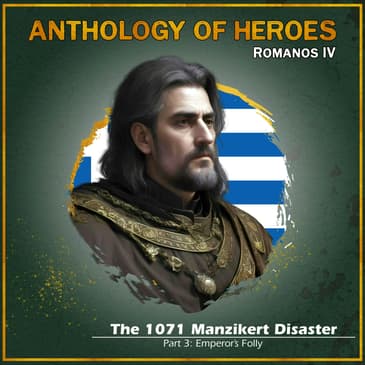
“The most decisive disaster in Byzantine history” - Steven Runciman
In the epic conclusion to our series, we delve into the monumental Battle of Manzikert in 1071.
Through the perspectives of Alp Arslan and Emperor Romanos IV Diogenes, we explore the motivations and strategies of these two pivotal leaders leading up to this climactic confrontation. Drawing from primary and secondary sources, we provide a detailed, blow-by-blow account of the battle, capturing the intensity and drama of the conflict.
Following the battle, we discuss its far-reaching consequences, marking the beginning of the Byzantine Empire's decline and its impact on world history.
What if The Byzantines won at Manzikert?
The Turks may have never settled Anatolia and the Greek Orthodox population may've maintained majority.
Join us as we unravel the events and aftermath of the Battle of Manzikert, a turning point that changed the course of history forever.
CHAPTERS:
00:00:00-Recap of series
00:02:29-Romanos IV marches east
00:06:22-Alp Arslan caught off-guard
00:14:06-Peace negotiations fail
00:18:35-Battle begins
00:24:09-Romanos IV betrayed
00:29:29-Romanos IV returns to Constantinople
00:33:52-Death of Romanos IV
00:37:00-Aftereffects of the battle
00:40:14-Epilogue (rise of Alexios I)
Learn more about your ad choices. Visit megaphone.fm/adchoices
Learn more about your ad choices. Visit megaphone.fm/adchoices
[00:00:00] Hey everyone, what's going on? Welcome back to Anthology of Heroes where we share inspiring stories of figures and events that change world history. This is the final episode of a three-part series telling the lead up to the 1071 Battle of Manzikert.
[00:00:15] This battle is a big deal. The fallout from it was immense, beginning the Eastern Roman Empire's decline and transforming Anatolia's ethnic makeup from Orthodox Greeks to Sunni Turks. In our first episode we covered the spiralling state of affairs in Eastern Rome, also known as Byzantium. Weak,
[00:00:34] cowardly emperors, bloated civil servants and a heavy reliance on foreign mercenaries. In the second episode we covered the rise of the Seljuks. Under Alparslan's uncle Turgrul we saw the band of unruly steppe archers transformed into something like an empire. In this episode we cover the battle itself.
[00:00:52] Emperor Romanus IV is just about to march out for the biggest Eastern campaign the Empire has seen for decades. With him is everything the weak in Roman state could muster. Men from all over the Empire, siege weapons, gold.
[00:01:06] Romanus had bet everything on a win and it was time to go big or go home. Alparslan, the Seljuk leader, is about to be caught completely off guard. Accustomed to weak Roman emperors, he didn't anticipate facing such a large force in response to his raids.
[00:01:23] And so here we are now at the Nexus, the big battle both sides knew was coming. If you haven't already I'd recommend listening to episode 1 and 2 so you've got the backstory.
[00:01:32] But if you're just here for the battle and you don't really care about that stuff then crank the volume knob and settle in. Let's get going. The 1071 Man's Kurt disaster part 3, Emperor's Folly.
[00:01:47] Right, so we have tracked through a lot of history here. So let's just recap on our main characters. We've got the current Emperor of the Romans or Byzantines, Romanus IV. We've got the Sultan of the Seljuks, Alparslan.
[00:01:58] We've got the Dukids or the Dukas family, the current ruling dynasty that Romanus married into. And we have the Comnemnoi, another very influential dynasty that Romanus was trying to tie himself to.
[00:02:10] We also have Andronicus Dukas, an army captain with a strong dislike of Romanus and how he muscled his way onto the throne. Robert Crispin, a Norman adventurer who had already once raised the flag of rebellion against Romanus and was currently imprisoned by him. Got it? Cool. Let's go.
[00:02:29] Preparations began for a huge expedition to the eastern borderlands of the Empire, the likes of which hadn't been seen in decades. A good old Roman show of force. From Constantinople marched everything Emperor Romanus IV could assemble.
[00:02:44] Small groups of Varangians and a handful of household guards made up the cream of the crop. Next came his group of Petchnecks, half wild horse archers whose trustworthiness extended only as far as they could be seen.
[00:02:57] Trailing behind them were their nomadic cousins, the Ogwuz, Turkmen nomads from the Black Sea, testing their bows and muttering to each other in their foreign tongue. Then came the Norman knights, both horse and man covered in flowing coats of chainmail, exuding an aura of martial prowess.
[00:03:14] Behind them marched the Germans, stout and disciplined soldiers known for their strict military training and adherence to orders. Following closely were Bulgarians, Armenians and Anatolians, each with their own loyalties and motivations making for a diverse and uncertain force.
[00:03:31] Each man was burdened with two months of supplies, a necessity given the ravages that Anatolia had been subjected to. In total about 40,000 men comprised this ragtag mixed bag of an army. Gold was the only thing keeping them united. A contemporary said of this army, quote,
[00:03:50] They were in a miserable condition and unprepared. That had been driven to the absolute depths of misery and appeared cowardly, feeble and absolutely useless for anything brave.
[00:04:01] Their very standard silently proclaimed this, for they looked filthy as if exposed to smoke and those who marched under them were few and pitiful. Despite their miserable conditions, Romanus had spared no expense to assemble this diverse group of men. This was everything Rome had.
[00:04:20] So short on cash was he that many imperial salaries had to be paid in silk rather than gold. He'd even relinquished the last Byzantine hold in Italy to bolster his forces. Under extreme pressure for a decisive victory, Romanus knew that returning with anything less could spell his demise.
[00:04:38] Court rivals would have his assassination arranged before he even made it back to the gates. Accompanying him were many mighty siege engines ready for cities that refused to surrender. Romanus knew that he'd probably never assemble an army this big again and had to be prepared for every situation.
[00:04:55] At the head of the army alongside the emperor trotted a throng of tacticians, secretaries and generals. Among them were four notable figures. Nicephorus Bryanius, a veteran soldier and renowned tactician. Theodore Alialtis, an esteemed Roman general and old friend of the emperor.
[00:05:12] The Norman Robert Crispin who Romanus had released on the condition that he accompanied him on campaign. And finally Andronicus Ducus, a princeling of the Ducus clan who Romanus had elevated to the trusted rank of rearguard commander.
[00:05:28] When word reached our pass line of the colossal army heading right for him, the sultan was campaigning in Syria, wearing down Byzantine border forts and stomping down disloyal emirs.
[00:05:39] Spies and envoys soon arrived to the emperor and reported an erratic and panicked Seljuk chief well in over his head. The sultan was trembling with fear, they said. His army in disarray and is focused consumed by events unfolding back in Syria.
[00:05:53] The image presented to Romanus was that of a confused and scared Turkic chieftain now facing more heat than he'd ever imagined. And these initial reports along with subsequent ones planted the seeds of a dangerous overconfidence within Romanus.
[00:06:08] Looking back on the endless lines of his army marching behind him, he started to believe himself invulnerable. A fatal mistake that would ultimately lead to his downfall.
[00:06:20] Guys, this is where I would usually cut to an ad, but instead I wanted to share with you a really fantastic podcast I've been listening to. It's called Cost of Glory and it's hosted by Alex Petkes, a former professor of ancient philosophy and history,
[00:06:34] who now uses his talents to bring to life some of the most interesting stories from the ancient world. Cost of Glory covers the rise of Sulla, Rome's first real dictator, and the reign of Pyrrhus, one of Rome's most enduring foes.
[00:06:46] But my favorite was the episode on Pompey Magnus, the late, great unsung hero of the Roman Republic. Just like I do, Alex utilizes all the sources he can find to bring figures like Pompey to life. It's a great show and well worth listening.
[00:06:59] So after the credits roll for this episode, I'm going to include a five minute extract so you can see if you like it. If you do check out all other Cost of Glory episodes on wherever you get your podcasts. I'll also drop a link in the episode description.
[00:07:12] But for now, back to the Seljuks. Alp Arslan had some big decisions to make and he had to make them quick. When he had ignored the emperor's demands to control his Turkmen, he never believed that the Romans would make good on their threat.
[00:07:29] Truth be told, he didn't think the empire had it in them, but there could be no doubt. His scouts reported an enormous army with many siege weapons steadily marching east. Led by the Roman emperor himself, there could be no doubt that this was a serious invasion force.
[00:07:44] Everything Alp Arslan and Tokrul had built could be lost in the blink of an eye. It was going to be tough, but the Sultan had to return to the heartland and regroup before he could confront the emperor in battle.
[00:07:56] Dismissing the majority of his army, Alp Arslan and 4,000 of his best warriors raced east. There wasn't much time. Spring was already upon them, and as they neared the banks of the fast flowing Euphrates River, it was swollen with thawed snow.
[00:08:11] Spurring his horses into the frigid stream, the Sultan urged his men forward. Over the course of his life he had faced insurmountable odds, but he knew this next month would be his greatest challenge. Emerging from the other side of the river,
[00:08:23] the animals shook themselves dry as they climbed into the uplands. The roaring River Tigris now lay before them. The Sultan would have chosen any route instead of this one, but there were no other options. If Romanus's siege weapons reached his realm, it was all over.
[00:08:38] Spurring his horse into the rapids, perhaps the Sultan muttered a prayer to the Almighty as he clung desperately to the beast, ignoring the screams of pack animals and men behind him who were washed away in the current.
[00:08:49] Wasting no time, the sodden horse archers climbed further into the narrow passes. It was a short cut home, but a dangerous one. The mountain passes were home to innumerable Kurdish tribesmen known to be incredibly territorial,
[00:09:02] but through luck and charisma, the Sultan managed to befriend many of these men, promising extensive riches for victory. Many Kurds joined the Sultan for the upcoming battle. While the Sultan raced through the mountain pass, his trusty governor, Nizam al-Mulk, mustered men from every corner of his realm.
[00:09:20] According to Islamic legend, when Nizam al-Mulk inspected the troops, he noticed a little hip squeak of a man who'd answered the call for jihad. Short, scrawny and without proper armour, this guy was more suited to cleaning stables and fighting. Al-Mulk's advisors laughed, saying,
[00:09:35] get rid of him, he's so puny, he'll do more harm than good. But al-Mulk joked, quote, what can be expected of him? Will he then bring captive to us, the Roman Emperor? The man was allowed to stay, and al-Mulk's words would turn out to be prophetic.
[00:09:52] Ragged but alive, al-Paslan, his household guard and a handful of Kurdish warriors arrived back at the Fertile Crescent to inspect his freshly mustered army. The final count was around 30,000 men, including 15,000 elite horse archers. Nizam al-Mulk is truly the unsung hero of this story.
[00:10:11] Al-Paslan didn't know if it would be enough, but time was up. The Sultan declared himself a Ghazi, a warrior of God whose upcoming battle was fought for Allah rather than himself. As prayers for the Sultan rang out across the Abbasid Caliphate,
[00:10:25] the Emperor's mood had soured during the long trek east. The challenges of leading a multi-ethnic army had surfaced on several occasions. His German mercenaries were accused of stealing supplies from local Greeks, so the Emperor stripped them of their position of honour beside him.
[00:10:41] Later, as they reached an Armenian colony, Greek settlers informed the Emperor that these particular Armenians had sided with the Seljuks during a recent raid. A fight broke out and Romanus stormed through the Armenian colony, trashing the village. According to an eyewitness, he raged, quote,
[00:10:57] When I finish battling against these Persians, I shall do away with the Armenian faith. Not a nice thing to hear as an Armenian serving in his army. Withdrawn and sullen, the Emperor sent several generals and their armies back to Constantinople, fearing he couldn't trust them.
[00:11:13] The only good news for the Emperor came from his scouts, who reported that Al-Paslan had fled back to Iran and left only a token force behind. As the Romans neared Lake Van, far west modern Turkey, Romanus got to work splitting his army up.
[00:11:27] There was a lot to do in one campaign, and seeing that Manzikert itself was lightly defended, he sent the majority of his forces under Robert Crispin to besiege the key fortress of Ahlat, while he brought Manzikert to heel.
[00:11:40] Once they saw the Emperor's catapults lining up at the city, the Seljuk governor of Manzikert surrendered the city without a fight. Before the garrison had even been disarmed, the Emperor surveyed the city, much to the alarm of his counsellors,
[00:11:52] who pointed out that he was defenceless if an enemy soldier rushed in with a knife. But Romanus felt better than he had in years. This strategic fortress had fallen even faster than he predicted. Soon all of Anatolia and Armenia would be pacified again. According to Islamic sources,
[00:12:08] the Emperor even began nominating governors for the regions he hadn't yet conquered. Letters of congratulations and offers of alliance came in from the Fatimid Caliphate, who were desperate for friends in their war against Al-Paslan. But word soon reached the Emperor of Seljuk troops spotted in the area.
[00:12:25] Still believing that the Sultan had fled to Iran, Romanus assumed this was the rearguard his scouts had warned him about. The idea that the Sultan had retreated, mustered a new army and doubled back in such a short time never struck Romanus.
[00:12:40] Now cut off from the majority of his army, the Emperor didn't realise that his divided forces were now facing the full Seljuk army. The Emperor sent forward his tactician, Briennius, to deal with the Seljuk rearguard. But Briennius soon sent back a call for help.
[00:12:57] The force he encountered was much larger than what he'd initially thought. Still not grasping that this was the main Seljuk body, Romanus sent forth another detachment under a local commander. This guy fell for the age-old trick, chasing the supposedly fleeing Turks all the way back to their camp.
[00:13:14] Once the Roman lines lost their cohesion, the group swung around and captured him. Romanus himself then sallied out and tried to salvage the situation, but by the time he arrived, the Seljuks were nowhere to be found. As the afternoon sunset, a horrible realisation set in for the Emperor.
[00:13:31] He was facing the full strength of the Seljuk army, alone. Finally grasping that this was Alp Arslan in the flesh, the Emperor sent out an order recalling Robert Crispin and the bulk of his forces he'd sent to take the fortress of Allat.
[00:13:46] Little did he know Alp Arslan had sent reinforcements and had already chased off the Romans. Crispin and about two thirds of the Roman total force had already been routed and were now long gone. Some historians speculate whether Romanus had already become a victim of treachery by this point.
[00:14:05] After their failure to take Allat, why hadn't these soldiers returned to the Emperor? Given Crispin's past actions, it's possible he accepted a payment from the Sultan to sit out the upcoming battle. Either way, the Romans spent a sleepless night, barricaded in their makeshift fort,
[00:14:21] as the Turks howled like demons firing arrows into their palisade all night long. When the sun rose, the Seljuks had repositioned themselves, blocking their access to the river and fresh water. Worse still, over the course of the night, several groups of Auguste Turks had defected
[00:14:37] and now joined their nomadic brothers on the opposite side of the field. Proving their mettle, Romanus and his Romans charged out of the abetted palisade and forced the Seljuks back into retreat, recapturing their access to fresh water. They were not beaten yet. Despite this unfortunate turn of events,
[00:14:54] Romanus was still confident in the troops he had on hand. He had already decided to give battle. The only decision was to weather to wait for Crispin and his Normans to return first. As the Emperor deliberated on his next move,
[00:15:06] envoys from the Sultan arrived at his fortified camp. The leader of the delegation was a man the Emperor knew well. He was an Islamic judge that had visited Constantinople regularly on behalf of the Abbasid Caliphate. Romanus had always treated him with kindness.
[00:15:21] With a broad smile, the wise and judged approached the Emperor as he'd done many times before, but he immediately knew something was different. The envoy opened with an earnest request for peace. He claimed that the Sultan had no wish for battle
[00:15:35] and that surely they could agree upon a solution that would bring peace and happiness to both peoples. This was probably a legitimate request. Anatolia had always been a sideshow for Alp Arslan. His real enemies were the Shia-led Fatimid Caliphate. The sooner he could stop wasting time here,
[00:15:51] the sooner he could get back to pressing matters there. But sitting on his gilded throne, the Emperor's hardened face showed no signs of compromise. The judge finished his speech and gave a little bow, but the Emperor didn't stir. Instead, he raised one finger and pointed at the dirt.
[00:16:09] Perhaps a quiet gasp spread over the entourage. Surely the Emperor didn't mean what they thought he did. To the humiliation of the entourage, the esteemed judge was made to perform the full proskinesis. Spreading his body out, bowing as low as possible,
[00:16:25] he approached the Emperor and kissed the bare dirt beneath his feet. A grave humiliation not just to the Sultan, but to the Abbasid Caliphate himself. Romanus presented him with his own terms for peace, which were virtually impossible to meet. The Emperor had already decided on battle,
[00:16:42] so he used this delegation as a propaganda exercise. The delegation soon left humiliated, having only agreed on the certainty of battle. Shopify grows your business no matter how far or big you grow. Shopify is the global commerce platform that helps you sell at every stage of your business.
[00:17:09] Whether you're selling your fan's next favorite shirt or an exclusive piece of podcast merch, Shopify helps you sell everywhere. Shopify powers 10 percent of all e-commerce in the U.S. Allbirds, Rothy's, Brooklyn and millions of other entrepreneurs of every size across 175 countries.
[00:17:31] Plus, Shopify's award winning help is there to support your success every step of the way. Because businesses that grow, grow with Shopify. Sign up for a one dollar per month trial period at Shopify.com slash income. All lowercase.
[00:17:51] Go to Shopify.com slash income now to grow your business no matter what stage you're in. And at the end of the day, we're building the energy infrastructure of tomorrow at my Nova, an attractive salary, including additional services and various educational opportunities.
[00:18:28] Now, apply at mynova.de slash career. The next morning in every mosque across the sunny Muslim world, a special prayer for the Sultan was read aloud. Quote, grant the Sultan Alpaslan, the proof of the commander of the faithful, the help by which his banners are illuminated,
[00:18:49] causes troops to be helped by your angels and his decisions to be crowned with good fortune and a happy outcome. The Roman army too gathered for a religious reading. In keeping with the theme of poor choices, the emperor's priests read aloud a passage that included the lines,
[00:19:04] quote, If they have persecuted me, they will persecute you, and yea, the time cometh that whosoever killeth you will think that he doth in God's service. Not what you want to hear before rushing into battle. The formalities completed, both sides marched out to the battlefield.
[00:19:21] The Roman troop deployment followed their traditional tactic. Tight formations of heavily armoured troops designed to deflect Turkish missiles and resist the urge to give chase. To achieve victory they had to hold the line and move steadily forward maintaining cohesion.
[00:19:37] Then when the enemy was worn out, explode forward at command. Romanus positioned himself in the centre where he expected the heaviest fighting to take place. On the other side of the field, our pass land dressed in all white as a gazi had deployed
[00:19:51] his men in a broken crescent formation. It was longer and thinner than Roman deployment with loose groupings to allow for manoeuvrability. His army was split into three groups with divisions that acted independently of each other. For the sultan, victory lay
[00:20:05] in breaking the enemy's cohesion, driving them wild with arrow fire until gaps formed in their ranks. But our pass land had a little surprise up its sleeve for the Romans. The manzikert battlefield was a long, narrow, grassy plain. There was plenty of room for his
[00:20:20] horse archers to manoeuvre. Behind him, the ground gradually became more broken with gullies, rocks and thin deep streams. In the woods behind these streams were two contingents of horse archers, ready to ambush the Romans if and when they broke ranks and gave chase.
[00:20:36] This was not just to be a physical battle but also a psychological one. Romanus would have emphasised the importance of never giving chase. Regardless of the circumstances, whether it was the heat of battle, anger or the loss of comrades to arrow fire, he would
[00:20:50] have drilled into his troops the principle of holding formation and never, under any circumstances, pursuing the Turkmen. It was Friday, August 26th 1071 as the army of Rome and the army of our pass land marched out for a battle that would change world history. Romanus initiated
[00:21:09] battle with a measured charge. Fully aware that this was going to be a long day, his heavily armoured infantry and cavalry advanced steadily keeping a tight formation. Our pass land's horse archers engaged the advancing Roman forces raining down arrows on them from their
[00:21:23] lethal composite bows. Groups of horse archers would charge forward, unload a volley of arrows into Roman ranks, manoeuvre around them and then retreat, repeating this tactic continually to never give the Romans peace. In the Roman lines, shields went up and though a few arrows
[00:21:39] found their mark, the well-drilled soldiers weathered the blow and advanced like a singular machine. The Seljuks retreated, reloaded and re-horsed. While they did so, the next band would charge in, fire another volley, loop around and pull back.
[00:21:52] And it was our pass land's job to ensure a steady, controlled withdrawal took place. From the vantage point behind the Byzantine lines, the Seljuk tactics may have appeared disorganised and chaotic but in reality this was a meticulously orchestrated manoeuvre
[00:22:06] overseen by our pass land. He had to keep the formations in a near perfect crescent where the middle fell back faster than the wings to increase pressure on the vulnerable Byzantine flanks. Conducting this on such a large scale was very difficult and the
[00:22:20] Sultan had to keep this balance at all times. As the day progressed, Romanius' troops continued their steady advance despite the relentless barrage of arrows from the Seljuk horse archers. With no way of retaliating, the soldiers could do nothing but grit their teeth
[00:22:35] and bear it, their fury growing with each casualty inflicted by the enemy. The Seljuk bands repeatedly attempted to lure the Romans into pursuing but the disciplined commanders of the Byzantine army kept their troops in formation, preventing any rash actions.
[00:22:49] By mid-afternoon the Romans had reached and overrun the forward camp of the Seljuks. Daylight was fading and with the Romans still maintaining their formation, our pass line grew anxious about the dwindling space from manoeuvring. Retreating in the dark could
[00:23:03] spell disaster and neither the Sultan nor the Emperor was willing to risk that. As the afternoon sun began to dip, the terrain changed. Craggy boulders and rivulets criss-crossed the grassy plains. The Seljuks danced their horses across the gullies as they
[00:23:18] looped around and around. One misplaced foot sent horse and rider screaming to the ground, eagerly hacked apart by the advancing tide of Roman soldiers. But the terrain was equally nasty for Romanus. Though they'd kept formation, the Roman wings began to diverge from the centre.
[00:23:35] Romanus knew the Sultan wouldn't miss an opportunity to drive a wedge in between. He had a decision to make. The sun would soon set and there was still no sign of breakthrough. Trying to retreat in the dying light could cost him everything.
[00:23:49] Better to try again tomorrow. It was four o'clock in the afternoon when Romanus reluctantly decided it was time to turn back. His squire flicked his wrist and the Emperor's imperial banner was reversed. The banner always faced the direction of the Emperor's advance,
[00:24:05] so it being backwards indicated that the army was to turn around. One flick of a wrist, so many consequences. The elite centre, upon seeing the banner turn around, realised this was a well understood signal and began to pivot in a controlled and steady manner.
[00:24:22] However, the troops on the disconnected wings misunderstood the meaning behind this movement. The mere hint of uncertainty from a senior commander, a raised eyebrow or a stutter was enough to ignite a wave of confusion and fear among the rank-and-file soldiers. Some
[00:24:38] began to whisper that the turning of the banner meant the Emperor had died, while others too far away to even see the banner found themselves lost in a state of uncertainty and apprehension. There's an old Greek saying that says Phobos, the god of fear rules the battlefield.
[00:24:52] All it takes is that fear to set into one man. A single person thought, to hell with this I don't want to be the last one, and started running. The panic spread. A few men from the back line of the right wing dropped their weapons
[00:25:06] The contagion of fear quickly spread to the second row, and then the third, and soon a cascade of soldiers began to break and run. With each successive wave of desertion, the speed and magnitude of the retreat only intensified. Romanus, in the thick of the
[00:25:20] centre, screamed orders to stem the withdrawal, but already it was too late. Soldiers on the periphery of the centre had seen what was occurring, and they too ran. Alparslan, seeing all this from a vantage point, knew this was his moment. In a shining white robe,
[00:25:34] the Sultan threw aside his bow and quiver, and motioned for his squire to bring his mace. A later Muslim source has him announcing to his household guard, quote, I will achieve this goal or I will go as a martyr to paradise. He amongst you who
[00:25:47] wants to follow me, let him follow me. He who goes away, the fires of hell and ignomony are obligatory for him. Notting his horse's tail, the heroic lion pulled on his chainmail coif and entered the fray. With his hidden riders from behind the hills, the Sultan sallied
[00:26:03] out and smashed into the disorganised Roman right wing. A Muslim source says the riders bellowed Alu-Akbar so loud that the mountains shook. Now in the thick of combat, Romanus IV parried blows left and right. While barking orders at his heralds, desperately trying to
[00:26:19] understand how bad the situation on his flanks were, a topaz charger of the emperor raised his banner high, signaling to his men that he still lived. Despite the pleas of his advisers to retreat, Romanus refused to yield. Then a stray arrow struck his horse,
[00:26:33] sending both rider and mount crashing to the ground. Covered in mud, Romanus rose to his feet and joined his Armenian comrades in the desperate struggle to hold the line. Though the situation was dire, he clung to hope, believing that if he could just hold out
[00:26:46] long enough, his rearguard might yet turn the tide of battle. As the chaos unfolded below him, Andronicus Ducus, accompanied by 5,000 men, stood impassively on a nearby hill. He had some of the best cavalry in the empire at his disposal, but Andronicus remained unmoved.
[00:27:05] With a cold detachment in his eyes, he observed the sultan's reinforcements maneuvering behind Romanus' position, effectively cutting off any hope of rescue. Shifting in his saddle, Andronicus ordered a retreat, turning his back on the emperor who fought valiantly for
[00:27:21] his life on the battlefield below. As the rearguard departed the battlefield, any remaining hope for the Romans vanished. Those who could still flee did so, leaving Emperor Romanus aforeth hopelessly encircled. Romanus fought on valiantly, buying time for
[00:27:38] his retreating soldiers to regroup and fight another day. The emperor slashed and parried the onslaught of Turkic riders, his Armenian troops beside him, the only ones having not fled. In the fighting, the emperor's sword hand was slashed, and as he bent over to
[00:27:52] retrieve his weapon he was taken prisoner by an unlikely adversary, a puny pipsqueak of a man who'd only been allowed to join the sultan's army on a whim. With the battle concluded, Albaaslan returned to his camp as he thanked Allah the Most Merciful for his incredible
[00:28:13] victory and even more incredible prize was bought before him. Cleaned and perfumed, the sultan sat upon his throne as a ragged prisoner was brought into his presence. The man was filthy, coated in mud and blood and covered in innumerable wounds. His jailer
[00:28:31] insisted that the sultan was looking at Emperor Romanus aforeth, but Albaaslan couldn't believe it, he thought he was being swindled. Only when one of his diplomats who had met the emperor before confirmed it did he realise that he indeed had captured a Roman emperor,
[00:28:46] the first to be taken prisoner in over 800 years. There are some conflicting reports on what happens next, but most agree that a degree of ritualised humiliation took place. Albaaslan, mimicking the treatment his envoys were shown, commanded the emperor to kiss the
[00:29:02] ground before him. Romanus, too proud, even now refused, and the sultan kicked him several times, raised him to his feet and then slapped him, rebuking him for not accepting his generous peace offer when he had the chance. The fallen emperor took the punishment silently,
[00:29:18] remarking only quote, the victory was yours so stop rebuking me. When Emperor Valerian was captured in battle in 260 AD, Roman historian Zosimus remarked that it was quote, the greatest shame to the name of the Romans for future generations. And as Romanus was led through
[00:29:36] the sultan's camp with a rope around his neck, Roman soldiers turned their head away and wept. The next day, with the theatrics out of the way, the sultan sent the emperor new clothes,
[00:29:51] and after his wounds were clean he and the sultan met on much more equal terms. Albaaslan was not quite sure what to do with the prize that had fallen his lap, so he asked Romanus,
[00:30:01] what would you do if I was in your position? According to Islamic sources, Romanus told the sultan he would have left him with the dogs with a collar around his neck. Admiring the fact that he told the truth, the sultan spent some time getting to know the emperor.
[00:30:15] An Islamic source recounts how the emperor shared a premonition with the sultan. Romanus explained to him that before the campaign there was an ominous sign suggesting he would lose. At the Hagia Sophia church, a large cross on the wall fell and landed pointing towards Mecca.
[00:30:30] Despite attempts to secure it, it fell again in the same direction. Even after being chained up, it twisted in its brace, pointing again toward Mecca. Over the next days, Romanus and Albaaslan hammered out a peace treaty. Considering
[00:30:44] the circumstances, it was fairly lenient. The sultan, realising the miraculous nature of his victory, stated to Romanus, quote, foolish is he who is not cautious before the unexpected reversal of luck. Romanus agreed to pay 500,000 gold dinars to the sultan along
[00:31:01] with an annual tribute of 360,000. He also agreed to release all Muslim prisoners and pledged to stay out of Islamic affairs in the future, ending all hopes of a potential alliance with the Fatimid Caliphate. He also officially relinquished control of several border cities,
[00:31:17] including Manzikert and the ancient holy city of Antioch. Once the terms were settled, the two parted ways, dressed in Persian attire under a banner proclaiming there is no god but Allah and Muhammad is his prophet, Emperor Romanus IV began the long march back to
[00:31:34] Constantinople. In the eight days since the battle took place, the Roman Empire had not stood still. The traitorous Andronicus Ducus was one of the first back to the capital, and he either told the court that the emperor had been killed or that he'd been captured.
[00:31:49] Whether or not Romanus's allies in the capital believed him was irrelevant, because he had on hand the only fully intact army within the empire. If you remember from earlier in the episode, Romanus shared the throne with a young Ducid family member, Michael. And
[00:32:03] with Romanus now out of the picture, the Ducus family raised a 21 year old to the rank of sole emperor. A lot of people think Alp Arslan knew this would happen and that by releasing Romanus
[00:32:13] instead of killing him, it was almost guaranteeing a long civil war which would weaken the powerful Roman state. But I don't believe this to be the case. Remember the whole war with
[00:32:23] the Romans was a sideshow? Alp Arslan wanted the whole thing put to bed so he could go back to his real war against the Fatimid Caliphate. A Roman civil war meant an unstable, possibly outright
[00:32:33] hostile neighbour depending on who was on the throne. Alp Arslan probably released Romanus as quickly as possible because having him as an ally meant having an emperor in his back pocket. Additionally, Romanus owed him a sizeable annual tribute that could fund his future wars
[00:32:48] against the Fatimids. Planned or not though, it wasn't quick enough. Now there were two emperors. Stepping down meant certain death either through the executioner's blade or poison at a later day. Civil war was all but guaranteed. The majority of Romanus's allies fled the capital
[00:33:05] and moved east where they met Romanus to consolidate his forces. He had a few thousand soldiers behind him but he hoped to gather more men to his cause. While Romanus's ranks did swell with additional soldiers, the time he wasted allowed the newly crowned Michael the
[00:33:20] Seventh to scramble his own forces. In such a desperate time, a mercenary was worth his weight in gold. And surprise surprise, who was in the right place at the right time? A Norman. Robert Crispin, the very same Norman knight who had left the emperor high and dry at
[00:33:37] Manzikert, bravely volunteered to defend the empire as long as, you know, the price was Crispin and his brutally efficient Norman knights met the army of Romanus, led by his old friend Theodore Alialtis who had never wavered in his loyalty to the true emperor. It was a bloody
[00:33:54] battle but there's a reason Norman knights were desired in every army across Europe. Mounted Viking knights cut through the beleaguered Roman army. Alialtis was captured and had his eyes gouged out with tent pegs. Romanus retreated and was beaten back again
[00:34:12] and again. As his forces dwindled he even reached out to the Seljuks for assistance but nothing came of it. Romanus really did try everything, even attempting to bribe Robert Crispin to turncoat again. We can only assume that Norman was being paid very well because
[00:34:28] he turned Romanus down. With only a handful of soldiers, he and his supporters holed up in a little city on the far eastern border. Ironically he was now safer close to Seljuk lands than he was to Roman ones. After agreeing to talk terms, Romanus came face to face
[00:34:44] with Andronicus Dukas. The man that had cost him everything and put him in this very position was the one he had to plead his case to. How did the grizzled emperor feel looking upon the man that had single-handedly destroyed his life and sent his empire into turmoil?
[00:35:02] Despite the two men's hatred for each other, a deal was struck. No harm would come to Romanus but he would be forced to retire to a monastery and live out his days as a monk. All his property and titles would be forfeit but he would live. Flanked by
[00:35:16] three bishops who guaranteed his protection, the emperor hung his head and agreed. Emperor Romanus was taken north to a small city while he waited transportation to a monastery where he could live out his days. But as he waited an order arrived from the capital.
[00:35:32] A decree that the ex-emperor must first be blinded. Romanus had proven too slippery and resourceful and the Dukas family deemed this step necessary to ensure he remained in the monastery. Romanus was seized. He begged for mercy, pleading and insisting that this had not
[00:35:49] been part of the agreement. But what could he do? He looked to the bishops who had guaranteed his safety but what could they do? Sadly they bowed their heads and began quietly chanting prayers. The once mighty Romanus squirmed and wriggled as the torturer approached him,
[00:36:05] wielding whatever cruel tools he had on hand and with ruthless determination began scraping out the eyes of emperor Romanus IV. On the tiny island of Proti just off the Greek mainland the man who had once been emperor Romanus IV writhed in pain on the floor of his cell.
[00:36:37] By now the monks had learnt to live with his hideous screams and his cries for help. The blinding had not been conducted correctly that had led to agonising infections in his eye sockets. There was nothing anyone could do for him. He would not last long. As the
[00:36:52] gibbering frame of Romanus IV fell around the haien dung on the floor of his cell he heard the gate unlock. Someone had sent him something. It was a letter from the capital from a man
[00:37:04] called Michael Sellos, our primary source for this series. As the letter was read to him, perhaps in his final moments the emperor found solace knowing that someone, somewhere, recognised all he did and everything he lost. Part of the letter read, quote,
[00:37:20] I am completely at a loss, most noble and miraculous man. Whether I should cry for you as a most unfortunate man, I should be amazed at you, a most glorious martyr. When I behold your suffering surpassing in number and intensity, I count you among the most unfortunate.
[00:37:37] When I reflect upon your so blameless conscience and your desire for good, I reckon you among the martyrs. Reflect on the coming day of judgement. The martyrs will caress your pained eyes, the angels will kiss them, and boldly I venture even God himself.
[00:37:55] Judgment day came quickly and mercifully Romanus died soon after receiving the letter. Emperor Romanus Doge Neset IV Reign had ended in failure. How much of that you put down to the man or down to the circumstances depends on your perspective. He had taken the throne with
[00:38:15] the promise of vanquishing the Seljuks, but from this point forward his empire would rely on them for almost every single future war. Undoubtedly he was a brave man and a fairly talented general, but he did make mistakes. On campaign he cut corners and rushed, wanting
[00:38:32] to make sure he got the most bang for his buck in a single season. He operated fairly well as a politician and his attempt to cosy up to the Comnemno family was a good strategy
[00:38:42] that would have bore fruit if he'd survived Manzikert, but he was also naïve and overly optimistic, putting too much trust in the Normans who had already betrayed him twice. Likewise a decision to leave a court rival like Andronicus Dukas in command of the important
[00:38:58] rearguard was foolish. Romanus failed to recognise the diverse composition of his army at the Battle of Manzikert, a stark contrast to the forces that were led by his predecessor, Basil II. Some historians argue that Basil II's expansionist policies
[00:39:14] all but confirmed an eventual setback like the one at Manzikert. Even at the best of times the empire's defences were stretched very thin. If you remember some of Romanus' advisors counselled the emperor to pull back to the old borders of the empire and just let go of
[00:39:29] the conquests of the past two centuries. How would that have looked? Who knows? So you might now be wondering why Manzikert was so important. Rome had lost big battles before and to be honest casualty rates weren't even that high. Seems only 5 or 10% of Roman
[00:39:44] troops were killed that day, a fairly light toll for what's considered a world-changing battle. But it wasn't the battle itself that was so pivotal. It's what happened after. Though the Roman Empire would continue for another 350 or so years, this battle marked
[00:40:00] a turning point. From here on the empire would rely on foreign soldiers, usually Normans or Turks, to fight their battles. Manzikert was the last hurrah for any sizeable Roman army to take the field against an external threat. From here onwards the empire would eat
[00:40:18] itself, spiralling into unending blood feuds and civil wars that would never really stop until the 29th of May 1453 when the empire finally fell for good. These big families, the Dukids, the Comnemnoi, the Paleologians and the Lascari, all of them would hire mercenaries
[00:40:36] for their family feuds. Seljuks, Normans, Bulgarians, Ottomans, all would be invited to feast on the rich carcass of the Roman Empire. When emperors had no more gold to give they would promise land. Once they ran out of land they'd give away tax collection
[00:40:50] rights then lordships, anything and everything to secure that precious short-term stability. Anatolia, the heartland of the empire where most of its horses were reared would be the first region to go. At first the Seljuks then later the Ottomans. Over the centuries the ethnic
[00:41:06] makeup of the countryside would change from Greek-speaking Orthodox Christians to Arabic- speaking Sunni Islam adherents whose ancestors now make up the population of modern Turkey. Emperor Michael VII, Romanus' replacement, would prove utterly worthless as ruler.
[00:41:23] Frivolous spending and further weakening of the army marked his reign which lasted just seven years. Those that followed him would follow the same well-trodden path, enriching their friends and power makers, guarding the military and relying on untrustworthy mercenaries for
[00:41:37] their defense. Though Romanus failed he deserves a truly esteemed spot in the hall of Roman emperors for going against the grain. He could have sat back as a spoiled palace emperor and let the empire fall apart but he didn't. He took the harder path and
[00:41:52] suffered immensely for it. As for Al-Paslan, his incredible victory repelled him into stardom across the Islamic world but his fame would be short-lived. Rushing back to subdue his troublesome realm, the Sultan was overseeing a minor rebellion. He promised the rebellion's
[00:42:10] leader amnesty if he came forward but when he did, Al-Paslan changed his mind and ordered the man executed. The condemned man driven by rage threw himself on Al-Paslan fatally stabbing him three times. In a cruel twist of fate, less than four months after the
[00:42:26] Battle of Manzikert, Al-Paslan was dead. His son Malik Shah took the throne but he wasn't made of the same stuff as his father or his grandfather. The newly founded Seljuk state broke out in civil war and the empire Turgul dreamed of crumbled quickly.
[00:42:48] It's 1073 AD. Three long years had passed since the Battle of Manzikert and for the Roman Empire, things had gone from bad to worse. The Caucasus were gone, Anatolia was gone, and Norman's shadow states had sprung up all over the empire.
[00:43:05] The Pax Romana, the piece of Rome, was a fading memory. In the burnt out husk of an old country estate in Castamone near the Black Sea coastline, a young Roman officer paced the halls of a crumbling villa. His name was Alexios Komnemnos and the villa had
[00:43:23] once belonged to his grandfather. Castamone, like countless other towns, had suffered the ravages of conquest, first by the Turks and then the Normans and then subsequent Turkish invasions. Now it stood as a desolate ghost town. Its once thriving streets deserted and its
[00:43:41] buildings left in ruins. Outside the villa, Alexios' soldiers waited, their impatience palpable as they tapped their feet, eager to depart from this desolate and lifeless place. Behind his soldiers, bound and gagged, was their prisoner, Ruzel, the Norman dog they called him.
[00:43:59] Ruzel, like every Norman before him and after him, had entered imperial service as a mercenary, fought a few battles and then turned on the emperor. Establishing his own shadow state within the empire, his men raided up to the gates of Constantinople itself.
[00:44:13] Every general sent to capture him he debated or defeated, but Alexios had got him. The stop at his old family state had just been a detour on the way back to the capital. Silently walking through the ashen frame of the old house, Alexios recalled the time he
[00:44:28] spent here in his youth. Plump purple grapes, sprawling green fields, the comforting warmth of sunshine that this ruin had once bestowed. Back then everything seemed so perfect, so safe. How had the empire fallen so low? Alexios Komnemnos was made of different stuff to other
[00:44:49] men. Wickedly intelligent and determined, he was a man forged in the crucible of a crumbling empire. He understood the shifting tides of change and witnessed the decline of the once mighty Roman state happening all around him. Yet instead of surrendering to the inevitable,
[00:45:05] he had taken a stand. Destitute as they were, he and his soldiers patrolled the borderlands, pushing back both Normans and Seljuks in an endless, thankless war. The Rome of yesterday was gone, as was the army that it had conquered the world with. But in these Europeans Alexios saw
[00:45:23] opportunity. These Norman dogs, there had to be a way to use and abuse their talents in service of the empire. Rome had weathered storms before, and each time it emerged stronger, there had to be a way back to the top. As the horrific screams of the Norman
[00:45:40] prisoner echoed through the silent halls of his ancestral home, Alexios knew, Rome was not finished. Not yet. Thanks for listening to Anthology of Heroes. The story of Alexios Komnemnos and the restoration of Rome will be coming at a later day,
[00:45:57] so make sure you're subscribed on Spotify or Apple Podcasts. But for now, as promised, here's a five minute teaser of the Cost of Glory podcast. It's ten years into the first great Roman civil war. Two Roman armies square off on
[00:46:11] a battlefield. During the battle, one young soldier fights with special bravery. He's cutting through the enemy lines when he finds himself locked in a hand-to-hand struggle with a mighty foe. His opponent singles him out as the man to beat, and he lays into the attack
[00:46:27] with a mortal ferocity that makes it clear only one of them is going to walk away alive. But the young soldier fights his opponent off and slays him in single combat, and the enemy's comrades scatter. As the fury fades from his eyes, he looks around and sees
[00:46:44] his side is victorious. The young man kneels down to strip his fallen enemy, but when he finally removes the man's helmet, he finds himself gazing in horror into the face of his own brother. They were in Spain, so far from their father's
[00:47:02] fields in Italy. This young man traveled all the way to this foreign land, believing that he was fighting for his country, never guessing that it was his destiny to rip apart his own household. He breaks down and weeps, and curses the gods for his unholy victory.
[00:47:20] Then he lifts up his dead brother tenderly upon his shoulder. He carries him off the battlefield, back to camp, wraps him in a costly cloth, and places him on a funeral pyre in order to cremate him following the custom by which the Romans honor their dead family members.
[00:47:37] He lights a torch, places it under the pyre. He then takes the sword which had done the hated deed, kneels over his brother, and runs himself through, so accompanying him on his journey to
[00:47:49] Hades. The soldier's name is not recorded, but his fate represented the greatest fear of many of his comrades. What son or brother, neighbor or kinsman, business partner, or drinking buddy might they end up slaying on these godforsaken fields?
[00:48:14] But that wasn't the only fear. More than four hundred years of Concord, unity, and success had propelled Rome to the domination of her world. She was unprecedented without peer. She had begun to seem invincible, but now the fabric that bound the Romans together was
[00:48:34] starting to unravel. Was it possible that Rome herself could fall in their lifetimes? That soldier was fighting in the army of Pompey, the subject of this biography. What does it take to command the loyalty of soldiers in times like this to preserve their will to fight?
[00:48:57] This was not a war that Pompey had started, nor was it one that he ever could have wished upon his fatherland. But the fact could not be denied. It was civil war that raised Pompey up
[00:49:09] higher than any man of his age or before, and it would be civil war that would one day bring him down again. I'm Alex Petkus, you are listening to The Cost of Glory. It is our mission to retell the lives of the great Greek and Roman heroes,
[00:49:31] in order to learn from their successes, harness their energy, and also, we hope and pray, to avoid their mistakes. This is part one of three of the life of Pompey the Great. Gnaeus Pompeius, as he was called in Latin, was born in 106 BC to a good family,
[00:49:58] but not a great one. And yet in that unbelievably competitive playing field of Roman statesmanship and warcraft, Pompey rose to become the most glorious Roman who up to that point had ever lived. Even before he went to fight Sertorius, the commander of the opposing army,
[00:50:15] in that scene that we open with, even before his 30th birthday, Pompey earned the epithet among the Romans that became known to history, that is, the Great, Magnus. And he kept that title as an official part of his name. He would sign his official documents with it,
[00:50:32] all the way up until he was eclipsed and defeated in a bloody war by one that became even greater, that is, his friend and relative by marriage, Julius Caesar. Hello everyone. My name is Tom Kearns and I host the Anglo-Saxon England podcast,
[00:51:21] where I cover the history and culture of England from the departure of the Romans in the 5th century to the Norman conquest in 1066. So far we've surveyed the collapse of Roman rule in Britain, the migration of the Anglo-Saxons, and the history of
[00:51:34] Northumbria from its beginnings in the mists of legend to its destruction at the hands of Viking raiders in the 9th century. I hope you'll come and give it a go.