
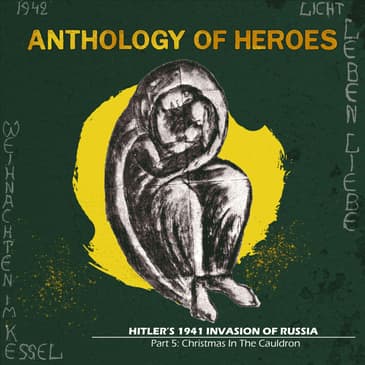
"Capitulation is impossible! The 6th Army will do its historic duty." - Adolf Hitler.
In the conclusion of our series, we unravel the final months of the Battle of Stalingrad, exploring the consequences of Adolf Hitler's decision to forbid the the Sixth Army to retreat.
We witness the long-awaited breakthrough for The Red Army, as Joseph Stalin and Georgy Zhukov launch Operation Uranus.
We delve into the emotional impact on German soldiers confronting their mortality. Through their personal letters, we glimpse into their thoughts and feelings about Nazi leadership and Adolf Hitler.
After the dust settles, we examine the aftermath of the Battle of Stalingrad and its enduring legacy in Russian history.
Tune in for an exploration of this pivotal moment, where the human toll and historical significance intertwine in a tale of sacrifice, resilience, and grit.
⚡Help support the show on Patreon check out our supporting reels on Instagram, and receive email updates whenever a new episode drops by joining our mailing list.⚡
CHAPTERS:
- 00:00-Introduction and Recap
- 01:58 - Episode start
- 07:27 - Fortress Stalingrad begins
- 16:49 - Christmas in Stalingrad
- 21:05- Last chance at surrender with Winrich Behr
- 31:36 - Paulus loses hope
- 40:56 - Fate of the main characters
- 45:57 - Red Army finds last letters from Stalingrad
Learn more about your ad choices. Visit megaphone.fm/adchoices
[00:00:00] Hey everyone, Happy New Year and thanks for tuning into Anthology Of Heroes, the podcast where we explore the stories of heroic figures who altered the course of history.
[00:00:09] Anthology Of Heroes is part of the Evergreen Podcast Network. I'm your host, Elliot Gates,
[00:00:14] and this right here is the final part of our five-part series on Operation Barbarossa, Hitler's doomed invasion of Russia beginning in 1941.
[00:00:24] If you've been listening since Part 1, we watched as the invasion shook and paralyzed the Red Army initially before eventually Stalin and the Stavka retake control.
[00:00:34] We've seen the march on Moscow and the Caucasus come to nothing, and we followed the Vemarch 6th Army into another bone-chilling winter spent in Russia, this time in the industrial city of Stalin-Grad.
[00:00:46] The previous episode and this one too are all about Stalin-Grad, because it's in this city where the Vemarch will meet its end, and Hitler's dream of a thousand-year-rike will come crashing back down to Earth.
[00:00:58] If you haven't listened to the other episodes of this series because you just want to hear about Stalin-Grad, that's no worries, but definitely do start on Part 4 rather than this one, because we're already well and truly in the thick of it by now.
[00:01:10] Just like Part 4, I'll be interspersing letters from German soldiers that were sent home from Stalin-Grad in between scenes.
[00:01:17] Just a quick note, because I'm currently traveling this episode, like the last one, was recorded in different locations, so there'll be three times in the episode where the sound of my voice changes noticeably.
[00:01:28] I did my best to try and normalize it, but you can still tell, so sorry about that. We'll react to normal for our next episode around late March or so.
[00:01:36] Anyway, we left the last episode just as Stalin and Zukov began their long-awaited counterattack, Operation Uranus.
[00:01:43] As a warning, this episode mentions rape and sexual assault in passing reference. So here we go. Hitler's folly, Part 5, Christmas in the Cauldron.
[00:01:55] Pulling the tarp hole and off their artillery pieces for 80 minutes across the front line, Russian Kutusha missiles roared in fury.
[00:02:07] The oddly symphonic noise they made led to the Germans nicknaming them, Stalin's organ.
[00:02:13] And as the symphony broke the early morning silence, it was clear that neither the Vemak nor their allies were prepared.
[00:02:19] For the first time since the war began, and probably for one of the first times in his life, Stalin almost smiled as Zukov read the initial reports of the advance.
[00:02:28] Puffing on his piped cheerfully, he sensed that this would be decisive in every sense of the word.
[00:02:34] For the first few days, the sheer scale of the invasion was hidden as a thick milky fog rolled in across the frontier.
[00:02:41] In his memoirs, German soldier Gunter K. Kushori describes a fog around this time saying that it was so cloudy that they could actually hear Russian soldiers laughing and chatting ahead of them, but they couldn't see them.
[00:02:53] So hearing all these noises, Gunter Squadron killed the engine of their vehicle and just stood silent.
[00:02:59] The grinding of the tanks got closer and closer until barely a few meters away from them, they stopped.
[00:03:06] Gunter held his breath. As the Russians, clearly suspecting something, shot a yellow flare into the sky.
[00:03:12] But the fog was so thick it was barely visible. Hearing Russians talking, Gunter and his squadron waited, hearts pounding.
[00:03:20] Then after what seemed like an eternity, the tanks slowly veered left and the sounds got quieter and more distant.
[00:03:27] As Winter went on, snow drifts began to form and the Vamuk found themselves spending more time digging their pansas out rather than driving them.
[00:03:35] Paulus now so reliant on Hitler to guide him did nothing.
[00:03:39] Communicades were coming in thick and fast from the Romanian divisions on the flanks.
[00:03:44] Urgent calls for reinforcements and resupplies, but so preoccupied with taking Stalin-grad these concerns seemed distant and unimportant to him until they weren't.
[00:03:54] By the time Paulus appreciated the seriousness of the situation, the route had already started.
[00:03:59] Germans and Romanians alike cut off from HQ ran in all directions into the blizzard.
[00:04:04] At first the injured were evacuated on sleds but soon the snow got thicker, they were left behind.
[00:04:11] Injured soldiers found themselves completely alone on the Russian step.
[00:04:15] As a blizzard peacefully lulled them into eternal sleep.
[00:04:19] For every Russian involved in the counterattack, even for newer cruts, morale was through the roof.
[00:04:24] For two years they'd ensured the humiliation and degradation of invasion and of the people being killed and raped with impunity.
[00:04:32] Over that time Soviet propaganda had dripped Fed hope, telling them to imagine how sweet the day would be when they,
[00:04:39] they personally liberated the motherland from the Hitlerites and now that day had arrived.
[00:04:45] Many veterans remembered this counter thrust as the greatest day of their lives, topping even their march on Berlin two years later.
[00:04:52] The Zippee Russian T-34 was advanced with such speed, the red army sometimes burst in on German headquarters that were still staffed.
[00:05:00] Those German staff officers that fled would have missed the full hearty order of Adolf Hitler sent to all divisions, quote.
[00:05:06] Sixth Army to stand firm in spite of danger of temporary encirclement.
[00:05:12] Varmuk field hospitals, if you could even call them hospitals, overflowed with casualties.
[00:05:17] Lines of dying men trailed out into the hospital and often to the snow.
[00:05:21] The groans of the dying were heard long before anyone laid sight on any building.
[00:05:26] Men with leg or spinal injuries dragged themselves, sometimes miles through the snow in hope of treatment.
[00:05:32] Amputations were mostly performed with no anisbetic.
[00:05:37] Fully conscious, the patients had their limbs held down as an exhausted doctor hacked off an arm or leg with a bone sore.
[00:05:44] Like a horror movie, torrents of blood flowed from the tents into the crisp white snow.
[00:05:50] Fleeing German officers torched their precious fuel depots to keep them out of Russian hands and bridges became the ultimate bottleneck,
[00:05:57] where in some instances German commando's blocked the crossing refusing to allow retreat.
[00:06:03] On the 22nd of November at 7pm, Pala sent a message to the Fuhrer bunker that began with Army surrounded.
[00:06:11] He and his 290,000 men were on the cusp of being completely cut off.
[00:06:16] The Soviet ring was closing.
[00:06:18] The red army was just over 40 kilometers, 25 miles from their HQ.
[00:06:23] As news of their rescue reached them, Troucov's battered defenders roared to life,
[00:06:28] emerging from their caves and counter-attacking with everything they had.
[00:06:32] The German army was now being hit from both directions and isolated breakthroughs had already started.
[00:06:37] The Romanians were in pieces, but the 6th Army, inside Stalingrad, still had time for a fighting retreat before the ring closed.
[00:06:45] Pala's would have no doubt noticed the grim irony that he and his men may yet fall into Polions' route, retreating out of Russia.
[00:06:52] But even now when it was so clear that the counter-offensive had failed, Hitler refused to even consider retreat.
[00:07:00] He ordered the defenders to take up defensive positions, the modern equivalent of yelling shield wall during ancient warfare.
[00:07:07] And with these new defensive postures he coined a new term that would be a harbinger for the destruction of the 6th Army.
[00:07:13] He ordered the Vemarch to create fortress Stalingrad.
[00:07:18] Deluded and disconnected, the Fuhrer likely babbled on about the magnificence of the heroic Aryan soldiers standing tall in the den of Bolshevism.
[00:07:28] Eagally he began planning air drops into fortress Stalingrad.
[00:07:32] Supplying an army of this size by air alone was a huge endeavor.
[00:07:36] There were almost 300,000 soldiers in Stalingrad. Soldiers are already living on starvation rations.
[00:07:43] Pala's calculated that if the Fuhrer really did want to hold out, he'd need at least 700 tons of supply per day to be air-dropped in.
[00:07:52] The Fuhrer on his own volition cut that number to 500.
[00:07:56] And by the time it got to hermenghoring, the head of the Luftwaffe had been whittled down to 350.
[00:08:02] They wouldn't even get close to any of these figures.
[00:08:06] Throughout the next few months, the Luftwaffe would manage about 73 tons of supplies per day.
[00:08:13] While the brave crusaders of Europe held the line against the evils of Bolshevism, the Fuhrer announced, a relief army would be assembled.
[00:08:21] The army would swiftly cut through the Paltry enemy forces, a corridor would form and the Aryan heroes would be resupplied.
[00:08:28] Operation Winter Storm would be Germany's finest hour, he insisted.
[00:08:33] And after the army was saved, they would hit back even harder with Operation Thunder Clap.
[00:08:38] Take a guess at who came up with these names, hey?
[00:08:40] His field marshals barely argued back.
[00:08:43] You almost get the feeling that they're just apathetic at this point.
[00:08:47] They now conclusively understood.
[00:08:49] Independent thought was not what Hitler wanted from them.
[00:08:53] Apart from worms like Joseph Gerber's few men seem to really believe in the myth of Hitler anymore.
[00:08:59] Where before they'd seen a proud, youthful leader who had raised up their exhausted nation in a time of need,
[00:09:05] they now saw a deluded, aged, egomaniac with a god complex.
[00:09:10] In wake of their input being disregarded, some members of Nazi high command pursued their own passions.
[00:09:16] Permen-Gurring, a master huge collection of stolen artwork from occupied territory,
[00:09:20] and Heinrich Himmler sent off men to look for Mjolnir, Thor's hammer, hoping that this mythical Aryan weapon could somehow turn the tide.
[00:09:28] Even officers began to openly mock Hitler,
[00:09:31] drogatively referring to him as Grophaz, a German acronym that meant,
[00:09:36] sarcastically, greatest commander of all time.
[00:09:39] But not parlors, Hitler had picked him well.
[00:09:43] And even now, as his Fuhrer refused to allow him to break out,
[00:09:46] Paulus's faith never waned.
[00:09:48] Buying the confidence of his man he assured his soldiers quote,
[00:09:52] Hold on, the Fuhrer will get us out.
[00:09:54] And most still believed he would.
[00:09:57] The winter chill was growing increasingly bitter,
[00:10:00] but the idea of retreating blindly into the open step was worse.
[00:10:04] Like it or not they were safe in Starlandgrad waiting for the Fuhrer's relief army.
[00:10:09] By the 7th of December, rations, already minimal,
[00:10:13] were cut by between 1-3rd and 1-1-half.
[00:10:17] Himmler's air drops which Hitler had banked everything on were sporadic and scarce.
[00:10:22] Just getting the planes off the ground was a mission itself.
[00:10:26] Just to get the engine started, ground crews needed to light a fire underneath.
[00:10:30] And once the planes made it to Starlandgrad,
[00:10:32] often the Russian artillery was so intense they were forced to drop their cargo from the air.
[00:10:37] For the planes that did make it, the odd arrival of bits and pieces would have been almost comical
[00:10:42] if not for the loss of life they caused.
[00:10:45] In one instance, the precious crates were eagerly prized open by hungry hands
[00:10:49] only to find the contents of the entire delivery which is pepper and majorium.
[00:10:55] In their bunkers, in their dugouts and in their caves,
[00:10:58] vemaged soldiers gathered like cavemen,
[00:11:01] staring for hours at a crumpled photo of a wife or lover.
[00:11:05] To pass the time they carved wooden frames from splinters
[00:11:08] and made a little nook in the earth and walls to hold the photo.
[00:11:12] One bunker was particularly popular for the troops
[00:11:15] thanks to the talent of one officer who would hold down an old piano which he played beautifully
[00:11:20] as a sounds of Russian artillery grew closer,
[00:11:23] soldiers sat silent,
[00:11:25] listening to the beautiful melodies of Bach Mozart or Beethoven,
[00:11:29] transported if only for a few minutes to somewhere else.
[00:11:33] Flites out of the city became rarer and rarer.
[00:11:36] Between the blizzards, the frees and the Russian artillery,
[00:11:39] the few landing strips the vem are tellered were out of action more often than not.
[00:11:43] The female nurses still left in the city
[00:11:46] were forced upon many of the last flights out.
[00:11:49] As the soldiers lined up to watch the women clamber aboard,
[00:11:52] it was only natural to feel envious, even jealous.
[00:11:55] But if Russian soldiers ever got their hands on German women,
[00:11:58] well, they'd be put through exactly what those German soldiers
[00:12:01] put Russian women through.
[00:12:04] With Christmas just around the corner, Kurt Ruber,
[00:12:07] a pastor wanted to give the soldiers something to remind them of home and of God's grace,
[00:12:13] even as a language in such a wretched place.
[00:12:17] On an old sheet with a charcoal pencil,
[00:12:19] he sketched what would come to be known as the Stalin-Grad Madonna.
[00:12:24] In it, the Virgin Mary sits knees to chest,
[00:12:27] wearing an oversized shawl, cradling baby Jesus close to her chest.
[00:12:32] Around the edges of the picture are written light, life, love,
[00:12:37] fortress Stalin-Grad, Christmas in the Colgion, 1942.
[00:12:42] Ruber was slightly embarrassed as his decrepit bunker became a de facto chapel
[00:12:48] and many soldiers who entered, wept upon seeing his drawing.
[00:12:53] With no hot water, lice, or radio problem ran rampant,
[00:12:57] as did the creatures that carried them.
[00:13:00] Driven indoors from the cold, the men slept surrounded by them.
[00:13:04] One soldier awoke to find a swarm of the vermin eating away
[00:13:07] at one of his frostbitten toes.
[00:13:10] Another noted that when a man died,
[00:13:12] a literal sea of lice could be observed leaving the body on mass and moving to a new host.
[00:13:19] The men took to using spatulas to try and scrape the little beasts off their beards in hair.
[00:13:24] In between the mice, the lice, the excrement, rotten food, and corpses,
[00:13:29] typhus soon followed.
[00:13:31] The only thing keeping these men together,
[00:13:34] keeping them following orders was the hope of the Fuhrer's relief army.
[00:13:38] Irrespective of their feelings towards Hitler,
[00:13:41] no one thought the Fuhrer would just leave the Sikhth army to rot.
[00:13:45] Morality aside, from a military perspective, it was incredibly wasteful.
[00:13:49] The Sixth Army was one of the last elite armies that Vamukt had left.
[00:13:54] Surely Hitler must be doing everything he could to get them out if only for them to defend the home front.
[00:13:59] But Hitler had other ideas.
[00:14:02] Even a mind as warped as his was finally coming to terms
[00:14:06] that there was no longer any hope of victory.
[00:14:08] The relief army he had promised had barely made headway through the Russian wall.
[00:14:13] Taking Stalin grad had always been about ego.
[00:14:17] Conquering the city of his rival's namesake was the ultimate prize.
[00:14:21] But if he couldn't have that, he'd settle for a glorious last stand.
[00:14:25] The Fuhrer imagined the rippling figures of his Aryan children,
[00:14:29] standing atop a mangled pile of Russian corpses.
[00:14:32] Machine got in hand firing down to their last bullets
[00:14:35] before the sub-humans' sliver cord overwhelmed them.
[00:14:38] This, he decided, was the ultimate ending.
[00:14:42] An ending every citizen could be proud of.
[00:14:44] An ending he could stomach.
[00:14:50] Dearest father, the division has been trimmed down for the big battle
[00:14:54] but the big battle won't take place.
[00:14:56] You will be surprised that I write to you and in the care of your office.
[00:15:00] But what do I have to say in this letter can only be said among men?
[00:15:03] You will transmit it to mother in your own way.
[00:15:06] The word is out that we can write today.
[00:15:08] For one familiar with the situation, that means that we can do it just once more.
[00:15:12] You are a colonel, my dear father, and a member of the general staff.
[00:15:16] So you know what this means.
[00:15:18] And I won't go into explanations which might sound sentimental.
[00:15:21] This is the end.
[00:15:23] It will last perhaps another week, I think, then the games up.
[00:15:26] I do not want to look for reasons which one could marshal for or against our situation.
[00:15:31] The reasons are altogether unimportant and pointless.
[00:15:35] But if I am to say anything about them, it is this.
[00:15:37] Do not look to us for some explanation of the situation, but to yourselves and to the man who is responsible for it.
[00:15:44] Beyond guards so that a greater disaster does not overtake our country,
[00:15:48] the hell on the vulgar should be a warning to you.
[00:15:51] I beg you, don't brush off this experience.
[00:15:54] And now a remark about the present.
[00:15:56] Only 69 men are still in fighting condition.
[00:16:00] Blair is still alive and so is Hartleib.
[00:16:02] Little Degan lost both his arms and will probably be in Germany soon.
[00:16:06] We still have two machine guns and 400 rounds of ammunition, one mortar and ten shells.
[00:16:12] Besides that, only hunger and fatigue.
[00:16:15] Without waiting for orders, Berg broke out with 20 men.
[00:16:19] Better to know in three days how things will end than in three weeks.
[00:16:23] Can't blame him.
[00:16:24] And now to personal matters.
[00:16:27] You can be sure that everything will end decently.
[00:16:29] It is a little early at 30, I know.
[00:16:32] No sentiments.
[00:16:34] Handshake for Lydia and Helen.
[00:16:36] Kiss for mother.
[00:16:37] Be careful old man.
[00:16:38] And cure a heart trouble.
[00:16:39] Kiss for girder.
[00:16:40] Regardless to all the rest.
[00:16:42] And to helmet father.
[00:16:44] Firstly tenant.
[00:16:46] Respectfully gives notice of departure.
[00:16:48] With just two days until Christmas, the very much soldiers have tried their best to make their miserable lives a little more festive.
[00:16:56] Even if just for the day.
[00:16:58] One division slaughtered their last pack-horse to make Christmas sausage.
[00:17:02] Another carve, little Christmas trees from wooden splinters.
[00:17:05] Others still saved up the fitness of food they were allocated.
[00:17:08] And hope of giving a final gift to a friend.
[00:17:11] Sigarettes, boots, picture frames.
[00:17:14] Any intact articles of clothing were passed around.
[00:17:17] Christmas and fortress style and grad was in full swing.
[00:17:20] Complete with a simple two from an office's bottle of wine that he'd saved for the capture of the city.
[00:17:26] Stalin, though, was never one for festivities.
[00:17:30] Early in the morning a Russian tank division had managed to punch right through the boundaries of Tatsun Skaya airfield, the Sith Army's lifeline.
[00:17:39] Under the cover of yet another blizzard, tanks advanced virtually unopposed to the edge of the runway and began taking pot shots at the precious Luftwaffe supply planes.
[00:17:49] Visibility was low, but there were so many targets that tanks fired blindly into the storms.
[00:17:54] It was pandemonium for the air marshals who would receive no warning that the enemy was so close to the base.
[00:18:00] As frantic messages warbled over the airways, planes took off left and right, crashing into each other and clogging the runway.
[00:18:07] Any craft that got airborne was ordered to make for their backup airbase, which was little more than a patch of tarmac in the snow.
[00:18:14] By the evening, the Russians had taken the vital airbase and destroyed about 10% of the total Luftwaffe's fleet.
[00:18:21] Stalin now had his foot on the last major blood vessel pumping life into Fortress, Stalin, Greud.
[00:18:28] Christmas had been a sombre affair for the Germans, but for the Red Army things were slowly improving.
[00:18:34] With the vulgar now frozen solid soldiers could cross with impunity, and many took advantage of the saunas that had been set up on the other side.
[00:18:42] Deloused and scrubbed clean, they returned in high spirits. On the note of spirits, General Chukov also took the opportunity to get out of Stalin Greud for the day.
[00:18:51] Returning in the evening, steaming drunk, he stumbled across the river and fell through a thin section in the ice.
[00:18:58] The rock nearly sank to the bottom, but a comrade pulled him free at the last moment.
[00:19:03] Let us to Russian wives showed that soldiers knew the tide had well and truly turned.
[00:19:08] Dying wrote one soldier, we are pushing the serpents back to where they came from.
[00:19:13] Our successful advance brings our next meeting closer.
[00:19:17] New years came and went, and though Paul's diary entries show that he knew their fate was sealed, he tried his best to keep his troops motivated.
[00:19:25] The men were now so weak, so malnourished that even if the order was given to evacuate, few divisions had the strength to do so.
[00:19:34] In the groups of starvation, soldiers dragged themselves from their hovels to hear Paul's read Hitler's New Year speech to them.
[00:19:40] In it, he talked of glory and if how he was doing all he could to bring them home, he concluded with quote,
[00:19:47] Your staunchness will come to the most glorious feat in the history of German arms.
[00:19:52] The men were relieved to hear that the Fuhrer had not forgotten them, and that any day now panses would burst through the lines with armfuls of ham, water, fresh clothes, medicine and ammunition.
[00:20:03] With nothing but a prayer keeping them going, no one thought too deeply into what glorious feat Hitler was referring to.
[00:20:12] Generals who visited the horrific front lines could have believed the skinny cavemen they saw were once a proud men of the Vemuktsiq army.
[00:20:20] They told Hitler what they'd seen and begged him to see reason, get these people out while he still could.
[00:20:26] There was no honour enforcing these men to die so needlessly and cruelly.
[00:20:31] General Zitler, in solidarity with the soldiers, reduced his own rations to match that over frontline soldier and lost 26 pounds 12 kilograms in just two weeks.
[00:20:42] Hitler disgusted at Zitler's withered frame ordered him to resume meeting normally and assured Zitler to show solidarity they would instead ban drinking champagne and brandy in the bunker.
[00:20:54] On the morning of January the 13th, 1943, Viennrigg Bair nervously cleater throat and combed back his dark hair.
[00:21:06] The 25-year-old officer stood in the parlour of the Wolfstead, waiting for an audience with Adolf Hitler.
[00:21:15] Hours ago, he had been at Stalingrad. A logistics officer Bair was responsible for the distribution of ammunition across the front but that morning he had been handpicked for a special mission by Marshall Pallus himself.
[00:21:28] He was being sent to meet the Führer in person and obtained permission to allow Pallus and the Sikhthami to surrender.
[00:21:36] So far, Hitler had refused to see reason. He'd ignored facts, figures and logistics. But Pallus knew the dictator was prone to following his emotions.
[00:21:46] Pallus figured that the same facts coming from the mouth of a young handsome staff officer who had lived through Stalingrad might be the chink in the Führer's armour.
[00:21:56] Bair represented the next generation, the one that the Führer always claimed to be building a world for.
[00:22:02] It also didn't hurt that he had a knight's cross metal for bravery and was visibly malnourished but not to the point that would sicken Hitler and make him turn away.
[00:22:11] Taking off his belt and pistol he made sure his metal was nice and high on his turtleneck as it was waived into a large meeting room when numerous generals and staff officers sat in gloomy silence.
[00:22:22] Standing over the table was Bair's supreme commander, his Führer, Adolf Hitler.
[00:22:28] Bair had met Hitler once before many years ago in France. At that time he'd been enraptured by the Führer.
[00:22:35] He thought the man are genius and his energy and dynamism kept him hanging on his every word. Now he looked aged and haggard.
[00:22:43] And before Bair could get a word in the Führer began his lecture.
[00:22:47] Wormly he welcomed him and acknowledged the problems faced in Stalingrad.
[00:22:51] But as he demonstrated on his map, the Reich had many problems and Stalingrad was just one of them.
[00:22:58] Bair had been warned against this. The dictator's strategy when receiving bad news was to just fill a bustle until the messenger gave up.
[00:23:06] Patiently Bair stood listening as the dictator motioned at various flags across the Stalingrad front.
[00:23:13] Each of the flags of Führer said represented a division, thousands of men.
[00:23:17] But Bair knew many of these flags were just down to single digits of men who could still hold a rifle.
[00:23:24] He felt the anger inside rising as Hitler spoke vaguely of the numerous SS divisions that would soon arrive to rescue them.
[00:23:32] Divisions that once again Bair knew were nowhere near the front.
[00:23:37] The Führer finished his lecture and with a smile moved to escort the young officer to the exit.
[00:23:42] But Bair didn't move. Hitler had his moment, now was his turn.
[00:23:46] Just like Paola's told him to do, he told the Führer simply that they were starving.
[00:23:51] The soldiers at Stalingrad had no food and little ammunition.
[00:23:55] When he points out that the air drops had all but ceased, a representative from the Luftwaffe moved to cut him off but hit him away.
[00:24:02] When he spoke about desertions from behind Hitler's back, the head of their van marked a waggleed his finger at the young man, indicating that he better shut up now.
[00:24:11] But Bair plowed on.
[00:24:13] Finally after upsetting almost every member in the room, he finished and you straight away, he had failed at his mission.
[00:24:20] Hitler immediately retorted with a well-oiled speech about the imminent arrival of the SS divisions.
[00:24:27] He counted that the Sigmund army had been complaining about dwindling supplies in early December but yet here they were holding out two months later.
[00:24:34] And he repeated over and over, Stalingrad must hold out.
[00:24:39] Bair left the map room, dejected only to find his pistol and belt, stolen.
[00:24:45] Sensing his deep frustration to staff officers approached him and quietly asked him if he'd like to join a conspiracy to assassinate Hitler.
[00:24:54] For this to be discussed so openly shows just how far faith had fallen in the disgrace dictator.
[00:25:00] Fearing for his safety, Bair said no.
[00:25:03] Later that afternoon he found out that he was forbidden to fly back to Stalingrad.
[00:25:08] Hitler feared his defeatist attitude would not help Pala's alone mood.
[00:25:12] Instead, Hitler sent Pala's transmission that read,
[00:25:16] capitulation is impossible. The Sigmund army will do its historic duty at Stalingrad until the last man in order to make possible the reconstruction of the Eastern Front.
[00:25:33] The time has come for me to send you greetings once more and to ask you to greet all the loved ones at home.
[00:25:39] The Russians have broken through everywhere.
[00:25:42] Our troops, weakened by long pudes of hunger, engaged in the heaviest fighting since the beginning of this battle without a day's relief.
[00:25:49] And in a state of complete physical exhaustion have performed heroically.
[00:25:54] None of them surrenders. When bread, ammunition, gasoline and manpower give out, it is God knows no victory for the enemy to crush us.
[00:26:03] We are aware that we are the victims of serious mistakes in leadership.
[00:26:07] Also, the wearing down of fortress Stalingrad will cause the most severe damage to Germany and her people.
[00:26:13] But in spite of it we still believe in the happy resurrection of our nation. True-hearted men will see to that.
[00:26:19] We are Prussian staff officers and know what we have to do when the time comes.
[00:26:24] And thinking over the course of my life once more, I can look back on it with thankfulness. It has been beautiful. Very beautiful.
[00:26:34] It was like climbing a ladder and even this last rung is beautiful. A crowning of it. I might almost say a harmonious completion.
[00:26:42] You must tell my parents that they should not be sad. They must remember me with happy hearts. No halo, please. I have never been an angel.
[00:26:51] Nor do I want to confront my God as one. I'll manage it as a soldier with the free proud soul of a cavalryman as a hair.
[00:27:00] I'm not afraid of death. My faith gives me this beautiful independence of spirit. Be especially loving with my parents and so help them get over the first grief.
[00:27:09] Put up a wooden cross for me in the park cemetery as simple as beautiful as uncles. This is my last great wish.
[00:27:17] In my riding desk is a ladder which I recorded my wishes during my last leave. So once more, I turn to all of you dear ones.
[00:27:25] I thanks once more for everything and hold your heads high. Keep on. I embrace all of you.
[00:27:32] As bear walked the jectored from the furrow.
[00:27:35] This episode is brought to you by Bumble. So you want to find someone you're compatible with, specifically someone who's ready for a serious connection.
[00:27:44] Totally open to having kids in the future, is a tall rock climbing Libra and loves Ron Comes with bacon pizzas on Tuesdays just as much as you do.
[00:27:53] Bumble knows that you know exactly what's right for you. So whatever it is you're looking for, Bumble's features can help you find it.
[00:28:00] Date now on Bumble.
[00:28:03] For Bunker, he couldn't know that the time for rescue had already passed.
[00:28:07] The Stavka had just launched Operation Ring, the final involvement of Fortress Stalingrad.
[00:28:13] The Red Army had now fully encircled the city, or then it is due was closed during.
[00:28:19] The skeleton soldiers from the Legion of the Damned fought back with the last of their strength.
[00:28:24] Just three days into the operation, Russian casualty figures topped 26,000 dead.
[00:28:31] Now that victory was assured, Zukov and others resorted to the same human wave attacks that they'd used at the commencement of the invasion.
[00:28:38] Just like in the past, the commanders couldn't give a damn about how many men died, meaning the objective.
[00:28:44] When the Red Army came across their defeated foes, even for veteran soldiers it was a shocking sight.
[00:28:51] Rake thin men dressed in rags, salowed faces covered in bites and sores with blackened hands soaked in yellow antifrost bite-oatement.
[00:29:00] Like rats on a sinking ship, Vemark soldiers were enough strength to walk made for the Potomnic Airfield, one of the last functioning air strips for sicker army still held.
[00:29:10] Soldiers rushed onto the runway trying to jump onto landing planes to get first dibs at any food on board.
[00:29:17] Wounded soldiers scheduled for evacuation were forced aside as men clambered to escape.
[00:29:23] As the crowd surged forward, airport staff fired warning shots in the air to try and reestablish order.
[00:29:29] One wounded soldier noted quote,
[00:29:32] Here was the greatest misery that I have ever seen in my whole life.
[00:29:36] An endless wailing of wounded and dying men, most of them received nothing to eat for days.
[00:29:42] No more food was given to the wounded, supplies were reserved for fighting troops.
[00:29:47] As the Russian divisions began to close in on Potomnic, many soldiers and officers rechecked their bearings.
[00:29:54] They were supposed to be heading towards an airfield but from the distance they saw a sizable town.
[00:30:00] It was only when they got closer, they realized this town was really just hundreds of burnt out and abandoned vehicles that ringed the airfield.
[00:30:09] An enormous junkyard, the husks of German personnel carriers tanks and planes had been left once the fuel run out.
[00:30:16] The area had become a dumping ground for discarded equipment and discarded people.
[00:30:22] Inside with the bodies of countless injured troops who, like their vehicles, had been abandoned in the rush to the airfield.
[00:30:29] Many were missing limbs and with no bandages available, they had been patched up with paper.
[00:30:35] If the Russians felt any pity for these men, it quickly evaporated when they found the Russian prisoners left behind.
[00:30:41] Virtually all were dead and those that weren't were so far gone that when given a bit of sausage or bread, their bodies could have processed it and died from shock.
[00:30:51] The last few planes to make it out of Potomnic, ordered to re-route to a new airfield that had not even been set up.
[00:30:58] Gumrach, eight miles to the east, was still having the radio beacons powered on as planes appeared in the sky and jerked down onto the patchy runway.
[00:31:07] The fall of Potomnic finally seemed to be the straw that had broken the camel's back.
[00:31:12] The scales had now fallen from the eyes of even the most zealous Hitlerites. Hitler wasn't coming to save them. They were being left here to die.
[00:31:21] The Stalin-Grad pocket had now been torn in two, with Paulus on one side and another commander holding the other.
[00:31:27] General Hube, a prominent Vemak officer, escaped the cauldron on one of the last planes out of Gumrach.
[00:31:34] Paulus prepared to go down with the ship.
[00:31:37] Perhaps on the same plane as Hube, Paulus sent his final letter to his wife along with his medals and wedding ring.
[00:31:44] What was the thought running through his mind at this point?
[00:31:47] He had served the Fuhrer loyally, he'd obeyed every order, every instruction no matter how difficult they were and what it had got him.
[00:31:55] An icy bunker in Stalin-Grad, a city that up until his operation began he had not even heard of.
[00:32:02] A sad looking swastika hanging limply in front of a bombed out department store was the last vestige of Nazi power in Stalin-Grad as all on side counted down their final days.
[00:32:14] In a deep depression, Paulus was approached by a major who begged of him advice, asking what he should do as they now ran out of reserves.
[00:32:22] Paulus, with a vacant expression on his face, replied quote,
[00:32:25] ''Dad men are no longer interested in military history.''
[00:32:29] As the last few bullets of the Sixth Army were fired in respect to the Fuhrers orders, Hitler had not only given up on the man but had moved on to a new plan.
[00:32:38] On the last flight, leaving Gumrak, Hitler ordered that one man from each division should be saved so he could rebuild the famous Sixth Army from the ground up.
[00:32:47] Historian Antibever coined this, the Sixth Army is Noah's Ark.
[00:32:52] To initiate this plan while he was refusing to let the very same men's surrender as perhaps one of the coldest, cruelest decisions he'd made up to this point,
[00:33:01] it shows that Hitler had his little regard for Nazi life as he did for the enemy's life.
[00:33:06] On January 30th, 1943, exactly 20 years since the Nazis took power, Joseph Goebbels gave a speech to the German public.
[00:33:16] In a Berlin auditorium decked out with swastikers, the German public tuned in for the latest news of the war.
[00:33:23] Housewives across the right crank the volume knob on their radio hoping for news of their brothers or sons.
[00:33:29] But Goebbels would disappoint them, mentioning Stalin grad just once in a list of the many fronts of their mark to when our stretched across.
[00:33:37] No amount of party rhetoric could hide his concern as he spoke about the need for total war.
[00:33:52] The time for sacrifice, he said, was coming, of 14 hour work days and a food rationing.
[00:33:58] Up until this point, German citizens had been shielded from the horrors of war.
[00:34:03] Cream, silk, chocolate and tin, in Britain these were scarce but Hitler had always wanted to keep the German public content.
[00:34:10] But now he had no choice, there was no more surplus.
[00:34:14] For them to have any hope in the war, the whole economy needed to be reorientated for the war effort.
[00:34:19] The citizens of the Reich were soon to experience the horrors of war just as Russian citizens had.
[00:34:25] As a naively voice of Goebbels crackled through the frigid barracks of Stalin grad, the wounded soldiers groaned as if hearing his voice was somehow worsening their injuries.
[00:34:35] Turn it off men yelled as Goebbels continued quote.
[00:34:39] The epic struggle of our soldiers on the vulgar should be a reminder for everyone to do their best for the struggle on the freedom of Germany and of the future of our people and at the same time in the broader sense for the preservation of our whole continent.
[00:34:53] As the protests and yells got louder, officers scrambled to turn off the radio.
[00:34:57] One man said the speech was like hearing his own funeral oration.
[00:35:01] The very next day, Marshal Paulus was promoted to Field Marshal.
[00:35:06] Paulus was no fool and immediately knew what the promotion meant.
[00:35:11] A Nazi Field Marshal had never been taken prisoner and Hitler didn't expect that to change now.
[00:35:19] The destruction of the Sikhthami was near and if you wanted to make sure he got the symbol again that he desired, Paulus was to kill himself.
[00:35:28] Field Marshal Paulus dressed in a shabby Ushanka Russian hat called the final staff meeting with his generals
[00:35:35] and for the first time in his life, voiced defiance at Hitler's order quote.
[00:35:40] I have no intention of shooting myself for this Bohemian corporal.
[00:35:45] One of his last orders was to forbid German soldiers from standing still above trenches and waiting for enemies to shoot them.
[00:35:52] Enough people had died, this fast had to come to an end.
[00:35:56] Within a few hours the Russians were at his door.
[00:35:59] Stalin had been in a mad panic to ensure Paulus was caught but he didn't need to worry.
[00:36:04] The Marshal wasn't going anywhere.
[00:36:06] Russian translators told him the city had fallen and that he was now their prisoner.
[00:36:11] Neither Paulus nor his staff objected.
[00:36:15] Handing over their pistols they followed the red army soldiers out of the bunker where a photographer was waiting.
[00:36:20] Eyes cast downwards, thin with a patchy beard.
[00:36:23] The twitchy Field Marshal Frederick Paulus was let outside, buddled onto a staff car and whisked away.
[00:36:30] Stalin had his prize.
[00:36:38] The siege of Stalin grabbed came to an end in early February 1942.
[00:36:43] After Paulus's capture a few of the most dedicated soldiers fought to the last bullet just as Hitler ordered but by the second organized resistance had all but stopped.
[00:36:53] The bloodiest battle in world history had lasted a little over five months and claimed the lives of some way between one and two million men, women and children.
[00:37:03] Once the prisoners were counted even the red army was stunned to see just how many soldiers they'd captured.
[00:37:09] Stalin was a exuberant to learn he just bagged himself 91,000 prisoners including 11 generals.
[00:37:17] Adolf Hitler was livid but not the fall of the city he expected that.
[00:37:21] He was beyond words with anger and fury.
[00:37:24] He couldn't understand why Paulus had not killed himself.
[00:37:28] To Hitler Paulus was the symbol of this economy and allowing himself to be captured completely ruined his idea of a glorious last stand.
[00:37:37] I mean this seriously until his dying day he would curse Paulus.
[00:37:41] In a fury but more astounded that he'd chosen not to fall on his sword.
[00:37:46] In a meeting with his generals it took place a few days after the fall of the city.
[00:37:50] Hitler anguishers that he should have picked up these defects in Paulus's character quote.
[00:37:55] He asked what should he do now?
[00:37:57] How can he even ask such a thing?
[00:37:59] So in the future whenever a fortification is besieged and the commanding officer receives a demand to surrender he's going to ask first what shall I do now?
[00:38:07] Hitler continues.
[00:38:08] How easy it is to do such a thing.
[00:38:10] The pistol that's quite easy.
[00:38:12] What kind of cowardice it must be to even flinch from that.
[00:38:15] Ha! Better to let yourself be buried alive and in such a situation where he knows full world that his death is the requirement for holding the next pocket.
[00:38:23] Because if he gives an example like that you can't expect the men to continue fighting.
[00:38:28] As a dictator ranted one of his generals noticed how deranged and sick the fury now looked.
[00:38:34] Quote, his left hand trembled, his back was bent, his gaze was fixed, his eyes protruded but lacked their former luster, his cheeks were flecked with red.
[00:38:45] Back in Stalin, the last few Vemark soldiers were escorted out of their subterranean caves into the chilly February air.
[00:38:54] So used to death, fire, noise and decay. Everything was now still.
[00:39:00] For the men that had lived through the five hellish months of the siege, the quietness of the city and the calm of the vulgar must have seemed almost surreal.
[00:39:09] One Russian soldier yelled to a group of prisoners, motioning to the ruins of the city he said to them quote,
[00:39:15] You see this? This is what Berlin will look like. And he be right.
[00:39:21] The tide had finally turned. Stalin graded, the Russian campaign in general had been one front too many and the Reich was collapsing like a house of cards.
[00:39:32] By the end of 1943 the Red Army would push the Vemark back to the Deneeper River and the Allies would occupy Italy.
[00:39:40] By 1945 they would be in Germany. With enough trauma for ten lifetimes, there was little doubt about how German civilians would be treated by the Red Army as one marching song went quote.
[00:39:52] Soon the war will end. Soon Hitler will be kaput we vow. Soon our temporary wives will be bellowing like a cow.
[00:40:00] Oh you pigeon-toed Hitler, you'll surely pay for your sin. In what world the girls will be asking who made off with all our men.
[00:40:09] As the Andrew closer an increasingly delusional Hitler would dream up counterattack one after the other. Alone in his concrete bunker, manic and giddy he'd spend hours shifting flags and pieces around maps of Europe while as generals almost out of pity let him live in his fantasy world.
[00:40:28] With each punch the Vemark grew weaker and weaker eventually resorting to conscripting children and old men to fill their ranks.
[00:40:37] On the 30th of April 1945 Hitler and his wife of 40 hours Eva Brown sat down for a lunch in their bunker. Around the table was a remainder of their staff including Joseph Gerbals.
[00:40:51] When the meal ended, Hitler and Ava said goodbye to their staff members. With the Berlin defenders having less than 24 hours of ammunition remaining it was the end of the line.
[00:41:01] After about an hour and a half staff heard a single gunshot and entering Hitler's bedroom they found the lifeless body of the dictator and his wife.
[00:41:10] Hitler had shot himself in the temple with a walther P.P.K and Eva had taken a sign I'd capsule. With Hitler dead Berlin was ready to surrender.
[00:41:21] Georgi Zukov was in prime position to be the general that would accept the surrender of the city but Stalin whose paranoia had now resurfaced wouldn't allow it.
[00:41:30] Fearing Zukov's popularity could eclipse his own he permitted another red army general to gain the ultimate glory in his stead.
[00:41:37] Once the war was over Zukov remained an important part of the Soviet apparatus before he would again fall foul of Stalin and his successes.
[00:41:47] After a few stints and various government positions he retired from politics for good in 1957 to fish and write his memoirs. Following a decade of declining health Georgi Zukov died of a stroke in 1977.
[00:42:00] Vasiliy Chukov, the stone of Stalin grad fought loyally until the end of the war pushing the eastern front all the way back to Berlin. Unlike Zukov he was permitted to be present when the city finally surrendered.
[00:42:13] After the war he would continue serving in the Soviet military for many years. He was heavily involved in the planning behind Russia's most iconic statue.
[00:42:22] The motherland calls was a name given to the 85 meter statue constructed in the memory of the heroes who fought in Stalin grad.
[00:42:29] Built atop the heavily contested Tata burial ground within the city. At the time of the construction the statue was the tallest in the world.
[00:42:37] A proud looking woman symbolizing Mother Russia backens the citizens of the Soviet Union to her aid with a sword raised in her dress billowing in the wind.
[00:42:47] Always dancing with death the stone would finally succumb to sepsis from an old war wound and die in 1982. He was buried in Stalin grad atop the burial mound that he'd fought so hard for, whereas grave is still regularly visited today.
[00:43:03] Field Marshal Friedrich Poulos was kept as a prisoner of the Soviets for eight years. By the time he was released in 1953 his wife who would not see him since 1942 had passed away.
[00:43:15] Once he returned to a now divided Germany he announced he'd renounced most of his Nazi worldviews. At a conference in Berlin Poulos answered a question that no doubt many German citizens had been plundering since war ended.
[00:43:29] There are still many people today who wonder how Germany which no doubt possessed a highly trained army could be defeated in two wars.
[00:43:37] The question cannot be answered in military terms. The governments responsible for this have both put their armed forces in front of insoluble problems.
[00:43:46] Even the best army is doomed to fail when it is required to perform impossible tasks, that is when it is ordered to campaign against the national existence of other peoples.
[00:43:57] Poulos would spend his remaining years working as a kind of military historian preaching his belief that the peoples of Europe should mend the risks that had been torn apart by Nazi Germany.
[00:44:07] This, he proclaimed was the only way for Europe to avoid being dominated by the growing power of the United States.
[00:44:15] Friedrich Poulos died in 1957 and was buried next to his wife in Dresden, East Germany.
[00:44:22] Kurt Ruber, the pastor who sketched the Stalin-Grad Madonna, would die in a POW camp in mid 1944.
[00:44:29] His original sketch made it back to Berlin where it was still visited to this day.
[00:44:33] Copies of it can be found in churches in the UK, Germany and Russia as a symbol of reconciliation between the three nations.
[00:44:42] Joseph Gerberl's Hitler's most zealous follower would survive the war, ending up as one of the highest ranking Nazis rounded up for the famous Nuremberg Trials.
[00:44:52] His prosecution was eagerly watched by a nation that had grown used to his oily voice, spewing hate and lies weekly across the airways for years on end.
[00:45:02] Gerberl's like many others of Hitler's cabinet proved slippery, but with such troves of evidence against him was only a matter of time until prosecutors made some of them stick.
[00:45:11] Gerberl's was sentenced to death, but took his own life the day before the sentence was to be carried out.
[00:45:17] Joseph Stalin's intense paranoia would seem firmly retained the reigns of power until he died of a stroke in 1953.
[00:45:25] Stalin's legacy is much less black and white than Hitler's, while Germans today rightfully regard Adolf Hitler as a monster in Russia Joseph Stalin certainly has his admirers.
[00:45:36] When I visited Moscow a few years back, I saw an old babushka tearfully kneeling at his grave above a few long-stemmed roses.
[00:45:44] Likewise when I traveled to Transnistria, a little Russian exclave on the side of Moldova, I was shocked to see portraits of Stalin right next to Putin in many shops and businesses.
[00:45:55] It's not within the scope of this episode to try and summarize Stalin's legacy, but there's a quote that's usually attributed to Churchill, although I'm not sure he actually said it, that might help us to understand the thought process of Stalin's admirers.
[00:46:08] Stalin took Russia with horse and plow and left it with atomic bombs.
[00:46:22] It's May 2, 1945, and Hitler's capital, Berlin, lies in ruins. The destroyed streets are still quiet and sad.
[00:46:32] Residents pick through the pieces of the houses or businesses.
[00:46:37] In the bombed out ruins of the Reichstag building, Russian troops sought through the mountains of paperwork until one stack catches their eye.
[00:46:45] Removing the classified packaging wrap they find letters, hundreds of them.
[00:46:51] The letters were from many different hands but all came from one destination, Stalin grad.
[00:46:58] Neatly bound and ordered were the last words ever penned by the soldiers of the Sikthami of the German Varmukt.
[00:47:05] Within these letters to their wives, sons, parents, or friends, the troops of the Sikthami penned their final most enduring thoughts.
[00:47:13] Over the course of this episode you've heard these letters and learnt what these men reflected on their last days or hours on Earth.
[00:47:22] You heard that some went into darkness full of anger and fury, but the majority, reminisced and thought introspectively about what their life had been.
[00:47:32] The saddest part of all this is that none of these letters reached the person they were destined for.
[00:47:37] Filled with dangerous anti-Nazi rhetoric and sentimentality not appropriate for Aryan men, the letters were collected, personal information was stripped out,
[00:47:47] and the overall tone of the letter was classified to gauge the attitudes of soldiers toward Nazi leadership.
[00:47:53] Reading these letters made me reflect on how easy it is to get swept away with the pace of life, and how some of the little moments, road trip with your friends or a family dinner,
[00:48:03] eventually barely noticed at the time could well be the ones that stick with you.
[00:48:07] Over the last four episodes we've followed Hitler's 1941 invasion of the USSR.
[00:48:13] The Great Patriotic War, as it's called in Russia, remains one of the most important events in Russian history,
[00:48:19] and the siege of Stalingrad, now renamed Volgagrad, was the climax of that event.
[00:48:25] A time when military doctrine and superior technology smashed against raw grit and stubborn resistance.
[00:48:33] In this series I've tried to summarize what's a very complex topic, and for the sake of flow I've emitted a lot of detail and some very colorful characters I would have liked to work in.
[00:48:42] YouTube channels, books, podcasts, even people's careers have been dedicated to understanding the intricacies of this invasion.
[00:48:49] Needless to say this series is just meant to be an overview.
[00:48:53] If you'd like to learn more I put you in the direction of Antony Beaver's fantastic book, Stalingrad, which has been my go-to for this episode.
[00:49:01] If you'd like to listen rather than read, check out the podcast, The Battle of Stalingrad, by Des Leitham, which is a blow by blow or counter the battle.
[00:49:10] And if you're more visual and really want to see the messy front line waxing and waning day by day, check out the YouTube channel, TIK History.
[00:49:18] I really appreciate this is a very sensitive and comparatively recent topic compared to what we usually cover.
[00:49:24] And if you've listened through these four episodes and noticed I made some mistakes, please do let me know and if required, I'll add the correction on our website.
[00:49:31] I hope you've enjoyed our very first series for season 6. And if you have, it would be very appreciated if you could leave me a five star review on Spotify or Apple Podcasts.
[00:49:40] Likewise, hey, share the podcast with your friends if they're needing something to listen to while they wait for the next hardcore history to drop.
[00:49:47] This episode, like all others, is dedicated to our amazing patrons and an extra shout out to our just Indian tier members who are Angus, Claudia, John, Seth and Tom.
[00:49:56] If you'd like to join them in supporting the show for just a couple of bucks a month, please follow the link to our website.
[00:50:02] It's in the show notes. This will be the last episode before our extended break for season 6.
[00:50:07] For more information on that, check out our season 5 rap-up episode.
[00:50:11] I really hope you've had a wonderful holiday period and I'll catch you on the next one. Thanks guys, cheers!
[00:50:26] After all, coming in hot for the coldest cups on the block.
[00:50:31] Because there are drinks, then there are drinks from McDonald's.
[00:50:36] Mix things up with any size lemonade or sweet tea for $1.49, perfect with our classic fries.
[00:50:42] Price and participation may vary, cannot be combined with any other offer.
[00:50:46] Ba da ba ba ba.