
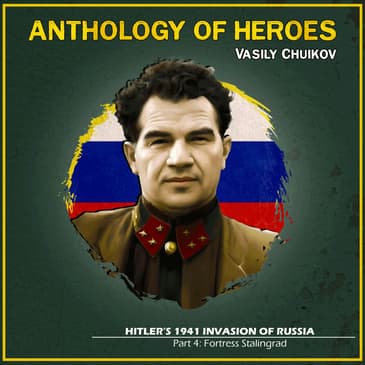
"In the blazing city, we do not suffer cowards..." - Vasily Chuikov.
This episode marks the penultimate episode of our series tracing Operation Barbarossa, Hitler's 1941 invasion of the USSR.
Join us as we follow Marshal Friedrich Paulus and the Wehrmacht 6th Army to their fateful end at Stalingrad. Through poignant handwritten letters, we'll delve into how frontline soldiers grappled with their mortality and the erosion of their faith in Nazi propaganda.
Throughout the episode, we explore the ingenious and brutal strategies employed by Marshall Vasily Chuikov to maintain order amidst the chaos.
In the desperate streets of Stalingrad, Rattenkrieg, or 'war of the rats,' emerged as a brutal form of close-quarters urban combat, marked by intense, chaotic skirmishes within the sprawling ruins of the city.
As the tide turns against the Wehrmacht, we witness the Nazi High Command's struggle against Adolf Hitler's insistence on a symbolic last stand.
The Battle of Stalingrad, often deemed the deadliest in history, holds a profound place in Russian pride today. Tune in to learn why.
⚡Help support the show on Patreon check out our supporting reels on Instagram, and receive email updates whenever a new episode drops by joining our mailing list.⚡
CHAPTERS:
- 00:00-Introduction
- 03:37-Main Characters Recap
- 06:30-Episode Start
- 12:18-Chuikov's Innovations
- 21:09-Wermacht on brink of victory
- 29:48-Luftwaffe Bombing Run
- 35:24-Red Army heroism
- 40:30-Wermacht dug in for winter
- 49:38-Operation Uranus begins
Learn more about your ad choices. Visit megaphone.fm/adchoices
[00:00:00] Hey guys welcome back to the Anthology Of Heroes Podcast where we share the stories of figures and events who changed the course of history.
[00:00:07] Anthology Of Heroes is part of the Evergreen Podcast Network. I'm your host, Elliot Gates. Today is part four of our series following Operation Barbarossa.
[00:00:17] Adolf Hitler's doomed invasion of the USSR in 1941. In this episode we'll tell the story of that fateful city, Stalingred.
[00:00:26] It's impossible to overstate how important the Battle of Stalingred was for the overall outcome of World War II.
[00:00:32] Because this industrial city of minimal strategic value will be where the exhausted German Sikh army meets its end.
[00:00:40] The back and forth battle to control the city would rage for over five months and within this time period somewhere between one and two million people would perish.
[00:00:50] Estimates very wildly but even with the lower figures this battle is most likely the deadliest battle in the history of our species. Winston Churchill said that at Stalingred quote,
[00:01:01] the hinge of fate turned and that hinge was the people on the ground amidst the burning rubble and ash black and shrapnel the average lifespan for a Russian soldier entering the city was just 24 hours.
[00:01:14] In the last three episodes we've sat on the shoulders of the High Command, Hitler, Stalin, Zoukov, Polis and Choukov. We watched as their orders directly and indirectly change things on the ground.
[00:01:27] But all of them were spared the ultimate consequences from their decision. Staling wasn't going to be shot if he disobeyed Order 227 and Hitlerg didn't have to spend the winter of 1941 in a snowdrift eating horse flesh.
[00:01:39] In this episode we're going to hear from the men that did, the grunts, the foot soldiers, the cannon fodder who were thrown into this war.
[00:01:47] We're going to hear what they thought of the war and of their leaders. Throughout this episode where we cut between scenes I'll read out German letters that were sent home from Stalingred to sweethearts, fathers, mothers or friends.
[00:02:00] The letters are probably the most authentic palpable thoughts ever captured from frontline soldiers of this era.
[00:02:07] In their final moments when the propaganda and hate melts away, you'll see that their last thoughts are mainly memories of human connections and time spent with loved ones.
[00:02:17] If nothing else there are a reminder to cherish the little moments here with your friends, your family or your loved ones.
[00:02:23] Over the course of this episode we followed the invasion as it took shape in Varmarkthage Q. Through the mass encirclements of Kiev, passed the tooth-chattering winter of 1941 before coming to a halt with the fuel crisis of 1942.
[00:02:36] When things got started the plan looked to be another one of Hitler's master strokes, groups of 100,300,000 even 500,000 red army soldiers were taken prisoner and rightfully feeling responsible Joseph Stalin fell into a depressive stupor.
[00:02:52] But slowly the grit of the Russian people and Stalin's decision to relocate the industry of the USSR began to turn the tide.
[00:03:00] Outside the very gates of Moscow, the Germans were pushed back for the first time since World War II began.
[00:03:06] Bloodied but not defeated, the Varmarkth changed direction and moved south in an attempt to reach the rich oilfields of the Caucasus.
[00:03:13] Bending around the Volga River, the city of Stalin grad acted as a kind of gateway to this region and an increasingly delusional Adolf Hitler announced that taking this gateway was now the number one priority for the Varmarkth.
[00:03:26] Every other front was mothballed and every weapon in the German war chest was allocated to the capture of the city, so rushing troops from the north, Stalin leapt to the defense of the city of his namesake.
[00:03:37] Apart from Hitler and Stalin our other main characters in this series are Georgi Zukov, number one frenemy and troubleshooter for Joseph Stalin.
[00:03:46] Broadchested and confident Zukov was calm under pressure.
[00:03:51] Other said about him as danger increased he became like a tightly coiled spring alert and focused.
[00:03:57] Zukov was rare for a staff officer in the sense that he told Stalin what he thought and he got away with it.
[00:04:03] His advice as much as Stalin hated to admit it had probably saved the USSR at least once.
[00:04:09] Under him was a man cut from the same cloth, Marshall Vasilievichukov.
[00:04:15] Zukov was a man who death always seemed to stalk but could never quite catch.
[00:04:19] With almost as many pieces of shrapnel in his body as medals on his chest, Zukov was never far from danger.
[00:04:25] His men called him the stone, a fitting name as a Varmarkth seemed to break upon him.
[00:04:30] Flat faced with thin, slanted eyes, gold teeth and a mop of dark hair, Zukov had the stereotypical look of a Russian peasant.
[00:04:38] And as German troops poured into Stalin grad, Zukov and Stalin had put him in charge of the city's defences.
[00:04:43] On the German side of the field was Marshall Friedrich Poulis.
[00:04:47] Poulis was about as different from Zukov as anyone could be.
[00:04:50] A polite and industrious staff officer, Poulis had never commanded troops before this appointment.
[00:04:57] Described by his peers as more of a scientist in a general, Poulis was tall, a little ungainly with a high hairline and a recessed jaw.
[00:05:05] In his spare time he liked to look over old maps of Napoleon's invasion of Russia.
[00:05:10] When he was under stress his bow's loosened and a tick on the side of his face would tweak.
[00:05:15] And there'd be a lot of that to come, because Poulis had been rushed through a bunch of promotions to become the commander of the Varmarkth Sixth Army, tasked with capturing Stalin grad.
[00:05:25] As you can hear we've covered quite a bit.
[00:05:28] I've summarized our main figures but the character development for Stalin and Hitler as well as the development of the campaign itself are all very interesting so I'd really recommend starting at Part 1 before jumping into this episode.
[00:05:40] We left the last episode as a German Air Force, the Luftwaffe, and outstair rival Stalin grad with the largest bombing run made conducted since the invasion began.
[00:05:49] In Sendieri Bombs rained down on Stalin grad as the first fewer of the city's white apartment blocks collapsed into the street below.
[00:05:56] Before we get started if this episode sounds a little different than usual I'm currently recording from a studio as all of my gear is at this moment being shipped across the South China Sea to Australia.
[00:06:07] For more information on that and our release schedule check out our season five wrap up episode as a heads up rape and violence will be mentioned in passing several time throughout the episode and a big hello to anyone watching from the live stream.
[00:06:20] So let's get into it Hitler's folly operation Barbarossa Part 4 for Chistaland grad.
[00:06:28] In the evening of the 23rd of August 1942 the women and children of Stalin grad pulled the corpse of their friends and neighbors from the robber of their homes.
[00:06:39] Prior to the bombing Stalin grad had been something of a model city for the USSR named after the dictate of himself its new build apartment blocks featured pristine views of the shimmering vulgar river which lapped peacefully at the banks of the city.
[00:06:55] Lutely Stalin grad was split into north central and southern districts most of the employment was to be founded factories in the north while in the southern district docks and railway stations were all the supplies were bought in but it was a central district that was the most picturesque bulging from flat banks was an old tartar burial ground that had been repurposed as a central park complete with wildflowers picnic spots and ice cream stands.
[00:07:20] Now is a drone of air raid sirens began to subside that tranquility seemed a lifetime ago the fewer now considered the capture of Stalin grad the number one priority for the Veyramarkt and speed was of the utmost importance.
[00:07:34] It was now almost autumn and once Stalin grad fell the Veyramark still had to march on the oil fields in the south and secure the black sea all of this preferably before winter set in that gave them about six months.
[00:07:47] There was no room for errors no room for setbacks no room for other opinions many of the few as generals who had been instrumental to his earlier victories had now been dismissed Von Bock Clist list and home all gone but most shockingly Hitler had also fired France holder.
[00:08:05] Haldar was to Hitler what Zoukov was to Stalin the chief of staff had been snippy with Hitler since operation Barbara so began as the invasion dragged on in his private diary he bashed the dictator more and more.
[00:08:18] Eventually Hitler had enough his back chat he fired his chief of staff telling him quote you and I have been suffering from nerves half my nervous exhaustion is due to you it's not worth to go on we need national socialist order now not professional ability.
[00:08:35] I cannot expect this of an officer the old school such as you.
[00:08:39] For Hitler to explicitly state we don't need professional ability was just one more red flag of the few as egotistical megalomania leaving he alone was all the Veyramark needed for success.
[00:08:52] As Friedrich Pahlers led the six army towards Stalin grad the weight on his shoulders must have been heavy he was now answerable directly to the fure there were no more smooth talking field marshals to sugar code any setbacks and big up victories the buck now stopped with him and he must have wondered am I up to this.
[00:09:11] For the red army high command there was none of this high school drama for marshal visily chokov his assignment to Stalin grad consisted of a five minute meeting
[00:09:20] to ensure chokov had understand the mission the representative asked him to explain his objective without missing a beat chokov responded quote we shall hold the city or die here.
[00:09:31] They offered him a cup of tea he said no thanks and he was whisked off to Stalin grad by early September 1942 the last line of defense for the red army the roll river had been breached the speed in which the Germans encircled the city had caught the red army completely off guard.
[00:09:48] Burning through the last few canisters of fuel that already made it to the outskirts of Stalin city where inside chokov desperately waiting on reinforcements from the north scrambled to fortify the corridors and NKVD agents ran through the suburbs pasting up propaganda posters on walls and lampposts each poster had the same message resist.
[00:10:10] Citizens were ordered to barricade themselves in their apartment blocks and turn each block into a fortress they were told not to give an inch of ground.
[00:10:18] The posters didn't mince words either one large newspaper print showed a frightened young girl with hands tied behind her back and a headline that read what if your beloved girl is tied up like this by fascists and underneath it continued first they'll rape her instantly
[00:10:34] and throw her under a tank advance warrior shoot the enemy your duty is to prevent the violator from ravaging your girl.
[00:10:42] Critical to the rapid German advance was their air force more than just bombing runs the Luftwaffe provided cover for all ground operations one Russian soldier talks about the horrible sounds these aircrafts made quote
[00:10:55] from that terrible day I could never bear the wild animal howling of German stucars the wailing they emit is head splitting it freezes your soul cast you into confusion paralyzes you like the gaze of a venomous cobra and lingers in your ears for a long long time.
[00:11:12] With no air force of its own the only thing slung the advance was a heroic red army female anti air gunners.
[00:11:19] These women had between a few weeks and a few months of training but as shells were so expensive many of them had actually never fired alive round nevertheless they learnt quickly and they were fearless many waved away their comrades is the air raid sounded and as bombs rained down around them they kept firing until the bitter end.
[00:11:38] By the time this September range set in the Germans were perilously close to the capture of the city they occupied about 70% of it and each attack pushed Choukov further and further back leading him to a remark after one attack quote one more battle like that will be in the vulgar.
[00:11:56] Slushing through the mud the Germans came night and day and the red army hit back with everything it could.
[00:12:02] From their factories in the north of the city tanks were pushed off the assembly line with astonishing speed unprimed with metal that was still warm they arrived piecemeal at the front to save time no gun sites were installed and crew could only fire them by looking through the barrel before loading the shell.
[00:12:19] Choukov understood that he was on a mission to buy time time for the stuff cut to ready account or attack time for the allies to push back in France time for general winter to arrive in the east as he himself said quote time is blood men's very lives became the currency in which time could be bought.
[00:12:38] And it's with the implementation of this strategy that Choukov really started to shine as a commander.
[00:12:43] The majority of the marshals career had been spent fighting an open warfare pitch battles so the densely packed urban warfare of style and grad was completely new to him but unlike other commanders who stubbornly clung to strategies they were familiar with Choukov adapted as tactics throwing away anything that didn't work.
[00:13:01] The very mark drew the sky he couldn't change that but he realized they were much less willing to drop bombs if there was a chance of hitting their own German troops so he began to order his commanders to hug enemy positions.
[00:13:13] He orders divisions to remain as close as possible to the enemy with little more than a street house or even a wall separating Germans and Russians the Luftwaffe became more cautious with their bombing runs.
[00:13:26] Aware that his hastily assembled tanks were inferior to the German ones he drove the metal beasts into piles of rubble throughout the city.
[00:13:33] Barried in debris up to the turrets it became impossible for very marked soldiers to know if a twisted pile of scrap metal camouflaged a working tank again slowing them down.
[00:13:44] On the morning of September the 14th general Choukov deployed his very last reserve 19 tanks and a few hundred soldiers departed his headquarters into the blazing city.
[00:13:55] Iying the few pistols and crates of grenades in his cramped HQ he must have seriously thought that this day might be his last.
[00:14:02] He said in his biography that his office felt like a grave low earthen ceilings and dirt falling upon his head were a constant reminder of the man's own mortality with nothing left to lose he tried something that he was almost sure would fail.
[00:14:17] The NKVD were a specialist branch of Soviet military sort of like the secret police they maintain their own military arm and command structure.
[00:14:25] And the men in that military arm were quite good too highly motivated and well trained there were mostly stationed at military checkpoints outside the city.
[00:14:34] If Choukov could tap into their reserves he could keep the fire burning a little longer so he summoned a high ranking NKVD colonel and effectively told him he was taking control of his troops.
[00:14:46] The colonel said no absolutely not but Choukov pushed him telling him if he didn't like it he gets Stalin on the phone right now.
[00:14:53] It was a bold move from Choukov because if push came to shove he didn't actually know whose side Stalin would take but he had nothing to lose his position would be overrun in the next day if he didn't get men now.
[00:15:06] Face with the thought of having to answer to Stalin if the city fell the colonel reluctantly agreed time was blood and with it Choukov had bought himself a few more days.
[00:15:16] With the newly arrived NKVD troops providing cover Choukov was finally confident enough to authorize a river crossing.
[00:15:24] With all the entrances held by the Nazis the Volga was now the only route in or out of the city.
[00:15:30] The serene calm of the river had now become a soupy mess of oil and blood and to cross it was to put yourself in the most vulnerable position of all.
[00:15:39] A hodgepodge of transport boats, paddle steamers, gun boats or even row boats were all the USSR had access to and on this day making the crossing were 10,000 men of the 13th Rifle Division.
[00:15:52] Rushed straight from training camps these men were incredibly green, one in 10 didn't even have a rifle.
[00:15:58] The experience of paddling towards this inferno would stay with them for the rest of their lives.
[00:16:04] Arriving at the river a driftwood sign nailed to a tree with the word fairy scrolled on it let them know they'd reached their destination.
[00:16:13] Operational staff rushed each soldier and dumped into his arms a few grenades, some ammunition, bread, sugar and a sausage and then shoved them towards the boats.
[00:16:22] Before the men knew what were happening they were aboard a bullet-ridden paddle steamer heading towards Stalin-Grad.
[00:16:28] One soldier said there was so much smoke that could actually see where they were headed but he could quote feel the hot breath of the city.
[00:16:36] He went on to say quote, this must be how Rome looked after Nero put it to the torch.
[00:16:42] The only difference is that he or the inferno was made worse by the screaming shells and lethal explosions, increasing the madness and giving the onlook of the impression that he's witnessing the end of the world.
[00:16:53] A German shell made a direct hit on the boat next to one soldier killing 20 men splattering water and gawr onto the adjacent boats.
[00:17:02] The vulgar itself looked like a disgusting broth full of dead fish, slicks of oil and floating body parts.
[00:17:09] For the men on this boat statistically they were likely to be dead within 24 hours.
[00:17:15] That same soldier goes on to say quote, the further we penetrate into the city the closer the shells fall around us, the sky is glowing over Stalin-Grad.
[00:17:25] Graysch-white-smog billows from the ground flames shoot high in the sky in between.
[00:17:30] The long probing fingers of searchlights tear at the half-darkness of the breaking day, bombs are ceaselessly raining down on a city that has been condemned to death.
[00:17:41] That particular description of Stalin-Grad was actually from a German soldier named Gunter Kurshordi but at this point the German experience was probably equal to that of the Russian.
[00:17:51] Paulus predictably was a nervous wreck. Hitler had handed him a blank check for the operation and was constantly checking in to see when his investment would pay off.
[00:18:01] How long until Stalin-Grad fell, Hitler asked him continuously daily hourly.
[00:18:07] All Paulus could do was relay the facts that his generals gave him.
[00:18:10] He told Hitler that he expected the Russian casualties will roughly double their own and turn the question back to the Fuhrer how many men do they have left?
[00:18:19] Hitler told the Judith Marshall the same lie that he told his generals his minister, the public and the press, a lie that he probably now believed too, that the Russians were down to their last reserves and there were no more men they could call upon.
[00:18:32] Paulus was respectful enough not to point out that the Fuhrer had been saying this for almost a year and a half now.
[00:18:39] All he could do was believe Hitler because he was churning through reserves at a terrifying rate.
[00:18:45] All of the Reich waited in baited breath for the news of the cease capitulation.
[00:18:50] The press were already ready with camera crews to film the historic event.
[00:18:54] A few months back, the average German soldier had never even heard of Stalin-Grad but Nazi propaganda had whipped them into such a frenzy that there was now even greater excitement than there was during the assault on Moscow.
[00:19:06] Joseph Gerbels had to actually tell the editors to tone down the hyper few levels on the off chance the city didn't fall within the next few days.
[00:19:15] Only a few kilometers away from Paulus, Marshall Choukov was again down to his last reserves.
[00:19:20] By now, any idea of a front line had gone out the window.
[00:19:24] One battalion held a grain silo in the north, another squad held the department store in the south and smaller bands were split apart throughout the city with little pockets of Nazis in between.
[00:19:36] Communication between the Red Army divisions was so frequently disrupted that Choukov had been forced to grant his soldiers a high degree of autonomy.
[00:19:44] From here on out, divisions would need to operate with the assumption they would be cut off from communications for days or even weeks at a time.
[00:19:51] And this led him to a new approach sometimes called his strong point strategy.
[00:19:57] Crumbling apartment blocks and the shells of factories were transformed into what he coined centers of resistance.
[00:20:03] And Choukov gave guidance on how these centers of resistance were to be set up.
[00:20:07] They should have 360 degrees of vision on the suburbs below, they should have a space for their own makeshift hospital, mess hall, ammunition dump and headquarters.
[00:20:17] Ideally burnt out apartment blocks were best because they could not be set on fire and buildings that had a basement were particularly prized as soldiers could ambush the convoys outside before retreating back on the ground.
[00:20:28] Strong points soon became strong pockets.
[00:20:31] Once an apartment building was secured, soldiers would wait until nightfall, creep across to the neighboring building, clear it out and secure it, and so on and so on.
[00:20:41] Choukov was making innovations on the fly, really he was making it up as he went alone.
[00:20:46] And for a fairly old school general, especially a Soviet one who was used to pitch battles in front lines, he showed a commendable amount of adaptability and creative thinking.
[00:20:55] Casualty skyrocketing the Germans soon began to use a similar strategy, but we've got to remember the victory conditions were different.
[00:21:02] The Russians just needed to hold on to what they had, but the Germans needed to defend their strong points while taking Russian ones.
[00:21:10] By mid-September, the fighting in the city was reaching its climax. The Vemark was now on the brink of splitting the Russian controlled portion of the city into.
[00:21:19] For the Red Army this would be a disaster. They were used to operating independently for a few days but Choukov knew if they permanently lost control of entire districts, soldiers would either surrender or be killed.
[00:21:32] Vemark Lieutenant Viner paints a vivid picture of how it was to live in the city at this point.
[00:21:37] The street is no longer measured by meters, but by corpses.
[00:21:41] Stalin-Grad is no longer a town. By day it is an enormous cloud of burning, blinding smoke. It has arsed furnace lit by the reflection of the flames and when night arrives, one of those scorching, hailing, bleeding nights.
[00:21:56] The dogs plunge to the vulgar and swim desperately to the other bank. The nights of Stalin-Grad are a terror for them. Animals flee this hell. The hardest stones cannot bear it for long. Only men endure.
[00:23:10] I believe it because I have to believe in something. If it is not true, what else could I believe in? I would no longer need spring, summer or anything that gives pleasure. So leave me my faith, dear Greta.
[00:23:22] All my life, at least eight years of it, I believed in the fure and his word. It is terrible how they doubt here and shameful to listen to what they say without being able to reply.
[00:23:33] If they have the facts on their side, if what we were promised is not true, then Germany will be lost. And in that case no more promises can be kept.
[00:23:41] Oh, these doubts, these terrible doubts. If they could only be cleared up soon.
[00:23:49] In the Kremlin, Stalin wore out the carpet of his office pacing up and down as he barked orders at everyone and anyone to get him a status report on what was going on.
[00:23:59] In the middle of reports about the largest attack yet, the Stavka had lost contact with Chokov. They'd intercepted German communications announcing that the city had fallen but no one seemed to know for sure.
[00:24:10] The US Embassy at Moscow certainly believed it and they were already preparing accordingly. Everyone was in a state of panic, wondering if Moscow would be next again. But in the burning city, Chokov was still there.
[00:24:23] As clumps of dirt rained down upon him and his staff, line repairers, mostly women, scurried across the city patching up fried cables.
[00:24:32] After an anxious afternoon, the gruff voice of Chokov warbled into Stavaha HQ. Stalin grabbed still hells but just barely.
[00:24:42] As unhelpful as ever, Stalin told Chokov to fight harder and counterattack as soon as he was able.
[00:24:47] Chokov may have wondered where all his reinforcements were. Over and over, he'd requested brigades and instead been dripped fed platoons.
[00:24:55] By his own words, he didn't know what the Stavka were planning but he knew they must be working on something.
[00:25:01] For months now, Stalin had been pushing the Stavka to launch their long awaited counterattack, more than pushing insisting that it had to start now.
[00:25:11] But our old friend, Georgi Zukov, who had since been promoted to Deputy Supreme Commander, pleaded with Stalin to just give him a few more weeks.
[00:25:20] As usual, Zukov pushed Stalin further than any others dared, copying an earful as the dictator rauded him, quote,
[00:25:28] Any delay is equivalent to a crime. Stalin was more than ready to send in the unwashed masses without training or rifles, but Zukov had seen first hand what one well placed Maximkut could do against waves of men.
[00:25:41] So as he delayed and delayed again, Zukov rushed soldiers through training, scraping together every rifle it could find and redistributing artillery all across the front.
[00:25:51] There was a fine balancing act because if Tukov lost Stalin, it would all be for nothing and the longer they delayed, the greater the chance of that occurring.
[00:26:01] After much convincing, Stalin finally re-entered and Zukov knew this would be the last delay he'd be granted.
[00:26:09] With little reinforcements to speak of, and Stalin still refusing to allow any retreat, Tukov ordered his troops to reduce the front line to just 50 yards, 45 meters.
[00:26:20] This was a ballsy move, almost daring the Luftwaffe to continue bombing their positions when the chance of friendly fire would be so high.
[00:26:28] Miner by minute the Varmak advanced closer and closer, now almost outside Zukov's headquarters, but still Stalin refused to retreat.
[00:26:38] Everyone in the Stavkan you took of would died as post, but what good would that do?
[00:26:44] Somehow this man had resisted the German onslaught for three months if he died who would replace him.
[00:26:50] At last when the Germans were almost on top of his position, Tukov and his staff received Stalin's permission to retreat.
[00:26:57] Scaring out of their bunker as the Germans advanced in, they moved into their last refuge in the northern districts of the city.
[00:27:04] The Red Army were now holding onto Stalin grad by their fingernails.
[00:27:15] You are my witness that I never wanted to go along with it because I was afraid of the east. In fact, of war in general.
[00:27:22] I've never been a soldier, only a man in uniform. What do I get out of it? What did the others get out of it? Those who went along and were not afraid?
[00:27:31] Yes, what are we getting out of it? We who are playing the walk on parts and this madness incarnate. What good does a hero's death do us?
[00:27:39] I've played death on the stage dozens of times, but I was only playing and you set out front in plush seats and thought my acting was authentic and true.
[00:27:48] It is terrible to realize how little the acting had to do with real death.
[00:27:52] You were supposed to die heroically, inspiringly, movingly from inner conviction and for a great cause. But what is death in reality here?
[00:28:01] Here they croak, starve to death, freeze to death. It's nothing but a biological fact like eating and drinking. They drop like flies, nobody cares and nobody buries them without arms or legs, without eyes with bellies torn open. They lie around everywhere.
[00:28:20] Everybody in your crew identifies as either Big Mac Burger, McNuggets or McRisby Sandwich. But you're the Faleo Fish Sandwich all day. That crispy fish that savory tartar sauce, that melty cheese, that pillowy bun? Yeah, you get it every time.
[00:28:39] And if you love the Faleo Fish, right now you can catch two of the classics you love for just six dollars. Limited time only price and participation may vary. Cannot be combined with any other offer single item or regular price.
[00:28:52] By mid-October, the siege had dragged on for two months. The Vermark now controlled about 85% of the city.
[00:28:59] Apart from Chokov's HQ, the Red Army were clinging on to a few apartment blocks in the center and around the train station.
[00:29:06] Palace had double the amount of men, all the air cover and most of the tanks. And it was figures like this that Hitler continually hit back with when he needed to justify the siege.
[00:29:16] Off the top of his head, he could rattle off the number of men, the number of planes and number of tanks, even the thickness of their concrete bunkers. But continually he disregarded the less tangible combat modifiers, morale, fatigue, hunger and cold.
[00:29:31] He told Pylos to ready the troops for October the 14th. This day, he announced from the comfort of his bunker would be the day of the final assault on Stalin-Grad.
[00:29:41] Chokov's center's resistance had been the primary barrier to the Vermark's advance, so Hitler's solution was just to remove them.
[00:29:48] Another round of carpet bombing to just level the city, reduced it to nothing, then the rats would have nowhere to hide.
[00:29:55] Hitler knew time was running out. Winter was just around the corner. If it didn't take the city soon, Vermark would need to spend another winter in Russia.
[00:30:06] Even in a dictatorial state like Nazi Germany, optics mattered. How much longer could his papers spend the story of victory being just around the corner? He had to end this God for the Saken War before winter.
[00:30:19] On October the 14th, the sky turned to dark grey as the Luftwaffe unleashed another 550 tons of bombs on the city.
[00:30:27] Leaving the Red Army no time to recover, Nazi ground troops burst through the lower levels of the tractor factory, one of the last major holdouts for the Red Army.
[00:30:36] Cruel booby traps maimed the first men to enter and the Red Army from above sprayed bullets down on the troops.
[00:30:43] Through the steam and heat the Germans took many casualties that they advanced room by room, level by level.
[00:30:49] With visibility being so poor, the flame-thrower units torched entire rooms rather than risk entering them.
[00:30:56] Red Army soldiers continually ran low on ammunition and often resorted to charging German soldiers with sharpened spades or trench knives.
[00:31:05] Jukov told his men to be active at night and deny the Germans' rest, taking any advantage he could to try and level the playing field stacked against him.
[00:31:14] Especially trained dogs would run under German tanks with a hand grenade strapped to their back.
[00:31:19] And Vasilisa Zaytsev, the most famous Russian sniper in Stalingrad, magived his sniper optics onto an anti-tank rifle and began explosively sniping machine gun nests.
[00:31:30] In the ruined apartment blocks everyone was now crammed together like sardines.
[00:31:35] There could be a German squadron on the top floor, a Russian on the middle floor and civilians on the ground floor.
[00:31:41] The squad in old brown rags and dusted with ash, it was impossible to tell friend from foe.
[00:31:47] Sometimes med would bump into each other late at night and it would turn into like an old west in gunfight as both men reached for their weapon and yelled out for help.
[00:31:56] The world would become black and white, snow and smoke, oil and sky.
[00:32:02] Despite the pitiless conditions for the Russians fighting at Stalingrad there was now an element of pride involved.
[00:32:09] They knew their whole country stood with them.
[00:32:12] In his biography, Tukov writes, perhaps with a little bit of embellishment, quote,
[00:32:16] The men were in such a mood that if they were wounded, even with a broken spine, they had tears in their eyes as they were taken to the east bank.
[00:32:23] They'd said to their comrades who bought them out, I don't want to go, better to be buried here.
[00:32:28] For these men this was shaping up to be the great battle of their generation.
[00:32:34] If they could survive they could look forward to telling their children, their grandchildren, that they were there.
[00:32:40] They'd fought at Stalingrad.
[00:32:47] In Stalingrad, to put the question of God's existence means to deny it.
[00:32:52] I must tell you this father and I feel doubly sorry for it.
[00:32:55] You have raised me because I had no mother and always kept God before my eyes and soul
[00:33:00] and I regret my words doubly because they will be my last.
[00:33:04] And I won't be able to speak with any words afterwards which might reconcile you and make up for these.
[00:33:09] You're a pastor, father.
[00:33:12] And in one last letter, one says only what is true and what one might believe to be true.
[00:33:17] I have searched for God in every crater, in every destroyed house, on every corner, in every friend, in my foxhole and in the sky.
[00:33:25] God did not show himself even though my heart cried for him.
[00:33:29] The houses were destroyed.
[00:33:31] The men as brave or as cowardly as myself.
[00:33:34] On earth there was hunger and murder.
[00:33:36] From the sky bombs came and fire.
[00:33:40] Only God was not there.
[00:33:42] No father, there is no God.
[00:33:45] Again I write it and I know this is terrible and I cannot make up for it ever.
[00:33:49] And if there should be God, he is only with you in the hymns and in the prayers in the pious sayings of priests and pastors in the ringing of bells and the fragrance of incense but not in Stalingrad.
[00:34:02] October gave way to November and the final assault Hitler promised pitted out.
[00:34:10] The city had been levelled but still there were no white flags or ceasefires from the red army.
[00:34:16] And now alarmingly when the Vemuk soldiers gulped down their morning soup, there was a barely noticeable crust of ice they needed to pierce with their spoons.
[00:34:26] The winter was almost upon them.
[00:34:29] With most of Chukov's strong points leveled he again adapted to a new type of warfare.
[00:34:34] The Vemuk would christen it, Brat and Krieg.
[00:34:38] War of the rats.
[00:34:40] Amongst the rubble in literal caves or holes in the ground the red army soldiers set up shop.
[00:34:47] From now on there will be less gunfights in the street and more hand-to-hand fighting.
[00:34:52] Chukov, realizing the Germans preferred to kill from a distance, pushed his men to get nice and close before making a killing blow.
[00:34:59] The primal roar as red army soldiers tore out from their hovels and charged eyes wide and bayonets raised that he said would terrify the Vemukt.
[00:35:10] The glow of the burning city cast long shadows on the walls as red army soldiers crept quietly from their bunkers.
[00:35:17] Dropping into the sewers they'd re-emerge behind German positions.
[00:35:21] Once they'd kill all they could install and all they could they'd melt back into the shadows.
[00:35:25] Loan German centuries on night duty were particularly vulnerable.
[00:35:29] Staring into the pitch black their fingers always on the trigger, listening for the slightest noise in the darkness.
[00:35:35] The red army took to launching flares to mark the commencement of an eye attack but only sometimes would an attack actually follow.
[00:35:42] German defenders had their sleep disrupted as they ran to the rally point in preparation.
[00:35:47] As the radio cables were continually destroyed, Russian squadrons dropped out of radio communication for days or weeks.
[00:35:55] Chukov instilled in them the necessity of self-reliance to do what they needed to do to survive.
[00:36:01] Brasian both your water and ammunition as you may go days without either.
[00:36:05] Self-sacrifice went hand in hand with self-reliance and one of the most memorable scenes of the siege was the last stand of Mikhail Panakarko over the 193rd Rifle Division.
[00:36:16] Pinned down by German panzers and out of anti-tank grenades, Panakarko leapt from his trench with a mold of cocktail in each hand.
[00:36:24] As he wound back his arm to throw one, a lucky German bullet shattered the bottle in his hand.
[00:36:29] Drenched in petrol, Panakarko went up in flames but staggering forward he hurled himself over the last few yards and flung his body against the side of a tank, smashing the other bottle in a ball of fire against the side.
[00:36:42] Heroism like this was not only commonplace it was expected.
[00:36:46] Chukov's sense of duty to the motherland was as brutal and as unforgiving as Stalin's.
[00:36:52] As he stated quote, in the burning city we do not suffer cowards.
[00:36:58] One time he found a squadron of soldiers on the wrong side of the Volga River.
[00:37:02] Believing they were trying to desert, he pulled out his pistol, executed the commander, turned to the Khmissar and executed him too.
[00:37:10] A few minutes later he shot both Brigade commanders and their Khmissars, justifying his actions Chukov said in his biography that if anyone found him on the wrong side of the river then he would have been shot too and his executioners would have been right to do it.
[00:37:25] Some went even further. One of Chukov's generals, unimpressed with the discipline of his troops, reintroduced the ancient Roman punishment of decimation, walking the line of soldiers he shot every tenth man then and there.
[00:37:40] There is no land for us behind the Volga became a popular saying for the soldiers. In other words, Stalin grad was all that remained.
[00:37:49] For the Russian soldier there was no point thinking about tomorrow, there was just this moment. Every day was a game of chance and luck and the prize for surviving was the evening when their daily ration of vodka was dulled out.
[00:38:02] As if in the presence of something holy all fell silent when the vodka was passed around and when soldiers couldn't get it anything alcoholic was substituted.
[00:38:13] Filtering anti-freeze through a gas mask was one technique of making moonshine. We'll never know how many died from homebrew like this but one particularly nasty batch killed 28 soldiers who passed around this concoction that one of them referred to as quote, a kind of wine.
[00:38:30] But if you thought support personnel had it any easier, medical orderlies in these primitive hospitals went for days without sleep.
[00:38:38] Ghostly pale and sickly they became walking blood banks when reserves ran dry. On busy nights it was not uncommon for them to collapse due to blood loss.
[00:38:48] Female orderlies carried wounded soldiers over their shoulders for miles from the front line to these hospitals.
[00:38:56] By now the city itself was so pulverized that a Luftwaffe remarked there were few targets remaining. Every block now looked the same, black smoldering craters with nothing but an oil fire delineating one neighborhood from another, where houses once stood there were just antills.
[00:39:13] The only markers of basements that beckoned doom for any soldier who entered.
[00:39:19] But one structure jutting out from the featureless black mass was a grain elevator. This unassuming brutalist structure would soon be printed on the back of badges, patches and postcards if there was one structure that symbolized red army resistance it was this one.
[00:39:35] The Stalin-Grade grain elevator was a plant designed to process and store grain, a rectangular flat-face building with a grain shoot poking outside.
[00:39:44] It had also become the last holdout for a group of Russian soldiers in an area that had long fallen to the Varmarkt. Cut off and isolated the men inside knew they were on their own.
[00:39:54] The initial offer to surrender was met with a spray of bullets as the soldiers carefully made it out their rations of food, ammunition and water.
[00:40:03] With just two machine guns and two old anti-tank guns, the men inside repelled attack after attack. From all sides the German troops ran at the building but each time they were pushed back by the stubborn defenders.
[00:40:16] Artillery pounded the walls but the soldiers doggedly held on inside, making every bullet count they waited until the attackers were close enough to ensure a kill shot.
[00:40:26] The Varmarkt likely believed they were facing a full company or even a battalion but inside the reality was there were just 50 men.
[00:40:34] In a single day they repelled 10 attacks inside the air with thick and dry with grain dust as the soldiers methodically manned their posts, passing around their few precious bullets and whatever food they had left.
[00:40:47] After five days their water, food and ammunition were all gone and as the Germans finally smashed through the concrete the six men that still lived slipped away into the night.
[00:41:00] On November the 19th the German sick army awoke to a peculiar sound, a dull kind of grumbling in their rear.
[00:41:09] When they went to investigate they learnt the sound was caused by chunks of ice in the river freezing and grinding against one another.
[00:41:16] The vulgar river had now frozen. From this point onwards they would need icebreakers to bring in supplies and soon even that would be insufficient.
[00:41:26] Each German soldier had to now come to terms with the fact that they'd be spending Christmas in this pitiless wasteland.
[00:41:32] It was just like last year but worse. Now they were deeper into Russia with virtually no supplies and a shrinking number of ways to obtain them.
[00:41:41] Some German soldiers rations had been cut down to just 50 grams of dried bread per day.
[00:41:46] The temperature had already fallen to minus 18 Celsius, zero degrees Fahrenheit, the first taster of what general winter had in store for them.
[00:41:56] But thousands of miles away Hitler was not worried. The panic had said in last year too but if you remember from our last episode the Luftwaffe had managed to air drop food and fuel to the troops.
[00:42:08] In a Dictators mind he believed that if push came to shove the Luftwaffe could again save the day.
[00:42:14] But that was irrelevant because Stalin grad he believed would fall any day now.
[00:42:25] Nobody knows what will happen to us now but I think this is the end.
[00:42:28] There's a hard words but you must understand them the way they are meant.
[00:42:32] Times are different now from the day I said goodbye and became a soldier.
[00:42:36] Then we still lived in an atmosphere which was nourished by a thousand hopes and expectations of everything turning out well in the end.
[00:42:44] But even then we are hiding a paralyzing fear beneath the words of farewell, which were to console us for two months of happiness as man and wife.
[00:42:53] I still remember one of your letters in which you wrote you just wanted to bury your face in your hands in order to forget.
[00:42:59] And I told you then that all this had to be and that the nights in the east were much darker and more difficult than those at home.
[00:43:06] The dark nights of the east have remained they have turned much darker than I had ever anticipated.
[00:43:12] In such nights one often listens for the deeper meaning of life and sometimes there is an answer.
[00:43:19] Now space and time stand between us and I'm about to step over the threshold which will separate us eternally from our own little world and lead into that greater one which is more dangerous yes even devastating.
[00:43:32] If I could have made it through this war safely I would have understood for the first time what it means to be man and wife in its true and deeper sense.
[00:43:40] I also know it now now that these last lines are going to you.
[00:43:48] The white modern city that had stood before the 23rd of August was now completely unrecognizable.
[00:43:54] A black smoldering wasteland had taken its place.
[00:43:58] Bomb craters pocked every inch of the city glass and shrapnel covered every surface.
[00:44:03] At the old Tartar burial grounds not a single wildflower or blade of grass still remained.
[00:44:09] This patch of earth had been fought over perhaps more than any other and with each artillery barrage freshly buried corpses were churned up to the surface.
[00:44:18] In spindling teetering towers Russian soldiers counter their bullets as they waited for German officers to fall into their sights.
[00:44:26] And in the few buildings still remained Russian and German troops warmed their hands round fires with only a thin layer of concrete separating the two.
[00:44:35] In the middle of the city a statue of a group of children playing had somehow survived the bombing.
[00:44:40] The stark figures of happy children made for almost ghostly presence in the cold gloom of the city.
[00:44:48] Under the streets soldiers tried to forget the sound of distant gunfire and the constant groans of the dead and dying.
[00:44:54] One German soldier would say of this sound quote, it was not a human sound.
[00:44:59] Just the dull cry of suffering from a wild animal.
[00:45:03] One man described the smell of the city as something between a morgue and a blacksmith.
[00:45:09] The 10,000 civilians still trapped in the city lived like mice,
[00:45:14] huddling quietly in the ruins of their family homes only daring to emerge after nightfall and search of roots, berries or burnt horse meat.
[00:45:23] Before letting their daughters out, mothers would smear dirt or ash on their children's faces to make them less attractive in case they were captured.
[00:45:31] Russian squadrons summed down to just single digits and strength made the Germans bleed for every step.
[00:45:37] One man, the sole survivor from a gunfight returned to his command bunker.
[00:45:42] His right hand had been crushed in battle and he was unable to hold a weapon.
[00:45:45] But when he realized he was the last one left he took off his helmet, filled it with grenades and told his commander
[00:45:50] I can throw these with one hand before hobbling back out to the snow.
[00:45:55] Another group of men completely overwhelmed by a German advance sent back a wounded comrade to their headquarters with a message saying,
[00:46:03] quote, begin shelling our position.
[00:46:05] In front of us is a large group of fascists.
[00:46:08] Farewell comrades, we did not retreat.
[00:46:11] The brutality of the war was getting to the Germans on a psychological level.
[00:46:16] They'd hit this city with everything they had.
[00:46:19] They'd bombed it into the ground, they'd cleared every block, destroyed every landmark, cut every cable and yet Ivan persisted.
[00:46:27] Inside a collapsed basement or underneath a sewer drain he waited knowing almost vainly that he would outlast them,
[00:46:35] almost saying, is that it? Is that all you've got?
[00:46:39] Operation Barbarossa, Operation Case Blue are now Operation Brunswick had come to naught.
[00:46:45] Hitler had swapped places with Stalin, deeply distrustful of his generals that had been responsible for his victories, he'd become Stalin and withdrawn.
[00:46:54] The initiative being lost, morale had disappeared and all the forced counterattacks in the world couldn't bring it back.
[00:47:02] To the south of Stalin grad the Caucas army group had been frozen in their tracks, under supplied and over extended they'd barely moved since their front was deprioritized.
[00:47:12] Over dinner one of the generals from this front explained to Hitler that he didn't have enough troops to advance any further and Hitler screamed in his face, that is a lie.
[00:47:21] From here onwards the Fuhrer would eat most of his meals in private.
[00:47:25] Field Marshal Paulus had been advised by his doctors that he was headed for a nervous breakdown.
[00:47:31] His generals fed up to him that horrifying casualty rates of the Sixth Army to prove that they could not sustain this offensive for any longer.
[00:47:39] But Hitler's response was to tell him to prepare the panzers for another final offensive despite the fact that they had virtually no fuel.
[00:47:46] Reality was on one side and duty was on the other.
[00:47:50] The facial tick on his face must have winced incessantly as he again relented the Hitler's demands, accepting his order to try again.
[00:47:59] You must get that out of your head Margaret and you must do it soon.
[00:48:06] I would even advise you to be ruthless about it, for the disappointment will be less.
[00:48:11] In every one of your layers I set your desire to have me home with you soon, it isn't strange at all that you are looking forward to it.
[00:48:18] I too am waiting and longing for you passionately.
[00:48:22] That is not so much what disturbs me but rather the unspoken desire I read between your lines to have not only your husband and lover with you again, but also the pianist.
[00:48:32] I feel that very distinctly.
[00:48:34] Is it not a strange confusion of feeling that I who should be most unhappy have resigned myself to my fate?
[00:48:40] And the woman who should have every reason to be thankful that I am still alive, at least so far, is quarreling with the fate that has struck me?
[00:48:48] At times I have suspicion that I am being silently reproached as if it were my fault that I can no longer play.
[00:48:54] That's what you wanted to hear and that's why you keep probing in your letters for the truth, I would have much preferred to tell you in person.
[00:49:01] Perhaps it is will of destiny that our situation here comes to the point which permits no excuses and no way out.
[00:49:07] I did not know whether I shall have a chance to talk to you once more.
[00:49:11] So it is well that this letter should reach you and that you know in case I should turn up someday, that my hands are ruined and have been since the beginning of December.
[00:49:20] I lost a little finger on my left hand but were still as a loss of three middle fingers on my right hand through frostbite.
[00:49:27] I could hold my drinking cup only with my thumb and little finger.
[00:49:31] I'm quite helpless.
[00:49:33] Only when one has lost his fingers does one notice how much they're needed for the simplest tasks.
[00:49:39] The thing I can still do best with my little finger is shoot.
[00:49:42] Yes, my hands are wrecked.
[00:49:44] I can't very well spend the rest of my life shooting simply because I'm no good for anything else.
[00:49:49] Perhaps I could make out as a game warden but this is only gallows humour, only right to calm myself.
[00:49:56] Pity that I am not a writer so that I could describe how a hundred soldiers squatted round in their great coats with blankets over the heads.
[00:50:03] Do you feel better now that you know the full truth?
[00:50:09] 500 miles away in the Kremlin, an exhausted Gjogi Zukov hurriedly dusted the snow off his boots as he entered Stalin's office.
[00:50:17] Having just arrived from the burning city, he was there to give Stalin the report that he'd been chomping at the bit for.
[00:50:23] The confirmation that their long awaited counteroffensive, Operation Uranus, was ready.
[00:50:28] The plan was kind of a reverse barbarossa, a huge encirclement of German forces.
[00:50:35] But it wasn't to be contained within Stalingrad, who was further reaching than that.
[00:50:39] One million one hundred thousand men were waiting on the southern and northern flanks of their front line, ready to crumple in woods and encircle the Sixth Army.
[00:50:49] Tjulkov had done everything he promised he would.
[00:50:52] For months his troops had held on in the burning city, forcing Hitler to commit the best German troops into an endless street battle.
[00:51:00] Like a whirlpool, artillery, soldiers, planes, fuel, everything ended up in Stalingrad.
[00:51:06] The Varemarked forces that remained outside the city were a skeleton crew, one that had been picked out to feed the Stalingrad meat grinder.
[00:51:14] All that was left on the flanks now was a stripped back core of mostly Romanian troops.
[00:51:20] Operation Uranus would begin on the extreme flanks of the front line, quickly defeating the foreign troops and collapsing inwards in circling Stalingrad.
[00:51:29] If I went to plan, Pallus and his legion of the dam would be trapped inside, and Stalingrad would be their grave.
[00:51:36] The plan required a massive manpower, and whilst Stalin was happy to send in untrained fodder, it had been Zukov that insisted the men have at least basic training.
[00:51:45] Now, crates full of American spam were piled high in red army storehouses, as with nearly acquired jeeps, hardy automobiles that Russian soldiers seemed to love.
[00:51:56] Over 60% of the red army tanks and most of its artillery had been put aside in preparation for Operation Uranus.
[00:52:03] Hitler had keenly noticed the lack of firepower at Stalingrad, which had led him to believe that the USSR was finally at the end of their rope, while in reality the equipment had just been sent elsewhere.
[00:52:14] And so, in the early hours on the 19th of November 1942, red army artillery divisions received a single code word over the radio.
[00:52:24] Siren!
[00:52:27] On that note, we'll pause things for part 4. We'll be back in two weeks for the long awaited reckoning of the red army and the aftermath of Stalingrad.
[00:52:36] Hope you've had a great new year and kicked off any resolutions you've been working on.
[00:52:40] On the note of resolutions, mine was to try and hit 1000 ratings for the show.
[00:52:44] Podcast ratings go a long way in convincing new listeners to give the show a first try.
[00:52:49] So, if you've enjoyed the series so far, I'd be very grateful if you could give this podcast a 5-star rating on Spotify or Apple Podcasts.
[00:52:56] It just takes a few seconds. If you're on Apple Podcasts, scroll down to the bottom of the anthology of Heroes' page, tap 5 stars and write a short review.
[00:53:05] I'd love to hear what episode you enjoyed the most and I read each one.
[00:53:08] If you're on Spotify, it's even easier. Scroll to the very top of the anthology of Heroes' page and tap 5 stars.
[00:53:14] You can't leave comments on Spotify yet.
[00:53:17] I'd also like to shout out to our amazing patrons who pay for the sound effects of music that I think really go a long way to setting the mood in many of the scenes.
[00:53:25] Thanks a lot to you guys and a big shout out to our Justinian tier patron members, Angus, Claudia, John, Seth and Tom.
[00:53:32] Cheers guys, see you on the next one!