
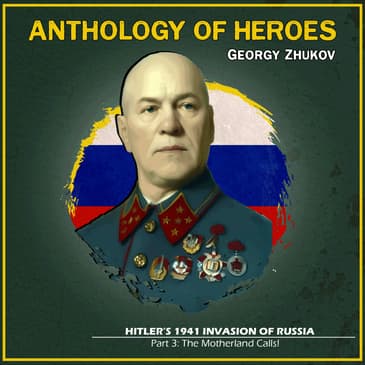

"It is time to finish retreating. Not one step back!" - Joseph Stalin.
In part three of our series on Operation Barbarossa:
The Wehrmacht, desperately needing fuel after Operation Barbarossa, surprises everyone by heading south to the Caucasus, targeting rich oil fields in modern Armenia, Azerbaijan, and Georgia. Stalin's Red Army, still recovering from 1941, scrambles as move to bolster the southern front.
As Hitler tightens his grip on power, dismissing commanders and taking direct control, a staff officer named Friedrich Paulus is thrust into the spotlight. While on the Russian side, General Vasily Chuikov is tasked with holding the line.
This episode unveils Operation Case Blue, Operation Brunswick, Stalin's Order 227, and the rising complexities on the battlefield.
As America enters the war, Hitler's desperation grows, and victory slips through his fingers. The Fuhrer sits in his stagnant bunker, shifting red flags around a map moving toward Stalingrad...
⚡Help support the show on Patreon check out our supporting reels on Instagram, see our sources used for this episode on our website and receive email updates whenever a new episode drops by joining our mailing list.⚡
Learn more about your ad choices. Visit megaphone.fm/adchoices
Learn more about your ad choices. Visit megaphone.fm/adchoices
[00:00:00] Hello and welcome back to Anthology Of Heroes, the podcast where we explore the most pivotal moments of history through the eyes of those who lived it. Anthology Of Heroes is part of the Evergreen Podcast Network. I'm your host, Elliot Gates, and you've just dropped into Part 3 of a 4-part series on Operation Barbarossa, Hitler's ill-fated invasion of the USSR back in 1941. Did you know that by the end of Hitler's life he was throwing down a literal cocktail of drugs each day?
[00:00:30] And Camer-Mile Enemies, Cultured E. Coli and Methamphetamine just to name a few? Is it any wonder that by this point he was beginning to lose his grip on reality?
[00:00:40] In our last two episodes we started in the 1930s watching as Germany and the USSR cozyed up to each other, getting to the point where the dictators were even sending each other birthday messages. But on June 22nd 1941 Hitler pulled the rug out from Stalin, launching the biggest land invasion in world history.
[00:00:59] Four million men and thousands of tanks charged over the border between two states, catching their leader, Joseph Stalin, completely by surprise.
[00:01:09] Through the episode we saw the first few catastrophic engagements as the underprepared red army floundered against the elite German army known as the Varmukt.
[00:01:18] We went into detail about Hitler's twisted ideology behind the war, his insistence on racial purity and his eventual plans for the territory of Russia that was to be incorporated into his greater German Reich.
[00:01:31] We followed Stalin's spiraling depression, as the dictators struggled to pull himself together he categorically forbade any retreat leading to the disastrous fall of Kiev, one of the key cities of the USSR.
[00:01:44] Parallelously close to defeat, Stalin finally began to listen to his advisors and one of them Georgi Zukov quickly proved his worth successfully defending the capital as a biting Russian winter froze the Varmukt in their tracks less than 100 kilometers from Moscow.
[00:02:00] As the advance slowed we observed Hitler turning inward, disregarding the advice of his generals he pushed the Varmukt deeper into the frigid Russian interior.
[00:02:09] Their tanks falling to bits and their soldiers freezing veteran commanders like Franz Halter and Fedor von Bock found themselves at odds with the Fuhrer leading to the resignation of many experienced commanders as the Fuhrer looked to surround himself with yes men.
[00:02:25] We left the episode in late 1941, as Zukov's energetic counterattack had pushed the Germans back for the first time since the invasion began.
[00:02:34] Soviet bombers dropped leaflets to their citizens and soldiers about the valiant triumph of Moscow and the people desperate for some good news tearfully clutched the papers close to the chest, the first good news they'd had since June.
[00:02:47] Moscow and the USSR were saved, for now.
[00:02:52] In this episode, oil is the word of the day. With the horrific winter of 1941 behind them the Varmuk will be coming out swinging.
[00:03:00] Stalin and his stavka were ready for round two in Moscow but Hitler had other ideas.
[00:03:06] The Varmukt we desperate need of oil to keep their tanks going. Germany didn't have any oil fields of its own and after the advance on Moscow they were running on empty.
[00:03:15] So instead of heading to the capital like Stalin expected him to, Hitler changes direction and sends a Varmukt south to the Caucasus.
[00:03:22] The mountainous region that makes up modern Armenia as a bygian and Georgia.
[00:03:27] In this little pocket with some of the richest oil fields in the world, if the Varmuk could take them it solved their fuel shortage and created one for Stalin.
[00:03:36] Bailey recovered from 1941 the Red Army will need to scramble to reorganize once they realize Moscow is not the real target.
[00:03:42] In this episode we're going to see a drug addicted Hitler turn further inward.
[00:03:46] Throwing out veteran commanders one after the other the Fuhrer will take direct control of the army, further reducing the autonomy of his field marshals.
[00:03:55] In desperate search of men loyal only to him, a bookish staff office they named Friedrich Polis will be thrust into the limelight.
[00:04:03] While over on the Russian side a gold toothed peasant general who is men called the stone will be commanded to hold the line no matter what.
[00:04:12] This episode is where Hitler and the Varmukt really begin to unravel.
[00:04:15] With America entering the war the possibility of victory begins to slip through Hitler's fingers and that makes him desperate.
[00:04:22] Complicated maneuvers and shifting priorities frustrate everyone on the battlefield as the Fuhrer sits in a stagnant bunker shifting red flags around the map.
[00:04:31] So let's get into it. Hitler's folly part three, the motherland calls.
[00:04:39] On the 5th of April 1942 Adolf Hitler's personal plane touched down in the little city of Paltava occupied Ukraine.
[00:04:48] Nipping off the tarmac into the breezy spring air the Fuhrer felt reborn.
[00:04:53] Determined to put the setbacks of late 1941 behind him he came to the occupied territory with a plan tucked under his arm.
[00:05:00] Belly able to contain himself he impatiently sat through a rendition of swan lake that had been organized in his honor performed by Polish dancers who were being kept alive especially for the occasion.
[00:05:11] It had been four months since Varmuk's failure to capture Moscow.
[00:05:15] Four months since the German army had been pushed back for the first time since the war began.
[00:05:20] To the German public Hitler wrote the setback down to an early and unexpectedly severe winter, something no one could have seen coming.
[00:05:27] And while the weather did play a role in the setback it was his overconfidence aboard the greater burden of responsibility.
[00:05:34] And that overconfidence had not dissipated within a year.
[00:05:37] Although Moscow survived Hitler was sure that his invasion had crippled the Russian state beyond recovery.
[00:05:43] What was needed was one more big attack, one more push and the rotting frame of Bolshevism would collapse.
[00:05:49] The great gambler had always trusted his instincts and he felt this at his core.
[00:05:53] The failure to take Moscow was a setback but a recoverable one.
[00:05:57] But that was easy for him to say.
[00:06:00] To the German army it was a different story.
[00:06:02] They'd spent the cold December waiting the season out in the snow.
[00:06:06] The elite Varmukdami which had proudly entered Russia in pristine uniforms singing marching songs had devolved into fragmented groups of men,
[00:06:15] who spent their winter gathered around a burning oil barrel or in some peasants hut.
[00:06:20] Constantly harried by Russian probing attacks there were numerous calls to retreat even just a little but Hitler would have none of it.
[00:06:27] Instead of issuing them with winter uniforms he sent them a condescending leaflet that educated them how to keep warm in the snow.
[00:06:35] Here's an extract quote. The lower part of the abdomen should be especially protected from the cold by the application of newspaper sheets between the sweater and the undershirt.
[00:06:45] Put some felt, a hankachief crumpled newspaper or a forage cap with underlining beneath your helmet while you wear it.
[00:06:51] You can make armlets from old socks.
[00:06:53] Thanks to regular air drops from the Luftwaffe, the German Air Force, the Varmukd had survived the Russian winter although they were worse for wear.
[00:07:02] But there was some silver lining. In the early months of the year as the winter frost began to thaw, Stalin had launched a preemptive counterattack in the south.
[00:07:10] It was a dismal failure. Inexperienced troops and overbearing commanders led to the capture of hundreds of thousands of red army prisoners.
[00:07:18] The failure of their operation was a bucket of cold water to Stalin's optimism that the Germans were as good as dead.
[00:07:25] One Soviet soldier noted that it was almost as if the fascists had been hibernating over winter and their offensive had woken them back up.
[00:07:32] So, as the 1942 campaign season began, the red army was cautious of the Varmukd while the Varmuk believed the red army had learnt nothing from the slaughter of 1941.
[00:07:43] All across Europe and down into North Africa, the German army was stretched thin but its grip was still firm.
[00:07:50] All of Central Europe apart from Switzerland and southern France were pacified. Northern Europe apart from Sweden was conquered, their Italian allies held most of the Balkans and down in North Africa the coastline was still theirs.
[00:08:02] Hitler had all his chips at the table and he'd taken many from other big players. If he was to cash them in right now like many advised him to, Germany could exit the war with an enormously enlarged territory.
[00:08:14] Liebensraum, his idea of a greater German Reich could reach its tendrils into France up to Denmark down into the Balkans and who knows maybe Stalin would even give up Kiev.
[00:08:25] The Reich's enormous army could ensure the land would not be retaken and his new world order could begin.
[00:08:31] But it wasn't enough. Hundreds of kilometers away from the front line in essentially heated bunker, the broken tanks and complaints of soldiers seemed a world away.
[00:08:40] Increasingly detached from the real world it seemed to Hitler that everything was so close and that he was so near to complete victory he couldn't stop now. Why couldn't his witless field marshal see that?
[00:08:52] However, the events on the eastern front were not unfolding in a vacuum. Since December 1941 Hitler's nominal ally that Japanese had bombed Pearl Harbor an important American strategic base in the middle of a Pacific Ocean.
[00:09:07] The bombing had dragged the USA into the war and ended the Führer's hopes of Japan invading Russia from the east.
[00:09:14] The USA was the sleeping giant of the 1940s an industrial powerhouse that Hitler wanted to keep out of the war.
[00:09:21] The fact that Japan barely even informed Hitler before the attack showed that the relationship between the two countries had deteriorated.
[00:09:28] In truth, since Barbarossa had began Hitler had sidelined everything else.
[00:09:32] The war in the east had taken so much of the Führer's attention that he neglected all other fronts of war.
[00:09:38] North Africa particularly was left with a skeleton crew to defend the coastline from the British.
[00:09:43] Irwin Rommel, the so-called desert fox, had petitioned Hitler over and over for more troops.
[00:09:49] He insisted that with just a few divisions he could push the British out of Africa for good but Hitler's response to him was the same one he gave to every other front.
[00:09:57] Not until Russia is defeated.
[00:10:00] Now as the Führer entered the old administrative building at Paltova, the pressure to close off the eastern theater of war was greater than ever before.
[00:10:08] As they took their seats around the table, Joseph Gerbels, Minister of Propaganda and one of Hitler's closest disciples, noted that their dear Führer looked aged grey and bloated.
[00:10:19] With sweaty palms his field marshals, older knew, listened as the fidgety out of Hitler unrolled the map and explained the new plan.
[00:10:28] Operation Case Blue
[00:10:30] Put simply, Operation Case Blue was a change in direction from north to south.
[00:10:35] Instead of attempting to retake Moscow or Leningrad the army would pivot and swing south toward the Caucasus.
[00:10:42] The Caucasus were a little mountainous region on the southern flank of the USSR, today making up as a by Jan, Georgia and Armenia.
[00:10:50] The region was, and still is, full of minerals, crops but most importantly oil.
[00:10:56] About 80% of the USSR's oil came from this region alone.
[00:11:01] The Varmarkt was desperately low on oil.
[00:11:04] And because the army was so reliant on mechanized units, you know, cars, tanks, trucks, the need for oil was prioritized above everything else.
[00:11:13] If the Varmarkt could seize the oil fields around Baku, the capital city of modern Azerbaijan, their oil problems would be solved and Stalin's would begin.
[00:11:22] It wasn't just a direction that was to change though.
[00:11:25] Case Blue would be much more hierarchical than Operation Barbarossa.
[00:11:29] Traditional German or Prussian battle plans usually said an objective and let the field marshals achieve it in any way they saw fit.
[00:11:37] Case Blue was more like a lengthy complicated instruction manual.
[00:11:41] A how-to guide that the all-knowing furor had dictated and handed out to his underlings.
[00:11:47] And the more they learnt about it, the more the commanders realised they'd had their wings clipped.
[00:11:51] Case Blue seemed like a step back in time to the Napoleonic era of warfare.
[00:11:56] You go here than you wait here then this person goes here then you advance and you stop.
[00:12:01] General Wall amount expressed privately how many field marshals felt as they cast their eyes over the plan.
[00:12:06] Quote, it was long and repetitive. It jumbled up operational instructions and universally known strategic principles.
[00:12:13] In general it was unclear and in detail it was complicated.
[00:12:17] This was no walk in the park. To reach the Caucasus, the Varmarkt which as we've mentioned were chronically low on fuel needed to travel 800 kilometres or 500 miles from their nearest command centre.
[00:12:29] We are getting into some extreme distances here.
[00:12:33] Prior to the invasion, the Varmarkt quartermaster theorised that the German army could advance 500 to 800 kilometres or 310 to 500 miles into Russia before communications really broke down.
[00:12:46] By now they'd already passed that distance and just like he'd said communications and supplies were stretched like a rubber band ready to snap.
[00:12:54] The first objective for Case Blue was the southern city of Varenz where the Russian hero Peter the Great constructed the very first fleet hundreds of years ago.
[00:13:03] Attacking Varenz was intended to fool Stalin into believing that an attack on Moscow was swinging up from the south and once he took the bait and reinforced the city, the Varmarkt would swing south again into the Caucasus, taking and fortifying the black sea city of Astrakhan.
[00:13:19] Astrakhan was a northern gateway to the oilfields and once taken, the overstretched German army could be resupplied by sea instead of land.
[00:13:27] In terms of Soviet resistance Hitler wanted to repeat the success they'd had with mass encirclement, the panzers were to blaze ahead and pinch off the armies just as they'd done back at Kiev.
[00:13:37] Once the oilfields were taken and their armies had surrendered, Stalin would be well and truly on the back foot and the Germans could be home in time for Christmas.
[00:13:46] As Hitler finished the explanation, there were quizzical looks around the room. Everyone had the same question. How?
[00:13:53] After the disastrous end to 1941, how could Hitler propose to push deeper into the USSR?
[00:13:59] The front line was a jagged mess with bubbles jutting out in all directions. Stretching from Crimea to Leningrad, the front was about 2700 kilometres or 1,680 miles north of the south.
[00:14:13] The Vermakta already stretched then. If they met the objectives of Case Blue, that front line would grow to 4,100 kilometres or 2,550 miles long.
[00:14:24] That is almost the distance of the USA coast to coast.
[00:14:27] And it wasn't like fighting had died down the north. Leningrad was still under siege and Zukov spirited counterattacks were coming day and night.
[00:14:36] Since the invasion began, the Vermakta casualty figures were topping 1 million men. So where would the personnel for this campaign come from?
[00:14:44] While it was true there were a limited number of pure blooded Aryan soldiers. There was a deep well of Allied soldiers that Hitler could call upon.
[00:14:52] During the early days of Operation Barbarossa, Hungarian, Italian, Romanian and finished soldiers were left to more rudimentary duties but that would now have to change.
[00:15:02] These soldiers would now march alongside the Vermakta in front line combat. With this announcement you could almost hear the collective groaning of every Vermakta soldier on the east in front.
[00:15:11] Hitler was well aware that German staff officers viewed one German formation as equal in power to one Italian division.
[00:15:19] Generally speaking, German soldiers were contemptuous of Allied troops and while some of this was good old fashioned Nazi racism, it was definitely true that Vermakta soldiers were a cut above.
[00:15:29] The average German soldier had better training, better leadership and better equipment than any of their allies apart from perhaps the finished soldiers.
[00:15:37] The fewer sympathized the situation wasn't ideal but it was the way things had to be.
[00:15:42] The final count for Operation Case Blue was 1 million German soldiers and about 300,000 Allied troops.
[00:15:49] As the Fuhrer stood to leave he emphasized a need for complete secrecy regarding the plan.
[00:15:54] He handed out a copy of the plan to each of the field marshals instructing them that the documents should never leave headquarters nor should they ever be flown anywhere at risk of being shut down.
[00:16:03] His field marshals stood to attention, they mannered have liked it but this was the Fuhrer's will. With a sea kyle, Case Blue was finalised.
[00:16:13] I'm Allison Holland, host of the Kennedy Dynastie podcast.
[00:16:20] Equipped with a microphone and a long term fascination of the Kennedy family, I am joined by an incredible cast of experts, friends and guests to take you on a fun, relaxed, yet informative journey through history and pop culture.
[00:16:32] From book references to fashion, to philanthropy, to our modern expectations of the presidency itself, you'll see that there are so much more to Kennedy than just JFK or Conspiracy theories.
[00:16:42] Join me for the Kennedy Dynastie podcast.
[00:16:46] Hello everyone! My name is Tom Kernes and I host the Anglo-Saxon England podcast where I cover the history and culture of England from the departure of the Romans in the 5th century to the Norman Conquest in 1066.
[00:16:59] So far we've surveyed the collapse of Roman rule in Britain, the migration of the Anglo-Saxons and the history of Northumbria from its beginnings in the mists of legend to its destruction at the hands of Viking raiders in the 9th century.
[00:17:11] I hope you'll come and give it a go.
[00:17:18] The Fuhrer had a good reason for strict orders around secrecy.
[00:17:22] Throughout a year back, a German pilot had crash landed in Belgium while carrying with him secret plans for Case Yellow, a secret Nazi plan to invade Belgium.
[00:17:31] And Hitler wanted to ensure nothing like this happened again.
[00:17:34] But just a few weeks after the briefing, Major Rikkel tucked the plans for Case Blue under his arm as he flew reconnaissance over the front and as luck would have it, he was shut down.
[00:17:45] By the afternoon, the highly classified plans for Operation Case Blue on the desk of Joseph Stalin.
[00:17:51] But Hitler would get another lucky break after Stalin decided that the plan was a ruse.
[00:17:57] Stalin had fallen for a bit of a double bluff because while the documents sat on his desk were legitimate, a few weeks earlier he'd got his hands on another Nazi plan, Operation Kremlin, a renewed German march on Moscow.
[00:18:10] Operation Kremlin was completely bogus, Operation Case Blue was real, unfortunately Stalin picked wrongly.
[00:18:18] Sure that Hitler would again try for Moscow, Stalin and the Stavka, who wasn't just Stalin this time, disregarded Case Blue and redoubled the defences around Moscow.
[00:18:28] On the 28th of June, Operation Case Blue began.
[00:18:32] Just as they did in Operation Barbarossa, the Varemarked coordinated the start of the attack to the precision of a mechanical watch.
[00:18:39] Most of the red army sat around the Moscow front, waiting, but in the south it was like Barbarossa all over again.
[00:18:45] The Panzer Division's advance with impunity, what little Soviet resistance they found melted away.
[00:18:51] The Russian army had improved since 1941, but it was still rudimentary and toe-to-toe it stood little chance against the Varemarked.
[00:18:59] We've got to remember these guys were really starting from scratch after Stalin's purges, and predictably the southern front unraveled quickly.
[00:19:08] Cases of desertion skyrocketed.
[00:19:11] Across the collapsing front, 100-200 red army soldiers defected to the German side each day.
[00:19:18] That's almost an entire division lost per month.
[00:19:21] And the Germans were really clever with this, saying airdrop these little pamphlets that had almost like coupons,
[00:19:27] the Russian soldiers could tear out, that would say something like, tear off and keep this pass.
[00:19:32] Upon coming over to our side, present it, legal crossing will save your life.
[00:19:37] These things looked really official, and despite being forbidden, many Russian soldiers held onto them just in case.
[00:19:43] Once night fell came and the trenches went quiet, soldiers who were deserted earlier that day would call out to their old comrades.
[00:19:50] Broadcast over loudspeaker, imagine hearing this from your close friend, quote.
[00:19:55] Private Soraga Kanlemnoi, a soldier of the first company of the first battalion of the 673rd Rifle Regiment is speaking.
[00:20:04] Greetings, Varnak. Listen up dear friend, and pass along my message to the whole company.
[00:20:09] The Germans received me just as they said they would.
[00:20:12] I am warm and my belly is full.
[00:20:14] Come on friend, leave your crummy life and come over to the Germans.
[00:20:18] They're decent people, not like our fowlmouthed officers.
[00:20:21] They're giving us French chocolate, Dutch cheese and Danish ham to eat.
[00:20:26] Imagine sitting in your filthy trench with a bowl of lumpy gruel served with a side of abuse from your company Kamasar
[00:20:32] as you listen to that.
[00:20:34] By July the 4th, the Varemak did reach the Don River.
[00:20:37] As he surveyed the calm, glistening river, General Hoth who hadn't liked Operation Case Blue from the start,
[00:20:43] wrote to Chief of Staff Franz Holder noting, quote.
[00:20:47] Maybe Hitler was right? The Russians are finished.
[00:20:50] For the red army soldiers that lay in the trenches listening to the tempting voices of their former comrades,
[00:20:56] the pressure to run was stronger than ever before.
[00:21:00] One soldier talks about the feeling that goes through you when you head to advance from your own trench.
[00:21:04] Quote.
[00:21:05] Time strangely slows down and moves in fits and starts.
[00:21:09] At the last moment I managed to catch a side of the bright sky
[00:21:12] and the earth's wonderful field before me,
[00:21:15] clenching my teeth now no longer thinking of anything
[00:21:18] as if I switched off my mind, I rise up slightly in my burrow.
[00:21:22] The inexorable power of the call of duty instantly forces me out of my trench.
[00:21:27] So many of these soldiers speak about this, this sense of duty.
[00:21:31] But we've got to remember this wasn't duty to Stalin, the man that had forced them to the front
[00:21:35] or to the NKVD who'd imprisoned their family members.
[00:21:39] It was duty to their countrymen, their wives, sisters, brothers and fathers.
[00:21:44] One soldier remembers a conversation in the mess hall.
[00:21:47] After presumably throwing back a few glasses of vodka,
[00:21:50] he expressed the feeling many frontline soldiers had as he asked another soldier, quote.
[00:21:55] I'm curious, what sort of motherland are you planning to defend?
[00:21:58] The one that betrayed our fathers and mothers?
[00:22:01] For me it will be the most exquisite, magnificent day when I can strike dead just one commiser.
[00:22:07] They're just dogs that aren't even fit for damnation.
[00:22:10] No kind sir, I'm going to battle for different reasons.
[00:22:13] I'll be fighting against the foreigners who have laid their hands on Russian soil
[00:22:17] and who rape our women and girls.
[00:22:19] My Kossak grandfather and Kossak father were always a source of support
[00:22:23] for the fatherland and for the Saa.
[00:22:25] So for the fatherland, I'll never be afraid to lay down my life.
[00:22:29] Regardless of men like this, the front was collapsing.
[00:22:33] Historians are really split as to whether the stream of retreating men was sanctioned by the Stavka
[00:22:38] or whether it was just a mass rout.
[00:22:40] After the war, the official government line for this maneuver was called a quote,
[00:22:45] elastic defense, a strategic withdrawal that had been planned all along.
[00:22:51] And I mean maybe, but knowing Stalin could you see him okaying a strategy with the word elastic in it?
[00:22:57] The man was about as elastic as a steel bar.
[00:23:00] Whatever the case, and this may surprise you, the Russian retreat was terrible news for the Germans.
[00:23:06] Think about it.
[00:23:07] The entire point of case blue was to encircle and eliminate Soviet forces so they could take the oil fields unopposed.
[00:23:13] But how can you encircle an army if everyone just runs before combat begins?
[00:23:18] The Vermarkt had cast their fishing net deep into the ocean, pulled it to the surface and caught precious little fish.
[00:23:24] All that fuel all that time and what did they achieve?
[00:23:28] A few more cities in the endless expanse of Russia.
[00:23:31] But there was still hope, the strategic city of Varenz laid just ahead.
[00:23:36] And it's about here when the cracks in case blue really begin to surface.
[00:23:41] Hitler was frustrated with his generals.
[00:23:44] He had been for some time.
[00:23:46] That they'd made remarkable progress he could fuel the campaign season slipping through his fingers just like last year.
[00:23:52] These overly cautious, narrow-minded field marshals were incapable of following his instructions to the letter like he told them to.
[00:23:59] In one of his rants he almost seemed to envy Stalin and the hold he had on his field marshals quote,
[00:24:04] he must command an unconditional respect.
[00:24:07] In his own way he is a hell of a fellow.
[00:24:09] He knows his models, gingous Khan and the others very well and the scope of his industrial planning is exceeded only by our own four-year plan.
[00:24:17] Since the floundering start to Bob Ross, the Hitler had always wanted to tighten the control he had over his generals.
[00:24:23] But all this comes down to ego because despite the stories he worked into with speeches out of Hitler,
[00:24:28] the soldier had seen precious little command experience during World War One.
[00:24:33] Addy, as he was known back then, spent the majority of his service as a runner,
[00:24:38] relaying messages between command posts.
[00:24:40] A lufan prudish about smarty stories that other soldiers told, Hitler was a loner and never advanced anywhere close to the command level.
[00:24:48] So his insistence on taking personal command was at its core arrogance.
[00:24:53] The way Hitler saw it his instructions were clear.
[00:24:56] Play your role and do your part as per the plan.
[00:24:59] Essentially he was telling the generals to disregard their military training.
[00:25:03] One who either couldn't or wouldn't was Fedor von Bock.
[00:25:07] Von Bock was a highly decorated field marshal who had fought in both Poland and France.
[00:25:13] Since Operation Barbarossa began, he and Hitler had repeatedly butted heads on objectives
[00:25:18] and as his tank division pulled up to friends, he earned the Fuhrers' eye once again after he was drawn into street fighting.
[00:25:25] Clearing out the city block by block, he lost 48 hours at the Fuhrer considered vital to the success of the entire operation.
[00:25:33] Hitler was displeased at von Bock tying up his precious tanks that were badly needed in the south.
[00:25:39] Von Bock was confused.
[00:25:41] As he pointed out, case blue clearly specified that Varenz was to be taken.
[00:25:46] He was doing just that so what was he doing wrong?
[00:25:49] To clear the confusion, Hitler flew out and met von Bock in person.
[00:25:53] In a cordial meeting, Hitler explained that the attack on Varenz was a diversion to hide their march south.
[00:25:59] He told the field marshal that if the city could be taken easily, great but if not just keep the enemy busy.
[00:26:04] Both men thought they understood each other but once Hitler returned to his bunker, the days dragged by.
[00:26:10] Von Bock still hadn't taken the city or relinquished the panzers and with each day Hitler's fury grew.
[00:26:17] After 10 days, von Bock captured Varenz but Hitler couldn't care less.
[00:26:21] He felt that the man had deliberately disobeyed him.
[00:26:24] While von Bock believed that not only had he followed the objective to take the city but he also followed the furious secondary objective of taking it quickly.
[00:26:31] 10 days for a major city was no small feat.
[00:26:34] Fuming in his bunker, Hitler spat fire.
[00:26:37] What was Varenz to the Reich? Nothing.
[00:26:40] A tiny pinpoint on a map that had drained all his manpower and fuel.
[00:26:44] Either von Bock had sabotaged him on purpose or was too stupid to see the vision of what they fought for.
[00:26:49] Either way, there was no place in the Varenz for him anymore.
[00:26:52] Von Bock was fired and the spring cleaning of senior Varenz's officers began in earnest.
[00:26:58] A crucial point in the war had been reached for both sides.
[00:27:04] With the Red Army in retreat, or route depending on your perspective, something had to be done.
[00:27:09] At this rate, they'd be in Siberia by Christmas.
[00:27:12] Pacing up and down in his office, Stalin put forward the idea for a new executive order.
[00:27:17] And as members of the staff caretid, they may have exchanged a few nervous glances but none dead to object.
[00:27:23] On 29 July 1942, Stalin's new order was read aloud to the troops.
[00:27:29] It was to be his most infamous command of all time. Order 227. Not one step back.
[00:27:38] The order was draconian in the truest sense of the word.
[00:27:41] From this point onwards, if you retreated, you would be shot.
[00:27:45] As the battered ranks of the Red Army lined up to hear the new directive,
[00:27:49] one soldier remembers seeing the college as leave the face of the man next to him.
[00:27:53] An extract from the order states a following quote.
[00:27:56] Some stupid people at the front calm themselves with talk that we can retreat further to the east
[00:28:01] as we have a lot of territory, a lot of ground, a lot of population that there will always be bread for us.
[00:28:06] They want to justify the infamous behavior at the front but such talk as falsehood, helpful only to our enemies.
[00:28:13] The order concluded with quote.
[00:28:15] It is time to finish retreating. Not one step back. Such should now be our main slogan.
[00:28:21] Stalin had drawn a line in the sand. It was the final round and Russia was staggering.
[00:28:27] If he could make his regime or terrifying than the Germans, his soldiers would have to stand and fight.
[00:28:32] No more routing, no more elastic defeats, give no ground, die where you stand.
[00:28:38] It wasn't just an empty threat either.
[00:28:41] From here on each front was ordered to create so-called blocking detachments.
[00:28:45] Battalions that literally stood behind other units with orders to shoot any men that retreated or tried to surrender.
[00:28:52] Penal battalions made up of convicts or cowards were forced into the most suicidal pockets of the front.
[00:28:58] With the blocking battalion behind them and the machine gun turrets ahead of them,
[00:29:02] the casualty rates for these men was almost always 100%.
[00:29:06] The common soldier was now obligated to shoot any comrade who they caught in the act of deserting while officers were made liable for the desertions of their soldiers.
[00:29:15] The penalty for failing to stop a deserter was death.
[00:29:20] The war had become so twisted at this point that once German soldiers learnt about this order,
[00:29:24] they began to provide covering fire for the Russians who were deserting their lines.
[00:29:29] The fate of the USSR hung in the balance and the red shadow of comrade Stalin now loomed over the shoulder of every Russian conscript.
[00:29:38] To deny the Germans' shelter, entire villages were torched, inhabitants be damned.
[00:29:43] General Layers Shenko describes this barbaric interaction he had, quote,
[00:29:47] we got an order from the division to burn down all villages within reach.
[00:29:51] We were in the dugout where I was explaining how we were to carry out this order.
[00:29:55] When suddenly, breaking all regulations, the radio operator, a middle-aged sergeant, butted in, comrade major, that's my village,
[00:30:03] my wife and children and my sister and all her children are there.
[00:30:06] How can we burn them down? They'll die.
[00:30:09] You mind your own business, it's for us to sort out, I told him.
[00:30:13] That man had to go on marching, fighting and dying for the system that had just orchestrated that.
[00:30:19] For Stalin he couldn't have cared less.
[00:30:22] A textbook psychopath he never showed a shred of empathy.
[00:30:25] When his own son, Yakov was captured, the dictators only concerned with the optics,
[00:30:30] lamenting that he should have died rather than allowing himself to be taken prisoner.
[00:30:35] A few weeks later are led up from the Red Cross arrived, asking if the dictator wished to try and secure Yakov's release.
[00:30:42] Stalin pondered for a minute or two and then began speaking about a different topic.
[00:30:47] Yakov would die in that period W camp about a year later.
[00:30:51] Already a workaholic, Stalin now barely left his office.
[00:30:55] A Zukov and the stab could plan their counteroffensive, he slept in two hour bursts.
[00:31:00] One time, his assistant took pity on him and let him nap for a bit longer.
[00:31:04] Waking up and suddenly checking the time, Stalin was furious and lambasted the secretary, quote,
[00:31:10] a philanthropist all of a sudden, huh?
[00:31:12] Get Vasilevsky on the line. Quick! A bald philanthropist, huh?
[00:31:16] For the dictator there was always something that had to be done.
[00:31:19] Through truly superhuman effort on behalf of the citizens, Stalin's migrated factories had now churned out
[00:31:25] 4,500 tanks, 3,000 aircraft and 14,000 guns.
[00:31:30] While Hitler believed every Russian division was down to their last tank or their last bullet,
[00:31:34] more were being produced by the day. And the men using them were getting better.
[00:31:40] Any red army soldier that survived 1941 had literally been baptized by fire.
[00:31:45] Remember what we said about the 1942 army being built on the bones of the 1941 army?
[00:31:50] Those privates that had survived Kiev or Moscow were now divisional commanders, who knew from firsthand experience
[00:31:56] what worked and what didn't.
[00:31:58] There was also another type of Russian soldier which really made the German squirm.
[00:32:02] Women.
[00:32:04] Hitler's traditional gender roles had women restrict to the role of housewives, nurses or teachers, not so in the USSR.
[00:32:12] Comrades were women just as much as men.
[00:32:15] And while traditional frontline combat soldiers were usually men,
[00:32:18] Stalin tried and tested many female fronted divisions.
[00:32:22] Perhaps the most famous were the 588th nightbomb of regiment, better known as the Night Witches.
[00:32:29] This all-women regiment was the brainchild of Marina Ruskova, who sometimes called the Russian Emilia Ehard.
[00:32:35] Piloting ancient World War I era biplanes, the Night Witches were a bombing squad that flew low over enemy positions.
[00:32:42] Their wooden planes were so slow that even when the German fighter planes were idling they were still too fast to shoot them.
[00:32:49] In the dead of night the pilots would kill their engine and glide over the target silently.
[00:32:54] The only indication they were coming was the faint sound of their engine which sounded like sweeping broomsticks.
[00:33:01] Back in Werewolf HQ, Hitler sat, grim and agitated.
[00:33:06] Joseph Goebbels wrote about his mentor quote,
[00:33:09] tragic that the Fuhrer is closing himself off from life like this and leading such a disproportionately unhealthy existence.
[00:33:16] He no longer gets any fresher hair, he doesn't take any kind of relaxation, he just sits in his bunker.
[00:33:23] The Fuhrer was not himself.
[00:33:25] The dictator had a new physician, a quack named Theodore Morrell.
[00:33:30] Hitler had been introduced to Morrell back in 1936.
[00:33:34] Morrell was a specialist in sexually transmitted diseases which the Fuhrer had always been terrified of.
[00:33:40] Hitler liked magic, he always had, and Morrell who tread the line somewhere between a mystic and medical profession appealed to the Fuhrer.
[00:33:49] By 1942 although the Fuhrer had all manner of highly qualified specialists by side he trusted Morrell above them all.
[00:33:56] The thing was, Morrell was a pig.
[00:33:59] He sank, chewed with his mouth open, ate with his fingers or round not a pleasant individual.
[00:34:04] Other members of Nazi command complained about so much that Hitler had to defend the good doctor saying quote,
[00:34:10] I did not employ him for his fragrance but to look after my health.
[00:34:14] As time went on, the Fuhrer became increasingly dependent on Morrell's concoctions to keep him going.
[00:34:19] As his workload increased, so too did his reliance on the drugs.
[00:34:24] Some of these were usual vitamins and minerals but some of them certainly were not.
[00:34:29] In the morning, skipping the coffee, the Fuhrer would pet a few drops of cocaine and adrenaline into his eyeballs.
[00:34:35] After breakfast he'd take oxycodone for pains and spasms.
[00:34:39] Midday he'd throw back a few pills of cultured E. coli, that's human feces which apparently helped his flatulence.
[00:34:47] After lunch at the dictator's own request it was time for an enema of camomile.
[00:34:52] After that, time for a drink of orchardkin, a tonne of the doctor's own creation made of cow testosterone.
[00:34:58] As that began to wear off he'd have a hit of pervertine, methamphetamine to put some spring in his step.
[00:35:04] Maybe then it would be time for an injection of prostachranum which were minced up prostate glands and seminal vessels supposedly to treat his depression.
[00:35:14] And finally at the end of the day it tranquilized it to counteract everything and put him to sleep.
[00:35:20] This is just a sample of the many medications the Fuhrer was on.
[00:35:24] He may not have had all of them in a single day but at any given time up to 28 concoctions of various stimulants, medications, narcotics, uppers, downers, affradiacs were causing through the body of the Fuhrer.
[00:35:36] You hear sometimes Adolf Hitler being praised for his simple diet and lifestyle.
[00:35:40] Evorted meat, didn't smoke, didn't drink and stayed away from caffeine.
[00:35:43] I mean if you're starting your day by dropping cocaine into your eyeballs, well I reckon I could probably skip my morning coffee too.
[00:35:49] Bouncing off the walls from Morales Magic Mix Hitler's orders became erratic and illogical.
[00:35:55] Robert M. Satino writing in his book Death of the Varemarked said about this period quote,
[00:36:01] what happened over the course of the next few days in any other context but war could be described as a comedy.
[00:36:08] Holding out for that big encyclment he was praying for, Hitler commanded the Panzer tanks in a series of circling maneuvers.
[00:36:14] Burning fuel the divisions criss-crossed north, south, east and west.
[00:36:19] Folls leads led them in one direction before doubling back, going south and waiting for an order to return.
[00:36:24] When they found nothing and ran out of fuel many tanks were forced to stop and wait for a resupply.
[00:36:30] This is not some scouting party, this is a colossal army poking around no man's land looking for an army to fight.
[00:36:37] City after city felt the Varemarked but when their pants are closed the net there were no soldiers there to catch.
[00:36:43] Weeks passed on like this stopped start advances in multiple directions chasing ghosts.
[00:36:49] Sitting on a nondescript plane on the edge of the known world the Varemarked sat and jenz idling waiting for orders of where to go next.
[00:36:57] They had won virtually every battle and occupied more land than any German empire before them, yet they were losing.
[00:37:05] Why? Was it Napoleon's curse? The misguided belief that what worked in Western Europe would work in Russia?
[00:37:12] Was it the difficulty of coordinating so many men over numerous objectives at once?
[00:37:17] The reasons for the failure of case blue were all of these but overall it was not a great plan to begin with.
[00:37:23] Too much distance, too little fuel and too few men to occupy such a colossal front line.
[00:37:29] They were worn down. Disobedience in the ranks were rising.
[00:37:33] Some night soldiers would hear a lone gunshot from a sentry post only to find that the sentry left alone for a few hours had killed himself.
[00:37:42] Another morning field officers found graffiti on the side of their quarters it said quote,
[00:37:47] we didn't want this war, we are dirty, we have lice and want to go home.
[00:37:52] Some all was fading fuel was low and when the final tally came in for the captured prisoners who was just above 40,000 men
[00:37:59] the aim of case blue had always been to destroy armies not to capture territory.
[00:38:04] So comparing this figure to the almost accidental capture of 500,000 prisoners after Kiev,
[00:38:10] case blue with its detailed instructions and complex concurrent maneuvering had failed.
[00:38:15] When the USA had joined the war, the furious goal of unconditional victory had disappeared
[00:38:21] and now the chances of conditional victory were slipping through his fingers.
[00:38:25] In front of the TV cameras and on radio the furious presented the advance as an unstoppable march but as generals knew the truth.
[00:38:32] They hadn't liked case blue from the beginning but the belief in Hitler's might has touched kept them on board.
[00:38:38] Now it was becoming clear, the great gambler's winning streak had just run out.
[00:38:48] On the 23rd of July 1942 the van marked Hoist de la Swastika above the city of Rostov.
[00:38:55] An important port city on the Black Sea coast.
[00:38:58] Rostov had fallen in just 5 days, predominantly thanks to Brandon Berger saboteurs who had kept bridges from being blown.
[00:39:05] This was the furthest south the van marked had pushed and both Russian soldiers and Stalin were now sure the true objective of the march lay in the Caucasus not Moscow.
[00:39:15] It was going to be a major headache for Stalin to move the bulk of the red army south but Hitler unexpectedly came to his aid.
[00:39:23] As the weary soldiers of the van marked lined up for breakfast very next day they were told that the furor had released an important statement for them.
[00:39:31] According to the furor, thanks to their efforts case blue had now successfully been completed.
[00:39:37] Many of these soldiers listening to this message had now spent over a year in Russia and hopes were high that finally this was to be their marching orders, their return home.
[00:39:47] Instead the announcement was met with collective groans as it continued.
[00:39:51] According to Hitler only a few enemy divisions had escaped in circle and were massing at the city of Stalin-Grad.
[00:39:59] Stalin-Grad, Hitler continued, was important to the enemy as it enabled them to ferry reinforcements down the vulgar and into the Caucasus.
[00:40:07] Because of this the van marked forces would now be split in two. Half would head north, take Stalin-Grad and the other half would continue south into the Caucasus as planned.
[00:40:17] There would be no returning to Germany. Operation case blue was finished but Operation Brunswick had begun.
[00:40:24] For these men that had done all the fighting the announcement didn't make sense.
[00:40:28] There would be no major battles since case blue began. How could the furor say that only a few divisions escaped in circle?
[00:40:35] Where would the rest of the red army then?
[00:40:38] Hitler knew that like all his other plans Operation Brunswick was a gamble.
[00:40:43] The red army was not defeated he knew it and so did his troops but the war was becoming larger. Britain was growing bolder, pushing back in North Africa and even launching probic attacks on the coastline of France.
[00:40:55] And so preoccupied with Europe, Hitler had hugely underestimated the power of the USA.
[00:41:01] He saw the country as a bourgeois nation corrupted by materialism. A nation commanded by a cripple, ruling a population that was half judized, half neakerified.
[00:41:13] Well that very same nation was now bearing down on the Japanese who were already starting to wobble.
[00:41:18] Time was running out.
[00:41:20] If Britain or the USA managed to open another front and Germany hadn't secured any oil it was game over.
[00:41:27] By this point in the plan the red army was supposed to be destroyed.
[00:41:31] Hitler knew that it wasn't the case but he hoped that the earlier mass route meant they were as good as destroyed.
[00:41:38] But even his own intel proved this wasn't correct. These corkers cities like Tabli, Sea and Baku guarded some of the richest lands of the Soviet Union.
[00:41:46] For Hitler to just assume Stalin would not move heaven and earth to hold onto them, well it was beyond wishful thinking.
[00:41:53] Everything else was now out the window. Forget the insurquents forget the cities just get to the corkers now.
[00:42:00] A desperate plan by an increasingly desperate and disconnected commander.
[00:42:05] The march from Rostov to Baku was 700 miles or 1100 kilometers.
[00:42:11] Even if the Vemarkt had fuel distances like this were bonkers.
[00:42:15] As for Stalin grad taking it meant crossing two rivers under fire and the elongated bend of the city that snaked around the river meant insurquement would be impossible.
[00:42:25] Whatever poor sap attacked it would need to clear it block by block house by house, room by room.
[00:42:32] That man was to be Frederick Paulus.
[00:42:36] If there was ever a Nazi depitty, it is without a doubt Frederick Paulus.
[00:42:41] Paulus has been involved in this story since the beginning but up until now he worked in the background.
[00:42:46] Paulus was a staff officer meaning he had no combat experience.
[00:42:51] There's not a criticism of the man some people skilled were just better spent in the back office and Paulus was one of them.
[00:42:57] At 52 years old he'd spent the majority of his career writing plans and operations.
[00:43:02] Even in a spare time he liked nothing more than sitting down with a cigarette and a map and retracing Napoleon's invasion route of Russia.
[00:43:09] Tall, somewhat ungainly were weak chin and high hairline and he was someone who thrived in the background.
[00:43:14] If situations got too stressful a tick on the left side of his face became more pronounced and his irritable bowels got the best of him.
[00:43:22] Compared to swaggering Nazi personalities like Irwin Rommel or Franz Halter who argued back or bent the rules Paulus had the utmost respect for the chain of command.
[00:43:32] Mild manned and dedicated another officer described him as more of a scientist than a general.
[00:43:38] More important than anything else though he had great admiration for Adolf Hitler.
[00:43:42] And so when Hitler was clearing his cabinet of disobedient generals or doom sails Paulus quickly could desire as someone he could trust to follow his instructions to the letter.
[00:43:52] So the Fuhrer promoted Paulus several times actually.
[00:43:56] The bookish staff officer who had never commanded men before was now responsible for 360,000 lives as a new commander of the German Six Army.
[00:44:06] By the end of the campaign they would be known by another name, the Legion of the Damned, their destination, Stalingrad.
[00:44:18] Operation Brunswick began in earnest and the steel fist of the Vermak split into.
[00:44:24] While Paulus's forces faced stiff resistance from the get-go, the southern army shot out like a bullet from a gun.
[00:44:30] A real testament of what the Vermak could achieve when they had fuel they cut through 250 kilometres or 400 miles of Russian territory like a hot knife through butter.
[00:44:40] Brandenberger divisions raced ahead and broadcast messages on the radio in Russian commanding troops to withdraw.
[00:44:47] While the Red Army soldiers pondered what to do, commandeered Soviet trucks full of German soldiers talked their way through checkpoints and secured the rear.
[00:44:55] By August 9th, just 17 days after receiving the orders for Operation Brunswick, the southern army took my cop, a little city that boarded the sacred oil fields they needed so badly.
[00:45:07] Finally the Vermak had oil or did it.
[00:45:10] Pacing back and forth in his office, Stalin was kept up to dates with the regular reports of the German advance.
[00:45:16] And he told the garrison commander at my cop that if the city fell and those oil fields were still functional, he'd be shot.
[00:45:23] As you can imagine the commander got to work pretty quickly.
[00:45:26] By the time the Nazi engineers arrived and looked over it, it was clear no oil was coming out of those wells for a long, long time.
[00:45:33] The Red Army had thoroughly disabled my cop, but the Germans were now in oil country.
[00:45:39] Many cities, not far away had vast oil reserves.
[00:45:42] Their advance had been so thorough and their route of the enemy so complete that for the first time since case blue began, morale lifted.
[00:45:49] If they could secure a seaport, resupply troops and fortify positions Operation Brunswick could well be a success.
[00:45:56] But Polis's advance on Stalin-Grad had been a different story.
[00:46:00] From the start he faced stiff resistance that only grew as he battled towards the city.
[00:46:06] It seemed that Stalin had realized this city would be a lynchpin and men flooded in from the Moscow front to bolster the defenses.
[00:46:13] Noticing the disparity between the two advances, Hitler ordered more and more support be directed to Polis and his six army.
[00:46:20] But it never seemed to be enough. Dug in Russian divisions fought back with vigour.
[00:46:25] With such easy success in the south, Hitler announced a reversal in priorities.
[00:46:31] It was now Stalin-Grad, not the Caucasus which was priority number one for the Vemak.
[00:46:36] This may not sound like a big deal.
[00:46:38] But with the Vemak's middling supply of petrol this decision meant that the Stalin-Grad front would now get first dibs and the southern army would get the rest.
[00:46:46] It wasn't just fuel but air support, ammunition, medical supplies all of it.
[00:46:51] The Caucasus would now just be another side show, unless the theatre of war like North Africa or the Pacific.
[00:46:58] And the men that had just conquered my cop immediately began to fill the pinch.
[00:47:02] The idea of pushing and securing more oil filled seemed impossible.
[00:47:06] The Luftwaffe and their precious air cover were gone.
[00:47:09] In their absence, the Red Army Air Force gained air superiority and pinned down Germans from advancing further.
[00:47:16] For the southern army this was to be their graveyard.
[00:47:20] The furthest east of German army would ever advance.
[00:47:23] Hitler's dream of following Alexander into India would never be fulfilled.
[00:47:28] The sprint to the Caucasus really was an incredible achievement.
[00:47:33] With almost no fuel to spare and shoestring supply lines, the field marshals really did do the impossible.
[00:47:40] Just like Rommel's North Africa campaign, they had come tantalizingly close to victory.
[00:47:46] It's strange to think how much could have changed if Hitler had secured that coveted oil.
[00:47:50] I've got no doubts that if Germany had won the war, this would have been one of their greatest achievements.
[00:47:55] But hindsight is 2020.
[00:47:57] No doubt Hitler thought Stalin-Grad would fall quickly and he could resume as much on the south soon.
[00:48:02] The riding was on the wall as all 200,000 residents of Stalin-Grad rushed to their work duties.
[00:48:10] Into the hard, sandy earth, young women dug the outlines of anti-tank ditches.
[00:48:15] Older women caded the earth away in wheelbarrows and schoolchildren constructed earth and walls around petrol tanks.
[00:48:22] Anti-tank binds freshly shipped from the factories and the urals were planted and hastily covered on the city's western axis.
[00:48:29] All knew a storm was coming, but none could imagine the scale.
[00:48:34] Stalin-Grad was a fairly new city.
[00:48:36] The towering white apartment complexes centralized factories and neat outer gardens had been a bit of a prototype for Stalin's vision of the future.
[00:48:44] A model city.
[00:48:46] Even the name Stalin-Grad was new.
[00:48:48] The city that was their prior had been renamed in honor of Comrade Stalin, because according to Red Army propaganda,
[00:48:55] it was at this location where Stalin turned the tide against the royalists during the Great Revolution in 1917.
[00:49:02] If citizens believed that, it meant they were standing on hallowed grounds and the speakers around the city belayed propaganda that reminded them of it.
[00:49:10] Not one step back, it is here that the Hitlerites will smash against the steel bastion of Bolshevism.
[00:49:16] Supervised in the ditch digging was Marshal Vasiliev Chukov.
[00:49:21] If there was one man suited to hold the line, it was him.
[00:49:24] His men called him the Stone or the Man of Iron Will.
[00:49:29] If Chukov told Stalin he would do something that dictated a new what would be done or that Chukov would die in the attempt.
[00:49:35] Born in the slums of Moscow's industrial quarter, Chukov was one of twelve.
[00:49:40] With a flat face, slanted eyes and a mop of dark hair he had the stereotypical look of a peasant.
[00:49:45] He was a man that appreciated a stiff drink and a good laugh.
[00:49:48] And when he heard something that tickled him just right, he threw back his head and let out an ear-rending cackle, exposing his mouthful of gold and tooth caps.
[00:49:56] Explosive with a temper and feel as in battle, Chukov was never afraid to put himself in danger.
[00:50:02] He'd fought in both the Great Revolution and in Poland.
[00:50:06] A true frontline commander, he'd been seriously wounded four times and carried in his left arm a medley or shrapnel that would one day kill him.
[00:50:15] Chukov was never one to trust the word of his subordinates when his eyes could give him a true picture.
[00:50:20] Later that week he insisted on personally inspecting the various defense points across the Stalin Great Front.
[00:50:26] Because of the distance, a plane was the best way to get around.
[00:50:29] Daring a little too close to the frontline, he was shot out of the sky.
[00:50:33] But the stone walked out of the burning inferno with nothing but a bruised forehead.
[00:50:38] Back at HQ for dinner and Bell even mentioning this latest brush with death.
[00:50:42] While Chukov's energetic tours were a morale boost to the soldiers, the fact of the matter was that the full force of the German army was now directed at this front.
[00:50:51] The Hitler's war chest was open and Paul was dug deep, the rage of the Reich.
[00:50:56] River crossings were bloody and tenuous. But the Luftwaffe proved their worth as they bombed out the nearby cities.
[00:51:03] Pacing up and down in his office, Stalin took the news badly by raiding Chukov.
[00:51:08] What's the matter with them? Don't they understand if we surrender Stalin-Grad, the south of the country will be cut off from the centre and we will probably not be able to defend it?
[00:51:16] Don't they realize that this is not only a catastrophe for Stalin-Grad, we will lose our main waterway and soon our oil too?
[00:51:23] On the 23rd of August, air raid sirens bled through the city of Stalin-Grad.
[00:51:28] Comrades and air raid warning has been sounded. Attention comrades and air raid warning has been activated.
[00:51:34] Sirens had become so frequent in the city that townsfolk paid little attention or sought cover.
[00:51:40] But this one was no false alarm. Like a horrific swarm of birds, 600 stookers blot it out the afternoon sky.
[00:51:49] The full might of the Vermarked rain death on the city, as thousands of incendiary bombs fell.
[00:51:56] There was no strategy to the carpet bombings. Bombs landed on civilian housing factories, docks and everything in between.
[00:52:03] The women and children screamed as Stalin's lily white apartment blocks collapsed around them.
[00:52:09] Pillowing stacks of smoke trailed up into the clear sky as the residents got their first taste of what was to come.
[00:52:15] With virtually no men left, it was up to the women to pull children from the rubble.
[00:52:19] Mother's cradled their children's dead bodies and one boy looked for pieces of his father in an attempt to bury him.
[00:52:26] One German bomber after dropping off his payload was hit by an anti-aircraft shell and parished you directly down into the fire he just created.
[00:52:34] Black, acrid smoke billowed out of the city, clearly visible 40 miles or 60 kilometers away.
[00:52:41] A dark beacon showing any Russian soldier in the vicinity. This is what awaits you at Stalin, Greg.
[00:52:51] And that is where we're going to leave it for today.
[00:52:54] Our next episode is where everything has led to the bloodiest battle in world history where soldiers' lives were measured in hours.
[00:53:01] The drug-addled mind of Adolf Hitler meets the cold heart of Joseph Stalin and together transform the city into the closest possible thing to hell on earth.
[00:53:11] If you've enjoyed this series which I really hope you have, it would be great if you could leave us a rating on spotifier Apple podcasts.
[00:53:17] If you want to keep up to date with our releases, sign up to our mailing list on anthologyofheroespodcast.com
[00:53:22] And follow us on Instagram at anthologyofheroes or one word.
[00:53:27] Both those links are also available in the episode description.
[00:53:30] I'd like to extend my thanks to all of our show's patrons and a big thank you particularly to our just-diny-entier members.
[00:53:35] Angus, Claudia, John, Seth, Shane and Tom.
[00:53:39] Thanks a lot and speak to our next one.
[00:53:44] Around 10,000 BCE families and tribes of the ancestors to the people of Britain would arrive in southern part of the island after crossing from land that bridged from Europe.
[00:53:54] The Welsh-built houses, communities, kingdoms and continued to survive through Romans, Saxons, Danes and Normans.
[00:54:01] The language and culture influenced by these sources continued to change and thrive becoming ancient and modern at the same time.
[00:54:08] Join me as we travel through the history, meeting the kings, queens, nobles and everyday people that create and grew modern whales from the seeds of the ancient past.
[00:54:18] Kreosso, and welcome to the Welsh History Podcast.
[00:54:21] Hello, we have this superb podcast called We Didn't Start the Fire. The only podcast started by Billy Joel.
[00:54:28] It is the most original fascinating and random way to learn the story of the 20th century.
[00:54:33] Oh, pretty darned random and we are joined by some pretty incredible guests.
[00:54:37] I only wrote stuff that I wanted to hear. If it turned out to be a hit, it was pure dumb luck.
[00:54:42] With me, Katie Puckrick. A meet on four dice.
[00:54:45] This is We Didn't Start the Fire. The only podcast started by me, Billy Joel.