
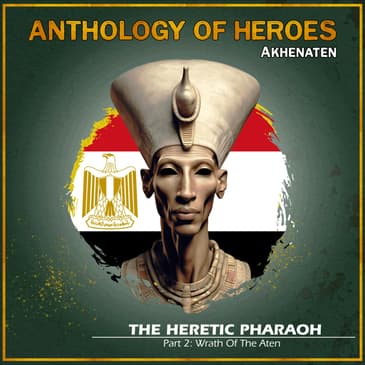
"The Gods had turned their backs on this land" - Tutankhamun's Restoration Edict
In part two of our series, we delve into the downfall of Akhenaten, The Heretic King.
As Akhenaten's religious reforms shake the very foundations of his kingdom, the Pharaoh lashes out at his citizens, closing temples and destroying statues of traditional Gods.
Isolated and alone, Akhenaten's actions become increasingly bizarre as he embarks on an incestuous relationship with two of his daughters and ostracizes his allies.
We explore Akhenaten's downfall, the role Nefertiti played, and the mysteries surrounding Smenkhkare, his successor.
Finally, we follow the footsteps of Tutankhamun as he scrubs his father's reforms from history and erases any record of his rule.
Join us as we unravel the tensions, complexities, and enduring legacy of history's first "individual," whose personality oozes through the dusty passages of time.
Learn more about your ad choices. Visit megaphone.fm/adchoices
[00:00:00] What is new everyone?
[00:00:02] Welcome back to another episode of Anthology Of Heroes, the podcast sharing the true stories
[00:00:07] of figures who shaped our world.
[00:00:09] Have you ever wondered why we know so little about Tootin Carmen?
[00:00:14] I mean, think about it, the most famous pharaoh of all, the only fully intact tomb
[00:00:19] ever discovered, overflowing with the most spectacular treasure.
[00:00:23] But look up who his father is or even his mother and the family tree turns into a
[00:00:28] spreadsheet.
[00:00:29] And it only gets weirder from there.
[00:00:31] Turns out Tootin Carmen wasn't even his real name.
[00:00:35] In this episode, we're going to find out why.
[00:00:38] We're about to journey into one of the darkest, murkiest periods of Egyptian history,
[00:00:43] the downfall of Akhenaten, the heretic king.
[00:00:47] This is a proper ancient Egyptian mystery that at this very moment is still being
[00:00:52] deciphered. To this day, archaeologists are digging around in the ruins of
[00:00:56] Akhenaten, looking for that one little scrap of evidence that will finally,
[00:01:01] definitively solve the mystery of what happened to the heretic pharaoh and how
[00:01:05] Tootin Carmen ended up on his throne.
[00:01:08] In this episode, we're going to get into it.
[00:01:10] We're going to talk about Akhenaten's completion of his city, Akhenaten.
[00:01:14] We're going to talk about his growing paranoia and his dictatorial state he
[00:01:17] created, his persecution of the traditional gods and goddesses, his incestuous
[00:01:23] relationship with his daughters.
[00:01:25] We'll explore the public's attitude towards his new religion, the disgrace of
[00:01:29] his queen, Nefertiti and the advancement of his supposed male lover,
[00:01:33] his mysterious death and the rise of his unknown successor, Smenkakari.
[00:01:38] Finally, we'll see his memory raised and damned for all eternity.
[00:01:42] Tootin Carmen's restoration of the status quo and the unique legacy this
[00:01:47] pharaoh left behind.
[00:01:49] This is part two of our series.
[00:01:51] In part one, we did the rediscovery of Akhenaten, his early childhood and
[00:01:56] the first few years of his rule.
[00:01:58] That episode focused on his father, Amano Tep III, but his story ties
[00:02:02] directly into his son, so it's worth listening to that one first.
[00:02:06] As a warning, this episode discusses incest and the sexual exploitation
[00:02:10] of children.
[00:02:12] So grab your tools and let's get digging.
[00:02:14] Akhenaten, The Heretic Pharaoh, Part Two, Wrath of the Aten.
[00:02:25] I'm Ken Horbaugh, host of Warriors in Their Own Words, a podcast that
[00:02:29] presents the unvarnished, unsanitized truth of what we have asked of those
[00:02:33] who defend this nation.
[00:02:35] As a country, we need these stories more than ever.
[00:02:38] Stories from Americans who have borne the battle, including 30-year-old
[00:02:42] remastered interviews with veterans from World War I recounting their
[00:02:46] time in the trenches of Europe and with veterans from World War II,
[00:02:49] Korea, Vietnam, and from our most recent conflicts in Iraq, Afghanistan,
[00:02:54] and other battlefields Americans may never have heard of.
[00:02:58] Hear their stories by listening to Warriors in Their Own Words,
[00:03:01] wherever you find podcasts.
[00:03:05] History is the greatest adventure story, but does it ever leave
[00:03:09] you wondering what the women were doing all that time?
[00:03:13] This is Laurie from the Her Half of History podcast, and the answer is
[00:03:17] that some women were seizing power or escaping slavery or spying for
[00:03:21] their country or creating artistic masterpieces, while countless others
[00:03:25] were doing the laundry, getting married and wondering why their
[00:03:28] clothes don't have more pockets.
[00:03:30] If you would like to hear the stories of women doing all of those things,
[00:03:34] check out Her Half of History at herhalfofhistory.com or wherever
[00:03:37] you get your podcasts.
[00:03:42] In his golden chariot, Pharaoh Akhenaten rode through the slumbering
[00:03:46] streets of Akhetaten, the new capital of his kingdom.
[00:03:50] The journey had become something of a ritual for the pharaoh.
[00:03:53] The recently paved Royal Road ran perpendicular to the Nile, and each
[00:03:58] morning the pharaoh would make this journey, mimicking the sun or
[00:04:02] the Aten's path across the horizon.
[00:04:05] The Aten was the favoured and only god of Pharaoh Akhenaten,
[00:04:10] and this city had been built entirely in its honour.
[00:04:13] The budding religion had a bureaucracy, a priesthood and a
[00:04:16] brand new set of hymns and prayers.
[00:04:19] But how many converts did it have?
[00:04:21] Wrenching the public away from their traditional gods had been
[00:04:24] harder than expected, and the powerful priesthood of Amun had been
[00:04:28] a thorn in the pharaoh's side ever since he took office.
[00:04:32] Akhenaten had uprooted a millennia of tradition and upset some
[00:04:35] very powerful people, so now swarms of bodyguards jogged
[00:04:40] alongside his chariot, keeping a lookout for anyone who may
[00:04:42] seek to harm their paymaster.
[00:04:45] His chariot passed the Great Aten Temple, where on the outer
[00:04:49] walls, high priests were chiselling his newly devised prayer
[00:04:53] to the Aten.
[00:04:55] Try and imagine this half-built city with its sweltering open
[00:04:58] air temples bustling with activity and the proud
[00:05:01] twenty-something pharaoh riding past as you listen to this
[00:05:05] three thousand three hundred year old prayer.
[00:05:08] I've swapped out a few birth names to king names so it's
[00:05:10] easy to understand, quoting the great hymn of Aten.
[00:05:14] Oh living Aten, the creator of life, when you rise on the
[00:05:18] eastern horizon you fill every land with your beauty.
[00:05:22] High over every land you're raising compasses of lands.
[00:05:25] How manifold are your deeds, though hidden from sight?
[00:05:29] Soul God, apart from whom there is no other, you created
[00:05:32] the earth according to your desire when you were alone.
[00:05:36] You are my desire and there is no other who knows you
[00:05:39] except for your son, Akhenaten, for you have
[00:05:43] apprised him of your designs and your power.
[00:05:46] When you rise, everything grows for the king and for
[00:05:50] everyone who hastens on foot, because you have
[00:05:52] founded the land and you have raised them for your
[00:05:54] son, who has come forth from your body, the
[00:05:57] king of upper and lower Egypt, master of regalia,
[00:06:01] Akhenaten, the long lived and the foremost
[00:06:05] wife of the king whom he loves, the mistress of
[00:06:08] two lands, Nefertiti, living young forever and ever.
[00:06:16] Inside his temples, mounds of fruit and meat sat
[00:06:19] spoiling in the sun, swarming with flies,
[00:06:22] offerings to nourish the hungry Aten on his
[00:06:25] daily journey across the horizon.
[00:06:27] The Aten had its fill, as did the scribes and
[00:06:30] priests and anyone else connected to the cult
[00:06:32] of Aten. But what of the common people?
[00:06:36] Far away from the royal road cramped into the
[00:06:38] corner of the valley was the city of Akhetaten.
[00:06:42] At around 200 square kilometres, 77 square miles,
[00:06:46] Akhenaten's new capital hummed with life.
[00:06:49] This squalid shanty town was home to somewhere
[00:06:52] between 20 and 50 thousand civilians, mostly
[00:06:56] labourers shipped in from all across Egypt to
[00:06:58] help construct the new city.
[00:07:01] The government buildings were laid out in a
[00:07:02] modern grid formation, but the workers' city
[00:07:05] was a hodgepodge mess.
[00:07:07] Swept to the side of the plateau like dirt,
[00:07:09] there were no piles of fruit, meat or even
[00:07:12] basic public services for these people.
[00:07:14] From their battered skeletons, we know that
[00:07:16] they lived short, tough lives.
[00:07:19] Were these people planning to live in the
[00:07:21] city once it had been built?
[00:07:22] Or did they have a family to return to?
[00:07:25] I suppose it didn't really matter.
[00:07:26] The backbreaking nature of their labour meant
[00:07:29] most would never leave.
[00:07:31] Mornings bent over steaming furnaces and
[00:07:33] afternoons hauling heavy stones.
[00:07:35] About half died in their teens and almost
[00:07:38] all were dead by 35.
[00:07:41] But at least in the service of the Aten, they
[00:07:43] had an afterlife to look forward to, right?
[00:07:47] We've got no record of how these labourers
[00:07:49] felt about the new religion.
[00:07:50] One crude bit of graffito found inside a
[00:07:53] commoner's house seems to indicate a man was
[00:07:56] trying to invoke the power of the Aten
[00:07:58] inside his house, proving that he either
[00:08:00] did not understand that only Akhenaten
[00:08:03] could worship the Aten or more likely he
[00:08:05] wanted to go directly to the god and skip
[00:08:08] the pharaoh.
[00:08:09] Both scenarios, we can imagine, would not
[00:08:11] have pleased Akhenaten.
[00:08:13] Had every citizen of Akhetaten tried
[00:08:15] something like this?
[00:08:17] Was the plethora of Akhenaten's propaganda
[00:08:20] that they themselves were writing slowly
[00:08:22] being observed by these workers?
[00:08:25] Small statues of both Akhenaten and
[00:08:27] Nefertiti have been recovered from the
[00:08:29] ruins and from the size and quality of
[00:08:31] them, we can guess that they were
[00:08:32] created for veneration in home shrines.
[00:08:35] Were these statues the pharaohs attempt
[00:08:37] to re-educate the commoners on how to
[00:08:40] correctly worship?
[00:08:41] Or far away from the great Aten temple
[00:08:44] masked by the din of the blacksmith
[00:08:46] hammer did the commas snigger at the
[00:08:48] stupidity of the pharaoh and his new
[00:08:50] religion.
[00:08:51] Maybe they were confused by it.
[00:08:53] Never before in their history had
[00:08:55] they been told to worship just one
[00:08:57] god.
[00:08:58] Whatever their reason, converts weren't
[00:09:01] forthcoming and the pharaoh was
[00:09:03] displeased.
[00:09:04] Akhenaten could play make believe in
[00:09:06] his perfect city, but in the old
[00:09:08] capitals in Memphis or Thebes, the
[00:09:10] old gods Amun, Hathor and Ra had been
[00:09:14] bloodied but not vanquished.
[00:09:17] Apart from the men he'd elevated to
[00:09:19] positions of power there were precious
[00:09:20] few people with flesh in the game in
[00:09:22] his new religion and by the tenth
[00:09:24] year of his reign Akhenaten seemed
[00:09:26] to realise he was fighting a losing
[00:09:28] battle.
[00:09:29] Changing the demographics of society at
[00:09:31] such a core level was near impossible
[00:09:34] in such a short amount of time.
[00:09:36] His father's religious reforms took
[00:09:38] place over 39 years and they were far
[00:09:41] milder than this.
[00:09:42] Akhenaten had tried to force the
[00:09:44] population of his entire empire to an
[00:09:46] accepted almost complete overhaul of
[00:09:49] their world in less than a decade.
[00:09:52] But he wasn't to be deterred.
[00:09:54] Isolated in his great royal palace
[00:09:56] where the floors were paved with
[00:09:58] images of his enemies, the heretic
[00:10:00] king schemed furiously.
[00:10:02] He was about to show every citizen,
[00:10:04] from slave to high priest, that there
[00:10:06] was no shadow their gods could hide in.
[00:10:09] He'd given them all the chance to
[00:10:11] bask in the glow of the Aten.
[00:10:12] They had refused and now they'd be
[00:10:15] scorched by it.
[00:10:17] From Memphis to Thebes and all down
[00:10:19] the twisting deltas of the Nile,
[00:10:21] Akhenaten's agents arrived in
[00:10:22] force.
[00:10:24] Craftsmen flanked by the pharaoh
[00:10:26] thugs stomped down into city
[00:10:27] squares and temples.
[00:10:29] Some carried hammers, others
[00:10:31] chisels, but all were there for the
[00:10:32] same reason.
[00:10:34] Citizens of the kingdom could only
[00:10:36] watch open mouthed as the pharaoh's
[00:10:38] men began destroying statues of
[00:10:40] their gods.
[00:10:41] Head in hands they watched the
[00:10:43] slender figure of Hathor, Tita
[00:10:45] and Smash as the thugs hammered her
[00:10:48] into dust.
[00:10:49] The proud handsome face of Osiris
[00:10:51] beaten and hacked away.
[00:10:53] Never before had Egypt experienced
[00:10:55] anything like this.
[00:10:57] No island was too remote, no shrine
[00:10:59] too distant and no tomb too sacred.
[00:11:01] Wherever they could be found the old
[00:11:03] gods were brutalized and destroyed
[00:11:05] under the direct orders of Akhenaten.
[00:11:08] The public outcry must have been
[00:11:10] ear splitting but the heretic pharaoh
[00:11:12] was not done yet.
[00:11:13] It was not enough to dispel the
[00:11:15] gods.
[00:11:16] Akhenaten wanted to rewrite history
[00:11:18] and pretend they never existed at
[00:11:20] all.
[00:11:21] Hieroglyphics that used the Egyptian
[00:11:23] word for God in plural form were
[00:11:26] re-chiseled into singular form.
[00:11:29] Akhenaten's hit squad were illiterate
[00:11:31] but it didn't matter.
[00:11:32] He'd drawn for them a list of
[00:11:33] hieroglyphics to look out for and
[00:11:35] what to recast in their place.
[00:11:37] Priests who dared to protest were
[00:11:39] beaten and those that hid statues
[00:11:41] faced execution.
[00:11:43] There was virtually nothing anyone
[00:11:45] could do.
[00:11:46] Power was held so tightly at the
[00:11:47] top that any rebellion would have
[00:11:49] been over before it began.
[00:11:51] The population could only watch in
[00:11:53] horror as men shimmied up obelisks
[00:11:55] and chiselled off references to
[00:11:56] their gods.
[00:11:58] It must have seemed like the ends
[00:11:59] of the world.
[00:12:01] No longer content with the Aten
[00:12:03] being the supreme god,
[00:12:05] Akhenaten was now insisting it was
[00:12:07] the only god.
[00:12:09] For the first time in Egypt and
[00:12:10] very likely the first time in the
[00:12:12] history of humanity,
[00:12:14] someone had decreed that only a
[00:12:16] single god existed.
[00:12:18] A claim that would, much later,
[00:12:20] become the dominating view of many
[00:12:22] world religions.
[00:12:23] But there was nothing prophetic
[00:12:24] about the pharaoh's claim.
[00:12:27] Perhaps he really did believe his
[00:12:28] own propaganda, but the fact remains
[00:12:31] it was a religion about him.
[00:12:33] Citizens only need to gaze up at
[00:12:35] the murals to understand the
[00:12:36] king's vision for them.
[00:12:38] The Aten, who, remember, had
[00:12:40] merged with Akhenaten's father,
[00:12:42] bathed light on the royal family
[00:12:44] and they, the public,
[00:12:45] worshipped the pharaoh.
[00:12:47] As his propaganda made it clear,
[00:12:49] the Aten's will could only be
[00:12:51] understood by him.
[00:12:53] Akhenaten had driven a wedge
[00:12:54] between people and the divine,
[00:12:56] a wedge that only he could fill.
[00:12:59] A cult of personality with
[00:13:00] a religious twist.
[00:13:02] To replace the images that his
[00:13:03] thugs had smashed,
[00:13:04] the pharaoh's craftsmen tooled
[00:13:06] away on new figures and statues.
[00:13:09] Most of these hated images are
[00:13:10] now lost to history,
[00:13:11] but a few survive.
[00:13:13] As in the case of Hitler
[00:13:14] showing himself with a puppy
[00:13:16] or Kim Jong-un running arm in
[00:13:17] arm with children,
[00:13:19] Akhenaten wanted to show off
[00:13:20] his softer side.
[00:13:22] In one statue, he sits on a
[00:13:23] chair with his first wife,
[00:13:25] Kia, sitting on his lap.
[00:13:27] Another shows the royal couple
[00:13:29] relaxing with their daughters.
[00:13:31] Akhenaten cuddles Meritaten.
[00:13:33] Meketaten bounces on Nefertiti's lap
[00:13:36] while Anka's son, Partan,
[00:13:37] grabs at her mother's earring.
[00:13:39] Nefertiti was almost as
[00:13:41] instrumental to the religion
[00:13:42] as Akhenaten himself.
[00:13:44] And making the situation even
[00:13:46] stranger is the fact that
[00:13:47] Nefertiti bore Akhenaten
[00:13:49] no sons.
[00:13:51] For most pharaohs,
[00:13:52] this would be a source of shame,
[00:13:53] but Akhenaten went to
[00:13:54] unprecedented heights
[00:13:56] acknowledging his daughters,
[00:13:57] each of them having their own
[00:13:58] little temple at Akhetaten.
[00:14:01] The pharaohs seemed to love
[00:14:02] his daughters more than most,
[00:14:04] though perhaps this love
[00:14:06] was not the paternal type.
[00:14:09] In Egyptian mythology,
[00:14:10] many gods and goddesses
[00:14:11] married their siblings.
[00:14:13] Pharaohs constantly tried
[00:14:14] to emulate the gods,
[00:14:15] so brother-sister marriages
[00:14:17] were fairly common
[00:14:18] and not really taboo.
[00:14:20] Father-daughter relationships,
[00:14:21] though, were virtually
[00:14:23] unprecedented.
[00:14:25] Egyptologist and archaeologist
[00:14:27] Nicholas Reeves
[00:14:28] concurs with many other
[00:14:30] historians who believe
[00:14:31] Akhenaten was having sex
[00:14:32] with at least two
[00:14:34] of his six daughters.
[00:14:35] One of these affairs
[00:14:36] seems to have resulted
[00:14:37] in a stillborn child,
[00:14:39] while another probably
[00:14:40] killed his daughter,
[00:14:41] Meketaten, during childbirth.
[00:14:44] If these relationships
[00:14:45] were publicised,
[00:14:46] the revulsion felt by
[00:14:48] the Egyptian population
[00:14:49] would have been similar
[00:14:50] to our own in the 21st century.
[00:14:52] This was not common.
[00:14:54] The only other recent example
[00:14:56] of father-daughter incest was,
[00:14:58] again, Akhenaten's father,
[00:15:00] Amanotep III.
[00:15:02] As for reasons why,
[00:15:04] the prevailing theory
[00:15:05] for these affairs is that
[00:15:07] by year 10 of his reign,
[00:15:09] Nefertiti was probably
[00:15:10] past child-rearing age.
[00:15:12] The couple had undoubtedly
[00:15:14] tried for a male heir,
[00:15:15] but six daughters later,
[00:15:16] their time had run out.
[00:15:18] Akhenaten did have a son,
[00:15:20] but it was through
[00:15:21] his first wife, Kia,
[00:15:22] a woman who had either died
[00:15:24] or been removed from court
[00:15:25] at this point.
[00:15:26] Does that mean that Nefertiti,
[00:15:29] a figure so often associated
[00:15:31] with femininity and beauty,
[00:15:32] proposition Akhenaten
[00:15:34] to have sex with their daughter
[00:15:35] to ensure her offspring
[00:15:37] would continue ruling?
[00:15:39] It's a dark
[00:15:40] and pretty sickening question
[00:15:42] and one we'll probably
[00:15:43] never have a clear answer to.
[00:15:45] Likewise, there's the question
[00:15:46] as to what these two young women
[00:15:47] were forced to go through,
[00:15:49] all at the sick desires
[00:15:50] of their father and possibly
[00:15:52] their mother too.
[00:15:54] I can't help but wonder
[00:15:55] how indoctrinated were they?
[00:15:57] Did they believe
[00:15:58] what they were doing was
[00:15:59] for the will of the Aten?
[00:16:02] By year 12 of his rule,
[00:16:04] Akhenaten and Akh-Taten
[00:16:06] were unravelling.
[00:16:08] Temples to the traditional gods
[00:16:10] were closed
[00:16:10] and falling into disrepair,
[00:16:12] leading to tens of thousands
[00:16:14] of priests and scribes
[00:16:16] out of work and destitute.
[00:16:18] Without these core institutions,
[00:16:20] the commonists suffered.
[00:16:22] Festivals and holidays
[00:16:23] vital to keep the masses happy
[00:16:24] had ceased,
[00:16:25] and in their place was a confusing,
[00:16:28] unrelatable religion
[00:16:29] that few people really
[00:16:30] felt attached to.
[00:16:32] The construction of Akh-Taten
[00:16:34] now had Egypt teetering
[00:16:35] on bankruptcy
[00:16:37] and foreign kings waited,
[00:16:38] licking their lips
[00:16:39] for the impending collapse
[00:16:40] of the all-powerful Egyptian state.
[00:16:43] In these troubled times,
[00:16:44] a forlorn priest of Amun named
[00:16:46] Pa-wa scribbled down a prayer
[00:16:48] on a scrap of parchment
[00:16:49] and tucked it away into a doorway,
[00:16:51] where it lay for 3,000 years
[00:16:53] before being rediscovered in 1893.
[00:16:57] Crying out to Amun,
[00:16:58] he wrote, quote,
[00:16:59] Come back to us,
[00:17:01] O Lord of continuity.
[00:17:03] You were here before anything
[00:17:04] had come into being,
[00:17:05] and you will be here
[00:17:06] when they are gone.
[00:17:08] As you have caused me
[00:17:09] to see the darkness
[00:17:10] that is yours to give,
[00:17:11] make light for me
[00:17:12] so that I may see you.
[00:17:14] As your car,
[00:17:15] meaning your essence,
[00:17:16] endures
[00:17:17] and your handsome beloved face endures,
[00:17:19] may you come from afar
[00:17:20] and allow this servant,
[00:17:22] the scribe Pa-wa, to see you.
[00:17:24] O Amun,
[00:17:25] O great Lord
[00:17:26] who can be found by seeking him,
[00:17:28] may you drive off fear,
[00:17:30] sit rejoicing in people's hearts.
[00:17:33] Joyful is the one who sees you,
[00:17:35] O Amun.
[00:17:37] Coming up on 5 Minute News,
[00:17:41] I'm Anthony Davis.
[00:17:43] You might think it's partisan
[00:17:45] because maybe it's crazy
[00:17:46] because maybe it's critical
[00:17:47] of one side or the other,
[00:17:49] but it's not.
[00:17:50] It's just the truth.
[00:17:51] And I think that's also something
[00:17:52] that's kind of unusual
[00:17:53] for Americans listening to the radio
[00:17:56] or to podcasts
[00:17:57] because the news landscape
[00:17:59] in the States
[00:18:00] has been so partisan
[00:18:02] for so many decades.
[00:18:04] So 5 Minute News is verified,
[00:18:07] truthful, independent, unbiased
[00:18:09] and essential world news
[00:18:12] daily.
[00:18:14] Hello,
[00:18:15] this is Gary Chahot welcoming you
[00:18:17] to check out the French History Podcast.
[00:18:19] Our main show covers the history of France
[00:18:21] from the first humans until present.
[00:18:24] If you like Mike Duncan's
[00:18:25] The History of Rome
[00:18:26] and wanted a similar program
[00:18:28] covering the land of beauty,
[00:18:30] culture and love,
[00:18:31] we are exactly that.
[00:18:33] We also host world-renowned scholars
[00:18:35] who have delivered guest episodes
[00:18:37] on their specialties
[00:18:38] including 18th century pirates,
[00:18:41] revolutionary booksellers
[00:18:43] in 20th century Paris,
[00:18:45] the special friendship
[00:18:46] between the Marquis de Lafayette
[00:18:47] and Thomas Jefferson
[00:18:49] and numerous others.
[00:18:51] Learn what you love
[00:18:52] and listen to the French History Podcast today.
[00:19:01] By the end of Arkinaten's 12th year of rule,
[00:19:04] something very strange happened.
[00:19:07] Nefertiti, the royal wife
[00:19:09] who had always been integral
[00:19:10] to the cult of Arten
[00:19:12] disappears from the record.
[00:19:14] Always pictured beside her husband
[00:19:16] in similar scale,
[00:19:17] it's hard to read into this
[00:19:18] as anything but scandalous.
[00:19:20] And her replacement confirms it.
[00:19:23] Where Nefertiti once stood,
[00:19:24] hand in hand with Arkinaten,
[00:19:26] someone else stood in her place.
[00:19:28] A man.
[00:19:30] A surviving stelae shows two kings
[00:19:32] of the same height sitting on thrones.
[00:19:35] The secondary king reclines back
[00:19:37] stroking the chin of Arkinaten
[00:19:38] and kissing him on the mouth.
[00:19:41] The evidence seemed to speak for itself.
[00:19:44] The title of great royal wife
[00:19:46] which had only ever been associated
[00:19:47] with Nefertiti now darkly passed
[00:19:50] to their daughter, Meretaten.
[00:19:53] Had Nefertiti been caught up
[00:19:55] in some court drama?
[00:19:56] Perhaps her husband's mad reformation
[00:19:58] had finally pushed her into open rebellion.
[00:20:01] Had she been killed and replaced
[00:20:03] with an unknown male lover of the pharaoh?
[00:20:06] And was Arkinaten the first openly gay
[00:20:08] or bisexual ruler in history?
[00:20:12] In the early 1900s,
[00:20:13] this was a prevailing thought,
[00:20:14] but as the study of hieroglyphics progressed,
[00:20:17] archaeologists blew the case wide open
[00:20:19] and revealed an even stranger truth.
[00:20:23] Something happened around
[00:20:24] the 12th year of Arkinaten's reign.
[00:20:27] We still don't know what,
[00:20:28] but the prevailing theory is that Nefertiti,
[00:20:31] far from being disgraced,
[00:20:33] was elevated to the rank of co-ruler.
[00:20:36] Royal wife had become co-king.
[00:20:39] There was precedent for this.
[00:20:41] The 18th dynasty saw more women
[00:20:43] in power than any other.
[00:20:45] Had Shepsut, the woman king,
[00:20:46] been the best example of this?
[00:20:48] But to make things even more confusing,
[00:20:51] Arkinaten himself disappears soon after this.
[00:20:54] The last solid piece of evidence
[00:20:56] we have for his rule,
[00:20:57] a faded tag attached to a jug of wine,
[00:21:00] references his 17th year on the throne.
[00:21:03] And then, after that, nothing.
[00:21:05] Nothing at all.
[00:21:07] What had happened?
[00:21:07] Had Arkinaten finally lost his mind?
[00:21:10] Was Nefertiti's promotion to co-ruler
[00:21:12] not a power grab,
[00:21:13] but the desperate measure of a government
[00:21:16] fearing total collapse?
[00:21:18] Whatever had happened, Arkinaten was gone.
[00:21:21] And in his place was King Nefertiti
[00:21:24] and a co-king Smenkakari.
[00:21:28] Trying to find anything about Smenkakari
[00:21:30] is like grasping at mist.
[00:21:32] Theories as to who he was,
[00:21:34] if he was a he,
[00:21:35] range from Arkinaten's lover,
[00:21:37] his son,
[00:21:38] or even Nefertiti again.
[00:21:41] Perhaps the queen formally embraced
[00:21:42] a masculine name to help establish her rule.
[00:21:45] Again, there was precedent for this.
[00:21:47] Another theory goes that after the death of Arkinaten,
[00:21:50] Smenkakari was a rival claimant for the throne.
[00:21:54] Perhaps he'd been raised up by a traditionalist
[00:21:56] who didn't want a woman as head of state.
[00:21:58] Whoever he or she was,
[00:22:00] they weren't around for long.
[00:22:02] Two or maximum three years later,
[00:22:05] Smenkakari was gone
[00:22:06] and Nefertiti was probably
[00:22:08] the sole ruler of Egypt.
[00:22:11] What had happened to the heretic king?
[00:22:14] If there's one thing ancient Egypt is famous for
[00:22:17] besides the pyramids,
[00:22:18] it's record keeping.
[00:22:20] Damned as his memory was,
[00:22:21] maybe, just maybe,
[00:22:23] under the shifting sands of Arkinaten
[00:22:25] there's another chest full of clay tablets
[00:22:27] waiting to tell the full story.
[00:22:29] Arkinaten's religious reforms
[00:22:31] emphasised the present and,
[00:22:33] apart from picking the location of his burial,
[00:22:35] he doesn't seem to have given much thought
[00:22:36] to the afterlife.
[00:22:38] But perhaps we can garner a glimpse
[00:22:40] of his frenzied mind
[00:22:41] by the objects found in his tomb.
[00:22:44] Alongside the pharaoh's body
[00:22:46] were two shabtis,
[00:22:47] miniature figurines,
[00:22:49] and next to them,
[00:22:50] two magic bricks dedicated
[00:22:52] not to the Arten,
[00:22:54] but to Osiris,
[00:22:55] the old god of the underworld.
[00:22:57] In his final moments on Earth,
[00:22:59] did Arkinaten's restless soul
[00:23:01] return to the fold?
[00:23:04] In 1906,
[00:23:05] Hugo Winkler,
[00:23:06] a German archaeologist,
[00:23:08] was digging in central Anatolia,
[00:23:10] now eastern Turkey.
[00:23:11] Winkler was no Egyptologist,
[00:23:13] he was instead looking for
[00:23:14] the fabled Hittite capital of Hattusa.
[00:23:18] The Hittites, you'll remember,
[00:23:19] were one of the other power holders
[00:23:21] at the time of Arkinaten
[00:23:22] and his father, Amanatepe III.
[00:23:25] After several months of digging,
[00:23:26] Winkler's crew reported
[00:23:28] an enormous cache of clay tablets,
[00:23:30] almost 10,000 in total.
[00:23:32] Winkler cracked the crate open
[00:23:34] and looked at the language.
[00:23:36] It was one he knew well,
[00:23:37] cuneiform,
[00:23:39] the language of the Amanatepe letters.
[00:23:42] Pouring over the tablets,
[00:23:43] one caught his eye,
[00:23:44] and its contents would turn out
[00:23:46] to be one last tantalising clue
[00:23:48] in the mysterious tale of Arkinaten.
[00:23:51] In a correspondence
[00:23:52] directed to the Hittite king,
[00:23:54] it read, quote,
[00:23:55] My husband died,
[00:23:56] a son I have not.
[00:23:58] But to you they say
[00:23:59] the sons are many.
[00:24:01] If you were to give me
[00:24:01] a son of yours,
[00:24:02] he would become my husband.
[00:24:04] Never shall I pick out a servant of mine
[00:24:06] and make him my husband.
[00:24:08] I am afraid.
[00:24:11] The correspondence was signed
[00:24:13] Dahamanzu.
[00:24:14] Dahamanzu is a new name for us,
[00:24:16] but archaeologists quickly realised
[00:24:18] this was the Hittite pronunciation
[00:24:20] of the Egyptian title
[00:24:22] Tehmetnasu,
[00:24:23] meaning the king's wife.
[00:24:26] Dating these tablets
[00:24:27] narrowed the writer down
[00:24:28] to just two people,
[00:24:29] Tutankhamun's wife,
[00:24:31] Ankasenamun,
[00:24:32] or
[00:24:33] Nefertiti.
[00:24:35] If the queen really did request
[00:24:37] a foreign king to marry her,
[00:24:39] it was a desperate last resort.
[00:24:41] As Amanatep III had once
[00:24:43] told the Mitanni king,
[00:24:44] no daughter of the king of Egypt
[00:24:46] is given to anyone.
[00:24:48] And here was Nefertiti
[00:24:49] not only offering a daughter,
[00:24:50] but inviting a son
[00:24:52] to marry into the Egyptian royal line.
[00:24:55] Inheriting the kingdom of Egypt,
[00:24:58] could there be a greater dowry payment?
[00:25:01] The Hittite king,
[00:25:02] incredulous as he was,
[00:25:03] jumped at the opportunity,
[00:25:05] scrambling an expedition force together
[00:25:06] he duly sent a son as requested.
[00:25:09] But the queen's treachery
[00:25:11] caught up with her.
[00:25:12] The Hittite entourage
[00:25:13] was met halfway
[00:25:14] by an Egyptian governmental force
[00:25:16] and slaughtered.
[00:25:18] If Nefertiti had been Dahamanzu,
[00:25:20] then her treacherous plot
[00:25:22] would be a last act in public office.
[00:25:24] Soon after,
[00:25:25] she too died.
[00:25:28] While the final years
[00:25:29] of our Kanatan
[00:25:30] remain for now a mystery,
[00:25:32] the subsequent years
[00:25:33] are some of the most well documented
[00:25:34] in Egypt's history.
[00:25:36] Akhenaten was gone,
[00:25:37] Nefertiti was gone.
[00:25:39] Whoever Smenkakari had been
[00:25:40] was gone.
[00:25:42] From the lowliest labourer
[00:25:44] to the most refined courtesan,
[00:25:46] almost every person in Egypt
[00:25:48] desired a return to the old ways
[00:25:50] and the old gods.
[00:25:52] Not only that,
[00:25:53] but all wanted this
[00:25:54] blemish on the record
[00:25:55] of their state expunged.
[00:25:57] Akhenaten never reigned
[00:25:59] and Akhetaten never existed.
[00:26:02] The quickest way back to stability
[00:26:04] was a run-of-the-mill pharaoh
[00:26:05] at the helm.
[00:26:07] No unorthodox beliefs,
[00:26:08] no strange representations,
[00:26:10] no father-daughter marriages,
[00:26:11] a boring standard pharaoh.
[00:26:14] Luckily,
[00:26:15] there was one to be found
[00:26:17] and you already know his name,
[00:26:19] Tutankhamun,
[00:26:20] King Tut.
[00:26:22] How Tutankhamun came to be
[00:26:24] is a bit of a mystery.
[00:26:26] He is probably Akhenaten's son,
[00:26:28] but possibly his brother.
[00:26:30] As for his mother,
[00:26:31] no one is really sure.
[00:26:33] A prevailing theory was that
[00:26:34] he was the son of Kya,
[00:26:36] Akhenaten's first wife
[00:26:37] who disappeared from the scene early on.
[00:26:39] Another theory speculates
[00:26:41] that he was the incestuous offspring
[00:26:43] between Akhenaten
[00:26:44] and one of his daughters.
[00:26:45] The boy king certainly had
[00:26:47] some physical defects
[00:26:48] consistent with incestuous co-parenting.
[00:26:51] Whoever's offspring he was,
[00:26:52] he was young and pliable.
[00:26:54] Guided heavily by a council of regents,
[00:26:57] Akhenaten's probable son
[00:26:59] set to work undoing everything
[00:27:00] and anything his father had changed.
[00:27:03] The first to go was his name.
[00:27:06] Like most of Akhenaten's children,
[00:27:07] he was named in honour of the Aten.
[00:27:10] Tutankhamun was the child's birth name,
[00:27:13] a name meaning
[00:27:14] living image of the Aten.
[00:27:16] This was quietly altered
[00:27:18] to Tutankhamun,
[00:27:19] the living image of a moon.
[00:27:22] Up and down the Nile,
[00:27:23] the heavy temple doors
[00:27:24] that had remained closed
[00:27:25] for nearly 15 years
[00:27:26] slowly creaked open.
[00:27:28] Cobwebs were brushed
[00:27:30] from Horus's face
[00:27:31] and the towering statues of Amun-Ra
[00:27:33] were hauled back
[00:27:34] to their places of prominence.
[00:27:36] A flurry of activity gripped Thebes
[00:27:38] as workmen,
[00:27:39] all eager to do their part,
[00:27:41] repaired the temples
[00:27:42] and churned out new statues,
[00:27:44] showing Tutankhamun,
[00:27:45] the boy king,
[00:27:46] sitting proudly beside Hathor and Ra.
[00:27:49] Within the great temple of Amun at Thebes,
[00:27:52] Tutankhamun,
[00:27:53] or more accurately,
[00:27:54] his regents installed a plaque
[00:27:56] that emphasised his part
[00:27:57] in the restoration of the Old World Order.
[00:28:00] Part of which reads, quote,
[00:28:02] When his majesty was crowned king,
[00:28:04] the temples and the estates
[00:28:05] of the gods and goddesses from Elephantine,
[00:28:08] as far as the swamps of lower Egypt
[00:28:10] had fallen into ruin.
[00:28:12] Their shrines had fallen down,
[00:28:13] turned into piles of rubble
[00:28:15] and overgrown with weeds.
[00:28:16] Their sanctuaries were
[00:28:18] if they had never existed at all.
[00:28:20] Their temples had become footpaths.
[00:28:22] The world was in chaos
[00:28:23] and the gods had turned their backs
[00:28:25] on this land.
[00:28:26] Hearts were faint in bodies
[00:28:28] because everything that had been
[00:28:29] was destroyed.
[00:28:31] Now the gods and goddesses of this land
[00:28:33] are rejoicing in their hearts.
[00:28:35] The lords of the temples are in joy.
[00:28:37] The provinces all rejoice
[00:28:38] and celebrate throughout this whole land
[00:28:40] because good has come back into existence.
[00:28:44] By the time of Tutankhamun's death,
[00:28:46] about nine years later,
[00:28:48] almost everything was back to normal.
[00:28:50] Akhetaten,
[00:28:51] the heretic king's treasured capital,
[00:28:53] emptied quickly.
[00:28:55] The towering, great Aten temple
[00:28:57] stood quiet and still
[00:28:59] in the center of the dead city.
[00:29:01] The grass being golden,
[00:29:02] rays of art and still grazed its structure
[00:29:04] and crossed the horizon each day,
[00:29:07] but none were there to welcome them.
[00:29:10] Towards the back of the valley
[00:29:11] in his great royal tomb,
[00:29:13] Akhetaten was interred,
[00:29:14] just as he'd ordered.
[00:29:16] The dead king's lonely sarcophagus,
[00:29:19] the only reminder
[00:29:20] of the so-called Amarna period.
[00:29:23] Over the next few years,
[00:29:24] weeds sprouted in between
[00:29:25] the marble tiles.
[00:29:27] Carian birds made their nest
[00:29:29] in the awnings and locals chipped away
[00:29:31] at the great Aten temple,
[00:29:32] quarrying off stones
[00:29:33] for their own dwellings.
[00:29:36] Years turned to decades.
[00:29:39] The mortar that supported
[00:29:40] the murals of the Aten
[00:29:41] cracked in the hot desert air
[00:29:43] and mosaics of Akhetaten
[00:29:45] and the royal family
[00:29:46] fell from the walls
[00:29:47] and lay forgotten
[00:29:48] on the floors of empty buildings.
[00:29:51] Within a generation,
[00:29:52] few remembered the cult of Aten
[00:29:54] and those that did
[00:29:55] didn't wish to recall it.
[00:29:57] When a future pharaoh
[00:29:58] set out to record every king
[00:30:00] in Egypt's history,
[00:30:01] Akhetaten was skipped.
[00:30:03] When scribes were forced
[00:30:05] to mention his name,
[00:30:06] they referred to him as
[00:30:07] the enemy or that criminal.
[00:30:10] Even this, it seems,
[00:30:12] did not satisfy Egypt's
[00:30:13] loathing of their dead king.
[00:30:15] Sometime later,
[00:30:17] someone snuck back in
[00:30:18] and returned to the ghost city
[00:30:19] to perform one last act
[00:30:21] of indignation
[00:30:22] on the heretic pharaoh.
[00:30:23] Just as he had once done
[00:30:24] to their gods,
[00:30:26] they did to him.
[00:30:27] With hammer and chisel,
[00:30:28] they pried open
[00:30:29] the outer lid of his tomb
[00:30:31] and hacked off his face
[00:30:32] and name from his wooden sarcophagus,
[00:30:34] trapping his soul
[00:30:35] eternally in the mortal world.
[00:30:38] Around 1500 years later,
[00:30:41] after the eternal power of Egypt
[00:30:42] had been eclipsed by another,
[00:30:44] soldiers of the Roman Republic
[00:30:46] camped in the heretic king's
[00:30:48] lonely halls.
[00:30:50] Sheltering from the winds
[00:30:51] of the desert,
[00:30:52] perhaps they lit a fire
[00:30:53] and cooked a stew.
[00:30:55] One legionnaire
[00:30:56] wandered off from the others
[00:30:57] and carved his name
[00:30:58] into the stone entrance hall.
[00:31:00] Perhaps he looked around
[00:31:02] and wondered
[00:31:03] what this place was.
[00:31:05] Religions came and went
[00:31:07] and empires fell,
[00:31:08] until one day
[00:31:09] a French surveyor
[00:31:11] employed in the army
[00:31:12] of Napoleon Bonaparte
[00:31:14] marched past
[00:31:14] the sand-covered ruins
[00:31:16] and noticed the telltale signs
[00:31:18] of large-scale habitation
[00:31:19] in this unmapped corner of Egypt.
[00:31:22] By then, only Bedouin nomads
[00:31:24] inhabited the half-buried ruins
[00:31:26] and they knew nothing
[00:31:27] about its history.
[00:31:28] The French surveyor
[00:31:29] would be the first to map
[00:31:30] the ancient city
[00:31:32] in over 3000 years
[00:31:34] and his sketch
[00:31:35] would generate some interest.
[00:31:37] The grid-style plan of the city
[00:31:38] gave credence
[00:31:39] to the site being one of importance,
[00:31:41] at least at some point.
[00:31:43] Over the next century or so,
[00:31:44] archaeologists would pass
[00:31:46] through the area
[00:31:47] and marvel at their unique frescoes
[00:31:49] and distorted figures,
[00:31:51] at least the ones
[00:31:52] that hadn't been smashed apart.
[00:31:54] But it was only in 1887
[00:31:56] when a peasant woman
[00:31:58] sold a box of clay tablets
[00:31:59] that the story of Akhenaten,
[00:32:01] the heretic king,
[00:32:03] would come to light.
[00:32:06] What can we say about Akhenaten?
[00:32:08] Despised as he was
[00:32:10] during and after his reign,
[00:32:12] he occupies
[00:32:13] a truly special place
[00:32:14] in Egyptian history.
[00:32:15] For a man whose memory Egypt
[00:32:17] was so keen to banish,
[00:32:18] he's one that's proven
[00:32:19] near impossible to forget.
[00:32:22] Visionary,
[00:32:22] innovator,
[00:32:23] despot,
[00:32:24] heretic.
[00:32:26] However you see his rule,
[00:32:27] there's been no shortage
[00:32:28] of special interest groups
[00:32:29] wanting to co-opt his image
[00:32:31] for their own cause.
[00:32:32] Afrocentrists point to him
[00:32:34] as the first of many glorious
[00:32:36] black free thinkers
[00:32:37] whose memory has been
[00:32:39] misappropriated and tarnished
[00:32:40] by white scholars
[00:32:41] in their western agenda.
[00:32:43] Some point out that he was,
[00:32:45] on the world stage,
[00:32:46] a pacifist,
[00:32:47] a man whose only wish
[00:32:48] was to build a utopia
[00:32:50] for his beloved citizens.
[00:32:52] Nazi pseudo-scientists
[00:32:54] also put their claim on the pharaoh,
[00:32:55] inventing a nonsense family tree
[00:32:58] and speculating that
[00:32:58] Akhenaten was
[00:32:59] at least partially Aryan,
[00:33:01] evidenced by the sun worship
[00:33:03] which they claim
[00:33:04] is an old Aryan practice.
[00:33:06] Many claim him
[00:33:06] as the first monotheist,
[00:33:08] the first individual in history
[00:33:10] to promote the worship
[00:33:11] of a single deity.
[00:33:13] Some take it even further
[00:33:14] and claim the hymn to the Arten,
[00:33:16] which we read earlier,
[00:33:17] directly inspired passages
[00:33:19] in the Bible,
[00:33:20] specifically
[00:33:21] Psalms 104, 16-23.
[00:33:25] And psychoanalyst
[00:33:26] Sigmund Freud
[00:33:27] takes to the extreme,
[00:33:28] speculating that
[00:33:29] maybe Moses had served
[00:33:30] Akhenaten as a high priest
[00:33:32] and after the collapse of his reign,
[00:33:34] rehashed his teachings
[00:33:35] to found a new religion.
[00:33:38] Whatever you or anyone else
[00:33:40] believes about him,
[00:33:41] the secret of Akhetaten,
[00:33:43] once buried on the East Bank
[00:33:44] of the Nile,
[00:33:45] has been unearthed permanently.
[00:33:47] And for Akhenaten,
[00:33:49] a man so desperate
[00:33:50] to be remembered and worshipped,
[00:33:52] well, 3,300 years later,
[00:33:55] perhaps the cult of Arten
[00:33:56] is stronger than ever.
[00:33:59] This has been Anthology of Heroes.
[00:34:01] If you've enjoyed this episode,
[00:34:02] please spend just five seconds
[00:34:03] giving us a five-star rating
[00:34:05] on Spotify or Apple podcasts.
[00:34:07] Ratings go a long way
[00:34:08] to entice first-time listeners
[00:34:09] to check out the show.
[00:34:11] Blessed by the Arten would you be
[00:34:12] if you did so.
[00:34:14] Perhaps you'd also consider
[00:34:15] joining our Patreon page.
[00:34:16] We've recently revamped
[00:34:17] our Patreon offerings
[00:34:18] to include some really interesting
[00:34:20] rewards.
[00:34:21] We have a new mini series
[00:34:22] called Quickfire starting soon
[00:34:24] that patrons will get full access to
[00:34:26] and you also get the option
[00:34:27] to read out the outro
[00:34:28] of our episodes
[00:34:29] leaving your little mark
[00:34:31] on the world of podcasting.
[00:34:33] A huge shout out
[00:34:34] to our Justinian-tier patrons,
[00:34:36] Claudia, Angus, John H,
[00:34:38] John K, Sam, Seth and Tom.
[00:34:40] Good on you guys.
[00:34:41] See you on the next one.
[00:34:48] History is complicated.
[00:34:50] The story of human progress
[00:34:52] is long, messy
[00:34:53] and riddled with controversies
[00:34:55] big and small.
[00:34:56] On Conflicted,
[00:34:58] we dive head first
[00:34:59] into history's most infamous events
[00:35:01] and contentious figures.
[00:35:02] We try and untangle
[00:35:04] the good from the bad,
[00:35:05] the facts from the fiction
[00:35:07] and the monsters
[00:35:08] from the misunderstood.
[00:35:10] Was Genghis Khan
[00:35:11] a murderous butcher
[00:35:13] or a civic pioneer?
[00:35:15] Did the allied powers go too far
[00:35:17] in firebombing
[00:35:18] the German city of Dresden
[00:35:19] at the twilight of World War II?
[00:35:22] And how did the Marquis
[00:35:23] de Sade acquire such
[00:35:25] a sinister reputation?
[00:35:26] And was any of it true?
[00:35:28] These are just a few
[00:35:30] of the tough questions
[00:35:31] we wrestle with
[00:35:32] and investigate on Conflicted.
[00:35:34] So if you love history
[00:35:36] or just enjoy a good story,
[00:35:37] please join me,
[00:35:39] your host Zach Cornwell
[00:35:40] for a fascinating new topic
[00:35:42] each and every month.
[00:35:44] Conflicted, a history podcast
[00:35:45] is available on Spotify, Apple
[00:35:48] or wherever else
[00:35:49] you get your podcasts.
[00:35:50] I hope to see you soon.
[00:36:03] The Battle of Waterloo
[00:36:05] was one of the most famous
[00:36:06] turning points in world history.
[00:36:09] But what happened next?
[00:36:11] My name is David Montgomery
[00:36:13] and I'm the host of The Siecle,
[00:36:15] a history podcast
[00:36:16] that tackles exactly that.
[00:36:18] Join me as I cover
[00:36:19] France's overlooked century
[00:36:21] in between Napoleon
[00:36:22] and World War I.
[00:36:24] The Siecle, spelled S-I-E-C-L-E
[00:36:28] is part of the Evergreen
[00:36:29] podcast network
[00:36:30] and can be found
[00:36:31] wherever you get podcasts.