
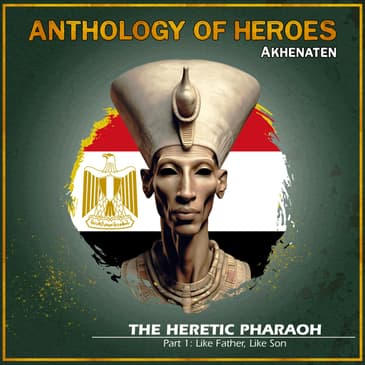
"The Pharaoh's sinister smile seemed to whisper love me… but fear me.."
Embark on a journey into ancient Egypt's shadows with our latest episode, as we delve deep into the enigmatic life of Akhenaten, the heretic pharaoh whose legacy was damned by his own people.
We uncover the intriguing tale of Akhenaten's formative years, shaped under the towering influence of his illustrious father, Amenhotep III.
With the help of The Amarna Letters, we'll untangle the mysteries surrounding Akhenaten's bizarre physical traits and his shocking depiction in royal imagery, foreshadowing the turbulence of his later rule.
As the young Pharaoh's arrogance grows, we witness Akhenaten's defiance against the powerful priesthood of Amun and his audacious vision to revolutionize ancient Egypt.
Finally, we follow The Pharoah in his bold quest to establish a new capital city devoted to the sun god Aten, setting the stage for a monumental upheaval in the ancient world.
Tune in to unravel the dark story of the heretic pharaoh, offering insights into one of history's most fascinating and controversial figures.
Learn more about your ad choices. Visit megaphone.fm/adchoices
Learn more about your ad choices. Visit megaphone.fm/adchoices
[00:00:00] G'day guys, Elliot here. Welcome back to Anthology Of Heroes. It has been a while but I'm glad to say
[00:00:05] I've finally settled back into Melbourne, Australia and managed to dig myself out of the mountains
[00:00:10] of Ikea boxes to get this episode recorded. For any new listeners, in this show we share
[00:00:16] gritty stories of figures and events that changed world history. And today we're coming up blazing
[00:00:21] with a story I've been itching to share with you guys for a long time. If you're listening to a
[00:00:26] History Podcast, I've got a pretty good idea that you're into Ancient Egypt. I know that because
[00:00:32] for many kids, myself included, it was the pyramids and their towering exotic pharaohs that lit the
[00:00:38] spark of interest in history. You can see white, right? An ancient civilization so different from
[00:00:44] ours, one so imposing and advanced that seemed to just vanish beneath the sands, waiting to be
[00:00:50] rediscovered one day. You know one fact that still makes me go wow every time I hear it?
[00:00:55] Cleopatra, the famous queen of Egypt, is closer to our time as in 2024 than she is to the date when
[00:01:03] the great pyramids were initially built. I mean the oldest hieroglyphics we've identified are from
[00:01:08] around 3000 BC. That's 5000 years ago. Egypt was the first real nation state. It lasted for over
[00:01:17] 3,000 years. That's what tripled the duration of the Roman state and so far still longer than
[00:01:24] our own western civilization. Growing up I remember I had one of those big thick DKI witness books,
[00:01:30] you know the ones I mean right? They're full of pictures of huge crumbling temples, brilliantly
[00:01:34] coloured hieroglyphics and bizarre animal headed gods. What kid wouldn't be into that? Flicking
[00:01:40] through the pages there was a famous gold mask of Tutankhamen, the boy king, the towering
[00:01:45] monoliths of Ramses II and the beautiful carved bust of Queen Nefertiti. But there's one figure
[00:01:52] you won't find in those books, a pharaoh named Arcanathan. In fact if the ancient Egyptians had
[00:02:00] that way we would never know he existed at all. Before this pharaoh's body was even cold his
[00:02:07] statues were being smashed to pieces, his religious edicts erased and the very record of his life
[00:02:13] scrubbed from the imperial record. As soon as he was gone it was like everyone just wanted to
[00:02:18] pretend he was never there. Why? What did this man do to warrant such hatred? Did he deserve it?
[00:02:27] Over the course of the next two episodes you'll learn the incredible lost story of pharaoh Arcanathan.
[00:02:33] I promise you this is a wild one full of incest, religious cults, body dysmorphia,
[00:02:39] lost temples, vanity and above all power. It's also an unfinished story because of how
[00:02:46] intensely his memory was damned there are tons of gaps in Arcanathan's story. Gaps that every
[00:02:52] specialist group you can think of has slotted into fill. Arcanathan has been called the first gay man,
[00:02:59] the first monotheist, the first trans person, a role model for modern families and the patron
[00:03:05] saint of pedophiles. He's inspired the works of feminist artist Frida Kahlo and has been a
[00:03:10] point of fascination for psychoanalyst Sigmund Freud who speculated that the pharaoh had
[00:03:16] been a mentor for the biblical figure Moses. Afrocentrists point to him as a missing link to
[00:03:21] forgotten deeds of black Africans while Nazis declare him a partial Aryan, a forefather of their
[00:03:28] racial purity policies. There are people who point to him as the first communist, a man who envisioned
[00:03:34] a new utopia for his people but just as many others would describe his vision more akin to
[00:03:39] that of Kim Jong-il's dystopian North Korea. By the end of this series whatever you think
[00:03:45] of him I think you'll agree with Egyptologist James Henry Breasted who called him the first
[00:03:50] individual in history. For a person we know only by fragments of statues and chips of
[00:03:57] smashed tablets his personality oozes through the dusty passages of time. This is going to be a
[00:04:03] two-part series, the first episode is going to focus predominantly on the rediscovery of this
[00:04:08] pharaoh and of his father Amano Tep III. To know Arcanathan you've really got to know his
[00:04:13] dad because the son's rule was in many ways the evolution of his father's vision just cranked up
[00:04:20] to 11. For this episode we're lucky enough to have some primary sources, a collection of clay
[00:04:26] tablets collectively referred to as the Amano Letters that record communication between Amano
[00:04:32] Tep III, Arcanathan and neighboring kings. I found these tablets so interesting because some of
[00:04:38] them are just so so petty. They were written thousands of years ago in a language that died
[00:04:44] out long ago but the contents of them wouldn't look out of place in a Reddit comment section today.
[00:04:50] Ego, sex, threats and squabbling over money we really never do change do we?
[00:04:56] As a warning this episode makes passing references to incest. So let's get started.
[00:05:02] The story of the most hated man ever to rule ancient Egypt.
[00:05:06] Arcanathan, the heretic pharaoh. Part one like father like son.
[00:05:16] Now's the time to start your next adventure behind the wheel of an exciting new Toyota Hybrid.
[00:05:21] With the largest lineup of hybrid plug-in hybrid and electrified vehicles to choose from,
[00:05:26] Toyota has the one for you. Every new Toyota Hybrid comes with Toyota Care
[00:05:31] two-year complimentary scheduled maintenance, an exclusive hybrid battery warranty and Toyota's
[00:05:36] legendary quality and reliability. Visit your local Toyota dealer today. Toyota, let's go places.
[00:05:42] See your local Toyota dealer for hybrid battery warranty details.
[00:05:49] I'm Ken Harbaugh host of the new Medal of Honor podcast from Evergreen Podcasts
[00:05:53] brought to you in partnership with the National Medal of Honor Museum.
[00:05:58] In each three-minute episode we'll learn about a different service member who distinguished
[00:06:02] him or herself through an act of valor. We'll include stories from the civil war to Iraq and
[00:06:07] Afghanistan and from all branches of the military. We'll talk about service members
[00:06:12] who were overlooked for the medal at first due to their race or religion and about those
[00:06:17] who were celebrated at the time. We'll hear stories of soldiers like Audie Murphy,
[00:06:22] future Hollywood star who mounted a burning tank to hold off German infantry in World War II,
[00:06:28] and people like Dr. Mary Edwards Walker, a Civil War Army doctor and the only woman to
[00:06:33] receive the Medal of Honor so far. Learn about these heroes and more wherever you get your podcasts.
[00:06:41] It's the year 1887 in a mud bank on the east side of the Nile River, a peasant digger at the sandy soil.
[00:06:52] Behind her a wooden cart piled high with slabs of mud brick,
[00:06:57] ancient building material that made excellent fertilizer. Little did that woman know
[00:07:03] that 3200 years ago in that very spot stood an ancient post-war war.
[00:07:09] This spot stood an ancient post office in an Egyptian city unlike any other.
[00:07:15] As the wind whipped up the sands, the woman pulled her headscarf down to shield her eyes
[00:07:20] just as a shovel hit something hard and hollow. It wasn't mud brick. Her heart stopped dead
[00:07:26] as she excitedly dug at the ground heaving up a wooden box, a box that hadn't been touched
[00:07:32] by human hands for over three millennia. Her mind raced as she dragged the heavy
[00:07:37] chest from the earth. What lay inside? Gold, silver, jewels? But as she ripped the ancient
[00:07:44] lid from its hinges her heart sank. Blocks. Old clay blocks with strange triangles drawn on them.
[00:07:53] Pulling out the first layer and peering beneath was just as disappointing. Every one of them looked
[00:07:58] the same. With a heavy heart she tossed the tablets back into her cart. Many broke but
[00:08:03] who cares. Whatever they were they didn't look valuable and they certainly weren't gold.
[00:08:09] Perhaps she'd get a few pennies for them at the market. As she kept digging for the mud brick,
[00:08:14] the woman had no idea that in the back of her cart lay the key to illuminating the darkest
[00:08:18] chapter in Egyptian history. A period that modern historians call the Amana period.
[00:08:26] By the turn of the 20th century Egyptology had come a long way. The discovery of the
[00:08:31] Rosetta Stone had paved the way for the reading of hieroglyphics. While the unearthing of the enormous
[00:08:38] Abus symbol temple had lit Europe on fire. The discovery seemed endless. Almost every day
[00:08:45] another enormous immaculate statue was hauled from the grounds of this ancient land.
[00:08:51] All around Europe but especially in France and England, rich young men left the comfort
[00:08:56] of their chateaus and flocked to the mysterious land of Egypt. Never since the crusade had so many
[00:09:02] rich Europeans departed into Muslim lands in such great numbers. All wanting to carve their name
[00:09:08] in the history books, their destination was usually two places. The mouth of the Nile,
[00:09:13] where under the shade of the pyramids and the watchful gaze of the Sphinx they could
[00:09:17] search for fame in the ruins of Memphis or Giza. Or the southern city of Luxor where the
[00:09:24] Middle Temple's kingdom capital of Thebes once stood. But what lay in between? In 1799,
[00:09:32] when Napoleon's soldiers trampled through Egypt, one of his cartographers was taken by a sprawling
[00:09:37] ruin on the east bank of the Nile. Located seemingly in the middle of nowhere was a large,
[00:09:44] well-planned city that he guessed may have housed up to 50,000 people at one point.
[00:09:49] The nomads squatting at it called it Amarna after their clan name but none had any cluess to the
[00:09:56] history of it. Smack bang in the middle of the traditional northern and southern capitals of
[00:10:01] ancient Egypt, the city seemed purpose-built and when the sun's delicate rays reached over
[00:10:06] the crumbling yellow cliffs it all but confirmed it. The city was put here for a reason.
[00:10:12] After sketching what became the very first map of the city, the cartographer and his army
[00:10:17] moved on and for almost a hundred years the forgotten city of Arcatartin lay slumbering,
[00:10:24] its secrets simmering beneath the sands. It was only when in 1887 a local peasant woman sold some
[00:10:31] clay tablets to an antique dealer that interest in the mysterious city was renewed. Sir Flinders
[00:10:38] Petrie, a silvered British archaeologist and pioneer in Egyptology, was tipped off to the
[00:10:44] arrival of several strange crumbling tablets through a friend of his at the Cairo Museum.
[00:10:50] As soon as the aged lord cast his eyes over the tablets he knew they were unusual.
[00:10:56] The language on the Amarna letters, as we'll refer to them going forward, was cuneiform,
[00:11:01] the oldest written language in human history, originating from the modern areas of Iran and
[00:11:07] Iraq. To find something within the borders of ancient Egypt that weren't written in hieroglyphics
[00:11:12] was already unusual but that was just the start of the mystery. Petrie scooped up the tablets and
[00:11:18] bought them before his academic friends who could read cuneiform. They could make out some words
[00:11:23] but told him the dialect was peculiar and varied. Sub-tablets were inscribed in different languages
[00:11:29] including a loan letter in a Syrian dialect known as Harian. Petrie was shocked to learn that
[00:11:35] this was the only long form account of this language ever discovered. Realising now the
[00:11:40] importance of what these tablets could contain Petrie raced through the antique shops of Cairo
[00:11:45] frantically trying to buy up every one of the fragile artifacts and translate them before
[00:11:50] their secrets were lost for good. Once he'd secured as many as he could he took the next
[00:11:54] desert caravan to where they were found and soon arrived at Amarna. Before Petrie's arrival
[00:12:01] there had been speculative interest in the area. Everyone seemed to know that something had stood
[00:12:06] there once but with Petrie's open checkbook one of the first real excavations began. Busying
[00:12:13] himself in the ruins he began sketching what he found and what he saw surprised and disturbed him.
[00:12:19] A seasoned Egyptologist Petrie was used to the usual portraits of Amun Raa the Falcon god,
[00:12:26] Wajit the Snake god or Isis the Divine Protector but these deities were nowhere to be found.
[00:12:33] Likewise the portraits of strong proud athletic pharaohs were missing.
[00:12:38] As the sands of Amarna revealed their ancient secrets the reoccurring find was a portrait of a man.
[00:12:45] At least he thought he was a man though he was no pharaoh Petrie recognised. His skull was long
[00:12:51] and oval shaped like an alien, his lips plump and feminine and his eyes long almost
[00:12:57] arm and shaped slits. In his physique he seemed almost malnourished, he had a sagging
[00:13:03] punch of a stomach, thin arms and calves and wide womanly hips. After a few moments staring into
[00:13:11] the ancient face of the pharaoh perhaps Petrie wished to look away to avert his gaze. The
[00:13:17] pharaohs obscene proportions and sinister smiles seemed to whisper love me but fear me.
[00:13:25] Labours swore in Arabic as they hoisted the enormous statue from its sandy tomb
[00:13:30] as Petrie looked the figure up and down. Who was this person with such a warped body? Were
[00:13:37] these statues accurate representations and even if they were why would a pharaoh choose to betray
[00:13:43] himself in such a way? Accompanying the figure in almost every scene with a small circular disc
[00:13:50] clearly meant to represent the sun and from it came rays of light with peculiar grasping hands and
[00:13:57] fingers many of which clutched an ink the symbol of life. Whatever the circular disc was one thing
[00:14:05] was clear the light it gave was reserved only for this figure and his family. The public who
[00:14:11] were noticeably portrayed with the usual Egyptian anatomy were not worthy of receiving the light
[00:14:17] instead they worship the royal family who in turn worship the disc.
[00:14:23] By the time Petrie returned to Ammanah the news of the stone tablet had made waves.
[00:14:27] Tourists and rubber-neckers flocked to the backwater eager to see this odd looking figure.
[00:14:33] There were no paths set up so they trudged over local crops
[00:14:37] and farmers hoping to reduce foot traffic defaced and destroyed many of the ancient reliefs.
[00:14:43] Petrie's sketches are now the only records of these artifacts that had survived for over three
[00:14:48] millennia. Speculation ran ripe as to what was wrong with this figure did he have some ailment?
[00:14:56] Some speculated that he suffered from Marfan syndrome a condition shared by Abraham Lincoln
[00:15:01] that resulted in slender frames with unusually long wiry limbs. Others insisted it was
[00:15:07] clearly a woman who had wished to look like a man for whatever reason. The truth would soon be
[00:15:13] revealed and it was much stranger than anyone could have imagined.
[00:15:22] Long before the times of Caesar or even Alexander the Great it was the kingdom of
[00:15:27] Egypt that reigned supreme. Like the sands of the desert where its citizens made their home
[00:15:32] the kingdom was almost timeless. Empires rose and fell around it and though occasionally humbled
[00:15:39] the kingdom always rose again. By the time of the 18th dynasty of what historians now refer to as
[00:15:46] the New Kingdom Egypt as a state was already thousands of years old. The 18th dynasty was
[00:15:52] one built on foreign conquest stable government and cultural splendor. Its founder had come
[00:15:58] to power after wrestling control back from a foreign dynasty that had come to dominate Egypt over
[00:16:03] the preceding centuries. In the not too distant past the kingdom of Egypt had teetered on the brink of
[00:16:09] total annihilation. Occupied by foreign rulers and losing most of their territory a succession
[00:16:15] of great warrior kings and queens had fought an outnumbered war and against all the odds
[00:16:21] had reclaimed their ancient throne. A dynasty born in blood. This return of the king moment
[00:16:28] was accompanied by a significant shift in power from the northern capital Memphis to a newer southern
[00:16:34] capital Thebes. Ancient Egypt with polytheistic meaning they worshipped many gods but everyone
[00:16:41] had a deity they favored and for Pharaoh Amano tep the third that god was Amun the creator god
[00:16:48] sometimes he's also called Amun Ra after his merge with Ra the sun god. The sudden elevation
[00:16:54] of Thebes as a national capital had been primarily responsible for the sudden explosion in popularity
[00:16:59] of Amun Ra. It was taken for granted that Amun's favor had been pivotal in their dynasty's success
[00:17:05] in reclaiming the throne and for that the creator god was owed their eternal loyalty
[00:17:10] and there were few as devoted to Amun Ra as Amano tep the third. Pharaoh Amano tep the third
[00:17:17] stood as a pinnacle in an already prosperous dynasty sometimes called Amano tep the magnificent
[00:17:23] we only have to count his surviving statues to know this guy was a big deal the world today
[00:17:28] has more statues of him than any other pharaoh the scale of his building projects too had not
[00:17:33] been seen since the ancient time of the pyramids like reeds and the Nile foreign kings of every
[00:17:39] color and stature bow low before Amano tep the magnificent. His empire shared the world stage
[00:17:45] with a couple of big players Babylon Assyria the Matani and the Hittites to name a few
[00:17:52] and though the rulers of this ancient VIP club referred to each other as brother each of them
[00:17:58] begrudgingly acknowledged Egypt as the jewel in the crown in one of the Amano letters we see King
[00:18:04] Tushrata of the Matani right from his empire in northern Syria to Amano tep the third quote
[00:18:11] for me all goes well for you may all go well for your household for your wives for your sons
[00:18:18] for your nobles for your warriors for your horses for your chariots and in your country may all go
[00:18:22] very well we can easily imagine the oh so uninterested Amano tep the third motioning
[00:18:28] is caught scribed to hurry along as the letter was read out to him waiting for Tushrata to get
[00:18:32] to the point the letter continues quote may my brother send me unworked gold in very great
[00:18:38] quantities and much more gold than he sent to my father in my brother's country gold is as
[00:18:44] plentiful as dirt there it was the tacit acknowledgement that Egypt was richer and therefore mightier
[00:18:51] according to the archaeological record Amano tep the third undeniably possessed a truly staggering
[00:18:57] amount of gold on a single temple a surviving work order shows an order the 3.25 tons of gold
[00:19:05] let alone bronze copper or any other precious stones Amano tep the third lived in a world
[00:19:10] of opulence that was completely alien to the population he ruled vast palace complexes adorned
[00:19:17] with exotic vibrant textures and walls literally covered in frescoes of him arm in arm with the gods
[00:19:24] the trappings of power pervading every corner of his sprawling palaces golden ebony tables that
[00:19:29] hosted an opulent array of intricately blown glass perfume bottles and silver trays overflowing
[00:19:35] with dates figs and jars of honey his sexual appetite to was voracious the imperial harem
[00:19:42] overflowed with women from all over the world including one lovely lady whose name meant
[00:19:48] i promise i'm not making this up she whose nights on the town are numerous
[00:19:55] every one of Amano tep senses was indulged basking in such opulence is easy to understand
[00:20:01] his bold reaction when anyone dared to compare themselves to him as they're equal captured in
[00:20:07] another one of the Amano letters he responds to a request for one of his daughters to marry
[00:20:12] the Babylonian king you can almost hear Amano teps incredulity as he writes quote from time
[00:20:19] a memorial no daughter of the king of Egypt is given to anyone a response which clearly didn't go
[00:20:25] well as the Babylonian king replied quote when i wrote about marrying your daughter in
[00:20:30] accordance with your practice of not giving a daughter you wrote to me saying from time a memorial
[00:20:35] no daughter of the king is given to anyone why not you're a king you do as you please were you to
[00:20:41] give a daughter who would say anything women gold spices slaves all were provided to the great
[00:20:48] pharaoh and if he would grace you with so much as a thank you well consider yourself blessed
[00:20:54] this kind of ego had not sprung up overnight by the year 1383 Amano tep had ruled for over 30 years
[00:21:02] Amun Ra had clearly blessed him with an unusually long life and as he approached his third decade
[00:21:07] of rule the king floored with the idea that he was a cut above pharaohs of the past to celebrate
[00:21:14] his upcoming jubilee he held lavish expensive festivals that sometimes lasted months and while
[00:21:20] the public no doubt loved the day off as much as we do they must have noticed the spectacles were
[00:21:24] becoming just stranger navigating the bustling streets of thebes high priests ceremonially
[00:21:31] paraded statues of Amun the creator god and Ra the falcon headed god of the sky and pressed
[00:21:37] in between them was the image of Amano tep himself sometimes he wore the gods clothing
[00:21:43] other times he took on their aspects their powers a pharaoh underlining his closeness to
[00:21:49] the gods was nothing new the pyramid age was long in the past and without these colossal structures
[00:21:55] to remind the subjects of their subservience pharaohs demonstrated to the subjects their physical
[00:22:00] and spiritual closeness to the gods as a way of proving their right to rule but soon statues
[00:22:05] of the pharaoh progressed past him sitting alongside the gods now it seemed the pharaoh
[00:22:10] wished to be represented as a god pharaohs were understood to be the intermediary between
[00:22:17] the gods and the mortals but Amano tep wanted to be seen as one of them from a young age the
[00:22:23] pharaoh seemed to harbor a bit of an obsession with the cosmos particularly the sun he favored the
[00:22:29] gods or their aspects were related to the sky or the sun amun the creator of the solar system
[00:22:35] moot amun's wife and mother of the world and their son consu god of the moon and if an
[00:22:41] average egyptian citizen stopped to admire one of Amano tep's colossal statues that adorned
[00:22:46] their streets they'd notice not always but sometimes a glowing orb stamped on the king's body
[00:22:53] the orb was known as the artan aten the artan was nothing new for egyptians
[00:23:02] ra was usually pictured with the artan above his head almost like a halo there wasn't all
[00:23:07] that much mythology behind the disc itself and this allowed the pharaoh to construct his own
[00:23:11] narrative it was there where he would return to rule after his sovereignty on earth came to an end
[00:23:19] increasingly Amano tep the third began to identify personally with the artan for a pharaoh that
[00:23:25] blazed brighter than all others it only seemed to make sense to select this symbol to symbolize
[00:23:30] his reign something that his young son arc an artan would have observed as Amano tep the
[00:23:37] third aged his megalomania grew for his chief consort a woman called tea he constructed an
[00:23:43] enormous man-made lake at a hometown his statues sprung up in every major city from memphers to thebes
[00:23:50] to Amano tep there was nothing he could not achieve no challenge too difficult no province
[00:23:55] too distant for his light to reach so much so that he soon added a new title for himself
[00:24:02] the dazzling sun disk high priests found their services altered by the pharaoh to include prayers
[00:24:09] not four but two the artan around the year 1383 bc Amano tep the third celebrated his jubilee
[00:24:18] 30 years on the throne was a momentous and rare achievement and one that only seemed to prove
[00:24:23] his divinity in thebes along the west bank of the Nile a truly lavish procession took place
[00:24:30] this festival had been years in the making no expense was spared like the sun crossing the sky at
[00:24:36] dawn Amano tep and his entourage set off down a stone highway that connected the two enormous
[00:24:41] temples crowds pushed and shoved jostling for a view many who couldn't make the journey to
[00:24:47] the capital instead paid a friend to bring a small statue in hope that the magic of the
[00:24:53] ceremony would rub off in the statue and be transferred to the owner the entire length
[00:24:58] of the road was girded by stone sphinxes over 10 000 in total priests of a moon walked alongside
[00:25:04] the pharaoh throwing out rings bangles and necklaces gifts for the commoners to remember the occasion
[00:25:11] thebes was alive rhythmic drumbeats pulsed in the aroma of incense wafted over the
[00:25:16] procession as heavy statues suspended in litters trailed behind members of the public thronged
[00:25:22] forward jostling for a chance just to touch the stone statues and the pharaoh's personal bodyguards
[00:25:28] looked on their hands on their club for any signs of disobedience Amano tep the third draped in rich
[00:25:34] cottons and silks threaded with gold led the parade ale was passed out freely and as the crowd
[00:25:40] got maria the young arc norton Amano tep's son observed with wide-eyed wonder the flocking
[00:25:48] crowds the sounds the towering temple columns the colors the gold who else but a god could arrange
[00:25:54] such a spectacle this he must have seen was true power and pivotal to it all was the artan
[00:26:02] shining bright in the sky its golden rays stroked the brow of his father as the road ended the
[00:26:08] procession reached an enormous gateway leading to another temple this time the crowd was held
[00:26:13] back from here Amano tep marched on alone one innocent looking fresco painted for the occasion
[00:26:20] even recorded the moment of the pharaoh's divine conception his mother Muhtem Wia and his father
[00:26:27] tap most the fourth in the imperial bed chamber but wait a minute that wasn't tap most it was
[00:26:33] a moon rah dressed up as tap most if picturing the pharaoh's mother copulating with a literal
[00:26:40] god was too subtle for anyone we're uh lucky enough to know that Muhtem Wia really enjoyed the
[00:26:47] encounter as the plaque below tells us quote she awoke because of the god sent and cried out
[00:26:54] with pleasure before his majesty she rejoiced at the side of his beauty and the love of him
[00:26:59] suffused her body by now in a state of ecstasy Muhtem Wia swooned over the god exclaiming
[00:27:05] how great is your power your sweet fragrances stiffen all my limbs after the deed was done a moon
[00:27:11] rah presumably while he waited for his uber told the queen quote Amano tep ruler of thebes is the
[00:27:18] name of this child i have placed in your womb he shall exercise potent kingship in this entire
[00:27:23] land he shall rule the two lands like rah forever through the dimly lit palace Amano tep walked
[00:27:30] to the inner sanctum for an entirely new ritual his personal meeting with his father a moon rah
[00:27:38] after a brief delay having received divine instructions the pharaoh emerged who was adoring
[00:27:43] public on an elevated platform adorned in a dazzling set of new garments the somber and
[00:27:49] serious king who had marched into the temple re-emerged energized sprightly and youthful
[00:27:55] though subtle this change was symbolically profound new statues were unveiled to the public
[00:28:01] and in them Amano tep the third took on a new appearance the pharaoh appeared leaner stronger
[00:28:07] almost reborn cartoon like eyes large lips and high cheekbones graced his continents his face
[00:28:14] his whole person had been rejuvenated from his mystical communion with the god a moon had
[00:28:21] quite literally blessed the pharaoh so close was their bond every bit of this ceremony had
[00:28:27] been preplanned even the material for these new statues were quarried from specifically selected
[00:28:33] red and gold quartzite stones that were known to sparkle and dance in the light the public must
[00:28:39] have shielded their eyes nearly blinded by the dazzling rejuvenated image of their king
[00:28:45] in his statues metaphor and propaganda the message Amano tep the third wish to convey was that
[00:28:50] he had surpassed the role of a king or a pharaoh no longer was he just these people's ruler he
[00:28:57] needed the status of their god the jubilee festival more than any other would have been where the young
[00:29:03] arc nathan would have observed the truly staggering power that one man could wield
[00:29:09] unbeknownst to the drunken crowd the teens observations would later usher in one of the
[00:29:14] darkest moments in their history under the glowing light of the art in
[00:29:20] Amano tep the third would celebrate a second and even a third jubilee festival but none
[00:29:24] would be as grand as the first he may not have wanted to acknowledge it but his kingdom was
[00:29:29] dipping into a recession Amano tep had been an unusually insular ruler for a dynasty that had
[00:29:36] muscled their way back into power he had led exactly zero foreign campaigns and even to his
[00:29:42] vassals he was aloof and distant no foreign booty combined with this obsession with building well
[00:29:49] let's just say money was getting a little tight egypt was the greatest power in the region but that
[00:29:54] didn't mean the pharaoh could sit idle in his ivory tower but an even more pressing issue was
[00:30:00] weighing on his mind for everything that his communion with amun ra had provided him there
[00:30:05] was one thing that he was denied time contrary to the towering youthful athlete shown in his statues
[00:30:13] Amano tep the third was arthritic overweight and old painful abscesses and dry sockets in between
[00:30:20] his teeth put him in a perpetually cranky mood and by the time he hit his mid 40s succession was
[00:30:25] on his mind his heir apparent tutmo's had died at an early age and though Amano tep had many
[00:30:32] wives including two of his own daughters he had only one living son his name was Amano tep the fourth
[00:30:40] but to make things easier to follow we've used and will continue to use the name he's known by today
[00:30:46] arcana as we get into arcana stories there are going to be big chunks that are still missing
[00:30:52] and as you'd expect from a figure so controversial there are many different opinions as to what
[00:30:56] took place in these gaps for the sake of keeping the story moving i'm not going to stop each
[00:31:01] time this happens instead i'll pick the one that makes the most sense as always all the sources
[00:31:06] i've used on our website anyway it seems likely that young arcana and co-ruled with his father for
[00:31:12] some years as the heir apparent the teenager would have needed to catch up quickly we can only
[00:31:18] speculate about how he felt towards his father on a father son level but he certainly must
[00:31:22] have idolized him in the fragments of freezes and statues from this period if the teenager
[00:31:28] harboured any plans for his revolution by this point he kept them to himself depictions and portraits
[00:31:35] followed the royal line fairly normal depictions of the young prince showing him praising a moon
[00:31:41] the first event that arcana and formally resided over with his father's funeral
[00:31:45] like all good pharaohs Amano tep the third had long prepared for his death
[00:31:49] and the same splendor that accompanied him through life would guide his soul back to
[00:31:53] the art and where he would rule fraternity shoulder to shoulder with subjugated vassal kings and weeping
[00:32:00] foreign emissaries arcana and watched a procession of high officials ceremoniously pulling like sled
[00:32:06] dogs the gilded heavy coffin of his father towards his enormous mortuary temple in the valley of the
[00:32:13] kings as a chance and incense faded arcana and found himself as the sole ruler of the most
[00:32:19] powerful kingdom in the world his father's reign had been the most splendid in a millennia
[00:32:26] but arcana had already planned to eclipse it something truly revolutionary was coming to egypt
[00:32:32] we often hear about the individuals who took the oath of office to become the chief executive
[00:32:50] but what about the other people who play a role in each administration are the events that may
[00:32:54] not be as well known but that contribute to the reshaping of the office of the american presidency
[00:33:00] on the president seats of the united states we explore each administration beyond just the person
[00:33:05] holding the high selected office in order to better understand the history that brought us to the
[00:33:09] modern day presidency i hope you'll join me on this journey through the annals of presidential
[00:33:14] history presidencies can be found anywhere fine podcast can be found and is a proud member
[00:33:19] of the evergreen podcast network history is the greatest adventure story but does it
[00:33:28] ever leave you wondering what the women were doing all that time this is lori from the her half of history
[00:33:34] podcast and the answer is that some women were seizing power or escaping slavery or spying for
[00:33:41] their country or creating artistic masterpieces while countless others were doing the laundry
[00:33:46] getting married and wondering why their clothes don't have more pockets if you would like to
[00:33:51] hear the stories of women doing all of those things check out her half of history at her
[00:33:55] half of history dot com or wherever you get your podcasts
[00:34:01] when my brother a man who tep the third went to his fate it was reported when i heard what was
[00:34:07] reported nothing was allowed to be cooked in a pot on that day i myself wept and sat wrote to
[00:34:14] a shrata king of the matani he continues on that day i took neither food nor water i grieved
[00:34:20] saying let even me be dead or let 10 000 be dead in my country and in my brother's country 10 000
[00:34:27] as well but let my brother whom i love and whom loves me be alive as long as heaven and earth
[00:34:34] this mournful account is another one of the amana letters showing the reaction of other kings
[00:34:38] learning about the death of amana tep the third from tush rata's letter we learned that this
[00:34:43] vip club of kings were eager to welcome their new brother arkhanaten into the fold
[00:34:49] egypt's vassal kings were even more sycophantic it's very easy to imagine the smug grin stretching
[00:34:56] across the face of the teen as he read the correspondence from the king of a small city
[00:35:00] in modern lebanon another amana letter records quote i fall at the feet of the king my lord
[00:35:07] seven and seven times i am the dirt beneath the sandals of the king my lord my lord is
[00:35:12] the sun who comes forth over all lands day by day very quickly the arrogance of the teenage pharaoh
[00:35:19] emerged already considering himself above these petty kings arkhanaten quickly made a poor impression
[00:35:26] on them forcing their messages to stand out in the sun something foreign kings found bizarre and
[00:35:32] insulting one wrote to arkhanaten saying quote why should messengers be made to stay constantly
[00:35:38] out in the sun and so die in the sun if staying out in the sun means profit for pharaoh then let
[00:35:44] the messengers stay out and let him die right there in the sun but for pharaoh himself there must be a
[00:35:49] prophet in other words kill my messages if you wish but at least have a good reason for doing so
[00:35:56] but the new pharaoh cared little for the braying of barbarian kings to bask in the light of his
[00:36:01] father the artan was a privilege even if they didn't understand it arkhanaten saw his father's
[00:36:08] rule as a pinnacle so rather than supplant it he aimed to be a continuation of it but with one key
[00:36:14] difference within the sacred temple of thebes where his father's jubilee festival concluded he built a
[00:36:20] new wing not within the temple itself or even near it arkhanaten's new wing was constructed to the
[00:36:26] east of the temple meaning the morning rays would greet his structure first named gempa artan
[00:36:34] meaning the artan is found this was a deliberate snub to the high priests of amun and within this
[00:36:40] hastily built structure were the first representations of how he wished to be seen though as father had
[00:36:46] toyed with new forms of representation arkhanaten took it to the next level the young pharaoh and
[00:36:52] his immediate family were deliberately portrayed as different from all others the cartoon like eyes
[00:36:58] of his father's likeness were distorted further stretching them even longer and adding a sloping
[00:37:04] brow the pharaoh's face was lean and his cheekbones raised and elongated the pursed thin
[00:37:11] lips of previous kings were replaced with plump extended lips that curved around into a slight
[00:37:16] smile but it was a pharaoh's body that was the strangest where his father showed himself
[00:37:22] as lean and muscular arkhanaten once again emphasized how different his body was from others
[00:37:29] a long snake like neck elongated skull thin wiry limbs in a punching belly arkhanaten was breaking
[00:37:36] new ground no other pharaoh had cast himself in such a way and none ever would again equally
[00:37:44] as strange was the prominent role his wife nephetiti played in royal imagery few other
[00:37:50] pharaohs pictured their consorts and for that matter their children alongside them but from the
[00:37:55] offset arkhanaten seemed to have intended for his entire family to be the center of the new cult
[00:38:02] from the fragments that survive we see the royal family portrayed in a much more intimate manner
[00:38:08] nephetiti sits on his lap twisting a head around to kiss the pharaoh his children always
[00:38:13] pictured naked with extremely long bald heads play at their feet as the life-giving rays of
[00:38:19] the art and shine down on the blessed family perhaps most shockingly a tiny fragment seems to
[00:38:26] show nephetiti and arkhanaten getting into bed together a shocking almost pornographic image
[00:38:32] of the monarch one can only wonder if there's a plaque that went with this one also the first
[00:38:38] question is why why did arkhanaten choose to take this path for reasons that aren't clear
[00:38:43] to us arkhanaten was not on good terms with the priesthood of amun even his egomaniac father
[00:38:49] had kept the priests of his patron god close by but the teen seems to have spurned them from the
[00:38:54] get go it could be that he felt genuinely spiritually connected to the art and felt amun was nothing
[00:39:00] but a relic of the past but it seems more likely that he resented the power this priesthood had
[00:39:06] over his kingdom and rejecting their god was the quickest way to new to them patience was not
[00:39:12] an attribute bestowed on arkhanaten zealously he began numerous building projects imitating
[00:39:17] his father but the quality was lacking the shimmering quartzide his father utilized had to be quarried in
[00:39:23] nubia and that would take too long instead arkhanaten had court artisans create his likeness in
[00:39:29] sandstone a softer weaker stone that was cheaper and quicker to work with by the time of his third
[00:39:36] year on the throne he celebrated his own jubilee festival one that took a profoundly different
[00:39:41] tone to his father's surviving inscriptions tell us that the festival was not to celebrate
[00:39:46] arkhanaten but the art in itself the government line was that his father had not really died
[00:39:53] instead his spirit had merged with the art and where he would rule fraternity the art and ruled
[00:39:59] the celestial kingdom and hand in hand archanaten ruled the earthly one in the fourth year of his
[00:40:06] rule archanaten formally changed his name for simplicity i've been calling him archanaten
[00:40:12] but up until this moment his birth name had been amanotep the fourth not anymore
[00:40:18] pharaohs had numerous names entitled throughout their life but changing one's birth name was
[00:40:23] unprecedented amanotep the fourth a name which meant a moon is pleased became archanaten
[00:40:30] meaning effective for the artan nephatiti too adopted a new moniker nepho nepharaten
[00:40:38] meaning beautacious are the beauties of the artan what were the citizens of his empire to think of
[00:40:43] these profound changes did the new pharaoh really expect them to turn their back on generations
[00:40:48] of traditions on a whim for the commoners the intrigues of the king were a world away from their
[00:40:54] daily life each pharaoh had their own patron god and they had theirs as long as they paid
[00:40:59] their taxes well life went on but archanaten wasn't content with the artan being just
[00:41:05] another god in the city of thebes temples to various gods blotted out the skyline
[00:41:11] long ago had the temple replaced the pyramid as the ultimate symbol of majesty and the towering
[00:41:17] structures that thebes devoted mostly to amoon blocked the rays of the artan figuratively and
[00:41:23] literally if the population was to truly embrace the artan as their one true god it could never
[00:41:29] happen here the taint of amoon was too strong archanaten had clipped the wings of their moon
[00:41:35] priesthood but the sheer scale of their cult meant he could only do so much what he needed was a
[00:41:41] clean slate a break from the past virgin ground where his new religion could be nurtured and
[00:41:48] so the search began for a new capital city founded in honor of an eternally dedicated to
[00:41:54] the artan in his fifth year of rule archanaten and his entourage assembled on a dry patch of earth
[00:42:01] halfway down the nile on the east bank ferra archanaten lay the foundation stone for his new
[00:42:06] city full of excitement his mind raced this was much more than a city to him this was a new
[00:42:13] empire a new religion a new order on paper it was dedicated to the artan but really it was
[00:42:20] about himself and his father by now he'd set up the foundations however wobbly of his new religion
[00:42:27] a multitude of high priests had begun rituals of offering for the artan in the open air temples
[00:42:33] plates of meat and fruit were piled highest nourish the hungry sun as he made his daily journey
[00:42:38] across the horizon scribes had written lengthy prayers and blessings for and about the artan
[00:42:45] though many were ripped straight from existing dedications to a moon the people feeling all these
[00:42:50] roles were new men bureaucrats raised up from some obscure posting who now owed their careers to
[00:42:56] archanaten and should they wish to maintain their cushy lifestyle had a vested interest in
[00:43:01] the success of this new religion the spot chosen for the capital was strategically placed in the
[00:43:07] middle of the two ancient capitals memphis and thebes like everything archanaten did this
[00:43:13] placement was symbolic here he could start afresh it was an area free from the gods of old memphis
[00:43:19] or new thebes as the warm fingers of the artan crept slowly over the mountains bathing the
[00:43:26] pharaoh in light he declared triumphantly that in this location would be the new capital of
[00:43:31] his eternal religion a place where false gods were banished and where the artan would reign
[00:43:37] forever and ever he christened it arcataten meaning the horizon of the art rapidly the city began to
[00:43:44] take shape with archanaten's vision meticulously guiding the placement of each brick in egyptian
[00:43:50] mythology there is life and there is the afterlife as the sun rises in the east and sets in the
[00:43:56] west the traditional burial sites for egyptian pharaohs was on the west bank of the nile
[00:44:01] in the valley of the kings there in the dusky twilight under the watchful eye of asiris god
[00:44:07] of the underworld a deceased pharaoh would navigate the perils of judgment day and hopefully arrive
[00:44:12] at the field of wreaths paradise but archanaten changed this too one of the first buildings he
[00:44:18] created was his royal tomb sitting on the east bank of the nile he decreed that wherever he died
[00:44:24] it was here he was to be buried soon an elaborate though rushed tomb was completed it was enormous
[00:44:32] far too big for one man and that was because arcanaten was building for the future this site would
[00:44:38] be the new valley of the kings where the body of all his heirs would remain after their souls
[00:44:43] made their final journey to join the artan in that vein an equally large open top temple to
[00:44:49] the art and was constructed every one of these buildings was strategically placed so that when
[00:44:54] the artans golden fingers clawed over the mountain range each morning they first illuminated the pharaohs
[00:45:00] administration further proved that he was indeed beloved by the artan deliberately contrasting
[00:45:06] the dark incense filled temples of a moon these new temples had an open roofing after
[00:45:12] all this was a city for the artan the solar rays that he sent down were a gift and one
[00:45:17] that should not be squandered all these changes probably left the public a little bewildered
[00:45:23] not to mention foreign diplomats who were left scratching the heads trying to figure out what this
[00:45:27] artan expected of them but just like his father arcanaten cared not a bit for the opinions
[00:45:33] of foreign kings too ignorant or barbaric to understand his religion both arcanaten and his
[00:45:40] father had known nothing but prosperity and stability they had squandered the lessons of
[00:45:45] their ancestors who had reconquered egypt by the skin of their teeth bathed in the warmth of the artan
[00:45:51] the pharaoh was hell bent on unraveling everything his ancestors had built this he knew was the will
[00:45:58] of the artan and the artan must be obeyed well guys that is where we leave things for today
[00:46:06] we'll be back in two weeks to finish this story if you've enjoyed this episode please don't
[00:46:10] forget to give us a five star rating on Spotify or Apple podcasts it really does help also please
[00:46:15] consider joining our show's patrons for just a few bucks a month you can enjoy ad free and early
[00:46:20] release episodes as well as the personal satisfaction that comes from keeping an independent podcast
[00:46:25] free and easy to listen to to all of the show's patrons thanks so much for sticking with me
[00:46:30] through the break and finally quick shout out to our justinian tier members Seth Tom Sam Claudia
[00:46:36] Angus and John cheers guys see you on the next one a new story gets shared by a friend on social
[00:46:44] media or you catch a tweet that really makes your blood boil but how do you separate fact from fiction
[00:46:52] that's the premise behind disinformation a 10 part series from evergreen podcasts and emergent
[00:46:59] risk international coming this fall to an end to disinformation wherever you get your podcast
[00:47:05] and remember don't believe everything you read hello we have this superb podcast called we didn't
[00:47:14] start the fire the only podcast started by billy joel it is the most original fascinating and
[00:47:19] random way to learn the story of the 20th century oh pretty darned random and we are joined by some
[00:47:25] pretty incredible guests i only wrote stuff that i wanted to hear if it turned out to be a hit
[00:47:30] it was pure dumb luck with me katie puckrick and me tom fordice this is we didn't start the fire
[00:47:36] the only podcast started by me billy joel