
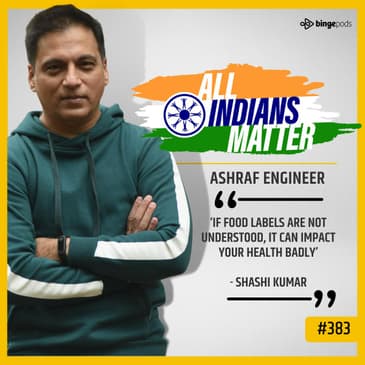


There have been several warnings that information on packaged food labels can be misleading. For example, food advertised as sugar-free may be loaded with fats, refined cereals and even hidden sugars. In July, the Food Safety and Standards Authority of India, approved a proposal to display nutritional information, such as total sugar, salt and saturated fat content, in bold letters on packaged food labels. However, experts feel this may not be enough to make consumers aware of the contents. Shashi Kumar, co-founder and CEO of Akshayakalpa Organic, spoke to All Indians Matter.
Learn more about your ad choices. Visit megaphone.fm/adchoices
[00:00:01] I think I get a...
[00:00:06] Immopret N helps at the beginning of the heat with its unique 7-Planzen combination.
[00:00:11] It can strengthen your heat, prevent your heat, prevent your heat and reduce your heat.
[00:00:16] When a heat, Immopret N helps at the beginning of the heat with its 7-Planzen combination.
[00:00:21] To Risiken and Nebenwirkungen, read the package and ask your doctor or doctor.
[00:00:25] Hello and welcome to All Indians Matter, I'm Ashraf Engineer.
[00:00:28] In May 2024, the Indian Council of Medical Research or ICMR warned that information on packaged food labels can be misleading.
[00:00:36] ICMR guidelines drafted with the help of the National Institute of Nutrition said, and I quote,
[00:00:40] health claims on packaged food are designed to catch the consumer's attention and convince them that the product is healthy, stop quote.
[00:00:47] One example was sugar-free foods associated with low calories preferred by diabetics or people watching their weight.
[00:00:53] ICMR's Dietary Guidelines for India 2024 warned, and I quote,
[00:00:56] sugar-free foods may be loaded with fats, refined cereals, white flour, starch, and even hidden sugars, maltitol, fructose, corn syrup, molasses.
[00:01:05] These would imply high glycemic index and high calories in the food item, stop quote.
[00:01:10] In July, the Food Safety and Standards Authority of India or FSSAI approved a proposal to display nutritional information
[00:01:16] such as total sugar, salt and saturated fat content in bold letters on packaged food labels.
[00:01:22] However, experts said this may not be enough to make consumers aware of the contents, and they demanded even more definitive warning systems.
[00:01:37] We have on the show Shashi Kumar, co-founder and CEO of Akshay Kalpa Organic.
[00:01:41] After 17 years in the technology industry, Shashi turned his mind to rethinking and recreating India's farm sector.
[00:01:47] Six generations of his family were involved in agriculture, so this was a subject close to his heart.
[00:01:52] In 2010, he, along with noted veterinarian and social entrepreneur Dr. GNS Reddy, started Akshay Kalpa Organic.
[00:01:59] Today, it is one of India's largest certified organic milk companies, serving customers across Karnataka, Telangana, and Tamil Nadu.
[00:02:06] Shashi, welcome.
[00:02:08] Thank you, Akshay, for hosting me. Thank you.
[00:02:12] Shashi, on the face of it, food labeling requirements seem to be well-formed.
[00:02:16] However, they don't actually perform the tasks they're supposed to.
[00:02:19] Where do they fall short?
[00:02:20] I think there's a huge gap between what label says and what consumer understands.
[00:02:27] So that is where the problem is.
[00:02:29] There's a big gap.
[00:02:31] There's a labeling law which says you need to display certain information in a certain way.
[00:02:36] And we need to really, why that display, the law is saying is, consumer need to understand.
[00:02:43] But consumer understanding of that information is extremely low.
[00:02:47] So, for example, when you say there's no added sugar, doesn't mean there's no sugar in the product.
[00:02:54] Okay, there's a very mis-labeling.
[00:02:57] Okay, but you can still say there's no added sugar.
[00:03:00] But sugar can come from a lot more sources.
[00:03:02] For example, sugar can come from fruits.
[00:03:05] Sugar can come from, okay, dates.
[00:03:07] Sugar can come from a lot of things as an ingredient.
[00:03:09] Okay, in the overall product.
[00:03:12] So, therefore, show me an example.
[00:03:15] For example, how many of us understand those INS numbers?
[00:03:18] Okay, I as a consumer, I don't understand.
[00:03:21] Okay, there is a lot of INS numbers, E numbers associated with every ingredient.
[00:03:27] Okay, which is going into the food.
[00:03:30] Okay, be it a preservative, be it an emulsifier.
[00:03:33] Okay, be it a acidity regulator.
[00:03:36] Be it, you call whatever you want to call.
[00:03:39] Okay, understanding at a consumer level is extremely poor.
[00:03:43] So, that is a gap.
[00:03:44] So, what regulators are trying to do is, can we put it in bold?
[00:03:48] It will catch people's attention.
[00:03:51] Or regulators are trying to say, can we change the nomenclature of how it is written?
[00:03:56] Okay, and also they are trying to regulate.
[00:03:58] When you say sugar-free, what do you mean by sugar-free?
[00:04:02] So, they are trying to give that kind of interpretation.
[00:04:04] I think it is an ongoing exercise of a discussion between food industry and regulators.
[00:04:10] It will be ongoing and it will continue to evolve.
[00:04:13] But the gap is that what is said and what is understood is miles apart.
[00:04:19] Yeah, true.
[00:04:20] And according to you, what should be the key elements of any warning system?
[00:04:24] The fundamental of any food, in my opinion, should really come out.
[00:04:29] So, you are being in this product as something which is not natural.
[00:04:35] For example, you have got added a flavor, which is not natural.
[00:04:41] Okay, I have added an acidity regulator.
[00:04:43] It is not natural.
[00:04:44] So, you have added an emulsifier, which is not natural.
[00:04:47] So, you have got a lot of preservatives, which are not natural.
[00:04:51] They need to really pop out.
[00:04:53] Okay, but generally that doesn't happen.
[00:04:55] If you really take any label, if you go and see what has been added, those are written in
[00:04:59] a very smallest possible font on a label.
[00:05:05] Okay, so can that be changed?
[00:05:08] That is one aspect.
[00:05:08] Of course, nutrition label is coming out quite well.
[00:05:11] Okay, now what is the fat content?
[00:05:13] What are the saturated fats?
[00:05:15] Okay, what are the sugar content?
[00:05:17] How much calories out there?
[00:05:19] All these things are fine.
[00:05:21] Even that understanding itself is lacking how to read a nutrition label.
[00:05:25] But ingredient reading is the most critical aspect.
[00:05:29] So, ingredient reading and the nutrition reading actually gets muddled up more often than not.
[00:05:36] Ingredients are separate.
[00:05:37] The nutrition is separate.
[00:05:38] They get mixed up.
[00:05:40] So, in my opinion, there needs to be a clear distinction on ingredients.
[00:05:44] What's happening?
[00:05:46] Okay.
[00:05:46] And for example, you can call it as a kaju barfi.
[00:05:49] If a kaju is 2%, okay, there are a lot of things which are happening.
[00:05:53] Okay.
[00:05:55] So, these kind of things in a label now makes consumer getting confused.
[00:06:01] Nutrition part and ingredient part getting mixed up.
[00:06:04] For example, I'll give you one more example.
[00:06:07] You've got a preservative.
[00:06:08] Okay.
[00:06:09] Added into your food.
[00:06:11] What part of the nutrition it is contributing?
[00:06:14] Nobody knows.
[00:06:15] It's a preservative.
[00:06:17] Okay.
[00:06:17] To give a shelf life to the product.
[00:06:19] It is not contributing to any part of the nutrition.
[00:06:22] In fact, it is contributing to side effects if it is consumed disproportionately.
[00:06:27] That is never discussed.
[00:06:29] So, this is where our food systems in India are right now.
[00:06:33] I should say very transitionary phase.
[00:06:36] Okay.
[00:06:37] From what it was hidden facts to open facts to facts which consumers can understand.
[00:06:43] So, in my opinion, these two parts.
[00:06:46] Okay.
[00:06:46] One is the ingredient part and the nutrition part really need to be made an attempt by regulators
[00:06:53] and brands.
[00:06:55] Okay.
[00:06:55] To call them out and call them out and explain to consumers properly.
[00:07:01] Absolutely.
[00:07:02] And Shashi, I know you've touched upon this next issue a bit but I want to talk a little
[00:07:06] bit about it in detail.
[00:07:08] Because there seems to be a lot of concern over products that claim to be sugar-free or
[00:07:12] low on fat.
[00:07:13] That's not always the case as you've explained to some extent.
[00:07:18] Could you walk us through a little more in detail on that issue?
[00:07:23] When you say sugar-free, okay.
[00:07:26] Now, we need to really understand what I mentioned.
[00:07:28] What is an added sugar?
[00:07:30] Okay.
[00:07:32] For example, if you take, let me say, sugar broken into fructose.
[00:07:39] Take sugar and fructose.
[00:07:40] So, fructose has got more sugars than the actual sugar.
[00:07:44] So, when you say sugar-free, okay.
[00:07:47] What does it mean?
[00:07:48] It needs to be really defined.
[00:07:50] Okay.
[00:07:50] And consumers don't understand.
[00:07:52] Okay.
[00:07:53] The problem starts there.
[00:07:54] I'm just giving an example.
[00:07:55] Okay.
[00:07:56] And let us assume, okay.
[00:08:00] If you take milk as an example.
[00:08:02] Milk has lactose.
[00:08:03] Okay.
[00:08:03] Lactose gets broken into glucose and galactose if a certain enzyme is present in the gut.
[00:08:09] Okay.
[00:08:10] Glucose and galactose are much more sugary than actual sugar.
[00:08:14] Okay.
[00:08:15] So, we need to really make consumers understand.
[00:08:18] Sugars are required.
[00:08:19] It's an energy source.
[00:08:20] It is required.
[00:08:21] But how sugars are given, it's very, very important.
[00:08:25] Okay.
[00:08:25] For example, if you're consuming a sugar through a lactose.
[00:08:28] Okay.
[00:08:29] Okay.
[00:08:29] What happens when you're consuming a sugar through lactose is, in a body, gut already has
[00:08:34] an enzyme.
[00:08:34] Okay.
[00:08:35] Lactase acts on lactose and breaks down to, okay, glucose and galactose.
[00:08:42] Okay.
[00:08:42] Now, body absorbs.
[00:08:44] Body can't take lactose.
[00:08:45] Okay.
[00:08:46] But it can take glucose and galactose.
[00:08:48] So, therefore, it's a slow release system of energy, not a spike.
[00:08:51] Okay.
[00:08:52] So, when it happens, most of the sugary foods, sugar-free is a very nonsensical word in my
[00:08:58] opinion.
[00:08:59] Okay.
[00:09:00] And sugars are required.
[00:09:01] But how the sugars are released into the body is what it is important.
[00:09:06] Sugar spikes are not good.
[00:09:08] Sudden spike in sugar is not good.
[00:09:11] Can you get a slow release of the sugar is what is important.
[00:09:14] So, therefore, most of the natural, okay, sugar, for example, when you eat a fruit, not a fruit
[00:09:20] juice, okay, it's a better sugar release system.
[00:09:25] Okay.
[00:09:25] More often than not, we don't understand.
[00:09:27] Okay.
[00:09:28] Rather than eating glucose, can we actually use lactose so that enzyme can act and slowly
[00:09:34] release it.
[00:09:35] So, these are some of the changes we need to understand from a sugar.
[00:09:39] Sugar is free.
[00:09:40] It doesn't mean anything.
[00:09:43] What is important is how the sugars are released into the body, into the bloodstream.
[00:09:48] And Shashi, one of the biggest problems in India is that many labels feature misleading
[00:09:53] claims.
[00:09:53] There are inconsistent standards.
[00:09:55] And sometimes the text is illegible.
[00:09:57] Now, one consistent complaint is that enforcement of regulations around these things is also
[00:10:02] weak.
[00:10:02] What impact can this have on consumer health and safety?
[00:10:06] Oh, it's a disaster.
[00:10:07] Right now, if you really look at the labeling laws, okay, and I told you a kaju example I
[00:10:15] gave you.
[00:10:15] It's a kaju burfi.
[00:10:17] And you're calling it kaju burfi.
[00:10:18] Only 2% of it is kaju.
[00:10:21] Can you call it as a kaju burfi?
[00:10:22] So, we can give a lot more examples like this, what's happening.
[00:10:27] But one is, okay, of course, nutritional aspect of the food.
[00:10:31] If you can leave that one out.
[00:10:33] If the label is not properly understood, it has a huge implication on consumer health.
[00:10:38] If a consumer doesn't understand, okay, that, okay, this kind of product is actually spiking
[00:10:44] my sugar.
[00:10:45] One part of it.
[00:10:46] What is metabolically, what is impacting in his body?
[00:10:50] So, first understanding.
[00:10:52] The labeling laws are not very, very clear on this aspect.
[00:10:56] So, labeling, you say no added sugar, label alose, okay.
[00:11:01] But what happens if they don't add sugar and you've got a replacement for that sugar?
[00:11:06] Okay.
[00:11:07] So, there are no questions.
[00:11:10] Okay, let me say it's adding a lot of fruit.
[00:11:13] Okay, a lot of fruit pulp.
[00:11:14] Or you're adding this one.
[00:11:16] Okay, still it is giving sugars.
[00:11:17] It's no added sugar, but still it is giving sugars.
[00:11:21] The health implications to your question is, most of, for example, if you take milk as
[00:11:28] an example, okay.
[00:11:29] Milk, nobody says on the label that my milk is alphotoxin free.
[00:11:36] Okay.
[00:11:37] Alphotoxin is the most carcinogenic known.
[00:11:40] Okay.
[00:11:41] If you eat it, for sure, your liver damage will happen.
[00:11:45] Okay.
[00:11:46] Most of the milk in India has alphotoxins today.
[00:11:49] There's a regulation around amount of alphotoxins in the milk.
[00:11:52] It is not enforceable.
[00:11:54] So, I'm saying consumers are absolutely blind on their food and implication on health.
[00:12:02] So, therefore, labeling laws and brands actually should make that attempt to educate consumers
[00:12:08] what is happening.
[00:12:10] For example, we write boldly saying that, you know, milk is free of antibiotics and alphotoxins.
[00:12:17] Okay.
[00:12:17] Because a lot of work has happened on that and we can write that.
[00:12:21] But, if consumers, what is this interpretation of alphotoxin?
[00:12:25] Does it really understand what alphotoxin means?
[00:12:28] Brands should make an active effort.
[00:12:30] Why?
[00:12:30] They should seek out a food which is free of alphotoxins.
[00:12:34] Okay.
[00:12:35] Antibiotics.
[00:12:35] Other aspect in, okay, for example, how many consumers understand implications of antibiotics?
[00:12:41] Today, World Health Organization says very clearly what is the biggest, okay,
[00:12:47] entrance to human health is antibiotic resistance.
[00:12:51] We are eating antibiotics through food, left and right, through meat, through milk.
[00:12:56] Okay.
[00:12:56] Through a lot of means, we are eating it.
[00:12:58] Okay.
[00:12:59] The body is developing resistance to, okay, any, okay, infection.
[00:13:05] Later on, when you treat for that infection, the body is not responding because you already
[00:13:10] loaded with a lot of antibiotics.
[00:13:12] So, consumers are absolutely blind on that.
[00:13:15] Okay.
[00:13:16] You heard a lot of conversations.
[00:13:18] My dad was perfectly fine.
[00:13:20] Okay.
[00:13:20] He was eating perfectly fine food.
[00:13:22] He got a cancer.
[00:13:24] So, they are anecdotal.
[00:13:26] Okay.
[00:13:26] We can always go back and see what is perfect food.
[00:13:28] Okay.
[00:13:29] And they never understood, okay, these implications.
[00:13:33] Okay.
[00:13:33] This already is happening.
[00:13:35] So, in my opinion, Ashraf, we have reached a stage in the country where, in my opinion,
[00:13:42] battle on the food labeling is lost, to be honest.
[00:13:46] And no consumer understands.
[00:13:49] A regulator, okay, is trying his best to fix this issue.
[00:13:54] Okay.
[00:13:54] But it is too big a problem.
[00:13:58] And I'm glad you mentioned consumer education.
[00:14:01] Because I think successive governments have tried to do something about it.
[00:14:05] I mean, let's be fair.
[00:14:06] Say every government has tried to do something about it.
[00:14:08] But obviously, it's not worked well enough.
[00:14:10] What do you think is needed for a more educated consumer to come about?
[00:14:17] Three fundamental questions we need to ask, Ashraf.
[00:14:20] Okay.
[00:14:22] We need to encourage consumers to ask, where did my food came from?
[00:14:26] Okay.
[00:14:26] So, source traceability becomes critical, irrespective of if it's organic or otherwise.
[00:14:30] Okay.
[00:14:31] And the second thing is, who grew it and how it was grown?
[00:14:34] If these three questions are answered, okay, most of the supply chain issues, for example,
[00:14:39] once, let me say, once a vegetable which is produced, okay, without using any chemicals,
[00:14:47] okay, with a good, okay, production practices, getting into your supply system, it is perfect
[00:14:53] food.
[00:14:53] Okay.
[00:14:54] But we are not answering questions there.
[00:14:57] Okay.
[00:14:58] And a recent study in Bangalore, okay, regulators picked up some sample of vegetables throughout
[00:15:04] the Bangalore from various distribution points.
[00:15:07] And it's damning.
[00:15:09] The report is damning amount of lead contamination, amount of heavy metals, amount of pesticides.
[00:15:14] It's just a damning, okay, in vegetables and greens.
[00:15:18] Okay.
[00:15:21] Okay.
[00:15:22] Okay.
[00:15:22] Our challenge for anybody who wants to get into education spaces, how to put it across
[00:15:28] to a consumer the way you understand.
[00:15:30] So, encourage them to ask questions, questions, questions, go deeper.
[00:15:34] Then the brands who are providing these produce to consumers, they will become conscious.
[00:15:41] It has to be brand-driven approach to solve this problem.
[00:15:45] While the regulator is supervisor, the regulator is telling you, hey, do this.
[00:15:49] But brands really need to go out of way, okay, to take consumers onto their side.
[00:15:54] It is not happening right now, Ashraf, to be honest.
[00:15:58] In fact, that was going to be my next question.
[00:16:00] How much of the onus is on the food corporations or the brands that are in the market?
[00:16:05] We've answered that, of course.
[00:16:07] But, you know...
[00:16:07] No, no.
[00:16:08] Just to add in that point, all of it, okay, lies on the brands and food companies.
[00:16:15] It is their responsibility to really educate customers in terms of what they are feeding
[00:16:21] them.
[00:16:21] Okay.
[00:16:23] So, for example, if you take on a juice bottle, which is bottled, okay, bottled, versus a fruit,
[00:16:33] okay?
[00:16:34] Fruit is always 10,000 times better than what is actually bottled.
[00:16:39] But why are you bottling it?
[00:16:41] Fine.
[00:16:41] You bottled it as a business model.
[00:16:43] Now, we explain what are the implications.
[00:16:46] Is there a regular...
[00:16:47] Acidity regulator is there.
[00:16:48] Preservative is there to shelf life.
[00:16:50] Okay.
[00:16:50] And you're adding a lot of sugar to make sure, okay, carbs are that one again and again.
[00:16:56] When it drinks one bottle, again, it takes another bottle.
[00:16:58] So, versus a fruit, which is with a lot of pulp, a lot of fiber, you eat.
[00:17:03] So, can brands take this bold approach saying that, hey, you know, by taking this, this is
[00:17:10] the downside.
[00:17:11] Taking this, this is the upside.
[00:17:13] But in my opinion, it's very difficult for brands to make that call.
[00:17:18] In fact, Shashi, one of the key worries is the food that our children consume.
[00:17:21] Now, we live in an era of packaged foods, of course.
[00:17:24] And even milk has additives, as you've mentioned.
[00:17:27] Children certainly don't eat labels.
[00:17:29] But even parents often neglect to do so carefully.
[00:17:32] What would you advise parents to do before giving their children packaged food?
[00:17:35] I think because what's happened is today, it's become very common to feed children packaged
[00:17:39] foods because parents are busy.
[00:17:40] There's a huge amount of pressure on time.
[00:17:43] So, this seems to be the easy way out often.
[00:17:47] This again boils down to the same question, Ashraf.
[00:17:50] Can parents read the label?
[00:17:52] Okay.
[00:17:53] And understand what are the implications.
[00:17:55] Say, I've been a chess player.
[00:17:57] Okay.
[00:17:57] I've played a lot of chess, a lot of tournaments.
[00:17:59] Every tournament I went now, when I sit in an opponent player, a lot of them are kids.
[00:18:04] Six years, five years, ten years kids.
[00:18:07] Okay.
[00:18:08] Because there's a chess playing kids.
[00:18:10] Most of them have a sugary drink on the table.
[00:18:14] Okay.
[00:18:15] And parents actually walk in and hand over the sugary drink to the kid.
[00:18:19] Okay.
[00:18:19] Kid puts on the table and pays three hours match.
[00:18:22] Okay.
[00:18:23] He keeps drinking that sugary drink.
[00:18:24] Okay.
[00:18:25] So, that's the level we have gone of ignorance.
[00:18:28] Okay.
[00:18:29] In my opinion, we should hold parents accountable for what kids are eating.
[00:18:34] Okay.
[00:18:35] Parents these days don't cook at home for various reasons.
[00:18:38] They are busy and package it for.
[00:18:41] Okay.
[00:18:42] Food coming from a lot of restaurants, which is unauthenticated.
[00:18:47] We don't know what they are using.
[00:18:49] It is not under labeling purview.
[00:18:51] If you say paneer butter masala.
[00:18:54] Okay.
[00:18:55] What does that mean?
[00:18:56] It means a lot of things in Pune, a lot of things in Bangalore, a lot of things in a lot of places.
[00:19:00] Okay.
[00:19:02] So, parents need to really start understanding what kid is eating.
[00:19:08] Start eating.
[00:19:09] Start cooking at home.
[00:19:10] So, that's a fundamental answer, Ashraf.
[00:19:14] Okay.
[00:19:14] Beyond that, if parents are conscious about children's health, they need to make an attempt.
[00:19:21] Yeah.
[00:19:22] Actually, I also wanted to talk a little bit about the organic food trend that we are witnessing nowadays.
[00:19:27] ICMR guidelines said that not all organic food claims should be believed.
[00:19:31] And they said, and I quote,
[00:19:32] When a food label states organic, it may simply mean that it is free of all artificial preservatives, flavors and colors,
[00:19:38] and that the food ingredients are free from pesticides and chemical fertilizers.
[00:19:42] If both the above conditions are met, then the label can state 100% organic
[00:19:47] and have the Jaivik Bharat logo approved by the FSSAI.
[00:19:50] Stop quote.
[00:19:51] At the same time, any food item including fruit juices containing only 10% or less of fruit is allowed to claim
[00:19:58] that it is made with real fruit pulp or juice.
[00:20:00] However, the product may have added sugar and other additives with only 10% of actual fruit pulp.
[00:20:06] So, there is a huge contradiction there.
[00:20:09] Yes.
[00:20:10] See, the challenge, for example, the organic process now, one thing is, okay, absence of, okay, chemicals,
[00:20:18] absence of, okay, pesticides, traces, residues, etc.
[00:20:22] Another is the production process itself needs to be certified.
[00:20:25] For example, you can't use a Gahu, okay, which is just free of pesticides, okay, free of, okay,
[00:20:32] chemical tases and still claim organic.
[00:20:34] No.
[00:20:35] How the Gahu itself was produced?
[00:20:37] The land needs to be certified.
[00:20:39] Crop needs to be certified.
[00:20:41] Then the Gahu coming out of that, getting into any ingredient, actually qualifies to be organic.
[00:20:46] So, that is the organic process.
[00:20:48] Actually, a lot of people misunderstand this entire thing.
[00:20:51] So, that's the reason the certification systems are very clear.
[00:20:56] Certify the land first.
[00:20:57] Two, three years it will take to organic certification.
[00:20:59] Then certify the crop.
[00:21:01] Crop output coming from the crop actually can get into an organic, okay, labeling system.
[00:21:06] Organic ACTA you can call.
[00:21:08] Okay, once you have that.
[00:21:09] Of course, to make the ACTA itself, there are a lot of restrictions in terms of, okay, ACTA making system.
[00:21:15] Okay, how it should be, okay, isolated in terms of a traceability point of view.
[00:21:19] All of it, okay.
[00:21:21] Yes, so the second point, what you raise, okay, is in terms of using 10% of, okay,
[00:21:30] you can just say it is an orange juice, okay, if you want to claim that.
[00:21:35] So, there are no restrictions on that, okay.
[00:21:38] I think law itself, no, needs to be really re-looked at it, okay.
[00:21:42] But I think regulators are making that attempt.
[00:21:44] Okay, let us see how it progresses, Asha.
[00:21:48] Takes us back to the 2% kaju and kaju barfi example that you gave.
[00:21:53] You know, it also reminds me, given that you are talking about barfi and juice and sugars, etc.
[00:21:57] India has become the diabetes capital of the world.
[00:22:01] And heart ailments are also so increasingly common.
[00:22:03] And it just struck me that labeling becomes even more critical in such a situation.
[00:22:08] It could well reduce the disease burden and the pressure on the national health system.
[00:22:13] Yeah.
[00:22:14] Now, Shashi, India largely has back-of-pack labeling.
[00:22:18] But now, several food scientists and activist groups around the world have demanded front-of-pack labeling.
[00:22:24] And this is happening in India also.
[00:22:26] And this is a global practice proven to reduce the consumption of unhealthy foods.
[00:22:30] Are you in support of that?
[00:22:31] What's your view?
[00:22:32] Yes.
[00:22:33] Yes, very much.
[00:22:34] The front-of-pack FOP, okay, is a very critical element to state what is important.
[00:22:41] That's the reason I'm saying, you know, in the back of a pack, what you can write in very, very small,
[00:22:46] unconstructed, even not able to read kind of a situation.
[00:22:50] Can you bring your INS number?
[00:22:52] Can you dare it able enough to bring your INS number?
[00:22:54] Say, I'll use the preservative.
[00:22:56] Okay.
[00:22:57] Be conscious about that.
[00:22:59] So, the front-of-pack labeling, you know, it's an extremely important initiative.
[00:23:05] If we can bring majority aspects into front-of-pack, okay, that actually solves a lot of problems.
[00:23:10] It catches the consumer attention first time, okay, and the consumer is able to decide, hey, should I give it or not?
[00:23:17] See, for example, if you could see in a lot of protein drinks, actually, they are able to say, this has got 25 gram protein.
[00:23:23] So, you could really see, Amul, okay, recently launched, okay, one milkshake, okay.
[00:23:30] In that one, they are written, it has got 25 gram protein.
[00:23:33] So, it's a good front-of-pack labeling initiative.
[00:23:37] Just, you're trying to declare this is the amount of protein it has.
[00:23:40] Of course, we need to be able to declare, hey, I've also added, okay, preservative to make sure the milkshake reaches you.
[00:23:46] So, those kind of, okay, initiatives, okay, need to really become mainstream.
[00:23:51] But bands are doing on their own, okay, but that needs to become mainstream.
[00:23:56] Yeah.
[00:23:57] And also, I think it's not just about font size, which we have talked about, you know, when it comes to sugar and things like that.
[00:24:02] And it's not just about front-of-pack labeling.
[00:24:04] But, you know, when you say the component of sugar is this much or fats is this much, that's actually normally of the entire pack.
[00:24:13] And, you know, we also need to say what is it per serving that is actually more informative and would probably make for a better informed consumer.
[00:24:21] What's your view?
[00:24:23] In fact, the labeling law is very clear.
[00:24:26] We need to declare per serving how much, okay, it is.
[00:24:28] For example, if you are buying a one liter, okay, let me say milk, okay, per serving, okay, nutrition needs to be deplete.
[00:24:39] Per serving, if it is 200 grams, per serving, if it is what you are taking.
[00:24:43] We need to declare for 200 grams what is the calcium, okay, what are the vitamins, what is this?
[00:24:48] And we need to declare.
[00:24:49] It is mandated by law, okay?
[00:24:51] I think that's a very good starting point.
[00:24:53] But we generally don't understand, okay, between the quantity which is there in that pack versus per serving.
[00:25:00] That's the problem.
[00:25:02] Okay, more often than not, I've done a lot of tests with consumers, okay?
[00:25:06] I've shown this pack.
[00:25:07] I'm saying this nutrition information is into the entire pack or per serving.
[00:25:12] They don't know.
[00:25:13] Okay, it is clearly written it is per serving.
[00:25:15] So once we understand that probably our consumption pattern law would change.
[00:25:20] Okay, probably I would avoid, let me say if I got a one liter sugary drink.
[00:25:25] Okay, maybe if you look at a per serving half, calorie value per serving is 450 calories.
[00:25:31] I need to just take 100 ml out of that.
[00:25:33] Okay, maybe if you just take one liter of that, if you consume, then you're into trouble.
[00:25:39] The entire calorie requirement two times over, okay, in that entire day you got it through one bottle of drink.
[00:25:47] So therefore, per serving, understanding that one is very, very critical.
[00:25:51] I think that's a very good example.
[00:25:53] I mean, somebody who suffered from that himself, I am talking about myself here.
[00:25:58] I used to consume a drink years ago, a lot of sugary drinks, sometimes consuming up to two liters an evening.
[00:26:04] And that made me very, very sick.
[00:26:06] And you're absolutely right.
[00:26:07] I had no idea how much sugar I was taking in and whatever else there is in that drink.
[00:26:12] Shashi, thanks for all of this.
[00:26:13] I also wanted to ask you a little bit about the journey of Akshay Kalpa Organic.
[00:26:17] How did the idea come about?
[00:26:19] How did you establish it?
[00:26:20] What is the journey it has undertaken so far?
[00:26:23] The Akshay Kalpa Organic journey has been a crazy journey.
[00:26:28] This is about 27 people from the technology industry.
[00:26:32] Okay, they thought they can leave their job and go and change farming.
[00:26:36] Okay, nothing like that happened.
[00:26:38] Only thing which happened is we changed ourselves.
[00:26:42] So, and in the journey now, okay, for the first nine years, we came six times close to bankruptcy.
[00:26:52] Okay, and we didn't know how to run the business.
[00:26:55] Okay, and the problems in farming is too overwhelming.
[00:27:00] Then we decided it is not a one generation solution.
[00:27:03] Okay, exists.
[00:27:04] So we need to attack the problem one by one.
[00:27:06] Let's start solving cash flow problem for a farmer.
[00:27:09] But Akshay Kalpa technically is a farming company.
[00:27:12] We do a lot of work on soil management.
[00:27:14] Only work we do is soil management.
[00:27:16] Manage the soils in the farm and get the crops grown in a way, okay, where consumers can actually take it very confidently.
[00:27:26] That's what we do.
[00:27:27] You can call it as Akshay Kalpa is the biggest soil management and dung making, manure making company in the country.
[00:27:34] Okay, so over a period of time, we also learned how to deal, okay, with these farming challenges.
[00:27:41] And the products what we, okay, marketing actually is helping to solve cash flow problem for the farmer.
[00:27:49] So while the cash flow problem is solved now, we are able to intervene with a little bit of beekeeping, okay, a little bit of a backhand poultry, a little bit of vegetables, a little bit of greens, a little bit of a banana.
[00:28:01] So that entire farm now is becoming a full package.
[00:28:04] So it's a very comprehensive system we are trying to build.
[00:28:08] So that's a quick brief on Akshay Kalpa.
[00:28:11] So it's a crazy attempt.
[00:28:15] Hopefully that craziness has some value.
[00:28:19] And what lies next for it?
[00:28:21] The problems in the farming space is too deep, Ashraf.
[00:28:25] So what we envision probably has solved one or 2% of it.
[00:28:30] So we need to really go deeper into farming productivity, soil management.
[00:28:35] If you don't do it, farming is gone in India.
[00:28:38] Right now, if you understand, okay, average age of a farmer in India is 55 years.
[00:28:45] All the food what we are eating actually is grown by a person who is age 55 years.
[00:28:50] Country is a young country, 30 years of age.
[00:28:54] No youngster is getting into farming.
[00:28:57] Forget about everybody.
[00:28:58] Me only, no.
[00:28:59] My father, I was born in a farming family.
[00:29:02] My father never wanted me to be a farmer.
[00:29:05] So to your question, okay, is what next?
[00:29:09] Next is getting youngsters back to farming.
[00:29:12] What needs to be done to get young population into farming?
[00:29:16] After their graduation, they can become doctors.
[00:29:18] They can become engineers.
[00:29:19] They can become whatever they want.
[00:29:21] They should also have an aspiration to become a farmer that is not there in the country right now.
[00:29:27] Okay, so that movement we need to start.
[00:29:30] We need to get thinking people, youngsters back into farming.
[00:29:34] Today it is not.
[00:29:35] If you are not able to do anything in life, you become a farmer.
[00:29:39] So that's what it is right now.
[00:29:41] Those are the people who are producing food for us.
[00:29:43] We should be grateful to them.
[00:29:45] But this is not going to work for long.
[00:29:48] So Shashi, here's a question I ask all my guests at the end of the show.
[00:29:52] Why do you do this work?
[00:29:54] It's very selfish thought, okay, Ashraf.
[00:29:57] Okay, to be honest.
[00:29:59] I am worried, okay, to my children, my grandchildren, who will grow the food?
[00:30:04] So very simple, okay, question.
[00:30:08] Will there be people growing food for my children and grandchildren?
[00:30:12] There will not be.
[00:30:13] We can forget farming.
[00:30:14] So that's what we are trying to solve.
[00:30:17] Okay, Nakshakalpa.
[00:30:18] I am trying to solve a problem of growing food for my children, my grandchildren and generations to come.
[00:30:24] So therefore, I believe it's a very selfish thought.
[00:30:28] Okay, but it is solving a bigger problem.
[00:30:31] Shashi, thanks so much for being on the show.
[00:30:33] Thanks, Ashraf.
[00:30:34] And I appreciate this opportunity.
[00:30:37] Thank you.
[00:30:40] All Indians matter.