
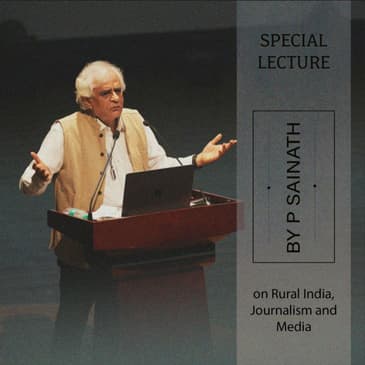
A special lecture by P. Sainath on Rural India, Journalism and Media hosted by International conference on Popular Culture and National Identities (PCNI) organised by Department of Media studies, Christ University in collaboration with Routledge Taylor & Francis, Curtin University and the University of Westminster, London on 25th June 2026.
Credits: This episode was edited by Aditya Srinivas, illustrated by Vernika Singh and hosted by Prachi Pinglay. Signature tune by Prof Ananthu.
Learn more about your ad choices. Visit megaphone.fm/adchoices
[00:00:15] Welcome to 4C Radio. We are broadcasting from the Central Campus of Christ University, Bangalore. 4C Radio is brought to you by the Department of Media Studies of Christ University. For all who are looking for a platform that focuses on communities, commons, climate and communication, this is the place to be. What's more, this station is run by a diverse community of students and dedicated faculty members.
[00:00:45] Tune in to experience hard-eating interviews, fact-checks, myth-busting, on-ground stories, campus news and more. Today we are coming to you with a special address by none other than P.Sainath. The veteran journalist, winner of Ramon Maxese Award, founder editor of PARI, People's Archive of Rural India,
[00:01:12] spoke at a conference titled Popular Culture and National Identities at Christ University. He spoke about a range of issues from rural and agrarian distress, corporate ownership of media and journalism in these tough times. We are sharing his entire talk unedited without any cuts because, simply put, there wasn't a single moment or thought that you would want to miss from this talk.
[00:01:42] So here is P.Sainath at PCNI, Christ University. What changes when rural India tells its own stories rather than being spoken for? That's a tall order, but we'll take a short edit. First and foremost, what the heck is rural anyway?
[00:02:14] You know, if you look at the full expanded census of India, there's millions and millions of bits of data about coming under rural, which makes it very odd that nowhere does the census of India define rural. rural. It does not define rural. It does not define rural. It does not define rural. The census defines urban. Yeah?
[00:02:44] It says something is an urban settlement, agglomeration, whatever. If it has a population of over 5,000, minimum 5,000, if it has a population density of more than 400 to a square kilometer,
[00:03:13] and if 75% of the male workforce is no longer in agriculture. 75% of the male workforce is no longer in agriculture, 400 density per square kilometer, and minimum 5,000 population. That makes urban.
[00:03:41] And the census then cutely informs us. Anything that does not fit in this definition of urban is rural. So, it's actually astonishing for most people to realize, as it was for me when I first did, that the census of India does not define rural, but tells us that 69% of the population live in rural India.
[00:04:10] Now, this rural India of that 69% is very, very, probably the most complex part of the planet Earth. You're talking about people speaking 780 living languages, eight of which are spoken by more than 50 million people, four of which are spoken by more than 80 million people,
[00:04:39] one of which is allegedly spoken by more than 500 million people, but it's a bit of a stretch. Hindi, which they claim is spoken by more than 500 million people, actually has another 55 languages, much older than Hindi, clubbed into it, like Bojpuri, Chattisgadi, Amadi, Brijabashra, Brijabashra. If you remove those 55, it's 340 million.
[00:05:08] But the fact is, four languages, more than 80 million people speak, and one, more than 300 million. At the other end of the spectrum, are a whole heap of endangered languages. Languages which have less than 10,000 speakers, some which have less than 2,000 speakers, mainly Adivasi, or what you'd call indigenous people's languages. Yeah.
[00:05:39] Now, it's wonderful. I'm one of those people who wakes up and thinks, how rich we are. That stretch of languages covering, God knows how many families of languages globally. Unfortunately, we live in an era where people feel threatened by diversity and do everything they can to squelch it. You know, of those 780 languages, less than 4% of those 780 languages
[00:06:08] have schooling past class 7. Right? Now, think for a language to stay alive is got to be spoken by the mother to the child at home, got to be in school, yeah? And has got to be of transactional value as well in the modern world, which means that since in the last 50 years,
[00:06:37] 225 other Indian languages have gone extinct. That is, one dying at the average rate of one every 90 days. Right? The People's Archive of Rural India exists to capture, to be with, to protect, preserve, promote. One of our mandates is Indian languages,
[00:07:05] which are at the soul of rural India. Personally, I know that I will always be asked the question, you did Everybody Loves a Good Drug in areas with hundreds of languages, how did you manage? I don't know. I mean, I speak five languages equally badly. But there is the language of communication and there's the language of literature. If you ask me about literature, don't ask me.
[00:07:34] Communication is a different thing. If people, if you make the effort to talk to people and people want to talk to you, you'll find a way. Sometimes with three-way interpretation, sometimes with four-way interpretation. Like in Odisha, when I interviewed the Bondar tribe, you know, somebody spoke Bondar, somebody knew Bondar who spoke Deshia, the local, the Odia plus
[00:08:03] Koraputi languages mix, and somebody knew Hindi and two of us knew English and Hindi. So that's how it worked. But, now there's 700 in rural India, 780 living languages and an equally incredible number of occupations, vocations, cultures.
[00:08:33] You know, incidentally, we don't, in Pari, we use the word, we don't get into this language versus dialect. Everybody's tongue is a language for that person. So we don't use the word dialect. For everything, we club it under a very democratic word called tongues. Okay? Everybody's got one. Right? So,
[00:09:03] some are double-talked or stupid. Yeah. So we, we, we stick to this word, tongues. We do, of course, use the word languages, but we almost never use the word dialects. How, the same thing, the same diversity is shown in looks and appearance. One of our activities is
[00:09:33] we are mapping the facial diversity of this country. Okay? And it's astonishing. the range and range of that diversity. The, this incredibly complex entity called rural India, which consists, in our count, of 95
[00:10:03] natural, physical, or historical regions. We try to report from every one of them. In the main media, or legacy media, or social, whatever you want to call it, never more, pick up the newspaper, never more than six or seven regions find themselves in a, in the newspaper. And, the Center for Media Studies, the oldest media monitoring organization in India,
[00:10:33] struggling for existence because newspapers don't give, don't patronize it anymore. They go to market research companies, right? They don't want to know about their readers. They want to know how much their readers can buy. So, the CMS last gave me these numbers on a request from me. They had done a survey of six Indian newspapers, three Hindi, three English,
[00:11:03] six Indian television channels, three Hindi, three English, covering the largest audiences you can imagine. Rural India, 69% of the population on the front pages of the national dailies scored an average of 0.67%. 69% of the population, 0.67%
[00:11:31] of news of rural origin on the front page of national dailies. By the way, the national daily is also acutely defined. It means anyone who has an edition coming out of Delhi, even if that is the only edition. Because it's coming out of the national capital. The rest of us aren't anti-national. I mean, widely acknowledged fact these days, right? So, and widely propagated fact by the government,
[00:12:01] surely. So, you know, guys, one thing, since there are so many of you from media studies and from journalism here, I'm going to lay down a certain basic thing for you. So, media and journalism are two very different entities in our time. Yeah? Media are corporations, institutions.
[00:12:30] They are rent-seeking, profit-making institutions. And, you know, as I was in Delhi a month ago and listening to people pros on about the duty of the media is to inform the public to build democracy. It is not the duty of the media to inform the public. It is not the duty of the media to build democracy.
[00:13:00] The duty of the media is to make money for its ownness. Those demands you make, make it of journalism. That's another thing altogether. You make those demands of journalists, not of media. I mean, please tell me what social conscience you are appealing to if you are addressing these questions to Elon Musk or Jeff Bezos.
[00:13:30] how stupid it feels, now you're laughing. But day after day they put up these stupid questions. Media duty to inform, it is not their duty, their duty is to make money for their owners and they do it damn well. the latest figures on Indian media and entertainment industry. If the business guys are interested, the source is Ernst and Young. Ernst and Young tells me
[00:14:01] that India's, the total value of India's media and entertainment industry, industry, for they are indeed one and the same industry. The total value of India's media and entertainment industry as of March 31, 2026, 2.78 trillion rupees. That's got 12 zeros, guys.
[00:14:31] It takes me a little time to get it off my tongue, but 2.78 trillion rupees is 31 billion US dollars. Do you know how much that is? It means the Indian media's value, estimated by Ernst and Young, is greater than the GDP of any one of 73 other nations. Right? 73 other
[00:15:00] nations have a GDP less than 31 billion dollars. Maybe 75 actually, but 73 I'm fairly sure about it. So that's how, so they're doing their job, they're making money. Their cumulative, their CAGR, their cumulative, you know, the growth rate, 9%, which means they're going to double every six years. Right?
[00:15:32] Right. also to know, sorry to say, because I came in at a different era, I was very lucky, when media and journalism were interchangeable terms. I have promised you never called myself a media person. In the 45 years I've been a journalist, I say I'm a journalist, I'm a reporter. Which is a very different thing. I don't want to represent these guys. they don't
[00:16:02] represent me. So, in the, in this 2.78 trillion, more than 1 trillion comes from digital media. Yeah? More than 42, somewhere between 42 and 45%. Last year, digital media emerged the largest segment of Indian media and entertainment industry.
[00:16:32] The level, the level of monopoly, the level of monopoly, the level of concentration, this 2.78 trillion or 31 billion dollars, two years ago, was just 24 billion dollars or 23 billion dollars. It went to 31 billion dollars in one transaction. which app most of you have on your phones,
[00:17:03] or on your TV. When Mr. Rambani, the richest Indian, also the richest media owner of the country, created the Jio Hot Star merger. merger, emerged Jio with Disney Hot Star and created a behemoth overnight worth 8.5 billion dollars, which means that streaming,
[00:17:31] 50 to 60% of all streaming in the subcontinent is in the hands of one man. Yeah? That's the level of concentration we now have in that section of the media. Now, why then, as Padma Kumar asks, do the media not cover rural
[00:18:01] India? Rural India doesn't make you money. You know, you have in Australia the concept of news drought, news drought regions, right? Why is it not covered? It's covered because it doesn't make enough money for the Murdochs. It doesn't make money for the others. You don't, why should I cover you? You're not making, contributing to my revenue. Why the hell do I care
[00:18:31] about you? Sometimes I have to cover you if you are stupid enough to go and die in hundreds somewhere, you know, in a rail crash or something like that. But otherwise I have no interest in you. until you can show me that you're making money. Where they are seen to be making money, and there the entertainment segment comes in, is through the fact that there has been a very significant expansion of
[00:19:02] streaming of films, of the Netflix, Amazon Primes, etc. There they have a place for you in rural India. Nothing that has a place for rural India in the media. 0.67% and that's only the front page guys. By the way, what happens to the other, you know, 99.4% or 99.3%
[00:19:32] 67% of the Indian newspapers national daily's front page comes from Delhi. OK? Then Mumbai because we have Bollywood and the stock exchange. Right? Then Chendai in Bangalore because of IT, software, etc. And then Kolkata. So
[00:20:01] what about the inside pages? Crime and entertainment entertainment have more space than all the social sector beats combined. OK? More than all the social sector beats combined. So what is the
[00:20:31] crime and entertainment? And in India, as you know, crime and entertainment are merged. Right? It's very hard to tell what you are. I mean, why do you have 200 TV cameras at the courts when Salman Khan is being tried for the black buck case, hunting an endangered species? Is it because we are so in love with the black buck?
[00:21:01] Or is it because Salman Khan represents primetime entertainment? You make your you decide what covers it. But just think in India, say 25 years from now, 50 years from now, I was trained by the way as a historian, not as a journalist, but and we used to in our innocence consult the newspapers, archives, etc. What happens if 50 years from
[00:21:31] now, someone concerns the newspapers of today and wants to know about what Indians ate, drank, sang, danced, produced, dressed. I mean, they would think that all Indians looked like Salman Khan and Katrina archives.
[00:22:00] And in politics, they would think that there were two and a half faces. I mean, Modi and Shah and occasionally Raul Gandhi, so, I mean, that's what they're going to get from their newspapers. Please, look at it from that perspective. Yeah. The first draft is now the final rubbish of history. So, you have even that reference. Back to
[00:22:30] rural India. Let's look at four or five major processes and events. Pari looks at the process, by the way. Event coverage is pretty easy. let's look at some of the major processes and events that occurred in India as a whole and how you never got to know anything about what was happening in your own country. To this day,
[00:22:59] can any one of you tell me, citing a newspaper or a TV channel, how many Indians died in COVID-19? I'm waiting. How many Indians died in COVID-19? You see, when you're a totally commercialized institution called the media, owned by corporate
[00:23:28] giants like Mukesh Ambani, richest man in India, 12th richest or 19th richest, in the top 20 in the world, you are never going to endanger what is the money that the Indian make? They make it from their contracts with government over public resources, mining, gas. These are public property in India. These are publicly owned mines, Bombay
[00:23:58] gas, Bombay high, gas, all these are publicly owned and the rents you are able to get by getting contracts on them and sub-leasing is how our super rich make their money. They also own the media. So the media is going to serve as a tool to enhance that wealth, certainly not going to do anything that threatens to diminish it. COVID-19,
[00:24:29] there were about seven international estimates of how many Indians died. Lancet said 4.2 million. WHO said 4.9 million. I'm sorry, WHO said 4.7 million. World Development Council said 4.9 million. Johns Hopkins gave three methodologies. You choose which one you wanted. All of them led you to a
[00:24:59] figure of 4 million. But then government of India said 486,000. The Vishwa guru has spoken. Not one editorial or TV commentary can you show me which says you know, you guys are a bunch of morons.
[00:25:30] Which doesn't even say that you know, you might be wrong. Others are saying nothing. Official spokespersons lashed out at the WHO for its figure, said it was a conspiracy against India ignoring the fact that the chief scientist of the WHO was an Indian, Dr. Soumya Swaminathan. And nothing, it didn't matter. It was an enemy
[00:26:00] conspiracy, but yeah. So, one of the biggest jobs of the media is to perpetuate an endless stream of conspiracies. So, including the Cochran Jatta Party. I mean, what should have been seen as an imaginative prank, you respond to it
[00:26:29] using the words, a serious threat to national security. Right? So, anyway, so none of you were able to put up your hand and tell me how many people died. I don't blame you. Your media didn't tell you. And those journalists who tried telling you are all confined to those ghettos we call independent media, including ourselves. Right? So,
[00:26:59] does it make money or does it not make money? Simple. Follow the money. See what it does for everyone. At one stage in the COVID period, the Indian media and journalism did brilliantly in October 2020 when they were covering the debts and bodies piling up on the banks of the Ganga, the Uttar Pradesh press did beautifully and then
[00:27:29] the government pulled the plug on government advertising. Everybody caved in but one paper. Dainik Bhaskar continued. Yeah? I don't know how many cases were filed against Dainik Bhaskar and I don't know how many conspiracies that involved it. But that's what happened to them. I rang up one of the news editors and said are all these agencies he said there are agencies from the
[00:27:59] alphabet I don't know. He said which all are there? ED, EOW, enforcement directorate, economic offenses wing, income tax, customs. He said if some other guys walking on the street from some other unaffiliated agency they invite him in as well. So, okay, that was what the news editors comment was above. One of the news editors. Then,
[00:28:29] nor did the media tell you, you all are aware of the large exodus, they told you about that, of people going back to the villages from the cities, right? How many people went back? Enough to create, the numbers were big enough to get press coverage, but the press coverage almost never mentioned the numbers. How many people do
[00:28:59] you think went back to the villages? Anyone, I mean, students, faculty, anyone. Anyone. Take a shot. Okay. The estimates, research surveys, government internal assessments, everything. All of these available to the media are between
[00:29:29] 40 to 60 million human beings went back. How do we know and put this together? For instance, you'll remember that on May 1st, 2020, so some of you would have been horribly young by then, but you can check it out. The railways department put out on its website proudly, how many
[00:29:59] workers it had carted home on the Shrabik trains. COVID lockdown began in March, March 24th. Shrabik trains after two months of telling the Supreme Court of India. Not a single immigrant is on the highway. That's what the solicitor general informed the Supreme Court. A month later, he informed the Supreme Court that there was 23,000 care and relief centers on the highway. For whom?
[00:30:28] If there was nobody on the highway. Were they trying to promote COVID tourism or what? And so then you had the Shrabik trains beginning. In 25 days, you see, one of the interesting things about large governments, large countries, when you try suppressing something in large, multiple ministries, countries. What one ministry
[00:30:58] censors, as public should not know, another ministry puts out on its website as its achievement. So the railways department put out saying, in 25 days, we have transported nearly 10 million Indians back to it. It's not that workers went only on those trains. They went on thousands of other trains. trains, but on these trains alone, nearly 10 million went. 40 to 60 million is the agreed range
[00:31:28] amongst those who still discuss the damn thing. Yeah. Can you, that is the biggest migration in human history. Find me another that has six crore human beings moving back to the villages. Yeah. You saw, if you look at your newspapers, they accompany the migrants to the city boundaries, not after that.
[00:31:58] Because their editors want sanction coverage to go all the way to the village and see what's happening there. By the way, that's how COVID spread to rural India. It came in urban India, starting in Ahmedabad, by the way, after Mr. Trump's visit, when he was accompanied by 2,000 cheering NRI Indians. Yeah. And soon in the airport, major airport areas, that's where COVID first shows up. But we did not ban, it was showing up from
[00:32:28] January, Feb, we did not ban the international flights till much later. Because we wanted Mr. Trump to come, right? And make us a big ally and partner. Boy, you know, that went well, didn't it? And so we are reporters trying to go to the villages where the
[00:32:58] COVID workers went back. We asked the people who were going, oh, the media had many editorials on the Exotas. They didn't. They were asking, why are they going back? They are, you know, they're going to not get, there is no chance of medical attention in the rural areas for the first time you're noticing that, right? There's no medical attention in the rural areas. They should go back. They should stay here. You know
[00:33:28] what we were really bemoaning, what we were really lamenting? We were lamenting the loss of our servants, our nannies, our mochis, our gardeners, our malis, our tailors, our drivers, cheap labor was going back. Do you know that Chennai, reality firms, real estate companies and construction
[00:33:57] companies in Chennai, hired chartered flights to Bihar to try and persuade the workers who had fled to come back. Punjab's richest farmers sent buses to Bihar asking the agricultural laborers to return, promising them thrice the wage that they were getting earlier. Yeah. These shrubik trains I told you about. So you have,
[00:34:28] also in answer to Padma Kumar's question, the nationalist narrative is a misnomer. book, the great nationalist uprisings under British rule, every one of them started in the villages, not in a city. Our telling, if you look at the school students and their textbooks, was this was all the doing of a bunch of Oxbridge
[00:34:58] educated, mainly lawyers. Right? And in fact, what happened, you know, we talk about the 1857 mutiny. There was no mutiny. Mutiny is something, is an uprising against a duly constituted government. We were under a bloody colonial power that had no legitimacy at all to be where it was. It was an agrarian
[00:35:28] uprising. Remember, the soldiers who revolted may have been in a city. They were in barracks. They were not citizens of Lucknow, Cancun, or Merak. They were farmers from the adjoining abad areas whose lands had been dispossessed by British land revenue officials. They were farmers fighting out in the famine of 1856 that their extended family of 28 had died of starvation.
[00:35:57] By the way, from that day to this day, the Indian jawaan is a kisag in uniform to this day. Meaning, the Indian soldier, the Indian soldier is a peasant in uniform. I'm not talking about air force and navy, but the army. It was a system that the British utilized a lot. You got a piece of land when you served the raj.
[00:36:27] So this 1857 onwards, all these were agrarian uprisings. They were uprisings of farmers, farm workers, workers in the cities that was industrial workers. The great corporate houses and leaders in the nationalist narrative never mentioned. In 1857, held public prayers, praying for the success of the British troops to prevail over the Indian
[00:36:57] revolutionaries. That's who your corporate houses were and that's what they laid. Now, what does popular culture do here? By the way, popular culture derives a hell of a lot from rural, from the rural. It derives a hell of a lot from rural India, appropriates a lot from rural India, tarts it up, dresses it up, and presents it in its
[00:37:27] own way through Bollywood, through WhatsApp, through whatever else. But that is pretty much drawn from rural India. How many of you know that over a 75-year period, most Hindi film hit scripts were written by Urdu writers? They wrote in Urdu script writers. Today, if you acknowledge that, I mean, don't go home today.
[00:38:01] The rural India, just like with COVID, with the COVID migrations, with the farmers' suicides, with the farmers' suicides, as of date, according to the government of India, which has the worst massaged figures possible that I've practiced since 1995, when they started farm data in the National Crime Records Bureau. Farm suicides are recorded in the National Crime Records Bureau. You know,
[00:38:31] suicide's a crime. You commit it and we'll teach you never to do it again. So, and since 1995, the official figure is 450,000 farmers having taken their own lives. This excludes tens of thousands of women farmers, Dalit farmers, Alivasi farmers, and a lot
[00:39:00] of what are called student suicides are actually agrarian crisis suicides. But how did we ever discuss this in the media? One of the leading representatives of the leading media, the great journalism of courage and all that, once asked me in public, challenged it, and said, that was when I was doing my rounds, finding out that we were concealing mass agrarians.
[00:39:30] I was asked publicly more than months, sir, the collector of that area had written a note about the increase in alcohol consumption and said that the farmers are committing suicide because of this. And I was challenged by a correspondent and journalism of equal years of experience to mine and who had lived in that area for 25 years. Sir, is it not a fact
[00:40:00] that these fellows are all committing suicide because they drink too much? I said, you have a point about alcoholism being a problem, but damn it, and this was at an annual journalist conference in that region. I said, damn it, if excessive consumption of alcohol is the driver of suicide, heck, there'll be no bloody journalists left alive in the world.
[00:40:30] And very few academics. And no human rights activists at all. So, this kind of dismissive narratives, this kind of dismissal stuff, 20 years later, they begin to accept that there's an agrarian crisis. Parliament set up things. In 2007, I was actually called to address them in Parliament. the Lok
[00:41:00] Sama speaker had a speaker session for outside speakers. And how out of touch they were with their constituents. The single biggest problem of rural India is the single biggest problem of urban India. It's the single biggest problem almost anywhere in the world. It is the incredible grotesque levels of inequality.
[00:41:30] That is the biggest problem. Yeah? Let me tell you through your Parliament. Let me tell you through your Parliament. Karodhpathis. Karodhpati means multimillionaire. Okay? Karodhpati is multimillionaires for those who don't know the term. In 2004, Indian Parliament and Election Commission introduced an affidavit system where you declared your full wealth, your full wealth,
[00:41:59] about which when you're asked to do it on an election commission form, you become very modest about your wealth. But still, you're required to sustain your full wealth and the breakup. In 2004, when that was introduced, 23%, less than a quarter, 23% of all members of Parliament in the Long Saba, people's house, were Karodhpati's or multimillionaires. 2009 election,
[00:42:29] this is self-declaration. 2009 election, that was 28%. 2009, it was 53%. 2014, 53%, sorry. 2019, 83%, 2024, 93% of India's members of Parliament
[00:42:59] are multimillionaires expected to represent the poorest Indians in their constitutions. How well do you think that's going to go? Yeah? Five days after, three days after an election result, 100 MLA's from one party defect to another. It's not as if there was any time for ideological
[00:43:28] differences. Yeah? They went where the money is, where the power is. And that's one more thing that I want to tell you guys. Apart from shedding all these shibolens of the duty of the media, you know, another thing, here's one for journalism. I agree there's a certain truth in it, I'm sorry, I'm going to take a little more than five. Yeah.
[00:44:00] So, you know, this, a thing which has an element of truth in it, as all these statements originally did, becomes a cliche and a caricature when we keep shouting, speak the truth to power. power, you know, it's almost as if power is such a naive creature. Tell them the truth and they'll set it right, right? Speak the truth about
[00:44:30] power. Speak the truth about power. Then, anyway, so, this inequality, look, I just checked this morning, the website I visit most frequently is Forbes Billionaires List. They have a daily, they have sometimes three times in a day an update and I watch it like a hawk. It's my
[00:45:00] favorite. Maybe it's an aspirational thing, you know? You keep seeing the list of names and who knows? Now, this one, I'm just going to give you this one point and I'm going to race through showing you nine or ten slides which will show you what it will show you. In 1991,
[00:45:30] the year we embraced neoliberalism, there were zero dollar billionaires in India. As of today, Forbes Billionaires List, I swear on the Bible of Gordon of global capitalism, we have 226 dollar billionaires which,
[00:46:00] by the way, is more than what Australia and Britain together have, which is more than four times what our former colonial power has, 58 Britain as of March 31 this year, we have four times that. We rank number three in the world list of billionaires, dollar billionaires, but we rank 130 in the
[00:46:30] Human Development Index. billionaires. If understanding this is understanding both rural India and urban India, do you understand now why rural India is not going to get covered the way you want it to? It's not going to. billionaires, but what do we do? What does Paris do? What do we try to do to make it different? Incidentally, the big new thing coming up again, when we're talking about media and
[00:46:58] giant companies that own media and other stuff, like Elon Musk. If Mukesh Abani is the richest Indian in the world, the biggest media owner in India, Elon Musk is the biggest social media owner in the world, and he's the world's first trillionaire, and everybody is going to ask me, but what about AI? Right? Now look, what is AI? In the words of its champions, and I'm using an AI device here, in the words
[00:47:28] of its champions, AI is the effort to encompass and quarrel all the knowledge, experience, thought, and histories of all humanity, all humanity, and monetize that for a bunch of billionaires, one of who has since become a trillionaire. That's what we are about. Okay? And now we're going to have in rural India,
[00:47:58] you're going to see the next big thing, please ask why, which is data centers and AI data centers. And that's going to come to rural India, which is the source of water in India, which gets 25% of the water that the cities get. though the water source is from there, it gets 25% of what the cities get. Now look at India. We generate
[00:48:28] 20% of the world's data, but only 4% of it is processed here. So now we're going to get data centers, 20% of the world's data, 80% of the world's population, 4% of the world's water. one medium sized data center that I was trying to visit some time ago, which has not yet come up in Rhinosema, but threats exist if it's coming, is
[00:48:58] going to take 80,000 households worth of water and electricity. 80,000 households worth of water and electricity. And we are going for the big thing. You're thinking of 100 gigawatts and whatnot. So that's what's happening there. And now I'm going to show you this quick
[00:49:28] thing about rural India and you can see whatever else you want there. According to the 2011 census of India, 1.21 billion Indians, 833 million, who are living in rural areas, it's closer to 900
[00:49:57] million now, roughly. These are our daily newspaper. The world at our feet. Prime Minister Narendra Modi doing an asana that I don't know how we got out of. India first with 80,000 cases a day. Vaccine diplomacy. Okay. In headwind, budget stays the course. A few days ago, the long-standing
[00:50:26] columnist of the Times of India, Swami Nadane S. Iyer, wrote how brilliantly India had managed the Iran war crisis. No impact. Well, it does matter that Swami is sitting in Washington, D.C., where he has lived for many years. Okay. But I'm going to show you what Pari does. We have been running a series on the impact
[00:50:56] of poor Indians, poor rural Indians and poor rural Indians working as migrants in urban area. Oh, this is the Freedom Fighters Gallery in Paris. It has honors all these freedom fighters whose names never entered an Indian textbook. Their names never entered an Indian textbook. One of them was from the city of Bangalore, H.S. Doriswan,
[00:51:26] the last one right corner there, who at 102 was addressing public meetings in this city standing up on a platform without support. This was our coverage of COVID-19, which runs to hundreds of pieces. Okay. What is this about? The impact of the LPG shortage because of the Iran war is eroding
[00:51:55] the midday meal scheme in India, which is the one nutritious meal that Indian children get in a day. Now, there's no LPG, so the teachers and the students every day go out looking for firewood. Now, in highly urbanized areas or urban periphery, firewood is at a premium. Okay? So these kids, they are on the border of Lucknow, in a block at Lucknow corner. Yeah.
[00:52:25] Millions of Indian children are suffering in the midday meals erosion. In Bihar, now these guys were earning thousand rupees a day in Chennai. Thousand rupees a day in Chennai. Bihari migrants in Chennai, their LPG ran out. They live eight, ten of them in one room, they live eight, at least eight of them, will live in one room, do the cooking there.
[00:52:55] Their LPG ran out, they couldn't afford the raised prices, the landlord said, I cannot allow you in such a small room to cook firewood, and firewood anywhere, getting firewood in Chennai. You can get concrete in Chennai, not firewood. And so then they tried going to a hotel, they were buying a meal for 90 rupees a day, chicken, curry, rice, 90 rupees a meal. Overnight, because of the LPG shortage, it went to 160 rupees per day, they went home to
[00:53:24] Bihar, where they are earning, when they are lucky to get work, 200 rupees a day. So their debts, their loan repayments are becoming impossible. They will never be able to repay the mounting debt. Kashmir, it has devastated the wedding season in Kashmir, because the Kashmiri wedding, rich, poor, whatever you are, it has a vazwan, an approach
[00:53:53] to wedding cookings. Vazwan, seven dishes compulsory, some of them of Central Asian descent 1,100 years ago. Now the cooks are going without work and firewood is costing double what LPG would cost. and they're not getting that firewood. So weddings have been put on hold, wedding
[00:54:23] organizers have pulled out of particular dates because they can't assure that the food feasts will take place and the people can't afford it. Punjab, it's pushing farmers in Punjab further down the debt trap. Now look at the size of those drums, those farmers when the war broke raced to the petrol pumps, bought 200, 300 litres of diesel for which they took
[00:54:52] loans at 18% interest. In Varanasi, these are the two most famous burning cremation ghats in India. The Manikarmika Ghat and the funeral and the Raja Harish Chandra Ghat. Dalits working there, they are Dalits. There is no North Dalit who does this work. The Dalits working exclamation workers are telling us we are having
[00:55:22] to steal wood from the funeral pile to cook at home. There is nothing else this. This is a very prosperous village in Maharashtra in Beed district, which is a very backward, very poor district. This is a very prosperous district, village, where three guys got together, truck drivers, bought their own trucks, and it encouraged 80 other young men in the
[00:55:51] same village to buy trucks and containers, and the large logistical travel companies of India outsourced work to them. They became rich, 400 container trucks, truck containers, in a village of 1,400 people. They were making money, they pulled themselves out of poverty, now the diesel shortage comes with the Iran war, their trucks are lying abandoned all over
[00:56:21] Maharashtra, where they are because they're not able to get sufficient diesel for it. We are meanwhile building mega expressways, by the way it costs those truck drivers, Aurangabad to Bengaluru and back, one journey, 40,000 enrolled in road taxes and toll taxes, 40,000 rupees. Anyway, their profits are frozen, they don't have any.
[00:56:52] Water, there are eight transfers actually, but two are general and four to nature. What happens is, guys, the biggest transfer of water is from poor women to the rest of society. 80% of water collected in India, 80% of collection time over water comes from women and mostly poor rural women. water,
[00:57:22] and women and girls are the ones more vulnerable to abuse, attack, and ill-help affecting their ability to study and work. Women, water, and the world, you know, that the average rural woman spends between six to eight hours on three chores, collecting food, sorry, collecting fuel, collecting fuel
[00:57:52] and firewood, I mean, collecting water, and collecting fodder. These are the three functions which can take up to a third of her life and most of her waking life. Incidentally, water shortages increasingly sharpen caste conflict. Well, okay. And this, in this
[00:58:21] water-conflicted country, are these guys coming with their data centers in rural India? Microsoft, 17.5 billion, in addition to the 3 billion already announced this year. Amazon, 35 billion investment in India to advance AI innovation. Google and Beta USD, 115 billion to border largest data centers outside US in Vishakapan. By the way,
[00:58:50] city after city, town after town in the US is passing laws banning data centers and that's why they're coming here, not because you're brilliant software geniuses for God's sake. OpenAI and Tata grew. They're beginning with 100 megawatts of capacity, scaling up to 1 gigawatt over time. Adani grew, 100 billion dollars in investment. Where is the electricity going to come from? Where is the water going to come from?
[00:59:20] 18% of the world's population, 4% of its freshwater. Hyperscale data centers require, all this is rural India, missing in your narrative in the mainstream media, require huge amounts of power, lots of land, enormous quantity of freshwater. In India, the expanding data centers are encroaching on the water supply of neighborhoods where the poorest
[00:59:49] communities bear the bread. Across India, data centers consume 150 billion liters of water last year, a figure that's poised to double by 2030. And this is Mr. Naidu's latest advertisement for Wysang. The G in Wysang now stands for Google because it's got a 15 billion data center deal. Guys, I,
[01:00:19] incidentally, I've taken exactly an hour from the time I started. Thank you. Thank you for your patience. That hour long talk is sure to keep you thinking and thinking really hard for several hours after. Resistance of our farmers, be it near Delhi or near Bidadi in Karnataka, is something that we all need to engage with
[01:00:48] deeply and as constructively as we can. In the next episode, we will bring to you his sit down interview with our team. Thank you for listening to this podcast. As always, stay curious and tune in for more. This episode was hosted by Prachi, edited by Aditya Srinivas and illustrated by Varnika Singh. Please write to
[01:01:18] us and follow us on X, Instagram and LinkedIn.