
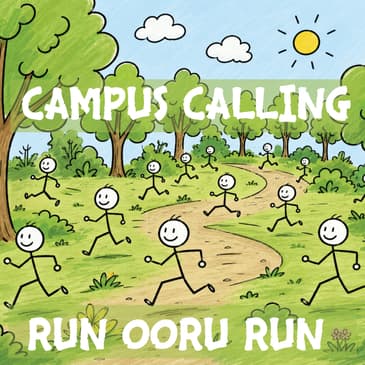

Student reporters Disha Maloo and Amy Biju Joseph explore Bengaluru’s growing run club culture through conversations with founders, runners and marathon participants.
The episode examines how neighbourhood run clubs are fostering fitness, community and belonging, while highlighting the role these grassroots initiatives play in shaping the city’s evolving social and fitness landscape.
Credits:This episode was hosted by Azraa Prem Navaz Khan, Reportage and Narration by Amy Biju Joseph and Disha Maloo. It was Edited by Guru Aditya, Amy and Disha and the cover was illustrated by Vernika Singh. Signature tune by Prof Ananthu.
Learn more about your ad choices. Visit megaphone.fm/adchoices
[00:00:16] Welcome to 4C Radio. We are broadcasting from the central campus of Christ University, Bengaluru. 4C Radio is brought to you by the Department of Media Studies, Christ University. For all those who are looking for a platform that focuses on communities, commons, climate and communication, this is the place to be. What's more, this station is run by a diverse community of students and dedicated faculty members.
[00:00:44] Tune in to experience hard-hitting interviews, fact checks and myth-busting, on-ground stories, campus news and more. Bangalore is a busy city, known for its traffic and fast-paced routines.
[00:01:14] But in the early mornings and late evenings, a different side of the city appears. Runners gather in neighbourhood parks, quiet streets and around lakes, turning everyday spaces into shared training grounds. Over the past few years, run clubs have quietly become an important part of the city's community culture.
[00:01:41] Some are well-established, while others are just beginning. Small groups coming together to stay active and connected. In this episode, we explore how neighbourhood run clubs are shaping Bengaluru's running culture, speaking to founders, runners who are a part of this growing movement.
[00:02:06] To understand this change more closely, we begin with two run clubs in Bangalore that are at different stages of their journey. One is a well-established, running community with structured training and a growing membership base. The other still in its early phase, gradually building its community step by step.
[00:02:34] Student reporter Disha Malu talked to the founders of both the run clubs to learn more about how these clubs began and how they are growing now. The Indranagar Run Club is now one of the most and more recognisable community fitness groups in the city.
[00:02:58] What began as a small group meeting for casual runs has gradually developed into a structured and consistent running community. With regular training sessions and organized marathon preparation programs, the club brings together runners from different professions and backgrounds. I spoke to Maninder Singh and Prabhu Dhat Thakar, founders of the Indranagar Run Club, about how the club first began.
[00:03:27] I do remember the exact moment when IRC went from just a few people running to becoming something big. This was the moment when we participated in our first marathon in 2025, Tough Men, which happened in January.
[00:03:45] We were actually about 20 to 25 runners that participated and then everybody got like at least 50% people got PRs. PRs is a personal record. They were able to complete their first marathon. Nobody was injured and I got actually emotional that we were able to make this impact. People have not done any marathons before this. We were able to get them out of their houses.
[00:04:16] Like we were able to get them to train with us in the mornings and then we were able to complete that marathon. That was the first milestone that I heard. Prabhu Dhat Thakar also explains how the club has evolved over the years, with more runners joining and the community continuing to expand. Hi, I'm Prabhu and I'll be speaking about how has our club grown in terms of numbers.
[00:04:45] So initially when we did the run, in the first run there were only 5 people and then in the second run there were 60 people. And after that it has always been more than 300 but we have started capping the number to 150 because logistically it becomes hard to manage 300, 400 plus people. We have also seen about 450 people in a run at Lal Bagh but we don't do that anymore.
[00:05:08] So yeah, if you see realistically in the last 6 months or so the interest in joining a new run club has pretty much plateaued. That's what I see in the market. So it was trending in 2024 and until like third quarter of 2025 after that it has sort of plateaued. I don't see like new interests coming up.
[00:05:36] Generally people who would have ever tried running have most likely tried already. So that is one of the observations I have had. Apart from that, yeah, I think the number of people who are now ready to pay for any sort of fitness related event has increased significantly. That is what I observed not just in our club but also across the market.
[00:06:05] It used to be the case that people were earlier trying out exploring things but now it has become a very important part of the lifestyle for a lot of people. So they are okay spending on it. So from a lifestyle point of view that is a big change that a cohort of the society especially in tier 1 cities is getting into.
[00:06:32] So yeah, I would say this is something important that we should research. The SG Palya Run Club represents an exciting stage of growth and possibility.
[00:06:56] As it steadily builds its membership base, the club places strong emphasis on encouraging beginners and creating a welcoming environment for the first time runners. I spoke to founders Garvit Saraf and Rajdeep Das Gupta about how the club began. So the inspiration for the SG Palya Run Club, it primarily came from the two things.
[00:07:24] Like so we were on the first of February, Tough Man India which is like a sports endurance platform. We organized this very major half marathon in Bangalore which are a couple of us friends. We decided to participate in and we, you know, we won medals. We really enjoyed the vibe there. You know, the community bonding, people of all age groups and people of all different kinds of paces. Just everyone running and having a good time, no judgement and everything.
[00:07:52] So we wanted to replicate something like that here in our local community. Add to that, you know, like this observation that Bangalore itself has so many localities that have so many run clubs. But SG Palya doesn't really, like we didn't really have a running presence. So there weren't any casual run groups and in around the locality.
[00:08:16] The area itself is extremely friendly when it comes to the idea of community because it has a vibrant mix of students, young professionals, residents, like especially in and around the Kharaj University. So on. But there wasn't a consistent community fitness space, you know, like where people could be brought together to be brought together to run.
[00:08:39] We wanted to create basically something simple and inclusive, like a place that people could show up, run at their own pace and basically meet others who can share the same goals of staying active. Like just to foster community bonding.
[00:08:54] The inspiration is basically was really about building a small, but meaningful community where running was more than the competition and less about competition and more about consistency, bonding, connection and in a nutshell like enjoying the process. Yeah.
[00:09:16] Rajdeep says the community has been gradually expanding with runners traveling from nearby neighborhoods such as Kora Mangala and BTM Layout to join their weekly runs. So the S.G. Pala Run Club is barely a month old at this point, and we have already witnessed significant growth. So today it has grown into a steadily expanding community.
[00:09:45] And we have runners joining us, not just from S.G. Pala, but also from, you know, BTM and Jainagar and also, you know, the larger Kora Mangala area. So initially it was just students from Christ University, just our own friends and people that we knew and acquaintances. But eventually with, you know, enough traction, we actually had lots more people joining in.
[00:10:13] So the local, you know, neighbors, people who were interested in running in general, even younger professionals, all of them started joining in. So it was really interesting and it was really exciting to see and basically witness that growth firsthand. And basically what started with just a handful of runners in the first few sessions has now grown into a much larger and more active group.
[00:10:39] So we have almost 300 people, you know, as we speak, who are a part of the Run Club and it hasn't even been a full month yet. And more important, you know, than just the numbers, you know, is the fact that we have maintained consistency because every week we see familiar faces returning, new runners joining and people, you know, gradually improving their stamina and their confidence.
[00:11:06] And, you know, basically enjoying the community bonding and the sense of togetherness. The entire point of a Run Club is to ensure that you can have people run at their own paces and not, you know, feel demonized, you know, by that.
[00:11:26] He also shared the club's future plans, including collaborations with Christ University and organizing runs that support social causes. So looking ahead, the goal for us basically is to grow the Run Club into a much larger, stronger and a lot more structured community while keeping the same welcoming spirit that, you know, we started with.
[00:11:53] So since the Run Club started with, you know, people from Christ University joining us for our first runs, we want to introduce more of, you know, collaborations and organized runs, maybe in partnership with certain centers or clubs of the Christ University and organize runs for different important causes.
[00:12:15] But apart from that, we also want to organize themed events, you know, runs for different, you know, awareness campaigns, collaborations with other running groups in Bangalore, collaborations with other organizations, other centers in and around the city, even brands, you know, and companies and so on.
[00:12:49] But Run Clubs are not just organization or training schedules. At the center of these communities are the runners themselves. People who show up week after week despite demanding jobs and busy schedules. Many are professionals working in fields such as law, technology, education and management.
[00:13:15] For them, running offers not just fitness but also companionship and motivation. Student reporter Disha spoke to several runners about their experience. For many runners in Bangalore, what begins as a fitness routine gradually becomes something more.
[00:13:38] Running helps them clear their minds, rebuild focus and find balance in a busy city. Corporate lawyer Nayana S. says the community aspect of Run Clubs is what keeps many people coming back. In my experience, Run Clubs have been very community driven, very supportive and people just coming together to have more fun.
[00:14:04] And outside of Run Clubs, people do have more specific groups where they try to be competitive when they're training for specific events. But Run Clubs in general are more open, more collaborative and they're generally welcoming to people from all sorts of living who are very much into fitness. And even those who aren't really, haven't really tapped into that potential yet. So I don't find it to be more competitive, rather more social.
[00:14:31] She also spoke about some of the popular routes that runners frequently use for training. The most popular route that runners absolutely love here would definitely be Kabban Park and Lal Bag. Especially because of the huge place and the nice greenery, the weather. And the fact that a lot of people who are into fitness, running, walking, yoga show up at these places. It's a very nice cohort.
[00:14:58] So I think these are definitely the top preferences of runners in Bangalore. While Bangalore's weather makes it an ideal city for outdoor running, the city also brings its own challenges. Software engineer Hitesh Singh says traffic can sometimes make running difficult. I feel Bangalore's weather has never been a problem. The traffic is a problem though.
[00:15:26] Because as a runner, you end up scheduling your runs either too early. That's way too difficult to get out of the bed. Or way too late where you end up either meeting a police or dogs. So traffic is the problem. Weather has never been a problem. He adds that runners often choose routes based on safety and comfort.
[00:15:52] If I consider about the routes, I guess everyone wants to run at new routes. No one wants to keep running on the same monotonous routes or the circles. So people prefer everything from parks to lakes or even streets like MG Road or running across the nice road.
[00:16:09] The impact of these clubs become visible during the marathon season. Events such as Bengaluru Marathon and Tuffman Half Marathon attract runners from across the city.
[00:16:31] For many first-time participants, run clubs provide the training and support needed to prepare for these long-distance races. Student reporter Disha spoke to marathon runner Nirvana Jane. A marathon is about starting slowly and building endurance over long distances, along with strength training, says Nirvana Jane, who regularly participates in marathons across Bangalore.
[00:17:01] He also explains how run clubs help runners stay consistent and motivated during training. I have run in all sorts of marathons. Hosted by TCS, Wipro, Toughman, etc. I'll maybe do an Ironman in the future. A big maybe. And as of run clubs, I feel run clubs are a good place to start because there are like-minded people
[00:17:30] to keep you accountable throughout your prep and who are running with you regularly. Like, for example, I regularly run with Indra Nagar Run Club on Sundays. A big shout-out to them. They are based out of Bangalore. Sometimes there are specific training blocks which are organized by these run clubs to help you prepare in a structured manner.
[00:17:58] Training for marathons can be challenging. And Nirvana also spoke about the physical and mental demands of preparing for long-distance races. I think my biggest challenge is managing my strength days alongside my run days. Preparing for a marathon takes that I should, at least in a minimum capacity, cover 30 kilometers or more per week.
[00:18:23] And I dedicate three days to running specifically, in which I try to cover 10 kilometers per session. Now, sometimes the volume is not accepted well by my body and recovery takes a heavy toll. And then the priority completely shifts to recovering first and then training afterwards.
[00:18:48] In this way, neighborhood run clubs connect everyday running with the city's larger fitness culture. That brings us to the end of this episode. As Bengaluru continued to grow and evolve, neighborhood run clubs show how small community initiatives can shape the city's expanding fitness culture.
[00:19:17] What often begins as few people meeting for a simple run can grow into a network of encouragement, discipline and shape purpose. In a city known for its fast pace and constant motion, these runners remind us that sometimes the best way forward is to simply keep moving.
[00:20:03] Asif and Disha Malu. It was edited by Guru Aditya, Amy and Disha and the cover was illustrated by Vennika Singh. Please write to us and follow us on X, Instagram and LinkedIn.