
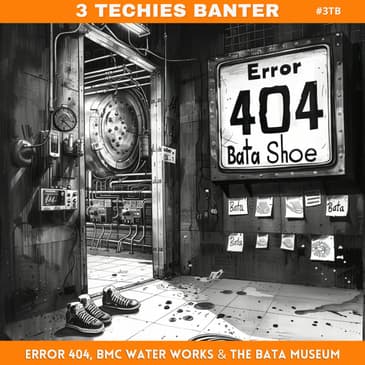




From absurd web beginnings to some misplaced national pride, tech folklore never disappoints. A mouthful of a name that could make even the most patient typist weep, "Jerry and David's Guide to the World Wide Web," could have single-handedly crashed Netscape Navigator. Meanwhile, the digital world's party crasher, Error 404's origin story - linked to CERN's room 404 - proves even glitches have intriguing backstories.
Closer to home, Nilesh's trip to Mumbai's Panjrapur water plant uncovered a juicy tidbit about BMC's potential entrepreneurial foray in the water business. And Sheetal's pilgrimage to Toronto's Bata Shoe Museum shattered our collective illusion - turns out, our favourite "Indian" shoe brand has been international all along, leaving millions of Indians feeling somewhat... misled.
We remain your #funtech companion through traffic jams, morning jogs and side-listens during boring Zoom meetings.
Learn more about your ad choices. Visit megaphone.fm/adchoices
[00:00:10] So it has become a bit of a tradition now that I start the shots. For whatever reason, maybe I'm the most absurd of the three. So that's the way to start.
[00:00:23] So what I like to do, that's why typically is that, you know, leave you with a few, you know, warm up absurdities. So that you get in the mood.
[00:00:35] Yeah, absolutely. Mental stretches. Totally. Here are a few of them. In the course of my great journeys of discovery, I realized that Yahoo's original name was Jenny and David's Guide to the World Wide Web.
[00:00:50] That was actually the name. And imagine typing that as a search engine. It's like you type that out and then the search engine will come up. But luckily they're kindred it into Yahoo.
[00:01:01] Then the other one I discovered...
[00:01:03] How long did you see the Shami Kapoor movie where he says...
[00:01:05] That was a junkie guy.
[00:01:10] So the other one I came up with was, you know, is there this error 404 not found, right?
[00:01:18] So the genesis of that is that the original web servers used to be located in the CERN. Okay, all the web servers.
[00:01:26] And all the searches that could not find a destination used to be directed to a room which was room 404.
[00:01:34] So that's how error 404 came up on the web.
[00:01:38] Wow, that's an interesting one.
[00:01:40] That's interesting.
[00:01:41] So that's not so absurd.
[00:01:42] Not so absurd.
[00:01:43] Not so absurd.
[00:01:44] I was just going to say this.
[00:01:45] So back to absurd then.
[00:01:47] So the first...
[00:01:49] The history of the first bug.
[00:01:51] Okay.
[00:01:51] So the first bug actually was a moth that was found on top of a Mark 1 computer in Harvard.
[00:01:59] Okay.
[00:02:00] And that moth was removed and that's where the term debugging came.
[00:02:04] So it was...
[00:02:05] Literal bug.
[00:02:06] The worst bug.
[00:02:11] Good question.
[00:02:11] And on to my last one, I promise.
[00:02:15] So the first webcam was kind of created or invented in the University of Cambridge by researchers.
[00:02:22] So there was this room called the Trojan Room where there was a coffee pot.
[00:02:26] And people used to journey there and sometimes there was no coffee.
[00:02:29] So they actually put a camera there to just see whether there was...
[00:02:32] Enough coffee.
[00:02:33] Enough coffee in the coffee pot and only then they would go.
[00:02:35] So that was the genesis of the first webcam that was ever created.
[00:02:39] Such utility.
[00:02:41] Coffee.
[00:02:41] Well, for a good cause, I think coffee makes you do things.
[00:02:46] Strange things.
[00:02:47] People do strange things for coffee.
[00:02:48] Yeah.
[00:02:48] Tech guys just don't want to leave their couches and walk.
[00:02:53] See, I'm telling you, laziness is the mother of innovation.
[00:02:58] Absolutely.
[00:02:58] If you weren't lazy, nothing would get done.
[00:03:01] That's true.
[00:03:02] That's true.
[00:03:04] That's my solemn advice.
[00:03:07] So from all those very interesting facts, some absurd, I had a good fortune of visiting BMC's water treatment plant.
[00:03:19] And I thought it would make a good subject for our shots because it is something to be really proud of.
[00:03:25] So I'll give some details about it.
[00:03:28] BMC's water treatment plant, it's near Bhivandi, Pandharapur.
[00:03:33] And it supplies by the way 455 million liters of water per day, purified water.
[00:03:41] Wow.
[00:03:41] Wow.
[00:03:42] And the level of purification from this BMC water treatment plant is, it is the most purest water possible across all municipalities in the country.
[00:03:52] Okay.
[00:03:52] So that was another very, very interesting fact.
[00:03:56] It is, I think, Asia's biggest water treatment plant.
[00:04:00] Wow.
[00:04:00] Yeah.
[00:04:01] And when I saw it, it was mind boggling.
[00:04:03] It's huge.
[00:04:04] And, you know, there was a person who took us there, who has been with BMC for a very long time now, retired, and he showed us around.
[00:04:13] I was asking, why is the plant here?
[00:04:17] One is water source, but the water was flowing somewhere, right?
[00:04:20] So there are reasons why you would put a plant there because the sweetness and salineness of the water and the kind of water that is there.
[00:04:28] But, but now think about it that this is about 48 to 50 kilometers from Mumbai, right?
[00:04:35] So you are doing this and I'll not go into details, but there are multiple stages of filtration and water is getting purified.
[00:04:42] How do you get the water to Mumbai?
[00:04:44] That was the very interesting stuff.
[00:04:46] Gravity takes it there.
[00:04:48] So what they do is they actually have pumps.
[00:04:51] Okay.
[00:04:52] And they took a kind of a small hill and they cut the hill and built two huge,
[00:04:58] water reservoirs on top of the hill and they pump the water to that reservoir.
[00:05:03] And then you just have to open the tap.
[00:05:05] It travels 48 kilometers without any requirement of electricity by gravity.
[00:05:11] Wow.
[00:05:12] That's insane.
[00:05:12] Yeah.
[00:05:13] So those big pipes that are there, the water is traveling alongside.
[00:05:17] You can, you can see it in the near some roads.
[00:05:20] Right?
[00:05:20] So that's, so just the gradient takes it 48 kilometers to Mumbai from Bhivandi.
[00:05:27] Wow.
[00:05:28] So another interesting thing he mentioned was the, the level of purity of water is so good.
[00:05:34] I mean that, that once the processes are done that they once thought of actually bottling that water and selling it at five rupees, you know, so that it's all the other companies said that, you know, you, why don't you just stick to your, you know, supplying water rather than bottling water and selling it.
[00:05:51] But I, I found it very interesting and honestly, you know, some thoughts were running in my head, you know, being coming from living in Gurgaon and then living in Bangalore and then coming to Pune.
[00:06:02] Actually, people in Mumbai, Pune should be very happy.
[00:06:04] The kind of water you get here is way, way better than what you get in Gurgaon and Bangalore.
[00:06:09] Correct.
[00:06:10] I mean, it was such an impure water that you have to use heavy duty ROs for home consumption.
[00:06:16] While in Pune and Bombay, actually, if you, if you use heavy duty ROs, you are actually making the water worse.
[00:06:23] Correct.
[00:06:24] Because it's a, yeah, exactly.
[00:06:26] Even Pune water is quite good.
[00:06:28] You just need basic filters.
[00:06:30] The water is already good.
[00:06:31] So that was a fantastic trip to BNC and, and hats off.
[00:06:36] I mean, it's, it's something to be proud of.
[00:06:37] That's amazing because normally poor BNC is only getting brickbats from the residents of the city.
[00:06:43] It's a very complex task, you know.
[00:06:44] And you're just taking water and so the same is true for drainage and cleaning the roads.
[00:06:49] Oh, by the way, I mean, he was telling, so he has been with BNC.
[00:06:52] Water treatment was one of the things.
[00:06:54] I mean, you guys must be aware of it.
[00:06:56] The BNC budget is more than most of the mid-level states of India.
[00:07:03] Yeah.
[00:07:04] So, take an example of Kerala and everything less than Kerala has lesser budget, state budget versus Mumbai's BNC budget.
[00:07:13] Yeah.
[00:07:13] But I wish they would put it to a little more efficient use.
[00:07:16] I'll still crib about it.
[00:07:18] Despite the fact that they give us better water, I'll still crib about the lack of services that BNC puts on the table.
[00:07:24] So, my husband and I always have these places on our list, right, when we are recommending to people.
[00:07:30] And so far, we've always said New Zealand is a must-visit country.
[00:07:35] And then South Africa is a must-visit country because it's just naturally beautiful.
[00:07:41] Our recent trip to Canada has now added Canada to that list because it's just an absolutely naturally beautiful country.
[00:07:51] But more than that, what fascinated me was that we were in Toronto and we went to the Bata Museum.
[00:07:57] And you kind of say a shoe museum, I mean, yeah, but they have more than four and a half thousand.
[00:08:05] No, they have more than 15,000 pairs of shoes on display in the museum.
[00:08:11] And they have like these temporary displays and permanent displays and all of that.
[00:08:15] And it is so fascinating the history that they have pulled up from the first, you know, shoe that was worn, which would be literally grass and things like that, to where we are today.
[00:08:29] And they've covered every kind of footwear in that museum.
[00:08:34] So, I'm not going to the rest of Canada because I think that is another episode by itself.
[00:08:40] But if you ever land up in Toronto, please go visit the Bata Museum.
[00:08:45] It's an eye-opener on how shoes have played such a distinct role in our lives.
[00:08:51] We don't even realize it, right?
[00:08:52] So, for the longest time, we wore this shoe called the Naughty Boy Shoe.
[00:08:56] Naughty Boy Shoe.
[00:08:57] The Naughty Boy Shoe was just like black in color.
[00:09:00] And of course, the fact that I think every Indian group grew up thinking that Bata was an Indian company.
[00:09:07] I mean, that is true branding, right?
[00:09:10] That you, everybody believed that Bata is ours.
[00:09:12] Because all our school shoes came from Bata.
[00:09:15] Whether they were the white canvas, whether they were the black Naughty Boys,
[00:09:19] whether they were the brown canvases that we had in our school.
[00:09:22] All of us just lived and grew up on Bata shoes.
[00:09:25] I think yesterday we visited a watch this thing also, right?
[00:09:29] And we saw Fever Luba, right?
[00:09:31] So, these are couple of global companies which came to India so early on that we believe they are ours only, right?
[00:09:38] Yeah, absolutely.
[00:09:38] Like Bata is one of them.
[00:09:39] I mean, those watches will think that Fever Luba is Indian.
[00:09:43] Correct.
[00:09:44] In fact, again, Fever Luba trivia.
[00:09:47] So, my mom had given my dad a Fever Luba on their wedding.
[00:09:51] And I said, yeah, okay, must be some country.
[00:09:55] I mean, no, no, no, no, no.
[00:09:56] Indian, just like HMD or something like that.
[00:09:58] Correct.
[00:09:58] And then I later realized, oh, it's actually a Swiss company.
[00:10:01] So, once again, Bata is not an Indian company.
[00:10:05] It's not Canadian either.
[00:10:07] So, it was quite fascinating to see the shoe music.
[00:10:11] Though I have to say that Bata Nagar is near Calcutta.
[00:10:14] So, make it your own.
[00:10:20] Long live the Ghali's, long live Bata types.
[00:10:25] So, this brings us to the end of another shorts.
[00:10:29] The crazy ones that Samiran always brings to you.
[00:10:32] The interesting ones that Nilesh always brings to you.
[00:10:36] And the, I don't know, the more random ones that I bring to the table.
[00:10:41] I hope you enjoyed the shorts.
[00:10:43] Write in to us, tell us what you'd like to listen to.
[00:10:46] Or what things you think we haven't covered and you should think we should cover.
[00:10:51] We'll be happy to hear from you.