
https://thethinkschool.com/sp/communication-masterclass/
If you are a copyright owner and believe your work has been used improperly, please contact us at writers@thethinkschool.com for prompt removal or credit.
VIDEO INTRODUCTION:
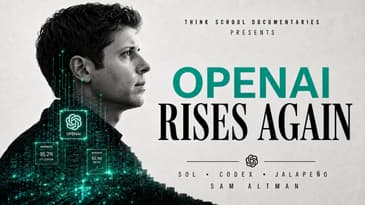
Ladies and gentlemen, for the last three years, OpenAI has been running one of the most confusing businesses on Earth. In 2026, the company is on track to lose around $28 billion, even though its revenue has surged to a run rate of about $25 billion a year, an increase of nearly 92% over the last 12 months. Yet the pattern has remained the same: the more OpenAI grew, the more it bled cash. In fact, in January 2025, Sam Altman himself admitted that the company was losing money even on its $200 ChatGPT Pro subscriptions.
Now, do you see the irony? In almost every normal business, your best customer is your most profitable customer. But in OpenAI's world, your best customer is actually your least profitable customer because the cost of running cutting-edge AI models is extraordinarily high. This is exactly why some of the smartest investors on Wall Street have argued that AI is in a bubble. Their thesis is simple: if the biggest and strongest player in the industry cannot make money, how will everyone else? And if no one can make money, why is the world pouring trillions of dollars into AI?
The only way for this AI bubble to become a genuine gold rush is if someone can reduce AI inference costs by 10 to 100 times. And ladies and gentlemen, over the last 90 days, that comeback may have already begun. While everyone was focused on OpenAI's losses, the company quietly made four major moves: it launched GPT-5.6 Sol, which reportedly matches Claude Fable 5 at roughly one-third the cost; it turned Codex into a breakout product, with active users growing by 500%; it introduced ChatGPT Work, bringing email, documents, files, and Codex together in a single workspace; and finally, it unveiled its own AI chip, codenamed Jalapeño. Suddenly, it feels like OpenAI might actually be moving toward profitability. The question is: why does OpenAI lose money even on its most premium customers? What exactly is Jalapeño? And why could these launches be the key to turning OpenAI into one of the most profitable technology companies in history?
Our Best Indian Business Case Studies:
1. Dhirubhai
https://youtu.be/bSx6hDjALkQ?si=wE6PGMgiv7PpHdla
2. Milky mist
https://youtu.be/-98fnc4VAo8?si=NtKHTWjvtr_9V8ne
3. Old Monk
https://youtu.be/GQPymbqa08A?si=BXhcZhDPXt9wTxO4
4. Waaree
https://youtu.be/T1PLEPTbXc4?si=3VbRKyBnd-3Trfqt
5. Blinkit
https://youtu.be/OGs2YsqvWDg?si=bZ_AqkdGEsl2X3xW
✅Study Materials:
https://artificialanalysis.ai/agents/coding-agents https://a16z.com/llmflation-llm-inference-cost/
https://www.reuters.com/world/asia-pacific/openai-unveils-custom-chip-it-designed-with-broadcom-boost-its-ai-infrastructure-2026-06-24/
https://www.bloomberg.com/news/articles/2026-06-24/openai-and-broadcom-unveil-ai-chip-to-run-models-faster-cheaper
Think School is a Digital School that we all deserved, but never had
►►Check out Think School's Online courses: https://www.thethinkschool.com
#thinkschool #businesscasestudy #geopolitics
Credits: CNN-News 18, WION, NBC News, Money control pro, Business standard, TV18,Business Today, ABC news, CNBC, ET now ,Bloomberg originals, Financial Times, DW documentary, AL Jazeera English, BBC news, Firstpost.