
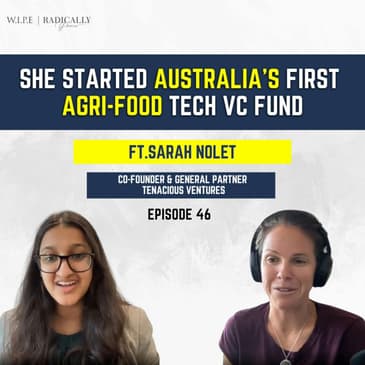
“𝐈 𝐰𝐞𝐧𝐭 𝐨𝐧 𝐚 𝐡𝐨𝐥𝐢𝐝𝐚𝐲 𝐭𝐨 𝐒𝐨𝐮𝐭𝐡 𝐀𝐦𝐞𝐫𝐢𝐜𝐚, 𝐚𝐧𝐝 𝐭𝐡𝐨𝐮𝐠𝐡𝐭 𝐨𝐟 𝐭𝐚𝐤𝐢𝐧𝐠 𝐬𝐨𝐦𝐞 𝐭𝐢𝐦𝐞 𝐭𝐨 𝐟𝐢𝐧𝐝 𝐰𝐡𝐚𝐭 𝐈 𝐫𝐞𝐚𝐥𝐥𝐲 𝐰𝐚𝐧𝐭 𝐭𝐨 𝐝𝐨 𝐢𝐧 𝐥𝐢𝐟𝐞. 𝐈 𝐥𝐢𝐯𝐞𝐝 𝐨𝐧 𝐚 𝐟𝐚𝐫𝐦 𝐟𝐨𝐫 𝐚𝐥𝐦𝐨𝐬𝐭 𝐚 𝐲𝐞𝐚𝐫 𝐭𝐨 𝐟𝐢𝐧𝐝 𝐰𝐡𝐚𝐭 𝐈 𝐚𝐦 𝐩𝐚𝐬𝐬𝐢𝐨𝐧𝐚𝐭𝐞 𝐚𝐛𝐨𝐮𝐭, 𝐚𝐧𝐝 𝐫𝐞𝐚𝐥𝐢𝐬𝐞𝐝 𝐢𝐭 𝐰𝐚𝐬 𝐚𝐠𝐫𝐢𝐜𝐮𝐥𝐭𝐮𝐫𝐞 𝐚𝐧𝐝 𝐟𝐨𝐨𝐝 𝐬𝐲𝐬𝐭𝐞𝐦𝐬 𝐚𝐧𝐝 𝐡𝐨𝐰 𝐜𝐥𝐢𝐦𝐚𝐭𝐞 𝐜𝐡𝐚𝐧𝐠𝐞 𝐰𝐚𝐬 𝐢𝐦𝐩𝐚𝐜𝐭𝐢𝐧𝐠 𝐭𝐡𝐞𝐦.”
Meet Sarah Nolet, Co-founder and General Partner of Tenacious Ventures, Australia’s first agri-food tech VC fund.
In conversation with our founder Radhika Bajoria, Sarah shared about how she created an impact-based fund to fuel innovation and technological advancements that create an impact towards sustainability and climate change mitigation.
She has invested in innovative agri-food tech startups like,
1. azaneo - it has developed an appliance that uses pulsed electrification to manage weeds without any chemical inputs
2. GOTERRA - an organic waste management solution that uses insects to process food waste
3. Vow Food Co., ltd. - they are reinventing food by creating delicious meat from cultivated cells
4. RapidAIM Pty Ltd - provides accurate region-to-farm pest detection and forecast in real-time
Sarah also shared her journey of finding a co-founder, and how choosing the right co-founder helps to grow a business exponentially.
“𝐖𝐞 𝐥𝐨𝐨𝐤 𝐟𝐫𝐨𝐦 𝐰𝐡𝐞𝐫𝐞 𝐚𝐧𝐝 𝐡𝐨𝐰 𝐫𝐞𝐭𝐮𝐫𝐧𝐬 𝐰𝐢𝐥𝐥 𝐜𝐨𝐦𝐞 𝐚𝐧𝐝 𝐚𝐥𝐬𝐨 𝐞𝐧𝐬𝐮𝐫𝐞 𝐭𝐡𝐞 𝐞𝐧𝐯𝐢𝐫𝐨𝐧𝐦𝐞𝐧𝐭𝐚𝐥 𝐢𝐦𝐩𝐚𝐜𝐭 𝐰𝐞 𝐰𝐢𝐥𝐥 𝐡𝐚𝐯𝐞.” Sarah explained to us how they are managing to get returns from the impact-led businesses they invest in while also keeping in mind the foundational principles of sustainability.
Sarah and her fund are not just investing in startups but also investing in a future where food and resources are abundant, sustainable, and accessible to all. 𝐓𝐡𝐞𝐢𝐫 𝐩𝐨𝐫𝐭𝐟𝐨𝐥𝐢𝐨 𝐢𝐬𝐧'𝐭 𝐣𝐮𝐬𝐭 𝐚𝐛𝐨𝐮𝐭 𝐟𝐢𝐧𝐚𝐧𝐜𝐢𝐚𝐥 𝐫𝐞𝐭𝐮𝐫𝐧𝐬; 𝐢𝐭'𝐬 𝐚𝐛𝐨𝐮𝐭 𝐜𝐫𝐞𝐚𝐭𝐢𝐧𝐠 𝐦𝐞𝐚𝐬𝐮𝐫𝐚𝐛𝐥𝐞 𝐢𝐦𝐩𝐚𝐜𝐭!
If you are a startup founder building in the climate and sustainability space, you must reach out to Tenacious Ventures!
Link to our conversation with Sarah: https://lnkd.in/djdvs8-k
#SustainableFarming #ImpactInvesting #FutureOfFood #SustainabilityLeaders #MeasurableImpact #womenleader #womenentrepreneurs
[00:00:01] Why is women's face in post-synchroneous at times? Thanks, Sarah, for joining us in our series called Wipe. The premise of this interview is that we address why the unconscious gender bias still exists
[00:00:15] and why is it that women face in post-synchroneous at times and are not able to reach to the top especially when it comes to the field of investing. Why do we see lesser representation there?
[00:00:27] You being one of the few women who have not just made it on the top in investing but have launched a fund of your own, how is it for yourself while building up if you could give us a glimpse
[00:00:37] of your career that from the beginning as to how did you transition from your college, your graduation years to starting to work? Yeah, sure. So I guess my background is in computer science and systems engineering so started my
[00:00:53] career in the defense industry and I guess I realized pretty quickly that I wanted to do something more in the private sector. The pace of the defense industry wasn't as fast as I wanted to go but I didn't know what
[00:01:06] that would look like and it wasn't until I went on holiday to South America and then was kind of in a field literally on a farm and was like, wait a second, I don't need
[00:01:18] to necessarily go back and go to grad school or get a job or kind of keep on the exact track I've been on. Let me take a bit of time and think about what I really want to do.
[00:01:27] So I stayed in South America and lived on farms actually for almost a year and it really just flipped a switch in my brain about what I was really passionate about and for me that was agriculture and food systems and how climate change was really impacting them.
[00:01:42] So that kicked off a real left turn in my career and I've spent the next I guess decade really thinking about and working in early stage innovation in food and agriculture. So a bit of a roundabout pathway to get to investment and even that was quite a long
[00:01:57] journey but it definitely wasn't where I started out earlier in my career. Got it. But how did you get to live on the farms? Why did that thought come in your mind that okay this is something that I should explore? Yeah, it's a good question.
[00:02:11] So I really wanted to go backpacking and just be in the mountains and be in nature. That's how I've always kind of decompressed and I've always cared about the environment.
[00:02:19] And so a cheap way to be in nature when you're traveling is actually to live and work on farms. But I didn't think the farming part would be what I was passionate about but I was
[00:02:29] really interested and wanted to just spend more time yeah on farms and so wasn't expected but that's where I ended up. Yeah but you look like someone who likes adventure and that's also something of personality having
[00:02:42] said that you were also part of World Football and Football Club of your universities. I mean do you think that has made you the person you are today having you know explored those kind of activities because women generally tend to be the kind gentle ones who are
[00:02:57] the nurturers but you know that always doesn't work in their favors because feminine qualities are also sometimes not so appreciated by society but how is it that your experiences in these two different sports helped you? Yeah I mean I've always been an athlete.
[00:03:14] It's literally all I wanted to do for the first 20 years of my life. My parents tried to get me to do like mock trial or to you know think about other things and I just wanted to play sports whether it was a baseball or a swimming pool
[00:03:26] or a soccer ball that was really all I wanted to do. I think you learn a lot in sports. You learn definitely about hard work and perseverance. I think you learn about feedback and having a coach and really taking on areas for
[00:03:42] improvement and kind of working through things that you're bad at and really acknowledging things that you're bad at and I think you learn a lot about being the right balance of sort of competitive but team oriented right.
[00:03:57] You have to be competing against the other team and trying to win but you can't do it alone. You even in an individual sport you have a coach and trainers and things like that but in a team sport you're really working with each other so plenty of lessons
[00:04:10] from sports that I've been applying in business. Yeah speaking of being a team player how was it that you developed your own team because having a co-founder by your side is also in a way very difficult and many founders struggled with it.
[00:04:25] We had fund managers or entrepreneurs so how did you meet your co-founder? Yeah it wasn't something that we planned in many ways I got lucky so when I left grad school and moved to Australia I ended up founding my own business
[00:04:39] in the advisory kind of consulting space and that was really because I didn't know what else I would do and I had the opportunity to start doing projects. Really my criteria for what I wanted to spend time on was like first food
[00:04:52] systems and climate change like that was the number one I wanted to be working on that but after that I was sort of less clear is it you know big company or a small company or is it early stage or later stage it was really actually team.
[00:05:04] So for me the next most important criteria was like who on a day-to-day am I working with and I think that came from sports just like knowing how important it is when you're like training and sweating and you know
[00:05:14] blood and tears that people you're working with just matters so much and so it wasn't until I met Matthew that I started to think like actually he's someone I think I could work with and we did a few projects together and we
[00:05:27] would catch up after conferences and spend more time together and at one point I said just kind of bluntly to him like hey look if you ever are thinking about doing something next you're probably one of the few people I've
[00:05:39] met that I could see myself working with and so if you're ever interested in exploring that like I'd love to explore it and fortunately he said oh I feel exactly the same like let's start talking about that.
[00:05:50] So it was quite a long process of getting to know each other and building confidence but it also kind of took that moment of me just saying hey just putting it out there if you were ever interested in this like I would love to explore it further.
[00:06:02] Yeah I mean putting out your opinions is very important which most of the women at least hesitate to ask so that asking is extremely important without having the perception that what if you are judged but how did you meet him for the very first time?
[00:06:20] Where was it in what kind of city? And exactly to your point he I mean he's 20 years older than me. He's Australian so it was in some ways intimidating to even put that out there so I definitely but so worth it.
[00:06:33] So I think asking for what you want is a really important lesson. We met though he when I first came to Australia I had just searched on the internet for AgTech and sort of who was working in this space and there really
[00:06:45] wasn't much but Matthew had just written an article on a conference that he had been to and so I found him on LinkedIn and just sent him a message and said hey I saw you wrote this article it was interesting like would you ever
[00:06:58] be up for a chat and he immediately said yeah call me anytime here's my number and so I remember being like oh Jesus he can have an Australian accent like I don't know this guy I had just moved to Australia and so I did
[00:07:11] call him and he was lovely he was super helpful and it turned out that he was coming to Sydney where I live in a couple weeks and so I went to the conference that he was going to and we met up and that was the first time
[00:07:23] we met in person. Understood and did you ever expect a response from him because like you said he was 20 years elder to you and very much experienced so while writing to him did you have this feeling that okay I'm trying it out let's see
[00:07:36] how it goes or you knew that my idea proposition is really interesting and purpose driven and I will definitely get a response. What was there in your mind while you were writing the message? Yeah it's a good question so when I before I moved to Australia I was
[00:07:52] working on my master's thesis and part of my thesis was reaching out to about 100 investors that I didn't know in many cases and asking for a chat with them to talk about their investment thesis and their views on the
[00:08:05] food system and so I guess I had built a bit of thick skin around just reaching out to people cold and using LinkedIn and asking for intros and things like that so that helped a ton when I moved to Australia and I
[00:08:18] didn't know anyone and I had to do a bunch of things like reach out. I think in the case of Matthew I wasn't like asking him for anything specific it was like hey I just want to connect I just moved here and I
[00:08:29] did have a little bit of credibility in the space I had finished my thesis and done a few consulting projects and so yeah I probably was I didn't know if you would answer or not but I was just asking for a chat so I was probably pretty confident.
[00:08:42] And what was the timeline like from your first message to him getting convinced of building something with you? Well I think I don't know who was maybe convinced sooner but it took me
[00:08:52] a few years for sure of us I mean we didn't we don't live in the same city and we didn't work closely together for many years so it was he was always someone I respected and would ask for advice and he would do the same
[00:09:04] and we would catch up at conferences so I mean we would maybe see each other four or five times a year for the next couple years. It wasn't it wasn't a lot but it was probably two years later where
[00:09:17] I had a few projects in my business that I thought could use his skill set and expertise and so I asked him if he wanted to collaborate on those projects and then from there once we started actually working on
[00:09:28] things together sort of pretty quickly built confidence that wanted to do more of that. Yeah speaking of that confidence like you said that your thesis had made you a thick skinned in order to also face rejections and take
[00:09:43] you know whatever comes your way but why is it that women sometimes tend to give up when they're not accepted for something that they really are into I mean you really need to also see that the world we always
[00:09:55] not like what you built or what you have in mind but really that thick skin is not developed as such women is what generally I see at least what is your view of that. Yeah I mean again maybe my experience as an athlete makes it a little bit
[00:10:11] different where I just have spent my whole life failing at things or being bad at things until you succeed right you don't win tournaments until you've lost a lot of tournaments you don't score goals until you've missed a lot of goals and so I think there's probably
[00:10:23] something in that kind of resilience you build through sports. What I would say is that the I learned a lot about changing sort of how and what you ask for it's pretty unlikely that you get a response when you're either pitching and selling something or
[00:10:41] when you aren't pretty intentional about who you're speaking with and why so if you just send a random message of hey I want to chat with you do you have five minutes can I pick your brain that's pretty
[00:10:51] tough and you'll get a lot of rejection but if you're hey I read this thing you wrote this part in particular stood out to me I really appreciated this insight here's how I thought about it would you have
[00:11:02] five minutes to go a bit deeper like that's a pretty different proposition and so it took me a while to learn how to craft emails like that and kind of do that research but I think that's putting in the work really does help.
[00:11:17] Yeah but having done it yourself when you see founder emails come to you now how is it that you see messages in different ways you know and forms. Yeah I mean it's such a good question and it's so it's so
[00:11:31] frustrating when we get like hey we're a Web 3 crypto you know fintech play can we can we talk to you about our investment and it's like we don't invest in fintech like why are you reaching out to us we're an agtech investor it's very clear on
[00:11:43] our website on my profile so yeah when people don't do the research it's a pretty easy no for me but if people do take the time to do the research and you know think about why they want to speak with us I almost always say yes.
[00:11:59] Understood and what kind of founder messages do you really like of course given the fact that they understand what area you invested but how is it that you would want to see them explaining their business in the first message that they send
[00:12:12] out to you. Yeah so in that first message and it goes whether it's a message or meeting at a conference like I do want to build a bit of a relationship with them and so especially at a conference or in person like coming up to an
[00:12:26] investor and starting to pitch right away is pretty is pretty tough whereas coming up with a you know more getting to know you as a human and then creating the opportunity to set up a phone call or share the pitch deck afterwards that
[00:12:41] makes a lot more sense and tends to work better so that everyone is really in the right headspace when you do go into that pitch because while the founder might be ready to pitch the investor might not be ready to receive the pitch
[00:12:51] in that moment and so you really want to create that context where both sides are ready to have that conversation. In a digital world we're pretty clear that we have a form on our website and we review it every week
[00:13:04] and we get back to everyone who fills out the form that's a fit for our mandate and so it's truly not a like shrugging you off if we say fill out the form it's so that we reduce bias and don't only take warm intros but actually
[00:13:17] have people come through the same process as they reach out to us. So that's how we handle it online. Yeah speaking of the pitch many people just go on explaining what they do instead of asking okay what would
[00:13:28] you want to know and it seems like more of a script rather than an actual conversation and that's what pisses off most of the investors. So in that case what is it really that catches your attention in a founder's pitch.
[00:13:41] Yeah it's a really good question. I mean the more than it can be a conversation the better. So I think that's a really good point of not just like if someone's talking at me no matter how interesting they are if they're just talking at me for 15 20 minutes I'm
[00:13:53] going to lose interest it's just really tough. So more of a conversation. I really like getting to know them and like their why why are they founding the company we invested the really early stages and so knowing the team and what motivates them is
[00:14:06] really important. A big thing in food and ag and because we don't only invest in software is the business model and so like how are they thinking about actually getting their technology into the system. It's probably not just selling it to farmers maybe there's some kind of nuance
[00:14:24] or channel or distribution strategy and kind of thinking about that business model. We find really important and I mean for us we do really look through the lens of climate impact and both from why we think there will be
[00:14:39] returns in how food and ag is changing but also from the environmental impact standpoint. And so understanding like does the founder care about that too. Is that a driver for them. Have they thought about unintended consequences. That's also important. Yeah one debatable question
[00:14:55] that I get reminded of while you speak of impact is that many people don't know how to measure impact and this still are deliberating on different ways to actually calculate the returns basis impact. How is it that you measure
[00:15:07] the ESG index. Yeah for sure. So when I was writing my master's thesis exactly to your point I called all these investors and I thought I'm going to talk to them all about impact investing and after about four maybe five phone calls where every time I said so
[00:15:20] impact how do you measure it. How do you think about it. They all said oh well we're in food and ag we feed people its impact done like there was no more sophistication no more. I mean this was almost 10 years ago so things have changed quite a lot
[00:15:33] but it was interesting at the time that there was really not an advanced set of metrics are thinking now the way we work on it is impact is embedded in our process from the very beginning so we will actually pass on companies for financial
[00:15:48] reasons and for impact reasons for us the lenses of impact are ecological sustainability decarbonization and adaptation and resilience. So we need the company to align with one of those three and then as we invest both their business model and team and all the
[00:16:04] normal stuff we also think about that impact and we actually write it up as part of our investment assessment so it goes to our investment committee and forms part of our analysis and then once we decide to invest we document the we in our term sheet that we
[00:16:19] will report on impact and that we will agree with the company the specific metric that will report on and for us it's really important that the impact metric be both custom for the company because if it's something that we're just making up and doesn't matter to them
[00:16:34] like it's not going to work and also really aligned with their commercial progress so sometimes that's a really direct correlation like the more revenue they get the more tons of waste they divert from landfill it's exactly you know aligned sometimes it might be with bit more indirect
[00:16:50] where the more traps they have out the more coverage of an area they have and the more likely that area is to transition to biological products so we have different levels of direct or indirect but for each company we do report on it quarterly it has to be
[00:17:07] aligned with how commercial they are or their commercial growth and then on our side internally we translate that back to things like CO2 equivalent or other metrics that we might report to our investors. You got it I mean this is a very
[00:17:22] tough task to do because you really don't know what's the right way to do it but in this case how is your fund structured because yesterday itself I was having a conversation with a women fund manager and she told me that if you are an impact based fund
[00:17:37] sometimes the general managers or the GPs let go of their management fee and adjust an 80-20 structure where you divide the carried interest so is that the case in your fund as well or how is it structured? Yeah so we do have a management fee on
[00:17:54] our fund and that's really to pay the salaries and operating costs of the team and to pay our team we our incentives really though are aligned with the investors around that upside which is an 80-20 structure and we believe a lot in our team having carry
[00:18:11] as well so our team members participate in that upside as well. Got it and are you seeing different ways in which funds are being structured at least in Australia? Yeah I would say it's mostly sort of two in 20 like 2% fees 20% carry most
[00:18:28] funds are structured like that what I have heard a little bit about and I haven't actually seen it yet but just people talking about it is an extra fee for impact so like maybe it's 2% for the general fee but then 0.5% for the impact fee because you do
[00:18:44] have to do extra things like the impact assessment and impact reporting and maybe there's a theory of change and so you know who's paying for that that's not how we've thought about it but I think it's an interesting concept. Yeah indeed it is but tell me one thing
[00:18:57] that how do you measure governance because that is also a part of the impact? Absolutely yeah so ESG is embedded in our term sheet and our process as well so from our diligence process to how we report quarterly we absolutely kind of have best
[00:19:14] practices there so things like governance, things like conflicts, you know things like diversity are all things that we measure. We're really proud that our team is more than half female and our portfolio companies over 50% of our portfolio companies have female founders or co-founders that's not a metric that
[00:19:37] we solve for but it is something we're really proud of. Got it and has this metric changed over years or did you always receive more of women applications in this space because there's also saying that you know women entrepreneurs are more driven towards impact based
[00:19:53] businesses rather than just tech businesses which means you burn a lot of cash and then you don't know when your revenue is going to come but women given the nurturing nature they have they always choose to you know have something which drives an impact in the world so
[00:20:09] is that the reason why you saw more women applications? It's really tough to know sort of correlation versus causation and we've always been an impact fund and I've always been a female GP so we don't really have the counterfactual but I imagine
[00:20:21] there's there may be an element of impact. I think there's maybe an element of my profile and the profile of our team but I would say even more broadly we're seeing men and women and all kinds of people want to get involved in impact
[00:20:35] more recently I think people sat around during COVID and you know had a bit of a moment of like what am I doing with my life what do I want to do that I'm going to be proud of and so we have seen an uptick in talent
[00:20:46] you know coming into food nag and climate more broadly. Got it and how do you how do you you know observe a difference when it comes to women founders who pitch to you versus a male founder because in the way they present themselves it's very different.
[00:21:02] Male would just talk about the bigger picture you know and then come towards what they are doing to achieve that but a female entrepreneur would always just talk about what they're doing at the present and sometimes not talk about the projection which always makes investors rethink the decision.
[00:21:17] So is that how you also see the style of pitching. Yeah I would say we see it break down probably more along the lines of backgrounds than of gender so if you're like a researcher maybe there's much more focus on like the product and the
[00:21:31] technology and the science and the accuracy and maybe less on the commercial side. If you're a farmer or an industry expert maybe you're focusing more on the problem and you're like very deep understanding of the domain but maybe you aren't using as many of the kind of
[00:21:47] terms and jargon of venture capital and you're not talking about your TAM and your SAM and your series B and all that kind of stuff so we really try to make sure we take the time to see through the backgrounds and the you know if
[00:22:01] they're pitching if they just don't understand how to speak venture that doesn't mean they're not building a great business so if we ever need to like push time out, explain or understand really what they're saying and then evaluate you know the quality of what they're saying.
[00:22:13] We hopefully try to do that because yeah we know that founders come in all shapes and sizes and they don't always speak fluid venture or pitch in the way that investors might expect them to and that doesn't mean they're not building really fantastic businesses.
[00:22:27] Yeah I mean that's a very good thought because most of the investors don't consider the fact that okay there can be differences and we should respect both of the styles. Is it also because you're a women leader and you can understand what other women entrepreneurs might be
[00:22:45] going through and that's how you are you know very related to what the differences are because many of the male investors don't realize this. Yeah I don't know I think definitely one of the reason is I've been in plenty of rooms where I didn't speak the
[00:23:01] language that others were speaking like when we are raising our first fund and I was in a room with more finance people and they're talking about oh there's the deiquities portfolio and their reverse takeover merger of this thing and I'm like I just that's it's not my world
[00:23:15] I don't come from that space or sometimes of him in an agriculture world and they're talking about like the nitty gritty of sheep genetics and and the ABBs and the different you know nuances of how decisions are made. That's not my expertise and so
[00:23:30] I've really had to try to build the muscle of not pretending I know what I don't know and also not just tuning out because I don't know but rather trying to say OK I can get curious here I can ask questions I can learn and
[00:23:44] maybe someday I will speak that language. But just because I don't speak the language doesn't mean I don't have value to add. And so I try to take that same approach when we hear people pitch to us is just because they don't speak the language doesn't mean they're
[00:23:56] not building a really good business. Understood. And how did you take that critical decision where you knew that you're good at you know maybe agricultural field and you have good knowledge there. But how do you really decide that OK I can become a fund
[00:24:11] manager and not an entrepreneur or vice versa. How does that. Sure. I mean it's funny I do. I mean I do think of myself in some ways as an entrepreneur in that we're building the firm of tenacious and growing it but I it was definitely
[00:24:25] you know an option to start a company or start a tech company instead of be on the fund manager side. And I think for me it came down to I didn't have an idea like I didn't have a specific company I wanted to start but I did on
[00:24:38] the investment side sort of say OK what do you need to be a good investor. Well you need deal flow and we had a lot of that we have the podcast and communities we would run and lots of entrepreneurs coming to us. You need operating experience.
[00:24:50] I had just sold another business I co founded Matthew had exited several of his businesses. So we sort of had the operating side and you need a thesis and I sort of said well I've been thinking about how the food and ag systems changing for almost you know
[00:25:04] five or six years at the time and I actually do have some things I believe in and want to say. And so the only thing we don't have is this fluency and venture capital. Well we can get mentors we can get advisors we can learn that more.
[00:25:16] And so that seems like a pretty compelling package to kind of bring to the market. And but yeah it was a big it was a big leap to say like we haven't worked in venture capital but we're going to raise a fund.
[00:25:27] And so all we can do is try and if we don't get there we don't get there but fortunately we did. And stood and like you said in many ways fundraising is also an entrepreneurial journey. How did you attract LPs for your first fund then convince
[00:25:44] them with your pitch that OK you need to invest your money with us because we're going to really give you a good return that with an impact. Yeah I mean at first we not only didn't know like we didn't have anyone to talk to
[00:25:57] you and we didn't really know what to say. So one thing we did early on that I always laugh about is we sent out an email to our whole mailing list that I had built and it said like Australia needs an AgTech VC so we're building
[00:26:10] one. And both Matthew and I thought we would send this this email and people would respond saying oh that's so interesting can I invest or how do I invest. And so we really thought like we're fundraising but we weren't fundraising we were just sending an email and so
[00:26:23] instead what happened is a lot of people said oh congrats good luck sounds fun like hope it goes well. And so then we had to really step back and say all right how do you actually fundraise because it's not just sending an email to your newsletter
[00:26:36] and start to think about like defining personas what's our value proposition how are we differentiated and be a lot more targeted in more of a kind of sales strategy to actually speak with LPs and I think it came back to that like we had we had deal flow
[00:26:51] we had operating expertise and we had a thesis and like a vision of how the future of the food system would be different than it is today. And so that's really what we were talking a lot about in raising fund one. Got it but one question that
[00:27:04] always I have in mind is that how do you really compete in a market which has great competition in your industry for example if you already have funds in AgriTech for example how do you make sure that you tell the investor that my fund can be
[00:27:19] different from the existing ones and you should put money in my fund rather than the other ones. Yeah so in our first fund there weren't any other so we were the first AgTech fund in Australia and so a little bit of our sales process was
[00:27:31] like do you care about food nagged do you think that's a good space if you do for the option right. So because we were the first one now when we're raising our second fund it's a little bit different because there are other funds even in Australia.
[00:27:43] And so yeah part of the process of fundraising is you really refine like what are the things that you're truly different and that other people think are different about you. And so for us that's really three things one we're quite thesis driven so we don't just
[00:27:58] invest or we don't just evaluate all the companies that come in the funnel we do do that but we also proactively do research on different areas of the food system that we think are high potential and doing that research means we connect with farmers and agribusiness executives and
[00:28:15] like are really quite ag as much as tech. So that's kind of one the second is we don't just invest in software so we invest in deep tech and we think that I mean you can't software and so it's really important for the future that
[00:28:27] we have things that aren't just software. And then the third is our impact focus and so we really look through that lens of climate change for where returns will come from and why returns will come as well as the environmental impact we can have I think those three
[00:28:42] things make us pretty different. We're also in Australia I'm a female GP you know there's a few other things but I think those are really the three that stand out for us. And how long did it take for you to close your first fund
[00:28:55] and is there a time difference in the second and the first one because now that you're established it's easier to raise is it that is. Yeah we'll see so we're still raising fund two fund one took us about two years to raise
[00:29:08] from kind of end to end and that's about average we think for funds especially first time fund and I mean it's such a funny one we like getting to the first 20 million was really challenging then we stopped fundraising and made some investments and
[00:29:23] it was COVID and so we just were focused on investing then we raised a bit more. And it was still quite hard we thought like well we've already got 20 million we've already made a couple of six investments like it's going well but it was still
[00:29:35] difficult people didn't know us we didn't have as many leads. But then towards the end as we got to kind of 26 27 28 we actually only wanted to raise 30 and we're like oh we're just never gonna age 30 it's so far away and then all the sudden it was like 29
[00:29:50] 30 32 and we're like oh I guess we'll increase to 35 and then we hit 35 and then we were over subscribed there was more we had to turn people away. So it was really a good lesson in like how human psychology works is no one really wanted
[00:30:03] to come in when it was like are they going to get there it's new I don't know but once it was like you're not going to get in everyone wanted to get in which was which was pretty funny and pretty frustrating. This time around I don't know
[00:30:15] I think it does take 18 months to two years to raise a fund were were not even six months into raising and so we're ahead of pace were on track for first close markets are very different now so that's a lot harder but we'll see I think
[00:30:28] it's it's a long journey for sure. Yeah but like you mentioned that your first fund was over subscribed so how do you really decide that OK this is what I wanted to close the fund at I'm getting more money I can stretch the target but
[00:30:42] this is the limit till which I can stretch. So we had set the target as 30 and then once we hit 30 we looked at both the strategy like will we have the same strategy if we raise more how much was really in the pipeline and then also like our
[00:30:58] promise to our initial LPs because we didn't want to just keep raising money forever when our first LPs really wanted us to be focused on investing. And so it was kind of that balance we did where we said OK going from 30 to 35 same strategy will close
[00:31:11] it quickly and that kind of works for everyone but if we said oh let's do 50 it kind of wasn't the promise that we made to those initial LPs. Yeah yeah that's correct and what kind of LP mix do you have what kind of.
[00:31:25] Yeah so you were really proud of our LP community so we have everything from kind of impact investors and family offices at the kind of larger end to individuals who are like farmers equipment dealers agribusiness executives so quite ag aligned and then also impact aligned
[00:31:47] so kind of more traditional impact investors again individuals families companies so yeah it kind of breaks down mostly private investors we have one cornerstone investor who's the clean energy finance corporation they're an institution but beyond that mostly private. Got it and do you also see
[00:32:04] retail participation when I say private you also see other people participating in because private funds are performing way better than other instruments in the markets right now. Yeah so our investors are private including individuals obviously well maybe not obviously everyone has to be a wholesale accredited investor
[00:32:25] so that's that's you know an important criteria for us in accepting an investor. What's the minimum ticket size that which an investor can come in and invest in your fund. Yeah so it's around 200 K Australian and yeah that's the kind of fund commitment which is drawn
[00:32:45] down over a time period you know over the investment period. Got it and like you said that you had more investors flocking in when you said that OK we don't want more so how do you really choose which one to go ahead with what kind of
[00:32:59] background you look at. Yeah we it wasn't there were like dozens and dozens of people in the waiting list there it was more some people who were we hadn't heard from and kind of other people that wanted to increase their commitment things like that.
[00:33:15] So what we said is look it looks like we're going to be oversubscribed. We want to be really transparent about that and so we're just going to accept applications in the order in which we receive them. We won't actually pick our choose it's just we want to get
[00:33:28] done with raising and get focused on investing and so we'll accept them in the order in which we receive them. Understood and like you mentioned somewhere in the interview that you come across so many innovative startups because it's tech plus it's impact. So many people can you know
[00:33:44] do gene cloning or maybe a sheep cloning for that matter. So is there any portfolios which were very innovative for you that you invested in. Yeah I mean we love our companies that is the kind of lifeblood of what we do everything from like green
[00:34:01] ammonia sort of novel inputs through to on farm robotics like actually robots that are managing weeds and precision spraying them reducing the chemical use on farm. We've got sensors that detect insect pests and actually will send the farmer a text message when there are
[00:34:17] certain pests on the farm. We've got robots that manage waste so organic waste management and create fertilizer and protein out the other side. And we have software companies that are measuring carbon emissions or natural capital so it's quite broad in terms of where we invest in.
[00:34:36] Yeah the companies are very much the most exciting part of what we do. Wow yeah I mean it sounds very interesting and I would love to connect with your women founders especially for the interviews so post this I'll get in touch with you and
[00:34:50] your EA to schedule some interviews with your portfolio companies. I'm sure that they would love to speak with our community as well. Yeah definitely they are fantastic just some amazing female CEOs that we get to work with. Yeah yeah indeed but when it comes to you know founder
[00:35:08] evaluation what are some of the red flags that you can't really keep up with? What are some things that go wrong while you are dealing with the founder? Yeah I mean there's any number of things that they can sort of make a deal shift or an opportunity shift
[00:35:26] from like more positive to kind of more negative over time. There's not often one specific thing. Some of the ones that have tripped us up like if the kind of incentive alignment for the founders is not there so either the salary expectations they
[00:35:42] have are too crazy or they don't want to take any equity or there's kind of weird structures in previous investments so that's kind of one challenge that can happen. Another one is more like just as you get to know the team their sort of skill set maybe
[00:35:59] isn't as aligned to the kind of opportunity and the kind of expertise and skills they'll need to build that kind of business and maybe they haven't attracted other people around them with complementary skills. We also see challenges where like in the investment process you end up
[00:36:17] having some kind of tough conversations whether it's just diligence or negotiating terms or talking about backgrounds or whatever it might be and you want to go through a tough conversation and come out the other side like wanting to work together more not less. And so there's sometimes we're
[00:36:33] just in the iteration of speaking more and working more together you sort of lose confidence instead of build it and that's never a good sign. Yeah and I think lack of communication is also something that just puts everything off instead of everything going well.
[00:36:51] But apart from that why do you think some startups which have great customer experiences and people love the product yet they don't survive in the market for too long what really goes wrong in that. Yeah yeah I mean the data show that like there's a
[00:37:07] bunch of reasons startups fail they didn't find product market fit they couldn't build the product co-founder issues they fight internally they couldn't raise money so there's a number of reasons I think another one is like the the market was quite competitive and maybe their product wasn't differentiated enough.
[00:37:24] So yeah all kinds of reasons where where things go wrong there's no if we knew there was like one reason they would fail we would just fix that and it would be easier. Yeah indeed but now that you're leading a team what's the leadership
[00:37:37] style with which you conduct yourself and how has it evolved over the years as you've been now building up. Yeah it's a good question I mean in many ways running the advisory business and then now running the fund is is in some ways a little
[00:37:54] bit different and so I've had to think a lot about how I want that style to evolve for sure I have great people on my team and ideally I just am hands off and empowering and enabling them to do amazing work and getting out of their way.
[00:38:09] I think sometimes one thing I've struggled with is like how how hands off am I and does that make it feel like they don't have enough support and so or if I'm trying to support them in my two hands on and it feels like micro management.
[00:38:20] So that's something I've been thinking about a lot is I believe in hiring great people empowering them to do great work and supporting them to do so and just finding that balance right between enough support and not too much support and it's really hard
[00:38:33] in a remote environment where natively remote as a team. And so you just don't always know when someone's locked or stuck or struggling and how to strike that right balance. So yeah, that's something I work on a lot with my coach and kind of think about a lot
[00:38:47] in improving my leadership style. Yeah, I remember a quote while you spoke that Richard Branson once said that hire smart people who can always leave you but you know treat them with so much love that they will never think of leaving you. So I think when you said
[00:39:04] that smart people, I'm sure you might have created a culture of love and trust where your people absolutely love what you're doing and they transparently communicate everything to you. Yeah, definitely a lot of transparency and candor on our team. That's really important to
[00:39:17] us. And I think a lot of values alignment like we all really believe in the mission of what we do and our founders and decarbonizing the food system. So like it really gets all of us out of bed every morning to kind of support those founders and
[00:39:31] that mission. Yeah, speaking on the hiring and the promotions front, what kind of talent do you seek for in the market? And what is it really that you look for in your people when you hire them? What kind of skill sets would you want them to come with?
[00:39:44] Yeah. So we're a really small team and we don't hire very frequently. So it's maybe a little different for us than others. We we think a lot about initially like values alignment. So our values are really core kind of thinking about grit, thinking about impact
[00:40:04] and thinking about being bold. Those are our values. And so that's kind of the first filter. And then in terms of like skills, it obviously depends more on the role. But there's I think a decent amount of kind of ag expertise and kind of industry insight that's
[00:40:18] required. And then I wouldn't say our team has like backgrounds in finance or venture capital, but definitely a willingness and aptitude to learn. And and so really needing to kind of dig into new areas. If it's a new area in ag or a new aspect of finance and
[00:40:33] venture and really be able to kind of get up that learning curve quickly. So that's kind of curiosity and intelligence and things like that we really value. I'm still and while promoting, how do you solve for this issue that when you have a younger person outperform
[00:40:51] somebody senior in the same organization? How do you really promote because sometimes people might give weightage to merit than age or experience? But at the other hand, some people really like to work in a hierarchical setup because that's how they run smoothly.
[00:41:07] So how do you engage with this kind of problem? Yeah, so we're really like flat organization. I mean, there's only sort of four to six of us depending on kind of how we work. So it's really flat and we don't try to have a lot of
[00:41:21] hierarchy. And and we have all different ages, all different backgrounds, all different nationalities and gender diversity. And so I think for us, it's really kind of merit based. And and we don't. It's pretty strong value to like let the person who's best for the job do it, whether
[00:41:38] they're the oldest person, the youngest person, the most qualified person. And there's examples of that. Like I'm, I'm, you know, the CEO, but I'm writing tweets. If I'm the best person to write that tweet, like it's not a Oh, that's beneath me. I won't
[00:41:50] do it. And same thing for literally everyone on our team. It's a real culture of kind of leaning in to do what it takes to help everyone be successful and not having a lot of ego around around this kind of tasks. Yeah, but one thing
[00:42:04] that I'm really mesmerized is that just with four to six people, you've invested in some great companies and you might be filtering out on so many applications that come your way. So how do you make sure that every person is working efficiently? Because that is
[00:42:18] what most of the leaders really tend to learn at every stage of their lives. Yeah, I mean, our team really loves what we do and really loves to work hard. And so there's not a lot of conversations around like, are you productive enough or are you
[00:42:33] working? It's more like, hey, sign offline, you've been doing too much like, hey, take a break. So we're really lucky. And that's part of the benefit of a small team that's, you know, really aligned to our mission. In some ways, it's more, yeah, thinking about how
[00:42:45] do we avoid burnout? How do we make sure we take breaks, make sure we do things to invest in the relationships we have with each other and not just be task oriented. So I probably spend more time thinking about that than thinking about how to have
[00:42:56] people be more productive. And stood and I know part of any forums where you support women entrepreneurs or, you know, tell them to get more into this field of entrepreneurship. So we probably think more about the like agriculture and climate tech communities that
[00:43:16] we're part of. And then by nature of who our team is and how we think about the world and who our portfolio is just kind of by example show the path for women. So we're not experts in diversity or experts in, you know, women's women's studies.
[00:43:29] So I think it's much more expertise in climate and agriculture. And then because of who we are as a team that gender lens tends to come through and hopefully pave the pathway and attract those great opportunities that maybe other investors miss. Got it on this expertise.
[00:43:45] Will you be able to maybe you or somebody from your team will you be able to have a 30 minute chat with us on your domain expertise for our community of women? Because we have a community of women entrepreneurs who are wanting to try out their hand
[00:43:57] at different businesses. And during videos of maybe your fund because they've done it with other funds also in their area of expertise and it gives the founders an overview of OK, what the investor really looks at how do they build a thesis that what they can take from.
[00:44:11] So will you be available sometime next year when we start this to? Yeah, we yeah, what I would say too is we we put out a ton of content already. So we've got like reports and podcasts and so for anyone that's interested in food
[00:44:25] and ag innovation like please check out our existing content and then if there's any way I can help to go deeper more than happy to. Yes, we love that. And do you hire shadow interns you mentioned you're a LinkedIn but how often do you hire interns
[00:44:38] or if you do do you also help give them the support and reduce shadow you? So we just have an intern now and it's it's our second one over the years because we're remote. It's a bit harder to kind of give an intern a good experience,
[00:44:51] but it's something that we're experimenting with right now and if it goes well, then maybe we'll consider again in the future. We just want to make sure that we can create a valuable experience for them, not just sort of give them work to do. Yeah, yeah, understood.
[00:45:05] Cool, great. Lastly, I just have this question around your venture as to what ticket sizes do you offer to entrepreneurs? What sectors and agritic also do you come in and why is it that an entrepreneur should raise money from you and not other fund like
[00:45:19] you said there are more funds in agritic now in Australia. Yeah, so we like average check size for us is sort of a couple hundred K up to maybe a million or two. So pretty early and small that kind of pre seed and seed stage
[00:45:34] we invest we actually have six themes there on our website for kind of how we see the food and ag system changing. But roughly that breaks down to kind of pre farm gate like inputs, biologicals into on farm use cases, you know, precision agriculture autonomy
[00:45:49] into the supply chain sort of processing packaging waste management and then downstream into sort of protein is one of our big thematics for for kind of the future of human needs. So those are the areas and then why a fund or why an entrepreneur should work with us?
[00:46:06] Well, I would say we that kind of thesis driven point like we really take it seriously to be or be able to become experts in these areas and really know kind of food and ag inside and out. We also really back founders and I mean this is better
[00:46:20] to ask our current founders than to ask me. But we believe like we're not running these businesses and ultimately investors like don't add a ton of value no matter how much value they say that it's your company that you're running. And so most of our job is to
[00:46:33] empower you to be successful in running that company. Occasionally it's jumping in with advice and connections. We're absolutely happy to do that and domain expertise. But a lot of what I think we where our entrepreneurs really like working with us is we truly back them
[00:46:48] to be to be those decision makers and those champions. And yeah. But you should ask them not not ask me. Yeah. Yeah. Definitely. I will. And what is it that you would tell someone who is an aspiring entrepreneur before they get into it because often
[00:47:04] I get told that OK you need to have good mental resilience because you'll be rejected so many times and you just have to be shameless while reaching out. So what is that piece of advice that you'd like to give people before they get their hands dirty
[00:47:18] to this field. Yeah. I mean I think that's that's a really good one. Like we get three to five nos forever. Yes. And our fundraise and for founders it's the same or more. So you have to kiss a lot of frogs before you find
[00:47:31] that prince I think is the saying. And so that kind of thick skin and that's one. I mean I think that the I know for me with food and ag and climate and with tenacious like I I couldn't not have it exist in the world.
[00:47:47] Like I just it needed to be there because these founders were not going to get capital unless we created tenacious to back them. And that was just like I needed it to be true. And I think founders start to feel that at some point is
[00:47:59] like this thing I'd needed to exist more than I care about how hard it's going to be to make it exist. And so kind of searching and finding and iterating until you have that really burning feeling. And then yeah backing yourself to go through the
[00:48:11] pain of all the nose and the rejection and the learning to make it real. Yeah indeed. I'm sure people who are doing this will take this into consideration. But really good chatting with you Sarah had a great time and I'm sure your insights
[00:48:26] on your podcast plus in this interview will be loved by many who watch it will stay in touch and whenever you need in India please let me know and be good to catch up. And if I'm in Australia I'll definitely make sure to wait me too.
[00:48:38] Absolutely thanks for all the prep you've done and the great questions and yeah really good to meet you Radhika thanks so much. Yes thanks I'll connect with you offline to connect with your founders separately. Perfect sounds good. Have a good one. Bye. Thank you for listening to this
[00:48:57] conversation. I hope it allowed you to dive deep into the mind of a senior women leader. We are hopeful to see more such women leaders in the future who have piped up the norm. If you love this episode please share it with your friends who
[00:49:10] might be fundraising or building a business. Also tell us if you have any questions that you would like us to ask our women leaders till then stay tuned for our episodes where we speak with global women leaders from countries like Palestine, Argentina, Mexico, America, India and others.
[00:49:35] Thank you for listening. Why we hope this conversation was helpful and allowed you to deep dive into the mind of a senior women investor. We're certain that we will soon see more women wiping out the norm and becoming senior leaders in investing. If you think you derived great
[00:49:50] learnings from us in this podcast please share it with your friends who might be fundraising or just wanted to get that push to get started. Also tell us if there's any questions you would want us to ask our transnational women leaders in our next interviews.
[00:50:04] Till then stay tuned for our other episodes where we speak with women investors from places like Palestine, Brazil, Argentina, Mexico and others.