
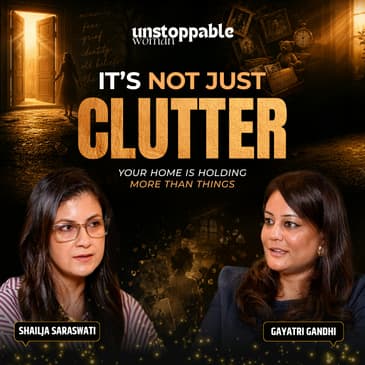

What if your clutter is not just clutter?
What if the things you keep are carrying fear, grief, memory, identity, family conditioning, emotional avoidance, and parts of your past you have not fully released?
In this episode of Unstoppable Woman, Shailja Saraswati sits down with Gayatri Gandhi, founder of Joy Factory and India’s first certified KonMari consultant, for a deeply personal conversation on clutter, closure, self-belief, spiritual grounding, and the courage to create space.
Gayatri’s journey began far away from the world of decluttering. As a child, she describes herself as quiet, underconfident, and someone who was comfortable living in the shadows. Through spiritual practice, inner work, and a growing sense of purpose, she began to reclaim her confidence, voice, and identity.
After a successful corporate career at Discovery, Gayatri felt called to build something that could help people not only organise their homes, but also reconnect with joy, clarity, and emotional lightness. That calling became Joy Factory.
But this conversation goes far deeper than home organisation.
Together, Shailja and Gayatri explore why clutter is often connected to fear, grief, old identities, inherited memories, family patterns, and the things we are not ready to release. They discuss why Indian homes hold so much emotional history, why objects can become containers of memory, and why letting go is often not a physical act — it is an inner act.
Through powerful client stories, personal reflections, and Shailja’s deeper lens, this episode reveals a simple but uncomfortable truth:
Sometimes the things we keep are keeping us.
Watch this episode if you are navigating change, emotional heaviness, transition, identity shifts, or simply wondering why some things feel so hard to let go of.
This is not a conversation about cleaning.
It is a conversation about fear, freedom, space, joy, and the inner work of becoming unstuck.
Tell us in the comments: what are you ready to release?
Subscribe to Unstoppable Woman for more conversations on inner work, outer impact, identity, leadership, transformation, and the courage to become who you truly are.
Chapters:
00:00 - Introduction: The Hidden Meaning of Clutter
05:30 - Shifting from Corporate to the "Joy Factory"
11:15 - Overcoming Self-Doubt and Finding a Voice
18:45 - The Psychology of Clutter: Why We Keep What We Keep
25:20 - The Unique Architecture of the Indian Home
32:40 - Objects as Containers of Grief and Memory
39:10 - Moving Past Old Identities
45:55 - The Courage to Create Space
52:15 - Stories from the Field: Lessons from Clients
58:00 - Final Thoughts: The Inner Act of Closure
#UnstoppableWoman #GayatriGandhi #ShailjaSaraswati #JoyFactory #Decluttering #LettingGo #InnerAuthority #EmotionalHealing #Transformation #ClutterFreeLiving #WomenInLeadership
[00:00:00] So when you said you were in the shadows and you were fine with it, for the longest time you were fine with it, right? So I think somewhere in the shadow I was there always and therefore I felt that it's okay to be a second person all along. So what unlocks did spirituality do to that identity breaking?
[00:00:26] And then suddenly I did not feel that I had to be dependent on anyone. And that feeling of being behind somebody's shadow, I didn't need it anymore. The deeper truth and realities unfolding guys as we can see on the show that it's not only a company going and cleaning people's houses but it's also sort of cleaning up the emotional baggages, the reinvention journeys or any grief and sorrow.
[00:00:56] Oh yes, I think that also started playing that actually clutter is not just the physical that we see around us. It's actually dwelling all inside us. So it's fair to say the way I'm seeing it now from a spiritual lens again that literally when you are in your home, every nook and corner of your home is extended body. And sometimes clutter is not about things really.
[00:01:20] It is about the things which we are holding on to, the inhibitions, the fear, the tragedies, the grief. That it's okay, no matter what, I'm enough. Welcome Gayathri.
[00:01:49] We are really honored to have you as part of Unstoppable platform today. And you have a very rich journey of decades where I know a lot about you but I still feel I don't know the transformation journey you went through. Right. Yeah. We have this platform which is more about the inner work, building the inner authority. Then we look at the personal mastery individuals go through and the leaders go through. So you are all about that.
[00:02:19] You know, so there is nothing which is the outer impact only. I think the outer impact is what happens with your clients and we listen to all those case studies and stories. But before that, I have three keys and each key allows you to enter a world of unstoppable. Are you ready? Yes, I am. So we have these three keys which allows you to enter the unstoppable world. I'll ask you one question. Yes. You can be as brief as possible.
[00:02:47] So what is one thing you had to let go of internally before your life could truly change? I think it was fear. Okay. This is your first key. For me. Second, what does clutter look like in the mind, not just in a home? Clutter in the mind is indecisions.
[00:03:14] And the ability to not believe in yourself. Personally for me, which I have seen and therefore I've seen it in clients as well. And that's what I try to do when I go to people's homes to make them really believe in the energy and the ability that they can do things themselves without being dependent on anyone else. Who are you today when you are no longer holding on to what is unnecessary?
[00:03:37] I think I'm someone now who's kind, hopeful and believing in myself, like I said in the previous answer. Because of the journey that I have been through last 10 years of helping people really identify what really sparks joy for them. Wow. So this is your next key. Welcome. Thank you so much. This is interesting. Yeah.
[00:04:07] So before Joy Factory existed, that before, even before you joined Discovery Networks, had the rich experience of working in the corporate life. Yes. We'll just go further back and see who Gayatri was as a child. Okay. Yeah. So just take us through the memory lane, give us a few glimpses. So in fact, it's very interesting because as a child, I was completely opposite to who I think I am today.
[00:04:35] And I was extremely underconfident, very quiet and somebody who could not believe in herself at all. And it was so tough because even at school, people and teachers used to tell my parents that Gayatri is maybe unwell because she's so quiet. I think maybe you could take her to a doctor. So I think from there to coming to Discovery, which was a big breakthrough that time.
[00:05:03] And then, of course, launching Joy Factory and then becoming a TEDx speaker. I think that whole thing was a turnaround, not just for the family and friends, what they experienced, but what I experienced as an individual. Because I felt that you are not who you are just because your childhood has been a certain time.
[00:05:24] And that's why I said that the capability that one has, it's insurmountable, unstoppable, as you said, you know, and as this network is. And that's personally I really, really believe in. And I think I, with all humility, I believe I'm an example of that. Lovely, lovely. Absolutely. We can see that through your life and your work. So what was the identity you were identifying with even before you joined Discovery?
[00:05:52] I think I was being identified myself as somebody who was looking up to people and not having an identity of my own. Okay. Because I had people and family members doing very well in their lives. So I think somewhere in the shadow, I was there always. And therefore, I felt that it's okay to be a second person all along. So till I think this realization came, also because I'm into spiritualism.
[00:06:21] And at that time, I was fortunate to have encountered the life philosophy of Nichiren Daishan's Buddhism. This was which year? 2003. Okay. So that was like a huge turning point for me. And it turned me around completely. Was it a chance discovery or you wanted to? Yes, it was a chance discovery. I was fortunate, I think, because I was seeking at that time to wanting to know myself somehow. I encountered people who led me to this path. Okay.
[00:06:50] So when you said you were in the shadows and you were fine with it, and for the longest time you were fine with it, right? So what unlocks did spirituality do to that identity breaking? I think this ability that I have the power myself. I don't need to be dependent on anyone else.
[00:07:18] I think that realization and the first thing that I answered that I let go of that fear, which was dwelling inside me. I don't know what, that I am somebody second all along. And I was okay about it. But then when I encountered this philosophy and of course then very fortunate to be with discovery and then so on and so forth.
[00:07:41] And the fear that went away, I think that was one of, I can say that I was Gayathri point two, you know. Okay. It was like that for me. Okay. So I'm a little familiar with, you know, your techniques. Yes. In spirituality. Right.
[00:08:01] But was there any conscious effort which you made in terms of besides chanting and besides the social work and the voluntary work which you guys do? Was there any conscious effort put behind breaking that identity or breaking the limiting belief which was holding you back?
[00:08:21] I think because the study of the philosophy was so strong, when I was able to apply the concepts of the philosophy, that really changed who I was as a person. And that made me feel very liberated. Because up until now, I mean, that time I felt that I was, like I said, really feeling comfortable with fear inside me, with being okay about it.
[00:08:48] And, of course, then encountering a mentor, I think, not just in spiritual nature, it just changes your life completely. And I'm sure you have experienced it in your lives as well. And I think that grounding from a mentor in life just changes everything. And I felt that I got that guiding spirit in Dr. Daya Sakwe Keda, who is my mentor.
[00:09:12] So it's a combination of the philosophy, the doctrine and the practices of chanting and obviously being part of a larger community. Yes. Which sort of unlocks everything. Absolutely. And you do feel that the power is within. Correct. And you start feeling that manifestation coming. Absolutely. So let's say that manifestation did start coming on the surface. What was the first few signs and symbols and things which caught your attention?
[00:09:41] There's some transformation which has begun. So I think the confidence for me to speak. That for me was a big turning point. Sure. And in fact, the validation that came from my parents itself and, of course, the family, because they had seen me as a child who I was. And this sudden shift that came when I started all this and this whole like a new guide three that came along was very evident.
[00:10:10] I felt that I became the S.U.N. Like suddenly this bright, you know, glowing sunshine that started coming from me. I knew it. Like I could see that shift. Sure. And then suddenly I did not feel that I had to be dependent on anyone. And that feeling of being behind somebody's shadow, I didn't need it anymore. I didn't know that I had the capability of.
[00:10:36] So essentially, see, it's a legit real thing which happened to you, which is basically when you're doing the chanting, the vibrations and the cleansing happens at a very deeper level. And also all the knowledge which you're soaking in, you just realize that the power is within. Absolutely. It's not really. And it was always there. It was always there. That is the thing. So when you connected with this thought, what you were just saying that, hey, Gayatri, it was always there. I was you were behind the shadow. Yes.
[00:11:06] What did it feel to you at that time? It's a feeling that I sometimes even go back to today because it was so empowering and it made me feel so joyful and happy that I don't need anyone. I think that was the biggest shift for me. And I feel I go back to that very often that it's OK, no matter what. I'm enough. Absolutely.
[00:11:34] So your transformation key started with 2003, 2004. You joined Discovery a couple of years later. No, in 2009. Yeah, 2005, actually. 2005. Yes. How was that journey for you? Because it's always also a very long journey which gave you its own learning. Yes, absolutely. So with this, you were already empowered. You already felt strong and you entered the world of Discovery. Yeah. How was it?
[00:12:02] So what identity was building at that time? So it's very interesting because when I graduated from my college, everybody was getting their college, you know, their jobs in the Indian channels. So you say. Yeah. And suddenly here I get a job at Discovery. Yeah. Now, that itself was a very big thing, as you can imagine, because at that time, like 20 years ago, Discovery. I mean, not that it's not good right now, but then it was something which was really sought after.
[00:12:29] So obviously that itself was, again, a very, very, like a point which gave me a lot of confidence. And I think the identity building, like you said, started building from there itself. Like it was like one milestone after another, one milestone after another. And even while at Discovery, I was fortunate to have worked in a lot of departments and done well.
[00:12:54] And then I could see that identity becoming, you know, firmer, stronger and more confident as I stayed there for 10 years. Right. So the transformation journey continued. And you were watching all this happen. Yes. Around you and to you. What happened for you to decide that I'm going to exit this corporate life? I've seen success, touched it, felt it, walked it. But now it's enough.
[00:13:24] I think it happens with most of us when one has worked in that corporate life. And personally for me, when I took that sabbatical and that break, I felt that I was not having a purpose in my life anymore. Okay. I felt that I wanted to do more. And while I was at Discovery, of course, I did great work. Everything was good.
[00:13:50] But then that point came when I felt that, like I'm saying, that I wanted to go out there and make a difference. Because I felt that I had got that with Buddhism and with the unlocking myself. I felt that I had the potential to maybe bring about that change in someone else's life as well. And I felt that through my work, whatever I would do later, I would like to bring that change somehow. So when did that thought start emerging?
[00:14:19] It started happening around 2014, 15. Okay. Yeah. Yeah. Okay. And because even in Buddhism, we do believe that you should unlock, try to unlock a potential not just for yourself, but for others as well. Because that is the highest form of, you know, giving light to somebody else, which is like in all philosophies. It's not something specific to Buddhism.
[00:14:42] So I felt that the more I was in that journey, I felt that I wanted to impart it to others around me as well and feel empowered, feel good. And mystically at that time, I did encounter a lot of people at that time who were feeling what I was feeling 10 years when I was, you know. At that time. At that time. Under the shadows. Yeah. That type of people.
[00:15:04] So I felt that maybe it's time for me to make that difference in these people's life and so many more because I have been through it. And the reason why I have been through it may be because I need to make a difference in someone else's life now. Sure. And mystically at that time, I, you know, came across that book by Marie Kondo. Life changing magic of typing up. So let me add here that I am also a very organized person generally. I mean, it's not something that I'm not. Okay.
[00:15:34] So which is why I picked up that book to read as well because the topic is such, it's very niche that not everybody will pick up a topic like that to read a book, you know, on title. Not also India. Yeah. Exactly. Yeah. So I came across this book in 2015, I remember. And I read it and it was, I was very fascinated. I cannot tell you.
[00:15:55] I said, wow, this person has actually created something so in like big with a very simple act like tidying, like organizing. Like it can't be more basic and simple than that. And especially in India, because our mothers are always telling us that, So I just felt that, wow, it's making a lot of sense. So the more I read it, I also started feeling that, that the question that you asked me that what is clutter?
[00:16:24] I think that also started playing that actually clutter is not just the physical that we see around us. It's actually dwelling on inside us. So if I'm able to help somebody identify that with the act of the physical, you know, way of moving, removing stuff and like understanding why clutter should be not there. Let me try and understand this more. Okay. And the more I read about the concept, the more I read about Marie Kondo. Yeah.
[00:16:53] And the whole philosophy that she has, which is, if it sparks joy, you keep it. And if it doesn't spark joy, you thank it and give it away. What does joy mean? So joy is nothing that, in this context, it is the feeling of making you feel really good about yourself or that thing that is there in front of you. Okay.
[00:17:18] Just from a very layman's understanding. Right. Whatever we own and we wear, it has our energy. Yes. Right. And when we are wearing something, it is also adding up to memories of when we are wearing it, for what occasion we are wearing it, what happens when we are wearing it, to what we do after that. Yeah. Right. So the relationship sort of continues.
[00:17:47] So are you saying that your entire, you know, what you did with Joy Factory was you really went deep into this? Yes, totally. Hundred percent. Because... And so niche. Yes. And the time you started... Yes. Was there any pushback from people? Yes. Okay. Close people. Very much. Okay. So what made you so convinced about it, Gayatri? Exactly.
[00:18:13] You know, I go back to that point a lot of times, even till today, because sometimes I feel that I don't have that conviction, which I had then. Like sometimes it... So I think at that time, maybe this whole feeling like I'm saying that I'm wanting to help people, wanting to understand and like make a difference in others. People was so strong. Very strong. It was so strong that I think I cut through every negative reaction that I got. Hmm.
[00:18:42] And I think that passion built so much inside me. Yeah. That I actually was like, I don't want to listen to you. It was meant to happen. It was meant to happen. And I must mention that I got a lot of support from my husband. I'll be honest, because I was in a very comfortable job at Discovery. Thanks, Manik. Since I know him. Thanks. Yes. So I know he, I mean, he really helped me.
[00:19:04] And of course, I did get a lot of, you know, doubts from my parents, because like any parent would be like, Discovery, why are you leaving Discovery? And what is this? Like, safai karani hai? Like, are you like, it's not making sense, you know? And not just family. But so many people around me, the doubts were, I cannot tell you, Shailja, how much there were. Yeah.
[00:19:31] But it was like, they are doubting, but I was getting more and more convinced that, you know what, I'm going to tell you. It actually became like that after a point. Well, was it becoming like a fuel? Yes. To the fire? 100%. It became so strong. I did research. I reached out to, you know, I did a survey in India and I reached out to lots of people.
[00:19:55] Because I said, I need to have not just theory, I need to have practical survey results as well so that I can back it up. Yeah. And I was amazed to see the kind of response I got. Everybody was like, let everybody come and just organize it for us. Need hai. Need to bilkul hai. Oh, hey. And fortunately, Marie Kondo started courses at that time in the US. Okay. And I was one of their first batches to, and I thought. So you went to New York? I went to New York.
[00:20:24] You took the course. Professional certification. From her, her team. Yeah. And I, because I thought if I want to do something like this in India. Yeah. Where there's always so many doubts, I need to have like a validation. Yes. Credentials. I was very, very clear. So you're the first Conmeri consultant in India who's opened a business out of it. Called the Joy Factory. Correct.
[00:20:48] The deeper truth and realities unfolding, guys, as we can see on the show that it's not only a company going and cleaning people's houses, but it's also sort of cleaning up the emotional baggages, the reinvention journeys or any grief and sorrow. Oh, yes. Right? So we'll go through all of that. I just want to unpack this bit a bit. Right? Like I have met so many founders and people who've done something similar.
[00:21:18] They've left corporate and they had this burning, you know, desire to do something and do something for people. And they just felt that this is the right moment. Right. And you said nothing would have come in your way because the conviction was so high. Yes. Do you see anything beyond the obvious in this? Considering your spiritual journey for 10 years behind it? Yes, very much.
[00:21:40] And I thought that because I had practiced Buddhism for so long at that time, I felt this work of mine was a physical manifestation and extension to be able to help and bring joy to people's life by enabling them to get rid of as simple as clutter first and then go into the inward journey.
[00:22:34] Hmm. Because self-doubt obviously used to do come in. Yeah. But I think the conviction was far stronger always. So I used to then go back in my inward journey, chant, go back, go to it, like attend my meetings and obviously speak to my husband and the whole thing was very strong.
[00:22:55] And like I said earlier, that the purpose of wanting to bring up difference in someone's lives was the point that I started coming back to all along. Hmm. And I felt that if I stop now, I will give in to the defeat and become the old Gayathri again. And I didn't want to. So you were fighting the old Gayathri also? I did. I did. Right. Who didn't want to be in the shadows anymore. Anymore. But you weren't in the shadows anyway. Anyway, yes.
[00:23:21] But still, I didn't want to come go back into that phase again. Journaling as well. Okay. Yeah. Okay. Was the transformation uncomfortable? Did it challenge who you believed you were? Yes, it was uncomfortable to begin with because it did not come naturally to me. And I think a transformation doesn't come naturally to anybody. Yeah, because you don't have a map. Yes.
[00:23:49] You are taking the steps and you have no other step to walk onto and there's no map. True. So it did feel uncomfortable. I'll not deny it. And there were times when I did feel underconfident again. And I felt that, Gayathri, are you sure? Like, what's happening? You know, there were those questions that did come to me. But I think I drew a lot of strength from, of course, you know, my philosophy.
[00:24:19] And talking to myself. And like you're saying, I used to journal a lot at that time. I started putting down my doubts on paper so that I empty it out from my brain and just delete it so that I don't keep dwelling over those thoughts in my brain. Because there is a potential of doing so much nicer and better things that just remove this unnecessary doubt that is bothering us.
[00:24:45] So I think what's coming up, at least for me, is I can see that there's a continuous endeavor to create that space. Yes. Right. And that space brings something more sacred. Yeah. And when you were doing all of that, Gayathri, what was the hardest part which showed up physically or emotionally for you? In what sense? Like in... When you were letting go and the transformation journey was happening.
[00:25:11] Was there anything which was still coming up, showing up as a resistance to give up emotionally or physically? I think the whole doubt from the friends and family. The voices. The voices were... You know, I mean, they were also coming from those people who I didn't expect it from. And I think that also is a form of, you know, like shattering your own confidence kind of a feeling that, oh my God, I always used to believe that they will always believe in me and they are only doubting.
[00:25:41] But, you know, that shit... E2 Brutus. Yeah. Exactly. So, it's like, no, you know, like, I mean, you do feel ki, come on. Abhi kya hai honka kehna? They are proudly telling everybody that this is... Dekho. Mare ladki. Yes. So, I think for me, that was the biggest victory, Jailja. The same person or the same people who said, what are you doing? Yeah.
[00:26:10] Now they stand with me, clapping for me, telling people proudly. Yeah. I think, wow, it's like, you know. So, the lesson or the learning probably is that loh kahenge, lohon ka kaam hai kehna. 100%. It is not that they're doing it to do anything to you. They don't know any better because they don't know your perspective or purpose or the vision.
[00:26:34] But it's for you to stand tall still and keep walking towards your goal. So, you want to say something to, let's say, anybody who's watching right now. And I'm sure women especially do feel this, right? Right. And do walk in shadows and they might just give up on their dreams. Can you just tell something from that experience of yours when you said, okay, this is tough, but let's go on. Yeah. So, I think for that, you also need to believe in yourself.
[00:27:03] And that will come only when you work on yourself, maybe spiritually or any other form of wanting to better yourself as a person. Because otherwise that confidence doesn't come to us naturally as women, I feel. And it's very easy for us, therefore, to continue to keep doubting.
[00:27:23] But I feel that because of the Buddhist practice that I had, I was able to go back to that point that, no, Gayatri, this is not the time for you to give up. It is the darkest before dawn. You are in that darkest space. So, hence, I would like to tell people, women, that please find a spiritual grounding alongside whatever you're doing right now to be able to break through that. Because we all need spiritual nourishment.
[00:27:53] It's not just the nutrition that we need. It is the spiritual nourishment that will bloom you as a person that you also didn't know that you had the capability of. Right. So, I think the minute I read the book, which was very quick, I finished the book literally in like maybe a day or two. And it was so prompt that I came back home that day, I remember, and I started decluttering and tidying up my room and my wardrobe and my husband's. And he was like, what's wrong with you? Are you okay? I said, no, no, no.
[00:28:23] You need to see. I'm doing something. And it was amazing because when I did what the whole philosophy talks about, you know, whole spark joy, picking up each item, asking myself, that does it spark joy. I actually applied whatever she had written in the book. So, there's a ritual. Yeah. I did that. So, when I did all that and the room became better, nicer, and my husband walked in and I remember he's saying, what have you done? Are you like, okay? So, I said, no, no. You see, there will be a big change.
[00:28:52] And actually what happened, about a month later or like some time later, he came and told me that there was something stuck in my business and it's seeming to have moved and I got like a call which a business, you know, like a proposal he was working on. So, he said that maybe it's because of that decluttering that you have done in my wardrobe. Okay. And it came from somebody who's not like a believer the way I was like so passionate.
[00:29:20] I think that validated for me because what Marie Kondo had written in that book, that things change, clutter, you know, brings new energies, things which are stuck because clutter is what? Negative emotions. Negative energy, burden, all that. So, when I cleared it out for my husband at that time, things started, came, you know, coming into his life which was stuck for him for some time. Sure. That validated for me seeing that it's happening for somebody who's not like a believer also like I was.
[00:29:49] That manifested it for me that if it's happening here, that means it will work. Okay. It will happen. Okay. And anything was happening with you? It started happening with me as well. Like what? So, it was more to do with, I think, this whole shift of course of feeling very joyful that I started feeling. And I wanted to share that joy with people around me.
[00:30:16] Because I started feeling the whole philosophy what sparks joy in my own life so much that I started feeling lighter, happier, good, confident that I felt that maybe with such a simple act of decluttering and tidying, I can help someone to do so as well. So, let me start and understand this path, how it can open up in India. Sure. So, just hold on to this. It's like, abhi ko jo dekhre honge wo bolengi ya, ham bhi to ghar ki se fai kar hai saturday, sunday ko.
[00:30:46] Right? We also tidy up. We also pick up things, put it in the right place and take out things which are not relevant and not needed. Obviously, we discard them with a lot of like, chalo khatam ho gaya, rishta khatam ho gaya. The rituals are not there. It is what we've seen our parents do it, do when we are doing the same thing. Right. So, what I'm listening right now is there is an approach, a process, a ritual and a feeling with which you do it.
[00:31:12] And that also, there's some deeper work which will unfold. Yeah. Which leads to joy in the house. Yes. And your things start settling. Yes. In your life. Yes. So, like you're saying that people do it on the weekends and everything. But yes, they don't do it with that heart which is supposed to be done. And secondly, people do not do decluttering. They keep organizing clutter. So, break it down. Yeah. Why is it important to do it with the heart?
[00:31:41] So, it's important to do it with the heart because the things or the items that are there with you carry emotion like we discussed. The energy. They carry the energy. So, it's important to not just let go of the item item but the energy attached to it for a better and a happier living.
[00:32:05] Because we may not realize it but they do have a deep impact on us and the way one is living their current life. So, it's fair to say the way I'm seeing it now from a spiritual lens again that literally when you are in your home, every nook and corner of your home is extended body. Absolutely. And mind. Yes. Right? The way you've touched it, seen things, put intention behind them, you walk over carpets, come the chair.
[00:32:34] Everything is my extended body. Correct. And if I don't dispose of or respect or ask for permission to exit some part properly, it will have repercussions. Yes. Repercussions in the sense that it could be blocked. Exclaim. Blocked energy in the sense it could be, it need not have negative, negative, you know, repercussions always. But it would also be that nothing is moving as well. Also. So, static.
[00:33:03] Static and like stagnant. Static and like stagnant. You know, it's just there. You're not being able to welcome anything new because you need to remove things to be able to welcome something new. Now, while you're talking, I mean, things are coming into my mind for my own life. Right. And even before coming for this, I was like, I'll have to start doing this. What are you saying? I was reading about your work. I'm like, because there's so much. I mean, it makes sense. At least it makes sense to me. Yeah.
[00:33:31] I'm sure to our audience because they've seen leaders who have, you know, such powerful insights and life of transformation. Right. But what you're getting today to the show is very different, Gayatri. You're getting a lot of signs to something and a legit experience of case studies of 10 years where you have transformed people's lives. Yes. So I just want you to pick up one best of your case studies and just walk us through.
[00:34:00] So everybody starts connecting with what we are really saying here. Right. So I think one of them, which is very close to my heart is somebody who I worked with. I worked with her for five years and she was a very, very extreme case of OCD. Okay. Now, OCD is a word that we use very casually, loosely. OCD. When I went and I dealt with her, I saw it in a very different way. She used to wash her hand 100 times a day.
[00:34:29] I'm not kidding. And it like it had become so bad that her skin was peeling off. And when I went to her house, she trusted me only. Nobody in her family, her parents, her siblings. And she used to feel that when Gayatri will come in, only she can touch my things and help me. Otherwise, you all of you cannot. So I think for me, that role was not just about physical tiding.
[00:34:58] It became so much deeper. And that time, Shailja, there were times when I used to just sit with her for hours without doing anything and just listening to her. Because for her, it was not just a physical act. It was so much deeper. And she used to go back into her, whatever, nostalgia stories and childhood traumas and whatever she had been through to be able to reach a state where it was confirmed OCD for her.
[00:35:25] And, you know, I remember that I used to schedule two hours meetings. But I used to be there for eight, eight hours sometimes, you know, because she couldn't, she didn't let go of me at that time. And I couldn't have said, no, no, we'll start decluttering. That time, you obviously have to listen to somebody. And I think that point, it made me realize the purpose of my work again. And I felt like, wow, this is why Joy Factory was started to create joy in someone's life who's feeling stuck.
[00:35:53] Yeah, like bad, not feeling good at all. So that started happening with this particular client of mine. And she was soon going to a rehab. So before going to the rehab, she had consulted with me saying that I want to organize my house before I go to the rehab so that I'm okay at the rehab thinking that everything is okay while I'm not there because Gayatri worked on it. And not nobody else is touching it. So she went to the rehab.
[00:36:23] She was there for about a year. And I remember she was told to call only two people from the rehab. One was my number and one was her father. Okay. And I used to get calls from her saying that, how are you? And I felt that so much trust was given to me. I was somebody, I didn't know her, like she didn't know me. But this whole journey and working with her really step by step, I did not hurry up with her, which is why I took five years to complete the whole decluttering journey.
[00:36:52] She came back from her rehab much better. Of course, she needed medication. But with the rehab, the act of decluttering and organizing helped her so much that she's almost okay now. Like, you know, so I feel that this is one case study which is so close to my heart. Of course, there are others as well. But this one is the most deep.
[00:37:15] And for me, she's like that I could bring such a big impact on someone's life with such a simple act of tidying. It may look as if it's just putting things on, you know, one side or the other. But it's making a huge difference in someone's life. This is very deep. And thanks for sharing. But if we were to, were there any connections which were formed between her OCD and what was happening at home? Yes. Yes.
[00:37:44] Are you okay to talk about it? No, I don't think so. Yeah. Okay. Yeah. Okay. Fair enough. But in most of her cases, there is a correlation. Yes. Because the deeper cleansing is happening at a mental and emotional level. Yes. Right? Very much. And most often than not, it is more emotional. Yes. Very much. Okay. Very rare is it that it's only at the surface level.
[00:38:05] So let's say, Gayathri, if somebody is listening and if I'm reflecting on my own life in my wardrobe, if I'm stuck with some clothes which I don't want to wear, don't want to give away part ways, there is a problem. Yeah. Not a problem. But it is something that you must tackle into. Don't let it be like that for very long. So it's stagnant. It is stagnant. It's holding something. It is holding on to. It's not creating that space for something new to come. Exactly. I was going to come to that.
[00:38:35] It's not letting you welcome, which is needed in your life now because that has served its purpose. It has served its purpose. So even when after people pass away, we hold on to their things. Yes. We should not hold on after, like we should not hold more than five, six, ten things. And even if we do hold on to those five, six things, there should be a purpose attached to it that this may be given to a family member or will be, you know. But not kept just for the sake of keeping.
[00:39:05] No, no. That's actually holding on to the energy. So I really share that a lot when people pass away in their homes that keep it, but then have a purpose attached to it because that's flowing energy, you know. That is continuing energy going from this house to whatever you're giving it to a donation center or to a family member or to anyone who you wish to, whatever. Yeah. But there has to be a flowing energy to anything that's with us. Sure.
[00:39:34] So let me play some part of a devil's advocate and somebody watching might say, what is this energy? Yeah. I think it happens. Like if you're sitting here, our energy is part of this or clothing or something like, is it and my question to you, is it proven somewhere scientifically? So proven in the sense that, I mean, there are enough and more books now that, of course, do say this.
[00:40:01] But from personal experience, I can say that you do feel an energy change the minute you do this decluttering journey. And I can say that for anybody, even if you go back today. Yeah. And I'm sure in your head, you may be thinking that there's one drawer that's bothering me. I need to. Yes. Even for all of us sitting here, everybody must be thinking that there is a problem. There is something that is. There is something that is. Exactly. I haven't seen the file. Correct.
[00:40:27] So if you go back today and you'll do it, you will see a change. Hundred percent. Two hundred percent. I can tell you that. And what that change would be is the energy, perhaps, which is conducive to who you are at that time as a person. So, I mean, I cannot say that, you know, like which is also which will be good. It will not be bad. So it's the identity at that time. Also. Which you had, which is part of the energy. Right.
[00:40:56] And if you, it's staying there, probably new things are not coming because your old identity. It's somewhere. Yeah. You don't have any space here. Correct. Absolutely. Okay. So there's, from what you're saying, there's a little of gender aspect here. And correct me if I'm wrong. Have you seen in your experience, women holding, holding a lot more? Just by the sheer role they play. Correct. Right. Because it's not only for themselves. They're taking care.
[00:41:26] They're taking care of the kid, the grandparents, the children and the grandchildren and the husband and everything. Absolutely. They're the caregivers and caretakers. Absolutely. Most of the time. Most of the time. Yeah. So how, what is the message for women? So, you know, I think one of the important thing to really understand is that we need to be sure of the fact that who we are as individuals first.
[00:41:54] I think that is something that always gets missing. And the identity therefore becomes a daughter, wife, all of those other roles, not as Gaitri or Shailjao as who we are. And in that bargain, we are unfortunately just taking on energies a lot more. And they don't belong to us. They don't belong to us. Yeah. Okay.
[00:42:19] It is, I mean, I mean, I can say it like we need to be careful. We need to be careful. But in your experience, you've come across something which can really go south. Yeah, it can because people, I have seen women and my clients who are there who have felt a lot more worse than they should be.
[00:42:49] I mean, what the situation is like. So I feel they go really down south unnecessarily, which is not needed. And I've seen that. Like women who have gone through a divorce and they have held on to things for so long. I mean, I was just dealing with somebody right now. And when I was helping her, I mean, me and my team were helping and she was sitting in one corner just crying. Just crying. While the process is going on. While the process is going on. We are doing the work.
[00:43:19] Okay. She was just seeing because she felt that she had been divorced for four or five years. But the stuff was still there for like obviously. So she's grieving. Grieving like how? And when I got the message after we finished the work, she said, Guys, you're like an angel in my life because you have actually helped me through something which I didn't have the energy.
[00:43:42] But even the confidence or that whole thing of letting go and pushing myself. It's amazing. You know, the stories that I get. And those type of stigmas, stereotypes are also there. Very much. Very much. So these kind of messages when I get, it's so gratifying.
[00:44:09] It's like, wow, Gayatri, that you have helped someone. And I'm sure you would feel, you know, when you help someone. You feel very gratifying. There's nothing, no better feeling in the world. No. Hundred percent. It's so gratifying. It's amazing. It is right now still very much my vision. Okay. I do want to scale up, but I also feel I want to find people who believe in the same passion with the way I believe in this.
[00:44:39] Also because it's a very laborious work. And it can look glamorous just from, you know, like what everyone is doing. But when you go into these, you know, stories that I'm telling you, it is very, very like it. It takes your energy as well. Right. And there are times when I go back from the client's homes. Like my husband, my mother. Like there are family. They say that, are you okay? Because I'm carrying that energy back with me as well.
[00:45:10] So, you know, sometimes I'm also told like have like a salt water bath and stuff so that you just cleanse off that energy. Because I'm dealing with a lot of clutter figuratively and physically. So, one has to be careful of that as well. That's true. Yeah. So, it is deep work and it is work which requires right intent. Yes. Because it's so deep. And it requires also somebody who can then cleanse and be strong and centered. Yeah.
[00:45:39] Right. It's not just working around with some items and shifting them here and there. There's far more deeper work. Absolutely. So, you work with hundreds of people, right? What is the real reason people struggle to let go? Simple. Simple? Yeah. It's the attachment that they have to items and India especially. Because fortunately, we are still like a nation where joint family system still exists because of people like great grandparents, grandparents still staying together.
[00:46:09] It's not just nuclear, you know, which is great in a way. Yeah. So, obviously, the multi-generations that are there in the family, they will never allow. I mean, usually they don't allow that. Why are you letting off that trunk and, you know, things like that. And it's also because of a very diverse history that one, the country has had partition and stuff. So, you're getting those emotions. Pakistan is what we need. You know how that feeling. The roher. Correct. That type.
[00:46:39] So, the level of attachment is super high in India. Super high. So, there are times when I'm just talking sometimes to the clients, trying to convince them it's okay to let go. It's really okay to let go. So, what is happening between holding onto the old identity and letting go? Why aren't they able to let go? That answer is, if I'm going to let go of the work, then I'll just keep it. You keep it. There's a room for that. It's absolutely right.
[00:47:08] And I'm sure you and your family, if you go back to your parents and like, you know, there is that store. If you need to learn something. If you need to learn something. Or if I'm going to put the wood, then I'll wear those clothes. This is a very good dialogue. And if you have a child, then they'll give them the clothes. Absolutely. These are very, very valid. Very Indian also. Very Indian. Because when I was living outside. Right. I found it odd that people don't carry all this ahead.
[00:47:36] So, in fact, one of my colleagues, she said, you know, all the freebies and all which we get. She's like, I don't keep all this. This is not part of our culture. It's right at the doorstep. It goes away. There's no space. Right. There's no space. Yeah. So, I think functionality helps them to look beyond. Do you think clutter sometimes is emotional avoidance? In any case, real case in your experience.
[00:48:05] Emotional avoidance? In what way? Just don't look in that direction. Yeah. I think you're right. Now if you're... Yeah. I think you're right. But it is like not... It's procrastination and then don't look only that way. Okay. Black spot or whatever. Chordo. Chordo. Chordo. Yeah. I don't want to visit that. I don't want to visit. I don't want to talk about it. I don't want to talk about it. Yeah. Totally. Which actually was also like is the case when I'm sharing about like these divorce cases and stuff like that.
[00:48:35] Because it's such a dark period in some people's lives. Yeah. That they're like... What do you want to touch? No talking. No revisiting. It's there. It's there. It's there. But it's... And how do you make them realize that it's there but it's blocking the energy? That's the role, you know, which I... Which is the counseling. Which is the counseling and the whole kind of therapy that one has to speak to. Have you seen people emotionally break down during decluttering? Are you whipped?
[00:49:04] How do you manage yourself at that moment? Anzhem. I think because I pray a lot before whenever I have to go for any session, I generally prepare myself. Both physically though is one thing but mentally also. Emotionally. Because I know for a fact that it will happen. That they will... Because when you churn something or move something, shifts something. Yes.
[00:49:29] And if you've not touched it for years together, there will be, you know, some emotion that will get churned inside you. For sure. A hundred percent. Then, of course, somebody starts like crying like crazy. You know? So then there are times when I have to tell my team, you please sit outside for some time and I'm sitting with the client that, no, no, don't worry. We'll stop work today. Don't wait. We need not continue. I have... Because one has to see the situation. Because it's not like...
[00:50:01] It's not like that. It's very, very personal. Human to human. Human to human. Yes. Very, very. So your journey started with reading a book. Yeah. You transformed your life. You started working towards transforming others. Yeah. And it's better than what you were doing at Discovery. Yeah. The Discovery Channel at that time. Thank you. Thank you very much. And whatever it brings in terms of managing emotions, angst, anxiety of people, you're fine with it.
[00:50:30] Hundred percent. I'm so excited. This is the purpose you were after. Yes. This is it. I can say it. I'm very happy. It sparks tremendous joy for me. And I feel so good about it at home, at your place. This journey? Yeah. Now? Now? Now it's not needed so often because it is like a one-time journey when I did it initially. Now it's regular. So it's a habit.
[00:50:59] It's a habit now. Do your clients go through this that it becomes a habit? They become habitual of just doing it because there is reward. Correct. So whenever we have also gone back to people's homes to do it, it's interesting that they have maintained the system. But in that system, the mess has got created. So which means that they are living it. But sometimes you're not able to fold that piece of clothing that time.
[00:51:28] You do it after 10 days. But the mess is created in that area only. So you know the system is working. But of course, you need that little revamp and reset to be able to do it. So just one question. You know, like when we have to go for meetings and do something which is tangible. Yeah. Touch and feel. We would go and do it because it's tangible. It's visible. People can see it.
[00:51:54] When it comes to clothing and belonging, it's okay to procrastinate. What is the deeper psychology behind it? See, when you do something that's supposed to be done, it will give you a sense of accomplishment and a sense of motivation. So personally, I feel that should be done. Yeah.
[00:52:15] But because it's okay sometimes to not do it and give focus on something if you feel is more important than that act of, you know. You deprioritize it. You deprioritize it. It's okay. There are times when I also don't fold every time. I mean, it's okay. It's okay. It's okay. But I will know that I will do it tomorrow. And when you don't do it, it just is in the back of your mind. For me, it is. It's for me too. Yeah. So I know it. It's like it is there. So I know I have to.
[00:52:45] So you're carrying the weight here. So therefore, it's not on the shelf. It's on your head. Correct. Correct. Which is why, therefore, I'm saying it should be done. But even if it's not done, delay it, but do it. It's like that. Don't delay it so much that it bothers you to the extent that you're like, Ab to ho hi nahi sakta ya. You know, like, you're like, just forget about it. Because that will continue to play on your head. It's like a woodpecker pecking your brain. Ki wo to karna hai. Ab abhi karo, kal karo, parso karo.
[00:53:15] So there are a lot of concepts like Feng Shui. Yeah. Raastu. Yeah. Right. There is also a concept of like you touched upon it when somebody passes away. Yeah. You should keep their belongings away. Or there's some people say that you should not give the clothes of your children away because they carry their energy and it's not okay to give it away just like that. So is there an art of disposal also? So there is another art called the art of Swedish death cleaning. It's a Swedish art. Okay.
[00:53:44] So it's not like an art, I would say. But like when you put the aspect of gratitude to your items and then let go, then in a way it has completed the journey with you. Oh. So therefore, it's okay to let go and it goes into... So it's served its purpose. It's served its purpose. It's as simple as it is. So what about the guilt of that I'm not giving it to someone and I'm going in the bin?
[00:54:11] That is something that we need to work on because it has still served purpose for me. Ah. And it has gone. Because usually that happens when we get gifts, no? Yes. Gift especially. Yes. Uska gift dia ha ha hai. Achha ha mein ni lag ra. Ne lag ra. Pada ha ha anddar hai. Ah. But ham ne usko yuz hi nahi kiya. Or dia bhi ni hai. Dia bhi ni hai. Wo guilt, that guilt is bothering us so much that we are not able to do anything about it.
[00:54:35] But if you serve the purpose by saying, okay, I did try to use it, but I'm not able to do it because that's not... Emotionally and psychologically, we've covered this quite a bit. Yes. We've also... Now definitely are in our next phase, right? You're looking at building this even bigger, looking at an academy which is coming up. This looks very enriched life. And thanks for sharing this with great detail.
[00:55:04] We have a few more questions before we let go, which is called Quick Bites. Okay. So is clutter a symptom or a cause? It's a... It's both actually. It's both. Sometimes it's a symptom and sometimes it's also a cause. Hmm. What do people fear more? Losing things or losing identity? To begin with, it's losing things.
[00:55:34] I have seen it. They have not... That's why I'm saying that, you know, sometimes people don't realize who they are. So, their identity is limited. Limited. Yeah. And their identity is through the things that they have or the possessions that they have and what all is around them. So, they are still not aware that you're losing the identity part. They are still bothered about the identity. Gayatri, it's... You know, we used to think that old people would be like this. That's how it's going to happen.
[00:56:01] I mean, my limited understanding is that as you age, your identity is limited to the things and people and your family and the house you stay in. No. No. It's a cross. Yeah, it's a cross. And the point we discussed about consumerism and this whole also social media awareness. It's... It's so much influence. It's so much influence. Exactly. Exactly. And it will happen. Will go. Watch out. Can letting go feel emotionally unsafe?
[00:56:31] Sometimes it can. Because people don't realize the real meaning behind it. So, therefore, they are holding on to things, thinking that if I let go of this, they'll become more vulnerable. You know? So, that's why it's a very soft process. It's a very... Handle with care. Yes, exactly. Is clutter postponed decision making, you've just said? Do high achievers struggle more with letting go? Yeah. Yeah?
[00:57:01] Yeah. They do. You're right. What do you have to say to them? Let go. Okay. As simple as that. Is discipline necessary for emotional clarity? It is. So, when we say discipline, it could be just making rituals and habits. Habits or any other way. But you need to have a... Like a discipline in place.
[00:57:29] What is one myth people misunderstand about minimalism? Minimalism is something that they feel that it should be... Which it is in a way that you must have things which are just right. So, if you have three pairs of jeans, one is gone for laundry, one is washing and one is your wearing. But actually, it's a bit beyond that because it's also giving you a lot of clarity.
[00:57:55] Because you're sifting through unnecessary decisions to be able to make in your life. Like, you know, having extra. To decide and choose from. To decide and choose from. Interesting. That's why some people just choose blacks or whites or grays. Yeah, even like Steve Jobs. We already know these examples. Yeah. Because you're actually then focusing on things which are more important to you rather than... Yeah. Even sportsmen have some rituals, right?
[00:58:25] They'll keep the bottle in the same place. Yeah. Same angle. Correct. So that you don't lose time on unnecessary things. So, space. Again, we're going back to space. Yeah. Space. And then what you do with that space is important. Can organized homes still hide emotionally chaotic lives? Yes, they do. They do. So, even if the house is clean... Yes. It's still not be in that rhythm. Yeah.
[00:58:55] Absolutely. Absolutely. So, what's holding? So, again, I think it's the whole aspect of delving inside to be able to know who you are and doing the whole process of decluttering in the right spirit. Oh, okay. You know, it comes back to that. Otherwise, on the surface though, it's looking very beautiful and really good. But the intent and the energy is not misaligned. Exactly.
[00:59:23] And that actually, I can see because I'm somebody who's going into their spaces to be able to then know. But on the surface, not everybody may be able to... That's also because I'm getting access to those spaces. Sure. Sure. So, what you're saying is when you walk into someone's house, it's spick and span. Yeah. Not necessarily. It's mindful and calm. Absolutely. Energy. I know you are intuitive as well. You'll also figure it out. You may think that it's beautiful, clean, spick and span. It's a good thing. It's all.
[00:59:54] What is one thing people should stop holding onto immediately? I think... In terms of a physical item, you mean to say? Yeah. Or anything? Anything. I think fear. For you, from your perspective, it's fear. Fear. And fear for anything. We do have a lot of fears. Because even the person doing most exceedingly well at that level, it's... There is some fear.
[01:00:24] Fear. Which is ruling the actions and the... Absolutely. Fueling the... Correct. The whole other, you know. Okay. What does a truly joyful life mean to you today? For me, I think right now is where I am today. I'm very, very happy and very, very satisfied.
[01:00:47] And I think, like I told you, those messages that I get from people around me, the clients especially, it's the best feeling ever. And I think, for me, it's a very, very purpose-driven and a very happy life. Thank you. Thank you, Gayatri. And sometimes clutter is not about things really. It is about the things which you're holding onto. The inhibitions, the fear, the tragedies, the grief.
[01:01:14] And I think one word which will stay back with me today is space. Right? Space for clarity, space for joy, space for togetherness. And what joy comes from releasing doesn't come from hoarding. Oh, yes. I think that's what I'm taking away. Yes, absolutely. I'm going right into my cupboard today. So thank you so much. Thank you so much for sharing all this with such deeper insight. I have learned a lot today. Thank you so much. Thank you. Thank you so much.