
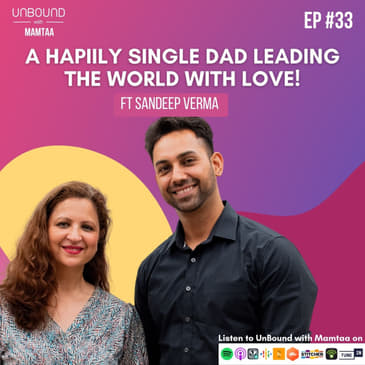

[00:00:01] Hi, I'm Bihalow and welcome to my show Unbound. I'm your host Mamtaa. A space curated for real stories of people from different walks of life who have sailed through uncharted waters and lived to tell their inspiring story.
[00:00:25] Unbound is a deep dive into their journeys, to unravel, unearth, uncover various facets of their lives as they remain unstoppable and continue to do the unthinkable. So you mind telling me a little bit about your life or whatever, like how it was how did things happen for you?
[00:00:54] So about my life, I mean before my manager was like any other guy who would roam around who likes to go places and was exploring about professional life. It was just something new and then life at a red-a-chapter of marriage and being a husband.
[00:01:21] And then things took a turn that she and I we had different opinions and different priorities. So, and then within a year, Ravansh was born in 2016. So here I will take a pause and so I had different perspective towards life even before that.
[00:01:48] I was more of a person who likes to read. So I was reading a lot of motivational books and all those things. Probably it had, it was within me, spec then also that I was reading more of those quotes.
[00:02:05] I used to remember and write them on my notebook, whatever I used to like. So in those terms, I was, I completely, I was completely, I was completely, I mean, in a different, different aspect of life. Not into usual stuff of how people are living their life.
[00:02:21] I had a different take on necessities of life versus man made things. Man made jobs. Man kind was not made for jobs. So that was my take on life, you know that I don't want to live a servant life that
[00:02:39] is going to a company living, I mean doing click 10 hour shift for no reasons. This is not what life is all about. It is job is a means to earn livelihood and that's it. Your life cannot revolve just around the job. It cannot end there.
[00:02:57] And so this is how I was like in a different mindset. And how will you? Around 30, till my 30s, in fact. And yeah, then marriage happened. Then revenge was born after year. This was in a range man. This was an arranged marriage case.
[00:03:17] So before revenge was born, I had different aspirations, expectations like any of the father, you know, I'll do this and that. I'll take my kid to swimming, to karate to maybe going for a walk or this and that.
[00:03:32] You know, all those, those dreams that any parent might have. The first was born. It was like all going good and probably he had that maternity connect with me then, then his mom. Yeah, he used to sleep on my chest like a new born kid.
[00:03:55] I remember when he was like a month old, he was, he was not well. He was was pretlazed and he was with his maternal grandmother. So I was called there that, you know, he did not sleep for the entire night and go to find.
[00:04:12] I was there at the hospital and then I just took him in my arms and I lied down in his left. He slept for the entire day on my chest. He was well rested and next he was the stars probably, I mean, I'm not sure if
[00:04:28] he was missing me that moment or something like that has happened. So like yeah, so something progressed and yeah, I once turned to, to and a half. But I could observe some changes.
[00:04:42] I mean, not changes as in, but kind of a difference of observations of him versus the other kids or how he responds. Usually, so I'm not comparing here just to call it out. It is not's comparison, but from a doctor's perspective.
[00:05:05] But you would take some of the figures that he had in the college. How is it? Yeah, yes, yes. You're the right track. What's the scale that usually doctors do? You know, that this is the mark that you know, get your starts to crawl, to walk, to speak,
[00:05:21] to understand, to to blabber walls and to talk few words. So I could see that he is bit delayed in terms of verbal communication. This physical markers were still good. In fact, he did not crawl. He started to walk straight away. Okay. That was a good one.
[00:05:40] So that's when I was getting worried and around an age of two and a half we, we, I started observing that one of his eyes like left eye started to move towards it was, it had delayed movements in the impotence of the right one.
[00:05:57] So something was going wrong somewhere. Then I started to discuss with doctors and when they, when they inquired more about things, they can know about about his gerity routine, what he does and how he is sponsored, looks at things and what he plays and how he plays.
[00:06:13] Then they, you know, they call it out, you know, you need to have a proper diagnosis term. So then we started off, we, we took an appointment in an IPCCC, National Institute of Public Cooperation and Child Development.
[00:06:32] So there it took like a sick, like good amount of time, like six months for, for assessments and for his reports to be out. But by the end of assessments by, we, so we were interviewed like every month there.
[00:06:49] So during those interviews I was convinced, you know, the child has some challenges and autism is the one because this is where it was leading to. I mean, I had a reference point of the past because luckily it just happened that 2010 there was 2008 or 10.
[00:07:09] There was a series which was aired on ZTV, which was about an autistic child. So I used to watch that somehow. And I, I wasn't inclined, I was interested. I, I used to watch it.
[00:07:19] So I had that reference point that this is how an autistic kid behaves and this is, this is the challenge they might come across. So with that, I was convinced and during our last interview with the doctors, I asked
[00:07:31] him, you know, that I am sure that is the case. So do you agree that I should start, get started with the therapies? You said, yeah, you should. And that's when even before the reports were out after a month, he was put on to the therapy.
[00:07:43] How old was Reanchev? Oh, three, three, something, three plus. Yeah, he don't three in March versus reports were out in April May. So they're like almost three or three years ago. So you have stayed on it? She could accept it. She could understand it.
[00:08:00] So where you on the face? Here is the here is the, the tricky point here. So during those, those assessments, we decided that we are getting separated. So, but it was not related to this. It was not related to this. Yes, of course.
[00:08:16] It was not related to this thing of in particular. And she was not with me. So during those assessments, we worked, we were there together in some of the questions but we were not together in terms of staying together. Same together. So yeah, this is what happened.
[00:08:39] Is it supposed for a while and we were like in in in discussion and have decided that we are getting separated? Yeah. Yeah, so that was like life changing moment when you actually hear somebody saying it for the first time, we know that your child has autism.
[00:08:58] So yeah, I mean of course she could not take it well. I mean she was with me right there. Yeah. Yeah. What gives you so much strength and the, what gives you so much positivity and so much strength
[00:09:14] to look beyond what is right in the face while others would just turn their back. Actually, my son is the reason of this strength. He's a source of my power. He has enabled me who I am today.
[00:09:39] I just recall that the lovely moments I spent with him before the diagnosis, the diagnosis was, it became irrelevant. The moment, I mean he was three when the diagnosis happened but before that we had so much time.
[00:09:54] We had those, those three years that I had spent with him, those lovely moments that the feeling of being a father, the feeling of being a parent, you know. And when he was five months the mother left.
[00:10:08] So he was with me for almost a month that I was taking care of him at, I mean, five year old kid. So I know, I mean, I've lived those moments. Five months, he was five months.
[00:10:18] So like I used to go to office, come back, take care of him. I'm used to be my wife with my parents and I had full day made, but during night, he used to wake up feeding him or putting him back to bed, then cleaning him, changing
[00:10:32] naffey is diapers all those things they have done that. And single hand. Single handedly. And that has given me immense of satisfaction of achieving something in my life. Okay, why can a men can take care of a kid? Why is this misconception?
[00:10:51] Why is that if we live in a patriarchal society, I understand that. And usually it is, it is the case that, you know, people that men go out for earning livelihood. But does it also mean that men are incapable of handling a kid?
[00:11:11] It doesn't or is this society by large things that women were given the opportunity of taking care of next generation, that they were, that they had that compassion or they had that love within themselves. Are we as men? Are we not craving for that love and compassion?
[00:11:31] Or are we not receiving that love and compassion from our mothers? We do. So why can't we translate it to our kids or our children? Well, that's the whole beauty of this show. And I am just so glad to have you to welcome you.
[00:11:45] Thank you so much, and we are bringing to do this. Ladies and gentlemen, whatever you've heard, and there's just so much more to what's coming. I have with me today an unstoppable human yet another one. Who would stop it? Nothing.
[00:11:59] Who would challenge the status queue to an extent that he's here to bend the rules? Not only for women but men too. Welcome to the show Sunday. Welcome to Unbound and you know this is just,
[00:12:13] it's really a power episode for me to have a man sitting across and talking about mothering a child. Yeah. In so many ways you are bending the norms, in so many ways you are teaching the world today's generation that how equally capable as a gender that you are.
[00:12:35] But tell me something, where you always prepare to be a parent? Well, no. As it is said that you don't have your handbook for being a for a parenting or being a parent. So I was not prepared but I always had that love for all compassion for kids.
[00:12:52] Kids used to feel so comfortable with me. My neighbors or otherwise my relatives are kids. So they are so comfortable and I was so, I used to enjoy time with kids. So probably that was one of the things that I always had in me.
[00:13:10] As an inherent nature or maybe I mean just being myself and but being a parent was a little tricky and challenging. But when you talk about being a parent, it opens the platform of
[00:13:27] of entire future or taking care of of of a kid from start till they become like adults. It is not just about just about the journey doesn't end. Yeah, never ends. So that's when I mean I was not prepared.
[00:13:45] So yeah, when it happened it happened and it was gracefully accepted. So this was what I tell people you know and that we never write a letter to God that this is what this is the feature that I demanded my kid you know blue eyes or
[00:14:01] fair color curly hair and all those things we never write it. If somebody writes it it gets, it gets you know what they asked for you are lucky but 99.9 and person people they don't even think of it right.
[00:14:18] So what you get is what you should just I mean gracefully receive it. As a gift it is what it is you cannot have a kid in exchange right. They are no this is not what I want I mean rather one you cannot do that.
[00:14:35] So this is what I mean when when revenge was born I mean I was the happiest person on earth like any any other parent and accepted it. So when revenge was there like a minute old probably he became the luckiest person to have somebody who loved him unconditionally.
[00:15:00] We all crave for somebody who can love, who can give you love, unconditional love and I will like most most can say hyped feeling that we have we all crave for it. Nobody thinks of giving love unconditionally and my son became the one lucky person just when
[00:15:20] he was a minute old to have someone who loves him unconditionally and that's it. Does the end of story? Whatever happens next we'll be taken care of. So tell me about your journey as a human as a person what's been your start how
[00:15:36] were you as a kid to begin with and tell us a little bit about your family as well. All right yeah so my father is a retired English teacher so he was teaching back then and my mother
[00:15:48] is a home maker so I have two siblings and a little sister and a younger brother so I was a middle one and I was a notorious one. I was a sister she was like back then it was more of and that
[00:16:02] two born in a teacher's family he was supposed to be disciplined he was supposed to be to be studying he was supposed to be doing this and that I mean at a particular time and my father was like
[00:16:14] you know is a question you're like that's so and I should take things my own way. I used to read when I wanted to and if I'm not feeling like I would not read at all.
[00:16:32] Do you think my exams are used to read something but go to know what? It's right everything which is a mystery for all of us. So yeah so this is how it was and so for me despite not being interested was put into engineering
[00:16:58] and we are cleared a cleared engineering and then started off with some job but I was not interested at all and under the influence of my friends I did post graduation. Okay. I've just looked like talking about less to MBA, less to MBA it will give us opportunities
[00:17:18] this and that okay fine, less to MBA did that but yeah lucky enough that afterwards I got good opportunities and yeah I mean again it became still like exploding phase you know once you
[00:17:33] went to a done with your MBA you're still exploring about where do you want to get settled because I mean for a person who is like 22 23 he still would want to explore his interest so that
[00:17:44] happened was I worked for for an airline also as a crew when they're for training and then after three months of training I was like no this is not what I should be doing. Came back back to daily
[00:17:57] joined another company with into IT then I was like IT's my first love I would go back to IT so I went back started off as an IT company and then they continued into IT.
[00:18:09] Okay yeah so this is how things went up and down and when did marriage happen? So it happened back in 2015. It was a happy marriage. Initially I have nobody plans for a for a divorce so yeah it was an arranged marriage and
[00:18:32] she's also an engineering graduate she's in fact a master's in engineering. So she was in her master's back then and we met we you know we had that connect we thought you know things will work and we were both the reading discussions we all as we all say
[00:18:51] we put our best forward when we meet somebody especially when it comes to marriage inch marriage that's what everybody does. In fact that's what couples do in one not looking forward to a marriage
[00:19:05] otherwise also we put our best forward that will if we agree agreed on certain terms you know this is all things will be managed we will will have a good life we got married and things changed
[00:19:18] yeah it happens that we live our life our own way before marriage but when you see when you have somebody in your own house you spend your 24 hours then you see the challenges.
[00:19:33] Yeah the unfortunate part was she and I were not friends she and I were husband and wife we could not become friends and that's when things are disarrated. You can be comfortable with somebody who is a friend to you no matter what kind of
[00:19:55] what what they do or what kind of shortcomings do they have but if you're just living a husband wife life yeah it's just a role you're playing. It just
[00:20:06] a role it becomes a role and becomes a burden on yourself just to just to show you know that whom you are not and that that's when we were like in discussion you know this is not that we should be
[00:20:17] so it was quite early in the marriage you figured it out. Yes quite early okay. So yeah this is what happened. I mean now this is when we agreed you know that
[00:20:29] like that society is not going to give us a medal for living a life that we never wanted and moreover let's choose our happiness why not and I don't want her to be just on any terms
[00:20:40] you know she chose her happiness and let it be why not she offered to the bunches custody to me despite the fact that the despite the diagnosis she told me that you
[00:20:51] know you are the better one who can take care of him. What made her think so? Probably that I was taking care of him like from the past three years the way I was or because she was not with me
[00:21:04] but Ravansh was maybe when his diagnosis was getting done. But were you prepared for this responsibility? I actually was actually in our discussions on my mind I had kept Ravansh out of this
[00:21:17] picture. I was always of the opinion if she offers me a lax happily accept if she wants to keep him let her let her have him. I'll not fight over him this is not a situation or this is not
[00:21:28] a win that I want to prove over her that I I have Ravansh this is not the way. Let why can't we accept the fact that the things are not happening between us and let's move on without
[00:21:41] proving right or wrong. I mean if we tend to prove right or wrong we can go into an endless discussion you know. I mean we we can pick the smallest thing about the other one we can write books but this
[00:21:55] is not the way this is not the way that's it. I'm just so appalled with your magnanimity something that while you know looking at that challenge which is staring you in the eye which is about
[00:22:09] the child's own disability and then going through a rough marriage and having and I'm sure there is some part of you that is unfulfilled when you don't have a good relationship and then embracing
[00:22:26] not only the situation the way that it is agreeing to go for a divorce and then further agreeing they're okay if this is the responsibility which is further going to possibly not make things
[00:22:40] easy for me in life but I'm happy to take that what kind of humans do that. No sure it was just the love or the love action I have for my son probably.
[00:22:51] Yeah I mean and this is you know what there's a saying as people say that if you want something to be done best do it yourself so if my son to be taken care best then who can do it better than me.
[00:23:09] Right and that's it it simplifies things keep on being what is necessary and you will do I mean even the unexpected things yeah once my work is over of course then his time his
[00:23:22] his homework or spending some time in terms of giving him some therapy so now it is more about making him to speak so he's known verbal he was non-verbalton now but he is recently started to
[00:23:36] blabber works so now he's more interested in dinosaurs and he was and some things that he has chosen so we are we keep on keep on like getting him into that that therapy mode that when we
[00:23:53] we talk and he it is he blabbers those works because that will make him speak. Okay yeah so that's when I mean my father or my dad we we engage him into those activities such
[00:24:08] that he keeps on you know repeating those words that he sees does this is where we don't want him to stop to stop. So this what happens a lot when we say bull neck of hyzone
[00:24:22] kisi ko but in our own life we say we say it multiple times you know you have to bull neck of hyzone and then we stop talking right it hit happens yeah this happens with kids also
[00:24:34] if when they're talking when they're saying something you do not acknowledge then they shut down so this is what I don't want to happen with Revarch. So whatever that he's speaking he's blabbering whether of course a lot of times it'll be very unstructured and informed
[00:24:52] you would continue to talk to yes I would keep on acknowledging him this is what my about I have even if I'm on call I just mute myself I see yes that's it I have to acknowledge acknowledgement and that's when he's said he would speak the next word
[00:25:11] and that's how it is happening. I mean it just it's the beginning acknowledgement is the key for making them to do certain things tell me how much of preparedness it is taken on your own
[00:25:22] part to be a parent to a child with special needs. Preparedness for being a parent so unlike any parent there's no book for me also it was just acceptance that I had in my mind that my child leaves
[00:25:42] help and I will provide that. This is the only thing which I recall myself you know that and most importantly that I'll walk alongside him with patients. Sanyam, Sankal or Samarbar it means he's a which I think are the mantra of my life.
[00:26:06] At Unbound we believe in the power of unhinged minds and untamed ideas of people from all walks of life as we sit down to talk with some of them we are listening to your voice
[00:26:19] as well. So share your thoughts ideas or take a visit from this podcast as a review on Apple podcast. Sanyam, Kisachal, Kisachal, Sankal, Kisachal, Sanmar, Parnakar, Diyah. Wow that's it.
[00:26:33] So this is what I was so simple but so beautiful and so not simple though. Well said well said I which is one of us that when this separation came about between you and your wife this was not
[00:26:47] over to revenge. This was not over revenge but how did revenge take it? Okay so before answering this let me talk about autism first. Yeah so autism is a neurological the world is disorder here wherein the brain is brain functions little differently. So for him, his understanding level
[00:27:15] is little different than kits what we usually observe in case of his age. So for him things were irrelevant whatever's happening around him is just completely irrelevant back then okay. So he does not have an understanding of what autism is. He does not have an understanding of what
[00:27:39] relations are. He knows his close proximity people but he would not he doesn't know what husband wise mean or what a mom dad mean would mean. So I should not say it but it's kind
[00:27:52] of a blessing in disguise for me that revenge became he's just indifferent of all these situations. So for him it did not make any difference if mom is not here or she wasn't she was there she
[00:28:07] wasn't she is not here anymore. So it did not make any difference. He never questioned. He never questioned. I mean he never did. I mean he he's unaware of it for in his world he's unaware of it
[00:28:20] at the same time yes but I made sure that he should not get a feeling of being abundant. I'm odd yeah yeah. Right so emotionally yes so I wanted to be there for him in every situation.
[00:28:32] So probably this is the feeling of maternity or paternity that I have in my own self and so those days did you those few months or days how how did you go about your routine like
[00:28:43] was it different were you always with him were you are showing him verbally it was difficult back then so yeah when it was diagnosed we did not have covid or lockdown my office was functioning properly
[00:28:56] it just that I reached out to my managers for flexible hours. So I used to leave early for office like before seven okay to reach office like by eight and leave fore home at four such that
[00:29:12] I can be home by five to take they want short therapy at five thirty. So it was like a running around those days for nine months my schedule hadn't like that and luckily I was going through
[00:29:23] the hours going through diverse and we were taking they want short therapy is also. Luckily my manager accepted the request and they gave me early heads, early start and one of my
[00:29:34] friends he understood my situation that I also need help in those yeah yeah so he got his work hours suggested though he was not in my organization we used to just carpool to office. So
[00:29:48] he we used to start early reach office early leave early for home take go home take revenge from home he was just I when I used to leave from office to home I used to call that you know I am on way get
[00:30:01] ready just reach home pick and get back to the car not even a sip of water at home. In the car then we used to go to therapy center there we used to drop in by five thirty he used
[00:30:15] to take therapies for three hours but did this never I mean honestly did it never ever occur to you that why me no thankfully no this this question everybody asks me that you know why do you see
[00:30:29] that why you I see it you know what I'm doing today this is why me I could do that that's why me it's not because why me I want to crib about it I am doing it today what how I'm handling it today
[00:30:46] this is why me good things happen to good people this is the good thing this is the best thing which has happened to me that I've evolved with this that I learned with this and that I was able
[00:30:59] to give a message to people this is why me God wanted me to do certain bigger things this is why me what else I should answer you why me I think you just you've just gone ahead and
[00:31:17] changed all of that for us you know I mean honestly even I'm a parent to young children and the question is always about that choices yeah priorities yeah I may it not which case I
[00:31:32] can do or they're just too many you're not too much of multi tasking there's just too much of us that life has and today sitting with you I just feel so small get it all yet very inspired
[00:31:48] very very inspiring I think this is I don't know maybe you were just showing a human being that what it is to be a human certainly okay whenever something happens you have two choices
[00:32:02] either to be the victim or to learn and move ahead and and prove the world that you know you can do certain things so what you're saying if I'm listening to it is you do the necessary
[00:32:18] that's what you do what is required one step at a time and life will show up absolutely support will show up people will show up so circumstances will show up yeah it's a hawa tana came
[00:32:29] me a kelej alas al karwamantagya you have to you have to start you have to get start somewhere that's when people will see and we'll keep on supporting you in your initiative you are
[00:32:40] living your life right now at an age of 30 35 40 whatever it is and you've learned thanks over the period recall your days when you were starting and that's what expectation you should
[00:32:54] have from your kid the manga is going to be I'm going to make a lot of money I have to do yeah I just need to do it I'm going to do it I'm going to do it I'm going to do it I'm going to do it
[00:33:10] why you have to do things to do the kid doesn't you need to take those 10 things out you need to prioritize your things if you have 10 things on priority do them first get free then sit with
[00:33:25] the kid you're getting frustrated because your of your own behavior yeah because of the fact that you are not able to manage your there not because of the kid that's it and life will be simpler
[00:33:41] you know when we started this episode I was so sure that I'm I'm going to get to know a human and his challenges and his victories but I think what I'm getting to know is also a parent,
[00:33:54] a teacher, a friend, a guide, a mentor and there's just so many shades to you suddenly like in raising a child I think you have really notched that game for yourself where you have risen by so
[00:34:08] many so many notches up in above I mean really really congratulating you on that victory over yourself and I think that is half the work done that if you can question yourself and say they're
[00:34:22] okay maybe I'm not doing it perfectly maybe there are you know imperfections of maybe I need to do more maybe I need to learn more maybe I need to fair better yeah absolutely and most of the
[00:34:35] world life is a marathon you know for me I see it as a marathon it is just that I keep on like doing it and I keep on taking my breaks which is necessary you have to have your refreshment
[00:34:49] points you know to complete the marathon this is what it is so I keep on doing it but at the same time I'm realizing it that I need my me time that's what I have to do how do you schedule your
[00:35:01] me time I understood the morning part morning what about your own your own friends circle what about your only to maybe go out and watch a movie you're hangout with friends or you know just unwind in what
[00:35:16] absolutely do they even holiday how how do you both holiday together so this is also like I make sure I also take three months out when needed like every weekend or have you all ready to be can't
[00:35:28] at the same because okay here's one more catch year that I want my parents to also take a break from him absolutely so I make sure that that he's out of the house yeah for some time maybe for
[00:35:40] for a few hours or for a night also like you know that's what I make sure and also there is another angle to it that you would want revenge to have that social yeah yes to face the world to absolutely
[00:35:52] out there conducting himself in a certain way or manner so does yeah this happens mean two folds that they once get out he also sees the outer world and my parents also get a like
[00:36:03] breather and they are timeout but is that a daunting task to take him out no because I also make sure that the next weekend I go out alone maybe to watch a movie go on lunch or dinner that's it
[00:36:20] that's a smart one yes yeah I mean see I have to be practical I do not have many people at home we're only four me my mom and dad and revenge if we all four are exhausted we will not be able to
[00:36:33] conduct our duties or our things for him so you have to take a break from each other as well yes that's what I make sure that the match goes out with me he also he to have his own time out there then
[00:36:47] I also make sure that I go out yeah I mean any other time so this is how it is for us wow wow such a range of work that you're putting on children with special capabilities or as we call them
[00:37:03] autistic children yeah this is about your journey yes it is yeah it began with when my my son was diagnosed with autism so like any other parent I was also like shattered devastated stressed
[00:37:21] and all those feelings happened to me which happened to any other parent but yes then I learned that I'll keep on doing my bed here and while I was visiting the therapy centers and
[00:37:33] uh visiting doctors then I realized that there's a need to spread awareness amongst the parents the parent of any special kid consider them as burden or they think that they have no futures they forget that each kid is different they forget that their kid might have
[00:37:53] a friend capacity different capability that they can develop so this this is when I started my own initiative that you know I should be making people aware that instead of focusing
[00:38:04] just on the fact that their kid is autistic they bought the label autism and and they now see the kid from that lens so stop doing that let's change the perspective and develop if the kid
[00:38:17] has different capacities and that's it it will make their life better when you create a positive environment around the kid they will flourish so this is the simple thing that I I mean I could see
[00:38:30] that and that's when I started with my own initiative of creating videos on Instagram how I functioned with my kid yeah so when the news broke or the day that the doctors declared so to say
[00:38:43] is it a declaration that happens step by step how does it even how do you even discover autism for example so for for that matter for any any disorder they have different uh questions set
[00:38:57] assessment questions that they ask parents and if the the person may answer they are as the person or if they have the child like the child if he or she maybe on different for different disorder okay
[00:39:14] so um and they do some observations also with the kid while do he or she's doing certain activities how the kid plays or how they react to certain things so this is this is an over a period this
[00:39:31] takes like six months for okay of for these assessments to be done to find it out and to probably that knows yeah there are there are many many disorders which are interrelated which could look similar but are totally different okay like ADHD ASD they are like different
[00:39:48] so they look similar but they are different and one person with one disorder may have another disorder also okay this could be a case so to diagnose properly that about that person they need
[00:40:03] longer duration time and it's a yeah so after six months uh that the news it I mean I was convinced by the end of uh last assessment that you know he has autism so it was for me it was already an
[00:40:19] acceptance uh in my heart that he has it autism and when the report came I wasn't surprised then then the doctor declared that this is the case that he has autism I was like okay fine I mean
[00:40:31] I my heart knew it already so it was I won't say in a very positive way I took it but it was not surprising okay and how about how with the rest of the family members uh was revenge as
[00:40:46] mother a part of this session she was a part of the assessment session she she completed it that way so she we went to sessions assessment sessions there about your opinions like how
[00:40:59] because they are like another generation yes yes for them it took longer because for them autism was something new no for them it was just that kid is not sad it has not started to speak and he's
[00:41:10] dead will stroke that's it for them the autism were not exist yeah they didn't see it coming yes so for them it was it was something something something new and um I mean my positive
[00:41:22] rest still has challenges of knowing more about autism my mother still does our home works she keeps on searching or storing YouTube about autism okay so she has more knowledge on autism than I thought so it is that way but yeah it took them took them time our
[00:41:42] taking revenge for therapies and they were like why you taking what therapies is nothing happening there's no result happening it's been nine months it's there's no result no progress but it was hard for them to understand that it takes time it takes longer time for anything to be
[00:41:58] to come into into picture to show results there for example it took me nine months for revenge to be trained a court it trained okay but what about the world around you Sanbi when
[00:42:11] you know this thing came to you like the assessments came the results came how did you did you see any kind of a change in people around you well um let me put it this way people will
[00:42:26] see my life with the words I put into into their ears right if I I show them how challenging my life is if I show them how stressed I am they will see me that way so I was not willing to do that I
[00:42:45] was I wanted to convey a good message you know despite that it's okay its life it happens nobody acquires a disability nobody chooses a disability for the care or for or for their own self
[00:42:56] it happens and it happens that's completely fine it should not change my perspective towards my life yeah and and it can happen to anyone in time I mean we cannot be in that space of ego thinking
[00:43:10] that this may not be the best way to happen yes people started visiting you you started you know going out socially moving around how how have has it has it ever been embarrassing for you not
[00:43:24] embarrassing but yes okay I tried to incident so I was sitting at a doctor's clinic and we were waiting for the reception reception is observed the launch for some time and then he says iscoquimental problem maker that was my first it was the first time in somebody confronting
[00:43:43] and they like that I was speechless I looked at that person I was this I mean I was not sure how to answer it like what to tell him but then I came back to myself I mean I still wanted to respond
[00:44:01] in a camel camel way that yeah because then I understood this is just the beginning and more over people are not trained to talk people they will still be using the words that they have learned
[00:44:16] by far he still chose a better word mental problem yeah other but somebody could have used anything anything yeah right so then I just said he has autism how does he take to this I mean
[00:44:31] has he has is he aware that this kind of for discrimination or distinction is getting carried out or is he aware that there is a word which is the way it is I don't I don't know whether
[00:44:46] he would look at that as a normal or this as a normal whatever his perspective is but there is a world there is this my world and then there is this other world does he have that no he has no distinction
[00:44:57] as such and I'm glad he doesn't yeah because I mean he functions in a different way and and that's completely acceptable respected and he's allowed to do that in in my world so if we look at things in a different way somebody flourish in environment which is supportive
[00:45:27] yeah so I want a supportive environment around him to flourish if those people if I if I impose him onto someone or onto his friends after sometime they'll start avoiding him I don't want that
[00:45:43] whatever time they give to him 10 minutes five minutes it's that's all right at least he's accepted for that time period and that's all right hoping that they accept him and then imposing him onto them will affect me negatively yeah them you know then they will not
[00:46:05] be available at all so tell me about education bringing knowledge how how are you really coping up how do you see the part of the society or our education system in bringing up children
[00:46:19] you know because of course they they are very very intellectually inclined kids and they have very you know evolve faculty so how do you go about it is he into a formal education right now
[00:46:34] he goes to a special education setup I will not call it a school but it does not formally it does not have an informal like syllabus where they teach kids like you know no no school
[00:46:47] mainstream school but yeah he goes to school wherein he's learning he's being enabled for life he he gets his therapies there speed each occupational special education all those things okay yeah so we're unwinding his difficulties capacities kid of his age might not know dinosaurs
[00:47:10] he knows a to the dinosaurs names okay wow he identifies dinosaurs with his by their names he cannot identify that at an age of seven um and Kilosaurus arky octarics
[00:47:24] tetar and rodon even I I I I learned it I learned it now yeah he can do that match making he has that so this is how I'm finding things he could write simple words without teaching him
[00:47:40] the spellings okay he could just gadget me by looking on the like on the books or just we say it so this is these are different capacities that we are we are in binding so first for society
[00:47:57] for aspect people as the way they are do not see them through the labels that that they've been given um I'm not saying that you have to like every person with a challenging life you must still dislike them it depends on your personal connect but understand that
[00:48:19] your when we say disable what imprints in an online a person on wheelchair that gets imprinted does the does the there's a common disability picture that we see yeah but not every visible
[00:48:32] every disability is visible so you need to acknowledge that and of course people might need help to carry out their life who are living with disabilities you may extend your help but at the same
[00:48:48] time you may also learn from them how to make life easier despite being disabled there are many things that they have that necessity is the mother of invention they might have done certain things
[00:49:03] or invented certain things for themselves to make their life easier you can also learn from them wow it's a given take relation you go you talk to them the challenge becomes people talk about
[00:49:14] their challenges true but not how they have overcome overcome it and how we can learn from their life yeah I think we're always putting ourselves on a pedestal give my my it's not my it's
[00:49:29] here so I am only better right it's not that despite that if he's happy he's in a better space he's carrying out you know absolutely then how are they carrying out yeah and most importantly they're more satisfied there's more satisfaction yeah thank you so much for bringing that
[00:49:49] but I don't think people get it at all yes we've ever seen that so there are many these are the things that society should learn I mean just just be open to what accepting these people
[00:49:59] and they will teach you many things yeah second for the parent it's just about accepting that the kid needs help but do not set back accepting that the kid needs help you need to keep on making your efforts if my kid hasn't learned something which I
[00:50:20] repeated 50 times I will still repeat at 51 times or 99 times or 100 times I'll still keep on repeating until he learns for the for the kids who are on spectrum they follow pattern and people say parents
[00:50:36] you do you do you do you do you do you do you do you do you do you do you do you do me on that you know they're next move you know what is going to do next you just need to change
[00:50:52] their habit and it will become the part of their their pattern simple so things take time I'm saying it that you know your kids next move so why not to change the pattern
[00:51:06] you want to invite a habit just be consistent until it becomes a pattern yeah and that's makes life easier for you and for them your goal should be to make to enable them for life
[00:51:18] right not to earn money for them well thank you so much for such an empowering perspective and not only just perspective but living it living by that example we come to a very interesting
[00:51:33] part of the show which is my personal favorite okay hopefully you will enjoy that too we call it a rapid reflex round so for this you have to give an answer to all my walley of questions that I'll
[00:51:47] throw at you and probably a word or maximum of sentence okay are you ready for this and deep okay all that's just all right life to you is butterfly and it's a terrible oh so sweet love to you is
[00:52:08] love to me that's little tree um living your life in the moments with anyone you are with that's love okay food to you is a thing to set up I'm like cravings at times nothing more than that
[00:52:24] all right you start your day with I start my day with one sentence saying a beautiful day has started right you end your day with thanking God for the beautiful day I had it and it is really
[00:52:40] true all right if not a kangaroo dad you would be I have a little single dad all right all right you're some of your favorite things that you do to pamper yourself maybe one or two
[00:52:58] you could tell us so there are many I'm in the cooking, baking, gardening, painting, resin craft the like many I keep on exploring your favorite book I've heard book Gita Bhagavad Gita that
[00:53:10] had been a saviour I read these doing COVID and during my my times when I even I needed to go guidance that really opened up the horizons that helped me to stay connected but still stay disconnected
[00:53:25] and keep on doing my bit Karman Newadi Karastay Mahapaleshw Kadasana Kankar Thara Falkicin Kamakkar beautiful and one thing as a message that you just like to spread just in a very
[00:53:39] short word or maybe a phrase you want to leave the audience with that this is that one thing they should remember from this show, from this conversation or from your life
[00:53:52] so leave your life in the moments with your kids and second life is not just about happy moments you will have ups and downs have patience wow that will I'm sure that will indeed pull us
[00:54:09] all through thank you so much for coming on to this show sharing your joy, your journey, your light, your love and so many learnings with us thank you so much for unbounding with me
[00:54:21] so that it's been a true, true pleasure and I would say even beyond it's actually an honour to have someone so unconditionally out there just not for your own child but now what you're doing with your
[00:54:33] work for the world thank you so much mum the for inviting actually I'm in giving you this platform to talk about it yeah it gives me strength that people like when people acknowledge and
[00:54:43] they get interested they get they want to know more about these things I mean this is my my person interest so thank you so much to you and to your entirety for reaching me to me out here and
[00:54:54] I'm here for the show thank you thank you and I truly mean it with the bottom of my heart and this is just on the parting note I'd like to say that may there just be no limits and you may
[00:55:09] expand exponentially thank you this is something I'm personally taking back from you thank you thank you so much thank you so much thank you so much for listening to today's episode I would love to know
[00:55:24] from you what idea or insight you unboxed from today's conversation just drop me a message over LinkedIn or in my inbox and remember to follow this podcast so that when the next episode drops you can
[00:55:38] join me for get another one too keep coming and keep unbounding till then this is your host mum the signing off