
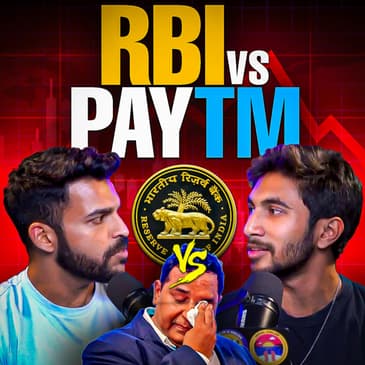

In this episode of The Startup Operator Roundup, Gunjan and Roshan break down the week's startup news and more!If you liked this episode, let us know by hitting the like button and share with your friends and family. Please also remember to subscribe to our channel and switch on the notifications to never miss an episode!
Topics
00:00 Introduction
01:39 Opening comments - Bharat Ratna winners & Pakistan elections
04:01 Paytm Vs RBI
13:39 Satya Nadella's visit to India
15:17 45X returns from Country Delight
18:04 Broadcasters push for separate OTT regulation
22:01 Karnataka to Ola and Uber surge pricing?
25:55 Delhivery hits profitability
26:55 Fundraises of the week
30:19 Talk of the town
-------------------------------------
Click here to get regular WhatsApp updates:
https://wa.me/message/ZUZQQGKCZTADL1
-------------------------------------
Connect with Us:
Linkedin: https://www.linkedin.com/company/startup-operator
Twitter: https://twitter.com/OperatorStartup
-------------------------------------
If you liked this episode, let us know by hitting the like button and share with your friends and family. Please also remember to subscribe to our channel and switch on the notifications to never miss an episode!
[00:00:00] Hello and welcome to another episode of the Startup Operator Roundup. I am Roshan Karihapah
[00:00:05] and I'm Gunjan Sahar and together we break down the biggest headlines from India's growing
[00:00:09] starter peak system.
[00:00:11] If you're a regular listener of this channel then please consider sharing this video with
[00:00:14] your friends and if you're tuning into the starter pop leader for the first time, please
[00:00:18] subscribe to our channel for our fantastic conversations with founders, investors and other
[00:00:23] people from the starter peak system.
[00:00:25] In this week's roundup, of course, the first big item that we'll be discussing is the
[00:00:29] entire Fiasco between RBI and PTM.
[00:00:33] It has been a while and this has allowed us to separate the myth from the facts so we'll
[00:00:37] be able to give you a clear perspective on what's happening.
[00:00:40] Last week, Microsoft CEO Satya Nadeela also visited Mumbai and made some major announcements
[00:00:44] on the AI front.
[00:00:45] Country Delight which has been pioneering on the milk delivery space gave its investors,
[00:00:50] especially O'Rai's ventures, a 45X returns on their investment and this has been from
[00:00:55] a partial exit not even a complete exit.
[00:00:58] TV industry urges the Ministry of Information and Broadcasting to exclude online streaming
[00:01:03] players like Amazon and Netflix from the broadcasting bill.
[00:01:06] This is an interesting move and lastly, it's a good news for Kanataka people.
[00:01:13] The government has announced that there'll be uniform fees for taxis that includes the
[00:01:17] likes of Uber and Ola and there'll be no more search pricing so we'll see how that
[00:01:21] will impact the cab availability in Bangalore at least.
[00:01:25] So let's get started in this round up.
[00:01:34] But before that, this has also been a big week for India.
[00:01:37] The Bharat Ratna list has been announced.
[00:01:39] Roshan did you get a chance to look at that?
[00:01:42] Yeah, three very well deserving winners of the highest civilian award in Bharat.
[00:01:50] My favorite is of course a former Prime Minister of PV Nursam Rao.
[00:01:53] He's the first Prime Minister that I recognized.
[00:01:56] I was probably five or six years old when the 91 reforms happened and what people don't
[00:02:03] realize is the amount of political capital that was required to sort of push through, not
[00:02:09] just the economics and so on and so forth.
[00:02:12] And he was a fantastic man, a statesman and a scholar.
[00:02:15] He could speak about 12 or 15 languages.
[00:02:19] He had a very long career in politics in service of the nation I should say.
[00:02:25] Was not very well treated within his own party and in his own time, right?
[00:02:30] He was pretty, he was sideline and everything but this is a fitting honor I should say.
[00:02:35] And you know, very big hearted off Prime Minister Modi to sort of recognize someone from
[00:02:39] the other side, right?
[00:02:41] And this is what I think national politics should be, right?
[00:02:45] I mean, recognize irrespective of party lines and so on and so forth.
[00:02:49] So I'm very, very happy about that.
[00:02:51] I think more people should kind of read.
[00:02:55] Vinay Sita Pati is book half-line on PV Nursam Rao.
[00:02:59] I've just started on it and hopefully I'll gain a little more knowledge on PVNR but fantastic
[00:03:07] honor I should say.
[00:03:15] And also in a neighboring country, the elections are on.
[00:03:18] Are you following that?
[00:03:19] Well, I mean some chaotic news coming from there that the elections are rigged and so
[00:03:21] on and so forth.
[00:03:22] Really, I mean the country is kind of unraveling, right?
[00:03:24] I mentioned watching a podcast sometime back and funny as it sounds, it's actually pretty
[00:03:31] crazy.
[00:03:32] I mean, and there's a lot of despair in Pakistan and I really hope that they're able to fix
[00:03:38] their circumstances and get back to being a sane country at least if possible that is.
[00:03:45] Well, it'll be interesting to see what's happening in our neighborhood while very soon
[00:03:51] we'll be entering our elections period.
[00:03:53] But anyway, coming back home to some of the big news, the recent clash between RBI and
[00:03:59] the PTM has definitely garnered a lot of attention from the start-up ecosystem, from
[00:04:04] the media.
[00:04:05] And all of this began when RBI initially reached concerns about PTM's post-paid feature.
[00:04:11] This was PTM's 4A into BNPL and of course BNPL has not really fared out well in the
[00:04:16] country.
[00:04:17] The RBI has since the beginning has reached concerns over it.
[00:04:20] They are saying, RBI in its latest sanctions against PTM is saying that this is because of
[00:04:25] persistent non-compliance and continued material supervisory concerns in the bank.
[00:04:31] And the RBI did not specify further to it.
[00:04:33] PTM's payments bank is restricted from adding customers in March 2022 due to similar concerns,
[00:04:40] but they continue doing business with existing customers.
[00:04:43] Now RBI has told the company to wind on most of these businesses by the end of this month.
[00:04:49] Amazis Regulatory Tussle, PTM is facing setbacks from investors, its valuations is taking
[00:04:54] a dive, share prices are plunging and this of course raises a lot of questions over
[00:04:59] PTM's growth trajectory and the market reputation.
[00:05:02] But despite these setbacks, I really think PTM will always remain as a pioneer in India's
[00:05:07] fintech space.
[00:05:08] Hopefully all of these controversies and actions will settle down.
[00:05:14] But what are your thoughts on this RBI PTM showdown?
[00:05:18] Let me caveat my response with a few things.
[00:05:20] So first I absolutely admire VSS.
[00:05:25] A phenomenal entrepreneur, really a trailblazer I should say and he's been at it for 20 plus
[00:05:30] years.
[00:05:31] And I would say he's a model to aspire for any other builders out there.
[00:05:37] I remember the early days when they were doing some mobile vast services and so on and so
[00:05:42] forth and then the inflection point with demonetization and so on and so forth.
[00:05:49] So I absolutely admire and respect VSS.
[00:05:53] And I think PTM, you cannot discount the amount of change they've brought in.
[00:06:00] I mean especially post demonetization and so on.
[00:06:05] They've really pioneered the payments ecosystem in India and that's taken a lot of time,
[00:06:10] money, effort, innovation, what have you.
[00:06:12] Now with that out of the way, look, fintech business is extremely complex heavy.
[00:06:18] We've had more than a few fintech founders on the podcast and one of the questions I
[00:06:22] always ask them is what is it like working with these banks?
[00:06:25] What is it like working with the regulators?
[00:06:27] What are those compliance norms that you have to meet?
[00:06:29] What are you doing to enable your business for that and so on.
[00:06:35] And everyone kind of respects that because that is a necessary condition to operate in this
[00:06:40] fintech ecosystem.
[00:06:43] While it may seem unfair that you know, PTM has been asked to stop operations and they've
[00:06:49] clamped on pretty heavily from what reports have emerged.
[00:06:53] And we've heard from the RBI Governor as well that this was a long time coming.
[00:06:57] Right?
[00:06:58] I mean, they've been warned for dating back to almost two years and even up six months
[00:07:04] of continued warnings as well on the regulatory front and they were not heated.
[00:07:10] Now should the law apply differently to PTM because it's such an innovative company?
[00:07:15] I don't think so.
[00:07:18] If they have not operated under the legal purview, obviously need to face the consequences
[00:07:26] of that and which is what is happening.
[00:07:28] Now I am optimistic about PTM in the sense that I know that they can fix those things and
[00:07:33] get back to being the fantastic brand and company they are and I'm really rooting for them.
[00:07:39] But in terms of the action itself, well, the payments bank was banned from taking any
[00:07:44] more deposits and so on.
[00:07:47] And the major point of contention here is that you know, the KYC for the wallet was used
[00:07:53] to add these customers for the PTM bank, right?
[00:07:57] The payment bank itself.
[00:07:58] And that's it.
[00:07:59] Yeah, exactly.
[00:08:00] And that was a, that was a, that was a gray area, right?
[00:08:04] Because technically these two things had to be siloed, right?
[00:08:08] I mean the payments bank and the PTM had to be, PTM wallet business and merchant business
[00:08:12] had to be siloed.
[00:08:13] But that wasn't the case, right?
[00:08:16] And you know, RBI came down heavily on that and sort of banned them.
[00:08:21] Now every other UPI provider whether it is Google Pay or phone pay, etc has tied up with
[00:08:26] another bank, right?
[00:08:27] I mean, so for instance, I think Google Pay has tied up with HTFC and ICIC, I see a phone
[00:08:32] pay with yes bank and so on, right?
[00:08:34] So the UPI address itself will, you know, be OK, I see, I see, I see, I have OK HTFC
[00:08:39] or YBL or something or that sort.
[00:08:42] But in PTM's case, it was PTM bank itself, right?
[00:08:45] Now because PTM bank has been asked to seize operations, the whole UPI infrastructure is
[00:08:52] also affected, right?
[00:08:53] Now imagine going to all of these merchants and sort of changing the QR code.
[00:08:58] That's not a small task.
[00:09:00] Come in, you're talking about hundreds of crores of logistics expenses on that front,
[00:09:06] right?
[00:09:07] And that is if they agree to do that and if they are still with you, right?
[00:09:10] And not to forget that, you know, there are other players in the market who will be more
[00:09:14] than happy to kind of tap this business, right?
[00:09:17] And then now before that imagine having to tie up with another bank now, right?
[00:09:23] Whether an ICIC or whoever else.
[00:09:25] That whole process itself is three months.
[00:09:27] Now they have to crush it down to, you know, I think by February 29th, there have been
[00:09:31] given time to sort of do that.
[00:09:33] So they have to figure a way to do that, right?
[00:09:35] Tie up with that other bank.
[00:09:37] So it's a humongous challenge in front of them, you know?
[00:09:42] And it seems very, very difficult to sort of overcome, I would say.
[00:09:46] I said, you know, when the PTM shares tanked about your back or so that, you know, at
[00:09:52] the right valuation, PTM could be an amazing business for something like a Tata or a reliance
[00:09:57] to sort of pick up, right?
[00:10:00] For a couple of billion dollars and change.
[00:10:03] Now I mean the way geo financial shares have been rallying and you know with the supposed
[00:10:09] rumors of HTFC being interested and so on, I mean that may very well turn out to be
[00:10:14] the case, but everyone will want to find out, you know, what their loan book is like,
[00:10:18] right?
[00:10:19] And what is the amount of regulatory hurdles here and so on, right?
[00:10:23] And overall, I think the other aspect that people will be sort of very about is the Chinese
[00:10:29] investor thing, right?
[00:10:30] I mean, and financial loans, something like 10% in PTM.
[00:10:35] And you know, there were data concerns in terms of, you know, the Chinese government
[00:10:41] having access to Indian records and so on and so forth.
[00:10:44] Now what I hear is, PTM has done a lot to ask you to use these concerns, but those
[00:10:50] still sort of remain, right?
[00:10:53] So all of that put together.
[00:10:54] It seems like a very, very thawney situation for PTM to get out of.
[00:10:58] I'm really rooting for them.
[00:11:00] I am really hoping that they're able to come out of this clean and resume operations.
[00:11:06] But it's a very useful lesson to every entrepreneur out there, right?
[00:11:10] Whether you're operating in Fintech or otherwise.
[00:11:12] See, oftentimes businesses are founded in that gray area and you really, really have
[00:11:19] to go out of your way to be compliant, right?
[00:11:21] Because something like this, an externality which can kill your business, really is something
[00:11:27] that you don't want to have to factor in.
[00:11:32] So yeah, have you bought PTM shares?
[00:11:35] No, I have but I sold it maybe in the nick of time.
[00:11:41] Yeah, I mean, it's a brother, you know, catch of flying.
[00:11:45] What's interesting, catch of falling knife kind of a situation right now, you know?
[00:11:48] I mean, I've been considering of, you know, investing in the company given the share prices
[00:11:52] have tanked so much.
[00:11:54] But you're still waiting to see how this plays out.
[00:11:57] Yeah.
[00:11:58] But it's also interesting that the entire Fintech ecosystem has, you know, gotten together
[00:12:02] to support PTM, right?
[00:12:03] There was news that a group of founders have written a letter to the Prime Minister Modi,
[00:12:08] Finance Minister Nirmala Sitaraman and the Reserve Bank of India urging them to reconsider
[00:12:13] sanctions against PTM and engage in constructive dialogues with the Fintech ecosystem.
[00:12:18] Now, while the support of course is applaudable, but I don't know whether if you really want
[00:12:24] to, you know, dub off in the wrong way with the RBI.
[00:12:28] But keeping that aside, the RBI is also keeping, you know, the best interest of consumers
[00:12:34] in mind.
[00:12:35] They are meeting with NHAI, NPCI and other stakeholders who chart an alternate course for
[00:12:39] the migration of PTM users.
[00:12:41] They are convening a meeting to facilitate a smooth transition of users and they're taking
[00:12:46] proactive steps to ensure that minimal disruptions happen to users and, you know, strengthen
[00:12:52] the confidence that users have in the digital India story.
[00:12:55] It's a lot, right?
[00:12:56] I mean, I think they have what 35 million users or something of that sort may be more,
[00:13:00] or 350 million users, I think, right?
[00:13:02] Overall, and you know, PTM Fast Tag has found like very wide adoption, right?
[00:13:09] And the wallet is, you know, one of the, you know, most popular wallets as well.
[00:13:13] And the merchant base is one of the largest, largest merchant bases.
[00:13:16] So, you know, what we don't want from this situation is for people to get spooked about
[00:13:22] all of these digital payments and whatnot, right?
[00:13:24] So I really feel like I hope the regulators work out a solution for the broader ecosystem.
[00:13:33] Yeah.
[00:13:34] Moving on, Satyana Deela's recent visit to India has definitely got the startup community
[00:13:38] buzzing.
[00:13:40] And the Microsoft CEO made some major announcements on the AI front.
[00:13:44] First of all, he's urging the startup ecosystem to ride the digital wave and innovate like
[00:13:49] never before.
[00:13:50] And to support this, Microsoft will offer AI-skilling opportunities and training to individuals
[00:13:54] in tier two and tier three cities as well as in rural areas of the country.
[00:14:00] While basic and advanced AI training will be given to five lack students and job seekers,
[00:14:05] one of the one lack women will be trained in in depth AI technical skills training.
[00:14:11] The Microsoft CEO also urged both India and US authorities to build consensus and cooperate
[00:14:18] on framing norms to regulate the AI space.
[00:14:21] And quoting Satyana Deela from the event, he says India has the tools and policy to manage
[00:14:27] positive transition to AI.
[00:14:30] Now this thing has two facets, right?
[00:14:32] One, of course, multiple reports claim that Indian talent is the best suited to take the
[00:14:37] AI innovation forward.
[00:14:39] And second, the population that India has, right, serves as the bed to test out what AI
[00:14:46] can do for mankind.
[00:14:47] And this AI story is growing so fast that Sam Orkman is out there in the market raising
[00:14:54] funds to build AI chips and other hardware to support AI development.
[00:14:59] Guess how much he's out there today?
[00:15:02] Billions?
[00:15:03] No, that's too small.
[00:15:04] He's out there raising $7 trillion in the market just to give some perspective that's more
[00:15:10] than the combined market cap of Apple and Microsoft.
[00:15:15] Uraiz Ventures just code a 45X returns in a partial exit from country delight.
[00:15:21] Country delight success story is not just about the financials but they've disrupted a
[00:15:25] very traditional business in India.
[00:15:28] They focus on quality, freshness and customer centricity and they have redefined dairy buying
[00:15:33] experience in the country.
[00:15:35] They've not only focused on quality, freshness and customer centricity but they've redefined
[00:15:41] their dairy experience and set new standards for the entire industry.
[00:15:45] Now the timing for this news could not be any better.
[00:15:48] Uraiz Ventures exit injects a lot of momentum in the Indian starter ecosystem given the funding
[00:15:54] sentiments.
[00:15:55] But do you think this renews investor confidence in the India good story?
[00:15:58] Well, it's a fantastic story.
[00:16:00] No doubt and the past few weeks and months we were looking for a flip-cut guys so that
[00:16:06] they can give us a party after the reset by back but now we'll have to look for some
[00:16:10] Uraiz guys.
[00:16:12] But yeah, 45X returns.
[00:16:14] That's handsome, handsome return.
[00:16:17] Just today I was talking to someone about all these funding cycles and they were asking
[00:16:21] me about what are people funding right now?
[00:16:24] What sector seems to be hard and I feel like you're always going to be behind the curve
[00:16:31] that way.
[00:16:32] I mean, if you invest because of something, something is hard and so on because the most
[00:16:37] amount of value that can be gained is ahead of the curve.
[00:16:43] And it's also equally risky and whatnot but props to these folks man.
[00:16:47] Country delight has done phenomenally well and it's an old traditional business that
[00:16:52] has been disrupted and it requires a level of execution that needs to be like really proper
[00:17:01] because we're talking about businesses with pretty low margins on the logistics front at
[00:17:07] least and set behavioral patterns and so on.
[00:17:10] So you're not going to switch your daily routines that easily but I know more than a few
[00:17:16] people who swear by country delight, the milk and cheese and they deliver some papers
[00:17:22] and whatnot also I suppose right?
[00:17:25] So Vegetable goes traditionally.
[00:17:27] Yeah, so good stuff.
[00:17:29] Yeah excellent.
[00:17:30] Hey talking about dude, do you remember that iconic song
[00:17:32] I mean many iconica songs on the Dude.
[00:17:35] Ooooh, Ooo知 Everyday snaps one through three
[00:17:40] Walk thu puck you touch the glass of facil an
[00:17:41] Do you remember thatision also in 3 to 4
[00:17:45] times a day I think, phenomenal.
[00:17:47] I mean 90s were such an amazing, amazing time to grow up,
[00:17:51] pre-internet, such internal curve, bone-witter, yeah,
[00:17:56] great stuff.
[00:17:57] OK, back to your regular programming now.
[00:18:00] The Indian Broadcasting and Digital Foundation
[00:18:02] are the IBDF, which is an industry body of TV broadcasters
[00:18:06] want online streaming platforms to be removed
[00:18:09] from the scope of regulations of the contentious Broadcasting
[00:18:13] Services Regulations Bill of 2023.
[00:18:16] This was introduced by the Ministry of Information
[00:18:18] and Broadcasting in November of 2023.
[00:18:21] The rise of online streaming platforms
[00:18:23] has of course disrupted traditional television broadcasting
[00:18:26] models, challenging established players
[00:18:29] and reshaping consumer preferences.
[00:18:31] Excluding them from regulatory oversight
[00:18:33] could amplify this disruption and impact
[00:18:36] the industry dynamics.
[00:18:38] But on the same side, the IBDF argues that TV broadcasting
[00:18:42] and OTT platforms are distinct and should be regulated
[00:18:45] separately.
[00:18:47] The proposed bill aims to bring all OTT platforms
[00:18:50] under its purview and introduce a three-tier regulatory
[00:18:52] structure for content evaluation.
[00:18:55] The IBDF expresses concerns over potential content
[00:18:58] censorship and urged the protection of freedom
[00:19:00] of speech and expression.
[00:19:02] Now, I think this needs to be taken a bit seriously
[00:19:06] because a lot of external agencies and bodies
[00:19:09] have a use of media censorship and content censorship.
[00:19:14] So what are your thoughts on this development?
[00:19:17] Yeah, I mean, this is going to cause a lot of outrage,
[00:19:21] because so if we back up a little bit,
[00:19:24] the old bill or rather act is one that was drafted in the early 90s,
[00:19:30] some Indian cable television act or something of that sort.
[00:19:33] And clearly, the world has come a long way since then,
[00:19:37] since the last 30 years.
[00:19:39] And so the new broadcasting bill draft that was proposed
[00:19:43] plans to bring all kinds of media under its purview,
[00:19:46] and that includes digital mediums as well.
[00:19:48] So OTT and including YouTube, for instance,
[00:19:51] imagine our content being regulated.
[00:19:53] Man, that'll be the day.
[00:19:55] So what do you mean that'll be the day?
[00:19:59] Why would you want a content to be moderated?
[00:20:02] No, I'm saying, I mean, we can't moderate it ourselves.
[00:20:06] I mean, good luck to anyone else who can moderate this content.
[00:20:08] But yeah, so it'll bring all sorts of actors
[00:20:14] into the same purview, right?
[00:20:16] And anything that will be ruled by committee
[00:20:21] is going to have its limitations.
[00:20:23] So if a committee is going to decide what
[00:20:25] is quote unquote safe content and what
[00:20:27] is suitable for people and so on and so forth,
[00:20:31] it's going to have its challenges for sure.
[00:20:34] My only submission on this is to make it
[00:20:39] as general and wide as possible, right?
[00:20:42] And not be really specific and have a proper retracell
[00:20:46] mechanism in place, right?
[00:20:47] So that people can sort of contest some of these things.
[00:20:51] Right now, of course, I mean, we're
[00:20:52] being regulated by the large on YouTube and other platforms,
[00:20:56] right?
[00:20:56] And the retracell mechanisms, of course,
[00:20:59] are less than optimal, I should say, right?
[00:21:04] So should the government consider a bill and an act?
[00:21:07] Yes, they should for sure, right?
[00:21:09] Because there's a ton of content and media
[00:21:14] and content can influence nations, right?
[00:21:16] I mean, we're speaking on in the week
[00:21:20] that Tucker Carlson in the US has interviewed Vladimir Putin
[00:21:25] of Russia, right?
[00:21:27] And some people are alleging that this
[00:21:29] is in time for the US elections and whatnot, right?
[00:21:33] Be that as it may, right?
[00:21:35] I think it's right for the government to think of a new broadcast
[00:21:38] act for sure, right?
[00:21:41] In terms of the specifics on what they should regulate,
[00:21:44] how and so on, so forth, I will leave it to wiser minds
[00:21:47] to prevail on this.
[00:21:49] Let's see what happens.
[00:21:51] Yeah.
[00:21:52] All right.
[00:21:53] Now coming to some Bangalore or I should say,
[00:21:56] Kanataka News.
[00:21:57] This is some big development for the ride healing sector.
[00:22:00] Kanataka government announces uniform fare
[00:22:03] regulations for Ola and Uber.
[00:22:05] By capping search pricing, Kanataka
[00:22:07] wants to make rides more affordable and accessible
[00:22:09] for all, especially during peak traffic
[00:22:12] hours and high demand periods.
[00:22:13] These are efforts to standardize fare structures
[00:22:16] and prevent price manipulation by ride healing companies.
[00:22:19] Now, well, of course, this means cheaper rides
[00:22:21] for passengers.
[00:22:23] But you know, you really got to think
[00:22:25] about the driver partners as well, right?
[00:22:28] Because out of 100 rupees at the make,
[00:22:32] 30, 35 rupees goes to the ride healing company.
[00:22:35] On top of that, fuel prices are going up.
[00:22:38] And the amount of money they actually take back home
[00:22:41] is very highly dependent on these search pricing
[00:22:44] or high demand times.
[00:22:47] Now with the standardization of fare,
[00:22:49] I really think their incomes will get affected.
[00:22:54] Yeah, for sure.
[00:22:55] Look, I mean, I think long term,
[00:22:58] there needs to be some kind of an open platform
[00:23:00] for ride healing, right?
[00:23:01] Because all of us kind of agree that ride healing
[00:23:03] is a necessity in any city, right?
[00:23:06] We're not going to go back to the days
[00:23:07] of calling caps from directories and whatnot.
[00:23:10] That's not happening, right?
[00:23:12] We had, you know, Wimmel of Nama Yathri on the podcast.
[00:23:15] And, you know, what they are doing
[00:23:18] is a flat subscription fee.
[00:23:20] So maybe like a different sort of a payment system emerges
[00:23:24] and whatnot, right?
[00:23:25] Because mobility in the city and especially
[00:23:27] last-mile mobility is broken.
[00:23:29] And we definitely need these services
[00:23:32] to kind of help us out, for sure, right?
[00:23:35] Having said that, I think the government in Karnataka
[00:23:38] is acting a little bit like a Soviet style, you know,
[00:23:42] makeup, right?
[00:23:43] Because one is the like the amount of welfare
[00:23:46] that it's investing in, right?
[00:23:48] Which has really hit the balance sheet
[00:23:50] of the government for sure, right?
[00:23:51] And in fact, so much so that they're asking the center
[00:23:53] for help as well.
[00:23:55] That is one thing.
[00:23:55] The second is to regulate these things
[00:23:59] in terms of caps and whatnot.
[00:24:01] Now the driver demographic in Bangalore, especially, right?
[00:24:06] It's significant enough that it's a key voting constituency,
[00:24:10] right?
[00:24:11] I'm sure that there will be some outrage on this, right?
[00:24:15] In terms of like a curb on the prices and whatnot.
[00:24:20] To be honest, it's a difficult challenge, you know,
[00:24:22] I mean, we keep making the point on the podcast
[00:24:25] that any of these new innovations, regulating them,
[00:24:28] drafting policy and so on is really, really hard, right?
[00:24:33] Because there are some second order consequences to this
[00:24:37] that we just simply can't grapple with, right?
[00:24:40] So on the one hand, I feel like, yeah,
[00:24:42] I mean, outrageous search pricing or 4x and 5x
[00:24:45] is bad for me as a consumer, right?
[00:24:48] On the other hand, I feel like the market should take care
[00:24:50] of this, right?
[00:24:52] And bear in mind that, you know, the right-hailing folks
[00:24:54] are not making a profit, right?
[00:24:56] It's almost like a loss.
[00:24:58] Yeah, exactly.
[00:24:59] I mean, all of these folks are operating on a loss.
[00:25:00] So it's almost like a public service enterprise
[00:25:04] in some sense, right?
[00:25:06] So should they be allowed to make a profit, of course, right?
[00:25:10] And will that entail, you know, search pricing?
[00:25:13] Well, of course, right?
[00:25:14] I mean, they do have to figure out a way to do that.
[00:25:17] I think one perhaps leverage or lever could be,
[00:25:22] you know, investing in green caps, right?
[00:25:25] For example, Blue Smart has been doing that.
[00:25:28] So bring up the fuel efficiency and so on, right?
[00:25:32] I mean, just to create a little bit of margin
[00:25:34] on the rides and whatnot.
[00:25:36] But yeah, let's see what happens in the future,
[00:25:41] but because I'm sure that the drivers
[00:25:43] and platforms will outrage on this.
[00:25:45] For once, they'll be on the same side, right?
[00:25:48] So yeah.
[00:25:49] OK.
[00:25:50] All right, before we move on to the key fund
[00:25:52] reasons of the week, delivery has hit profitability.
[00:25:56] And this is a big milestone in its journey
[00:25:59] and a very crucial step for its long term sustainability.
[00:26:03] In India, we are seeing e-commerce booming
[00:26:06] and delivery's profitability also prompts
[00:26:09] its competition and to devalue it, their business strategies
[00:26:12] and how they are maintaining efficiencies
[00:26:14] across their value chain.
[00:26:16] So yeah, big moment for the delivery space in India.
[00:26:20] Delivery, of course, has been helping a bunch of small and medium
[00:26:23] businesses get their goods and services across the country.
[00:26:28] And it's a type of business that I
[00:26:32] wouldn't envy operating in that.
[00:26:34] The margins are raised at thin, right?
[00:26:36] And you have to clock precisely.
[00:26:39] I mean, your efficiency has to be near 100%.
[00:26:42] In order for you to make any money at all.
[00:26:44] So like Kudos to the management team
[00:26:47] and Kudos on their execution, phenomenal stuff.
[00:26:51] Now let's talk about the notable fund
[00:26:53] raises from last week.
[00:26:54] It has been a good week for the event
[00:26:56] industry in general.
[00:26:58] There's startup deliver that raised $40 million
[00:27:00] from Yamaha Motors, AI Futem, Automotive,
[00:27:03] Lower Carbon, Capital and Toyota Ventures.
[00:27:06] EV focused NBFC startup Mofen Green
[00:27:09] finance raised to 140 crore rupees
[00:27:10] or $16.8 million from a group of family offices.
[00:27:15] We have FinTech startup which is focused
[00:27:17] on the mobility segment called Auto Capital.
[00:27:20] They raised $10 million from GMO Ventures, Turbo Start,
[00:27:23] Prime Venture Partners, Matrix partners and others.
[00:27:26] Created a focus platform, wish link raised $7 million
[00:27:29] from Fundamentum and Elevation Capital.
[00:27:32] And last but not the least, Metaphyn which is a clean tech
[00:27:35] focused NBFC raised $5 million from Prime Venture Partners
[00:27:40] and Varianium Capital.
[00:27:42] But apart from this fund raises, there's also
[00:27:44] a big announcement on the acquisition front.
[00:27:47] CRED has reached an agreement to buy mutual fund
[00:27:49] and stock investment platform Kuvera
[00:27:51] as part of the expansion deal into wealth management.
[00:27:55] Now, CRED has been rapidly expanding.
[00:27:56] They I think a few months back they announced
[00:27:58] CRED garage to move into the auto-financing space
[00:28:03] and now they're moving into the wealth management space.
[00:28:05] So what do you think CRED is doing?
[00:28:07] Does it have a business model in place?
[00:28:09] Look, it's building for that this is an eternal question,
[00:28:13] and I'm sure that we've talked about this
[00:28:15] more than a few times on the podcast itself.
[00:28:18] Their thesis is to build for that top 1% or top 5%
[00:28:22] of spenders and owners in India, right?
[00:28:26] And so which is why I mean this sort of wealth management
[00:28:29] acquisition also makes sense for them in some sense, right?
[00:28:32] So yeah, they've acquired them for obviously the license
[00:28:39] which they've also applied for actually, right?
[00:28:42] And for any of these products that they can probably
[00:28:46] pitch to those customers, right?
[00:28:48] So yeah, I mean it's not as simple as just acquiring
[00:28:52] a bunch of products and selling it, right?
[00:28:54] I mean because look, the mutual fund industry is like what
[00:28:57] is it?
[00:28:58] It's at least 30 years old in India, right?
[00:29:00] And it has its own rules to play by.
[00:29:07] And one thing that we all learned from the whole PTM Fiasco
[00:29:11] is that you have to keep some of these things separate,
[00:29:16] right?
[00:29:18] Interestingly, zero that is starting their own fund
[00:29:20] house as well.
[00:29:21] So they'll be launching a bunch of low-cost index funds
[00:29:25] and so on and so forth.
[00:29:26] And we've launched quite a few actually index funds.
[00:29:28] Yeah.
[00:29:29] So again, I hope that they're heating all the checks
[00:29:34] and balances required to manage these different parts
[00:29:37] of their business, right?
[00:29:39] But interesting news, nevertheless.
[00:29:43] I don't know anyone who uses credit though
[00:29:44] and it could just be my circle.
[00:29:46] I don't know if I...
[00:29:47] I mean, I might be scantrous to say.
[00:29:49] I used to use credit but I just did not see any benefit
[00:29:53] from it.
[00:29:54] Yeah, I used to play my credit card bills
[00:29:55] and then after that I had like some full-acquins
[00:29:57] and...
[00:29:58] What to do with this coin?
[00:29:59] Bias Ticaros.
[00:30:01] I don't know.
[00:30:02] I don't know.
[00:30:03] Yeah.
[00:30:04] But I do know one person who swears by credit
[00:30:08] but that's because he makes ad films for credit.
[00:30:11] So we know we're talking about it.
[00:30:13] Yeah.
[00:30:15] All right, let's move on to the talk of the town section.
[00:30:18] Rajiv Manthri made a very interesting tweet giving
[00:30:22] an alternate view to a Bloomberg article that quotes,
[00:30:25] Modi's thriftness may end up short-changing India.
[00:30:29] But Rajiv says the main point
[00:30:31] to this article is missing is that India has made great gains
[00:30:35] on the efficiency side, especially in welfare distribution.
[00:30:38] He says that India has the best in class system powered
[00:30:41] by digital infrastructure that has no parallels or precedence.
[00:30:45] Every rupee of welfare spending goes much further than it did
[00:30:48] earlier which is a remarkable step.
[00:30:50] And if there was honesty and curiosity
[00:30:52] in the community of academic economists
[00:30:54] and public policy analysts, tombs would have been written
[00:30:57] by now on what India has achieved.
[00:31:00] Yet is a graph to show what it means.
[00:31:02] Roshan, can you simplify this for us?
[00:31:05] Well, we had the budget recently and one of the things
[00:31:10] that struck everyone, interestingly even folks
[00:31:14] in the opposition also was how little was budgeted
[00:31:17] for welfare and so on.
[00:31:18] And that too considering this is an election year.
[00:31:21] And so obviously I mean people who have to write against the government
[00:31:25] for one reason or the other found this
[00:31:28] as a contentious issue, the fact that the government
[00:31:31] is not spending enough which is usually the opposite.
[00:31:37] But Rajiv makes a fantastic point
[00:31:40] that the direct benefit transfer has
[00:31:42] improved the efficiency of delivery
[00:31:45] by such a remarkable difference
[00:31:49] that the government does not have to do
[00:31:52] the conventional big spends of earlier years and so on.
[00:31:56] Not to say that the government is not spending
[00:31:58] they have to but that is the central point.
[00:32:02] And in the 80s Rajiv Gandhi had a quote
[00:32:06] that's Raul Gandhi's father by the way, thanks.
[00:32:09] No, I mean I can't take anything for granted so yeah.
[00:32:14] So you had a quote that for every one rupee
[00:32:16] the central government spends about five paisa
[00:32:19] ultimately reaches the end user or the end beneficiary
[00:32:25] as such and today that's not the case.
[00:32:27] I mean if you look at credits to farmers accounts
[00:32:32] that is like completely like taken care
[00:32:35] with other UPI and so on.
[00:32:38] And other services as well, whether you look
[00:32:40] at your LPG or housing or any of the other stuff
[00:32:45] null page electricity, all of that stuff.
[00:32:49] In fact, I think we should do maybe a video
[00:32:53] on just the DVD schemes itself.
[00:32:54] There are plenty of these and the beneficiaries are immense.
[00:32:58] I mean like hundreds of millions of people
[00:33:01] that we're talking about right?
[00:33:02] I mean so massive scale.
[00:33:04] So yeah, fantastic.
[00:33:06] I mean I think definitely explore some of the links
[00:33:09] that you know Rajiv has tweeted right?
[00:33:13] It's a great thread and Rajiv is a great follower also.
[00:33:15] Awesome.
[00:33:16] So I guess then that's it for the 142nd episode
[00:33:19] of the startup opt-in roundup.
[00:33:20] We hope you enjoyed this conversation
[00:33:22] and if you're still watching this video,
[00:33:24] thank you so much for being with us right till the end.
[00:33:27] Next week we'll be back again with more exciting news
[00:33:29] from India's startup ecosystem.
[00:33:30] Wait, wait, wait.
[00:33:31] We have to tell them about the episodes upcoming.
[00:33:35] We have a conversation with Ranjit Mukundan
[00:33:38] who is the co-founder and CEO of Stellapse.
[00:33:41] So we spoke about country delight, you know
[00:33:43] about milk and the execution it takes
[00:33:47] to kind of deliver change behaviors and so on.
[00:33:50] Well, Stellapse is building dairy farm automation right?
[00:33:54] End to end.
[00:33:55] Again, really, really amazing business.
[00:33:58] IoT plus marketplace plus SaaS plus bunch of other services
[00:34:04] all bundled together.
[00:34:06] Yeah, I really enjoyed this conversation
[00:34:07] and I'm sure you will too.
[00:34:08] So stay tuned for that.
[00:34:11] And we're approaching the 150th episode
[00:34:14] on the roundup, right?
[00:34:17] So if you guys have some special requests,
[00:34:19] if you want, you know, Gunjan to take his top off or, you know,
[00:34:24] if you wanted to play a song or if you want our producer
[00:34:28] to do a little dance, all of those requests are koshered.
[00:34:31] So let us know in the comments.
[00:34:34] Yeah, be continue as we were.
[00:34:39] All right, folks, that's it.
[00:34:40] We'll see you again next week.
[00:34:42] Please remember to do all the good stuff,
[00:34:44] like, share, subscribe to the channel.
[00:34:47] Yeah, we'll be back again next week with more exciting updates.
[00:34:49] See you guys.