
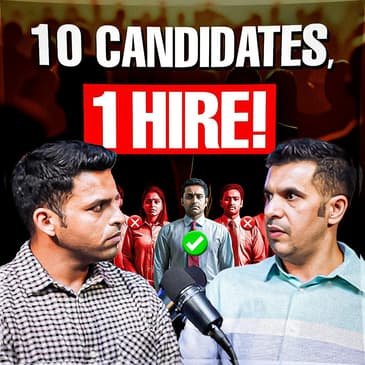

In this episode of The Startup Operator Podcast, host Roshan sits down with Divesh Dhawan, founder of Meyrahkee Advisors, to discuss the evolving landscape of hiring in startups. They delve into the importance of understanding Gen Z workers, the sectors currently in high demand, and valuable tips for candidates to get shortlisted. They also touch on the cultural aspects that influence hiring decisions and share some of the top startups known for their exceptional work environments.
00:00 Introduction
01:41 Current Hiring Trends in Startups
03:56 Tips for Job Candidates
07:38 Evaluating Company Culture
11:24 Top Startups to Work For
14:39 Funny Interview Stories
-------------------------------------
Connect with Us:
Linkedin: https://www.linkedin.com/company/startup-operator
Twitter: https://twitter.com/OperatorStartup
-------------------------------------
If you liked this episode, let us know by hitting the like button and share with your friends and family. Please also remember to subscribe to our channel and switch on the notifications to never miss an episode!
[00:00:00] Culture is the real deal breaker these days and coming to your point again to the founders and you know the operators the question is learn how to work with Gen Z. It's a skill which you need to learn they are the ones building for the future they are the ones you know helping your organizations or being part of it. You would be tagging them lazy you know kind of entitled whatever but every generation you know is given some tags or so but you know you need to learn how to work with that generation.
[00:00:29] Hello and welcome to another episode of the Startup Operator podcast I'm Roshan Karepa. On this podcast we deep dive on hiring all aspects of it from what startups are hiring to what skills they're looking for to who is the right fit for an organization how culture plays a part and then you know on the flip side as a candidate how do you get shortlisted how do you negotiate with an employer and so on. This was a fun conversation with my friend Divesh Dhawan who runs Meraki Advisors a boutique recruitment consulting firm.
[00:00:58] I hope you find this episode fun and insightful I certainly did so stay tuned.
[00:01:03] Hey Divesh welcome to the Startup Operator podcast thank you so much for making the time.
[00:01:14] Thanks Roshan excited to be here and looking forward I hope I add some valuable inputs for your audience.
[00:01:22] I'm sure I'm sure I mean we've been talking for a while and I think you're one of the smartest recruiters around.
[00:01:26] Thank you.
[00:01:27] So I hope that you know we'll be able to surface a lot of insights around hiring particularly the audience's founders and operators and they're looking for actionable insights on you know what they should and should not do.
[00:01:40] Sure.
[00:01:40] So yeah maybe I'll back up a little bit and talk about the macro stuff to begin with right I mean hiring is usually a good indicator of economy right whether businesses or startups or companies are hiring or not.
[00:01:53] So are startups hiring right now?
[00:01:57] Absolutely definitely hiring.
[00:02:00] If you compare it like six months ago things have improved.
[00:02:05] There is still an element of that cautious I would say you know cautiousness a little bit.
[00:02:12] But yes what I see as a trend is a lot of hiring is happening or started to happen at the mid senior level.
[00:02:23] Less on the leadership more on the mid senior bit.
[00:02:27] So that would be like eight ten years experience type.
[00:02:30] Yeah so I would say five to ten.
[00:02:32] So let's say a manager level to senior manager.
[00:02:35] So that's where most of the action is what we are seeing at least in the startup ecosystem you know where hiring is picking up or actively you know people reaching out in terms of to discuss around their hiring requirements.
[00:02:48] Right.
[00:02:48] Any particular sectors domains that are like doing better than the others?
[00:02:54] So engineering was never out of fashion.
[00:02:56] Of course.
[00:02:57] Still quite a bit.
[00:02:59] So that's always in demand.
[00:03:02] Design surprisingly we have started to get a lot of requests on you know lead designer or you know design lead per se especially on the UI UX or the product design.
[00:03:13] Demand gen again everybody is looking for magical demand gen marketers.
[00:03:18] So these three for sure you know are the most active ones.
[00:03:24] Along with that what I've seen is CS is kind of going through a lot of evolution where now CS plus support is kind of getting mixed together and people are looking you know for individuals who can handle both.
[00:03:38] So more like you know customer experience is how they're putting it now rather than kind of saying customer success or customer support you know separately.
[00:03:46] Right.
[00:03:47] Yeah.
[00:03:48] So these functions are where you know most of the requirements are coming or you know most of the discussions are happening.
[00:03:56] One thing I often hear from folks is that you know I've applied to 50 places I've not got shortlisted.
[00:04:04] Right.
[00:04:05] And I often ask like you know how are you applying or you know what are you doing to stand out and so on and so forth.
[00:04:12] I have my list of things that you know I feel you can do to get shortlisted.
[00:04:16] But you're the professional.
[00:04:18] So I want to ask you right if I'm a candidate and I'm applying to a job how do I increase my probability of getting shortlisted.
[00:04:25] See the biggest problem I'm seeing again now going to the talent side is you know again following the herd applying to a lot of jobs you know.
[00:04:34] You read demand gen and you feel you can do this role you know without really reading about.
[00:04:39] So one bit I tell them is learn to say no means you know the jobs you are not able to say no to to apply to apply to only those.
[00:04:49] So put this you know flip this around and you'll see the ones you're applying you know would actually be the ones you're actually sold to.
[00:04:57] And the chances to get you know at least the first level of interview would be much higher.
[00:05:02] Second I would tell you know everyone is be obsessed with data.
[00:05:07] You know talk only about impact.
[00:05:10] Means my recent LinkedIn thing I'm about to write is I'm not a fan of resume either.
[00:05:15] You know just give me the impact you've delivered in each role.
[00:05:19] I think that would tell me a lot about you know what you are able to bring to the table per se.
[00:05:24] So you know impact numbers wise it could be top lines bottom lines margins.
[00:05:30] You know productivity betterment you know optimization whatever means in every role try and question to say okay what is the impact you know I am delivering at the end of the day.
[00:05:42] Some numbers you would not be able to quantify which is fair enough but you know try and justify the impact to the extent you can in the roles you have you know kind of been part of or of your career journey.
[00:05:55] So I think less is more in terms of applying obsession with data for sure.
[00:06:02] Third is you know when you go for the interview bit try and you know again follow your instinct where you feel that culturally you might not be the right fit because you start to get a hint you know in terms of the interview process per se.
[00:06:21] You know try and stray away because in the long run if you think of it you join an organization just because you thought okay I will be able to handle.
[00:06:31] Though during the interview itself you got the hints that culturally you might not be you know able to do well.
[00:06:38] In six months you leave and it starts to put on you know your resume and it it kind of less valuable in the long run to you know what you actually thought.
[00:06:48] So I think those would be the elements I would say typically other than you know do your homework read about you know the journeys and what I am with people already are aware.
[00:07:00] I think the flipping of the mechanism to say the jobs I am not able to refuse to apply is what the jobs I should be you know applying to.
[00:07:09] And second like I said you know obsession with data means yeah if that's not there I think that's the most you know bit which is in demand where everybody is asking around the impact per se.
[00:07:23] So what impact have you delivered so talk about that as a part of your career journeys and anything else.
[00:07:28] But if it is a hiring manager and he or she is not able to tell you that's also for me as a red flag you know which I'm kind of judging you on that you don't know.
[00:07:38] Yeah I think a constant recurring theme you know I get from what you're saying also is that as much as the company is interviewing the person the person is also interviewing the company right.
[00:07:49] So yeah.
[00:07:51] And see the talent who knows their worth and who have delivered you know again impact scale and know are the ones actually rejecting companies than you know accepting offers.
[00:08:03] Because they're the ones the ones who are rejecting offers and the offers they are not able to reject based on the overall interview process which covers the elements what we have discussed are the ones they go into.
[00:08:16] So I think that's where you know the founders HRs hiring managers also need to understand and bring that clarity also.
[00:08:22] And going back to again to your question this is how you do well in the interview and this is how they also do well in the interview you know to bring that clarity.
[00:08:30] So lead with that clarity per se.
[00:08:32] So asking questions you know be prepared for unexpected by being true to yourself accept some mistakes don't you know try and sugar coat or go around you know in circles trying to justify that you know I can't be wrong.
[00:08:49] Because expecting someone not to do anything wrong is a bizarre expectation as per me right.
[00:08:56] So if you have goofed up it's okay everybody makes mistakes in life and that's fine.
[00:09:00] And then ask interesting questions judge them also ask them you know put them also on the spot to ask about you know the clarity on the roles etc.
[00:09:10] And if there are elements you know where you have read about culture being a problem let's say through Glassdoor or you know any other sites you've gone through or through your peer network.
[00:09:21] Ask them that this seems to be like you know something which is of concern have come to my notice and I wanted to you know bring this very upfront to check with you.
[00:09:29] What are you doing to you know make this whole bit better from a culture perspective.
[00:09:34] Are you seeing that's like a key deciding factor for some of the younger workforce I mean like culture you know what is the vibe at this workplace and so on because you know I started working about 16 years back and that was perhaps the last thing on my mind right.
[00:09:50] I mean we just went in for like gainful employment like our dads did perhaps right.
[00:09:56] I mean but today I think that whole culture vibe what's my manager like and so on right that's an important factor.
[00:10:03] Absolutely. Culture is the real deal breaker these days if you really ask me and coming to your point again to the founders and you know the operators the question is like my friend Victor said learn how to work with Gen Z.
[00:10:17] It's a skill which you need to learn because you know they are the ones building for the future they are the ones you know helping your organizations or being part of it.
[00:10:26] So learn how to work means you know you would be tagging them lazy you know kind of entitled whatever like Victor says but every generation you know is given some tags or so but at the end you know you need to learn how to work with that generation because that's the only way you're going to find a solution and you know kind of move forward.
[00:10:49] You can keep putting excuses blames to each other but that's never going to solve like the problem.
[00:10:54] Yeah.
[00:10:55] No this has been a learning for me as well right.
[00:10:57] I mean figuring out like what these folks are really good at and not obsess about the fact that hey I mean they're not like me.
[00:11:03] True.
[00:11:04] You know like hell I mean they're definitely not like us right.
[00:11:07] I mean they're many years apart.
[00:11:10] So figuring out the you know what are those things that are that they are uniquely capable of and focusing on that rather than like you know ruining the fact that oh they're not like us.
[00:11:20] They're not as disciplined.
[00:11:21] They don't do this.
[00:11:22] They don't do that.
[00:11:23] Yeah.
[00:11:23] Yeah.
[00:11:24] What are some companies that are amazing to work for?
[00:11:27] I mean we'll disqualify all of your clients in this right.
[00:11:30] I mean the ones that you work with but otherwise I mean let's say the top three top five startups in India to work for.
[00:11:38] Okay.
[00:11:40] That's a very tricky question.
[00:11:43] Now best ones to work for means what I've seen generally people talk and I take best ones to work for more from a longevity of the employees.
[00:11:55] So Zoho definitely comes in mind because you know I find it very difficult you know for people for Zoho to say okay we are exploring.
[00:12:03] So very rarely I'll see that.
[00:12:05] Does Zoho hire anyone at the lateral position?
[00:12:10] Means I've never worked with them to be honest so I don't know if they hire.
[00:12:14] So my hunch is they never hire at a lateral position.
[00:12:17] It's all homegrown talent.
[00:12:18] It's people who have worked there for like 5, 10, 15 years.
[00:12:21] So maybe that's a...
[00:12:21] Right who kind of go up the ranks.
[00:12:25] It's such a unique organization in that sense right.
[00:12:29] I mean yeah crazy.
[00:12:31] Yeah.
[00:12:32] One very recent organization I heard and you know I've interacted with the founders and they were really like an outlier in terms of you know the empathy and you know the value they were putting on empathy in the culture is an organization asset plus.
[00:12:50] So I can vouch that down the line you know it definitely would come up into the one of the best you know kind of startups to work for.
[00:12:58] So these two definitely come in mind now.
[00:13:01] You know the ones I have worked and I've thoroughly enjoyed are organizations like SAS Lab.
[00:13:08] That's one you know I've kind of enjoyed in terms of like what Gaurav brings to the table in terms of you know being involved etc.
[00:13:17] Few others now there is one in you know Pune HealthTech startup called Sprite.
[00:13:25] So now ex-colla CTO Bridges like the founder there.
[00:13:29] Now his clarity in terms of thought really impresses me and again you know though it's three year old as an organization I see the longevity again and you know the employees being there and you know being really passionate.
[00:13:42] Some people find his clarity you know to be kind of a little strong to come but I think that really helps to kind of put his viewpoint where he's telling them one is you know where your role you know is going to be headed to.
[00:13:57] So hence you know you know you can progress from a career progression perspective to this point and these are your expected you know KPIs what you know this role demands.
[00:14:06] And that brings a lot of you know clarity for people to say okay am I able to deliver or not you know if not then you know what I need to do.
[00:14:15] So these three four you know companies mix of with whom I've worked or you know heard of where you know I see a lot of you know kind of longevity of employees being there and people being happy.
[00:14:28] And then definitely you know charge fees fresh works of always people have spoken very highly of you know their culture etc per se.
[00:14:37] So yeah.
[00:14:38] What are some of the weirdest stories that you can share of like people interviewing for companies?
[00:14:46] Weirdest?
[00:14:49] I would really have to think through.
[00:14:52] Like you know someone interviewing for a director of engineering in a series A and when you know we were discussing okay what are your expectations on the number cash wise what he said.
[00:15:08] Then he said I need 3% of the company and my eyes popped out.
[00:15:13] And again no rationale but you know the person was adamant on 3% so I somehow felt that he doesn't realize you know what he's asking or what does 3% you know asking like an equity company mean.
[00:15:29] So that's the most shocking in terms to me so far.
[00:15:34] The others are always you know kind of asking for weird hikes definitely.
[00:15:43] One interesting incident happened is where someone went you know in the interview process without knowing anything per se and you know confuse one interview with the other and kept talking about maybe you know.
[00:16:04] Somewhere else they were interviewing and thought that it's you know the interview happening with that company so kept talking about you know that organization etc where the other person has to you know kind of stop and tell them that you know we're not sure you're talking about us you're talking about someone else.
[00:16:21] So I think maybe too much overload and you know just went in terms of.
[00:16:25] Crazy.
[00:16:25] Crazy.
[00:16:26] Yeah but these are like the most funniest ones in that sense which has happened like 3% equity you know that was like the for me like the benchmark of the weirdest thing ever asked.
[00:16:37] Crazy.