
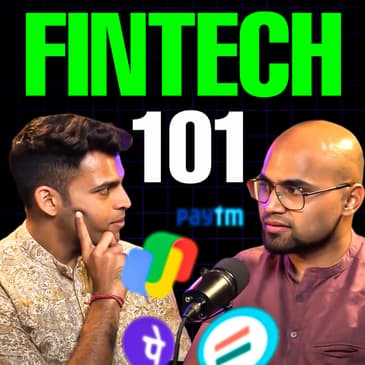

Manish is the Founder and CEO of Fello, a fintech startup that is gamifying investments and personal finances. Manish has over 7 years of experience in the fintech ecosystem and prior to founding Fello, he helped scale Koinex and Flobiz. In this conversation he talks about RBI's regulations and compliance, the MASSIVE Unsolved opportunities in fintech and gamifying finances.
Topic:
00:00 Introduction
02:29 Manish's take on Paytm Vs RBI saga
09:15 How RBI regulations are affecting fintech
22:02 Building a legally compliant Business
27:35 Massive Unsolved Opportunities in Fintech
35:29 What is Fello? Its ideation and execution
42:25 Achieving Product Market Fit
43:37 Gamifying your Finances
47:47 Customer Acquisition
53:47 Building Trust with Consumers
57:44 Studying Customer Behaviour
1:01:32 The YC experience
1:07:23 What's next for Fello
1:12:28 Becoming a Generalist
1:17:25 Books and Podcasts recommendation
-------------------------------------
Click here to get regular WhatsApp updates:
https://wa.me/message/ZUZQQGKCZTADL1
-------------------------------------
Connect with Us:
Linkedin: https://www.linkedin.com/company/startup-operator
Twitter: https://twitter.com/OperatorStartup
-------------------------------------
If you liked this episode, let us know by hitting the like button and share with your friends and family. Please also remember to subscribe to our channel and switch on the notifications to never miss an episode!
[00:00:00] I mean, I have a FinTech founder on the podcast, and so I can't resist asking, you know.
[00:00:06] I would love to know an insider's perspective on whatever is happening with this whole RBI
[00:00:11] and PDN saga.
[00:00:12] This is one of the things which I believe a lot is don't try to squeeze a product into
[00:00:16] the market, build a product what the market asks for.
[00:00:19] So that is where I see that when you work in a grey area, right?
[00:00:23] You have sleeplessness.
[00:00:24] Like tomorrow, like you have are critical to their business. And some of the levers he is sort of exercising on the branding and distribution front, his YC experience and other learnings from his journey. This like Paytm is the first company which they know about it. So they've achieved a big, bigger milestones. But what happened right now is one of the things which everyone needs to know is
[00:03:02] Paytm has two different entities. One is you have your one communications OCL and then you have the payment banks,
[00:03:07] Paytm payment banks.
[00:04:06] volume was significantly higher. The second one which caused biggest alarm was in terms of KYC verifications, erratic KYC verifications happening that was also found out as a part
[00:04:12] of this. And the third one which was the biggest red flag was one pan number can have only
[00:04:19] one account on PTM. There were fewB audience. Like there are days when we use PTM as our payment gateway services. There are a lot of, you have your voice machine boxes which you're seeing every day where
[00:05:44] Kirana store guys are using. and you've been warned multiple times, four, five, six times. And I would assume that you've hired some pretty senior people from the industry to run this. It's not like a bunch of kids who are handling all of this stuff. So I'm just wondering, how would it get to this? Is it a matter of scale? Is it a matter of just perhaps being lax on some things?
[00:07:03] I don't know.
[00:07:04] I would love to be a fly, PTM is one of those companies which has some of the best licenses possible as well. Due diligence is something which they have been doing concretely, but they have missed out on multiple occasions as well.
[00:08:20] So what this has been is a classic case of
[00:08:25] almost like one're talking pre, you know, early shares of pre pandemic and post pandemic. Like once the fintech wave just came in, you saw the wave kicking in much more like post pandemic and everyone had been adapting to financial services way more than before. Like the first wave of financial services started with, you know, demonetization in
[00:09:41] 2016.
[00:09:43] That is where digitization of banking started going big time. There was Slice and there was every fintech was trying to come with it. We had Uni on the podcast. Exactly, exactly. And again, someone who's a really experienced founder, right? I mean... Exactly. I guess that is the first time they saw that, okay, like, R.B. and Sebi are watching very, very closely. You're thinking that, you know, they're just not watching, but once they are seeing it,
[00:11:00] they're coming up with best practices, in fact, which is going to help us out in stopping
[00:11:06] from doing such sort of things. Hey, like be very, make sure that your entire team and even like tight from your customer success team member to as big as head of engineering, marketing, everyone are abiding few norms. So that is how I see this as a wake up call for everyone. Yeah. No, very well put. I, you know, I sympathize with the regulators as well.
[00:12:20] Right.
[00:12:21] I mean, because look, the whole demonetization wave was massive.
[00:12:24] Big time.
[00:12:25] I mean, I think they played catch up after least I have a ray of hope to follow. And that is where they're coming up with a healthy guy. And one of the things what I also realised is, see we're talking about a 1.3 billion populated country. And majority of the adapters of fintech ecosystem
[00:13:43] are the people who are not into the digital ecosystem.
[00:13:46] India is one of those countries where everywhere. They have PTM scams, they have phone-based scams and people are sharing fraudulent QR codes saying, no, we're payment card. People are just illiterate about how to consume these services. Now that is where Arbeya and Seviya has come up and said that, hey, like these are the best practices. Let's follow these. Let's not follow these. While these are happening, we also want to be vigilant. We want all the data coming up. So that is
[00:15:03] how I'm seeing that since 2018, there is a thought that, you know, uh, startups sort of take advantage of loopholes and stuff like that. But believe me, that's like building like a very profitable McDonald's on an active wall. Exactly. I see. I feel that startups are, you know, aspirational founders try to take the
[00:16:22] best out of the opportunity, which is lying over there, but eventually down went like minus 15 and I asked like what happened. It's a ring-fin situation. No bank is allowed to partner with us. And for the next seven months, we're just operating in a gray area. We don't know, should we continue with comics or should we do something else? Thankfully, like we took the very cautious call of coming into regulated business. We will flow bus later that and I know flow bus raised like $50 million doing amazingly well. So that is where I see that when you work in a gray
[00:17:44] area, right, you have sleepless nights likeyan Arbe comes, one best example, what I have is Sliceman. Like when the PPI, you know, ban was imposed, when I say ban, like you can't give credit on PPI, Slice by that point of time raised phenomenal capital. And one of the smartest thing, what I feel that it was, Dventon, you know, have got a primary stake in a bank.
[00:19:00] What a bank, right?
[00:19:02] That's phenomenal. sort of help itself is by being proactive on this front and working with the regulators and policymakers. I guess they both need to work hand in hand. For sure. See, penetration of new technology is growing at a massive pace. Previously, they used to say that generational gap is 30 years. Right now, it came to 10 years and this generational gap will squeeze down more.
[00:20:22] With every generation, penetration of new ideas and technologies equally going at a
[00:20:27] faster pace. I mean, it will take maybe a NASCOM equivalent in the FinTech world to sort of like do to, you know, FinTech, what NASCOM did for software services. I mean, yeah. I think the fundamental dichotomy I see, right, in operating in FinTech, right, in 2024,
[00:21:40] is this balance between growth, right how to also make sure to have a very sound check on compliance. What I did when I started fellow or ideated on fellow back in like 2021, 2022 was the first thing you have an idea, spend some money, get a legal or just
[00:23:02] jugaad market, just go to a legal person and get checked with the regulatory
[00:23:06] angle of it.
[00:24:05] got my consumer users very highly, but suddenly if a new regulation is coming up, like what happened with slice, etc.
[00:24:07] You also need to be ready to handle that in a very, very healthy way as well.
[00:24:11] So that is where what exactly we have as a strategy right now is grow at like a 15 to
[00:24:17] 25% month on month, very free or periodic.
[00:25:41] We also have these catch-ups with our banking partners, payment gateway partners.
[00:25:44] For example, we are right now ide which are going to come up as well. I would say also, right? I mean, platforms like Google, maybe I mean, let's say Azure, for example, et cetera, these are also great proxies for compliance. Exactly. Exactly. You meet, you know, Google compliance. And by extension you meet, you know, the other compliance norms required as well.
[00:27:04] Couldn't I agree with you more on this one?
[00:27:05] Like the level of information, what they're having overcoin finance is digital assets or crypto assets which are backed by real world assets and entire financial economy around it. That is the first one they are bullish about and second one what they're bullish about is the insurance ecosystem and removal of middlemen
[00:28:21] in the entire healthcare and insurance. This is Viacomnator. I mean, there's money to lose. Exactly. Exactly. So, yeah, I mean, yeah, sorry. I mean, I just thought that was an addition. You're absolutely spot on. When we were speaking with these people, firstly, they told that we know about US stock market, but we just know that S-LAS, your S-Books, they don't know others because it's a very
[00:29:40] different ecosystem demography when compared to India. because poaming significantly post pandemic is the entire insurance ecosystem. People became much more wary about insurance because when pandemic came up, people were not ready for such huge medical expenses. Like a lot of people just lost their savings. So that is where insurance was huge uptick. But again, that uptick is slightly flattening out, but it'll grow significantly.
[00:31:01] People have become much more wary about insurance.
[00:31:04] That is where I see micro insurance as a categoryaaS has grown very big time. Several, some of the best companies like Decent Row, payment, they recently acquired a payment aggregator license as well. So payment aggregator space is something which I'm super, super bullish about. But keeping these two things aside, I come from a solid trading background. So the only thing which I'm super bullish about
[00:32:21] in the coming days is the entire stock market ecosystem
[00:32:25] potential for disruption. If investors grow on board, it speaks volumes. So many first time investors. So many first time. We're talking about penetration into two to three cities. And mutual funds are being the first point of touch point for these people to get into and then they're getting into stocks as well. You believe on that. When we speak with our consumers, when you do consumer market interviews, people who
[00:33:44] are never invested, like let's talk about that category. Zerodas, Groves of India will have, of course, Angel Broking and all these up stocks. There'll be more players coming into this ecosystem and that is my personal interest or inclination or hypothesis that it will go. Yeah. No, I think they've been the shining light in the whole Frintech ecosystem.
[00:35:01] I mean, the Zerodas, the Groves, the. Yeah, but let's talk about fellow. Can you take us through the founding of fellow? How will you go from idea to product to company?
[00:36:20] Yes, absolutely.
[00:36:20] So after Kynix, I was part of, sorry, Flobus.
[00:36:26] After Flobus, I took a break. and if they love your idea, they also go ahead and put a pre-seed check in it. So the ad entrepreneur first, that is where started ideating speaking with consumers across different age groups and found out that people want to save and invest, but they don't have the motivation to save and invest.
[00:37:40] And only six to seven percent of the people with whom we're speaking were seasoned investors
[00:37:45] or savers, the rest of the friends and family. And third biggest point which we found out that these people were excited towards all those applications have a gaming element to it. And some
[00:39:03] side of some sort of gamification element. So that is a POC. I got a license, my tech team built a mini version of the application as soon as possible. And for two months, we ran a proof of concept of itUMs with bigger user base and start meeting some revenue targets what we have. So after that, we'll potentially go for a CDSA series. And after that, we want to be a self-sustaining business. That is what we want. So that's how the journey of our idea
[00:41:40] came to the level where we are.
[00:41:42] And during this journey, we were fortunate enough
[00:41:45] to have an amazing 26-member team. try to come up with potential solution. That's why we rule out a Robo advisory. And then we came up with something different. And this is what even the consumers were asking. So that's how the approach has been rather than trying to push something into the product. And I guess one of the best things what we did and we always do is if we are getting an answer as a no,
[00:43:01] we act on it as soon as possible also,
[00:43:03] because you just don't want to go blindly behind a no
[00:43:06] saying key, like this, the competition is intense. I never really cared so much about, you know, steps and whatnot. You see your Apple watch always like people just got lured into fission fitness, thanks to gamification. Exactly. I mean, I'm, I'm walking around like a madman and yeah, at 11, 11 p.m.
[00:44:23] Yeah, exactly.
[00:44:24] Night.
[00:44:24] Right.
[00:44:25] Oh, is it?
[00:44:25] Yeah.
[00:44:26] I guess we should all just say 11 to just run right? Exactly. You know, Jyothinamask to all the way to Gilead. Yes, yes, exactly. Yeah, yeah, yeah. There's something so visceral about that. That's, I mean, when we founded consumers were glued and when, this is a financial concept, by the way, like, you know, when we got the idea, we, when I told price links savings,
[00:45:43] so though I come from a finance background, I mean, I wasn't introduced to this concept who win the lottery as a reward. So people in anticipation of winning that lottery, they ended up saving for one month. And this bond runs even right now while we are speaking. They don't give out and the beauty of it is, it is tax free. Because this money is being saved, used by the government. So that is how we notice, okay, government is not there. Do you know that there are banks in the UAE called lottery millionaire banks?
[00:47:03] Wow.
[00:47:04] And what these banks do is, these are run by the Nationalized Bank.
[00:47:07] Like how we have SBIs over here. You could just talk about those different levers that would be useful for others somewhere in that journey. I'll talk about two perspectives. First thing I'll strictly tell from C. One of the things what we see is most of the companies which are building, they raise venture capital. And what exactly VCs got the first 10,000 consumers coming onto the platform. Nice. We were fortunate enough within this first 10,000 consumers, a couple of them were FinTech influencers. And they saw our customer success was very good. And we had a very sweet referral program. And they told that, hey, you are doing very good.
[00:49:42] The app is cool.
[00:49:43] I see that you're very new.
[00:49:44] You don't need to start.
[00:51:02] So flat out basically on that. other companies could cross sell. We are going, we already built a dashboard to onboard mutual fund advisors, mutual fund distributors, financial advisors, so they could cross sell our application to their end consumers. Through this, your cost of acquisition will completely come down and your revenue starts shooting up. So that is how we stage by stage, we are doing it. And if you want
[00:52:20] to play the VC game on, like if you want to raise capital, not for building a company and not
[00:52:25] bootstrapping it, these are some of the referrals, right? And, uh, you know, uh, refer on all of these, right? I mean, they're much abused terms. I mean, there are a lot of scammy apps.
[00:53:41] There's a lot of noise, right?
[00:53:43] How do you build that trust within these users?
[00:54:45] enter the fintech revolution and people are installing applications. And suddenly that person is asking to save with me.
[00:54:51] I will give you these many returns.
[00:54:54] Big no.
[00:54:56] You have seen some of the biggest scams in India.
[00:54:58] You're talking about the Sahara scams and you're seeing everywhere.
[00:55:01] In your street itself, we have heard of families selling so many scammy stories.
[00:55:05] Now Indian consumer behavior is very very different compared to others. faces or people who are behind the application faces much more, much more on the application or other channels. So that is where I started showing my face much more. I do my content and put it out on application wherever it is needed. All the product demo videos you see in the application, I am there, I'm speaking over that. I take customer interview calls and as soon as the consumer is coming onto the application
[00:56:22] also, our team gives a call to them.
[00:56:24] Through this, the human intervention, what they's face, boasting of your best backers plus being transparent, this is what FinTech Trust is all about, nothing else. Yeah, absolutely. You know, we had Rory Sutherland on the podcast, you know, Way Back When, right? And I mean, the man is obviously a genius.
[00:57:42] Yes, exactly.
[00:57:43] Right, he's got phenomenal insights on, you know,
[00:57:46] human behavior, consumer psychology within like one hours span. I called him up and asked like, who are you? What are you doing? And why this behavior pattern? It's I guess we are also doing the same thing. Like, you know, we just did not acknowledge it. He told that, hey, first you told that you're a new application in the market. I don't know who you guys are. So my friend told so I put 500 for me.
[00:59:03] Withdrawal is a trust factor.
[00:59:04] Is the money actually coming to my bank account or not?
[00:59:07] Along with the reward, what you're saying. was touch point with a financial institution, right? In India, I would say, right. Were these nationalized banks. Exactly. Right. And I mean, I'm still old enough that I I've been there. Yeah. I've actually queued to go and meet up to a dollar and so on and so forth. There's a lot of like, you know, uh, Sarkari-ness to it. Right. Uh, I mean, we
[01:00:22] all know the, exactly. So close for lunch you get your 4,000 users or so, right? I mean, it's massive right now, right? Perhaps the largest incubation in the world. Of course, the largest one, why are you speaking? So how has that YC experience been for you? Yes. What was the two or three most valuable things you learned from that as a founder? Get it.
[01:01:40] I'll speak on YC for sure, but also I want to touch base
[01:01:44] about EF as well, where we have grown much more, I feel,
[01:01:47] as well. is something which is very, very instrumental for you. You need to start focusing on your D30, D40, D90. Retention is, for example, if a person is investing on day one today, by end of the third month, how many people are still investing and sticking onto the platform? And they gave us some, like on your induction day itself, they tell that, they ground you down saying, okay, why is he happened?
[01:03:00] We know that you're some of the best companies,
[01:03:02] but right now let's make you bigger.
[01:03:04] And they tell that start focusing on retention.
[01:03:06] Start, one of the things what they believe in is
[01:03:08] make what people want. access to an ecosystem where in the long run right now, even if you have any biggest problem, you have a lot of YC community founders where you could just drop a message and they help you out. I personally feel that more than what YC gave us during those three, four months, what it is giving us right now, that value addition is absolutely phenomenal.
[01:04:21] Like you're just talking about like,
[01:04:24] like we have our demo day happening
[01:04:26] and that is a point of time.
[01:04:27] Like you don't okay, you're learning how to build this thing, right? There are three kind of companies slash founders who come to YC. First one is absolutely early stage. Like they haven't built a company in the past. The two founders, amazing, phenomenal folks, energetic potential of building a company.
[01:05:41] That is one kind of...
[01:05:42] It's like a napkin plan, basically.
[01:05:44] Exactly. The second one is people who are much more seasoned, but they're building for the first time. back then and we Aaron who was another B2C pro he was one of our mentors as well so the assigns that sort of mentor you have catch-ups every week they also bring in a lot of other founders for example Airbnb founders were giving us inductions and raise-up founders were talking with us telling what it goes from 0 to 1 0 to N it is structured for a reason because majority of the people
[01:07:04] are coming our first time say sorry severs I'm saying filoca lingo yusovil eating every random shit possible just for survival and running the business. No sleep, no nothing. Just numbers, numbers, numbers. Big calls till 3am. Exactly and you feel that, oh you're like ruling the world. But after a point of time you crash, you feel that, oh this is not what happens. That is where I started getting into healthy lifestyle and I realized, this is something which I need to maintain very good.
[01:08:21] And this need to come over here while this is happening.
[01:08:25] You need to make sure that, one of the things which you need to accept as a founder very good relationships with your team. So right now my time completely goes into deeper relationship building with my team members. Secondly, setting up healthy practices right now so that after a point of time when there's an unknown wall which comes up though you're not separated from the team, but again, your day-to-day interaction with the granular team members reduces down
[01:09:40] how to have those communications prompted.
[01:09:42] That is what it's happening on a personal level.
[01:09:44] But on professional level,
[01:09:45] what we're working on fellow right now is,
[01:09:47] fellow is going well, things are scaling up good. Don't over-hire, to be honest. The reason why I say don't over-hire is first. Why to have a leakage of capital? Try to test the optimum of your team members by having one or two buffers. That's what I believe in. I feel that, best example for me is Stripe. Stripe just had 50 team members and they had millions of dollars ARRs coming up back then.
[01:11:04] And right now Stripe is one of the biggest payment-gated companies.
[01:11:06] They were able to do it just to 50 team members. a while. Yes. Yeah. He can manage, you know, some other thing, outbound, for example, I guess, or someone who has just been working on a particular geography can pick up something else. Absolutely. Right. And go deep as well. I mean, it's just phenomenal. It's, uh, and the conventional thinking sometimes is to say that, and especially when you have money
[01:12:20] and when you're kind of in that scaling mode is to be like, Hey, let me just get this guy
[01:12:24] is doing what he's doing. Let him do that. Right. I mean, I remember our operations guy, writing some fancy macros. Is it right? I remember our, our VP of engineering, right.
[01:13:42] Fronting a new business initiative.
[01:13:44] Everyone, it seemed like, you know, they had a couple of hands.
[01:13:47] So like, I mean, they are trying to build a new product. They only had majorly engineers. They don't have PM till their first 50 product managers. What they used to do is a feature has been we've dissed PMs like horribly on the podcast before. Okay. So this is nothing new. I'll
[01:15:00] tell you what they used to do. They used to come and say changed, ecosystem has changed, but I guess unknowingly, I'm trying to stick back to the root basics. Yeah, I think that core ethos has to sustain. I mean, I think startup building is that. Exactly. I would say. So there's plenty of great things that have happened. I feel like 10 or 15 years back, we didn't have a precedence.
[01:16:20] We didn't have those frameworks, principles, and so on and so forth.
[01:16:24] That obviously we can leverage now.
[01:16:25] I mean, you don't have to stumble and or podcasts, other podcasts that you would sort of recommend? Oh, okay. So I'll tell you like, it goes without saying that the startup operator is recommended. So I'm a very different person in personal life. There was a point of time was completely into productivity. Let me have these productivity books, podcasts, everything right now. Very
[01:17:44] fine. I told you, right? Like what am two weeks ago, which was Iki Gai by Hector Garcia. The reason is again, as I told you, I'm trying to get into a healthy lifestyle. It is helping me right now. Period. If whoever is listening to it, sleep for eight hours. It's magic. It is absolute magic for sleeping eight hours. My productivity
[01:19:00] actually went up. I'm not kidding about it. And previously I was like four hours, let
[01:19:04] me just sleep from like four to eight, wake up eight, you know what? Is this a guy who gave a speech at the University of Texas? I've seen that. And something he said stuck with me ever, right? Like even now, as you said that, which is that no matter how shitty your day has been, when you come back to bed, at least it's made. Exactly. That's the same thing.
[01:20:20] And the first thing you wake up and you do this, you've completed one task.
[01:20:23] Even before you move out of your room, you've completed one task.
[01:20:26] You've completed the rest of the narrative.
[01:20:27] That is the other thing I'm going to check it out. One final thing which I highly recommend to everyone is...
[01:21:42] think smarter, think smart and talk faster.
[01:21:47] Think slowly. podcast keep scaling next time if you ask such amazing folks coming or just knock me up and say I even I'll any of the names what I told you is coming up yeah this message may I'll be there outside trying to meet them as a good see you man thanks have a good day yeah yes yeah all the best see you soon as well yeah all right folks uh why did I say see you soon actually can we cut it yeah okay