
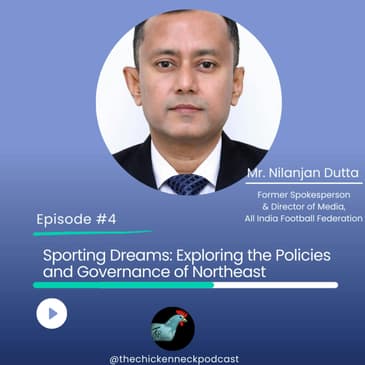
Welcome to fourth episode of The Chicken-Neck Podcast, where we take a closer look at the role of media in the world of sports. In this episode, we sit down with Mr. Nilanjan Dutta, who has had a long and illustrious career as the Director of Media and spokesperson for the All India Football Federation.
We begin our conversation by discussing the crucial role that media plays in sports, and how it has evolved over the years. Mr. Dutta shares his insights on the challenges that media professionals face in reporting on sports events, and how the rise of social media has changed the game. We then delve into the disturbing issue of online abuse against players, and how it affects their mental health and well-being. Mr. Dutta shares his thoughts on the steps that need to be taken to combat this growing problem, including the role of sports organizations and the media in speaking out against such behavior.
Our conversation then shifts to the key policy questions relating to sports in Northeast India. Mr. Dutta, who has worked closely with sports organizations in the region, sheds light on the challenges that need to be overcome to promote sports in this area, including infrastructure development and talent identification.
Throughout the episode, Mr. Dutta provides valuable insights and perspectives on a range of issues affecting the world of sports, drawing on his extensive experience and deep knowledge of the industry. So tune in to this insightful episode of TCN, and gain a better understanding of the vital role that media and policy play in shaping the world of sports.
Disclaimer: The views and opinions expressed in the podcast are those of the individual podcasters. Listener Discretion is advised.
Follow us on Twitter, Facebook, Instagram, and LinkedIn. You can listen to our show on all streaming platforms by clicking on the link:- https://bingepods.com/podcast/the-chicken-neck-podcast
Learn more about your ad choices. Visit megaphone.fm/adchoices
[00:00:00] Welcome to the Chicken League Podcast. Supported by the Idea Juice Network, we are a bunch of
[00:00:04] curious individuals based out of the Northeast, and we strive to bring you the best of policy
[00:00:09] discussions through the intersection of things that affect your and our daily lives. If you like
[00:00:14] what we do, show your support by sharing our work. Don't forget to leave your comments on this episode
[00:00:20] in our social media handles. We have a very special even my cousin sisters, my mom, maternal aunties, when my maternal uncles came in, everyone spoke about one of them Shamtaba bicycle goal bicycle volley and back volley and the entire neighborhood was dancing pure organic joy. I found that oh my goodness a leather ball can give so much of joy to an entire neighborhood or a community. That was one I fell in love then
[00:03:00] and then and then 1983 happened. 1983 I was I was born into a family of professors, so people felt the legacy needed to be carried on. So whenever people came to knew that I had an ambition
[00:04:20] or was pursuing journalism and becoming a journalist,
[00:04:24] not I won't, which were there, one which existed.
[00:05:40] It still exists.
[00:05:41] But whether it's significant anymore
[00:05:43] is the biggest debate which we all
[00:05:45] need to acknowledge in mind so that it's a very smooth process from their end. Well very rightly as you point out earlier when journalism was there, it still is there in the early late 90s when I joined the situation was different, the copy subscribers are more. For many other organizations, it's almost late as 12.30 in the night, past midnight even, the deadline which can go to print. Will or can the society today wait for that long for the needs to be coming out? Absolutely not. So with the advent of social media,
[00:08:20] everyone is a journalist out there.
[00:08:22] And people may debate whether it's right or it's wrong.
[00:08:26] But the reality stays that much more business to you. If you look at the IPL, the ad revenue being generated from the digital side is much more from what is being generated from the television side. Now over the years the survey has said that sports is no more about the life coverage which we have all over badminton. We have the best in the world. We are moving on as a sporting nation. The unthinkable has happened with Neeraj Chopra winning the winning the winning the Olympic gold in athletics and Thomas Scott victory has come in. So you need to get closer to all of them.
[00:11:01] Now you raise a very valid point out there.
[00:11:05] What strategies does one apply? It's extremely vast, it's the entire population of the country. So in that case, go ahead. But again, the private space is being invaded at certain times. And what is alarming is that many a time the social media influence and many a time the
[00:12:21] social media exposure is kind of hampering or it's not well crafted or not well thought out. On that note I think something
[00:13:42] that has been very intriguing for me personally as well because is the online lot many instances. You know the abuses will be coming in because the expectations are high. The education level, sporting education level of the average fan in our country isn't that much compared to the western part of the world. So that will always be there. So whenever India plays on for example if we are drawn with Japan in what do you say in the Asian Cup,
[00:16:06] the head coach would be a sports psychologist full-time. He or she needs to be speaking to and dealing with the people, people in the sense not just the coach and the players but even the staff,
[00:16:12] the backroom staff and even the employees who are there because there's a high level of education
[00:16:18] which needs to be imparted amongst all. When from my experience what we did was
[00:17:23] If this is the picture, what will be your caption? Are you posting something on this or you're not posting something on this?
[00:17:26] There have been many a player who have been kind of approaching me, still approaches me,
[00:17:30] despite me not being part of way.
[00:17:31] I have a Sariska captioned although how do I do with it?
[00:17:35] Obviously that's being done at a personal level.
[00:17:38] But there's only a section of the players from the Academy and the national teams who
[00:17:42] do approach me.
[00:17:43] I'm not saying that I am the best, but's a human psyche to be looking into the glorification aspects. Everyone feels happy. If I say you have done a brilliant job, you'd be happy. If you say vice versa, I'd be happy.
[00:19:01] So when the fans randomly are kind of putting up on journey of how, you know, what happens actually behind the scenes and imagine now, you know, what goes on through
[00:20:22] the mind of a player because, you know, one thing that I wanted to ask you is in terms of like the curriculum that you created. So in terms of that, how can this be implemented across sports in the sense that we have, now the academy culture is growing in India
[00:21:42] with the lead system coming in, more and more clubs
[00:21:45] or franchisees are opening up with, you know, or an Insta account, the parents encouraged them to have accounts of their own and then later on complain it's gone out of hand, they are not being able to handle it. So at a time when we were kids, moral science was being taught. People hated it, but it was taught and whatever is taught, something gets into the mind. I'm not saying 100% will get into the mind. It should be in the
[00:23:01] curriculum of each and every school across all or herself but not good on social media. It's infectious. And that boy or the girl would be speaking to others and then what happens is the wrong notions and the wrong strategies just come in and is being put up there.
[00:24:22] So this this needs to be dealt right from the school level and if you look at if you So can't end of story. Is that what the content should be? If you asked me, life is all about perspectives, I would say no. The guy or the girl who has done that content may say, OK, we are catering to the entire country, and it sells. Now, are you doing sellable content, or are you doing good content?
[00:25:40] You need to judge.
[00:25:40] It's what I or you as an organization want to give out,
[00:25:45] because the brand value of an organization You pointed out these things in such detail because no one really has, I think these discussions are the need of the hour because as you pointed out, sports is no longer about, if you look
[00:27:03] at football or if you look at any other sports, it all started from the North-East.
[00:28:21] The first captain of independent India was Tiau who's from Nagaland. Now you know what the in the early 2000 when a certain Mr. Bimal Ghosh coach, my famous football coach, Bimal Dha used to come and camp in northeast for around three months, have open trials, filter the best talent, take them out for Air India and other clubs in Mumbai both of them captain India and certain matches are the two ones whom I look up to to entirely galvanize the youth from the region and youth in the sense not just the boys more the girls and scout people put up a scouting network and
[00:31:00] take them outside outside in the sense to the honorable CM of and that's government support also coming in from Mizoram CM. The honorable CM of Manipur the other day. What do you say Mr. Biddin Singh and state associations need to have the government support and it's up to the state associations to get that government support. You cannot expect the government to be coming up to the state associations. country and I have huge excellent friends made all over the years from the northeastern part. It's not just about football. If you look at Manipur, even if you look at Assam, Yuma from Guwahati, I guess we have Olympic champions from this from this region. It's not just football.
[00:35:01] If you look at Manipur, the most sporting state was in its full flow, Ranjanda, Ranjan Chaudhuri, who has been the face of Tata Football Academy coaching for so many years, used to come personally to the Northeastern belt in the pockets and scout for talent out there.
[00:36:20] That scouting unfortunately has stopped. representing the certain age, all the age group teams and even the national teams. Is that enough? It's time for the state associations. It's not, I'm not saying in any political or what do you say statement at all. It's high time the state associations, especially that from the Northeast, I'm not saying that they are not doing it, to revitalize the scouting structure of the country,
[00:37:42] of their entire region or states.
[00:37:44] If that can be done and it's done,
[00:37:47] and there's huge government support that comes in the national team or the teams come out to play at that? How many how much of usage will be there at the domestic level of that stadium? In comparison, if he puts out some 200, 230, 250, 300 turfs all over the state, put in a scouting network, Manipur as a state can beat the entire
[00:39:03] national team hands down maybe each and every time they again we need to look back at the discussion which we had. Definitely, in the sense that I think when you pointed about the population proportion, there was very interesting things that came to mind. I instantly thought about Belgium
[00:40:21] as a country because I remember reading that Belgium actually got inspired from its, you know, now no longer is, you know, if a child tomorrow says that I want to be a footballer, it will not be as frowned upon as it was maybe a few years back because of the fact that, as you said, the commercial viability of sports has definitely increased. And with sporting success, people are also understanding how important sports has become
[00:41:42] as part of our lives.
[00:41:44] So in that sense, I think definitely several approaches need to be the hub and pipeline of football. But nowadays, even cricket is kind of getting into the Northeast region. Now, each and other sport is there as an attraction for the youth. So unless the platform is provided for the boys and girls to play,
[00:43:01] the entire situation and the moving out to other sports. You look the biggest rival of football. Take it from me today. In terms of team sports is not cricket.
[00:44:22] It's cupboard.
[00:44:23] Cupboard is vastly and very sports than Indian football, there's a mark difference. So unless that's done at the district and the state level, we'd only get poorer. You've beautifully elaborated how there needs to be an approach to make sure that from the grassroots level, we can create new talent coming in.
[00:45:43] Continuing with governance issues related to sports since, you'd say communication obviously because when you speak with your dad or family members, your wife or girlfriend or kid or friends, everything is communication.
[00:47:00] Maybe the media isn't there but that's communication.
[00:47:03] That communication as far as medical science is concerned, sports medicine is concerned even in leagues in an i-league where the media officer was kind of put in after pressure after first two rounds of matches that were completed. So similar is the situation for the medical staff of the clubs. And you know what? A player X, for example, Nelanjan is a player. I am just taking my name rather than taking any other name. I play at a certain club.
[00:48:22] Okay. I play at a certain club. Football is anything and treating the lunging all of its own.
[00:49:40] Now, there are certain parameters which most of the medical staff are not aware.
[00:49:45] Maybe you give a paracetamol or a cough syrup to a player, ban. That's been my concern. I have been speaking about it. It's been trying to get regularized, but due to non-availability and ions incompetence, lack of competent people in the domestic setup, the percolation of knowledge and information rather of what has
[00:51:00] been done to the luncheon's body is not passed on to the National Team Department. That's One of the key reasons on a very personal level, I have been very inculcated towards researching on doping and that is why it is very intriguing for me personally, how the lack of awareness has created this monster of unintentional doping in India as you pointed out. So on that note, since we have talked so much about sports authorities and sports governance
[00:52:23] and how because of the fact that India those teachers, physical education teachers who are there, are taught the basics of, if not all sports, certain sports. And I guess the government support needs to be there, along with some private support
[00:53:40] because most schools are private schools right now. there. Organize small sided matches, get the school in tandem or get the school in line with you and then try to get into the minds target the parents of those elite school students whom you feel can be helping your die for the cheer. So that's where the private sector, I would say, can get in. And there's a huge market to sell their commodities out there, rather than getting into a partnership at a high level, 16, 19.
[00:56:21] That's where I would have done it, but life is all about perspectives. you on board for other episodes because as I pointed out every answer or every discussion that we had just now could be translated into a separate episode because of the nuances of sports in India and how sports in India is growing. Thank you so much sir it was a pleasure hosting you I hope you enjoyed being on the podcast as well. The pleasure is entirely mine
[00:57:40] and looking forward to always ready to help. If you enjoyed listening to this episode of the