
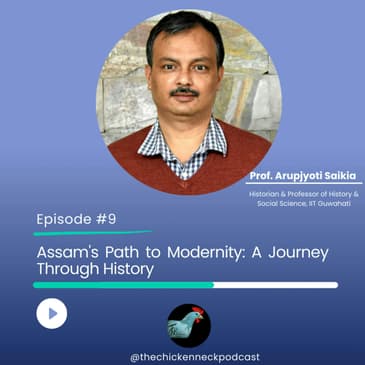
In the final episode of Season 3 of our podcast, we are joined by Dr. Arupjytoi Saikia, a professor of history at the Indian Institute of Technology, Guwahati.
Prof. Saikia is the author of - Forests and Ecological History of Assam, 1826-2000 (OUP, 2011), A Century of Protests: Peasant Politics in Assam since 1900 (Rutledge, 2014), and The Unquiet River: A Biography of the Brahmaputra (OUP, 2019). His A Century of Protests won the Srikant Dutt Book Prize awarded by the Nehru Memorial Museum and Library, New Delhi in 2015. The Unquiet River was short-listed for the Kamala Devi Chattopadhyay Book Award in 2020 and long-listed for the Atta Galatta-Bangalore Literature Festival Book Prize in 2020 and got ‘Honorable Mention’ for Ananda Kentish Coomaraswamy Book Prize in 2021 given by the Association of Asian Studies.
In this episode, we embark on a captivating journey through Assam's rich political history, unveiling its pivotal role in shaping the modern Indian subcontinent. We delve into the historical tapestry that has intricately woven Assam's identity, examining the profound impact of the struggle for independence and India's partition on its trajectory.
Our discussion is centered around the compelling insights from the latest book, "The Quest for Modern Assam: A History," which meticulously explores the interconnected realms of politics, environment, economy, and culture, shaping Assam since the 1940s. This authoritative account not only redefines the writing of regional political history but also offers an unmissable opportunity for those intrigued by Assam, India, Asia, or global history in the twentieth century.
Join us as we unravel the intricate layers of Assam's past, tracing back to ancient dynasties that once governed the land and examining the pivotal moments that led to its integration into the Indian Union. From the majestic reign of the Ahom Kingdom to the complexities of the British colonial era, and from the fervent fight for independence to the challenges posed by partition, we untangle the threads that compose Assam's exceptional political narrative.
This exploration offers an insight into the legacies, obstacles, and triumphs that have molded Assam's modern identity, providing a deeper comprehension of the region's significance within the broader context of India's history. This episode guarantees an enlightening journey through Assam's timeline, unveiling the defining factors that have sculpted its political landscape and contributed to its place in the nation's overarching narrative.
Find information about his latest book at: - https://www.penguin.co.in/book/the-quest-for-modern-assam-a-history/
Find the book at amazon: - https://www.amazon.in/Quest-Modern-Assam-Arupjyoti-Saikia/dp
Disclaimer: The views and opinions expressed in the podcast are those of the individual podcasters. Listener Discretion is advised.
Follow us on Twitter, Facebook, Instagram, and LinkedIn. You can listen to our show on all streaming platforms by clicking on the link:- https://bingepods.com/podcast/the-chicken-neck-podcast
Learn more about your ad choices. Visit megaphone.fm/adchoices
[00:00:00] Hello and welcome to the Chicken Nick Podcast.
[00:00:02] Supported by the Idea of Dreams Network, we are a bunch of curious individuals based out
[00:00:07] of the North East.
[00:00:08] And we strive to bring you the best of policy discussions through the intersection with
[00:00:12] things that affect your and our daily lives.
[00:00:15] If you like what we do, show your support by sharing our work.
[00:00:18] Don't forget to leave your comments on this episode in our social media handbooks.
[00:00:22] Hello and welcome to another episode. Thank you so much, Animesh and Subhan for inviting me to this broadcast. So, you know when we read your book about it kind of opened up a lot of those even for somebody who usually larger environmental situation where Assam is located. And it becomes easier for us to understand the 20th century development of Assam, right? If we keep saved our life, we saved the destiny of this region. We also saved the career of Indian Republic in the postcolonial time. As you rightly pointed out, it, they encounter the experience, political, cultural, tribulants, but those are a momentary, they come and go,
[00:05:40] but these are not, they come rarely, right? or the other very important development, for example, India in late 1940s, immediately after in the partition and independence. It experienced the questions of the amalgamation of India's princely state with the Republic of India, and it was really complex and very difficult process.
[00:08:10] Then obviously the great story of human mobility across nations, across borders, right? And these are really big in scale, right?
[00:08:14] This also needs to be discussed.
[00:08:18] Then many such experiments of making and unmaking right? How, as certain reasons become extremely poor, primarily as an opposite of the long history of imperialism,
[00:09:40] right?
[00:09:43] The making and unmaking of the great tea plantation
[00:09:47] story, for example. right and also obviously human being right. I think this is how I would like to see, I would not like to prioritize any big, any special moment, but I would say it's geo-strategic positions which are really critical in the making of this reason's history. You know, that's a very interesting point to lay out when you talk about the region's
[00:11:04] history because in the migration of people must have
[00:12:23] played the role.
[00:12:24] But how has the economics of essentially the Japanese occupation of Bama, which essentially send out quite a large dream of Pakistan and Assam's possible connections, Assam's possible link or Assam's possible place in the future Pakistan, right? This created a numerous amount of anxiety
[00:16:05] many permutation and combinations right during this sort time period.
[00:16:12] But more importantly around this time, 42, 43, 44, this was the time when the British ambition to separate the hill districts of Assam and the Mars dam
[00:16:19] with the western districts of Burma and create a separate homeland for the tribal populations. walk, mid-to-enjoy. It essentially tells how this squid in their moment and the second world were right. They were stepping much. Coming back to your second questions, the history of poverty. I think let us separate that questions. Let us see your one of,
[00:19:02] you pointed it out, one important aspect, the your resource, your transport mechanisms, right, the use, financial and the transport systems that were built since the 19th and the early 20th century to integrate these reasons with a larger Indian economy and global economy.
[00:20:25] It has really got disturbed at this moment. to reconnect quickly through building of roots, reluaries, and other systems. So, I think those are really important. But coming back to the last questions, the questions of poverty, right, the making of the poverty of these reasons, it needs to be seen from different angles.
[00:21:43] Think of the 19th century history of improvisations of these reasons. And also the major mediator between Calcutta and Assam's deep plantations. So, that is also benefited. A section of Assam's local populations, they began to participate in the larger, the employment
[00:23:01] sector became supplier of goods.
[00:23:04] So, those were peripheral benefit, but You know, most of the big industries that Assam began to enjoy in the second half of the 20th century. It was essentially centered around one resource. It is the oil industry. But you know, Assam's participation in the oil industry was essentially an attempt to let me reframe my answer or my conversation. This making of public sector industries, in Assam in the second half of the 20th century these Zoot industries. A section of the populations, they are definitely benefited by producing Zoot. But with the partition, the Zoot could not take off, right?
[00:27:00] And by 1970s and 80s, after a brief period of booming productions and profit of the part of a local bourgeoisie, right, all collectively. So essentially what I understand from what you have so far talked about this improvisation of a Sam is also the creation of the importance of creation of a wealthy class of individuals
[00:28:22] both in southern India and in other parts of India who not only led with initiatives of this entire state. Like you said, you talked a bit about the transportation of this region, which necessarily because of the geographical location and how it is situated, it's very difficult to create roads and, you know, railways in this region, some of the places which therefore do not have railway event today.
[00:29:41] So from that region, how important faced, or post-1947, it faced two major challenges. They are always bring to it thousands and thousands of vehicles, right? Boats and the ships, right? The speed, the vibrancy, they are really important for those rivers.
[00:32:22] But Brahma put it because of the water, because of the sediment,
[00:33:22] and also the 1950 art grade, right? The 50s art grade, it produced many environmental impacts.
[00:33:28] And one of them was the sudden,
[00:33:31] the brown patrol suddenly became a recipient
[00:33:34] of billion tons of the sediment, right?
[00:33:37] All of a sudden, we did a very close sort period,
[00:33:42] within a few weeks.
[00:33:44] And it also disturbed and. So the Prabhuput Trust is new history in post-1947 and 1950. It was a truly traumatic story.
[00:35:02] And I don't think we have been able to overcome that crisis. of the system and the economic aspirations and the political crisis of Osama in the 1940s and the 50s. None could address each other's worries and challenges. It was much beyond our capacity and
[00:36:22] imagination.
[00:37:22] around the same time in the rest of the world. So is this also, I mean, if I think out loud,
[00:37:26] is this also one of the reasons
[00:37:27] because Brahmaputra being such an enormous river
[00:37:29] like you just mentioned,
[00:37:30] and it's connection to this entire South Asian
[00:37:33] or Southeast Asian region,
[00:37:35] which essentially is the gateway to the rest of the world
[00:37:39] as well.
[00:37:40] So is there also another,
[00:37:41] not just from a some perspective,
[00:37:43] but from a trade perspective and losing out
[00:37:46] on this entire industrialization reports, Because it was without both you cannot survive, right? It is your essential essentially to struggle in this region. But these boats obviously, they were primarily for very small scale economy.
[00:39:00] These were not for carrying million the road transport, right. It essentially got displaced, right.
[00:40:21] Both is no more an essential element the mustard seed anymore, right? Mustard seeds, they were essentially produced in those river islands, the shores, right? Opium was also produced in the river islands in the early 19th century. So, because there were products, there were commodities, which needed to be marketed, traded.
[00:41:43] The boats became the mediator, right? North as a medium of economic exchanges. So I think the both, it had a great possibility of creating an economic foundations for these reasons in the 19th century. It did contribute significantly.
[00:43:02] But as we entered into the 19th century economies, the 20th century economies are essentially centered around this finished flagship industries. But these flagship industries were hardly anything to do with this the river economy. It had no connections.
[00:44:22] Fighting, this is how we need to see the story of air traffic and everything has greatly been connected better through the rest of the world, but because of that entire history of the city and part each other. But it is also a very modern story, right? The whole idea of stick and neck, it is truly a post-1947 story. It is so well connected, right?
[00:45:42] Through the Bay of Bengal, in that particular aspect of tea plantation in a sand? Essentially, the river acted as a conduit between Calcutta, which was one of the closest metropolitan from where the global capital can operate, facilitated making of modern tea. And I think we have to really admit and acknowledge the rule of
[00:49:44] the problem. that did not necessarily want to be part of, you know, the not just in Assam in the Greater North East Asian, there was a very, there was a confused state of mind as to where would they end up being in at the end of it, because of the first groupings that British government had formed. So, tell us a bit about how Assam's future, Assam as in the then bigger idea of Assam, how it was imagined in the floor
[00:51:05] of India's constitution, essentially, this region also, they participated in the making of the constituent assembly. First few months were obviously quite dramatic because of the uncertainties,
[00:52:20] whether a sum will participate in the process of
[00:52:24] constitution making process, right, how it will consume the idea of Assam, right, like the other provinces of India. But it was the most important thing that was discussed in the floor of constituent assembly, it was Assam's future finance,
[00:54:43] Gopinad Burdolan, who was Assam's premier at the time, and Momo Chadula, who belonged to Muslim League,
[00:54:47] but who later on became a key member
[00:54:51] in the drafting committee of the India's constitutions.
[00:54:55] Both played a critical role in emphasizing and highlighting
[00:55:01] that Assam definitely deserve a larger share
[00:56:07] needs to be seen, or needs to be discussed from the financial angle. That was, I think, an important aspect that some three
[00:56:11] representatives, they have very famous, eloquently and in a
[00:56:18] logical way they have been spelled out.
[00:56:21] But the other most important role that these reasons contributed Right? And you know, most of those districts were only partially governed or they were largely outside the frame of governance of British India. How the people, the residents of those areas would become the part of New Republic of India, right? They had their many ambitions, many dreams,
[00:58:44] of these regions into the idea of India. Obviously, 50s, 60s produced another kind
[00:58:51] of political history, many of whom
[00:58:54] were not happy with these arrangements.
[00:58:58] The classic examples were the Nargas.
[00:59:00] The Nargas are extremely contested political histories or their place in the Republic of India, that itself produced a political surname. People from Cassie Hills would come and submit a draft, say this is what is our dream constitution. People along the foothills of say modern urnational protests and assumptions, right? They would come
[01:00:20] and speak to Bordeaux. This is what we would like to see our future in the future constituent Balabai Patel and Nehru, they were extremely sensitive to the complexities of these reasons. Right. And I'm sure readers who read this book, they will get a sense of the challenges that India's constitution has simply faced came to this reason. This never happened to you in other parts of India, right? It is an extraordinary story. We must get a sense of that. I think that's a very interesting feature of this particular region as well an innate fear that they were contributing more and getting less or was there a fear that they would not be given enough, you know, fear, sorry, enough fines to that effect? You know, in 1920s, 1930s, right, as the larger financial arrangements of the Imperial India, that Assam is essentially getting a very small share from its two major commodity, oil and the children.
[01:05:40] That began to happen continuously in the early 1940s, in 44 and later also that was a major They wanted to make sure that they don't lose out. They already knew it very well, that culturally or socially, it might be a very vibrant reason. There is no doubt about that. But in terms of the economic benefit,
[01:07:00] it is essentially a small player.
[01:07:03] This was also very known to them.
[01:08:06] it began to impose an income tax on the tea plantations because planters were free from paying any kind of taxes. So, they also knew it very well that if we cannot really bring
[01:08:13] the steep plantations within the fold of taxation, this the soils of a place for a refinery in Ass talked about of oil refinery. I guess the establishment of IIT in Guwahati was a result of a huge protest that, you know, in a situation should be there in the state anyways, but I wanted to know a few specific things from you in regards to that.
[01:11:00] Now you talked about how different claims that have been were coming in from different parts of that was in the province of Assam and the South Lushah Hills that was within the Bengal presidency. And I believe in 1898 the region was united as the Lushah Hills District of Assam and the district was declared and excluded area in 1935 whereby the provincial legislature was stripped of this jurisdiction over the area. So and the responsibility of the district administration was given to the
[01:13:26] to the Brahmaputra Valley, right, and the Kachar, right. The making and making of Assam's geography in the 1910 to the 20th century, it was an extraordinary process, right.
[01:13:36] You merge them, then you demurse them, right. And it continued to happen. We should also include But this territory is obviously it underwent in a very short period of time, quick political, economic and also environmental transformations, which really came as a measure
[01:15:01] salins to the very idea of Assam, right? For the 1950s, 52, 53, we will see a cruminous debates taking place in the Luxova, say between Nehru and one of Assam's most charismatic
[01:16:20] political leader of the time, Hamborua,
[01:16:23] about the Nef with China, right? The heroes government obviously did not allow that process to every 50 years, about which a lot of good work has been written. The inability of the Indian government, the government of India led by Nihiro and also
[01:20:05] then that of the Bengal famine, right. It was the responsibility obviously goes to wide range of institutions, right.
[01:20:13] It was the bureaucracy, it was the political structures of the time and also the geography
[01:20:21] itself, right? And largely these were the troubles or the legacies left behind by the imperial power.
[01:22:51] the 1980s, Assam's residence of the 1970s, 60s and 70s, they obviously, they were part of, they were the children of this crisis, right.
[01:22:56] But essentially I feel the rise of this many different layers of complexities. But also, just adding on to when you're talking about the history and such a complicated region, it becomes very, I think as a writer you would obviously know better that there
[01:25:41] might be moments where you might write something and feel okay I might sound a little biased
[01:25:45] on it. a fresh look, right? You know, must amount of salinges that it had. It is an great, I would say it's a great violence that the colonialism had left behind as it's departed in 1947 and also history of decolonizations.