
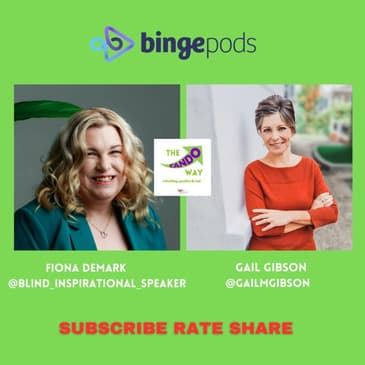

In this episode of The Can Do Way, I am talking to Resilience Coach and Speaker, Fiona Demark.
Fiona helps people who are stuck and frustrated with their lives to create a new reality.
Born in outback Australia, and legally blind since, birth Fiona loves to share her story of resilience, positivity, and life achievements to inspire and motivate others.
She is an adventure seeking, obstacle bounding, no regrets kind of girl that lives life to the extreme, having spent the past 30 + years using her talents in human communication, care, and kindness to help others.
Fiona’s Can Do story proves that all of us can learn the skill of reframing, to be resilient, strong, and grateful for what life presents us.
Listen for Fiona’s Can Do tips:
- Every day is a new opportunity
- Taking responsibility for you own stuff.
- Be grateful for the things that are happening right now.
Connect with Fiona https://fionademark.com.au/
Learn more about your ad choices. Visit megaphone.fm/adchoices
[00:00:01] Hi, dear Bro Studios. I'm Gail Gibson, accredited Master Performance Coach, International Speaker, Podcast Host and Author. Known as The Can Do Coach, I thrive on enabling leaders to step up, shake it off and shine. Welcome to my podcast, The Can Do Way.
[00:00:27] My guests from across the globe have Can Do stories of growth, resilience and success to share. Tune in and be inspired by these individuals who have developed a strong Can Do approach. Each one of their stories is unique. Each one of their stories has a key message.
[00:00:49] In today's episode of The Can Do Way, I'm delighted to be talking to resilience coach and speaker Fiona Demark. Now Fiona helps people who are stuck and frustrated with their lives to create a new reality.
[00:01:04] Legally blind since birth, Fiona loves to share her story of resilience, positivity and life achievements to inspire and motivate others.
[00:01:15] She's an adventurous seeking, obstacle bounding, no regrets kind of girl that lives life to the extreme having spent the past 30 plus years using her talents in human communication care and kindness to other. And right now Fiona is actually on a little adventure with her partner.
[00:01:37] So let's get on to the show for today. So welcome to The Can Do Way today Fiona. Thank you for having me.
[00:01:45] If we can first take a short walk through your life, if you can give the listeners just a glimpse of your background and what it is that drives your passion for the work that you deliver today.
[00:01:57] So I grew up in a little town in Outback New South Wales and it was quite isolated from lots of resources.
[00:02:07] So Capital City was about five and a half hours drive away and we needed to take that opportunity to go and have a little bit of a holiday when it was also time to go and see the ice specialist.
[00:02:21] And so growing up somewhere where there were not so many resources, taught me to be very resilient with my disability quite early on in life. And so there were no special schools that were special circumstances that were set up.
[00:02:34] It was just a matter of sort of facing the challenges as they came along and solving the problems and then working out how to get around those challenges that we faced with having that disability and then navigating the school system and life in general.
[00:02:49] And there were times where that was easy and times where it wasn't so easy. And the work that you're doing today then, what you've talked about resource, you've talked about resilience, what really kick started that coaching that you wanted to do? Why did you dive into coaching?
[00:03:11] I think what happened was, you know, again, I guess looking at different options for careers, I sort of had my heart set on being a writer or a journalist and realised that maybe that wasn't going to be as easy as I would have liked it to have been when I looked at that in terms of my disability.
[00:03:31] So then I looked at sort of other things that were happening. And I sort of had this bit of an epithety when I was in my later high school years and realised that I had the opportunity to use my own experiences to help out the people.
[00:03:44] And so I decided that the opportunity led to going to university in the capital city, so I went and studied social work and then just looked at different tools and things that I could add into that to then help other people.
[00:04:00] And I found that the social work was quite a structured process and tended to help people in certain situations, but didn't always move them forward with their goals.
[00:04:11] And so that's why I got into the coaching and the more sort of, I guess, you know, one-on-one inspirational work in the sense of actually working out, OK, well, what is it that people wanted to do?
[00:04:25] And to use some of the skills that I learned along the way to be able to help them, you know, navigate that journey for themselves.
[00:04:33] What do you think then it is that inspires that magic in you? You know, you talk about that one-to-one and it's something I share with you being a coach myself.
[00:04:43] That's when you're in that conversation with somebody, what brings out that magic in you to really make a difference to the people you work with?
[00:04:53] Seeing them make progress and changes and I'm, you know, I guess once they start to gain momentum and they can see that they're achieving the things that they want to achieve,
[00:05:04] then you kind of get caught up in that momentum yourself. And it's kind of like, OK, now you've done this, what else do you want to do? And what else? And what else?
[00:05:13] And so you end up being inspired by the people that were inspired by you and came to get that assistance in the first place, which is really cool. Yeah, yeah, that's so true. So true. That resonates very much with me as well, Fiona.
[00:05:28] And it really stands out as being, you are being that champion for people, but they are championing you as well. So when you think back to the start of your life, I guess, you know, you talked about your upbringing being in the outback and the youngest of five.
[00:05:46] And that's a pretty strong position in a family being the baby. I know my sister, I have a younger sister who's the baby of our family. But when it comes to that first champion, who would you say that was and why do you choose that person?
[00:06:03] I think it was definitely my dad. He had experienced a lot of different things in his life, was actually a World War Two veteran and sort of had come back from seeing and experiencing all sorts of terrible things.
[00:06:18] And I guess had just incorporated a very much take as it comes kind of life. And I guess he instilled that in all of us as we grew up. And so, you know, my sisters are probably the same. We're quite resilient.
[00:06:35] We're quite passionate about things that we want to do. And I guess all of us have got that driving force behind us going, OK, well, you know what? Like if there's there's things that you want to do, the world shouldn't stop you from doing them.
[00:06:50] Maybe it's not always going to be easy. You just have to work out what path you need to take to get to where you need to go. And so I think, you know, that was yeah.
[00:06:59] And it was it was very it was a very subtle thing like, you know, it was never it was never a real sort of sit down. This is what you need to do with your life kind of conversation.
[00:07:10] It was just in that natural sort of belief and value system that we were given as children. Is there any one mantra or anything that you do or father shared with you?
[00:07:25] Just something that just kept him going, you know, being in the war would have been, as you say, at a very tough experience. And he would have experienced many, many different levels of emotion and anger and all of those things, I guess.
[00:07:38] But is there any one thing that he had as a go to that really forged a path for you and your sisters? Not specifically, but I think he always tended to take a bit of a relaxed attitude to whatever came along.
[00:07:54] It was kind of like you can control some things and there's other things that you can't control. And so if you can't control it, just kind of go with the flow and don't stress about it.
[00:08:02] And, you know, do what you can to fix the things that you can fix, but the things that you can't fix. Like just just let it be and it'll do its own thing. And, you know, have a bit of a laugh about things from a time to time.
[00:08:15] Like, use your sense of humour. Yeah, definitely. Definitely. It's a very powerful tool, isn't it? And it can change the whole temperature and the whole direction of things as well when we can just laugh at ourselves sometimes as well.
[00:08:30] You talk about through your life and when I read your full bio Fiona, you talk about adventure as being something that inspires you. And just before the call, you were saying that you and your partner are off working somewhere else and you're taking a break,
[00:08:47] but working away the week before Christmas. So how do you feel that adventure and that kind of curious mindset really helps you to continue to be resilient and to, you know, just embrace all of the changes that life throws at you?
[00:09:04] I think I made a definite choice at some point in my life to just take things as they come and take as many opportunities as are thrown at me and to create as many opportunities as I can and to not live life with any regrets.
[00:09:20] And so if something comes my way and I'm like, oh, let's give that a go, then at least you know how it turned out even if that ending wasn't ideal. It's still a case of, well, I know how it came to be.
[00:09:34] And if you don't give it a go and you don't take those opportunities, you always are left wondering, well, what if I had done that? What if I had made that other choice? What what if what if? And I don't want to do that.
[00:09:47] Like I want to say, you know what, I gave it a red-hot go and it turned out a disaster, but at least I hope that wasn't not a good choice. Certainly, certainly. So using your using your blindness as a strength,
[00:10:01] what would you say has been your most daring adventure? Well, I think anything to do with water sports absolutely terrifies me. So the most recent water sport that I got involved in was earlier in the year I went jet skiing.
[00:10:18] And it was one of those things that I was like, oh, well, I'm not and I'm not a strong swimmer. But I sort of thought, well, you know, jet skis just like a motorbike in the water. Yeah, that'll be okay.
[00:10:30] And I've done many, many kilometers on the back of my husband's motorbike. So I sort of figured, well, if I make him drive the jet ski, it's just just like a motorbike in the water, it'll be fine.
[00:10:39] No, I didn't take into the account that the water was going to be bumpy and it didn't feel very safe and that I was going to be paranoid about falling off. And so that was a really big challenge and there was a point, you know,
[00:10:53] in 10 minutes into it where we're going over the waves and I'm like, I really don't like this at all. And then again, it was about reframing it and going, well, you know what, like out here in the middle of the water now, you've got another,
[00:11:06] you know, however long it is, another hour or something on this jet ski. Like you can either sit here and be terrified for the next hour or you can just go, okay, this is not ideal, but let's just make the best of it.
[00:11:19] And, you know, it didn't make it any less scary, but I think, you know, just rethinking that and going, okay, well, you know, I'm here now and I'm doing it. And yeah, so I think it's all about just taking whatever comes your way
[00:11:36] and if it doesn't feel safe, then, okay, well, can I do something about it? Well, now no. And actually how unsafe is that? Well, probably not really. And so it's like, okay, we'll just manage the fear and go with it.
[00:11:50] And you know, by the time we pull back up at the marina at the end, I'm like, I don't know whether I really ever want to go and do that again, but I can say that I've done it now. Yeah, exactly. Exactly.
[00:12:01] You gave it a go and you faced that fear and you did it anyway. So if you mentioned the word reframing in that passage and some people that process comes quite naturally to and yet others really struggle with that moment where they're facing something
[00:12:22] and some people are unable to see that opportunity, a different opportunity. What do you think it takes? What did it take in you to reframe? Is that something that you found you could do based on your strong upbringing and the guidance from your family in that support?
[00:12:45] Or is reframing something you felt you had to learn as a skill to be able to master it so much through your life now? Yeah, absolutely. It's a case of it's a skill. And I think the more you use it, the more it develops
[00:13:00] and the more naturally it eventually comes. Sometimes we just get in our little space and everything seems like it's just happening to us rather than us having control over it. And so sometimes you've actually then got a consciously think,
[00:13:16] oh, is there a different opportunity that I could be taking and dealing with this differently? And so changing it from just a subconscious pattern of the way that you've just always done things and the way things are happening to you to actually then take back control and go,
[00:13:32] you know what, like I don't feel good right now. Well, why don't I feel so good? And is there anything that I can do to change this situation? Definitely, definitely. I think it's something that I've been working on a lot with
[00:13:47] my clients lately too is that ability to reframe it and making it a habit that sticks because once we have it, as you say, once we have that tool, we can go back to it time and time again.
[00:13:59] And we're always in that process of continuing to grow and become. So it's still getting chipped away at and developed as we continue to face our lives as well. Yeah, I wonder. And it's not always easy.
[00:14:15] It's one of those things that it does take a bit of work and it does take practice. It's not, you know, it very rarely comes to us instantly and we just go, oh, that's a skill that I've got now.
[00:14:27] It does take work and the more difficult the situation, quite often the harder it is to get to that place where you do actually take that conscious stop. Yes, that's right. And I think it's that word conscious as you say,
[00:14:42] it's when we become aware that we're actually doing it. And that's when we start to notice it and probably the practice gets even stronger because we're fully aware of what's going on as well. So coming back to your champions in your life,
[00:14:58] you know, those people who've been there for you, they've supported you, guided you, listened to you, helped you grow. What value do you place on those champions in your life? I think it's about having shared those skills and not always necessarily through giving advice or whatever.
[00:15:19] It's sometimes just having that person that does things for me and gives you that different perspective of doing something or, yeah, I think sometimes it is really just being open to picking up different ideas. And, you know, sometimes we get stuck in our own little mindset
[00:15:39] and we don't want to listen only if necessary or always right. And those viewpoints are right for you, but to at least listen and then decide, okay, well, that's some advice or that's something that I want
[00:15:51] to move on or no, in fact, you know, I'll give it a go and see if it works. And if it works great, if it doesn't, then you discard it and move on to something else. But being open to those different things around you
[00:16:03] because I think we've all got the opportunity to continue learning and growing. And we can only do that by being open to what's around us and taking those opportunities that have put forward. Yeah, definitely, definitely. I share that, share that thinking completely. So wonderful.
[00:16:23] So Fiona, could you share with my lovely audience your three can-do tips, these things that you live by or maybe mantras that really power you through each day? That, I guess every day is a new opportunity, yeah. So even if yesterday didn't turn out
[00:16:40] or even if this morning hasn't turned out, we've always got a moment where we can make a conscious effort to say, okay, that's where I've been at, but I want to be somewhere else and let's actually do something different. And so to be able to take that choice
[00:16:56] to make something different can happen instantly. And I think taking responsibility for your own stuff, like sometimes that's really hard, but the answer is that no one makes you feel anything. You're always in control of the choices about how you feel.
[00:17:15] And it might be that those circumstances are created, but your reaction to whatever situation you're in is totally up to you. And that's a hard one to get your head around sometimes. It's like, no, this person did it to me.
[00:17:34] And it's like, yeah, but you're still choosing to react in whichever way that you're reacting. And that can be a good reaction, a bad reaction, whatever it is, that's your choice. And I think the last one would be to be kind to yourself
[00:17:51] and be grateful for the things that are happening, that are going right now. Like we're often so caught in the past or future or whatever. And it's important to have future goals and it's important to reflect on the past, but it's also really important to be able
[00:18:07] to enjoy what you're doing now because we never quite know what's around the corner and we can have the most well-laid plans. But enjoy the moment as well. Beautiful, beautiful. And you're doing exactly that by the sea, working on location from your camper van this week as well.
[00:18:28] So you're walking your talk, which is wonderful. So Fiona, the last question for you is how would you describe the opportunity of a can-do mindset? I think it's about not setting boundaries for yourself. It's about saying, okay, well, there's a whole world out there
[00:18:49] of things that I may or may not know about and let's be open to investigating different options and different themes. Great. Beautiful summary. Absolutely. It's been so wonderful to talk to you and I really feel that your story is an inspiration for my listeners.
[00:19:10] It's amazing to hear all these, as you shared before, different perspectives. We gain so much from all of the people that we speak to and we gain a lot of inspiration. And if there's one thing that my listeners can take away today,
[00:19:25] that is where the magic happens for them and if it gives them that impetus to do something different, then that is our story shared and it makes a difference to somebody's life. So thank you so much for being on The Can-Do Way today.
[00:19:43] Thank you for having me. It was fabulous. Thank you for listening to my podcast, The Can-Do Way. Do you live and breathe the can-do attitude? Since 2019, my podcast has gifted listeners across the globe access to an incredible selection of guests with stories to refresh your perspective,
[00:20:04] bring you joy and inspire can-do positivity. Always curious and with an insatiable appetite for a good yarn, I invite you to be a guest on my weekly show. If you have an inspiring perspective, a life-changing experience or an intriguing story to share,
[00:20:24] then drop me an email at gailmgibson.com Until next week's show, do share the inspiration of The Can-Do Way podcast with your friends, colleagues and clients and wherever you are listening from in the world. Remember to make every day an amazing can-do day.
[00:20:45] Yo, this is Ice Tea Repping Raisin' Canes Ice Tea. The only ice tea as fresh as me, brewed fresh throughout the day and perfectly poured over Cane's signature crushed ice. It pairs perfectly with those hand-batter cooked-to-order chicken fingers, crispy crinkle cut fries and buttery Texas toast.
[00:21:07] That's why Raisin' Canes Ice Tea is the official ice tea of me. Ice Tea. Raisin' Canes Chicken Fingers. One love.