
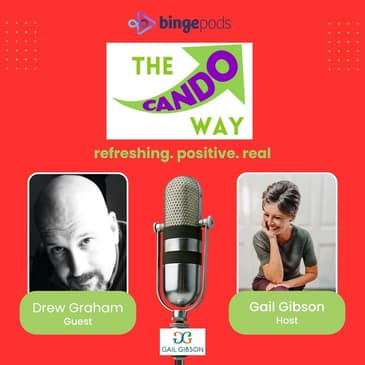
In this episode of The Can Do Way, I talk to Drew Graham, a Voiceover Artist.
Drew is a true renaissance man, with a rich background spanning voiceover artistry, broadcast communications, event production, and community development.
Before retiring from his successful mobile DJ company, he worked as a school bus driver, Development Director at his local Chamber of Commerce, and as a certified nursing assistant. In his spare time, he enjoys reading, strolling with his wife, playing cribbage with his kids, and savouring life’s simple joys.
A life shaped by embracing change, Drew’s inspiring Can Do story highlights the power of stepping outside your comfort zone. Living a life filled with exploration, curiosity, and fulfilment. Following his joy, Drew shows us how embracing new challenges can lead to growth, awareness, and a deeply rewarding journey.
Listen for Drew’s Can Do tips:
1. Active responding vs active reacting.
2. Drew’s Way of 4.
3. I am enough. I do enough. I have enough.
Learn more about your ad choices. Visit megaphone.fm/adchoices
[00:00:01] Hi, I'm Gail Gibson, Accredited Master Performance Coach, International Speaker, Podcast Host and Author. Known as The Can Do Coach, I thrive on enabling leaders to step up, shake it off and shine. Welcome to my podcast, The Can Do Way. My guests from across the globe have Can Do stories of growth, resilience and success to share.
[00:00:27] Tune in and be inspired by these individuals who have developed a strong Can Do approach. Each one of their stories is unique. Each one of their stories has a key message. In this episode of The Can Do Way, I'm delighted to talk to Drew Graham, Business Director, Director, Producer, Nursing Assistant, Broadcaster, Retired DJ, Bus Driver and VoiceOver Artist.
[00:00:56] A classic Renaissance man, Drew is involved in a plethora of trades that provide a wide array of services in his community. Before his time behind the mic as a voiceover artist, he settled into the air cushion seat of a school bus, helped businesses and business leaders thrive as Development Director at his local Chamber of Commerce,
[00:01:21] produced, captured and directed live streaming events and even was a certified nursing assistant. His background also includes multiple roles in broadcast communications and he recently retired from his successful event facilitation mobile DJ company. In his spare time, and as Drew says, spare time, what's that?
[00:01:45] He enjoys a good book, a nice stroll with his wife, Cara, playing cribbage with one of his three kids and simply taking in the wonderfulness that surrounds us all. Welcome to the show today, Drew. Thank you very much, Gail. It's a pleasure to be here. I'm tickled pink. Wonderful. You're a man of many hats with no doubt a host of colourful stories and experiences to share with my listeners today.
[00:02:14] So perhaps let's hear a handful of them. If you could take us on a brief journey through your life, just to give the listeners a glimpse into a little bit more about your background and the passion that fuels the work or the life that you're living today. Well, absolutely. I think that one of the things that inspires me to have so many, a plethora of occupations in my life
[00:02:41] is the need to engage at multiple levels with multiple people. I think that's a very important part of who I am as a human being. It's an important part, I think, of who we all are. Growing up in a very small town in the Pacific Northwest in the United States, in the state of Washington, I was the child of very counterculture thinkers.
[00:03:07] We moved from the big city of Los Angeles into a very small town. And my mom and dad, for lack of a better term, totally hipped out. And it was a very interesting way to grow up. And I think that's formulated my desire for knowledge and acceptance and very peaceful tone. I think that there are very few times in my life when I have ever been really kind of just way out there.
[00:03:35] But I think that counterculture really helped me. Very purposeful, very intent-driven, intention-driven, and very open to coexistence among different types of people and thoughts and ideas. So that certainly has been a... I look back fondly on that. For a long time, I was really frustrated that I didn't have the life that I thought others had.
[00:04:05] And now as I have gotten seasoned in my life, I'm like, Oh, that actually was a really good thing in hindsight when I look at it. It's like that way to live has been great. And it's taught me that to follow my joy, to be joyful in working and living. And part of living is working. We have to create some financial responsibility for ourselves and for our families.
[00:04:33] And I have found that I'm good at a lot of things. But I gravitate more towards the performance, for sure. I think driving a school bus to a certain degree is a performance. You're making sure that you're getting kids to and from school, but you're also educating at the same time. I find that that's super fun. Spent many years in radio, so behind a microphone is really very comfortable for me.
[00:05:02] I really enjoy that part of life. And also providing services for our community. Civically, I think the Chamber of Commerce that you brought up earlier was an important part for me to give back to my community as a whole. How can I help not only my tribe, but how can I help the greater community thrive and have a place that is so wonderful to be and live and work?
[00:05:27] So that's kind of, in a nutshell, where I've been and what I've done. So many things that you have shared there. And I think we'll go through some of them. But I just wanted to ask you for a moment. You know, you've got to a place that you said now you're following your joy and you're living your life fully on your own terms and you're giving so much back.
[00:05:50] But at the start, you said you moved from a large to a smaller place and life then became very different. Did you face any challenges when you had to make that move? Do you find in yourself or in the lifestyle that you went to that posed any challenges and was something that you had to go through and embrace the change to get there? Oh, absolutely.
[00:06:18] As a young child moving from a large city with family and friends around to a very small rural town with knowing no one other than maybe a couple of acquaintances that my mom and dad knew, which brought them to the town that we moved to, Squim. It was very, it challenged us.
[00:06:37] It brought us together tighter as a family, but it also made me realize that nothing is ever set in stone. I mean, it's always fluid, regardless of the foundation you think you might have. And so, yeah. So making new friends. I was fairly young, so it was pretty easy.
[00:06:59] But also the way of life, it's an interesting point that you bring up, the way of life that I lived in the big city with all of the luxuries of that to then adapt to a very small town where things ran at a much different pace with a much different mentality. That was a struggle for sure. I think I found strength in family. And I found strength in myself in knowing that at the end of the day, I am me.
[00:07:29] And I better get comfortable with me because I'm the only guy I got to be with 24-7, 365 for the rest of time. So what am I going to do to make me happy? I just found ways to make me happy. I just found whether it was through acting or whether it was through the church at the time or whether it was being a farmhand or splitting wood or being with my father or whatever the case may be. I knew that I had to find ways to be at peace with me.
[00:07:59] Even as a young guy, I didn't think those things. But in hindsight, I was doing whatever I could to be happy because it was just me. A lot of the time, it was just me, me and my sisters or just me wandering around aimlessly in the woods. Not quite like that. But, you know, I had to find things to do. And I learned quickly that I am responsible for me. Indeed, indeed.
[00:08:23] Going through that change, let's wind the clock back a little bit more because I love the way that you shared that you found yourself and that you realized in yourself that I am me. And that's a very powerful shaping, even from a young age, that has guided you and probably changed and morphed into different styles as you have aged.
[00:08:48] But who do you think it was in your life, that first person that kind of showed you the way that you could have that freedom of finding yourself, of being your own guide, really, and exploring, being curious. And I'm sure in amongst all of that, you were somebody who, you know, would sit and do nothing sometimes. And that is curiosity all on its own.
[00:09:13] But who was that person that perhaps guided that in you or people who believed in you and showed you that it was okay to live your life that way? Yeah, that's a really good question. And I've given it some thought. And I think that there are three people or three groups of people that really stand out. I think it goes without saying, based on the counterculture ideal that my mom and dad made a conscious decision to follow.
[00:09:40] I think, first and foremost, my parents allowed me to be who I was and be comfortable with that person. So I would first say that my mom and dad really gave me that foundation. Second of all, there was a high school biology teacher at my high school who, when I graduated, I didn't think that we had made a really strong connection. I know that we had made a connection and she had helped me along. I was, I am dyslexic.
[00:10:09] And so I struggled in high school and she figured it out pretty quick why I struggled. And she was very supportive in my learning. Jadine Groff. And she said to me upon graduating from high school, she pulled me off to the side, like one of the last days that we were in regular session. And she said, I just want you to dream big dreams because you are capable of way more, way more than you think you are.
[00:10:38] And she said, I, and, and I don't, she said, I don't tell everyone this, but I want you to be uncomfortable more often because you're very good at being comfortable. And you're very good at, at making people feel good. Um, but, but be better at and grow knowing that you are capable of much more than you think you are. Dream big dreams. Dream big dreams. And so it was in that moment, I'm getting chills talking about it.
[00:11:04] And, uh, it was in that moment that I, I realized that, that, that I could harness more of who I am authentically and it will get me to where I want to be. Maybe not right away, but it'll eventually get me to the place that I want to be, or that I think I want to be anyways. So yeah, it was that it was Jadine into my current wife. Finally, um, through a second marriage, I thought I knew what love was the first time around.
[00:11:30] And I, I honor the 20 years that we were together, but with my new wife, there is a level of support and understanding and compassion and acceptance that, um, is freeing. That is liberating, that allows me to really love me for who I am. Um, and I think it's in those moments of doubt and, um, and like imposter syndrome feelings that my wife's like, no, no, no, no, no, no, no, no.
[00:12:01] You, you are good. You are a good father. You're a good husband. You're a good friend. You're a good speaker. You're a good voiceover guy. You're a good bus driver. You're good. Whatever, what you do, do not sell yourself short because you are enough. You have enough and you do enough. You are enough. So she's taught me to, to be very, um, cut myself some slack, but at the same time, hold myself to a higher level. Does that make sense? It does indeed. Yes. Yes.
[00:12:28] And we all need those champions in our life who believe in us. And, and also you said at significant points of your life and yet those people, especially your high school biology teacher, you go back to that and just think, you know, that person came into your life unbeknownst to you, but for a reason. And, and it was that, that memory, that dream, big dreams that has stuck with you and obviously guided you at different points just to say, you know what? I do have this.
[00:12:58] I've got this. I can do this, which is what our show is all about today. And, and then your wife allowing you that acceptance. But of course, those guides that started out life for you as that foundation of the life you now have today, your parents. So I'm sure you are very grateful for all of those key champions in your life.
[00:13:20] And I'm sure the listeners are listening and thinking, well, maybe have I not sat down and thought about those people that have helped me to get into the person and grow into the person that I am today and will continue to be shaped. And by other people, I come along my life travels as well. I wanted to touch on those two moments that you mentioned talking about your champions there, Drew.
[00:13:46] And one was about being okay with getting uncomfortable and stepping outside that comfort zone. And you mentioned also about imposter syndrome and not always having that belief in yourself to actually say, you know what? I do have this. Well, actually, yes, you can. Somebody else encourages you. When you were faced with those getting uncomfortable and facing that imposter syndrome, what was it that you found in yourself?
[00:14:12] So how could you be resilient and handle that adversity when you were facing it? What's interesting about the imposter syndrome question is that I'd never had a word for it. I never had a syndrome for it or I don't even know with diagnoses. But one of the fears, and I think this is universal as I talk with people about this. It's one of those fears. I was always afraid. It's a nightmare.
[00:14:39] Literally toss and turn where I present well and my resume is killer. But when I get into the room, someone calls me out or something calls me out. And that fear stopped me from doing a lot of things. So how did I get through that? I got help. I got therapy. I talked to people, professionals about this. And what I learned is that it's so common.
[00:15:06] And it's not, and it was that part of my wife saying that you are enough. I think I learned that in therapy. And it's to know that, yes, there are things that you won't be as good at as other people.
[00:15:26] But comparing yourself and trying to stay up, keep up with the Joneses is not a fair place for your heart, your soul, and your creativity and your brain. It's not a healthy place to be. So have enough, do enough, am enough. I say that pretty commonly. So that was a big one for me in the imposter syndrome part, you know. And what a great learning from such a powerful and a very powerful experience as well.
[00:15:54] So tell the listeners, how do you walk into a room now? What's different about you? This just came up last night in a conversation. I have become the person who, when I walk into a room of peers or family and friends, I don't go around now and seek out people. I mean, I do at some point, but I don't make a point of it to go to every single person to know so they know that I'm here. I wait now.
[00:16:23] I don't wait, but I just, I walk into the room and if people see me, they see me and we have a communication. I don't go out of my way to please other people with the understanding of I'm doing this for them, not for me. That was a big one for me. So when I walk into a room now, I let people come to me and that's, I don't mean to be braggadocious or self-centered or egotistical.
[00:16:48] It's just that I don't make an, I don't, I don't let that stress overtake me. I don't let the thought of, I wonder what they're thinking about me overtake what I feel in that moment. And I'm sure you have some incredible conversations with the people that you do pull towards you. You know, you're not pushing yourself on anybody, but you're pulling the people that want to talk to you towards you. You never know where that conversation is going to go.
[00:17:17] Much more meaningful, much more heartfelt, truly authentic. Absolutely. That's a really good point. That's a really good point. Yeah. Yeah. So developing that mental habit of resilience and winning through those adversities and now being able to welcome people towards you. What is it that you do on a consistent basis to continue to build and maintain your resilience in life? This is a really great question.
[00:17:43] And, um, I, my mom early on in my high school years was, uh, shared a bookmark with me. I was not a very avid reader early on because I didn't know why I didn't like to read and why it took me so long to read and came to learn that it was dyslexia, um, or a form of.
[00:18:04] And so she gave me this, this, um, bookmark and on it was four sayings and I've come to, uh, adopt them as my rule of four. And this is what helps me regularly. Um, whether it's adversity or belonging or imposter or whatever the case may be.
[00:18:22] I remind myself, this is Drew's rule of four show up, pay attention to what has heart and meaning, tell the truth without blame or judgment and be open to outcome, not attached to it. Wow. Inside of that.
[00:18:43] And I've actually come to learn that that was something from, uh, an adoption of a, of a, of a, from a book by, uh, called the four fold way by anthropologist, um, Angelus Aran. Um, I've, I've read that book now a couple of times and it's so, it's so grounding. Cause I have to remember showing up as a dude, if you can show up, you can do 80% of anything, right. Or throughout a, throughout a percentage, it's just showing up. And that doesn't mean just physically showing up. And this is something that my mom and I talk about still to this day.
[00:19:13] It's mentally showing up. It's mentally being prepared. It's mentally being present, showing up, be here now, let everything else happen. You can't control what was, and you cannot control what will be, but you can control right now. You can control what you think and how you feel. Um, and then paying attention at what has heart and meaning. There is lots of stuff out there that is superfluous in, in, um, not necessarily true.
[00:19:39] But if you pay attention, the truth typically rises to the top. It's like good cream, right? In milk. It raises things, things happen. And the truth, your truth will, will be evident. Um, and then telling the truth without blame or judgment, that one is a struggle for me. And it's not, it's because I fear what other people think, right?
[00:20:03] So if I tell the truth without blame or judgment, I, I instantly start telling, I don't want people to think negatively or I'm still in this space of, oh my God, I can't control what you think, but I'm going to try. So telling truth without blame or judgment is, is one that I, that is, is my focus now in this part of my life is trying to be honest and being okay with being honest, regardless of how it lands. Cause I'm not responsible for it, how it lands. And then finally being open to outcome and not attached to it.
[00:20:31] That was one of the early things that I adopted to that I found that I found resonated with me in that if I'm open to anything that can happen, it's like an improv, right? Yes. And if I'm open to anything that can happen, anything can happen. But if I'm attached to what I think is going to unfold, then I become very easily disappointed or disillusioned because it's not to my expectations.
[00:20:56] But if I'm open to, to the universe providing and giving and sharing with me, it's moments. That's brilliant. You said the word presence in amongst those four wonderful mantras for life.
[00:21:12] I guess you could call them, but I think presence links all of them because you have to be, and you have to develop that awareness in yourself to notice and to say, you know, I am okay with this and I, and the way that I'm sharing and, and all of those, all of those things comes back to presence.
[00:21:32] And the more that you practice that, the more that you can master it because what you then notice is that you're seeing so much more and feeling so much more than you would have if you didn't allow those moments to happen. And moments only get maximized or optimized when you are fully immersed in them and 100% present. What would you say to that? Yeah, I would say yes. And there is something to be said about mindfulness.
[00:22:03] That's part of that presence. And I am, I am regularly grateful for the fact that I come from a time when we didn't know that we were practicing mindfulness all the time. Um, I saw a little clip on social media about the fact that when we were kids, we were practicing, when we rode the bus, we didn't have headphones on. We didn't have walkie talk.
[00:22:29] We, I mean, we had those things, but we, but 99% of the time we were just sitting there being present in that moment. Um, when we, when we would take a stroll, we didn't take pictures with our phone. We were like, Oh God, this is really pretty. And we remembered it with our brains. And so I think that there's, I'm, I'm fortunate. I feel fortunate that I come from a time when mindfulness, we were being mindful and we didn't even know it.
[00:22:53] And so I can go back to that time in moments in today's world and say, all right, well, I'm going to leave that all stuff behind. And I'm just going to go sit on this log, you know, and people think, well, what are you doing? I'm just being. Yes. Well, what good is that? Well, it's, it's very good. It's a lot, it's a lot better than you might think. And you said something earlier about being present and being open to everything that can happen in any moment.
[00:23:19] I also think that there's that opportunity to be present when nothing happens. And I think that there's power in that. And I think that to be cognizant of, of very little at any given time is also a gift. I completely agree with you. And it's a practice that I have been working on and, and really embracing for the last few years.
[00:23:43] And today, for example, I went on a walk that I, that I walk very often. So I'm very familiar with the path. And yet, every time I walk this path, I see something different, feel different. And I never take it for granted. So I really immerse myself in the moment. And being winter, of course, in the Northern Hemisphere, it's a time when there's a lot of birds around who are predominant in the wintertime.
[00:24:12] And I was absolutely grateful to see today. I saw five robins. Seeing one is, is remarkable because they're very territorial. And of course, they stand out with their red breasts. But I saw five looking after their own territories on the walk and they were singing joyously to the world. And I thought, you know, and I stopped and I thanked each one of them on my walk.
[00:24:36] And I, I just, I feel so truly grateful, but absolutely in awe of nature when I can experience those moments. And I do that on my own because those, those daily walks is such a, such a awe-inspiring, but a mindful, as you've used that word before, a very mindful practice that reinvigorates my day. But it also lets my mind really slow down and just be in the moment.
[00:25:05] So it's very, very powerful what you have shared and, and yeah, it's aligned with the life that I live as well. So. Yeah, perfect. Beautiful. Beautiful. So Drew, if you could share your top three can-do tips that guide your daily life. Okay. I would think that the, the three can-do tips is, uh, first of all, the act of responding at any given moment versus reacting to any given moment.
[00:25:35] Help me remember that it's, um, it's about a half a moment can make all the difference in the world. So, so the act of responding versus reacting helps me, helps me get things done. Um, as I said earlier, that, that the Drew's way of four, I, that's a regular mantra that I, I would clock that as one because I say them as one. And then finally, um, I think that I am enough. I do enough. I have enough.
[00:26:05] That reminds me that, that I, that I, that I am good the way that I am. And that's okay. And I can do more. I am capable of more. So I think, I think those three things, I would say the, the respond versus react, um, the, the, the, the rule of four. And then also that, that final one is that I can, I have, I am enough. Beautiful. Beautiful.
[00:26:32] And I, I think that the listeners will take away, you know, you've said, you've shared such an incredible story. And we've talked about a lot of those, um, areas in life and in our own personal development and the, the person that we are shaped by and who we become, um, that a lot of people often struggle with.
[00:26:52] And I, I hear it a lot in my work that I do as a coach, working with women leaders, people who struggle with imposter syndrome or being unable to step out of their comfort zone or just lacking in that confidence that they need in themselves to lead a team of people in a effective and a, and a, um, visionary way.
[00:27:13] So all of those, I'm sure will resonate with the listeners as well, um, and give them something to think about, especially your Drew's way of four. Perhaps they can take that into their own lives and think about how that, that can work for them as well. So what possibilities would you say emerge when you embrace a can do mindset? I think just about anything. I mean, to sound as, as, as cliche as that might, but I think, um, when I thought.
[00:27:43] When my thought process changed a couple of years ago from having to do something to the thought process of getting to do something, just that one word switch in my mind. It's like, Oh, I have to, I have to do this today and changing that to, Oh, I get to do this today. That brings a whole different vibe to my work ethic. It's, I have been given the opportunity to do something wonderful. Um, and I get to do that. That was a big switch for me.
[00:28:11] And, um, I know that that's a, that's a common, um, known, but when I heard it, it was one of those light bulb moments. It was like, Oh yeah, I feel the difference. Even saying I have to, and I pardon me, get to, when I say that I get to, Oh, it's, it's night and day. Um, I also find that a challenge at times to beat back the, the monster of, of confidence.
[00:28:37] And again, um, or lack of, I should say, I think I am very confident, but then there are times when I think that I don't, I have very little confidence in what I'm able to do. Um, um, um, and so I have to remind myself again, going back to that M do have enough, uh, and that's okay. And it's also super healthy.
[00:28:57] I've, I've come to realize that, that, that, that wavering of confidence brings me back to center and, and helps me write any ship that is maybe off, off course, um, for sure. And I struggle with, with, with discipline and action management, uh, or time management as some might call it. And so I'm finding ways to be better at that. And so that helps my can do attitude.
[00:29:23] Cause I, if I can find a way to do something a little smarter and a little more efficient than I can do more and I get to do more. What a wonderful way to bring the, your story to a close today.
[00:29:35] But I think the message that I'm left with from everything that you said, Drew, is that you've learned to reframe and by reframing the challenges that you face and how you feel about yourself inside, surrounded by those champions throughout your life, being able to reframe and then take the next step in your life, knowing that you are enough.
[00:29:57] And that you get to do these things as well is, is a perfect illustration, um, of somebody who is in you. It sounds like you're in a lot more control now of how you feel and the things that you can do with what you have. And yeah, reframing is such a wonderful tool to, to be able to get you there and to, to continue living your life fully. So I want to take this opportunity to say thank you so much for being my guest on the Can Do Way.
[00:30:26] It is my absolute pleasure, Gail. Thank you so much. And it has been a joy sitting here, um, chatting with you about, about life and stuff. It's, it's, it's refreshing. Thank you so much. Thank you for listening to my podcast, The Can Do Way. Do you live and breathe a can-do attitude? Since 2019, my podcast has gifted listeners across the globe access to an incredible selection of guests with stories to refresh your perspective,
[00:30:56] bring you joy and inspire can-do positivity. Always curious and with an insatiable appetite for a good yarn, I invite you to be a guest on my weekly show. If you have an inspiring perspective, a life-changing experience or an intriguing story to share, then drop me an email at gailmgibson.com.
[00:31:20] Until next week's show, do share the inspiration of the Can Do Way podcast with your friends, colleagues and clients, and wherever you are listening from in the world. Remember to make every day an amazing can-do day.