
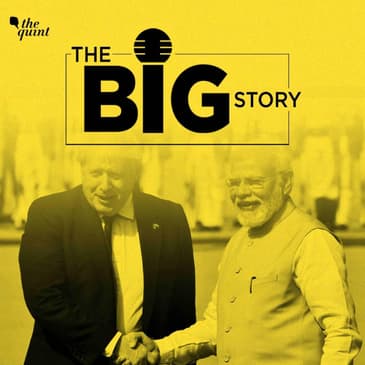
It has taken three attempts for Johnson to finally arrive in India, having cancelled his earlier trips as the chief guest of the 2021 Republic Day and then calling his trip off again four months later in April on account of the deadly COVID second wave.
However, even as her arrives in India, Johnson is being trailed by reverberations of “partygate” where the UK Parliament vote is deliberating on whether to refer him for a formal investigation into his is knowledge of parties at 10 Downing Street despite the countries strict COVID restrictions.
And his first day in India on 21 April was not a smooth landing, with an outpour of outrage online against his inauguration of a JCB factory in Gujarat, just a day after bulldozers made by the company razed alleged illegal construction in Delhi’s Jahangirpuri.
But despite the stumbles made by the Johnson, his visit to India since being elected to Prime Minister is important since it signals that the two countries have to a large extent let go of their legacy colonial issues, which have plagued negotiations and ties in the past.
In today’s episode, we take a look at the India-UK relations and the main takeaways from UK PM Boris Johnson’s India visit. Joining me today is Vivek Mishra, a fellow at the Observer Research Foundation.
Host and Producer: Himmat Shaligram Editor: Shorbori Purkayastha
Music: Big Bang Fuzz
Listen to The Big Story podcast on:
Apple: https://apple.co/2AYdLIl Saavn: http://bit.ly/2oix78C Google Podcasts: http://bit.ly/2ntMV7S Spotify: https://spoti.fi/2IyLAUQ Deezer: http://bit.ly/2Vrf5Ng Castbox: http://bit.ly/2VqZ9ur
Learn more about your ad choices. Visit megaphone.fm/adchoices
[00:00:00] In his first visit to India since being elected UK Prime Minister, Boris Johnson on 22nd April said that the relationship between the two countries is stronger than ever. It has taken three attempts for Johnson to finally arrive in India having cancelled his earlier trips
[00:00:29] as a chief guest of the 2021 Republic Day and then calling his trip off again four months later in April on account of the deadly Covid-2 wave. However, even as he arrives in India, Johnson is being trailed by reverberations of Quotengote Party Gate where the UK Parliament
[00:00:43] vote is now deliberating on whether to refer him for a formal investigation into his knowledge of parties at 10th Downing Street despite the country's strict Covid restrictions. And his first day in India on 21st April was not a smooth landing as well with an
[00:00:56] output of outrage online against his inauguration of a JCB factory in Gujarat just a day after bulldozers made by the same company raised alleged illegal construction in Delhi's Jahangirpuri. But despite the stumbles made by PM Johnson, his visit to India is important
[00:01:10] since its signals that the two countries have to a large extent let go of their legacy colonial issues which have plagued negotiations and ties in the past. So in today's episode we take a look at the India-UK relations and the main takeaways from UK PM Boris
[00:01:23] Johnson's visit. Joining me today is Vivek Mishra, a fellow at the Observer Research Foundation. You are tuned in to the Big Story, the podcast where we dissect the headline making news for you and I'm your host, Imat.
[00:01:47] Before we get into the main takeaways from Johnson's visit, let's get a sense of where the India-UK relations stand. Over the years there have been various degrees of partnership between the two countries and the relationship has generally moved
[00:01:58] on an upwards trajectory. And it was amplified in 2021 with the conclusion of the Enhanced Trade Partnership or ETP which will reportedly double the value of the trade between the countries by 2030 and also the announcement of a shared intent of working towards a free
[00:02:12] trade agreement. The Trade and Investment Package unveiled by number 10 in 2021 contained over 533 million pounds of new Indian investment into the UK covering areas such as healthcare and technology. This also included a 240 million pound investment by Serum Institute of India
[00:02:29] in the UK into its vaccine business and a new sales office in the country which is expected to generate new business worth $1 billion. And the ambitious roadmap 2030 continued along this year with Johnson stating ahead of his
[00:02:41] visit that the UK seeks to deepen trade relations with fresh push towards a free trade agreement. Vivek Mishra fellow at the Observer Research Foundation says that Johnson's visit to Gujarat to sign trade deals before heading to New Delhi to meet Modi is indicative
[00:02:54] of the UK's push towards more bilateral trade. Yeah, so this is in context with the long-term strategic partner elevation of India with a host of countries and in May 2021 India elevated its position with the UK
[00:03:14] and charted a comprehensive roadmap for 2030. Now a host of issues include this umbrella including health, climate, you have issues of defence and security, you have people to people ties, clean energy and many of the issues of clean energy will come this time including digital switchable buses etc.
[00:03:36] And this also the comprehensive roadmap is also in line with the both countries SDG goals, the sustainable development goals that they have signed up, the emission goals that they have signed up according to the Paris Agreement.
[00:03:50] So this is also the elevation is the roadmap is also part of the long-term strategic view and this you will get a glimpse of in the 2021 integrated defence review, integrated review of brought out by the UK government in which India is certainly treated as a
[00:04:12] high priority country. And I think it is a follow-up from that long-term vision of India as a strong partner that we are seeing a host of issues being at the centre of collaboration between India and the UK. So I think comprehensive roadmap for the 2030
[00:04:30] which was really instilled in May 2021 now is the time to sort of review that progress and chart out a very strict and a very comprehensive roadmap again based on the
[00:04:44] review in what we have done in the last one year and what we intend to do in the next let's say four and five years because this will always be in terms of short-term goals and long-term
[00:04:54] goals because it's a long term view of the relationship. So I think a host of that there is immense amount of agendas that is in the comprehensive roadmap 2030. So all of that will have to come together and I think all these sectors that I highlighted
[00:05:11] including health climate defence and people to people ties will be sort of integrated in that vision and that's why you saw Prime Minister Boris Johnson go to and sign a few important business deals and then come to Delhi which is the heart of all the discussion.
[00:05:30] Now coming to Johnson's visit, one of the main expectations from this visit was movement on the India-UK free trade agreement which has been waiting in the wings since the first round of talks in January 2021. One of the top demands from the UK when it comes to this
[00:05:42] trade deal as per a Financial Times report is the elimination of tariffs for British whiskey. The report points out that while the two-way trade is worth about $24.15 billion as of 2020, it has largely stagnated over the last decade. Though the two countries have progressed
[00:05:57] in lowering trade barriers with increasing immigration access to Indian professionals to the UK, the free trade agreements continues to be a sticking point in this relationship. According to a wire report, India continues to have a difference of opinion over the
[00:06:09] investment section of the FDA, especially the section on dispute settlement mechanisms. According to Vivek Mishra, the delays in the FDA are reflective of the differences between the economies of the two countries. Yeah, I mean, FDA is always a sticking issue.
[00:06:22] You see with countries including the US also in with the EU itself, the European Union. None of these has seen tremendous progress because these are sticking issues and this is also reflective of the difference in the nature of economies of the two countries.
[00:06:36] You know, we rely on a lot of farmer subsidies. They don't the Western economies are more developed and they don't. And of course, some of these issues speculate down to the WTO where we fought
[00:06:46] a case with the US last year, which was which came to conclusion last year. So I think what I want to highlight is because of the fundamental structural difference in the economies
[00:06:59] between two countries in nature we function, we are seeing a lot of delays in how we can comprehensively bring and align our trade issues. Now that is first, but if you I'm like you, I'm also
[00:07:12] skeptical of any progress in this meeting of the FDA because the third round of negotiations is due to be hosted in India by in this month. I'm not updated on whether it has already been.
[00:07:25] I don't think it has already been held, but maybe it's part of this visit. But it since the fact that it has not been highlighted in the visit. I am skeptical that it will. So it's an ongoing progress. I think third round is a good
[00:07:41] lead in the negotiation. We will see it certainly because I think it has been announced from the very top that we are in the process and we will see. But I think for this round of negotiations,
[00:07:53] you know, both the countries have appointed technical experts from both sides. And I think 64 separate sessions covering 26 policy areas in the FDA are being discussed. So just given the expanse of that, the number of sessions and the number of policy areas, I think it'll
[00:08:12] take more time than expected. Before we head on to the next segment of this episode, a short promo for a new entertainment podcast, it means thali bhate. Thank God it's Friday. As you wrap up the daily grind of the week, kick off your shoes
[00:08:27] and tune in to the quince weekly podcast series, it needs to be about where you have refreshing and candid chats with India's favorite Bollywood stars. Hi, I'm a V. Radha and catch my conversation
[00:08:40] with a couple this Friday only on it needs to be about available on most of your preferred podcast streaming platforms. And now back to the podcast you were listening to coming back to Johnson's visit, a total of two government to government MOUs and four non governmental
[00:08:58] MOUs were exchanged during Johnson's visit to India as per a Ministry of External Affairs statement. The two governmental MOUs focus on implementation for global innovation partnership and a cooperation on a global center for nuclear energy. And there were two other headline
[00:09:11] making announcements from this visit with the first being support from the UK for new Indian design and production of fighter jets and technology transfer for the same. And the second the issue of an open general export license to India which will reportedly reduce
[00:09:23] bureaucracy and shorten delivery times for defense procurement. Vivek Mishra says that the UK's push for trade with India signals a clear recognition of India's place in the world and as an important partner in a post-Pexat world. There is a clear recognition of the importance of Indian market,
[00:09:38] of the importance of Indian political relationship and of the importance of India's defense relationship, the importance of India being an anchor of stability in the Indo-Pacific vis-à-vis China or for you know which is a concern for both the country. So for all this
[00:09:53] gamut of reasons I think it is a very comprehensive sort of recognition by the UK of why India is important. Now in so far as your question of post-Brexit strategy, I think the UK laid down
[00:10:06] immediately after coming out of the Brexit a few strategies are roadmaps with a host of countries they have signed you know deals with Australia, Japan, South Korea and the US on various issues and India is certainly part of that strategic map that they have
[00:10:21] charted out for themselves. So in the post-Brexit strategy they see India as a huge market and not just a market but also a strategic partner and I think which this was the second
[00:10:35] the latter part of it was not stressed upon too much by the UK because you know they've also hence you know government swinging between the Tories and the Liberals. So I think with this Boris Johnson government I think the strategic partnership is a clear recognition for
[00:10:53] India. The people-to-people ties and there I come back to your question you know to the issue of legacy issues and that's why you see that during the trip the people-to-people ties have been
[00:11:05] sort of tried to by the UK side try to prioritize because and they have emphasized this because they want to overcome the whole legacy issue, the whole issue of colonialism, the internal resistance in
[00:11:18] some part of India too and mind you I am not saying bureaucratic resistance because I think lastly we've overcome that but I think the people-to-people resistance about UK being this colonial power so which from which we got independence. So I think that resistance in
[00:11:36] people's mind is something that the UK is trying to maybe trying to sort of overcome by harping on the people-to-people ideas and therefore you and one step is that you you know India is
[00:11:49] investing in the UK now to create more jobs and so you see the turn of the tide literally. So now Boris Johnson is inviting investments from India and hit the toe it only used to be the other
[00:12:02] side. So I think there is a turning of the tide and that will in an overall sense help us to come out of this whole idea of legacy of colonialism that that is attached with UK when we look at
[00:12:15] relationship to the UK. For more updates on the story especially when it comes to the free trade agreements follow the quaint on our social media handles and if you're not already subscribed
[00:12:24] to the big story podcast if you like listening to this episode please subscribe to the big story for episodic updates we're available on Apple, Google Podcasts, Spotify, Geo7 and most of the other popular podcast streaming platforms. For other podcasts please log on to the
[00:12:40] quaint website and for any feedback please shoot an email to podcastathequaint.com Thanks for listening log on to the quints website and check out our other podcasts