
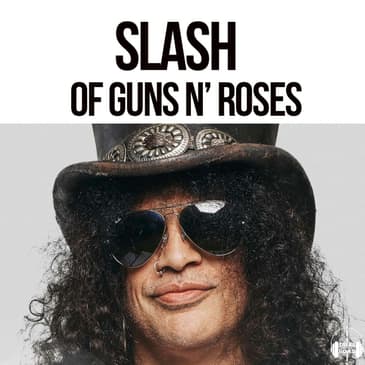
Saul Hudson, better known as Slash, has created some of the loudest yet melodic guitar riffs in rock history. As lead guitarist for Guns N’ Roses, he helped shut the door on the synth-heavy sounds of 1980s pop and ushered in a new era of salacious rock that sold millions of albums for the band. His solos on songs such as “Sweet Child O’ Mine,” “November Rain,” and “Estranged” have sealed his reputation as one of the guitar gods of rock.
We caught up with Slash to talk about 4 , the fourth studio album by Slash featuring Myles Kennedy and the Conspirators, and Slash's fifth solo album overall. It was released on February 11, 2022, as the first album from the new Gibson Records label.The album was produced by country producer Dave Cobb in Nashville.
---------------------------------------------------------------------------------------------------------------
Check out US Tour Dates starting 2/9: https://www.slashonline.com/tour
Instagram: https://www.instagram.com/slash Facebook: https://www.facebook.com/Slash Twitter: https://twitter.com/Slash SMKC TikTok: https://www.tiktok.com/@smkcofficial
---------------------------------------------------------------------------------------------------------------
Follow Tales from the Road
Facebook
https://www.facebook.com/talesfromtheroadofficial
Instagram
https://www.instagram.com/talesfromtheroad/
-----------------------------------------------------------------------------------------------------------------
Subscribe on Spotify | Apple Podcasts | Google | Gaana |Audible
You can also read, watch, listen via our website https://www.tftrmedia.com
Hosted & Produced by Vikram Chandrasekar and Moving Pictures Media
[00:00:26] Slash talking about the production of the new album. A lot of the records DNA was a result of conversations between you and Dave Cobb and Dave and Glyn Johns.
[00:00:37] Now, Glyn as we all know is a well-known recording engineer and producer. Can you talk a little bit about the production of the album itself?
[00:00:48] I mean, to start Dave Cobb is a huge fan of Glyn Johns. Glyn Johns really admires his work over the years and obviously Glyn Johns has done so many iconic rock and roll records from the hood of the stones to Zeppelin and that list goes on and on.
[00:01:04] And I'm a big fan of his because he was one of those handful of really great trailblazing engineers from the late 60s and through the 70s and was responsible for some of my favorite rock and roll records.
[00:01:19] So when Dave Cobb mentioned him, I was like that's exactly the direction that I want to be going at. You know, you're on record saying that the album was recorded with the band playing live and jamming. What was that whole experience like?
[00:01:38] I mean, we had a blast recording the songs. It was done totally live and we basically went in, worked on the arrangement of the song, got it to where we wanted it and recorded it live in the moment.
[00:01:54] And that's probably why it has a sort of jam session vibe because it's just really just a good quality recording of us just playing in a room.
[00:02:07] Is it in a sense easier or harder to record live versus layering it track by track? What were some of the challenges you faced while recording live?
[00:02:18] I mean, we've always recorded, I've always recorded in every band I've ever been in live to a point like we all played together and then I would go back and redo the guitars and the vocals are always done later.
[00:02:34] And I mean, and that works great because we do capture the energy but you know it's a little bit more controlled than what we were doing on this record.
[00:02:43] You know, the plus side of recording sort of like with Overdubs and all that is that you really do fine tune some stuff and you can get the sound exactly right.
[00:02:55] This and that and the other you can nitpick it to death. Whereas when you're playing it, you know just totally off the cuff you dial it in the best you can and then you just go for it and you don't go back and fix anything.
[00:03:07] So layered recording is high points is to be able to fine tune it as low points as you lose some of that energy. From the time you know you've started your career slash you've seen technology evolve. Right? How does technology impact production?
[00:03:32] What I'm trying to get at is, you know, how does one guard from sort of overproducing something to be perfect and risk losing the whole organic jam vibe of the music?
[00:03:44] You know that the fascination with technological development, I guess you call it, which is great. You know, and I'm really not knocking it but I think what happens is you find that you can do anything you want without really having to play a note hardly, you know?
[00:04:03] Like I know a lot of records are made by bands who call themselves bands, but they actually are just all pieced together and they've never played an entire song.
[00:04:13] And you know when you're in a rock and roll band, you really just sort of have one job. And I think you should be able to show up at the studio and everybody should be able to play their instruments and you don't need a producer to put it together for you.
[00:04:25] But you know that formula has been going on ever since pop music became popular. So, you know, it's nothing new but with new technology it's just making it easier to fool people and thinking they're listening to music produced by an artist when sometimes it really is not.
[00:04:43] Have you ever let a song get on the record without fixing it in production or forgotten to do something before it's finally mixed and mastered? Have there been songs on record that have so called imperfections?
[00:05:01] Not really. I mean usually when you record something, you sort of hear all that stuff and if there was something that really bothered you, you know, later you would probably have heard it when you did it.
[00:05:13] And so if you want to fix it, you can fix it. So I can't think of anything specific that I was like, God, there's that glaring mistake.
[00:05:21] But I have to admit there are some moments on record that I can think of where there was something that I wanted to do and forgot to do and never ended up doing it and then remembered it later.
[00:05:32] I was like, oh yeah, I was going to do that but I forgot about it. Anyway, so little things do happen that you know over time you realize that you might have wanted to do something different.
[00:05:45] This new album 4 has a very punk rock feel to it and I know you've been very influenced by punk rock as well. The album also has an aggressive feel to it. Was that sort of conscious decision?
[00:06:01] It's really just the nature of the attitude when everybody is just sort of playing off each other in a room. It's just, it's a slightly more aggressive and definitely more raw sounding.
[00:06:13] And there's a certain energy that happens. So it's one of the things that's important about how this was recorded because you're capturing an energy that sometimes often gets sucked out when you're in the studio.
[00:06:26] But when you're playing it the way that we did it, you sort of capture all that. One of the things about Recording Live is that the band needs to know each other really well and sort of understand each other.
[00:06:38] Tell me a little bit about the relationship between you and Miles Kennedy given that you guys have worked together for so many years. Yeah, I mean I would say that the chemistry that Miles and I definitely is an evolving kind of entity.
[00:06:58] You know? I couldn't put my finger on exactly what the developments are but just because we've been working together for so long you start to really get to know the other person and a lot of what they might do and things that they might like and things that will work.
[00:07:16] And it just sort of happens naturally and you just sort of go with it. The last couple of years have been crazy and you've been on the road a lot before that. So how did you sort of get through the pandemic and what did the pandemic teach you?
[00:07:34] I think the biggest thing for me really is patience. That's something that I have very little of and the COVID situation really forced me to observe patience. And I think I learned a lot about patience over this last couple of years.
[00:07:55] You did unfortunately end up getting COVID though, right? I mean, I have a history of not voting well during downtime. It's been the boon of my existence or my career.
[00:08:14] And so I've gotten sort of past all that but this event that suddenly presented itself was like, okay, there's no end in sight.
[00:08:25] So I just really got to work and just started focusing on playing and writing and recording stuff and doing some sessions and getting some guns and roses stuff that needed to get done and starting up this record.
[00:08:40] I really wanted to get a record done during this whole thing. So I kept myself busy to keep myself out of trouble. Nashville has now sort of become like the home of music or the Silicon Valley of music, so to speak.
[00:08:54] What was it like recording in Nashville and working with Dave Cobb? Well, Dave, I had not heard of Dave before and he was suggested to me and I looked at his discography.
[00:09:08] It was primarily country music, but it was like really great down to earth, very sort of raw and human country music, which is something I haven't heard in a long time because country music has really sort of gone the way of sort of pop music, that sort of filter of making everything sound the same.
[00:09:27] Anyway, so that was really refreshing. But on top of that he had done all the rival Sun's records, which is one of those newer rock and roll bands that I really like. And I think they sound great. So I gave him a call.
[00:09:42] And when we had this conversation and that's where Glenn Johns came up and recording live and all that.
[00:09:49] And recording live, the way we did it is something I've been wanting to do my whole career and no producer has afforded me the opportunity to do it because they just don't like the risk of having bleed on the mics and so on and so forth.
[00:10:03] Anyway, so that sort of locked me in with Dave Cobb right there. And then when we got to Nashville, the studio that he works out of is a real famous studio called RCA and it's Studio A.
[00:10:17] And it's this legendary room where all these really iconic country artists recorded from Wayland Jennings to Johnny Cash to Charlie Pride to Dolly Parton.
[00:10:31] I mean, like and the walls have got candid black and white photos of them recording all over the studio. So you really sort of immersed in this very creative kind of aura.
[00:10:44] And so that was very inspiring. And yeah, it was just and then we just we set up and we just started jamming in this big room that they've got there.
[00:10:54] And we really had a good time and Dave was great. He was sort of like the six beetle. He came in and he had his tambourine and he just sort of like, you know, hung out with us while we played and he's very, very enthusiastic and have great ideas.
[00:11:10] And it was a good, good experience working with him.
[00:11:13] The other thing I wanted to touch upon was that I know that horror films have been a huge influence on you. So do you sort of ever get musical ideas or do you get sort of inspired to write music after watching a horror movie or based on a horror movie?
[00:11:34] Yeah, I mean, I definitely have. I think it's one of the reasons why I got into producing is because the musical aspect of it is really exciting to me.
[00:11:47] But I've definitely gotten different ideas over the years from watching movies. Some of the cinematic stuff is just really inspiring and it can create a mood and you can, whenever I see a visual melodies come to me and it's, I love scoring.
[00:12:03] So it's, it's, it does happen. Yeah. So you know, actually, there's a song on this record, I just just donned on me. There was a song on this record called fall back to earth that was very much sort of inspired by some cinematic kind of a thing.
[00:12:20] What is your favorite riff when you pick up a new guitar slash what is sort of your go to riff every time you pick up a new guitar?
[00:12:31] That's so funny. I used to work in a guitar store and I remember people coming in and playing a star way to heaven to the point where yes, it was very memorable.
[00:12:40] And we had to, it was good to kick people out, you know, what see why I hate going into guitar stores and actually playing anything in front of anybody.
[00:12:50] But if I, if I do, you know, I was in Norman's Rare Guitars recently and and I was checking out a Fender. And so usually I work on, I'll play something that I happen to be working on at the moment just to be able to sort of see what that sounds like fresh in my, you know,
[00:13:09] because it's fresh and I was playing it through something else before and just to see what the tonal differences. But I never play anything by anybody else as a rule or or switch on.
[00:13:23] The other thing about the band is that your guitar playing in Miles's vocals just works. What's the sort of secret to that chemistry?
[00:13:36] I mean, it's just something that happened organically when we first met. I actually heard Miles sing an original lyric and melody to one of my pieces of music before I ever heard him sing anything else but also before I ever met him.
[00:13:54] And that first thing that he, you know, that we collaborated on was really special. And and and so that was a demo. Yeah, I sent him a piece of music and he wrote this song called Starlight.
[00:14:09] And and when I first heard the demo, I was like, wow, that's amazing. I've never met this guy. So he flew out to LA and we met at the studio and we hit it off really well, like instantaneously, it was just a certain kind of magic chemistry right there.
[00:14:25] And then we recorded the studio version of that song and I had another piece of music that I didn't have any vocals on and I asked him if he'd be interested in singing that and that was a song called Back from Cali.
[00:14:36] So those two songs were just off the cuff. And that's really sort of how our whole collaborative process started and it hasn't really changed that much.
[00:14:47] I just come up with pieces of music and he just naturally comes up with something cool for it. And we've just been sort of going like that, but we we get along really well on a personal level and we I think we definitely inspire each other and we have a great live chemistry as well.
[00:15:04] So it just works. On the new record slash there's a song called Spirit Love, and you've used a sitar on that. What's the what's the backstory there?
[00:15:17] That's really funny. That's a good question. I got that the electric sitar in the 90s and I've never used it because they're so cliche sound.
[00:15:28] And I never wanted to do anything that sounded like oh we're trying to be, you know, the Beatles or any other 60s band that brought sitar into it. Anyway, but when when I wrote that music, I did the intro on the guitar and it was fine.
[00:15:46] But then when we were packing up to go to Nashville, I started thinking you know that particular part would sound really good on the sitar so I packed the sitar we went out to Nashville and recorded that song.
[00:15:59] Initially with with guitar on the intro, and then I went back and plugged in the sitar through my Marshall and and started played the intro that way and recorded that and it just sounded really cool and I didn't think it sounded like the Beatles or rubbish and car anything
[00:16:15] like that just had a sort of gnarly kind of Middle Eastern sound. So that's that's basically how that happened.
[00:16:22] We have a lot of people listening and a lot of people that follow the podcast from Spain who have written in and sort of want to know when you'll be back in Spain.
[00:16:34] It's looking like the beginning of 2023 is when the conspirators are going to do their first European tour since 2019. I'm going to be doing some touring with guns and roses starting this summer, all the way through the end of the year makeup tours for everything that got postponed in 2020.
[00:16:56] All the conspirators international stuff will start in 2023. So, you know, I mean, I would expect it will happen. Let's see if the European tour with guns and roses in June and July happens.
[00:17:09] I figure it will but the COVID kept everybody dancing this entire time so I got my fingers crossed everything goes as planned. Recording live, improvising, not being too obsessed about the production side of things. The fact that all of you guys were together and jamming.
[00:17:32] Putting this album together, did it almost feel like a substitute for playing a concert?
[00:17:41] That's a good question. I had an intent, you know, that thought never crossed my mind. But you know, that's an interesting way of looking at it and it definitely is a precursor to the live show. So yeah, that's an angle I hadn't thought of.
[00:17:59] You know, it's well known that you've always worked with analog sound and that you prefer analog on your recordings.
[00:18:07] But that's not usually how it's done today in the music business. So you're sort of, you know, already reinventing that you've also gone in and recorded this album, you know 100% live.
[00:18:21] So I was wondering what have you learned from the overall experience about yourself about the band, just about the chemistry between all you guys. I mean, you know, I have a real passion for what it is that I started out doing and continue to do so.
[00:18:42] Right. I love guitar, I love rock and roll, I love everything about everything having to do with it. And it's still, it excites me probably more so now than it even did when I first started. And it's a journey that never ends.
[00:18:59] There's always new things to do with it. It's not even a matter of reinventing myself, I'm still in the process of inventing myself in the first place.
[00:19:07] And so I'm just sort of following those aspirations I started out with and trying to get good at this and good at that in terms of music. And it just, you know, as far as guitar playing is concerned, that too is a never ending journey.
[00:19:23] There will be always new things to discover on guitar until I'm pushing Daisy. So, you know, I just have fun with the whole thing and you have to work hard at it because there are so many obstacles that are there to sort of get you off your trajectory.
[00:19:41] I've always learned that you just have to persevere and so that's become part of my nature, I guess. But anyway, I love what I do and I can't see, I can't imagine ever stopping.
[00:19:53] Last question before I let you go, Slash. What was the original idea when you started out with Miles? Did you ever think that you guys would get this far?
[00:20:05] Well, I mean, all things considered, I'm just one of those people who really sort of think in the present. I never looked too far in the past and I definitely never looked too far into the future.
[00:20:18] So, you know, when I first hooked up with Miles, it was about, you know, that record and that tour. And then during that tour we started writing music for what ended up being apocalyptic love.
[00:20:30] And it's just been snowballing like that. I never thought about this far into the future at that time. And so when we actually got here to where we are now and we've been together for 12 years and this is our fourth record, I was sort of shocked.
[00:20:45] It didn't even occur to me that we've been together that long. So no, I wouldn't even have started to imagine that we'd be together at this point in time.
[00:20:55] That's it for this week's episode of Tales From The Road. Tales From The Road is brought to you by the concert photographer and Moving Pictures Media.
[00:21:02] Don't forget to join us next week for another episode. If you like what you heard, subscribe to our podcast on iTunes, Spotify or Google Play. Thank you for listening.