
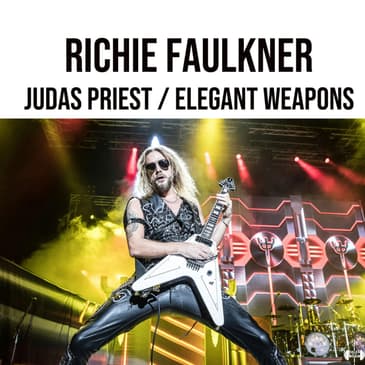
Elegant Weapons is the brainchild of Judas Priest guitarist Richie Faulkner. The quartet released their debut album ‘Horns for a Halo’ on May 26th via Nuclear Blast Records.Elegant Weapons are Richie Faulkner, Christopher Williams, Ronnie Romero and Dave Rimmer. I caught up with Richie from his home in Nashville, to talk about the new album, playing live, some epic road stories with JJ Nichols and Zakk Wylde. He also spoke about this collaboration with the legendary Christopher Lee, the new Judas Priest album and a whole lot more.
-----------------------------------------------------------------------------------------------------------------
For more on the band
Website – https://www.elegantweaponsband.com Facebook – https://www.facebook.com/elegantweaponsband/ Instagram – https://www.instagram.com/elegantweaponsband/ YouTube - https://www.youtube.com/channel/UCqdC4CpGCouDxCCQ83qwB1g ___________________________________________________________________
LISTEN TO THE SHOW
Apple Music: https://apple.co/3xg7v9Z
Spotify: https://spoti.fi/3foYNzm ___________________________________________________________________GET IN TOUCH
🌍 Our website: www.tftrmag.com
🌍 Work with us: vikram@movingpicturesmedia.in ___________________________________________________________________FOLLOW OUR WORK
📸 Instagram: https://instagram.com/vikramchandrase...
🌍 Our website:https://tftrmag.com
_____________________________________________________________
ABOUT US
Tales from the Road is a podcast where we talk to people from the world of performing arts, from those on stage and on screen to those behind the scenes, about life on the road and the journey behind taking their incredible art to the people. I'm your host Vikram and I'm a Music Photographer and Videographer.
[00:00:00] Welcome to another episode of Tales from the Road. My guest today is none other than Richie Faulkner, the renowned guitar player of Judas Priest and the founding member of the new band Elegant Weapons. Join us as we delve into the world of Elegant Weapons
[00:00:14] discussing their recent live performances, Richie's unique approach to songwriting and the behind-the-scenes stories of life on tour including some unforgettable encounters with the likes of Zack Wilde and Jared James Nichols. We'll also touch upon Richie's remarkable journey with Judas Priest, exploring his musical contributions to the iconic band.
[00:00:34] Additionally, Richie opens up about his experiences with a heart condition shedding light on his philanthropic endeavors. This is a conversation you won't want to miss. Congratulations, Richie, on the new album, on Elegant Weapons. Totally amazing. I've been listening to it nonstop
[00:00:51] and sort of my favorite album for this year, I think. Thank you very much, I appreciate that. It's always a bit apprehensive when you release a new record onto the world, especially when you're primarily responsible for it.
[00:01:09] You haven't got Rob or Glent to blame if it goes wrong as well. It's primarily you really, the spearhead of it, so it's good to see it being received well and positively received, so I appreciate you saying that. Yeah, and I think the album is on the charts
[00:01:29] across the United States, so that's pretty good as well. Yeah, I mean it's not, you know, you can't expect it to be a top ten album, you know what I mean? It's like slowly, slowly, you know,
[00:01:40] you've got to build the house one brick at a time, you know, both with the music and building up a relationship with the listeners, you know, that's what it's all about really. But as you said, if it goes in, if it registers somewhere,
[00:01:57] that's more than we can ask for really. The people are taking the time out and listening, they like it or they don't like it. There's so much music out there and stimulus out there at the moment. The fact that people can just take the time and listen
[00:02:12] is enough for us, you know, listen to us and then judge it and maybe come along with us for the ride, that's all we can ask for. Yeah, absolutely. I want to ask Richie, how easy or how difficult was it to consciously stay away from
[00:02:27] sounding like Judas Priest? This album, sort of, there's a lot of memories of classic metal as it were, but it sounds creatively fresh. And that's one of the things that have seemed to me about the album. But how hard or how easy was it to stay away
[00:02:43] from sounding like Judas Priest? I like the way you put it, memories of older material. I've never heard it said like that before and that's exactly what I think it is. There's echoes of influences. And to be honest, the influences, I think we're all proud of.
[00:03:01] And I think I wanted those influences to shine through. But as you said, I wanted it to sound like a modern album. So in terms of how hard it was to sound different to Priest, it was a priority. I think if it was a record that sounded
[00:03:17] like a Priest record, there'd been no point. That's what we do with Priest. So it was a conscious thing, but the good thing is, as I said before, when we write with Priest, me, Rob and Glenn would get in a room and we'd bounce those ideas
[00:03:35] off of each other and we'd come up with ideas from that. So me and you would get in a room with two ideas and we'd come up with another idea. So when we do the Priest record, that's what usually happens.
[00:03:50] With this record, musically I was so fully responsible. So I didn't have those two to bounce off. So I think it was going to be slightly different anyway. It's coming from the same DNA. It's coming from the same place. The guitar riffs are coming from the same place,
[00:04:07] the same influences that they would do on a Priest record, I think. Maybe just a different branch of the tree and then it didn't go through Rob and Glenn and me like it would do on a Priest record. So I think it was semi-conscious,
[00:04:21] but also I think it was fairly natural that it was going to take shape that way anyway because it didn't have those other guys putting their character on it as well. Yeah, because like I said, I mean, I think to walk that line and it's a fine balance
[00:04:35] to be loyal to classic metal and to sound creative, new, fresh, which I think you guys have done in Spain. I want to ask you, how did the band come about? What's the story with that? Well, initially, all the stuff was written
[00:04:54] before I assembled the band and it was done during lockdown. So I called out some good friends of mine. Fortunately, very grateful for the fact that some of them are legends, like Scott Travis from Judas Priest and Rex Browner on the record
[00:05:11] and they've been in the industry for the last 30-odd years with Pantera and Priest. And I always kind of, I promise Scott that if I ever did anything outside of Priest I'd give him the first call on the drums. Unfortunately, he was able to do the record
[00:05:26] along with me and Roddy Romero. So really, I'm just fortunate to call guys up that I knew would be great on it and then moving forward when the world opened up again and everyone was touring. Rex is now doing Pantera, Scott's doing other things.
[00:05:47] So it was again a case of the same thing really. I called up Davey Rimmer on bass from Uriah Heap who I've known for 25 years. We used to play bars and clubs and pubs together in London. So he was not only a great choice on bass
[00:06:02] but a great friend of mine that I could call up and Christopher Williams from Accept. So again, it's just who do I think would be the best for this? Initially on the record and then moving forward is the same thing really.
[00:06:20] And it would be the same, I think if anyone couldn't do it or they had other commitments and they couldn't do it it would be the same thing. I'd give you a call and say,
[00:06:30] you know, or whoever it would be who is the best to fill that slot? And that's what you do in a band. That's what bands have done for ages. If someone can't do it, you get someone who's the best to fill that slot.
[00:06:42] And again, I keep saying it but I'm just fortunate to have those guys at the end of the line the phenomenal players and legends in some cases. Yeah, but just to dive a little deeper with that part, Richie is there something specific that you look for
[00:06:59] with musicians that you want to collaborate with? More specifically with a singer like Rani there are incredible voice, incredible vocalist. Is there something specific? Is there a specific quality that you look for? I think it's hard to say. I think you know instinctively when the vocalist would work
[00:07:23] or not, if they've got the right voice. It might be a different voice but they might have something that could work it could be different enough to work if that makes sense. Sometimes it's too different. I can't hear it working.
[00:07:40] With Rani, when he's, well I was talking to a friend of mine Damon Johnson from Thin Lizzie, he's now a little bit skinner. I was talking to him about a vocalist and he mentioned Richie Blackmore's rainbow and the vocalist that Richie had
[00:07:55] and a light bulb went off and Rani Romero and as soon as he said his name it was a perfect, to me it was a no brainer. As you said before the memories of the influences in the music you can hear the same ones in Rani's voice
[00:08:15] you can hear where he comes from stylistically and you can hear those, you know the 70s the 80s, some 90s in his voice but he's very much a modern day singer in the rock circles and I thought that would be perfect
[00:08:31] not only is he a great singer and has those influences but he's a great front man he carries the band a certain way you know he fronts, you know what I mean he's up there, that's a skill that's a skill to be able to do that
[00:08:49] in the right way so luckily again I keep saying luckily I've had a lot of good fortune around me a lot of the time fortunately I caught him up and I spoke to him and he was interested and here we are today
[00:09:06] So Rani also sang with Michael Schenker and one of the songs on the album was UF for cover late south Do you have any memories with Michael Schenker have you played with him before do you have any stories to share with Michael Schenker
[00:09:23] Well we played with Michael Schenker's Temple of Rock they opened up for priest on a UK tour I think it was the last UK tour we did with priest in 2015 shockingly which is almost eight years ago and Michael opened up for us and Michael would come in
[00:09:45] just before they went on to do the show and then it leaves so I didn't get a lot of chance to talk to Michael but every night I was positioned behind his large cabinets and I watched Michael in the spotlight with his flying V in the air
[00:10:03] and he was just a master class in rock guitar he's probably my favourite guitar player still alive, obviously I'm a big Hendricks fan but Schenker I think is God as far as phrasing and note choice and melody, songwriting he's just a master class in rock guitar
[00:10:28] I think I said hello to him on the last night we all got together priest and Michael Schenker's band we got together for a photo and I said hi Michael, hi Richie and then he was off into the night which is almost
[00:10:43] for me it's like it strengthens the enigma somehow does he ask some of the love for the flying V come from Michael Schenker, watching Michael Schenker 1000% I mean it's Schenker, it's Randy Rhodes it's James Hepfield, it's obviously KK Downing it's Hamit, it's all those guys
[00:11:06] obviously Schenker hunched over to fly and V playing those riffs and melodies and classic solos, without a doubt the blonde hair and the flying V is iconic but Richie at a more philosophical level what have you learnt about yourself through the process of this album
[00:11:30] that's a good question I don't know really, I'm not a great leader put it that way, obviously I've spearheaded this band and I've put it together but it doesn't come naturally so it's something I have to work at, you know what I mean
[00:11:49] for better or worse and sometimes I think we realise what we're not good at and what we can improve on and that's great there's lots of things like that where you find out a lot about sometimes there's three or four of you pulling together
[00:12:10] in this situation it was a bit different you have to write all the stuff or you have to delegate to people that are better than you, that's another thing like the lyrics for example, I'm not a big lyric guy so instead of maybe having a subpar
[00:12:28] lyrical content I would offer it out to people to write better lyrics than I can so it's trying to get the better the better end product even if it wasn't me doing it, if that makes sense so delegating to people that are better than I am
[00:12:46] putting together a good team maybe because I'm feeling that I'm not a great leader I need other people with me to make me sound better, you know what I mean I don't want to do this but it's definitely a learning experience it's a great team like you said
[00:13:04] the band sounds incredible live, I was watching some YouTube clips and things like that, it sounded amazing thanks man but Richie did putting together this band have anything to do with you falling so seriously ill and I think sort of realizing how temporary things can be
[00:13:25] one minute you're playing in front of a large audience and literally 20 minutes later you're in hospital didn't that sort of hasten the process of putting together this band it definitely motivated me to wrap things up and get it finished I think everything was recorded before it happened
[00:13:52] so when I recovered I was well enough to get back in the studio chair I called up management, I called up the producer and I said let's mix the record let's master it, let's get it finished, let's get the artwork done
[00:14:07] there's a lot more to a record than just recording the tracks you've got to master it and mix it and everything and package it and get the record label on board but it was vital to me really first of all to get back on the guitar
[00:14:23] to get back to playing to get this record finished and released to get back on tour with priests, to finish the priest record I think you're right in what you're saying it gave me a not a sense of urgency but a sense of
[00:14:40] you never know what's around the corner so if you've got stuff that you want to do let's get it done because it was a very real feeling and still is, it still motivates me today it kind of makes you realise how short life is
[00:15:01] and how precious it is and how quickly it can be over without really knowing it so it was important to get it finished and inspired me to get all that stuff done get out on the road and get, I'm still doing it we're still in the mixing process
[00:15:16] of the priest record, we're getting that done and getting that ready to be put out on tour because it drives me, it's almost like a medicine the guitar and music is part of the healing process
[00:15:28] and as long as I'm doing that, as long as I've got my family then I'll be okay but I think even there it's a question of balance do you think there's sometimes the danger of wanting to do too much because like you said
[00:15:43] I have that battle all the time the balance between the two I consider myself fairly lucky that I can live with music at the moment and I know it won't always be like that it wasn't like that a couple of years ago everyone's touring life was cut short
[00:16:06] and we didn't know when it was going to reopen it is, for me it works it's busy, I like it that way and as I said it gives me focus and it's almost like a healing quality but at the same time sometimes the life work balance
[00:16:30] is a bit the other way but I think that's just a consequence again I'm fortunate to be in that position Judas Priest are putting out new music I'm putting out new music with my band and it consumes everything and it should
[00:16:48] Priest is something I've dedicated my life to you know, and these things aren't going to be around forever so while I'm relatively fit and healthy why not dedicate my time to them? Absolutely, absolutely Richie a little bit about songwriting
[00:17:06] briefly, you said you don't really like to write lyrics is the guitar your primary conduit to songwriting? Absolutely, yeah I always start with I sit down with the guitar I'm always sitting down and I strum in or playing UFO carbers or whatever
[00:17:26] something would jump out like a riff would jump out or a melody would jump out and that's where it comes from the guitar was like a conduit for those influences and it pulls them out and I'll record the idea and the guitar, the riff will
[00:17:41] inspire melodies and stuff like that which will in turn inspire a lyrical phrase for sure and I'll give that to someone and that might inspire a lyric but as far as the lyric, all the words it's not my thing I can definitely get lyrics from melodies
[00:18:05] you know when you hear a melody and you can hear a phrase around that melody it just lends itself to it but ultimately it's the guitar that pulls out the interest from me and I think you can if you go to a non-English speaking country for example
[00:18:23] I think people will latch onto the music and the melody maybe before they understand what the person is saying there's a melody in the music so that to me is what drives me and what turns me on musically more than the lyrics so when you go into
[00:18:44] sort of when you're working with a producer do you have a concrete idea of what you want things to sound like have you visualized a final product or did you do any sort of general direction when you're working with a producer? I think to some degree
[00:19:02] you've got an idea in your mind of what you think you want and what direction you want to go in albums sometimes have a way of changing through that process they become their own animal especially even with Judas Priest each album has become its own
[00:19:26] monster as it's gone through the process there's no pre-stabbing that sounds the same especially if you're doing your own like a record like this there's no blueprint for it so it could be anything so as you go through the process
[00:19:44] there's little things that you think let's try this and let's try that let's have a starting point and a direction at least to aim for and then along the way you kind of go where the album takes you and I'm up for that as well
[00:20:02] I'm up for kind of going wherever if there's a good idea along the way why not take that route so it's a bit of both really I was watching some YouTube clips and I saw you jamming with Jared James a bunch of others I think with Zach Meyers
[00:20:20] how much has moving to Nashville influenced your writing because they say that Nashville is like the Silicon Valley of music so how much is moving to Nashville influenced your writing well I think there's a lot of music and industry in Nashville as far as writing
[00:20:54] I still kind of the same really I haven't really written with a lot of other people me and Jared actually wrote a song just for fun here at the studio I think the way it influences it for me is there's more opportunity to write with more people
[00:21:21] there's more people around in that sense but I don't think it changes the way that I write I'm fairly set in my ways I like Sabbath riffs and maiden stuff I come from where I come from and I think having people like Jared down the road it presents
[00:21:48] the opportunity easier to come around and have a couple of beers and write a song for sure and then we both bring what we bring to the table but I don't think stylistically it changes me too much there's a lot of rockers out here now
[00:22:03] there's a lot of rockers that have moved to Nashville rock and metal and that's what's really difficult for sure because I remember reading a story about Brian Jones gifting Jimi Hendrix a copy of one of Ravi Shankar's albums
[00:22:18] and it struck me that there was a certain creative energy in the sixteenths so I was wondering if Nashville had that sort of creative energy where like you're saying you get to meet all these guys and hang out and just put together ideas and it definitely helps
[00:22:36] obviously Gibson's here as well I feel like I'm a big part of the Gibson family Gibson's a creative family, we're all friends and so everyone that's linked through Gibson whether it's Jared or Lizzie Howell or lots of others we meet up where we wouldn't have normally
[00:22:57] obviously in the sixties there were a lot more you know every one of us is getting together under the influence, you know if you give someone a sitar under LSD that's the result I don't think that happens as much anymore but I'm sure
[00:23:12] they had a big part to play in there correct what have some of your live shows been like you were out at Elfest, what did it feel like to have the crowd, I'm sure they were singing some of the songs on the album
[00:23:24] and things like that, what was that like yeah we were really surprised really, I mean I think when we set out first of all we didn't know how it was going to be received and we didn't know what the reaction was going to be
[00:23:36] sure, but we were surprised to see some people obviously we had our own shows as well and there more people were there to see us and then do the songs but when you play a festival like Elfest as you mentioned even with priests they're not all your audience
[00:23:54] they're there to see other bands so we were just lucky to have people there again taking the time to maybe watch us but even some of them were seeing the songs as well which was really, really nice to see and I think what Ronnie observed
[00:24:12] was that even if you could tell people didn't know the songs but they could understand they kind of got into them because of the riffs and the melodies you could see that they were not in their heads and they were into them
[00:24:24] even though they maybe didn't know them which is that's all we can ask for man hopefully they can stick around, hopefully they like it and hopefully as I said before they join us for the journey moving forward
[00:24:36] yeah without doubt, I also saw, I think it was a show in Berlin I saw Zach Wales sort of playing Rody slash Guitartek for you yeah, Zach's been a good friend for a few years and he loves, we know Zach he loves guitar, he loves guitar players
[00:24:54] and when we go out with priests we've been out with Black Labels Society a few times and Zach's always on the side of the stage when you turn around there he is because he loves to watch, he loves to be a part of it so that was genuine
[00:25:08] Zach had been coming up a few times during the Pantera shows but that was genuine, I turned around and there he was that was the first time I saw him that night he had a guitar and he just loves it and it's a pleasure having him there
[00:25:22] and it means a lot to have someone like Zach who's a big influence of mine you know up there he's almost like he's endorsement so it's an honour I noticed that you guys had played I think you did some covers, you did Judas Priest
[00:25:40] you did Black Sabbath as well do you have any favourite Judas Priest songs that you'd like to play live? there's a couple that we haven't played with priests and we've maybe tried in rehearsals but for one reason or another we never got round to it
[00:26:02] one of them was reckless from the Turbo record which I think is a fantastic song for one reason or another we never played it live we did it in rehearsal as I said I'd like to play that one, I'd like to play Ram it down
[00:26:20] so yeah there's definitely a couple maybe some of the stuff from Rocker Roller like Winter or Cheetah or something like that something different and also I was listening to Firepower the other day stuff that I forgot there's stuff like Children of the Sun, Lone Wolf
[00:26:41] kind of gets forgotten but there's some great stuff on there yeah, talking about collaborations I wanted to ask what it was like working with Christopher Lee from Dragon, A Lot of the Rings and stuff I said earlier on I've been fortunate to be surrounded with some great people
[00:27:02] some great circumstances but he was one of them his people that he worked with were great he was fantastic you can imagine he's from a different generation so he's got a different way of thinking about things and he was a real pleasure to listen to him
[00:27:20] and his input about current events and stuff like that and it's just inspiring for a man of his age to be making music like that and it was connected to him he was a resident of King Charlemagne so it was connected to him in the story
[00:27:41] and he was performing it and the redditing and singing where he could and it was great to be a part of it really it was pretty surreal to be part of a heavy metal album with Christopher Lee at that point of his career Star Wars
[00:27:59] and Dracula and he's been in the war next to him listening to the man talk really I remember reading it was an interview where he said he discovered heavy metal through Black Sabbath in the 70s and he listened to Sabbath I think I did too to be honest
[00:28:20] it wasn't in the 70s but I definitely discovered what I know is heavy metal through Black Sabbath what more can you say I was listening to this album just before we went on and there's just so many times I can think Tony I owe me and Black Sabbath
[00:28:38] there was one of the songs on there I slipped my mind which one at the moment I think it's Horns for a Halo when you're putting down your ideas initially you saved them song number one I think it was Horns for a Halo
[00:28:59] I saved it as I owe me because I thought this was something that gives me an I owe me vibe and again I'm not I'm not going to hide those influences it's obvious where they come from so I'm not going to be proud of it
[00:29:14] but it struck me as an I owe me Birmingham Sabbath type vibe that's what I saved it as in some of those riffs something else I wanted to touch upon I was going through your website I noticed that from the sale of t-shirts
[00:29:35] on your website and I think there was a Gibson line you're supporting two charities with Heart Health can you talk a little bit about that yeah exactly there's some t-shirts on there a guitar like a Gibson custom shop so all my proceeds
[00:29:56] everything that I would get from those sales go towards two charities and one of them is the John Ritter Foundation for Aortic Health which is not the heart it's the plumbing around it which actually was specific to me so it wasn't my heart it was all the Aorta
[00:30:14] and everything like that that ruptured is the American Heart Association which is much more general heart health so there are two charities that are close to my heart no pun intended and I just thought it was a way to give back and raise awareness
[00:30:32] because of what happened to me through the sale of a guitar so to me that's perfect that's giving back through something people can play the guitar they can create music and give back to those charities and raise awareness as well
[00:30:47] so to me it was fundamental that I did that yeah absolutely I think fabulous gesture but Richie talking about giving back I've been on a couple of your Instagram lives you seem to be doing it for like hours on end either breaking down
[00:31:05] songs or taking requests from people how important is teaching for you and how important is it to give back so to speak well that's a good question I mean I'm not a very good teacher teaching I think is a skill aside from the technical side
[00:31:28] of the guitars and people learn how to teach I've never learned how to teach but I think during the pandemic there was no live music so I was trying to create a way of interacting with people and playing creating that dynamic where
[00:31:49] because that's where it comes from you know playing in the bars and the pubs in London that's what it's all about people want Mustang Sally and you play Mustang Sally and it was about creating that dynamic for me as well I enjoyed that interaction
[00:32:07] and hopefully people enjoyed that interaction and hearing me play as well so it was like a two way thing so that's what it was really I've been a bit busy since the lockdowns lifted
[00:32:19] so I haven't done much of it but hopefully I'll be able to get back to it one day I enjoyed it I used to have a couple of drinks and sit here for hours doing it I love doing that stuff music I love interacting with people
[00:32:34] talking of Mustang Sally you were in a cover band with Dave Rimmer you're Camden down days and I think it was called Metalworks how is it it's not easy to be in a cover band it's not easy to do covers is it some people were geared towards it
[00:32:57] some people were not some people found it out, I've met people that it's hard to get their head around that kind of experience they find it easier to write their own stuff and come up with their own stuff for me it was just a necessary
[00:33:15] thing really to play live if I wanted to play live regularly I had to learn these songs and since I was about 12 seeing I'd been doing that anyway you'd learn a few songs that you knew you'd play a couple live with the band
[00:33:33] and that repertoire grew into like 5 songs 10 songs, you do one set maybe you do 2 sets and then you kind of became part of the band that was part of my life really since I was 13 years old so it was a natural thing
[00:33:48] but getting looked back and said this is what being in a cover band thought to be specific it taught me so much not only the playing obviously the playing night after night after night live is a big deal you get one shot, there's people in the audience
[00:34:10] you get one shot at playing that part so you do that night after night after night your playing becomes obviously elevated you can improvise because you're used to playing you know obviously where everything is you can improvise a lot more intimately but then there's also stuff like
[00:34:31] down you get to learn about your sound your role in a band you learn about listening to others communicating in a band all that stuff that I think it's taken for granted there's a lot of communication, there's a lot of listening
[00:34:49] there's a lot of delegating, there's a lot of stepping back and letting someone else do their bit and then you know being on time, fixing your gear what gear works for you throughout the years, fine tuning stuff there's a lot that you learn throughout the years
[00:35:10] aside from just playing I think so I think it was fundamental in my education why I might have been ready when I got that opportunity I felt like I had a shot at the opportunity
[00:35:31] because I felt like I was ready, I felt like I was on top of my game and so I went for it I grabbed the ball by the horns and went for it are you formally trained? or whatever the opposite of formally trained is that's me, it records
[00:35:52] and trying to copy the records sometimes you pick up the needle and put it back and find the note and put the needle back I did take piano lessons for about three weeks but there was an electric guitar and a drum kit in the corner
[00:36:13] and that's what I wanted to play I was playing the piano, twinkle twinkle in the corner was what I really wanted to play so I wanted to play no formal training at all have you felt any pressure over the years to study music? not really
[00:36:40] I think you build up your own systems and your own patterns you learn by ear and I think maybe learning theory now would maybe slow that down a little bit it's easier for me to listen to something and play it rather than look at it on the page
[00:37:01] it would probably take me longer to do that than listen to it because I've spoken to people who have said it might impede them creatively but I think it's probably if they are studying structure and things like that
[00:37:16] I think some people were geared towards that way of learning and other people were not so I think it depends on the person for sure what are your plans with the band? with regard to touring? is Asia on the cards at all? with Bodjudas?
[00:37:37] with Elecote weapons we are looking at all opportunities we've just got back from Europe and we are looking at stuff beyond the US, Japan, Asia, maybe South America we are looking at all opportunities wherever we can take the music and hopefully snag some new fare end
[00:37:52] so if we do get those opportunities we will let you guys know on the socials that will be fabulous Richie lastly before I let you go I have a question what would you like to do? with the time? UFOs, Strangers in the Night Metallica Master of Puppets
[00:38:21] Iron Maiden Somewhere in Time Jimi Hendrix Electric Lady Land Judas Priest Defender of Faith and Miles is the reality black sabre for the bonus but Richie thank you so much, thank you for your time I wish you well all the best
[00:38:39] Thank you, Baker, Mr. Bledger, hopefully see you where you are soon and there you have it another exhilarating episode of Tales from the Road comes to an end we hope you enjoyed this conversation if you liked the episode don't miss out on future Tales and interviews
[00:38:53] make sure to hit that subscribe button on YouTube to stay up to date with all our latest content for more audio only listeners follow the show on Apple Podcasts and Spotify or a podcast platform of your choice
[00:39:05] your support and enthusiasm drive us to bring you the best stories from the road so thank you for being a part of this journey