
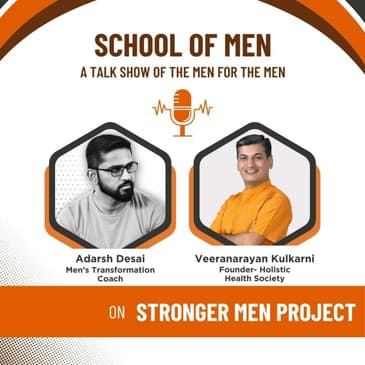
This is the first episode of the School Of Men interview show on the Stronger Men Project Podcast featuring Veeranarayan Kulkarni aka Veer
Veer is the founder of the Holistic Health Society, where he helps holistic health practitioners- Yoga teachers, Ayurvedic & Homeopathic Doctors,Naturopaths, Healers, Therapists, Psychologists and Nutritionists to build their online presence, impact and grow their income
In this episode, Veer takes us through his crazy ride from working in a corporate job to his work in promoting holistic health, struggles of entrepreneurship and his pursuit of meaning and purpose
You can get in touch with Veer on Facebook or email him at veer@veerkulkarni.com
00:00:00
Speaker 1: Namaskar. And welcome to the Stronger Men project. This is
00:00:02
Speaker 1: a very, very exciting day, because this is episode number
00:00:05
Speaker 1: one of the School of Men segment of the podcast.
00:00:08
Speaker 1: This is an interview segment where I plan to bring
00:00:12
Speaker 1: on experts and, uh, achievers and inspiring people who have
00:00:16
Speaker 1: inspiring stories to share. And then, um, as a number
00:00:21
Speaker 1: one student of the school,
00:00:22
Speaker 1: uh, I will, uh, grill them on your behalf and
00:00:25
Speaker 1: try to extract as many lessons as possible. Uh, get
00:00:29
Speaker 1: to know about their stories and experiences and, uh,
00:00:32
Speaker 1: uh, draw inspiration from their stories, which will help us to, um,
00:00:37
Speaker 1: get different perspective of life, get to know about, uh,
00:00:40
Speaker 1: different areas of life and also use those and apply
00:00:44
Speaker 1: in our life and do better in life. And today
00:00:48
Speaker 1: we are joined by a hell of a crazy man
00:00:50
Speaker 1: in his own right. We'll get to know why. I'm
00:00:52
Speaker 1: why I'm saying this in a short while. Uh, he's
00:00:55
Speaker 1: a friend of mine, and, uh, he's been a close
00:00:57
Speaker 1: adviser to me for a few months now.
00:00:59
Speaker 1: Let's welcome, uh, Mr Varian Kulkarni to the show and, uh,
00:01:04
Speaker 1: get to know about him. Vir, Thank you so much
00:01:06
Speaker 1: for joining today. Why don't
00:01:08
Speaker 2: you? Thank you. Thank you. I'm so excited. I just
00:01:11
Speaker 2: can't wait. I didn't even allow you to complete your sentence.
00:01:14
Speaker 2: I'm so excited.
00:01:16
Speaker 1: You have. You are always a high energy person.
00:01:20
Speaker 1: So why don't you introduce, uh, yourself and, um, let
00:01:23
Speaker 1: us know. Let our listeners know what you do and
00:01:26
Speaker 1: a brief background about yourself.
00:01:28
Speaker 2: Hi. Thanks for this opportunity. A, uh uh. My name
00:01:32
Speaker 2: is Virna R Kulkarni. I'm a resident of the Harvard
00:01:34
Speaker 2: for the last 10 years. I'm an engineer and an
00:01:37
Speaker 2: MB a by qualification. I've also completed my masters of
00:01:40
Speaker 2: science in yoga.
00:01:43
Speaker 2: And, uh, currently, I'm the founder and CEO of Holistic
00:01:47
Speaker 2: Health Society, where we help holistic health coaches like yoga teachers,
00:01:52
Speaker 2: either whether doctors, dietitians, I help them go online, and
00:01:56
Speaker 2: I help them increase their impact. I help them double
00:01:59
Speaker 2: their income. So this is what I do right now.
00:02:01
Speaker 2: And also, uh um it's been great associated with you
00:02:06
Speaker 2: other where I am coming to your gym every day and, uh,
00:02:09
Speaker 2: bulging my muscles. Now
00:02:11
Speaker 2: just a little
00:02:13
Speaker 1: bit. Yeah, it's a It's an honour to it's an
00:02:16
Speaker 1: honour to be associated with, uh, with you. And, um,
00:02:20
Speaker 1: you bring a lot of energy to the to to
00:02:22
Speaker 1: the table. And, um, thank you for being a close
00:02:25
Speaker 1: adviser to me And, uh, whatever value you have already
00:02:28
Speaker 1: added to my life. And, um,
00:02:31
Speaker 1: yeah, I mean, um, le let us know a little
00:02:34
Speaker 1: more about, um, what do you do specifically as, uh,
00:02:38
Speaker 1: you know, in your holistic health society.
00:02:42
Speaker 2: OK,
00:02:45
Speaker 2: it was a year 2018. I was doing my masters
00:02:51
Speaker 2: of science yoga, and I was also running a
00:02:56
Speaker 2: millet's restaurant in Hubli. And, uh, I was also having
00:03:00
Speaker 2: an organic shop, so I would start from the Harvard
00:03:03
Speaker 2: at around five o'clock in the morning, go to take
00:03:06
Speaker 2: two yoga classes, then go to my restaurant, make sure
00:03:09
Speaker 2: that everything is prepped up breakfast. Um, ingredients are all there.
00:03:12
Speaker 2: Then go to my organic shop, make sure everything is there,
00:03:15
Speaker 2: and then come back home to the Harvard late night,
00:03:18
Speaker 2: and then I would not see my daughters. Um, they
00:03:21
Speaker 2: would be sleeping by that time,
00:03:23
Speaker 2: but still, after this 1415 hours of hard work, I
00:03:26
Speaker 2: was not able to make money. I was not able
00:03:30
Speaker 2: to come out of the debt. So that is when
00:03:32
Speaker 2: I was thinking that even the holistic health and, uh
00:03:37
Speaker 2: is good. We have to profess this, but many people
00:03:41
Speaker 2: like me yoga teachers, dieticians were not able to make
00:03:45
Speaker 2: their ends meet.
00:03:46
Speaker 2: So that is when I thought that let me help
00:03:48
Speaker 2: such people to become better holistic health coaches by going
00:03:53
Speaker 2: online and
00:03:56
Speaker 2: get their true potential come to light in this world.
00:04:00
Speaker 2: And that's what holistic health society is all about. So
00:04:04
Speaker 2: we work at three levels. One is at the mindset level.
00:04:06
Speaker 2: We help them change that. Just working offline may not
00:04:10
Speaker 2: help you. You have to come offline, plus online model.
00:04:14
Speaker 2: Other mindset issues like I'm not good at technology. I'm
00:04:16
Speaker 2: not good at speaking. We help remove those mindset challenges.
00:04:22
Speaker 2: Second is, uh we help them giving those technology skills.
00:04:26
Speaker 2: And third thing is, we handhold them so that they
00:04:30
Speaker 2: start becoming confident in front of the camera. And, uh,
00:04:34
Speaker 2: these are the three things that we are working with.
00:04:36
Speaker 2: Holistic health, society,
00:04:38
Speaker 1: other.
00:04:39
Speaker 1: Yeah, that's awesome. Weird because, um
00:04:42
Speaker 1: uh, I also struggle with this as a gym owner
00:04:45
Speaker 1: and someone who is trying to bring about difference in
00:04:48
Speaker 1: other people's life. And, uh, what I what? I, um um,
00:04:53
Speaker 1: think I miss is, uh, not having those business skills.
00:04:56
Speaker 1: Even though my intention is right, intention is to help
00:04:59
Speaker 1: people and teach them how to lead a fitness lifestyle
00:05:03
Speaker 1: and teach them the proper way to exercise. And, uh,
00:05:07
Speaker 1: you know, follow follow a scientific method.
00:05:11
Speaker 1: And, uh, yeah, I can connect with that. Really? Um,
00:05:14
Speaker 1: because I have been through a lot of ups and
00:05:17
Speaker 1: downs in my own business, especially after covid. It has
00:05:19
Speaker 1: been very, very difficult.
00:05:22
Speaker 1: And I can understand it can happen with, uh, all
00:05:24
Speaker 1: other people who are working in the holistic health. Uh uh, realm.
00:05:29
Speaker 1: It's interesting that you brought this topic. You said you
00:05:32
Speaker 1: were running a millet shop and a millet restaurant and
00:05:35
Speaker 1: seems like you had a good intention to, you know,
00:05:38
Speaker 1: bring something healthy to people. Uh, can you just share me?
00:05:42
Speaker 1: What was your experience running your, uh, business. And, uh,
00:05:47
Speaker 1: what made you to, uh, shut down the business?
00:05:52
Speaker 2: OK. A, um that's been a great journey with a
00:05:55
Speaker 2: lot of learnings. Um, it was around 2000, uh, 14
00:06:00
Speaker 2: that I came back from Singapore, where I was working
00:06:02
Speaker 2: with American Insurance Group in the field of, uh, project management.
00:06:07
Speaker 2: And when I came back to the word, I wanted
00:06:09
Speaker 2: to do something which is meaningful. And one of the, uh,
00:06:13
Speaker 2: first few jobs that I did in the word was
00:06:16
Speaker 2: I was CEO of, uh, yoga and Naturopathy Hospital
00:06:20
Speaker 2: in this hospital. I started seeing that many people who
00:06:23
Speaker 2: came in with a lot of problems with back pain
00:06:26
Speaker 2: or headache
00:06:28
Speaker 2: with naturopathy and yoga. By the time they left after
00:06:31
Speaker 2: 10 days, they were totally different changed person,
00:06:35
Speaker 2: and I was wondering if it's so easy for people
00:06:38
Speaker 2: to get,
00:06:40
Speaker 2: Uh mm. They resolved the the problems resolved. Why are
00:06:44
Speaker 2: not people doing this? Then I realised that it is
00:06:47
Speaker 2: not just about coming here for 10 days, getting your
00:06:50
Speaker 2: treatment and then going back.
00:06:52
Speaker 2: The most important thing is abiding by it after you leave.
00:06:56
Speaker 2: So that was important. And many people said that, OK,
00:06:59
Speaker 2: had we known that if there is a place where
00:07:03
Speaker 2: we can go and buy such grains, or if, um,
00:07:06
Speaker 2: so that's the first thing that people started telling me.
00:07:09
Speaker 2: So that's when I started Millet Monk in Hubli. Where,
00:07:12
Speaker 2: um we started selling millets. In fact, before starting Millet
00:07:16
Speaker 2: Monk in Hubli, I started Millet Monk in my car.
00:07:19
Speaker 2: I had a green central car. I would load all
00:07:23
Speaker 2: the mills in the decade and make sure that I
00:07:26
Speaker 2: I went by whatever orders came to me by phone,
00:07:29
Speaker 2: I would go to their home and deliver and ask
00:07:31
Speaker 2: them How did your last minute meal What? How was it?
00:07:35
Speaker 2: What
00:07:35
Speaker 2: is it like? Did it taste well, uh, what is
00:07:38
Speaker 2: the feedback that you would want to give me? So
00:07:41
Speaker 2: this is how I would do. And then people would
00:07:43
Speaker 2: say that, OK, if there was a place where we
00:07:45
Speaker 2: could just go and eat millets. So that's when that's
00:07:48
Speaker 2: when the thought of Spring of Health a healthy millets restaurant,
00:07:51
Speaker 2: came in. So we started in a small three bedroom
00:07:54
Speaker 2: house in Holi. And then within a year, we expanded
00:07:57
Speaker 2: the opposite KSH hospital, uh, with more than 2000 square
00:08:01
Speaker 2: feet area.
00:08:03
Speaker 2: And, uh uh So when I started, uh, doing Millet
00:08:07
Speaker 2: Monk and Springfield, which is organic shop as well as
00:08:10
Speaker 2: a restaurant. Both were going very well, hand in hand.
00:08:13
Speaker 2: And I was taking yoga classes in the morning as well.
00:08:16
Speaker 2: So there was yoga, there was food and there were grocery.
00:08:19
Speaker 2: So all the three were ticked off and anything that
00:08:23
Speaker 2: is good people take time to adopt.
00:08:26
Speaker 2: And, uh, there was a lot of effort in marketing
00:08:29
Speaker 2: and letting people know what is millets and how this
00:08:32
Speaker 2: has to be done. So I'm talking this about 2015 1617,
00:08:36
Speaker 2: where millets was still not in vogue. And that was
00:08:40
Speaker 2: just picking up at that time? Yes, yes. People were
00:08:43
Speaker 2: realising the benefits of it,
00:08:45
Speaker 2: and at that point in time, it was going very well. And, uh,
00:08:49
Speaker 2: we were almost there breaking even. We were just, uh,
00:08:54
Speaker 2: not going into losses. That was the time, the dreaded day,
00:08:58
Speaker 2: March 14th, 2020. Covid stuck us, and
00:09:03
Speaker 2: I was thinking that this will go for a long time.
00:09:06
Speaker 2: The best part is I sent all my employees and
00:09:09
Speaker 2: then said that we will come back after 23 days
00:09:12
Speaker 2: if at all things better, then, uh, as you saw.
00:09:15
Speaker 2: Covid went on and on and, uh, I thought it
00:09:18
Speaker 2: was a good time to shut the shop because I
00:09:21
Speaker 2: was paying rent. And so that's how the business got closed.
00:09:26
Speaker 2: But the best part, what I felt was, um, Shanta,
00:09:30
Speaker 2: an handicapped employee in my millet monk shop.
00:09:33
Speaker 2: She approached me saying that Anna, can you sell the
00:09:36
Speaker 2: shop to me and with the brand name? And that
00:09:38
Speaker 2: was a time when I I was so happy that
00:09:42
Speaker 2: she was now the owner of that shop. So that's been, uh,
00:09:46
Speaker 2: the journey of, uh, Millet Monk and spring of Health.
00:09:51
Speaker 1: That's quite, uh, quite a quite an interesting journey that, uh,
00:09:55
Speaker 1: you sold your, uh, business to your employee. Uh, is
00:09:59
Speaker 1: it still running
00:10:01
Speaker 1: the current condition of the business?
00:10:04
Speaker 2: Yeah. Shanta was a handicapped lady who needs support. Uh,
00:10:07
Speaker 2: she drags herself on the ground, or she walks by
00:10:11
Speaker 2: kneeling down, and she is now the owner, and she's
00:10:13
Speaker 2: been running it successfully for the last 2.5. 3 years now, and, um,
00:10:18
Speaker 2: it's progressing very well. I'm so happy about it. It's
00:10:21
Speaker 2: still opposite the hospital in Hubli.
00:10:24
Speaker 1: Oh, that's really I did not really know about this.
00:10:26
Speaker 1: That's really awesome that it's still there. I thought you
00:10:28
Speaker 1: completely closed it and, uh, sold it off to someone else. And, uh,
00:10:31
Speaker 1: the brand got changed, and someone else is running a
00:10:34
Speaker 1: a regular restaurant in that place. That is what I thought. But, uh,
00:10:39
Speaker 1: this is new to me, and, uh, it's good to
00:10:41
Speaker 1: know that it's still running.
00:10:43
Speaker 1: And, uh, the common theme. What I hear is a
00:10:46
Speaker 1: lot of people got affected by covid. And I was
00:10:49
Speaker 1: also one of those people. The which, you know, which
00:10:52
Speaker 1: prompted me to go online and start building online business
00:10:55
Speaker 1: for myself. And, uh,
00:10:57
Speaker 1: um seems like, uh, we have a lot of common
00:11:00
Speaker 1: la is, uh, you know, common things. Uh uh, then
00:11:04
Speaker 1: which I already know that, um, you are working, uh,
00:11:08
Speaker 1: in a corporate world, you have quite a bit of
00:11:11
Speaker 1: experience in different. Uh, you know, you have worked in
00:11:14
Speaker 1: different countries.
00:11:15
Speaker 1: Uh,
00:11:18
Speaker 1: I think our listeners will be interested to know what
00:11:21
Speaker 1: prompted you to quit your job. You said you were, uh,
00:11:24
Speaker 1: living in Singapore when you left. Left your job. Uh,
00:11:27
Speaker 1: what were the things that led to you? Quitting the
00:11:31
Speaker 1: job and, uh taking such a huge, uh, you know,
00:11:34
Speaker 1: decision and risk. Because the word is, uh
00:11:37
Speaker 1: it's a very small city, and, um, it's called as
00:11:39
Speaker 1: a sleeping city or city of retired people. This is
00:11:43
Speaker 1: this is not a place for entrepreneurs, at least with
00:11:46
Speaker 1: the five years of my own experience. I can tell that,
00:11:50
Speaker 1: and you should be a crazy person to do that.
00:11:53
Speaker 1: I am interested to know really what happened and what
00:11:56
Speaker 1: led you to quit your job and come back to
00:11:58
Speaker 1: the world.
00:11:59
Speaker 2: Very interesting question. So I worked with Wipro for close
00:12:03
Speaker 2: to a decade, and then I worked with, um a
00:12:06
Speaker 2: IG in Singapore, worked in around 10 countries. Uh, while
00:12:10
Speaker 2: we were sitting with me and my wife in 2012,
00:12:13
Speaker 2: we were just thinking, Why were we in Singapore? We
00:12:16
Speaker 2: were in Singapore because I had purchased two homes in
00:12:19
Speaker 2: Bangalore and, uh, we were paying the EMIS.
00:12:22
Speaker 2: And so the question came, Once the EMIS are done,
00:12:26
Speaker 2: what should be our next step? The next logical step
00:12:29
Speaker 2: was that my next project would have been in US
00:12:31
Speaker 2: and then, um, another three years getting locked in there.
00:12:34
Speaker 2: So should we work for the third house of the
00:12:38
Speaker 2: second car. So these are the kind of discussions that
00:12:41
Speaker 2: me and my wife are doing. So that's when I
00:12:43
Speaker 2: realised that it's not all about, uh, as accumulating assets.
00:12:48
Speaker 2: It's also about mean living a meaningful life.
00:12:51
Speaker 2: So I was in Bangalore for 20 years.
00:12:54
Speaker 2: Uh, I studied in Bangalore in UVC my engineering, but
00:12:59
Speaker 2: I thought that that cannot be my karma boomi my karma.
00:13:03
Speaker 2: BMI has to be a place where I can contribute
00:13:05
Speaker 2: to people's lives. So that's when we started looking at.
00:13:09
Speaker 2: So there were two cities that were there in the shortlist.
00:13:11
Speaker 2: One was Mysore and second was Darva. And, uh, as, uh,
00:13:15
Speaker 2: my roots are from Kade. I decided to come and
00:13:18
Speaker 2: settle in Dhar
00:13:20
Speaker 2: And, uh, just not to get tempted, I made sure that, uh,
00:13:23
Speaker 2: I shifted all my luggage from Singapore directly to Darva.
00:13:27
Speaker 2: Had it gone to Bangalore, probably it would have tempted
00:13:30
Speaker 2: me And, uh So I came to Darva here and
00:13:34
Speaker 2: then looked for a place and settled down here, so
00:13:37
Speaker 2: that's how it all worked. Now, if you look at, um,
00:13:40
Speaker 2: the primary reason for moving from a corporate world to
00:13:44
Speaker 2: a place where
00:13:45
Speaker 2: could give back to society was the sense of meaning
00:13:50
Speaker 2: of life. I was searching for it. Uh, otherwise, it
00:13:53
Speaker 2: is a rat race in the corporate world. I just
00:13:56
Speaker 2: wanted to make sure that I come out of that orbit.
00:14:00
Speaker 2: And as you know, when when, um, the planets move
00:14:04
Speaker 2: around in an orbit, it's very difficult to come out
00:14:06
Speaker 2: of the orbit. There has to be an escape velocity.
00:14:09
Speaker 2: I thought, uh,
00:14:10
Speaker 2: going from Singapore to US was a nice, logical step.
00:14:13
Speaker 2: And by that time, both the home EMIS were done.
00:14:16
Speaker 2: I was debt free. And, um, I did a back
00:14:19
Speaker 2: of envelope calculation. Um uh, other. So then that time
00:14:24
Speaker 2: it was coming to around 22 was my monthly requirement
00:14:28
Speaker 2: for me to sustain life. So the the employer with
00:14:32
Speaker 2: whom I went is that I will work with you
00:14:34
Speaker 2: for three days in a week,
00:14:36
Speaker 2: So give me ₹25. Those three days I work for
00:14:39
Speaker 2: you and the rest three days. I will think, What
00:14:42
Speaker 2: should I do next? So that's how it all transitioned
00:14:45
Speaker 2: from being corporate to being in Harvard. and Harvard as
00:14:49
Speaker 2: such as a cool, calm, uh, place, even though it
00:14:53
Speaker 2: has got laid back attitude. Um, it it may not
00:14:57
Speaker 2: be the best to, uh, do your entrepreneurship, but I
00:15:00
Speaker 2: feel the the view with which I came was to
00:15:05
Speaker 2: amalgamate both, uh, taking care of my social responsibility as
00:15:09
Speaker 2: well as spending good time with my family. I think
00:15:12
Speaker 2: that is the best place. If anybody of you are
00:15:15
Speaker 2: looking for a place to settle down, then Dar is
00:15:18
Speaker 2: the best place.
00:15:20
Speaker 1: Definitely. I can watch for it. Uh, that is what
00:15:23
Speaker 1: I feel about Harvard. Uh, even though on a physical, um,
00:15:27
Speaker 1: in the physical realm of, uh, doing business and entrepreneurship,
00:15:31
Speaker 1: it is quite hard here because the population is small and, uh,
00:15:34
Speaker 1: it's always ever moving out population. Like a lot of
00:15:37
Speaker 1: young people, they finish their college and, uh, get out
00:15:40
Speaker 1: of here, go to Bangalore or Pune or Chennai, um,
00:15:45
Speaker 1: to in, you know, in search of jobs.
00:15:49
Speaker 1: Um, but I love Dhar. I have been brought up
00:15:51
Speaker 1: in Dharma, and, uh, that is the reason I came back.
00:15:54
Speaker 1: I didn't want to come back. Uh, you know, I
00:15:57
Speaker 1: was working in Germany. In automobile sector, I really did
00:16:00
Speaker 1: not want to go back to Bangalore or Pune or
00:16:03
Speaker 1: Chennai because those are the automotive hubs in India. And
00:16:06
Speaker 1: that is where I could find job if I came
00:16:08
Speaker 1: back with a job. And, uh, like you said something interesting.
00:16:13
Speaker 1: You know, um, you were looking for some purpose in life,
00:16:19
Speaker 1: right? And why do you think you are looking for
00:16:23
Speaker 1: a purpose? Because you were, uh, you know, very successful.
00:16:26
Speaker 1: You also said that, uh, you had made property, you
00:16:28
Speaker 1: had two houses, and, uh, you had a very good job.
00:16:32
Speaker 1: And also,
00:16:34
Speaker 1: um, I'm assuming a very, very good future. If you
00:16:37
Speaker 1: had continued there, it was safe, job safe, uh, route
00:16:40
Speaker 1: to take.
00:16:42
Speaker 1: And, uh, your life was almost settled. Then what was
00:16:46
Speaker 1: the strong reason like, um, for, you know, taking this decision.
00:16:50
Speaker 1: There has to be something which prompted you to take
00:16:52
Speaker 1: this decision.
00:16:54
Speaker 2: Uh, that's a good question. So other, um, if you
00:16:57
Speaker 2: look at, uh, my journey and your journey is almost
00:16:59
Speaker 2: the same, you came back and then you started doing
00:17:01
Speaker 2: something which you have not done in your life. Opening
00:17:04
Speaker 2: up a gym, helping people become stronger. And in my case, uh,
00:17:09
Speaker 2: it was to come back, and I was not knowing
00:17:11
Speaker 2: what I will do after coming back. I was totally blank,
00:17:14
Speaker 2: but I thought that let me come here. Uh, let
00:17:16
Speaker 2: me let me start swimming when I when I have
00:17:19
Speaker 2: to swim. So that was with with that intention, I
00:17:22
Speaker 2: came in here.
00:17:24
Speaker 2: Now, uh, Maslow's hierarchy, uh, talks about roti kraak Klan
00:17:28
Speaker 2: as the basic needs that one needs. After that, you
00:17:32
Speaker 2: don't need so many clothes. You don't need so much
00:17:34
Speaker 2: of food to eat. Uh, in fact, you you need
00:17:37
Speaker 2: lesser and lesser calories as you grow up, and, uh, entertainment. Uh,
00:17:42
Speaker 2: the mall culture. The I was not a mall person.
00:17:45
Speaker 2: I was more of going to nature going in the wild, uh,
00:17:48
Speaker 2: doing cycling, So I was that kind of a person.
00:17:51
Speaker 2: So, uh, what motivated me was to look for a
00:17:55
Speaker 2: place which will support all these and also, uh, as
00:17:59
Speaker 2: we move from the bottom layers of, uh, Maslow's hierarchy
00:18:03
Speaker 2: to higher layers is that we want to feel liked
00:18:07
Speaker 2: by people. We want to feel that our life is meaningful.
00:18:11
Speaker 2: So I thought these are possible in smaller cities because
00:18:15
Speaker 2: in bigger cities you find people who are self sustained
00:18:18
Speaker 2: they can mend their, um needs. They can find out
00:18:21
Speaker 2: and then take care of their needs. But in smaller
00:18:24
Speaker 2: cities is where you feel people need guidance. They need support,
00:18:27
Speaker 2: they need hand holding. And, uh, this is where I
00:18:31
Speaker 2: that the transition happened from corporate world to being here
00:18:34
Speaker 2: in a small town.
00:18:36
Speaker 2: Yeah.
00:18:37
Speaker 1: So you knew that, um,
00:18:40
Speaker 1: you are You are looking for meaning in life, but
00:18:42
Speaker 1: you did not exactly know what to do,
00:18:45
Speaker 1: right? I mean, you just wanted to take a break and, uh,
00:18:48
Speaker 1: then figure out what to do, right? That's a really,
00:18:51
Speaker 1: really courageous step. I would have not done it if
00:18:54
Speaker 1: I was in your place, because, um,
00:18:57
Speaker 2: wait. And in fact, at this point, I want to talk. Um,
00:18:59
Speaker 2: thank my cousin Girish Nag. Noor. So Girish, I asked
00:19:03
Speaker 2: this question to Girish. Uh, when I was on a
00:19:05
Speaker 2: call from Singapore, my wife was also on the speakerphone.
00:19:08
Speaker 2: I asked Girish In fact, Girish, uh was also an
00:19:11
Speaker 2: IT guy who had come and settled in Hubli, and
00:19:13
Speaker 2: he was doing well. He was working with NGO.
00:19:16
Speaker 2: And, uh so he's like a mentor to me. And
00:19:18
Speaker 2: I told Girish, uh, and, uh, what if I come
00:19:21
Speaker 2: to dwa and I don't know what to do, what
00:19:24
Speaker 2: will happen next? So Girish gave one very, very strong example. Uh,
00:19:29
Speaker 2: he said that you are going in a flight and, uh,
00:19:32
Speaker 2: just imagine that you have a parachute
00:19:35
Speaker 2: and, uh, when will you open the parachute? Will you
00:19:38
Speaker 2: open the parachute before you jump or after you jump?
00:19:41
Speaker 2: The parachute only opens after you jump it. You cannot
00:19:44
Speaker 2: open it while you're in the flight,
00:19:46
Speaker 2: so the mind also opens up when you are when
00:19:50
Speaker 2: you are when you are getting that situation where you're
00:19:53
Speaker 2: where the velocity of the gravity is pulling you, that
00:19:56
Speaker 2: is when the, um, resistance of the air opens the
00:20:00
Speaker 2: parachute the same way when you come into the Harward
00:20:03
Speaker 2: and you settle down, when you see the opportunities when
00:20:05
Speaker 2: you see the problems, then your mind opens up and
00:20:07
Speaker 2: you will know what to do. And I I should
00:20:09
Speaker 2: thank gs for that, and, uh, he did a fantastic
00:20:11
Speaker 2: job of counselling me and taking me, helping me take
00:20:14
Speaker 2: this decision.
00:20:16
Speaker 1: Yeah, that's really really, uh, the the example he gave is, uh, um,
00:20:23
Speaker 1: really eye opening for me, too, Because when, uh, you see,
00:20:27
Speaker 1: there is always some fear when you you also took
00:20:31
Speaker 1: a spec. You know, specific word in the initial, uh,
00:20:35
Speaker 1: you know, uh, initial part of this podcast, the rat race,
00:20:40
Speaker 1: and, uh, a lot of people I think a lot
00:20:42
Speaker 1: of men in, uh, in, uh, these days are stuck
00:20:46
Speaker 1: in this rat race. And I know that a lot
00:20:48
Speaker 1: of men feel somewhat similar to you and me.
00:20:52
Speaker 1: They want some meaning in life. They want to follow
00:20:55
Speaker 1: some purpose because, um, at least from my experience, I,
00:20:58
Speaker 1: um even though I was, uh, I did well in
00:21:00
Speaker 1: school and college, Uh, I had no special interests or talents, and, um,
00:21:06
Speaker 1: whatever job I was doing, I was just, uh you know,
00:21:08
Speaker 1: I was just surviving.
00:21:10
Speaker 1: I was just doing it for the sake of doing.
00:21:12
Speaker 1: I was just doing it for the sake of earning money.
00:21:15
Speaker 1: I was just doing it for, um, you know, um,
00:21:18
Speaker 1: to be safe. And, um, I was just doing it
00:21:21
Speaker 1: for the sake of social norms. I don't want it
00:21:25
Speaker 1: to look as a failure in front of other people's eye.
00:21:28
Speaker 1: And, uh, fortunately, uh, I
00:21:32
Speaker 1: you know, I got into fitness. Even though I was
00:21:35
Speaker 1: into fitness for almost 15 years, I never got results, but, uh,
00:21:40
Speaker 1: when I got into fitness in 2015, that completely changed
00:21:44
Speaker 1: my perspective. That was the first time I did something
00:21:47
Speaker 1: which was really interesting for me. Something which I did
00:21:50
Speaker 1: on my own and something where I put effort. And,
00:21:54
Speaker 1: uh
00:21:55
Speaker 1: uh, with with a lot of passion, I did it
00:21:57
Speaker 1: and that gave me confidence that I could do other stuff. Also,
00:22:01
Speaker 1: I can learn other things and, uh, you know, make
00:22:04
Speaker 1: something out of my life. And that also prompted me
00:22:06
Speaker 1: to that also gave me an idea because for a
00:22:09
Speaker 1: very long time, um, right from 2007, when I joined
00:22:15
Speaker 1: joined my first job, I felt I did not belong there.
00:22:19
Speaker 1: I always, you know, uh, wanted to,
00:22:22
Speaker 1: uh, do something on my own. But since I had
00:22:25
Speaker 1: no interests and talents, I had no idea what to do.
00:22:28
Speaker 1: And for the next 10 or 11 years. I just
00:22:31
Speaker 1: went with the flow. I played it safe. And, um,
00:22:34
Speaker 1: of course, I, uh you know, I, you know, earned
00:22:38
Speaker 1: good money and all. I was living in Germany. I
00:22:41
Speaker 1: had a chance to continue there as long as I wished.
00:22:43
Speaker 1: But I felt something was missing in my life,
00:22:47
Speaker 1: and I really missed being in Darva or being in, uh,
00:22:50
Speaker 1: you know, being around my loved ones, my relatives and
00:22:54
Speaker 1: my friends. And, uh, something was always pulling me back.
00:22:59
Speaker 1: But I had no idea how I'll make a living
00:23:01
Speaker 1: out of, uh, you know, uh, coming back. Uh, and, uh,
00:23:06
Speaker 1: I think
00:23:07
Speaker 2: the point that I that I want to mention here
00:23:09
Speaker 2: is
00:23:10
Speaker 2: see when a rocket is taking off. Um, it has
00:23:12
Speaker 2: to take off with the with a certain velocity, which
00:23:14
Speaker 2: is called as escape velocity so that it goes out
00:23:17
Speaker 2: of the Earth's gravitational zone. And many times, for people
00:23:22
Speaker 2: like me and you and for many professionals, those, um,
00:23:25
Speaker 2: gravity is the upbringing. Like my parents and your parents
00:23:29
Speaker 2: have already have always been salaried people. Taking risk is
00:23:33
Speaker 2: against their DNA, so they would always want you to
00:23:36
Speaker 2: tell that don't take risk. It it might. It might backfire.
00:23:40
Speaker 2: The other thing is, if you're settled earning good money,
00:23:43
Speaker 2: why come back to something which is not so great?
00:23:46
Speaker 2: So these are all things that hold us back. But
00:23:50
Speaker 2: we have to fight,
00:23:51
Speaker 2: and we have to fight. And these examples, like these
00:23:55
Speaker 2: will help others to take some action, go back to
00:23:58
Speaker 2: their native start contributing to making their places better place
00:24:04
Speaker 2: so that India becomes a better place so that India
00:24:06
Speaker 2: becomes a developed country faster than what it would have
00:24:10
Speaker 2: taken if if people do not come back.
00:24:14
Speaker 1: Yeah. So, so true. We're, um uh it is always
00:24:18
Speaker 1: our own limiting beliefs, which is which are holding us back. And,
00:24:21
Speaker 1: uh uh, just want to finish what I wanted to
00:24:24
Speaker 1: tell is, uh, somehow I took that plunge and, uh,
00:24:28
Speaker 1: you know, took that leap of faith and came back. And, uh,
00:24:31
Speaker 1: I'm perfectly fine. It's been, uh, about six years now,
00:24:34
Speaker 1: in a couple of months. Six years since I quit
00:24:37
Speaker 1: my job, and I'm still alive and still able to
00:24:39
Speaker 1: provide for my family,
00:24:40
Speaker 1: even though I've not achieved the financial, uh, financial success
00:24:44
Speaker 1: I expected to, um, expected to reach or, um uh, achieve.
00:24:51
Speaker 1: But there are other things. Like, uh, there are, um,
00:24:54
Speaker 1: unplanned things which will happen. Like covid is a major
00:24:56
Speaker 1: major thing, which is unplanned. And, uh, it, um, and
00:25:00
Speaker 1: I I have come to believe that, um um,
00:25:05
Speaker 1: no matter, Whatever happens, if your intentions are right, there
00:25:09
Speaker 1: is there is always a path, and you will find
00:25:11
Speaker 1: the path even though, you know, I have survived through covid. And, um,
00:25:15
Speaker 1: that paved a different path for me, and I'm on
00:25:17
Speaker 1: a different path now, and, uh, that is how it is. And, um, uh,
00:25:21
Speaker 1: I'm really grateful to a lot of advice. Uh, when
00:25:25
Speaker 1: I got
00:25:26
Speaker 1: at that point of time and I was trying to
00:25:28
Speaker 1: make this switch, I was listening to a lot of
00:25:30
Speaker 1: podcasts like this. And this is one of the reason
00:25:33
Speaker 1: I have started this podcast because I used to listen
00:25:36
Speaker 1: to podcasts at this time which were focused that men, uh,
00:25:40
Speaker 1: there is one specific podcast which is called Order of Men.
00:25:44
Speaker 1: Uh, which I listened regularly and it was specifically focused
00:25:47
Speaker 1: on men and issues men face in their life and
00:25:51
Speaker 1: it has been really, really valuable in my life. And, uh,
00:25:53
Speaker 1: it has, uh, guided me through all the ups and
00:25:57
Speaker 1: downs so far. And, uh, that is one of the
00:25:59
Speaker 1: reason I started this podcast. And we, like you said,
00:26:03
Speaker 1: um um,
00:26:05
Speaker 1: it is, um it is true that there is always this, um, escape.
00:26:09
Speaker 1: But you have to, you know, uh, work against the resistance.
00:26:13
Speaker 1: And that was also very, very hard for me when
00:26:15
Speaker 1: I started my business. Um, every everybody was opposed to it.
00:26:20
Speaker 1: But then when you start seeing that, um,
00:26:24
Speaker 1: uh, the work you're doing is adding value to the people. Uh,
00:26:29
Speaker 1: then it's it gives a lot of fulfilment and the
00:26:32
Speaker 1: kind of response you get from people. The kind of
00:26:35
Speaker 1: respect and love you get from people. Uh, it is
00:26:38
Speaker 1: something invaluable something, uh, you know, much more than the
00:26:41
Speaker 1: kind of money we can earn by doing it. And
00:26:44
Speaker 1: one specific point I want to highlight here is adding
00:26:48
Speaker 1: value to people.
00:26:50
Speaker 1: I was, uh, completely directionless and purposeless until I got
00:26:54
Speaker 1: to know that, um, success is all about adding value
00:26:59
Speaker 1: to other people. Something which people need give them something
00:27:03
Speaker 1: which they need and which will change their life or
00:27:05
Speaker 1: make their life better. Better. And that is when you
00:27:08
Speaker 1: can charge money and, uh, make a living out of it.
00:27:11
Speaker 1: And also, you know, uh, attach a kind of purpose
00:27:15
Speaker 1: with it.
00:27:16
Speaker 1: OK, so where I would, uh, like to like, uh,
00:27:20
Speaker 1: you know you to talk about one more topic, which is, uh,
00:27:23
Speaker 1: which you have not mentioned. But I know about you
00:27:26
Speaker 1: that recently in the last, uh, one year or a
00:27:29
Speaker 1: couple of years. You did few things like you had
00:27:31
Speaker 1: a bucket list. Uh, why don't you talk about that
00:27:34
Speaker 1: bucket list and, um uh, let the listeners go crazy
00:27:38
Speaker 1: by listening to your story?
00:27:41
Speaker 2: OK, so before that, uh, your your journey has been,
00:27:45
Speaker 2: um uh, very motivational worth emulating worth following. So you
00:27:50
Speaker 2: are a great motivation in the world. You've started one
00:27:53
Speaker 2: of the kind of gyms that people would love to
00:27:57
Speaker 2: come because I have, I've I've gym in at various
00:28:00
Speaker 2: places and this is one gym where I've been consistent
00:28:03
Speaker 2: for three months. I haven't been consistent for such a
00:28:06
Speaker 2: long time.
00:28:07
Speaker 2: Probably four or five months is my record, but then
00:28:09
Speaker 2: I was not very continuous here. I'm I'm continuously attending
00:28:12
Speaker 2: the gym,
00:28:13
Speaker 2: and, uh, it's making a lot of difference in my
00:28:15
Speaker 2: positive attitude. So you are lot adding a lot of
00:28:19
Speaker 2: value to people whom you are getting in touch with,
00:28:22
Speaker 2: and you are adding a lot of value to this
00:28:24
Speaker 2: place called as Darva. Thank you so much.
00:28:27
Speaker 1: Thank you. Thank you. Thank you so much before you continue,
00:28:31
Speaker 1: I would like to tell it is by design that, uh,
00:28:33
Speaker 1: you are, you know, you are stuck here for three months.
00:28:36
Speaker 1: It is by design. And, um,
00:28:38
Speaker 1: of course I did the work. But all the credit
00:28:41
Speaker 1: goes to all the online mentors I met earlier and
00:28:44
Speaker 1: all the people who have impacted my life and my
00:28:46
Speaker 1: own experiences
00:28:48
Speaker 1: that, um, you know, I was, uh when I was
00:28:51
Speaker 1: in 10th Standard when I was 15 years old. That
00:28:53
Speaker 1: is when I first joined the gym, and I wanted,
00:28:57
Speaker 1: you know, deeply wanted to, you know, had this deep
00:29:00
Speaker 1: desire to become fit and have a strong looking, muscular physique.
00:29:05
Speaker 1: But, uh, things were missing at that point. That was
00:29:08
Speaker 1: no proper guidance or no encouragement. Uh, still, now, a
00:29:12
Speaker 1: lot of parents actually discourage, uh, their Children from going
00:29:15
Speaker 1: to gym. Um, and, um, I'm grateful to all these
00:29:19
Speaker 1: life experiences. Like, um um,
00:29:23
Speaker 1: if, uh, have you heard this? Like, if someone asks you,
00:29:26
Speaker 1: Do you want to change anything in your life? Um,
00:29:29
Speaker 1: people will say, Like, I want to change some part
00:29:31
Speaker 1: of my life. I mean, I was That was not,
00:29:33
Speaker 1: you know, the worst part of my life. I don't
00:29:35
Speaker 1: want to cha I want to change that in my life.
00:29:37
Speaker 1: But I would say I have been through a lot
00:29:39
Speaker 1: of difficult times, you know, ups and downs in my life. Um,
00:29:44
Speaker 1: and I would say whatever I am today is, um,
00:29:47
Speaker 1: you know, I'm a product of my all my life
00:29:50
Speaker 1: experiences people who have come and gone in my life.
00:29:53
Speaker 1: And, uh, that is what has made my life. And,
00:29:56
Speaker 1: um
00:29:58
Speaker 1: um, what I have done in the gym is I
00:30:00
Speaker 1: have took all my I have taken all my lessons.
00:30:02
Speaker 1: Whatever was missing when I went to gym or lessons
00:30:05
Speaker 1: I learned from from my mentors and I have implemented
00:30:09
Speaker 1: I have tried to come up with a system which, uh,
00:30:12
Speaker 1: the intention of the system is to, um, add value
00:30:15
Speaker 1: to people and give them a system which we can,
00:30:18
Speaker 1: which they can stick to and, uh, really get that, uh,
00:30:22
Speaker 1: you know, transformation in their life. And, uh, thank you for, uh,
00:30:26
Speaker 1: acknowledging that. And, uh, now I'll let you speak about your, uh,
00:30:29
Speaker 1: bucket list.
00:30:31
Speaker 2: OK, so it all started in 2012. Uh, in Singapore,
00:30:36
Speaker 2: Four friends of, um 44 of my colleagues from India
00:30:40
Speaker 2: and from the same company we were sitting or a
00:30:43
Speaker 2: cup of tea. And then we were thinking, What should
00:30:46
Speaker 2: we do such that we remember it for a lifetime.
00:30:49
Speaker 2: And somehow I don't remember who suggested this, but, um,
00:30:53
Speaker 2: one of us suggested that let's do cycling from Kashmir
00:30:57
Speaker 2: to kanyakumari. So this was in 2012, and we set
00:31:01
Speaker 2: five years as the time frame. So by 2017, we
00:31:04
Speaker 2: should have done that.
00:31:05
Speaker 2: So 2014, I came back 1516. I was busy with
00:31:09
Speaker 2: all Millet monk, spring of health, and then, um, by
00:31:12
Speaker 2: around 2020 till 2020 I think in one of the, uh, uh,
00:31:17
Speaker 2: cleaning up work that we were doing in the home.
00:31:20
Speaker 2: I got to see that paper, uh, where we had
00:31:23
Speaker 2: all written that we will do Kashmir to connect money
00:31:26
Speaker 2: by 2017. And we had all signed on it
00:31:28
Speaker 2: and I said, Oh, my God, we had We had
00:31:30
Speaker 2: thought of doing this in 2017, and now it's 2020.
00:31:33
Speaker 2: So I contacted all my friends. Who are the four
00:31:37
Speaker 2: signatories on that saying that? Why don't we do that?
00:31:40
Speaker 2: So one of them said that? Yeah. After the BO
00:31:42
Speaker 2: we have, we have gone old with so much of,
00:31:45
Speaker 2: um potbelly. We can't do cycling now. So these were
00:31:48
Speaker 2: the reasons that
00:31:49
Speaker 2: came up. Then I realised that it's not going to
00:31:51
Speaker 2: work this way. So a year went by. I bought
00:31:55
Speaker 2: a cycle. I just thought of seeing whether is it
00:31:58
Speaker 2: really possible? Then I did a 20 kilometre ride, a
00:32:01
Speaker 2: 30 kilometre ride. I started getting confident. Then I said
00:32:05
Speaker 2: that I want to do this. I want to do
00:32:07
Speaker 2: the Kashmir to Kana ride even if nobody joins it.
00:32:11
Speaker 2: And that's when I started practising. Uh cycling in and
00:32:14
Speaker 2: around Hubli. I became a member of Hubli Bicycle Club I.
00:32:17
Speaker 2: I thank all the members of Hubli Bicycle Club for
00:32:20
Speaker 2: having supported me. I started doing the 100 kilometre ride,
00:32:23
Speaker 2: then 200 kilometre rides. Then I did the one from
00:32:27
Speaker 2: Hubli to Badami and back to hub.
00:32:29
Speaker 2: Uh, Hubli And what? And back to Hubli. I did
00:32:32
Speaker 2: one ride from Hubli to Goa, which was 200 kilometres.
00:32:35
Speaker 2: And with all this, I started gaining confidence. But I
00:32:38
Speaker 2: was not sure how will I do it alone? That's
00:32:40
Speaker 2: when I asked my wife, Purnima, that, uh, can you
00:32:43
Speaker 2: accompany me in the car? And, uh, I will be cycling.
00:32:47
Speaker 2: So we took this up and I was working with,
00:32:51
Speaker 2: um an organisation called Freedom from Diabetes, where I was
00:32:55
Speaker 2: heading the freedom from diabetes clubs and I. I approached
00:32:59
Speaker 2: Doctor P. Promo Tripathi. I have great respect for Dr
00:33:00
Speaker 2: Promo RTI, who is the founder of Holistic, uh, of
00:33:03
Speaker 2: freedom from diabetes. And, uh, he, um encouraged me by
00:33:07
Speaker 2: sponsoring this, uh, trip. He said that, uh, freedom from
00:33:11
Speaker 2: diabetes will sponsor this.
00:33:13
Speaker 2: And, uh, what we did is we We asked my
00:33:17
Speaker 2: daughter Amo who was seventh standard, then to also join
00:33:21
Speaker 2: my wife, Purnima, in the car. And, uh, we had, uh, PVI,
00:33:24
Speaker 2: another friend's son. He also joined. So Purnima and PVI
00:33:29
Speaker 2: were in the driving seat. Ah, Moni would take care
00:33:32
Speaker 2: of greasing my cycle, and, uh, it was this year. Uh, sorry.
00:33:37
Speaker 2: It was this day that I was sixth of February
00:33:40
Speaker 2: 2024
00:33:42
Speaker 2: that I was in. Um, Srinagar. I was in Jammu, uh,
00:33:46
Speaker 2: last year. So it started from Srinagar. We went to
00:33:51
Speaker 2: Srinagar by loading our cycle on the car. And then
00:33:55
Speaker 2: we went to Srinagar. We started there on 4th February, and, uh,
00:33:59
Speaker 2: we did this, uh, ride from Kashmir to Kanyakumari 4000
00:34:04
Speaker 2: kilometres over 41 days. And, uh, that's that's been a great,
00:34:09
Speaker 2: great experience for me.
00:34:12
Speaker 1: Amazing. Uh, we're, um See, um, Kashmir to Kana Kumari is,
00:34:17
Speaker 1: um is easy to say,
00:34:19
Speaker 1: but, uh, it seems very, very difficult and adventurous. And
00:34:26
Speaker 1: one thing that comes to mind, uh, is it's scary.
00:34:29
Speaker 1: It's really scary, like you have to, uh how long the,
00:34:33
Speaker 1: you know the distance is
00:34:35
Speaker 1: 4000 kilometres, 4000 kilometres that to on a bicycle 4000
00:34:39
Speaker 1: kilometres on a car. Seems very scary and a lot
00:34:42
Speaker 1: of commitment and a lot of time. And, um
00:34:45
Speaker 1: um, you know, a lot of, uh, going through a
00:34:47
Speaker 1: lot of pain. Even if you go by, uh uh,
00:34:50
Speaker 1: you know, proper vehicle. But you did it on a
00:34:52
Speaker 1: bi you know, bicycle. And it's really, really commendable. And, um,
00:34:57
Speaker 1: you know, outwardly, I can say there are very few
00:35:00
Speaker 1: people who can do this. You know, you set a
00:35:02
Speaker 1: great example here
00:35:05
Speaker 1: again. I would like to probe a little bit here.
00:35:07
Speaker 1: What really prompted you to take this up? Because it
00:35:10
Speaker 1: is It is, uh, you know, easy to make a
00:35:12
Speaker 1: plan like that. It is easy to Mm. You know,
00:35:15
Speaker 1: cast a dream.
00:35:17
Speaker 1: But really, bringing that dream to reality is something, uh,
00:35:20
Speaker 1: which very few people do. Can you can you share
00:35:24
Speaker 1: what was going in your mind? And, uh, why were
00:35:27
Speaker 1: you so crazy to take this project?
00:35:30
Speaker 1: Mhm.
00:35:31
Speaker 2: OK, so doing, uh, the the first risk was why
00:35:35
Speaker 2: we signed this paper in 2012. The reason was that
00:35:39
Speaker 2: we should remember this for the entire lifetime. There are
00:35:42
Speaker 2: many small incidents that happen in our life. And when
00:35:45
Speaker 2: we are at our 60th birthday or 80th birthday, we
00:35:48
Speaker 2: don't remember them. But there are few incidents in life
00:35:51
Speaker 2: which you will would want to remember recollect. So I
00:35:54
Speaker 2: wanted one of that and as you rightly pointed, it
00:35:57
Speaker 2: is difficult. It is not easy,
00:36:00
Speaker 2: but there were other driving factors which made it easy.
00:36:04
Speaker 2: One is it was not about me cycling from Kashmir
00:36:07
Speaker 2: to Kanak Mari.
00:36:09
Speaker 2: It was about spreading the message that diabetes is reversible
00:36:13
Speaker 2: through lifestyle change.
00:36:15
Speaker 2: That is when I started seeing that some people have
00:36:18
Speaker 2: changed their lifestyle and they're now out of diabetes. They're healthy.
00:36:23
Speaker 2: They're cycling now.
00:36:25
Speaker 2: So I found this to be very inspiring to do
00:36:28
Speaker 2: this journey and give this message. If I were to
00:36:31
Speaker 2: do this in a car or I would take a flight,
00:36:34
Speaker 2: it wouldn't have been so impactful. The other two things
00:36:38
Speaker 2: What we did in this journey is one is we
00:36:40
Speaker 2: said that we will avoid staying in hotels as much
00:36:44
Speaker 2: as possible. We'll stay at people's homes. We will consume
00:36:48
Speaker 2: the food they are consuming.
00:36:50
Speaker 2: Uh, and the the second thing is that we will
00:36:53
Speaker 2: not have any bottled water, so we'll drink the water,
00:36:56
Speaker 2: which our host is drinking. So these were the two
00:36:59
Speaker 2: things which made the journey very powerful. One is staying
00:37:02
Speaker 2: at people's homes. We got so much of love, affection
00:37:06
Speaker 2: and we could share our stories. We could impact them
00:37:08
Speaker 2: to take up healthy life
00:37:10
Speaker 2: for somebody who's cycling and telling they would take it
00:37:13
Speaker 2: seriously rather than somebody who's coming by car and telling.
00:37:16
Speaker 2: So that was 11 reason. And second is that I
00:37:20
Speaker 2: wanted to see myself. Whether am I the person who
00:37:24
Speaker 2: just talks or do I walk the talk here? Do
00:37:28
Speaker 2: I sign
00:37:28
Speaker 2: E of my talk? So that way I wanted to
00:37:32
Speaker 2: test my resolve. And through this I I got to
00:37:37
Speaker 2: know myself better because 10 hours being on a saddle,
00:37:41
Speaker 2: that small seat, remember, a cycle seat, uh, is very difficult.
00:37:47
Speaker 2: Uh, in fact, uh, it was so that 10 hours
00:37:49
Speaker 2: of cycling 100 kilometres every day, I would get so
00:37:52
Speaker 2: much of time to look back at my life what
00:37:55
Speaker 2: worked in my life? What? I could have changed. What
00:37:58
Speaker 2: I want to change in the future. If I wouldn't
00:38:01
Speaker 2: have done this. I wouldn't have got myself so much time.
00:38:04
Speaker 2: I also got so much time with my wife and
00:38:07
Speaker 2: daughter on the cycling journey. My daughter
00:38:11
Speaker 2: and my co communication relationship become better because she was
00:38:15
Speaker 2: taking care of greasing the cycle, making sure that it
00:38:18
Speaker 2: is fit and fine. Ruth and Puma were making sure
00:38:21
Speaker 2: that I could get the adequate breakfast lunch rest. So
00:38:25
Speaker 2: it was a great teamwork. So all these criteria helped
00:38:29
Speaker 2: me to make sure that my dream of Kashmir to
00:38:33
Speaker 2: kanyakumari has to become a reality.
00:38:36
Speaker 1: Excellent. We see, um, after listening to your story, uh,
00:38:40
Speaker 1: I think this is the first time I'm listening This
00:38:42
Speaker 1: from your mouth. I. I had known that you had
00:38:45
Speaker 1: done this kanya Kashmir to kanyakumari ride. Uh, and it
00:38:49
Speaker 1: was all about it. I mean, I really did not talk.
00:38:52
Speaker 1: We did. Really did not talk about it. I did
00:38:54
Speaker 1: not ask you how it was. And what were your experience. And, uh,
00:38:58
Speaker 1: thank you for sharing this because, um, what lessons I
00:39:01
Speaker 1: would like to draw from here is,
00:39:03
Speaker 1: uh, see one thing you said when you started, you
00:39:06
Speaker 1: had never done it. I mean, uh, you. I think
00:39:09
Speaker 1: you had not cycled for years. Is that right? OK,
00:39:13
Speaker 1: so one thing you started the start was important. You
00:39:15
Speaker 1: bought a cycle, you made a commitment. I think you
00:39:18
Speaker 1: spent quite a bit of money for your bicycle. You
00:39:21
Speaker 1: made that commitment. That was one thing I can say.
00:39:24
Speaker 1: Another thing is, uh, you said you started doing it
00:39:27
Speaker 1: and you started practising it. And, um, you joined the
00:39:31
Speaker 1: Hubli cycling club, right? And then you got, uh, you know,
00:39:35
Speaker 1: connected with people like minded people who are interested in cycling.
00:39:40
Speaker 1: You got, uh I'm pretty sure you got a lot of, uh,
00:39:42
Speaker 1: you know, knowledge from them. You got a lot of
00:39:45
Speaker 1: tips from them. And, um,
00:39:47
Speaker 1: I think you the journey also the you know, the
00:39:50
Speaker 1: training part also was fun because you had the people
00:39:54
Speaker 1: around you who are on this, you know, uh, who
00:39:57
Speaker 1: had the same mindset? Uh, when it comes to cycling, Uh,
00:40:01
Speaker 1: isn't that true?
00:40:03
Speaker 2: Yes. Absolutely. Without that support system, I wouldn't have been
00:40:06
Speaker 2: able to do this.
00:40:08
Speaker 1: Yeah, And then you said something very, very beautiful that,
00:40:12
Speaker 1: um
00:40:13
Speaker 1: um your daughter was helping you in greasing the cycle.
00:40:17
Speaker 1: So she also got to become part of this. So
00:40:20
Speaker 1: it's not only that you will be able to tell
00:40:22
Speaker 1: this story, uh, after you get old, but your daughter
00:40:25
Speaker 1: will also get to tell the story that she was
00:40:27
Speaker 1: part of this. And you said your wife was there and, uh,
00:40:30
Speaker 1: your friend was there, and it was all about teamwork. Right?
00:40:35
Speaker 1: So what I can say is, when and also that, um,
00:40:38
Speaker 1: you are doing it, uh, with a purpose in mind.
00:40:41
Speaker 1: You had a mission there. And when you, um
00:40:45
Speaker 1: when you start something which, with a strong purpose, something
00:40:48
Speaker 1: which is close to you something which is, um you know,
00:40:51
Speaker 1: which is important for you, Uh, that that gives you
00:40:55
Speaker 1: a lot of energy. That is what I can draw
00:40:57
Speaker 1: from here. And, um, when you start something with a
00:41:01
Speaker 1: vision in mind something when you start doing something big
00:41:05
Speaker 1: people will, uh, some some of the other way people
00:41:09
Speaker 1: will support you. You will definitely find that support. And
00:41:13
Speaker 1: you are lucky that your wife was supporting you and
00:41:16
Speaker 1: your daughter was supporting you.
00:41:18
Speaker 1: Um, and, uh, there is also one beautiful thing that uh,
00:41:22
Speaker 1: you said that you did not live in lodges. You
00:41:25
Speaker 1: went to people's places. You ate what they ate and
00:41:28
Speaker 1: you slept in their homes. Uh, people who are strangers
00:41:31
Speaker 1: to you till that point of time till the point
00:41:33
Speaker 1: you met them, right? And, uh, when you are doing
00:41:37
Speaker 1: with the cause and the mission, there are people who
00:41:39
Speaker 1: will get connected. People who are strangers, they also get connected.
00:41:43
Speaker 1: And that is where this mission is was, uh, you know,
00:41:45
Speaker 1: mission was important. And, uh, the cause was important. Uh,
00:41:49
Speaker 1: truly amazing. And a beautiful story here. Um, so can you, um,
00:41:55
Speaker 1: from your point of view, you said that you got
00:41:58
Speaker 1: a lot of time to think about your life, all the,
00:42:01
Speaker 1: you know, things which have happened in your life. Or
00:42:03
Speaker 1: maybe you thought about what to do in your life.
00:42:06
Speaker 1: Can you just, um, share a few of the lessons
00:42:09
Speaker 1: or the major? Uh, you know, insights. You got, uh,
00:42:13
Speaker 1: during this, uh, journey.
00:42:16
Speaker 2: OK, so, um,
00:42:19
Speaker 2: there's one more, uh, activity that I do every year
00:42:22
Speaker 2: to reset myself. That is I do patra, which is, uh,
00:42:27
Speaker 2: two Dharmala in Karnataka. The first one. I did it
00:42:30
Speaker 2: in 2008, walking from Bangalore to Darvas, a distance of
00:42:34
Speaker 2: 340 kilometres. So I keep doing this and then this
00:42:38
Speaker 2: February 24th will be my 16th year of consecutive padras.
00:42:41
Speaker 2: Whichever country I'm in, I come back to Bangalore or
00:42:46
Speaker 2: Harward and then I start walking.
00:42:48
Speaker 2: So even in those journeys and this citing journey, what
00:42:50
Speaker 2: is important is the time that I get to think
00:42:53
Speaker 2: about myself, my past. So what I realised whenever I
00:42:57
Speaker 2: think is that what could have I changed while I
00:43:02
Speaker 2: was growing up
00:43:04
Speaker 2: looking it from my perspective. Rather than blaming anybody, I
00:43:08
Speaker 2: would say that I would have done. I wouldn't have
00:43:11
Speaker 2: procrastinated so much, I would have concentrated more on science
00:43:15
Speaker 2: and math. And now I take those, uh, changes that
00:43:20
Speaker 2: I could have done.
00:43:22
Speaker 2: I'm seeing in today's date. What are those things I
00:43:27
Speaker 2: can change in myself.
00:43:29
Speaker 2: So it helps me to, um, map it to my
00:43:35
Speaker 2: present day problems and the solution for the present day problems.
00:43:41
Speaker 2: OK, the second thing is, um, IR. Look at all
00:43:45
Speaker 2: the things that went well and all the things that
00:43:48
Speaker 2: did not go Well, for example, I might have had
00:43:52
Speaker 2: a great, um, uh, quarter of sales when I was
00:43:55
Speaker 2: in V Pro. What made me get those sales, or
00:43:59
Speaker 2: how I was able to do a good project management
00:44:02
Speaker 2: implementation in five countries sitting out of Singapore.
00:44:06
Speaker 2: Then I look at what were the ingredients of them
00:44:10
Speaker 2: being successful and then map it out to today's date
00:44:13
Speaker 2: and age as what I will do. How I will
00:44:15
Speaker 2: copy my own success now and do it. I also
00:44:20
Speaker 2: look at some of the probably quarrels which I've had
00:44:23
Speaker 2: with my wife. What led to that quarrel? How would
00:44:26
Speaker 2: I have
00:44:28
Speaker 2: communicate it better to my wife if it were to
00:44:31
Speaker 2: be a discussion that I'm doing today? And so these
00:44:35
Speaker 2: things are even though they look imaginary. But they give
00:44:40
Speaker 2: you a time of mapping those successes and those failures
00:44:44
Speaker 2: on to today's problems. What I face. So that's been
00:44:49
Speaker 2: a fantastic first revelation that I got Whenever I get
00:44:53
Speaker 2: time to myself.
00:44:55
Speaker 2: So, like this Patra, we walk for seven days. Every
00:44:58
Speaker 2: day we walk 30 kilometres to 35 kilometres. So 10
00:45:01
Speaker 2: hours of walking, uh, and especially morning two o'clock. 2 a.m.
00:45:05
Speaker 2: to 6 a.m. You are walking in the dark and
00:45:09
Speaker 2: there is only moonlight Uh, full moonlight is there. And then, um,
00:45:13
Speaker 2: you are going with your own thoughts going in your
00:45:15
Speaker 2: mind There are other 1520 3040 people walking along with you.
00:45:19
Speaker 2: So these, uh, episodes get, uh, revisited in my mind.
00:45:25
Speaker 2: So that was the first thing. The second thing is, um, when,
00:45:29
Speaker 2: um the learning has been that
00:45:33
Speaker 2: a powerful learning has been that you ask and you
00:45:37
Speaker 2: will get, for example, in Kashmir to kanaka recycling. There
00:45:40
Speaker 2: have been instances where we wanted to stay at a
00:45:44
Speaker 2: place and there were 34 guests who wanted to come
00:45:47
Speaker 2: and they wanted us to stay at their place. So
00:45:49
Speaker 2: there was there was a fight amongst themselves as to
00:45:51
Speaker 2: where will we Marine stay?
00:45:53
Speaker 2: And there were places like bean air where till four o'clock.
00:45:57
Speaker 2: We did not know where we are going to stay.
00:45:59
Speaker 2: But just one S MS one message saying that I'm
00:46:02
Speaker 2: in Bikaner. I want a place to stay within half
00:46:05
Speaker 2: an hour, we get a place and this Actually I
00:46:10
Speaker 2: have been teaching this to my daughter that you ask
00:46:13
Speaker 2: and you will get it. The problem that we are
00:46:16
Speaker 2: currently face is that we don't ask. We expect that
00:46:18
Speaker 2: we may not get, and then we just keep quiet
00:46:21
Speaker 2: in our comfort zone.
00:46:22
Speaker 2: So these were two of my great learnings. One is
00:46:25
Speaker 2: looking back to my old life and what I would
00:46:28
Speaker 2: have done changing second is you ask and you will
00:46:32
Speaker 2: get it
00:46:33
Speaker 1: really, really valuable lessons. One thing is, um, here you
00:46:37
Speaker 1: talk about the contemplation going within you and, uh, assessing
00:46:42
Speaker 1: what all actions you've taken so far, what went right
00:46:47
Speaker 1: and what went wrong. And, uh uh, this you are
00:46:50
Speaker 1: doing it with a sense of self improvement, right? Uh,
00:46:54
Speaker 1: with a kind of, you know, perspective of reflection. What
00:46:57
Speaker 1: you could have done better. Or, uh,
00:47:00
Speaker 1: you know what? You did well. And, uh, use those
00:47:03
Speaker 1: lessons so that, uh, you know, you can, um, bring
00:47:08
Speaker 1: that in the forefront of your mind and use those
00:47:11
Speaker 1: lessons in the future to come. Uh, that's really valuable.
00:47:15
Speaker 1: One lesson. I, um you know, I would say, um,
00:47:19
Speaker 1: the second one is Ask and you will get This
00:47:22
Speaker 1: is something a lot of people struggle with. And I
00:47:24
Speaker 1: also struggle with this a lot when you want something.
00:47:28
Speaker 1: And when you ask other people most probably the worst
00:47:33
Speaker 1: thing that can happen is they may say no.
00:47:36
Speaker 1: Right. And, uh, like, uh, with your experience, um, your
00:47:41
Speaker 1: experience is that when you ask, there'll be more than one.
00:47:44
Speaker 1: give us one more thing. Um, I missed the missed
00:47:48
Speaker 1: to ask you which I got in my mind when
00:47:50
Speaker 1: you're telling your story.
00:47:53
Speaker 1: So you said that, um, you know, doing, uh, deciding something.
00:47:59
Speaker 1: Planning something is different than actually going on and doing
00:48:03
Speaker 1: the thing
00:48:06
Speaker 1: that will change something. Uh, you know, um, change your
00:48:10
Speaker 1: own opinion and mindset about yourself. Can you talk a
00:48:13
Speaker 1: little more about that
00:48:15
Speaker 1: with all the experiences which you had?
00:48:19
Speaker 2: Yeah. So, uh, when I'll take the example of Kashmir
00:48:22
Speaker 2: to connect M in my first walk from Bangalore to
00:48:25
Speaker 2: that masa, which I did that was alone. I did
00:48:28
Speaker 2: not have any support. Uh, the the third or fourth day,
00:48:32
Speaker 2: my father joined in and he took my luggage, but
00:48:34
Speaker 2: then I was walking alone.
00:48:36
Speaker 2: When you look at anything, um, it looks very enormous
00:48:41
Speaker 2: and big because that's something you have not done. It's
00:48:45
Speaker 2: the first time you you are handling that, uh, becoming
00:48:50
Speaker 2: a parent for the first time. You don't know how
00:48:52
Speaker 2: to handle your child. It's only through experience. Kashmir to
00:48:55
Speaker 2: kanyakumari 4000 kilometres ride was a big thing. But what
00:49:00
Speaker 2: helps and, um helps you manage this
00:49:04
Speaker 2: cutting down, breaking down the bigger goal into smaller ones
00:49:09
Speaker 2: and then making sure that you take mark those smaller
00:49:14
Speaker 2: goals as achieved. And you would see that the entire
00:49:18
Speaker 2: bigger goal is taken care of like, for example, in
00:49:21
Speaker 2: Kashmir to connect motorcycling every day. I have to just
00:49:24
Speaker 2: think of the next day that next day, 100 kilometres
00:49:28
Speaker 2: next day. This is the destination where I have to reach.
00:49:30
Speaker 2: And once I break down the next day, then it
00:49:33
Speaker 2: is about 10 hours of cycling every hour. I have
00:49:36
Speaker 2: to see that I have I have done that 12 kilometres,
00:49:39
Speaker 2: 14 kilometre right. And every minute I have to just
00:49:42
Speaker 2: look at that pedal that I'm peddling. That's it. Uh,
00:49:45
Speaker 2: so that way breaking down bigger goal into smaller goals help.
00:49:48
Speaker 2: Even in my first walk in 2008 from Bangalore to Dharma.
00:49:53
Speaker 2: There were times when there were a lot of, uh,
00:49:57
Speaker 2: boils in my shoe and I couldn't lift my leg.
00:50:01
Speaker 2: In fact, the third day morning while I sat down
00:50:05
Speaker 2: on an, um, Indian WC um uh, for my toilet
00:50:10
Speaker 2: I I couldn't get up. My legs were so sore.
00:50:14
Speaker 2: But the only thing was that that evening I had
00:50:16
Speaker 2: to reach that place.
00:50:17
Speaker 2: If I were to look at breaking down the bigger
00:50:20
Speaker 2: ones into smaller ones, it makes it so easy. That's
00:50:24
Speaker 2: one lesson is what I would feel would be worth
00:50:28
Speaker 2: taking a note of that whenever something seems to be
00:50:33
Speaker 2: a very big
00:50:36
Speaker 2: just break it down, just make sure that, um, you're
00:50:39
Speaker 2: done with it. In fact, I'm now, um, listening to, uh,
00:50:43
Speaker 2: the book called as atomic habits for the second time. And, uh,
00:50:47
Speaker 2: I am, uh, I'm I'm surprised that whatever um, I've
00:50:51
Speaker 2: been doing is is, uh, there in this book. So
00:50:55
Speaker 2: that way, uh, breaking down makes a lot of sense.
00:51:00
Speaker 1: Yeah. Yeah, we that that is one book that has
00:51:02
Speaker 1: also changed my life. And, um, you know, um, contributed
00:51:07
Speaker 1: to how I, uh, coach other people when it comes to, uh,
00:51:11
Speaker 1: physical fitness And, uh, you know, general transformation,
00:51:14
Speaker 1: it is all about, um, you know, these taking these steps,
00:51:18
Speaker 1: it is all about the system you follow.
00:51:20
Speaker 1: Of course, the goal is important. Setting a big goal
00:51:23
Speaker 1: is important and having a purpose. And, uh, and a
00:51:26
Speaker 1: mission is important, which will energise you to, uh that will,
00:51:29
Speaker 1: you know, energise you to take those initial steps. But
00:51:33
Speaker 1: what really matters in, uh uh, when it comes to
00:51:37
Speaker 1: your journey of achieving big things is, uh, each step
00:51:41
Speaker 1: you take,
00:51:42
Speaker 1: it's all about taking one step after the other. And, uh,
00:51:45
Speaker 1: this is something valuable. I learned from this book. Also
00:51:48
Speaker 1: like that, uh uh, the author talks about, um
00:51:52
Speaker 1: you know, once you set the goal,
00:51:54
Speaker 1: you set the systems like, what do you really want
00:51:57
Speaker 1: to do to achieve that goal? What steps do you
00:51:59
Speaker 1: want to take?
00:52:02
Speaker 1: Right. And, uh, he also talks about a very special thing. Is, um,
00:52:07
Speaker 1: if you want to be fit,
00:52:10
Speaker 1: you have to become a fit person.
00:52:13
Speaker 1: You have to start acting like a fit person. And
00:52:16
Speaker 1: what does a fit person do is he has a system.
00:52:19
Speaker 1: He exercises regularly, he takes care of his diet.
00:52:22
Speaker 1: And, uh, he takes care of his roee and maintains
00:52:25
Speaker 1: a generally healthy lifestyle, which is, uh, something sustainable which, uh,
00:52:30
Speaker 1: he can follow for a long period of time. And
00:52:33
Speaker 1: that is what you need when you want to achieve
00:52:35
Speaker 1: your fitness goal or, for that matter, any big goal.
00:52:38
Speaker 1: You just just need to have that system something which
00:52:42
Speaker 1: you can follow and sustain for a long period of time.
00:52:45
Speaker 1: And, uh, which will, uh, keep you engaged and, uh uh,
00:52:48
Speaker 1: take you towards the end goal. Whatever. Is that?
00:52:52
Speaker 2: Absolutely, absolutely.
00:52:54
Speaker 1: And, um, I cannot help but, uh, draw a conclusion
00:52:58
Speaker 1: that anything and everything in your life, whatever you want
00:53:00
Speaker 1: to achieve, has the same basic set of principles.
00:53:05
Speaker 1: And if you apply those principles that will take you
00:53:09
Speaker 1: to your goal, this is what, uh, has been my
00:53:11
Speaker 1: own learning. And, uh, I'm happy to learn that you
00:53:15
Speaker 1: you have also drawn the same kind of lessons from
00:53:17
Speaker 1: your own experiences. And one more thing. I have to
00:53:20
Speaker 1: mention that you turned out to be crazier than what
00:53:23
Speaker 1: I thought. What I thought initially because I really did
00:53:26
Speaker 1: not know about your pad Yatra. I thought it is
00:53:28
Speaker 1: some patra you're doing, and maybe you've done it a
00:53:31
Speaker 1: couple of times, but 16 times is really amazing. And,
00:53:34
Speaker 1: uh
00:53:35
Speaker 1: uh, it seems like, uh, you know, craziness, uh, has
00:53:38
Speaker 1: been your has been your habit so far. Um, again,
00:53:43
Speaker 1: Thank you so much for sharing all your lessons. I
00:53:45
Speaker 1: think we have crossed the limit of, you know, the
00:53:48
Speaker 1: time limit of this, um,
00:53:50
Speaker 1: podcast. Whatever we planned earlier. Now I realise that there
00:53:54
Speaker 1: are so many things I need to ask you.
00:53:56
Speaker 1: And, um, I definitely want you to come back again
00:54:00
Speaker 1: in future. I definitely want to talk more about your, um,
00:54:05
Speaker 1: Kashmir to Kana Kumari adventure and a little more about them.
00:54:09
Speaker 1: You know, um, freedom from diabetes. But since you since
00:54:15
Speaker 1: you brought it up, can you just quickly talk about
00:54:18
Speaker 1: what is freedom from diabetes? And, um, what kind of
00:54:21
Speaker 1: work you did there and, uh, what kind of impact
00:54:24
Speaker 1: it is creating? Because I think this is something valuable that, uh,
00:54:28
Speaker 1: this information can help a lot of people.
00:54:31
Speaker 2: Yeah, even if it touches one diabetic and then he
00:54:34
Speaker 2: wishes to change. Then I think this podcast has done
00:54:37
Speaker 2: its job. Uh, freedom from diabetes is an organisation that
00:54:41
Speaker 2: I respect a lot. I worked there for 2.5 years.
00:54:44
Speaker 2: I joined as an exercise expert after completing my MS
00:54:48
Speaker 2: C yoga. And then I changed, uh, around 5 to
00:54:51
Speaker 2: 6 roles within the organisation within 2.5 years because it
00:54:54
Speaker 2: was so challenging, it was growing very well. Uh, Doctor Pramod,
00:54:59
Speaker 2: who is the founder of freedom from diabetes, always says
00:55:02
Speaker 2: that lifestyle disorders are because of lifestyle challenges
00:55:07
Speaker 2: because of wrong lifestyle. If you take care of the lifestyle,
00:55:12
Speaker 2: the disorders also disappear. So it's about reversal of diabetes
00:55:17
Speaker 2: or remission of diabetes. Many people, uh, play with this world,
00:55:22
Speaker 2: but then what it is is just think of this way.
00:55:25
Speaker 2: There is a car that is going, uh, uphill, and, uh,
00:55:29
Speaker 2: when you when it comes, starts coming back, you say
00:55:31
Speaker 2: that it's in the reverse mode, right?
00:55:33
Speaker 2: So the same way, uh, if your energy levels are decreasing,
00:55:37
Speaker 2: if your medicines are increasing If, uh, you are, uh,
00:55:42
Speaker 2: urinating a lot So then this is the car is
00:55:45
Speaker 2: going this way. Then once you start fixing your lifestyle,
00:55:48
Speaker 2: it starts coming back. As in, your medicines are reducing.
00:55:52
Speaker 2: You are getting better sleep. Your urination problem is taken
00:55:55
Speaker 2: care of. So that's reverse reversal of diabetes and the
00:55:58
Speaker 2: symptoms that are there with diabetes.
00:56:00
Speaker 2: So this is done through simple things, like changing the
00:56:03
Speaker 2: food that you're eating, having better knowledge of what to eat,
00:56:07
Speaker 2: What not to eat these days. There are so many
00:56:09
Speaker 2: suggestions that come on YouTube on WhatsApp, but you need
00:56:14
Speaker 2: to follow one mentor, one system, give it one year
00:56:17
Speaker 2: of time and follow dedicated. And because of that, more
00:56:22
Speaker 2: than 15 people have reversed their diabetes,
00:56:25
Speaker 2: and they are free from medicines. In fact, the the
00:56:29
Speaker 2: fun part is, uh, towards the end. Once, uh, you
00:56:32
Speaker 2: have reversed the diabetes, there's something called a GB test,
00:56:35
Speaker 2: so you're given 2345 JB and you are made to eat.
00:56:39
Speaker 2: And without medicines, your blood sugar is normal because your
00:56:43
Speaker 2: body has become so strong from within that it is
00:56:46
Speaker 2: able to take care of so much load of sugar
00:56:48
Speaker 2: that is coming into it. In fact, the next step
00:56:51
Speaker 2: is glucose tolerance test glucose tolerance test is you are
00:56:54
Speaker 2: given 75 grammes of sugar
00:56:57
Speaker 2: And, uh, you made to eat that sugar and then
00:57:00
Speaker 2: even after two hours of not having medicine, you should
00:57:04
Speaker 2: be out of medication. And even after two hours, the
00:57:06
Speaker 2: blood sugars are normal. So that's the epitome of reaching
00:57:10
Speaker 2: a stage where your body is capable of taking those
00:57:12
Speaker 2: shocks that come in through high sugars.
00:57:15
Speaker 2: So freedom from diabetes is doing a great work. Uh,
00:57:19
Speaker 2: I suggest the viewers to look at so many free
00:57:22
Speaker 2: resources available on YouTube. Um, which are available, um, from
00:57:27
Speaker 2: freedom from diabetes and many other organisations. Just start doing
00:57:31
Speaker 2: those smaller changes,
00:57:32
Speaker 2: understand the basics. Start working on your health. You will.
00:57:37
Speaker 2: Your identity will change Like, uh, other was saying, If
00:57:41
Speaker 2: your earlier identity is that you are a diabetic, a
00:57:44
Speaker 2: diabetic identity is that you will go into a wedding.
00:57:47
Speaker 2: You will say that No to sweets. Um, from that
00:57:50
Speaker 2: you will change to a normal person or, um, you
00:57:53
Speaker 2: will be a gymer. You will be Yogi, you will
00:57:56
Speaker 2: be a cyclist. You will
00:57:57
Speaker 2: not say that I am diabetic. You will say that
00:57:59
Speaker 2: I'm a cyclist. I'm a I'm a jogger. I'm a runner,
00:58:03
Speaker 2: so these kind of changes will happen. Your identity will
00:58:07
Speaker 2: shift from being a diabetic to somebody who is non
00:58:10
Speaker 2: diabetic or who is a, uh, gym. Um uh, G Who?
00:58:15
Speaker 2: Who wants a gym body. So those identity shift will happen.
00:58:20
Speaker 2: So if I were to conclude this
00:58:23
Speaker 2: lifestyle disorders are because of the first word, which is
00:58:27
Speaker 2: improper lifestyle, change it and you will have a new
00:58:30
Speaker 2: identity for yourself.
00:58:32
Speaker 1: That's really humongous. Like, um, it has affected 15 people.
00:58:37
Speaker 1: I can see. Um, it's not a number. It's not
00:58:39
Speaker 1: just a number of 15 people. I can see how
00:58:42
Speaker 1: it might have impacted their life and the life of, uh,
00:58:46
Speaker 1: their family,
00:58:48
Speaker 1: right. And, uh, you know, it comes with a lot
00:58:50
Speaker 1: of pain. A lot of, um
00:58:52
Speaker 1: you know, um, lot of, uh, money is being spent
00:58:57
Speaker 1: on the disease, and, uh, lot of, uh, you know,
00:59:01
Speaker 1: heartburn and, uh, issues that that come with the lifestyle issue, like, uh, diabetes.
00:59:08
Speaker 1: And I'm pretty sure that person went on to, um,
00:59:12
Speaker 1: change himself. And not only that his family members will
00:59:16
Speaker 1: also have changed.
00:59:18
Speaker 1: And probably it might have prevented a lot of people
00:59:21
Speaker 1: from becoming diabetic. And, uh, diabetes is something which could be,
00:59:25
Speaker 1: you know, mm uh, passed down to, you know, the,
00:59:29
Speaker 1: You know, uh, through genes. It is, um, kind of, uh,
00:59:32
Speaker 1: proclivity to have this, uh, diabetes, That, uh, a person
00:59:36
Speaker 1: who is diabetic. His Children may also suffer with diabetes and,
00:59:40
Speaker 1: uh uh by, you know, creating this awareness and teaching
00:59:44
Speaker 1: them
00:59:45
Speaker 1: the right way of, uh, you know, eating and the
00:59:48
Speaker 1: right way of life. Um, I think, uh, freedom from diabetes, uh,
00:59:53
Speaker 1: is doing a humongous job. Yeah. In
00:59:56
Speaker 2: fact, uh, this this What do you mentioned? Dr Pramod
00:59:59
Speaker 2: and Doctor Neil Bernard, who is a very well known
01:00:01
Speaker 2: personality in this field. He says that Just think of
01:00:04
Speaker 2: a gun. OK, this gun is there. It's like you
01:00:08
Speaker 2: and your Children will inherit this gun. But to fire
01:00:11
Speaker 2: this gun or not, it depends on your lifestyle.
01:00:14
Speaker 2: Even though you have diabetes, it is there in your genes.
01:00:17
Speaker 2: You're passing on the skin to your child. But then
01:00:19
Speaker 2: whether with your son, fire it or not. Depends on
01:00:22
Speaker 2: what kind of lifestyle he or she adopts. So lifestyle
01:00:26
Speaker 2: adoption is a personal choice. Uh, genes are there, but
01:00:30
Speaker 2: then to turn it on or not is our personal choice.
01:00:33
Speaker 1: Yeah. True. True. Like, uh, if you, uh, train your
01:00:36
Speaker 1: Children to use the gun and use it responsibly and
01:00:40
Speaker 1: use it, um,
01:00:41
Speaker 1: and also teach them when to use it and when
01:00:44
Speaker 1: not to use it. Uh, that is what you know.
01:00:46
Speaker 1: That's kind of debate that goes on in the US. Uh,
01:00:49
Speaker 1: but not here in India. Guns are not so common, but, uh,
01:00:52
Speaker 1: I
01:00:53
Speaker 2: corollary to saying that, um, the the gun is there,
01:00:56
Speaker 2: but if you don't load the gun, it will not fire.
01:00:58
Speaker 2: So that way, if you don't, if you change your
01:01:00
Speaker 2: lifestyle such that, uh, the gun is not loaded. So
01:01:04
Speaker 2: then it will not even fire.
01:01:05
Speaker 1: Yeah. Yeah. True. Like it's, uh, if I want to, um,
01:01:10
Speaker 1: put it in the scientific way. Like, genes are nothing, but, uh,
01:01:13
Speaker 1: these are the operating system of our body. And, uh,
01:01:16
Speaker 1: what kind of application you load application is, um, your
01:01:19
Speaker 1: habits and your lifestyle. And what you do in your life,
01:01:22
Speaker 1: what you eat. What is the kind of activities. You do? Uh,
01:01:26
Speaker 1: that is the application, which you're running on your life.
01:01:29
Speaker 1: And based on that application, the operating system does its job,
01:01:33
Speaker 1: and the natural response of your body is to become diabetic.
01:01:36
Speaker 1: If you're not following the right kind of lifestyle,
01:01:39
Speaker 1: it's good that I brought this up. And, uh, I'm, uh,
01:01:43
Speaker 1: happy that, uh, I didn't miss this part. So that,
01:01:46
Speaker 1: you know, listeners who are listening to this they may
01:01:49
Speaker 1: have diabetic people around them. They themselves may be diabetic,
01:01:52
Speaker 1: and this might help, uh, end up helping them. Like
01:01:55
Speaker 1: you said, even one person gets benefited from this. Then,
01:01:58
Speaker 1: uh
01:01:59
Speaker 1: um, Then I would consider this podcast as a success.
01:02:02
Speaker 1: That brings us to, uh, the close, which is, uh,
01:02:06
Speaker 1: I would say inevitable because we are short of time. Uh,
01:02:09
Speaker 1: we I would like you to like to part away, uh,
01:02:13
Speaker 1: from this, uh, podcast, uh, by sharing, uh, some of your, um,
01:02:19
Speaker 1: insights of life, I would say, or your advice to
01:02:22
Speaker 1: men who are stuck in the They may be stuck
01:02:27
Speaker 1: in the
01:02:27
Speaker 1: right race, or
01:02:30
Speaker 1: they may not be, um, fulfilled in their life, or
01:02:34
Speaker 1: they may be struggling with finding a purpose in their life,
01:02:37
Speaker 1: or they may be doing well or they may be
01:02:40
Speaker 1: doing fine, but they could do better. What kind of advice? Or, um,
01:02:45
Speaker 1: you know, takeaway points. Do you like to give to
01:02:49
Speaker 1: the listeners?
01:02:51
Speaker 2: OK, I'll give only one. I'll share my thoughts rather
01:02:56
Speaker 2: than it being an advice. Start donating, donating your time,
01:03:01
Speaker 2: donating your time to something which you resonate with. It
01:03:06
Speaker 2: could be donating your time to a charity to an
01:03:10
Speaker 2: organisation one hour a week on the weekend, so that
01:03:14
Speaker 2: starts opening up your horizon.
01:03:17
Speaker 2: You're not stuck in that rat race, just thinking that
01:03:20
Speaker 2: this is life. This is how I need to go.
01:03:23
Speaker 2: So when you broaden your horizon, many possibilities start coming.
01:03:26
Speaker 2: Many opportunities start coming in your way,
01:03:29
Speaker 2: so make sure that one hour of the week is
01:03:33
Speaker 2: for somebody else. It's not for yourself. It's not for
01:03:35
Speaker 2: your wife, not for kids, but somebody else who is
01:03:38
Speaker 2: not part of your family. And you are contributing that
01:03:41
Speaker 2: one hour you're donating one hour of your time of your, uh,
01:03:44
Speaker 2: week and that, I think, would be the start point
01:03:49
Speaker 2: to escape the midlife crisis that many, uh, professionals who
01:03:55
Speaker 2: have done there who've been working for a decade or
01:03:58
Speaker 2: two decades might be facing. So just take this one
01:04:02
Speaker 2: step of one hour every week, and things will start
01:04:06
Speaker 2: opening up for you. The world is will be yours then.
01:04:10
Speaker 1: Thank you so much. Uh, Vera, that's an amazing, uh, suggestion. Um,
01:04:15
Speaker 1: I would like one more thing from you. There may
01:04:18
Speaker 1: be people who are going through tough times. There may
01:04:21
Speaker 1: be people who may be feeling their life is meaningless,
01:04:26
Speaker 1: who may be feeling stuck or, uh,
01:04:30
Speaker 1: who may be feeling, uh, you know, uh, unfulfilled. And
01:04:33
Speaker 1: they may be in a lot of pain. Or, uh,
01:04:35
Speaker 1: they may be thinking, um, like there is, um there
01:04:39
Speaker 1: is no way out of it.
01:04:41
Speaker 1: Can you give one advice to those kind of people?
01:04:44
Speaker 2: OK, so because
01:04:46
Speaker 1: what you what you talked about is giving your time
01:04:48
Speaker 1: to other people giving, uh, you know, donating your time
01:04:51
Speaker 1: and effort to some other cause. But there are people
01:04:54
Speaker 1: who need help the help in their own life, like
01:04:58
Speaker 1: they may be struggling in their life. Uh, can you
01:05:00
Speaker 1: give one advice to those people so that they can
01:05:03
Speaker 1: come out of, uh, whatever ditch they are in. And, uh,
01:05:06
Speaker 1: you know, find more, uh,
01:05:09
Speaker 1: meaning and purpose in their life and start adding value
01:05:12
Speaker 1: to other people's
01:05:14
Speaker 2: I I'll just relate this to one of the examples. Uh,
01:05:17
Speaker 2: how the same advice of one hour. Um, donating one
01:05:20
Speaker 2: hour will help. It was, uh, we were travelling through
01:05:23
Speaker 2: Rajasthan and, uh, in one of the places, uh, we
01:05:27
Speaker 2: were hosted by a family who were living in a
01:05:29
Speaker 2: one bedroom house, and it was very cold, I think
01:05:32
Speaker 2: eight degrees in the night. And, uh, we were given
01:05:35
Speaker 2: the bedroom where we could have slept. And, uh, we
01:05:39
Speaker 2: were very comfortable, cosy.
01:05:41
Speaker 2: And in the morning when we wake up, we asked
01:05:43
Speaker 2: the host Where were they sleeping? And I was I
01:05:47
Speaker 2: was really moved when they said that all the four
01:05:51
Speaker 2: of them were sleeping on the ground in the kitchen
01:05:54
Speaker 2: where it was very cold,
01:05:56
Speaker 2: and it moved me because they wanted us to see comfortable.
01:06:00
Speaker 2: They gave up their bedroom to us and they were
01:06:02
Speaker 2: sleeping on the ground in the kitchen.
01:06:05
Speaker 2: Now, when you look at people like those you feel
01:06:08
Speaker 2: you're much more fortunate than them. You feel moved by
01:06:12
Speaker 2: the sacrifices that they do for you. When you look
01:06:16
Speaker 2: at people who are not so fortunate, you feel that
01:06:19
Speaker 2: you are more fortunate.
01:06:21
Speaker 2: So if there are two lines, how do you make
01:06:24
Speaker 2: one line shorter either by rubbing that line or extending
01:06:27
Speaker 2: the other line so that this line becomes shorter? This
01:06:30
Speaker 2: line looks like short. So start contributing that time and
01:06:35
Speaker 2: effort to others, and then you will see that you
01:06:37
Speaker 2: are doing a great job. And the, uh, meaningful blessings
01:06:42
Speaker 2: that you start getting will make you motivated to come
01:06:46
Speaker 2: out of it. In fact,
01:06:47
Speaker 2: just look at my life as, um, two sides of
01:06:52
Speaker 2: one coin. So right now I have shown you that
01:06:55
Speaker 2: coin where I'm confident I have done so many things
01:06:57
Speaker 2: in life. But in the month of January, I've been
01:07:00
Speaker 2: struggling with procrastination. I was not able to do many
01:07:03
Speaker 2: things which I thought I will be doing. So that
01:07:05
Speaker 2: was the worst side of the coin, which I'm not
01:07:07
Speaker 2: shown yet. But I know that life is a sinusoidally curve.
01:07:12
Speaker 2: There will be ebbs. There will be troughs. There will
01:07:15
Speaker 2: be highs. There will be lows. But the only thing
01:07:17
Speaker 2: is that if you're at the ebb of the life
01:07:21
Speaker 2: or if you're at the lowest point, the only thing
01:07:23
Speaker 2: that can happen is
01:07:25
Speaker 2: a high point when it is dark. The next thing
01:07:28
Speaker 2: that can only happen if you wait is the morning brightness.
01:07:33
Speaker 2: And don't think happiness will be there forever. If you
01:07:36
Speaker 2: are happy, if it is bright, it is going to
01:07:38
Speaker 2: be dark. So accept life as it is coming. And
01:07:42
Speaker 2: then make sure that you wait for the next change
01:07:44
Speaker 2: that's happening. Just hold on. Just hold on. Keep contributing.
01:07:49
Speaker 2: Keep moving. On a lighter note, Johnny Walker said, Keep walking.
01:07:55
Speaker 2: That's really
01:07:55
Speaker 1: beautiful way you put it. Uh, so the gist of
01:07:59
Speaker 1: it is like, uh, when you are at the bottom,
01:08:01
Speaker 1: the only way is going up. Thank you so much
01:08:05
Speaker 1: for sharing that lesson. Uh, we, um last but not
01:08:09
Speaker 1: the least. If people want to connect with you, uh,
01:08:12
Speaker 1: look into your work what you do. How can they
01:08:15
Speaker 1: get in touch with you?
01:08:17
Speaker 2: Yeah. Uh, thank you so much. A, um I can
01:08:20
Speaker 2: help holistic health coaches um, go online. I can help.
01:08:24
Speaker 2: If anybody has challenges with their help, I can connect
01:08:27
Speaker 2: them with the relevant holistic health coaches. So, uh, Veer
01:08:30
Speaker 2: Maran Kulkarni is my name. You can search for me
01:08:32
Speaker 2: on Facebook. You can send a direct message, and my
01:08:35
Speaker 2: email address is veer VE ER at the rate veer kulkarni.com,
01:08:40
Speaker 2: you can send me an email as well, and, uh,
01:08:42
Speaker 2: we will be in touch, and I'll help you. Whatever
01:08:45
Speaker 2: your chat
01:08:46
Speaker 2: changes are, um, how to come out of that? In
01:08:49
Speaker 2: whatever little that I have known about life and in
01:08:53
Speaker 2: whatever little way I can contribute, I will feel myself
01:08:56
Speaker 2: fortunate to do that. And thank you others for giving
01:08:58
Speaker 2: this opportunity and ability to connect with your audience. Thank
01:09:02
Speaker 2: you so much.
01:09:03
Speaker 1: Thank you so much. Ve I'm honoured that you came here.
01:09:05
Speaker 1: You spent so much time, uh, time here and, uh,
01:09:08
Speaker 1: you know, really shared all your lessons and, uh, experiences
01:09:11
Speaker 1: with our listeners. And I can watch for this that
01:09:14
Speaker 1: Weir is a very, very helpful person. He is very energetic,
01:09:17
Speaker 1: as you may already know now, by listening to his
01:09:20
Speaker 1: voice and, uh, if someday this comes out as a video.
01:09:23
Speaker 1: We'll also see him, uh uh, in a video. And, uh,
01:09:27
Speaker 1: you can, uh, see. He's very ener energetic, And, um,
01:09:30
Speaker 1: he's very authentic.
01:09:32
Speaker 1: And, uh, believe me, he has helped me a lot.
01:09:34
Speaker 1: I mean, uh, when it comes to these matters, he
01:09:36
Speaker 1: has helped me, and, um Yeah, well, I'm really honoured
01:09:41
Speaker 1: that you, uh you were here today and, uh, give
01:09:44
Speaker 1: you time to time to me, and I'll make sure that, um,
01:09:47
Speaker 1: all your contact information,
01:09:50
Speaker 1: your email and all I'll link it in the description
01:09:53
Speaker 1: so that, uh, people can access it whenever they listen
01:09:57
Speaker 1: to this episode, and they feel like they can get
01:09:59
Speaker 1: connected with you again. Thank you so much.
01:10:02
Speaker 2: You a, uh, for being my fitness coach, guiding me
01:10:05
Speaker 2: in my fitness journey. Thank you so much.
01:10:07
Speaker 1: Thank you. Thank you. Ve That's, uh, really, really humble
01:10:11
Speaker 1: of you know, you to, uh, acknowledge me. Thank you
01:10:14
Speaker 1: again for joining in. And, uh, we'll see when we can, uh,
01:10:18
Speaker 1: come again on this podcast. Thank you so much. Thank you.
01:10:22
Speaker 1: And that was Mr Varen Kulkarni for you. Thank you
01:10:25
Speaker 1: for staying till the end of the episode. And if
01:10:28
Speaker 1: you are still here, that means you felt the episode
01:10:30
Speaker 1: was engaging. And, uh, you could draw some lessons from
01:10:34
Speaker 1: the episode and you felt the episode was really, really
01:10:37
Speaker 1: valuable to you. And if you're a holistic health practitioner,
01:10:41
Speaker 1: a yoga teacher or ayurvedic or a Homoeopathic doctor or
01:10:45
Speaker 1: a nutritionist or a naturopath or someone who is, um,
01:10:49
Speaker 1: into counselling and, um, a psychologist, then definitely check out
01:10:54
Speaker 1: what we does. I leave his contact details in the
01:10:57
Speaker 1: description the link to his Facebook profile and email ID
01:11:00
Speaker 1: do check out his, uh, free webinars and, uh, see if, uh,
01:11:04
Speaker 1: his work can be helpful to you. He helps, uh,
01:11:07
Speaker 1: holistic health professionals to go online and build their online
01:11:11
Speaker 1: presence and earn more money while also creating more impact
01:11:15
Speaker 1: in the world. Once again, thank you so much for
01:11:17
Speaker 1: tuning in. Today I'll come back with another episode of
01:11:20
Speaker 1: School of Men where I'll bring another man or another
01:11:25
Speaker 1: person who is an expert or an achiever or a
01:11:28
Speaker 1: person who has an inspiring story to share. Stay tuned
01:11:31
Speaker 1: for the next one. This is others always here to
01:11:34
Speaker 1: help you become the best version of yourself