

Empowering Women with Financial Literacy and Independence
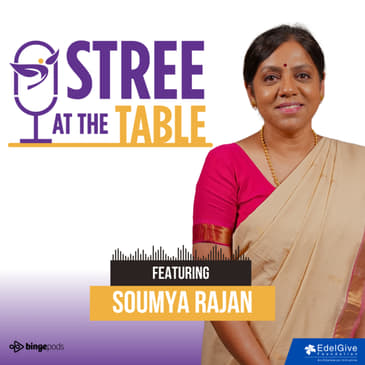
In this inspiring episode of "Stree at the Table," we sit down with Soumya Rajan, the founder and CEO of Waterfield Advisors, one of India's largest independent multifamily offices and wealth advisory firms.
With over 25 years of experience in private banking and wealth management, Soumya shares her journey from a mathematics graduate to a leader in the wealth management industry. She discusses the importance of financial literacy for women, the challenges she faced in creating a fee-based advisory model, and the significance of aligning interests between advisors and clients. Soumya also delves into the unique challenges women face in managing wealth and how her program, Heritage, aims to address these issues by fostering financial literacy and creating supportive networks for women.
Tune in to gain valuable insights on women and wealth, entrepreneurship, and the evolving landscape of wealth management in India.
[00:00:00] When I met an entrepreneur soon after I'd actually given up my job at Stanchard, he said, you know, you've done the most important thing, which is leave your previous employer.
[00:00:09] Because for most people, that's the toughest thing to do. You are financially independent, but you want somebody else to take the control. It's because you feel inadequate about your own ability to manage that money.
[00:00:22] My sincere request to every woman is that at least understand the basics. You may not want to actually have control, but you shouldn't be in a position where you are not aware or educated to be able to make a decision if you have to.
[00:00:37] Most of us tend to shy away from working with difficult bosses because you just feel that, you know, it's too tough.
[00:00:44] The intent is really that when you look back on your career, you'll find that working with some really difficult bosses is really where you learned the most.
[00:01:05] Welcome to another inspiring episode of Stree At The Table, where we highlight the journeys of amazing leaders who are making a significant impact in their fields.
[00:01:14] Today, we have the privilege of hosting a distinguished guest who has made noteworthy contributions to the development and growth of the wealth management industry in India with her client-first approach.
[00:01:26] Soumya Rajan is the founder and CEO of Waterfield Advisors, one of India's largest independent multifamily offices and wealth advisory firm.
[00:01:35] With over 25 years of experience in private banking and wealth management, Soumya's career is a testament to her visionary leadership and entrepreneurial spirit.
[00:01:45] Beyond her professional achievements, Soumya is a passionate advocate for women's financial literacy and independence.
[00:01:52] We are excited to get her insights on women and wealth.
[00:01:56] Soumya, thank you for joining us for Stree At The Table.
[00:02:00] Thank you, Nagma.
[00:02:01] We are very grateful and we are very happy to have you here.
[00:02:04] I have been following you and the fantastic work that Waterfield has been doing for years now.
[00:02:12] And the way it's really made wealth management and money accessible to regular folks like us.
[00:02:19] So, very excited to have you here.
[00:02:21] And to begin this conversation, really, I'd like to go back to very early days of you entering what then was the banking sector,
[00:02:31] you know, foreign banks, Indian banks.
[00:02:34] It was like the banking sector in India was kind of beginning to look very different.
[00:02:38] And you joined ANZ, I think.
[00:02:40] So, and from there to 17 years, you became head of private banking.
[00:02:45] And tell us a little about that journey, because I don't think at the beginning of it, there were enough women.
[00:02:51] But yes, by the time you became private sector, private banking head, there were a lot of women in the room.
[00:02:57] What was that journey like?
[00:02:58] So, thank you, Nagma, for having me on the podcast series.
[00:03:02] It's a real pleasure.
[00:03:04] And to really be able to share a little bit about my journey with everyone.
[00:03:09] When I first got into the corporate sector, this was 30 years ago.
[00:03:14] And at that time, I had just finished a degree in mathematics.
[00:03:18] I'd finished five years of doing two degrees in mathematics.
[00:03:21] And by then, I'd had enough of maths.
[00:03:23] And I was considering a corporate sector job at that time.
[00:03:26] Both my parents were in banking.
[00:03:29] My mom and dad were both from State Bank of India.
[00:03:33] And given the kind of background that we came from, upper middle class, everyone really looked at finding a good stable job.
[00:03:41] Which was either at that time in government, in consulting or in banking.
[00:03:46] Typically, the career choices that were available to you.
[00:03:49] So, given that both my parents were bankers and I'd had enough of maths after the two degrees.
[00:03:54] I said, well, let me try my hand in banking.
[00:03:56] And I remember sending out applications from England to different management, to different banks.
[00:04:03] And GreenLays was the one that I chose.
[00:04:06] Interestingly, the reason one chose it is also because it had the longest training period for management trainees.
[00:04:12] It was about six months.
[00:04:13] And everyone talked about the wonderful facilities that they had for management trainees.
[00:04:18] They did.
[00:04:19] Which is why everyone was prompted to join a foreign bank in particular GreenLays.
[00:04:23] And that really set me off on the journey in the corporate sector.
[00:04:28] And one that I think I've learned so much from throughout that journey and those early days.
[00:04:37] What was wonderful about the bank was that it allowed you to have different job opportunities if you so wanted to.
[00:04:47] So, you could be a generalist or you could be a specialist.
[00:04:50] And for me, if I look back on my career, one of the things that always worked for me was the fact that I'm a bit of a risk taker.
[00:05:00] And I like to move out of my comfort zone.
[00:05:03] So, if there's an opportunity, I'll put my hand up for it.
[00:05:07] And then jump into something.
[00:05:10] And then really try and make the most of it.
[00:05:14] That's a mindset which I think came from the early days.
[00:05:20] Because I'm one of a twin.
[00:05:22] I have a twin sister.
[00:05:23] Okay.
[00:05:23] So, there were no brothers in the house.
[00:05:27] My parents didn't have sons.
[00:05:30] So, we were encouraged to do everything that we possibly could.
[00:05:36] And it didn't matter whether you were a woman or whether in terms of your own career growth.
[00:05:43] Because you were told right from the early days that you could be as good as you wanted to be.
[00:05:52] And it was all about working hard to get to where you want to be.
[00:05:55] So, that's something that I think.
[00:05:57] So, a very nurturing environment at home.
[00:06:00] Extremely nurturing environment.
[00:06:01] My grandmother was actually a master's in history.
[00:06:09] She had done a master's in presidency college in Chennai after she had got married.
[00:06:15] The family came from a background where the motto really was that if you educated a woman, you educated the family.
[00:06:23] If you educated a son, you educated the individual.
[00:06:26] So, right from those background and those values is really the environment around which we grew up.
[00:06:36] Amazing.
[00:06:36] Amazing.
[00:06:37] And then you went on to start your own business.
[00:06:40] So, basically, two stereotypes that we've been carrying for decades, which at least now are getting broken.
[00:06:45] One is that women are not good at math.
[00:06:49] And women are not good at managing wealth or business.
[00:06:53] You've broken both.
[00:06:54] When you first ventured into it, what did the ecosystem tell you?
[00:06:58] What did you hear from everywhere?
[00:07:00] Everyone told me I was doomed to fail.
[00:07:03] I think if I met, you know, 100 people, 90 told me it's not going to work.
[00:07:13] Because the model that we were trying to actually put together at Waterfield was where it was a fee-only and fee-based advisory.
[00:07:22] Yes.
[00:07:22] At that time, there was no one in the industry who was actually doing fee-based advisory.
[00:07:28] Yes.
[00:07:28] It was ahead of its time because I strongly believe that you needed to have an alignment of interest with your clients.
[00:07:35] And the entire wealth management industry was actually one which was what we call distribution.
[00:07:40] Right.
[00:07:40] And distribution was where you made your money from the product manufacturer.
[00:07:44] Right.
[00:07:44] I just felt that that was all wrong.
[00:07:46] Yeah.
[00:07:47] So, but I felt that also the time had come because this was 2010, 2011.
[00:07:53] You had the global financial crisis, which had just happened.
[00:07:56] And you saw the anger that clients had against their banks because they saw that the banks were doing one thing in terms of the way they invested the client money.
[00:08:05] And they were looking at it quite differently in terms of proprietary capital.
[00:08:09] And at that time, I was reading, sitting in the private bank and standard chartered, all these concepts of the family office, clients wanting to take more charge or more control of their own wealth.
[00:08:21] And then I said, well, this is going to happen to India as well.
[00:08:24] It's just a matter of time.
[00:08:25] And that's how really the early stages of thinking about what the company should do started.
[00:08:31] And the intent was that could we create a business where the alignment of interest was complete.
[00:08:37] But in that process, I also realized that there was no regulation to support it.
[00:08:42] So this was August 2011 when the company started.
[00:08:46] And then the regulation for the mutual funds having distributor versus direct codes only came in September of 2012.
[00:08:55] And the registered investment advisory guidelines came in January of 2013.
[00:08:59] Right.
[00:09:00] In that one year, I actually thought, Nagma, I'm going to close the company because every client that I went to would actually turn around and say, why should I pay fees twice over?
[00:09:10] Because I'll pay a distribution fee and I'll pay an advisory fee.
[00:09:13] It makes no sense for me.
[00:09:14] But then when regulation changed, that's when I said, well, we have a business.
[00:09:20] We have an opportunity to build something.
[00:09:23] So the two pillars on which Waterfield really started was one, could there be an alignment of interest, which was fundamentally very important?
[00:09:30] The other is that could we actually be an organization that provided more holistic services to clients in wealth management?
[00:09:38] Because everyone's definition of wealth management at that time was to say that it is about investments.
[00:09:46] They will say, have you invested in a mutual fund?
[00:09:49] Have you invested in a PMS?
[00:09:51] I was thinking wealth management is much more.
[00:09:54] It's about philanthropy.
[00:09:56] Right.
[00:09:56] It is about succession.
[00:09:58] Right.
[00:09:58] It is about tax optimization.
[00:10:01] It's about having the right investment vehicles.
[00:10:03] But who is the client going to serve each of these areas?
[00:10:08] They were only looking at different providers for each of these things.
[00:10:13] But they are busy with their operating businesses.
[00:10:16] They have better things to do in terms of how they could spend their time to do what they really wanted to do.
[00:10:21] So the intent of Waterfield was could we solve for that problem as well?
[00:10:25] Could we be a much more holistic wealth management provider that looked at pulling it all together for the client so that they could do what they did best, which is could be writing a book, could be running their company, could be looking at philanthropic causes.
[00:10:41] But they should have that choice.
[00:10:43] Their choice.
[00:10:43] And today I felt at least in 2011, that choice was not theirs to make.
[00:10:49] So it's not just about taking the risk of starting on your own, but you were challenging an entire industry practice.
[00:10:58] And I would like to stay here for some time just because the nature of pushback or responses would have been hard, to put in widely.
[00:11:09] Very hard.
[00:11:10] And in fact, hard from multiple stakeholders.
[00:11:13] Right.
[00:11:13] So on the one hand, you have your family because the family is actually thinking and a little bit to the point that just covered earlier is that I came from a background where everyone was in a salary job.
[00:11:28] My dad joined State Bank of India, retired from State Bank of India, 30 years in the same company.
[00:11:35] Likewise for my mother, she joined as a probatory officer of State Bank and then left the bank and then didn't take up another formal employment.
[00:11:42] So these were people who only seen one job all their lives.
[00:11:46] So for them, when I'm sitting at, in some ways, the peak of my corporate career at 40 as the head of the private bank, I was the youngest in Standard Charter to have that opportunity.
[00:12:00] They looked at me and said, what are you doing?
[00:12:03] You know, squandering it away.
[00:12:05] Squandering it away or throwing your life away.
[00:12:07] And then here I am telling them that actually, this is an idea.
[00:12:11] I feel very strongly about the way in which business is done or conducted in the wealth management space.
[00:12:19] And, you know, when you're in the corporate sector, you're always sometimes you'll have a cup of chai with somebody and say, oh, let's start something.
[00:12:27] Let me do something on my own.
[00:12:29] I realized that it's one thing to just talk about it as, you know, with a group of friends.
[00:12:35] It's quite different to actually take that plunge.
[00:12:39] And I remember when I met an entrepreneur soon after I'd actually given up my job at Stanchard, he actually told me, he said, you know, you've done the most important thing, which is leave your previous employer to start and embark on an entrepreneurial journey.
[00:12:55] Because for most people, that's the toughest thing to do.
[00:12:59] Cutting the cord is.
[00:13:00] Cut the cord to actually move on to what you believe in and what is your passion.
[00:13:06] But tell me, how did you navigate?
[00:13:08] I mean, I want to hear again from your personal.
[00:13:11] What was your strategy of managing this multiple levels of rejection slash pushback?
[00:13:20] I think what an entrepreneur has, Nagma, is belief.
[00:13:25] No matter what the odds are, you just believe that the.
[00:13:32] If you work hard, again, coming back to the values that were instilled from the early days, if you work hard and if you stay true to what you are building, you will succeed.
[00:13:43] I think the concept of failure, one, I don't think necessarily arose.
[00:13:51] Also, maybe because I think I had a lot of pride to say that, you know, I've come off this, you know, corporate sector job at a high.
[00:14:01] Yeah.
[00:14:01] And I'm not going to let myself down.
[00:14:04] There has to be some motive.
[00:14:06] I think for me, that motive was really, I will succeed.
[00:14:10] And it doesn't matter how long it takes.
[00:14:13] I just fundamentally believe that this is the right thing to do.
[00:14:16] And I also think that also gives you a lot of mental courage.
[00:14:21] Because when you know that you're doing the right thing, you're doing the right thing for the client, you know you're doing the right thing for the ecosystem.
[00:14:28] Then you also feel almost like I have the moral right in many ways to also champion this cause.
[00:14:37] So I know I've had people tell me, Samya, you've almost done it with missionary zeal.
[00:14:43] I do sometimes feel like that because it was something that never existed.
[00:14:48] Advisory never existed in India.
[00:14:50] Now when we look at competition all around, everyone is talking about the advisory landscape.
[00:14:56] But 10 years ago, there was no one.
[00:14:58] There was absolutely no one at all.
[00:15:00] No, it's nothing short of outstanding what you've pulled off and what the industry is following now.
[00:15:07] And there are many young girls who are moving into employment.
[00:15:14] We know there are many.
[00:15:16] At the entry point, there's almost a 50%.
[00:15:18] And at different stages of career, women start dropping off.
[00:15:23] There are also many women who have entrepreneurial ideas, who are looking to raise capital, starting off on their own.
[00:15:30] And there are, it's not even teething problems.
[00:15:34] There are incredible problems that all entrepreneurs and people in workforce, but being a woman brings its own, you know, own set of problems.
[00:15:43] Women have had a very interesting and problematic relationship with money.
[00:15:49] The earning of it, the guilt-free earning of it and the managing of it.
[00:15:53] In your journey again, from employment to entrepreneurship and now managing wealth, what have been some of the things that you are shocked by or you find are difficult to change?
[00:16:04] So, I think one of the things that I've seen with women and money is that they tend to relegate the whole discussion around money.
[00:16:18] Because from, maybe not in this current generation, but certainly in the earlier generations, conditioned to think that it is not something that they need to be fully aware of or understand.
[00:16:32] Because there's always going to be a spouse or there's going to be a brother or a father or someone who's going to look after their financial security as well as, you know, anything related to finance.
[00:16:47] That was a conditioning which was there early on, which I see fortunately now changing.
[00:16:54] You do see it changing.
[00:16:55] I do see it changing.
[00:16:56] And I do see it changing, Nagma, because, you know, what I've seen in Waterfield is that, and I'll just give you a small story here, where we had a client, because we had just launched a new program called Heritage,
[00:17:09] which is really for women entrepreneurs, women inheritors and professionals.
[00:17:14] And I was very keen for women to have a better relationship with money, specifically for that reason.
[00:17:21] And the pillars around that was that all these women are financially independent, but they're not financially literate.
[00:17:29] And there's a big difference in the two statements, because the whole concept of relegating or letting it go to someone else to manage your affairs is because you are financially independent, but you want somebody else to take the control.
[00:17:45] And sometimes the reason why you want someone else to take the control is because you feel inadequate about your own ability to manage that money.
[00:17:54] Women are very fearful that they will make mistakes.
[00:17:58] And if they make mistakes, somebody is going to point a finger to them and say, hey, you lost money.
[00:18:03] And that is something that to the point that you made guilt free, guilt free in a number of ways.
[00:18:08] Yeah.
[00:18:09] Not just in terms of having a job and earning the money, but also that if I invested the money and I invested it wrongly, somebody is going to come after me.
[00:18:18] Or I'm wasting it or my husband will blow me up or my father will blow me up and saying, how did you invest in such a product or service?
[00:18:26] So in that sense, I thought what was very important is that women needed to be better educated and be far more literate in understanding financial concepts so that even if they made an investment, they were making it through the lens of an informed decision.
[00:18:45] They weren't doing it because somebody told them this is a product to invest into, but because they themselves had assessed whether this was an investment worth making or not.
[00:18:56] But they would not be able to do that unless you actually taught them.
[00:18:59] Yes.
[00:19:00] And said, this is what asset allocation is.
[00:19:03] This is what it means to have a financial plan.
[00:19:06] This is what can go right or wrong.
[00:19:08] This is the risk of the investment.
[00:19:10] And what we saw at Waterfield through Heritage is that women also in a larger group, which has only women, will ask all the questions.
[00:19:23] But if you put them sometimes in a group where they are fewer in number with predominantly men, they may not ask the questions for fear of looking silly or asking a foolish question.
[00:19:34] So we needed to take out some of these reasons why women may not open up around finance or otherwise create an environment where they would feel comfortable asking questions.
[00:19:47] Yeah.
[00:19:47] And then really focus on the education.
[00:19:50] Because at the end of the day, life expectancy the way it is, women outlive men.
[00:19:56] They come into wealth much later.
[00:19:59] And when they come into wealth much later, they are then too fearful of how to handle that money.
[00:20:05] So if nothing else, my advice, my sincere request to every woman is that at least understand the basics.
[00:20:15] You may not want to actually have control, but you shouldn't be in a position where you are not aware or educated to be able to make a decision if you have to.
[00:20:24] Do you think also, and I only have anecdotal or observatory remarks on something like this, but do you also think in a lot of cases, women are earning significantly and they do, again, feel guilty that they are equally or in some ways contributing and relegate that responsibility to the male member so that they're now more.
[00:20:47] Or it becomes easier for the family to deal with the fact that she comes with her power of money.
[00:20:54] Is that something that you've also seen?
[00:20:58] I think I would look at it slightly differently.
[00:21:02] And it's an interesting comment that you made because we recently did a study on women and wealth where we interviewed about 100 women who were high net worth individuals,
[00:21:13] had a net worth of more than 10 crores, which is quite substantial.
[00:21:17] Right.
[00:21:18] And we asked them the question, how involved are you in the decision making in your household for your finances?
[00:21:27] What was interesting as a comment that we got back as feedback is that for 42% of homemakers who did not, who were not earning, they were not involved at all.
[00:21:40] Right.
[00:21:40] In the in the in the affairs of the investments or otherwise, where they were earning, only about 40% were involved.
[00:21:50] Yes.
[00:21:50] So it then means that there's a fairly large chunk of women who are in some ways letting another individual in the family control the finances.
[00:22:02] So they don't have agency on their finances.
[00:22:03] They don't have agency on their finances.
[00:22:05] And sometimes it's voluntarily given and sometimes the ecosystem kind of.
[00:22:09] But my my sense also is that it's about multitasking, you know, because women have to multitask all the time, whether it's their kids, whether it's their elderly parents, whether it's their job, their spouse.
[00:22:23] And there are a bunch of different things going on when you have a task which can be given to someone else.
[00:22:29] You don't have to do.
[00:22:30] It's easier to give that task to someone else.
[00:22:33] Yeah.
[00:22:34] So I don't necessarily think it is always conscious.
[00:22:38] It may be it's easier.
[00:22:41] Yeah.
[00:22:41] You know, because I have one less thing to do on my plate, which is why I come back to the statement that it's important that you at least know.
[00:22:50] Yes.
[00:22:51] It doesn't matter if you do or don't participate, but don't don't not participate because you don't know.
[00:23:00] And that is something that is something that I think at Waterfield, we're very conscious.
[00:23:04] We have to correct.
[00:23:05] Yes, we do have to correct a large number.
[00:23:08] Like you said, 60 percent of the women were contributing financially to the household with zero agency over the money or even a vote in how it is being spent, which may not come out of a malicious system or a family that doesn't want more.
[00:23:25] But which definitely needs correction because we're also teaching our next generation how to operate.
[00:23:32] Absolutely.
[00:23:33] Absolutely.
[00:23:33] But I'm actually quite enthusiastic about the next generation.
[00:23:36] I think when I see and certainly what the research showed for us is that the next generation and we were looking at the 22 to 30 year olds, much more interested in their in the financial outcomes, interested in public markets.
[00:23:52] 60 percent were interested in private markets because they're seeing an ecosystem where they're hearing about startups.
[00:23:59] They're hearing about entrepreneurship.
[00:24:01] They're hearing about wealth creation and they want to be a part of it.
[00:24:05] And I think those are extremely encouraging if we look at, let's say, India 10 years later or 15 years later.
[00:24:12] Yeah.
[00:24:13] And yes.
[00:24:14] And what we do with them, how we facilitate them becomes very important, which is why wealth advisory that speaks particularly to women also, because they have vulnerability or they are inhibitions about being wealthier.
[00:24:27] Absolutely.
[00:24:27] And having more to manage needs to be shared.
[00:24:30] And I think the other thing for women, interestingly, you know, was also life events.
[00:24:35] You know, what happens tomorrow if you have a child with special needs?
[00:24:39] What happens if you're going through a divorce?
[00:24:42] What happens if you've lost your job?
[00:24:44] What happens if you want to set up a business and you want to be a solopreneur?
[00:24:50] These are all things that management schools don't teach you.
[00:24:54] Yeah.
[00:24:54] But who do you ask?
[00:24:56] And women don't have enough of those networks.
[00:24:58] Correct.
[00:24:59] In order to even talk more about these issues.
[00:25:02] I think those are the things that we really want to try and address as a company.
[00:25:07] So in terms of the social evils and what women are going through and in life, what again we've observed is that there is a sense of isolation that I am alone and my journey is unique.
[00:25:22] And I am going through so much because I've made these five mistakes.
[00:25:26] But we are actually a community of isolated people.
[00:25:31] And the same, I'm hearing almost a similar parallel with management of money when you're speaking.
[00:25:37] Have you conducted a survey or is this something again you've observed over time or is this something that you've got kind of data on also?
[00:25:45] So I won't say that we have data on this.
[00:25:48] I think for us, I think for us, it's more just anecdotal.
[00:25:50] But certainly what we find is that when we looked at heritage as a program, while one pillar was on financial literacy, the second pillar was actually on networking.
[00:26:03] Because to your point, we didn't want women to feel alone.
[00:26:08] We wanted women to be able to come together as a group and be able to ask each other or at least discuss matters which were related to their financial well-being, which they could do with a group of other women.
[00:26:25] And that financial well-being could also be something like raising capital for my business.
[00:26:29] How do I go about doing that?
[00:26:31] Because these are from the old boys network.
[00:26:36] You can always go back to somebody to ask, well, how did you do it?
[00:26:39] Unfortunately, there are not enough women founders who have even raised capital.
[00:26:45] And there are also not.
[00:26:47] And even statistics show that, you know, venture funding for women is not more than two or three percent.
[00:26:52] It's like that in India, but it's not as if developed countries are any better.
[00:26:56] No, globally, it's just two percent.
[00:26:58] It's just two percent.
[00:26:58] So this is not a phenomena which is uniquely Indian.
[00:27:02] It's a phenomena which is this women founders themselves find it harder to actually go and raise capital.
[00:27:09] So these are things that we think that from a networking lens is very important because as a founder, you actually feel very lonely.
[00:27:19] It's a very lonely journey.
[00:27:21] And I don't know how many people have said that, but I can tell you it is a very lonely journey.
[00:27:25] Most people don't talk about it because they'll always talk about all the, you know, I was successful and I did this and did that.
[00:27:31] It's all romantic after it's done.
[00:27:33] It's done.
[00:27:34] But those that to that point, it's very hard work.
[00:27:37] It's just, you know, constantly, you know, kind of digging deep into your mental strength and mental courage to get through to that point.
[00:27:51] So we think that having these networks within the program will actually help other women so that you can find almost like a safe harbor where you can ask the questions and no one will judge you for what you're asking.
[00:28:07] Because I think that's the other thing about women.
[00:28:09] You're always feeling that you're being judged by whoever in terms of what you do, how you've spoken, how you've conducted yourself.
[00:28:22] It's almost like you're on test and watch that much more in terms of the story.
[00:28:28] A lot of it happens and a lot of it becomes a reflex thought.
[00:28:32] It does.
[00:28:32] You know, and it doesn't serve any of us very well because continuously beyond our scanner is a difficult place.
[00:28:41] It's very difficult.
[00:28:42] And it's surprising how many actually feel that way all the time.
[00:28:46] True.
[00:28:47] And I remember in the corporate sector, you know, we had one of my women colleagues would always say you have to work twice as hard to get half as far.
[00:28:56] Yeah.
[00:28:57] For women in the corporate sector.
[00:28:59] Yes.
[00:28:59] Yes.
[00:28:59] There used to be that whole anecdote, not anecdote, that whole proverb, right?
[00:29:04] You have to work like a dog and you have to work as hard as a man and something like a dog.
[00:29:12] And anecdotes that just made women working hard pedestalized in a way, but also kept a little bit of a gap between, you know, the smarts that are needed.
[00:29:21] Yeah.
[00:29:21] And the access that they deserve.
[00:29:23] Yeah.
[00:29:23] You know, so hard work is there, but the system and the ecosystem also has to serve this hard work.
[00:29:28] And support it.
[00:29:29] Yes.
[00:29:29] Which is now becoming more of a conversation.
[00:29:32] Now you've raised two rounds of capital.
[00:29:34] You've also been good at math.
[00:29:36] Which is, and we were speaking earlier about how that is still a surprise in many conversations that, you know, when anything that looks remotely like numbers is understood by women.
[00:29:46] And what do you, what do you really think is the reason for this even now?
[00:29:53] So, so I'll say a little bit of perhaps just breaking the norm a little.
[00:30:00] Being proficient in maths helps, particularly in the job that I'm in.
[00:30:04] I won't say it doesn't.
[00:30:06] But certainly, you know, raising capital has been something which is something that really teaches you many things, actually.
[00:30:20] One, because one of the things I've realized is in the journey of raising capital as a founder.
[00:30:28] So, I actually wear many hats at Waterfield.
[00:30:31] I wear a hat of a founder.
[00:30:32] I wear the hat of an investor when I'm investing through some of our funds.
[00:30:40] Also wear the hat of GP, LP, you know, also sitting at one level as a CEO as well.
[00:30:48] And each one of these, you've got to think of something or be something different.
[00:30:52] But when it comes to raising capital in particular, as a founder, you have a belief in terms of building the company for a very long period of time.
[00:31:05] And for instance, when I think about my business and I think about Waterfield, I think of building it as a legacy business that it'll outlive me.
[00:31:13] But then when you're raising capital, you're bringing in an investor.
[00:31:17] The investor's lens is very different.
[00:31:20] The investor is looking at, I'm coming in at a price.
[00:31:23] I will also exit at a certain price.
[00:31:28] Their time horizon is much shorter.
[00:31:32] It can be five years.
[00:31:33] It can be seven years.
[00:31:34] If you're lucky, it'll be 10.
[00:31:36] But that is a fundamental shift that founders and entrepreneurs need to be comfortable with.
[00:31:44] That you have a 20 or 25 year view on the company that you're building.
[00:31:52] The person who's entering has a very different view.
[00:31:55] And therefore, the role of actually a board is so important at that stage because it's trying to marry that.
[00:32:05] I won't call it a disconnect because it's not boards.
[00:32:09] Investors are very supportive.
[00:32:11] But it's about managing that expectation, which is quite different.
[00:32:15] For the first three years of Waterfield, I never raised external capital because I was quite convinced that an investor will come in and they will just change the way in which I want to build this business.
[00:32:29] And it'll destroy the values, culture, and all that.
[00:32:34] These are the notions you have.
[00:32:35] And again, I didn't have friends as entrepreneurs who I could actually talk to because just the ecosystem was more salaried professionals who were there.
[00:32:44] But then what I realized is that investors, the board can be incredibly supportive in that journey.
[00:32:51] Because at the end of the day, to scale a business, you do need capital.
[00:32:56] And without that, you can't really have the desired impact that you want.
[00:33:02] But as a woman founder, again, research has shown that women tend to hire more women.
[00:33:09] So if women founders actually scale their business, chances are you have more employment for women.
[00:33:17] And that in itself will have a multiplier effect.
[00:33:22] But not enough women raise capital.
[00:33:25] Most of them tend to be solopreneurs.
[00:33:27] Correct.
[00:33:27] And they are hesitant to how do I raise capital.
[00:33:31] And the whole question of finance versus somebody's going to get diluted.
[00:33:35] How much stake am I going to have pre-money, post-money?
[00:33:38] I mean, all those jargon that gets thrown at you can be quite overwhelming.
[00:33:43] I think here it's important to take a step back saying raising capital can be good for you.
[00:33:49] Having the right investor can be great for you.
[00:33:52] You can actually scale and create an impact which is much bigger than you ever imagined possible.
[00:34:00] And that's the journey you have to embark upon.
[00:34:02] True.
[00:34:03] And with a very positive lens, I think that's very important.
[00:34:07] That ultimately, you have to think that when you're raising capital, it's a win-win for everybody.
[00:34:14] Because if you start with a win-lose, then it's never going to go far.
[00:34:18] So you have to stay the course.
[00:34:21] Why, according to you, is this 2% block?
[00:34:28] Not just in India, globally, the fact that only 2% women entrepreneurs are able to raise capital.
[00:34:34] What are the structural issues that prevent it?
[00:34:36] One big structural issue that I think is that we don't have enough women investors.
[00:34:43] You don't have enough women sitting in these funds or sitting on the other side of the table who are able to resonate with what it means for the woman to get to this point to seek capital.
[00:34:59] And I think that's a big, big deterrent.
[00:35:02] Absolutely.
[00:35:03] Because the way in which the conversation or the lens through which maybe men are looking at the opportunity or otherwise may be quite different.
[00:35:12] Which is why you even, for instance, seek, even on a board, you are always seeking diversity on the board.
[00:35:18] Why is it that we say you want at least 2 or 3 women on a board?
[00:35:22] Because you know the conversation and the discussion that you're going to have on a particular topic is going to come with different perspectives.
[00:35:30] Correct.
[00:35:31] So if you don't have enough women sitting as investors asking the questions which could be a little bit more about, you know, different aspects of the business which may not come naturally to the way someone is thinking and who may be male.
[00:35:47] I think that's a huge structural change that needs to happen in the first instance.
[00:35:52] We need to see more women who are sitting on the other side.
[00:35:57] And I think that for me would probably be the biggest game changer.
[00:36:02] One of the reasons why even for me personally, when I invest and I do any kind of private equity and venture investing, I will only support women founded funds.
[00:36:15] Because I know that if you have, if we're empowering that woman to have money that she can deploy into other companies, it's going to be a much more powerful domino effect in the longer term.
[00:36:29] Absolutely.
[00:36:30] And now that you are involved again with watching and participating with women investors, women of wealth, women in different roles, whether with an employment on ways.
[00:36:42] What are two or three of the messages that you would like to land with women as far as wealth, ownership, management of wealth is concerned?
[00:36:51] So I think for me, don't be afraid.
[00:36:58] I think getting over the fear is probably the biggest thing, particularly when it comes to money and managing money.
[00:37:08] Take the time to educate yourself.
[00:37:11] I think that for me would be a big thing.
[00:37:14] The third is really spending time to understand what are the goals of that wealth.
[00:37:27] Because I feel too often you have some finances or money.
[00:37:35] Women tend to be quite goal oriented in terms of where they want to, what is the outcome they want for their wealth.
[00:37:44] I would tell women spend some time to understand what that outcome looks like for you and then work backwards in terms of the investment, investments that you want to make.
[00:37:55] Because if you start creating an investment portfolio where the outcomes are quite different, then you may end up with suboptimal choices that you make on the portfolio itself.
[00:38:06] So for me, overcoming the fear first.
[00:38:10] Second is just educate yourself.
[00:38:13] And third, let the wealth have a meaning.
[00:38:17] These would be three takeaways.
[00:38:20] Lovely.
[00:38:20] A lot of what your journey has been has been to an environment in your early years where being a woman was not considered as a disadvantage in any form or fashion.
[00:38:35] Disadvantage may be a strong word, but you know what I mean.
[00:38:38] The biases that come.
[00:38:40] And in this current generation, as we are raising the next generation of children,
[00:38:46] if you have to think of two, three things that we may want to purposefully plant in our children or avoid in particular, what would that be for you?
[00:38:57] So, great question.
[00:39:00] I think women particularly just put a lot of pressure on themselves.
[00:39:06] Maybe children as well.
[00:39:08] They just put too much pressure on themselves.
[00:39:11] And perhaps in today's day and age of social media, there is an expected manner in which everyone is supposed to be.
[00:39:20] I feel somewhere that we shouldn't lose sight of the genuine authenticity of people and the genuineness of who the person is.
[00:39:30] And I think that genuineness and authenticity will help anyone in any professional capacity or personal capacity.
[00:39:42] Because I see that building genuineness, authenticity is fundamental to the way in which they will be perceived and they will grow.
[00:39:52] So, staying true to that, and I say it more particularly for women, because I think somewhere you end up being who you think the other person expects you to be.
[00:40:04] True.
[00:40:04] Whereas you need to be who you are.
[00:40:07] And if you're, so let's say you're in the corporate sector, you are an introvert by nature.
[00:40:13] You don't have to be an extrovert to be recognized.
[00:40:16] You can be recognized in many other ways.
[00:40:18] I remember getting some very good advice early on saying that, you know, it's not about being aggressive.
[00:40:24] It's about being assertive.
[00:40:25] And there's a difference.
[00:40:28] There's a very fine line in both those words.
[00:40:30] In the generation that I grew up in, it was about women had to be aggressive to get noticed and to, you know, go up the corporate ladder.
[00:40:41] And the advice that it's important to be assertive is, it was a good one.
[00:40:46] Because then you know then that you continue to always play to your strengths.
[00:40:52] And that's the other big belief I have is that play to your strengths.
[00:40:56] You know, everyone has weaknesses.
[00:40:58] We know that.
[00:40:59] But in a corporate job or in, if we're trying to move up the corporate ladder, play to your strengths always.
[00:41:08] I would also say that find the best leaders to work with.
[00:41:13] Most of us tend to shy away from working with difficult bosses because you just feel that, you know, it's too tough.
[00:41:20] You know, they're going to make me work 24 by 7 and, you know, I'm going to have, you know, be the dog's body.
[00:41:26] But the intent is really that when you look back on your career, you'll find that working with some really difficult bosses is really where you learned the most.
[00:41:36] So early on in your career, be true to yourself.
[00:41:41] Make sure that you work with really good bosses because you'll imbibe the most at that point.
[00:41:49] Be genuine and authentic because that's what will help you grow.
[00:41:56] And I think the fourth would also be you have to be competent in your job.
[00:42:00] No one's going to make any, you know, kind of give you any extra points if you're not good at what you do.
[00:42:08] Yeah.
[00:42:08] And everyone has to remember that, that you've got to be fundamentally competent.
[00:42:14] And again, the motto, being a student for life, I think is something that has to be imbibed.
[00:42:22] You have, you will always be a lifelong learner.
[00:42:26] You have to just assimilate that.
[00:42:29] That's not going to change.
[00:42:30] So whether you're 20, whether you're 30, whether you're 60, always be open to learning because that is fundamentally how you grow as a person.
[00:42:40] So these would be some of my.
[00:42:41] Thank you.
[00:42:42] Thank you so much.
[00:42:43] Thank you so much for coming here.
[00:42:45] Thank you for the insights.
[00:42:46] There's a lot that we've taken away from this conversation.
[00:42:49] And I hope everyone who's heard it and seen it is feeling the same.
[00:42:55] Thank you very much.
[00:42:56] Thank you so much.
[00:42:57] It was such a pleasure.
[00:42:58] Thank you.
[00:42:58] Thank you.