
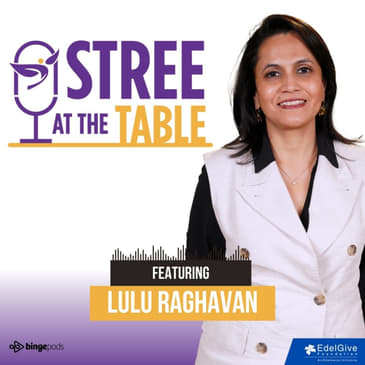

In this captivating episode of Stree at the Table, our host Naghma Mulla sits down with the dynamic Lulu Raghavan, President APAC, Landor. Lulu shares her transformative journey from her multicultural upbringing to becoming a global leader in branding. Discover how her experiences have shaped her leadership style and her commitment to advocating for diversity and empowering women in leadership roles. This episode is packed with insights on navigating career challenges, the importance of mentorship and sponsorship, and the power of owning your personal brand.
Tune in to be inspired by Lulu's remarkable story and her dedication to breaking barriers for women everywhere
[00:00:00] You have to put your money where your mouth is.
[00:00:01] Absolutely.
[00:00:02] When you have the voice, advocate for women.
[00:00:05] Madeleine Albright, who said that there's a special place in hell for women who are mean to other women.
[00:00:12] I don't want to be the woman who's mean to other women.
[00:00:16] Separate your identity from the work.
[00:00:19] You might have 999 positive comments saying how much they love the book and how they learned so much from it and how fabulous it was.
[00:00:28] And there'll be one comment there which said, oh, it was just nothing new.
[00:00:33] You just regurgitated.
[00:00:34] If you're mature, you can get over that.
[00:00:37] And that inner drive can be as simple as wake up, dress up, show up.
[00:00:43] It's that power to soldier on no matter what.
[00:00:46] And I think for the last 25 years of my career, I've woken up, dressed up, showed up and it's a new day.
[00:01:04] Welcome to Stree At The Table.
[00:01:06] The podcast where we bring powerful women to the forefront.
[00:01:10] Those who are not just part of the conversation, but are also leading it.
[00:01:14] I'm your host, Nagma.
[00:01:15] And today we have an extraordinary guest whose work is transforming the landscape of branding and setting a new standard for women in leadership.
[00:01:24] Lulu Raghwan is a force to be reckoned with.
[00:01:27] As the president of APAC, Landor & Fitch India, she has reshaped some of the world's most iconic brands and led a team of creatives and strategists with unparalleled vision and expertise.
[00:01:40] But her influence goes far beyond the boardroom as she is an advocate for diversity, a mentor to many and a role model for women striving to break through the glass ceiling.
[00:01:51] In this episode, we go into her journey from her roots in a multicultural upbringing to becoming a global leader in brand transformation.
[00:02:00] So, if you're ready to be inspired by a woman who is not only at the table, but redefining what it means to lead, this episode is for you.
[00:02:10] Let's get started.
[00:02:12] Lulu, welcome to the show.
[00:02:14] And thank you so much for joining us.
[00:02:17] We have been eagerly waiting to have this conversation with you.
[00:02:21] Thank you so much, Nagma, for having me.
[00:02:23] Yeah, we've been hearing a lot about you.
[00:02:25] I've been following you for years, really.
[00:02:27] You are one of those people that I've been admiring for not just having one perspective.
[00:02:33] You always put yourself out, been quite vocal.
[00:02:37] So, having you here gives me a chance to really probe a little bit on your journey.
[00:02:43] The reason why we do this podcast, Lulu, is that those women who have risen the ranks,
[00:02:48] you know, achieved a certain amount of, you know, aura, credibility, position.
[00:02:55] They are role models to many, many other young people, women and men.
[00:03:00] But there seems to also be a little distance between what regular people in careers think they are
[00:03:07] and what they imagine successful people look like.
[00:03:11] When someone like you reaches there, it becomes important to probe a little bit and understand
[00:03:15] what has been your journey like.
[00:03:17] And from all the early readings that you've done, you've had almost a global, you know,
[00:03:23] early stage in your life.
[00:03:24] How did that motivate or how did that influence your choices in early life?
[00:03:31] Being many places all at once, knowing many languages.
[00:03:35] Thank you.
[00:03:36] You've obviously researched me well.
[00:03:40] Yes.
[00:03:41] So, even within India, where I grew up for the first 18 years of my life,
[00:03:46] I lived across Bangalore and Mumbai, but was in many different schools.
[00:03:51] So, I've always had to adapt to learn to make new friends, learn to adjust to a new environment
[00:03:58] and frankly, survive and thrive wherever I was.
[00:04:03] So, that was good training ground.
[00:04:05] And then I got a scholarship to study in the U.S. for my undergrad.
[00:04:10] I went to Davidson College in North Carolina.
[00:04:12] And it was the first time I was going abroad, going alone.
[00:04:18] Hugely different experience.
[00:04:21] I was in North Carolina where at that point in time, there weren't many Indians.
[00:04:24] And getting out of your comfort zone from quite a protected upbringing in Mumbai to being in the U.S.,
[00:04:35] having to figure everything out for yourself is a huge wake-up call.
[00:04:40] That was great grounding.
[00:04:42] Everything from learning how to study and do well in college to just managing yourself.
[00:04:49] Life skills is something that I learned undergrad.
[00:04:52] I was also fortunate that my scholarship at Davidson gave me an opportunity to do six months in France.
[00:05:00] So, I lived with a French family, spent time understanding the people and the culture in France.
[00:05:08] And that broadened my perspective.
[00:05:11] And of course, at Davidson, we had many international students.
[00:05:14] I was also the president of the International Students Association.
[00:05:17] So, I got a real opportunity to know how people from different cultures thought, how they lived,
[00:05:25] their fears, their anxieties, their aspirations as well.
[00:05:29] That was really good grounding.
[00:05:31] And so, I would say that those early influences of my education
[00:05:37] really helped me have more of a global perspective and not be limited by just the upbringing that I had in India.
[00:05:48] So, exposure to different worldviews, different ways of thinking, of living,
[00:05:54] that exposure was helpful at that young age because it also helped me determine choices that I wanted to make,
[00:06:01] whether choices about marriage, choices about children, about career, and frankly, the way you want to live your life.
[00:06:09] Yes.
[00:06:10] Those were very influential in the early days.
[00:06:13] So, a question I have is, you know, it sounds very adventurous that you have such a range of experiences.
[00:06:21] You had to go through so many new decisions that you needed to make, so many new situations.
[00:06:26] Does it ever get easier?
[00:06:29] It does.
[00:06:31] Because you've been there, you've done that.
[00:06:34] You have to just channel that confidence.
[00:06:38] Another example is speaking, right?
[00:06:41] You think that once you speak publicly, you get over the fear and the next one will be easy.
[00:06:49] It's never easy.
[00:06:51] It's easier.
[00:06:53] I still have that stage fright once in a while when I suddenly have 200 new clients to impress or a big stage.
[00:07:01] But I remember having conquered it and I just close my eyes and think back to those successful moments
[00:07:09] and take a deep breath and remember how fantastic it was, how great I felt, and then just let go.
[00:07:17] So, yes, it does get easier, but the fear never fully goes away.
[00:07:25] Similarly, with meeting new people, you have that confidence that you can draw upon,
[00:07:31] but each time you just have to overcome, you know, a few jitters you may have.
[00:07:36] You've been in leadership roles for more than 15 years now and, you know, with different people of different cultures, backgrounds.
[00:07:47] What is it about India as a country in terms of cultural norms, in terms of how we view leadership and particularly women in leadership?
[00:07:57] Is it uniquely different?
[00:07:58] Is it the same everywhere?
[00:08:00] Because as an Indian people, we believe some of it is unique to us.
[00:08:05] But are we really that unique or the way we look at leadership as well as women in powerful positions?
[00:08:10] How common or how dissimilar is it?
[00:08:13] That's a hard one because there are companies in India that are more international in their outlook and very progressive.
[00:08:24] There are those companies that are more conservative and have a different value system.
[00:08:30] So I think it's hard to paint everyone with the same brush.
[00:08:35] Having said that, generally in India, you don't have that many women leaders, that many role models,
[00:08:45] other than industries like financial services, where there have been many in the past and several now as well,
[00:08:53] perhaps public sector organizations as well.
[00:08:55] And so there are things that are very unique to corporate life in India.
[00:09:02] Yeah.
[00:09:03] For example, things do tend to be very hierarchical within an organization.
[00:09:09] You have to be careful what you say, who you say to.
[00:09:14] The opportunities to speak freely are also sometimes limited.
[00:09:20] Again, you have to be careful in some organizations in the West.
[00:09:25] You are encouraged to speak your mind.
[00:09:28] Yeah.
[00:09:28] I know you can't always do that here.
[00:09:31] In India, I also think being a woman, being young, perhaps having had an education or having lived abroad,
[00:09:40] all of those are for a while held against you.
[00:09:43] Yes.
[00:09:43] Because it's almost like you're from another planet.
[00:09:46] Yeah.
[00:09:46] And you have to work from the ground up, establishing credibility, establishing those relationships,
[00:09:55] and seeking common ground with your stakeholders.
[00:09:58] Yes.
[00:09:59] So yes, it is different in those regards.
[00:10:01] But as the world opens up and Indian companies do business globally,
[00:10:08] there's a lot more similarities coming in.
[00:10:12] Yes.
[00:10:13] No, I'm so glad you made that point.
[00:10:15] For many women who are in mid-management, moving into senior management,
[00:10:20] this does become that space where there's a lot of uncertainty, a lot of self-doubt.
[00:10:27] Are we doing the right things?
[00:10:28] Are we saying the right things to the right people?
[00:10:30] There is some...
[00:10:32] Are there some ways where women should fall back onto...
[00:10:36] Or some reliable ways of navigating that space?
[00:10:40] Because we lose a lot of very high potential women apart from the fact that there are pregnancies and marriages and all of that.
[00:10:48] There's also this self-doubt that impairs a lot of careers.
[00:10:52] What, according to you, are some of the ways in which women can and should navigate this?
[00:10:57] I think a support system is extremely important.
[00:11:02] Indra Nui famously talks about the choice of spouse or partner.
[00:11:08] And I do think it starts there.
[00:11:10] For those who have a partner, having a supportive spouse, supportive family members is extremely important.
[00:11:18] Because your equilibrium or lack of at home carries through to the workplace.
[00:11:25] A lot of either confidence is seeded at home or the lack of also starts from there.
[00:11:33] So I believe that a lot of times self-work or therapy with, you know, couple therapy, all of that needs to happen.
[00:11:44] And you have to be in a good place at home to get that confidence.
[00:11:50] That's where a lot of people get their source of strength from.
[00:11:53] Yes.
[00:11:54] So that's one.
[00:11:55] Second, I think the role of coaches is hugely important.
[00:12:04] Yeah.
[00:12:04] Because a coach can show you the mirror.
[00:12:06] A coach can help you ask questions.
[00:12:08] A coach can help you see those blind spots and guide you.
[00:12:13] Yeah.
[00:12:14] Having mentors is also very important.
[00:12:17] Mentors and even sponsors.
[00:12:19] Yeah.
[00:12:19] In an organization.
[00:12:20] Somebody who's willing to stick their neck out and say, you know what?
[00:12:24] I'm going to get you ahead.
[00:12:25] You've spoken about mentorship in many places.
[00:12:28] Like when we were reading about you, you've time and again spotlighted the fact that we need to look for mentors.
[00:12:36] We need to seek them.
[00:12:39] Do women do that enough?
[00:12:41] And what should one be looking for in a supportive mentor?
[00:12:45] No, I don't think women do that enough.
[00:12:49] I didn't when I was growing up.
[00:12:52] In fact, mentorship wasn't even talked about.
[00:12:55] Yeah, it wasn't talked about.
[00:12:56] It wasn't such a concept, right?
[00:12:58] It's probably gained currency in the last four or five years, I would say.
[00:13:04] It is hugely important because you have to learn from others, from their journeys, what they did well, what they didn't do well.
[00:13:15] They can help you guide the way and not make those same mistakes again.
[00:13:19] So actively seeking out mentors in your organization, outside of your organization, in the industry or from some other industry, I think is hugely important.
[00:13:29] Absolutely.
[00:13:29] You should do that.
[00:13:30] I think you should constantly read and look out for those people who have a spark, who have some energy, who are doing great things for their companies or for other organizations.
[00:13:43] Seek them out.
[00:13:45] Now it's easier than ever.
[00:13:46] I can't tell you, Nagma, how many people reach out to me on Instagram or LinkedIn.
[00:13:52] And many of them I end up having a coffee with or speaking to virtually.
[00:13:58] And sometimes depending on my mood, I might even say, yes, I'll mentor you.
[00:14:02] Yes.
[00:14:02] So you have to reach out and ask.
[00:14:04] Yes.
[00:14:05] And I've done that within my organization.
[00:14:07] But I find too many people hesitate to ask.
[00:14:11] They're so sure of being turned down.
[00:14:13] And that's like the larger percentage.
[00:14:16] But I'll tell you, there's also a way to ask.
[00:14:18] Because you can't just send somebody a LinkedIn request for the first time and say, will you be my mentor?
[00:14:24] Yeah.
[00:14:25] There's no reason that that person is going to say yes.
[00:14:28] But I'll give you an example.
[00:14:29] There are people who comment on my posts, who have followed me for a year, who've said something, congratulated, made an insightful comment or sent me an article.
[00:14:42] And their name has been popping up for a while on my feeds.
[00:14:46] And I can see that they're very invested in following my journey, learning from me.
[00:14:51] Now, when this person's email comes into my inbox, it's very warm already.
[00:14:57] You take note.
[00:14:57] And I take note.
[00:14:58] Yes.
[00:14:59] So that's what you need to do.
[00:15:00] I keep telling young people who I mentor, identify eight to 10 people in the industry, men and women who are doing great work, who you're inspired by.
[00:15:10] Start following them, you know, show up where they might be at a conference and go for it.
[00:15:16] Absolutely.
[00:15:17] That is such brilliant, doable advice.
[00:15:20] You also spoke about sponsorship.
[00:15:23] I know for a fact that that word is not very well understood, especially by younger professionals.
[00:15:30] It's understood, unfortunately, after people have burned some fingers and realized that they do need a sponsor.
[00:15:37] Can you, in your words, kind of elaborate the importance of a sponsorship and also how to go about it?
[00:15:42] I mean, for me, sponsorship is when you are in a decision making capability and you choose to put a woman in a senior leadership role where you're advocating for a woman.
[00:15:58] So there's a position and there are lots of like candidates.
[00:16:02] You say, actually, we should choose her because.
[00:16:06] Yeah.
[00:16:07] Within the organization, it's hugely important.
[00:16:09] I'd like to openly say that wherever possible, I do promote women and I have a good track record of doing so as well because you have to put your money where your mouth is.
[00:16:19] Absolutely.
[00:16:19] You can't just keep mentoring women.
[00:16:21] But when you have the opportunity, not put somebody there.
[00:16:25] Having said that, I've promoted lots of men as well.
[00:16:28] Of course, it has to be on capability.
[00:16:30] Yes.
[00:16:30] And competence.
[00:16:31] But when you have the voice advocate for women.
[00:16:34] Yeah.
[00:16:35] Yeah.
[00:16:35] You know, it was, I think, Madeline Albright, if I'm not mistaken, who said that there's a special place in hell for women who are mean to other women.
[00:16:46] And I don't want to be the woman who is mean to other women.
[00:16:50] You know, I want to be the one who's lifting other women, giving them as many opportunities as possible.
[00:16:57] But of course, the foundation has to be competence.
[00:16:59] If you're not competent.
[00:17:01] Yeah.
[00:17:01] There's no question.
[00:17:02] Yes.
[00:17:03] But once you cross that bar, giving women more opportunities, I think is the best thing you can do.
[00:17:09] And so that's a sponsor.
[00:17:10] Yeah.
[00:17:10] Or someone who will say, I've identified this young woman in the organization.
[00:17:15] She has great potential and I'm going to stick with her, mentor her, coach her and try to get her ahead in every opportunity.
[00:17:23] So as a young professional, one must seek both mentorship as well as sponsorship in the environments in which they work.
[00:17:30] Yeah.
[00:17:30] Sponsorship has to be something that you earn.
[00:17:35] Yes.
[00:17:35] You can't go and ask for it.
[00:17:37] You can't ask somebody, right?
[00:17:38] But the way you build a relationship and establish yourself, a mentor or somebody senior in the organization can.
[00:17:47] Should feel compelled to become your sponsor.
[00:17:50] And a sponsor could be also, you know, in a boardroom setting or in a management team meeting.
[00:17:54] Yeah.
[00:17:54] You're just advocating for a woman much more vigorously than you would advocate for a man.
[00:18:03] And lots of men do this as well.
[00:18:05] Yes.
[00:18:05] And they say, you know, this woman is going to bring these particular qualities.
[00:18:09] So let's do it.
[00:18:10] Yes.
[00:18:11] That's what's required.
[00:18:12] Sponsors are those who are truly advocating for women when it matters.
[00:18:16] Yes.
[00:18:17] How does one become a responsible, strong sponsor?
[00:18:21] Again, many women are watching this.
[00:18:23] Many men are watching this.
[00:18:25] When we come into positions of power, we also hold some responsibility to ensure that the door opens for those who are deserving.
[00:18:33] While I will come to the questions around how does one put oneself out.
[00:18:38] But as a person in power, how do we use this power responsibly?
[00:18:46] I think first, you have to want to use it.
[00:18:49] Right.
[00:18:50] You have to be conscious and aware that you have the ability to influence change.
[00:18:58] And this is your opportunity to do so.
[00:18:59] The second part of it is fairness is important.
[00:19:04] Fairness and transparency.
[00:19:06] Because the last thing I want is men in the organization to feel like it was not a fair choice.
[00:19:12] Yeah.
[00:19:12] And just because she's a woman, she got it.
[00:19:15] That's not nice for the woman, for other people on the team or for the organization at large.
[00:19:21] And so making sure that you make the choice for the right reasons is super important as well.
[00:19:28] I would say when you have that power, you should also seek out women who are competent and just build your network of women professionals who you can keep in mind for opportunities, whether it's to recommend them to be on a board, to join an organization or generally have a lot of successful women in your network.
[00:19:50] I think that's something that you have a responsibility to do.
[00:19:54] No, lovely.
[00:19:55] You are in the world of branding and you have your own legacy in this universe.
[00:20:00] And I was reading your book, which is, by the way, a phenomenal book.
[00:20:05] I think too many, too many points that are going to stay with me for a while.
[00:20:10] But when I was also looking at the journey of how you have also highly recommended that a person owns one's own brand,
[00:20:19] I was thinking particularly about women who have an additional barrier of shying away from owning their own space.
[00:20:27] So brand is a distant dream.
[00:20:29] Just being confident enough to say that I am good takes a bit of a journey.
[00:20:35] Again, in your opinion, how does there's that extra mile that that woman has to travel?
[00:20:41] In your view, have you seen that difference even in the industry you come from?
[00:20:49] I have.
[00:20:50] And I must say there's a lot of work that's been done in the last several years of getting women to recognize their inherent self-worth.
[00:21:01] Because it's a huge problem.
[00:21:02] Yes.
[00:21:03] That women like to do the work.
[00:21:06] They don't like to talk about it.
[00:21:07] But the issue is, Nagma, you can't be a workhorse beavering away in the corner and thinking that your work will speak for itself.
[00:21:16] It never will.
[00:21:18] There's just too much out there.
[00:21:20] You have to be visible.
[00:21:23] You have to showcase your achievements.
[00:21:25] You can't only showcase your achievements.
[00:21:27] It has to be a balance of delivering and doing the work, but also showcasing.
[00:21:33] That's the most powerful combination.
[00:21:36] But I do believe that women are starting to recognize that they need to stand out and stand for something.
[00:21:47] Yeah.
[00:21:47] And yes, it's difficult.
[00:21:51] But people are overcoming that barrier because they can see others doing it.
[00:21:55] Now with platforms like LinkedIn, you can see other women making that journey of talking about their achievements, being a voice on a particular issue.
[00:22:06] You can see how they've built their brand.
[00:22:09] There's also been a very remarkable initiative by Google called Hashtag I Am Remarkable.
[00:22:17] They have Hashtag I Am Remarkable coaches around the world.
[00:22:21] They have a platform so you can Google it.
[00:22:24] And it's an initiative that helps women recognize their inherent self-worth and helps them overcome their barriers to talk about their achievements and not be shy about it.
[00:22:38] Personally, I feel there's a balance of screaming from the rooftop and doing the work.
[00:22:45] But I think if you can strike that balance well, then you have a very powerful personal brand which can open doors for you and create those opportunities which you dream of.
[00:22:58] But you don't need to take control of the narrative.
[00:23:00] You've got to, as you said, own your space.
[00:23:03] Yeah.
[00:23:04] And be unbashedly unapologetic about standing for something and standing out rather than just blending into the sea of sameness.
[00:23:16] I think a lot of fear also comes apart from the fact that, you know, inherent shyness to own one's space is there.
[00:23:23] But we see a lot more harsh criticism coming for, you know, women who speak their minds.
[00:23:33] Sometimes it may be fair.
[00:23:34] A lot of times it's unfair.
[00:23:36] Like whatever we see, whatever many men get away with, women are highly criticized for.
[00:23:42] How does one navigate with that?
[00:23:44] How does one prepare for it?
[00:23:46] Because, see, the thing about a brand is when you put yourself out, you have to be ready for everything.
[00:23:51] Right?
[00:23:51] Yeah.
[00:23:51] It can't always be roses and it's not always going to be.
[00:23:54] In fact, if the work is of any merit, there will be criticism.
[00:23:58] Yeah.
[00:23:59] But how does one find that space of being comfortable with what comes or be prepared for the harsh responses that also come with putting one's thoughts out?
[00:24:09] That's a really deep question and an important one.
[00:24:14] In fact, one of my favorite books is Elizabeth Gilbert's Big Magic, where she says that so many of us hesitate from writing a book or creating some art because we're so scared of the criticism, of rejection, of negative feedback, of people telling us that we're not good enough.
[00:24:37] But once you put yourself out, you should also, you know, be resilient to anything that people can say.
[00:24:51] When it comes to gender, I would encourage women not to go down the path of, oh, they're bashing me up because I'm a woman.
[00:24:58] Just leave that out.
[00:25:01] It can be very, very difficult.
[00:25:03] Sometimes these trolls can be very hurtful.
[00:25:06] Some authors say they don't ever read the reviews.
[00:25:10] Have you read yours?
[00:25:12] I have read mine.
[00:25:13] I have read mine.
[00:25:15] There are people who've given some feedback.
[00:25:18] You have to look at feedback as a gift and not take it as criticism, not take it very personally.
[00:25:25] You know, I'm in the creative business.
[00:25:27] Our clients trash us every day, trash our ideas, I should say.
[00:25:31] Right.
[00:25:32] Yeah.
[00:25:32] No matter how much work and passion we put into it, somebody in the room will say,
[00:25:37] Maza nahi ayaa.
[00:25:38] Or this is not on brand.
[00:25:40] And so I've learned over the years, Nagma, that you've got to be able to separate your identity from the work.
[00:25:52] And say, okay, that's what they feel about the work.
[00:25:55] It's not me.
[00:25:56] Yes, I've written it, but it's what I've written that they're criticizing.
[00:26:00] And not everybody is going to like what you've done.
[00:26:03] So you just need to have thick skin.
[00:26:06] I would say, yes, it can be hurtful.
[00:26:10] If you are going to read all of the comments, take it with a pinch of salt.
[00:26:14] The problem with the human mind is you might have 999 positive comments saying how much they love the book and how they learned so much from it and how fabulous it was.
[00:26:26] And there'll be one comment there which said, oh, it was just nothing new.
[00:26:31] You just regurgitated everything that everyone else has said.
[00:26:35] And that will stay in your mind forever.
[00:26:38] Right.
[00:26:39] But if you're mature, you can get over that.
[00:26:42] But that also brings us back to what you said very early on, which is at the core of it all, it is what is your sense of self-worth?
[00:26:50] And are you comfortable with who you are, with all your goods and bads?
[00:26:54] And that journey needs to be covered.
[00:26:58] That's a journey.
[00:26:58] That's a journey.
[00:26:59] And a lot of us, I'm the first one to say it, I'm a huge people pleaser.
[00:27:04] And as you become more senior, as you become the leader, you've got to let go of that because you can't please all people.
[00:27:13] People will say negative things about you.
[00:27:16] And as long as you have a conscious that you're doing the right thing and are not doing anything wrong to people, people can still have negative opinions about you.
[00:27:27] And you just have to learn to live with it.
[00:27:29] Now, especially because you said you're a people pleaser.
[00:27:31] How do you say or how do you manage to say no?
[00:27:34] That was the journey.
[00:27:36] And I've also written about in my book in the handy how to section of how to say no.
[00:27:41] Nagma, it's so hugely important to say no when it comes to taking on more work, saying no to doing something extra, saying no to people who are draining your energy, saying no to perhaps some advances that may happen to you, not work for you.
[00:28:03] So it's important.
[00:28:05] It's a muscle that you have to practice.
[00:28:07] You know, it gets better as with practice.
[00:28:13] It starts with the understanding that you do have power.
[00:28:19] You can say no.
[00:28:21] And once you start saying it, it's fun.
[00:28:24] It's fun.
[00:28:25] It's hugely fun.
[00:28:26] And I'll tell you something with the Indian psyche.
[00:28:29] Yeah.
[00:28:30] I've realized this in India.
[00:28:31] People do not like a no.
[00:28:35] And we as Indians don't say no.
[00:28:38] So we don't say no.
[00:28:39] We don't like to hear a no.
[00:28:40] Absolutely.
[00:28:41] Absolutely.
[00:28:42] You know, sometimes I'm again saying I'm in the in the creative business.
[00:28:45] So we are always looking for clients.
[00:28:48] We do pitches, etc.
[00:28:50] So many times people just leave us hanging.
[00:28:52] And I just ask, can we just close the loop here?
[00:28:54] Is it a yes or a no?
[00:28:56] We're quite happy.
[00:28:57] No, you didn't go with us.
[00:28:59] That's fine.
[00:28:59] But can you just close the loop?
[00:29:01] Similarly, when you ask people, it's just so vague.
[00:29:05] I take it upon myself very clearly.
[00:29:08] I say yes or no.
[00:29:09] And if I say no, I'm very polite about it.
[00:29:11] No, I'm sorry.
[00:29:12] I couldn't do this because I have something else.
[00:29:14] Or no, I actually have too many assignments right now.
[00:29:18] So I won't be able to take it on.
[00:29:20] It's an art.
[00:29:21] You have to learn to do it.
[00:29:23] But it's important to manage your time and your energy.
[00:29:26] Yeah.
[00:29:26] So hugely important to say no.
[00:29:29] It's those boundaries.
[00:29:30] You have to create those boundaries for a sense of healthy self.
[00:29:37] Yeah.
[00:29:38] But it's also a lot to do with how we are raised in our culture
[00:29:41] where a child's right to say no is almost not there.
[00:29:46] The muscle of obedience is very key to our upbringing.
[00:29:54] And it comes from a good place, I think.
[00:29:56] It comes from wanting good values,
[00:29:59] having children who support the family structure, all of that.
[00:30:02] But I think as adults, we kind of suddenly are lost.
[00:30:06] I think you're right.
[00:30:08] And I mean, one hack for that is don't immediately say no.
[00:30:11] You could always say, I've understood your request.
[00:30:14] I hear you.
[00:30:15] Let me think about it.
[00:30:16] And then you could do an email or send a text
[00:30:19] or just tell the person the next day,
[00:30:21] I've thought about it and unfortunately, I can't do it.
[00:30:23] So you've created some distance.
[00:30:25] So they also cool down.
[00:30:26] Yeah.
[00:30:27] In that moment, you don't want a heated confrontation.
[00:30:30] So just move away from it and then you can say no.
[00:30:33] Anything but ghosting.
[00:30:35] Yes.
[00:30:35] I think that's hugely rude and it really, really upsets me.
[00:30:39] Equally, Nagma, I find it shocking
[00:30:42] when you say no to somebody,
[00:30:46] especially candidates who are interviewing,
[00:30:48] they don't just write back and say,
[00:30:50] thank you for your consideration.
[00:30:51] Let's keep in touch.
[00:30:52] You never hear back from them,
[00:30:54] which I also think is rude.
[00:30:55] Yeah.
[00:30:56] You know, somebody's checked in what happened about the jobs.
[00:30:59] Like, I'm really sorry.
[00:31:00] You know, we won't be pursuing this conversation,
[00:31:02] but wish you the best.
[00:31:04] No response from them.
[00:31:05] I'm not going to talk to you anymore.
[00:31:06] Yeah, exactly.
[00:31:07] You know, we hate it.
[00:31:09] We do.
[00:31:10] I think this is a particularly Indian thing.
[00:31:13] Okay.
[00:31:14] Okay.
[00:31:15] You have written about parts of what you just said
[00:31:18] and your book has a lot of these hacks.
[00:31:21] I'm very, very, you know,
[00:31:23] impressed by the fact that you put so many of your learnings in the book,
[00:31:26] which is one of the things we hope senior leaders do.
[00:31:29] Not write a book, but basically pass on their learnings.
[00:31:34] What made you want to write it down?
[00:31:36] And how did you feel in the process of,
[00:31:39] I mean, finally putting words to your thoughts is a journey again.
[00:31:43] Thank you for that question.
[00:31:45] It's very, very thoughtful of you to ask why I did it in the first place.
[00:31:51] Actually, I was feeling hugely guilty,
[00:31:54] hugely guilty of saying no to so many people who are asking for mentorship.
[00:31:59] I was doing all of these workshops.
[00:32:01] I was out there talking about personal branding and leadership.
[00:32:05] And so many people, a lot of them women,
[00:32:08] would come to me and said, can you be our mentor?
[00:32:11] And I simply didn't have the time for that.
[00:32:14] And I did think about quitting my job and starting a mentorship company.
[00:32:19] No way.
[00:32:19] I did actually.
[00:32:20] I really did.
[00:32:21] But then I, you know, I love my job too much.
[00:32:25] I love the company and my career.
[00:32:27] And I said, okay, now that's not going to happen.
[00:32:29] So what's the next best thing?
[00:32:31] I need to package all of these learnings somehow.
[00:32:35] And I went to a friend of mine who was the editor of Forbes in India,
[00:32:41] IG, Indrajit Gupta.
[00:32:42] And I said, I want to write a book.
[00:32:43] And he said, you know, Lulu, that's a little bit old fashioned.
[00:32:46] Why don't you do something digital?
[00:32:48] Why don't you cultivate your audience digitally?
[00:32:51] I said, okay, that's really interesting.
[00:32:53] So I built a website, luluragudan.com.
[00:32:55] And then I started a newsletter two years ago called Ideas to Play With, focusing on one topic on professional development every week.
[00:33:06] So I started writing.
[00:33:09] And every Sunday at 6pm, I would send it out.
[00:33:12] And I slowly grew my subscriber base.
[00:33:14] And I had such positive feedback.
[00:33:17] People say, oh, we look forward to 6pm on Sundays.
[00:33:20] We love your writing.
[00:33:21] We love what you're putting out.
[00:33:23] And that really motivated me.
[00:33:25] So halfway through my journey, one of my colleagues said, Lulu, everybody in the world is writing a book.
[00:33:32] You are going to miss your chance.
[00:33:33] You better do it now before it's too late.
[00:33:36] You have so much to say.
[00:33:37] So she gave me a little bit of a kick.
[00:33:39] And she introduced me to a writing coach, somebody who could guide me on this journey.
[00:33:45] And so we put a concept together.
[00:33:47] I'm a consultant.
[00:33:48] So I actually put a pitch of my book together, including a prototype of the cover and what people who were endorsing it would say, what the chapter structure was like.
[00:33:57] I think the structure of the book is something that was appreciated by whoever saw it.
[00:34:04] And I sent it to many publishers.
[00:34:07] I did have quite a few rejections, which is part of the game.
[00:34:10] But then one day I got an email from Bloomsbury saying that they read it, they loved it, and they want to give me a contract.
[00:34:17] And boom, that was it.
[00:34:19] I had nine months to write it.
[00:34:21] And I had to sacrifice many things like watching Netflix on weekends, hanging out with my teenage daughters.
[00:34:29] That was harder to sacrifice.
[00:34:32] But nothing like a deadline.
[00:34:35] And I'm very committed.
[00:34:36] When I say yes to something, I will go above and beyond to get it done.
[00:34:41] I was one month late because I underestimated how much I had left at the end.
[00:34:46] So I had to ask for an extension of one month.
[00:34:49] But I got it done by the first week of December last year and sent it to the publishers.
[00:34:55] And where in July it was published.
[00:34:57] Yeah.
[00:34:58] Really amazing journey.
[00:34:59] Loved it.
[00:35:00] I thought it was a very generous book because it was very thoughtful for the reader.
[00:35:07] It was easy to consume.
[00:35:09] But more remarkably, it was easy to understand where we are in the scheme of things.
[00:35:14] Like what am I not doing?
[00:35:16] Like everything there was almost like an introspection for me as a reader.
[00:35:21] So I thought that was very thoughtful.
[00:35:22] And it looks like I'm being asked to promote it.
[00:35:25] But no, I'm just a very impressed reader.
[00:35:27] And I really like the segment on how to.
[00:35:32] It's very good.
[00:35:33] So we will be, I mean, I've asked you for permission referencing it.
[00:35:37] Of course, of course.
[00:35:37] And you know that came from Nagma.
[00:35:39] My fear that young people who it was meant for might actually get bored of the book.
[00:35:44] So I decided to have two interventions to break things up.
[00:35:49] The first one were these handy how to's.
[00:35:52] So written in shorter digestible form.
[00:35:55] Here's what you do.
[00:35:56] Here's the formula.
[00:35:57] And so many people have used it.
[00:35:59] Yeah.
[00:36:00] And the second was to bring other voices in.
[00:36:03] Yeah.
[00:36:03] So if you notice peppered throughout the book, I shine the spotlight on another woman leader
[00:36:09] who gives us advice on a particular issue.
[00:36:12] Yeah.
[00:36:13] And I think that also I felt will allow the reader to have something else and not just
[00:36:19] have me droning on and on.
[00:36:21] Because I was also a little bit worried if people might get a little bit bored about my
[00:36:24] journey.
[00:36:25] And one of the early drafts, I showed it to my husband and he was hugely critical.
[00:36:31] And then I said, I'm never going to show it to him again till he's done.
[00:36:34] He was like, you've written so much about yourself.
[00:36:36] It's so boring.
[00:36:37] No one's going to read it.
[00:36:39] And that really gave me anxiety for a few days.
[00:36:42] And my writing coach said, step back, cool down.
[00:36:46] Let's go with your instinct.
[00:36:47] The thing that she did was to help me hone in on my unique voice.
[00:36:52] And she said one thing to me, which was hugely helpful, Nagma.
[00:36:55] You know, I've written about breathing and sleep and emotional intelligence.
[00:37:00] On each of these topics, there are thousands of books that have been written.
[00:37:03] Yes.
[00:37:04] So when I started writing, I was a little bit nervous saying, what am I going to say that's
[00:37:08] different?
[00:37:09] What will be my take on it?
[00:37:11] Do I have to research the top 10 books on breathing and give a digest of it?
[00:37:15] Or should I think about what the experts have said on emotional intelligence and then have
[00:37:20] my take on it?
[00:37:21] After I actually sold it to Bloomsbury, I was like, oh my God, how the heck am I going
[00:37:25] to do this now?
[00:37:26] And a piece of advice that she gave me was brilliant.
[00:37:30] She said, for every topic that you're writing, just go away, shut yourself up, no access to
[00:37:37] the internet and just write everything you know about it.
[00:37:41] And it worked for me because then I was actually drawing on all my years of reading and knowledge
[00:37:49] accumulation and it just came out.
[00:37:52] Yes.
[00:37:52] The things that I knew.
[00:37:53] Then, of course, I researched and pulled in a few things here and there.
[00:37:57] But that first ugly draft of each chapter on each topic was purely my take on it.
[00:38:03] Yeah.
[00:38:04] And that's what I think allowed me to have a fresher perspective.
[00:38:08] I was also nervous that because this is self-help, a lot of people look down on the genre quite
[00:38:14] a lot, very cringe.
[00:38:16] So I was a bit nervous as to how it would be received.
[00:38:21] But I've had some positive feedback that it's very unlike typical books.
[00:38:26] And the fact that I've shared so much makes it very relatable.
[00:38:30] Though my dad, who just started reading it a few years ago, he was horrified about all of
[00:38:36] my confessions.
[00:38:38] He's like, I can't believe you've actually said all of this.
[00:38:41] So I had to tell him, Dad, that's what makes it interesting for other people.
[00:38:45] It's not all, you know, rosy.
[00:38:49] You have to share the struggles and the failures as well.
[00:38:53] But your honesty is beautiful, Lulu.
[00:38:55] I mean, you're being so vulnerable and honest about the way the journey went.
[00:39:01] It was not like you were this brilliant person and you got this offer and you wrote this book
[00:39:05] in like a record three months.
[00:39:07] You're sharing the journey, the good and the bad of all of this, which is so important.
[00:39:13] And I'm particularly spotlighting on it is because we need to see that side of leadership also,
[00:39:21] which I don't think enough of us do see.
[00:39:23] It's always the glorious headlines, you know, proud to be here, happy to be accepting this
[00:39:28] award, another promotion.
[00:39:29] But there's a lot of battle scars, a lot of those days of being down and out.
[00:39:36] And is there a way that you would again recommend that one navigates those days to show up for
[00:39:43] the next one?
[00:39:44] Because there are there must be many, many very hard days that nobody else gets to see
[00:39:49] apart from you.
[00:39:51] It's inner drive.
[00:39:52] Yeah.
[00:39:53] You know, what are you doing it for?
[00:39:55] Being a parent, that's the thing that you want to instill more than anything else.
[00:40:01] Of course, I want my kids to be successful, but more than their grades.
[00:40:05] It's and achievements.
[00:40:07] It's instilling that inner drive that you strive for every day.
[00:40:12] And that inner drive sometimes can be as simple as wake up, dress up, show up.
[00:40:20] And when you keep showing up, and this is what one of our founders, Rodney Fitch, said
[00:40:26] very famously, it's that power to soldier on no matter what.
[00:40:31] And I think for the last 25 years of my career, I've woken up, dressed up, showed up.
[00:40:37] And it's a new day.
[00:40:38] Yeah.
[00:40:39] And of course, I've had lots of periods in which nothing happened, where I was bored,
[00:40:45] or I was just upset because I wasn't progressing.
[00:40:50] But every day is a new day.
[00:40:52] And you have to have that energy and that optimism and positive outlook.
[00:40:57] That positivity is important.
[00:40:59] It can't be a fake positivity, because you will allow yourself that just to wallow in that
[00:41:05] self-absorption for a period of time.
[00:41:09] But then you've got to snap out of it.
[00:41:11] You've got to say, OK, tomorrow's a new day.
[00:41:13] I've got to do it.
[00:41:14] Facing that rejection and just waking up and moving on is hugely important.
[00:41:20] And you can get that from journaling.
[00:41:24] You can get that from meditation.
[00:41:25] You can get that from just seeing how much you have to be grateful for.
[00:41:32] You know, what we were talking about a bit earlier, our perspective sometimes is, oh, we've
[00:41:36] had such an ordinary life, you know, not very much.
[00:41:39] And here's who we've become.
[00:41:40] But actually, we've had extraordinary privilege.
[00:41:44] Yes.
[00:41:45] And opportunities.
[00:41:46] And so anytime I'm down, I always remind myself about how it's actually not that bad.
[00:41:55] And that there are so many women all around the world or men who are truly facing so many
[00:42:03] struggles that one cannot even fathom.
[00:42:05] Yeah.
[00:42:06] And that you've got to pull yourself out of these sometimes trivial things that we get
[00:42:12] worked up on and find a reason to keep going.
[00:42:16] Yes.
[00:42:16] And help others.
[00:42:17] That's another trick.
[00:42:19] About four or five years ago, one of my friends taught me that she started going to
[00:42:25] senior citizens home and spending time with them on the weekends.
[00:42:29] And that really allowed her to pull herself out of her own misery of not being able to
[00:42:35] find a job and finding joy in something else.
[00:42:37] Yeah.
[00:42:38] And that automatically changes your energy even for your own job.
[00:42:42] Absolutely.
[00:42:43] So I was just going to come to that.
[00:42:46] What you now pointedly said that there has to be a space where we we kind of self power
[00:42:51] ourselves.
[00:42:52] And that can come from outside of work.
[00:42:54] That can come from a space of our choice, whether it is reading, meditation or giving
[00:42:58] time to somebody else or simply just extending ourselves to people who need it and where we
[00:43:03] don't need to be.
[00:43:04] Yeah.
[00:43:05] And that's that that becomes, I mean, an immense source of of power for ourselves.
[00:43:10] And we need to nurture that that space.
[00:43:12] Absolutely.
[00:43:13] So when you are this conscientious and you've been doing a lot guilt because too many people
[00:43:18] are asking for your help is I mean, I'm not surprised anymore, but you decided to write
[00:43:26] a book.
[00:43:26] A lot of people cannot.
[00:43:27] But navigating guilt, navigating rejection.
[00:43:31] You spoke about navigating guilt is a big one.
[00:43:35] Whether we are in one whenever you're here, you're not there somewhere.
[00:43:39] You're doing something.
[00:43:40] You're not doing something else.
[00:43:41] What has been your experience with with guilt and how what are the apart from writing the book?
[00:43:46] What are the ways in which you recommend people managing it?
[00:43:52] Guilt is such a it's such a it's a deep topic.
[00:43:57] And Brene Brown has written a lot about it.
[00:44:00] Right.
[00:44:00] Guilt, shame, vulnerability.
[00:44:02] They all sort of go hand in hand.
[00:44:05] And I think women are particularly guilty of too much guilt, guilt about everything.
[00:44:11] Oh, my God.
[00:44:12] I have guilt on multiple levels.
[00:44:14] Guilt that I wasn't there for my two teenagers as much as I'd like to have been.
[00:44:20] Guilt that I get so many opportunities at work because I'm the boss.
[00:44:24] Guilt that, like I said, you know, I don't have time to help people enough.
[00:44:29] But at some level, you've got to get over that.
[00:44:33] The best way is to help others.
[00:44:36] It's the generosity.
[00:44:37] It comes back to that.
[00:44:39] Be generous with your time.
[00:44:41] Be generous with your energy.
[00:44:43] You know, even if I can't mentor people, I connect them to others.
[00:44:48] A lot of people who say I'm sending someone.
[00:44:51] So I'll give you an example.
[00:44:53] Last month, a very senior client of ours and a good friend.
[00:44:57] She sent me somebody that she knew their daughter who's looking for a job.
[00:45:03] I spoke to that girl.
[00:45:05] She was quite bright and smart.
[00:45:06] We didn't have a role.
[00:45:07] And I could have just finished the conversation and wished her good luck.
[00:45:11] But I was feeling a bit guilty that here was this young girl full of potential.
[00:45:16] And I was doing nothing to help her.
[00:45:19] So I immediately called another friend of mine who's at another design agency and said, hey, look, there's this really bright girl.
[00:45:25] I'm not able to hire her right now.
[00:45:27] But would you take a look at her and see if she fits?
[00:45:31] And she got hired by that agency.
[00:45:32] And she sent me this lovely thanks.
[00:45:36] My client sent me a huge thanks saying, Lulu, you're amazing.
[00:45:40] You know things.
[00:45:41] It's all about paying it forward.
[00:45:42] And I'm sure good things will happen to you or something like that.
[00:45:46] I can't always do that.
[00:45:48] But I am driven by when I say no to something, I'm always trying to help or trying to see if I could do something to address the situation.
[00:45:59] I'm very much driven by that.
[00:46:01] Are there people in your life who have inspired you on some facet or the other?
[00:46:07] There's so many great things that you've shared today, whether it is paying it forward or anchoring in one's own, you know, strengths, finding space.
[00:46:16] What are there some key people in your life who have had a remarkable influence on how you have turned out as a leader?
[00:46:25] My parents, to start with.
[00:46:28] My mom was in publishing and then 25 years ago, she went into social work.
[00:46:34] She has a PhD in social work.
[00:46:35] She identified the whole space of senior citizens and she established Dignity Foundation for seniors.
[00:46:42] And I've seen her relentlessly advocate for the cause.
[00:46:47] So it's not just an NGO or a nonprofit.
[00:46:51] You know, we were talking about advocacy earlier.
[00:46:53] She's been a relentless champion of senior citizens.
[00:46:56] I think seeing that growing up and giving her time, energy, her life to the cause was hugely inspiring and motivating.
[00:47:06] My father, also from the corporate world, his personality, he's super humble and extremely grounded.
[00:47:16] And I think I definitely got that from him.
[00:47:19] And he's very much a people pleaser as well.
[00:47:22] And by the way, he's written three books.
[00:47:24] Really?
[00:47:25] He's a Vedic scholar and he's translated books from Tamil and Sanskrit to English to make it a lot more accessible to readers.
[00:47:36] And so after his third book and he's 80 now, I got a bit of a jolt.
[00:47:41] And I said, my dad's churned out three books.
[00:47:43] I haven't even done one.
[00:47:44] So I better get my act together.
[00:47:47] So, yes, my parents have been a huge inspiration.
[00:47:51] Then, of course, there are others in the industry that I look up to.
[00:47:55] And you learn something different from everyone.
[00:47:58] I've also been very fortunate at Landor to have had bosses who've always sponsored me, advocated for me, pushed me to be better.
[00:48:09] So I've done had a lot of on the job learning.
[00:48:13] Yeah.
[00:48:13] Which I'm very grateful for.
[00:48:14] So you are paying it forward.
[00:48:16] And you are paying it forward as well.
[00:48:18] Yes.
[00:48:19] And finally, I would also want to ask you about your parents had a deep influence on you.
[00:48:26] I'm an only child.
[00:48:27] That's probably why also.
[00:48:29] Yes.
[00:48:30] But now times have changed and how and times are changing much more faster.
[00:48:35] Younger people, both men and women, are struggling with more than what we used to struggle, according to me.
[00:48:42] And that's because things are changing.
[00:48:44] Communication.
[00:48:44] We over communicate about many things.
[00:48:46] There's a lot of noise.
[00:48:47] And the role of a parent is even more important, if one can say right now.
[00:48:54] Parents to teenagers, young adults, people who are supportive.
[00:49:00] Some things that we must be mindful of as women who work and who should be working or, you know, with choice, of course.
[00:49:09] But what do we do also to pass this forward in the generations who are watching us?
[00:49:17] They say children observe how you are, not what you say.
[00:49:25] So I think your habits, your behaviors, how you show up at the workplace, what you do.
[00:49:32] That's the biggest way in which you can be a role model.
[00:49:36] You know, I can't tell my organization to get fit and be healthy if I'm not fit and healthy myself.
[00:49:41] Absolutely.
[00:49:42] Right.
[00:49:42] So modeling behaviors, I think, is hugely important.
[00:49:48] That's number one.
[00:49:50] Number two, this distraction economy, lack of attention that we have.
[00:49:55] That's another thing we need to model.
[00:49:57] We need to listen.
[00:49:59] We need to be the ones who are putting our phones away, not making the excuse of it's a work call, so I have to take it.
[00:50:07] And spending time with parents, with children, creating those family moments of togetherness and connection, I think is hugely important as well.
[00:50:19] And something else we need to model as leaders is being against workaholism, because I think that's killing us in the workplace.
[00:50:31] And you have to be the leader who's setting boundaries for the team, is helping create more wellness at the workplace.
[00:50:39] I'm a huge fan of Ariana Huffington.
[00:50:42] You know, her work is what inspired me to, you know, read, write more about holistic professional development.
[00:50:50] And I think as leaders, we truly have that responsibility for younger generations.
[00:50:55] Now, the challenge that we have is younger generations have almost gone the other extreme of wanting to lead such a balanced life.
[00:51:05] But then you have the reality of contribution to work.
[00:51:08] So I think we're still figuring out that right balance.
[00:51:10] But recognizing that the world has fundamentally changed and the meaning of work and the meaning of workplace has undergone a huge transformation.
[00:51:23] We need to firm up our own views on that because that's another legacy that we'd be leaving for the next generation.
[00:51:30] So a lot of it is leading by example and thinking about your belief system, because I think that's the best thing that you can leave for the next generation.
[00:51:42] And listening.
[00:51:43] And listening, for sure.
[00:51:44] Yes.
[00:51:45] We all are poor listeners.
[00:51:47] You know, I would say nine out of 10 people can improve their listening.
[00:51:51] And I'm the first one to raise my hand.
[00:51:54] No, thank you.
[00:51:56] Thank you for this very beautiful conversation.
[00:51:58] Very generous sharing of everything that you have.
[00:52:02] I was inspired before even more so now.
[00:52:06] And thank you for joining us.
[00:52:08] Really, it's been a wonderful conversation.
[00:52:11] Thank you.
[00:52:12] Good luck on everything.
[00:52:13] Thank you.
[00:52:13] And if there's anything that I could do for your initiatives or Eidl Give, please do let me know.
[00:52:19] Definitely.
[00:52:21] Thank you.
[00:52:22] Thank you.