
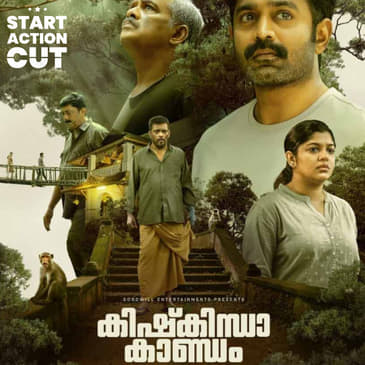
In this episode of Start Action Cut, Meenu and Padmakumar are decoding the Malayalam thriller drama Kishkindha Kaandam written by Bahul Ramesh directed by Dinjith Ayyathan and starring Asif Ali, Vijayaraghavan, and Aparna Balamurali in lead roles.
See omnystudio.com/listener for privacy information.
[00:00:12] Onmanorama, movie podcast, Start, Action, Cut
[00:00:12] Hello and welcome to Onmanorama movie podcast, Start, Action, Cut.
[00:00:16] Today we are decoding the Malayalam thriller drama,
[00:00:19] Kishkindha Kaandam, written by Bahul Ramesh and directed by Dinjit Ayyathan.
[00:00:25] And the film stars Asif Ali, Vijay Raghavan and Abhanna Balamurlinali, it rolls.
[00:00:33] Today we have Meenu to discuss the movie.
[00:00:37] The industry title of the movie is drawn from the epic Ramayana.
[00:00:41] As the story is based in a place inhabited by monkeys,
[00:00:46] the story revolves around an ex-military, personal, a pupilla and his son, Ajay Chantran and a lost pistol.
[00:00:55] So, first the movie is very interesting and captivating
[00:00:59] and what is so special, what I found so special about this film is the plot structure and the narrative style.
[00:01:07] So it flows in a non-linear pattern and apart from the way the suspense and revelations have been crafted,
[00:01:16] it creates a magical intrigue.
[00:01:19] Meenu, how do you analyze the plot structure and the narrative style in this film?
[00:01:25] Yes, Padma Kumar. For me also the most interesting part of Kishkindha Kaandam is the plot itself.
[00:01:31] From the title itself, Kishkindha, the Kingdom of the Vainaras or Mungies from the epic Ramayana,
[00:01:37] the movie brings the audience to a mysterious as well as an emotional journey,
[00:01:42] slowly unraveling the major plot where the storyteller wants to communicate with us.
[00:01:47] There is no hurry burry in unraveling this plot.
[00:01:51] Even the flashbacks that determines the growth of the plot are unraveled in a very smooth manner,
[00:01:56] perfectly blended with what's happening in the present.
[00:02:00] In a way the audience won't feel that this is the past or this is the present.
[00:02:04] It's not like that and there is something unique about the plot is that how a great epic is moved to this particular story.
[00:02:13] That's what I feel and we feel like we are also part of the story, not like an omniscient third person or something else,
[00:02:19] but as another character in the edit along with Aasi for Abbar Naaru Vijay Rahman.
[00:02:24] Yes, I liked how the revelations are placed in a surprising manner.
[00:02:29] Each and every episode comes out before us with a great punch.
[00:02:34] So that's what's interesting in the film.
[00:02:38] The setting of the movie is the mesmerizing terrain of Kallipati Reserve Forest.
[00:02:45] That itself is a story line and the treacherous topography, the lush greenery,
[00:02:53] they all serve a very intriguing purpose for the whole film.
[00:03:00] You watch, you are just, you are drop, airdrop right in the middle of that forest.
[00:03:06] So how that story begins and in that we are inside the business of a household where they have got so many issues.
[00:03:18] I mean, here Vijay Rahman who is the father of the protagonist Appu Pillai
[00:03:25] and how his issues are being shown to us one by one.
[00:03:32] So how would you explain the settings, the ambience of the movie?
[00:03:38] Yes, the setting plays a pivotal role in the storytelling here as you said.
[00:03:44] And it's a serene village very close to a reserve forest area Kallipati
[00:03:48] and it's Tiruneliyas I read from the signboards mentioned in that movie.
[00:03:53] And it's all about mountain roads, gut roads, dense forest, basically calm and cool atmosphere right?
[00:04:00] And it's a direct contrast to what the story of the movie is.
[00:04:05] Again, that is perfectly blended also.
[00:04:08] It's a reen atmosphere to thrilling emotional roller coaster that what I felt
[00:04:13] and the major advantage of this setting here is that it's very limited in itself.
[00:04:19] I felt so like limited places, limited characters, I mean the number of characters
[00:04:25] a place that is not that kind of accessible to everyone.
[00:04:30] And that helps the audience to be in the story.
[00:04:33] Like the audience became severely immersed in the plot and be one with the characters all the time.
[00:04:41] And the forest, high-range and a nuclear family, a perfect combo for the Malayalam mystery thrillers right?
[00:04:47] Yeah. And talking about the setting, I mean the place where we are in,
[00:04:53] we are right before the tall trees, the fine canopy of foliage and we are right inside that.
[00:05:03] So we have no escape until we finish the film
[00:05:07] and the makers have very perfectly blended all the ingredients of mystery, suspense
[00:05:14] and the storyline, emotions and everything for our sake.
[00:05:18] So we enjoy the whole thing from the beginning till the end.
[00:05:21] That's how the film is made.
[00:05:23] And talking about the making, beginning from the cinematography,
[00:05:28] actually the story itself is written by Bahul Ramesh who is the cinematographer of this film
[00:05:36] and he has the clear picture of what he had already seen in his mind before capturing those in the camera.
[00:05:45] So what he has captured is exactly what he had seen in his mind.
[00:05:51] So that's how we feel.
[00:05:53] We see the forest, we see the suspense, we see the emotions, everything in sync with the ambience.
[00:06:01] That's how it's made.
[00:06:03] And the BGM, as regards the BGM I think it differs from theatre to theatre.
[00:06:09] So where we were watching the film, the BGM sort of was jarring.
[00:06:15] So we know that it's good but we couldn't exactly enjoy it to the fullest.
[00:06:21] And then again there is no songs in this movie as we see in common Malayalam films or even in any other Indian films.
[00:06:32] We have got some northeastern folk songs or poems in the background.
[00:06:40] But I think the background music could have been cut down or slowed down a bit because it's too much there.
[00:06:48] Though they are good, they generate the suspense and the intrigue feeling that it requires.
[00:06:56] The whole movie exudes.
[00:06:58] But that's how the BGM has been made.
[00:07:03] And as regards the cinematography, we can see the effort behind it because in those terrains it's not that easy to show the drama, the way we see it.
[00:07:18] So what do you say about the making?
[00:07:21] I support most of your views Padma Kumar and for me it's how to describe the making of the movie.
[00:07:28] It's brilliant making. That's enough I think to describe.
[00:07:31] And for me, as I said earlier that two hours of watching this movie, I was travelling with the characters.
[00:07:39] I was sitting beside Svijay Dhaka and when he drove the vehicle and I was helping out Abarna to search her father-in-law's room.
[00:07:47] I was travelling with the seven men sent to find each other.
[00:07:50] I was with them. I became one among them.
[00:07:53] And for that director, Dinhjit Bissar is a hug I think.
[00:07:57] His first movie, Kaxi Amunipila in which as if I played the lead role is always close to my heart and a unique attempt in Malayalam cinema that movie was well crafted.
[00:08:10] And again after five years that movie released in 2019 and after five years with Kishkindha Khandam.
[00:08:17] Dinhjit proclaimed that he is here to stay right and entirely different with an entirely different treatment comparing to his previous craft.
[00:08:25] And he knows how to keep the audience engaged, how to craft a completely new thing and that's great that the effort is really great.
[00:08:36] He gave a movie that respects the audience I think so because a movie that values the audience time and effort.
[00:08:44] The movie's worth watching in terms of that and I feel like there is nothing lagging in that.
[00:08:50] Nothing to omit, not even a single dialogue, not even a single short everything fit for the movie.
[00:08:56] And here we have to add the efforts of the cinematography, editing and music also and all these together after Kishkindha Khandam made super much.
[00:09:06] And as I mentioned earlier the story is happening instead of very small perimeter but so beautiful to capture.
[00:09:13] You mentioned it already.
[00:09:15] This I'm sure Bahul Dhammesh who did the cinematography was really careful to repeat the region through different and unique shots but the audience won't feel there is a repetition in it.
[00:09:28] And almost 80% of the scenes are green.
[00:09:31] Yes, of course.
[00:09:32] But all these scenes and shots were captured in different shades from like Asafeli's house, their family and the forest.
[00:09:41] He carefully avoided any repetitions in capturing those scenes which included this house family and all things like that.
[00:09:51] And adding to cinematography editing was another thing to mention here.
[00:09:55] Again, all the shots were placed very carefully and I never felt any jump or anything like that between the shots.
[00:10:02] There is nothing more or more and nothing less.
[00:10:06] And the color grading was also done in a very good manner suits ambience of the movie which added to the ambience of the movie.
[00:10:14] And again, the music and BGM also played a crucial role.
[00:10:17] But for me at some parts, and I think it's because of the theater I chose, the sound felt a bit uncomfortable.
[00:10:24] But only a few places, right?
[00:10:27] But trust it was fine. Again, brilliantly blended with ambience and the story, the music.
[00:10:33] And helped a lot to create the mood, especially those scenes of suspense and emotions and BGM was a perfect fit for me.
[00:10:40] Thanks for mentioning Katchiang Amnipula menu because it shows how it differed from how this movie,
[00:10:49] Kishkandagandam, differed from the movie he made five years ago in every aspect.
[00:10:55] Because in Katchiang Amnipula it has a good musical treatment.
[00:11:01] So that's not here. That's a noticeable change or transformation or a growth of Diljit as a director,
[00:11:10] even though he has made only two films in these five years but that effort is what noticing.
[00:11:16] And as regards the performance, the movie depends on two pillars of these two characters.
[00:11:27] With regards to the success of this movie, I think it depended solely on the immaculate portrayal of the two characters,
[00:11:35] that is ex-military personal Apu Pula and his son Ajay Chandra.
[00:11:39] So Vijay Raghavan and Asif Pali was brilliant in their portrayal of the characters.
[00:11:47] So Vijay Raghavan, we have seen him playing so many different persons in different movies but here it's most intense portrayal.
[00:11:57] So even Asif Pali, he is very much adept in portraying the emotional side of a person.
[00:12:04] So even though I am slightly doubtful about how he performs with comedy, here he was pitch-perfect.
[00:12:13] So that's why we are immersed in the whole drama throughout.
[00:12:19] And also all the other supportive characters, supporting actors like Nishan who we remember him most in the film, Lutu.
[00:12:28] Now he is a more matured, very able officer in this film.
[00:12:35] So it was good to see him in that role and again all the other supporting actors did well.
[00:12:41] So what do you say about the performance of the actors?
[00:12:43] Yes, Patmakumar. I was actually waiting to discuss this aspect, the performance in the film.
[00:12:48] And I always feel Vijay Raghavan is one of the most underrated actors in Malayalam cinema.
[00:12:53] I don't know whether you support this but I feel so.
[00:12:57] And again here in Kishkindha Kanandam, he done a great job.
[00:13:02] It's he who actually shouldered the film and Apapula is a single piece like the emotions, the trauma which he had gone through.
[00:13:11] And Vijay Raghavan presented it on the screen really well I think.
[00:13:15] Almost three or four phases of his life were shown in the film and from 16 years earlier to present.
[00:13:22] Yes, there is almost three or four phases and each phase we can clearly witness a character growth of Apapula.
[00:13:29] How the character evolves.
[00:13:31] And fortunately the movies also about this particular characters evolvement right?
[00:13:36] And he did it in a brilliant way and about Asif Ali, yes he again proved it is one of the best with emotional scenes right?
[00:13:45] And here in those emotional scenes he was given with.
[00:13:50] We can see his growth as an actor like how mature he is handling those scenes now.
[00:13:57] We do feel the pain, his helplessness, we do feel his helplessness, his anxieties, fear, sometimes his laws, his sadness and everything he goes through.
[00:14:08] Like what he did in movies like Viras or Oyeray.
[00:14:12] It feels like he already lived that life.
[00:14:16] He is a JN and he is Apapula's son.
[00:14:18] It is not Asif Ali.
[00:14:20] And about Abarna Balamurli, she is also a proven actor.
[00:14:25] And here in Kishkindha Gandham her importance is that her character's importance is that through her reactions we get the impact of the acts of the characters, other characters I mean.
[00:14:37] From a sound she hears to a major twist she came to know.
[00:14:40] It's from her reaction we get the impact and she did it in a very good way I think.
[00:14:47] And yes but at a crucial point I felt that she could have done better, like more expressive.
[00:14:53] But still it's okay because Asif and Vijay Rakhman brilliantly complimented those instances or those scenes where she liked and thanks to the co-ipers.
[00:15:02] And about her role and such a subtle character in the plot, her role actually.
[00:15:08] But still has a crucial role to take the film from one piece to another like one development after another.
[00:15:15] And it's she who reveals a mystery and so that the audience can better identify themselves with Abarna's character the most.
[00:15:23] Like because we are also curious to reveal the mystery of the story right from the beginning.
[00:15:28] And he's the one who runs after this mystery, who is searching it on behalf of us.
[00:15:34] I think we can better identify ourselves with Abarna's character the most.
[00:15:39] And then speaking about Ashok and or Jagdish all played well the space they caught.
[00:15:44] And the detailing of these characters was also done in a good manner especially with Jagdish hand things like that.
[00:15:51] And then he's associated with the next late activities and about his past.
[00:15:56] Those things were brilliantly detailed using with his costumes and all things like that.
[00:16:04] And all the characters again I feel all these characters are layered like multiple levels of emotion and life.
[00:16:12] And that's conveyed in a very good manner here.
[00:16:15] Yes, Patma Kumar as you mentioned I'm also happy to see Nishant who started with Asif Ali in Ritu directed by Shama Prasad in 2009.
[00:16:24] And he also did a great job in Kishkindha Ganta.
[00:16:28] Yeah.
[00:16:29] When you talk about Vijay Raghavan playing the four phases of our popular character right from his early years in the military.
[00:16:38] And we see a kaleidoscopic view of a character who sets forth in his life with his practical realism.
[00:16:47] And what we see is even though we see different up a play we see that the basic trade is intact throughout.
[00:16:56] So even in his mannerism even the way he walks we have never seen him walking like that.
[00:17:02] You see you can identify this character as a popular in this film only we never see.
[00:17:07] We will never see any other movies.
[00:17:10] So that's a great thing about how I mean the makers and even the actor they both contributed to this character.
[00:17:18] So that was a marvelous watch when you talk about Abharmna Balamugali of course she is a proven actress.
[00:17:24] We have seen her doing magical things in other movies but here she had nothing much to express than just the one single emotion.
[00:17:37] That's her surprise and her desperate longing to know the truth.
[00:17:42] At one point she had the opportunity to make it very crucially intense so that scene demanded that punch.
[00:17:51] But I am not sure whether she could do that.
[00:17:56] So if she had done that this would have been a great performance by Abharmna Balamugali.
[00:18:01] So that single scene needed that spontaneous outburst but I think she underplayed that emotional expression.
[00:18:11] So I would count that as a flaw in this movie and also I would add to this some of the dramatic scenes
[00:18:19] were involving two characters talking to each other that looked kind of too dramatic.
[00:18:26] I mean there was no action so when they were talking about some crucial aspects about their business
[00:18:31] there were two persons involved so there was no much action cinematic action in the film.
[00:18:38] So that kind of I felt that would have been avoided and again one question cropped into my mind.
[00:18:44] I don't know if it's true when he sees a loss first loss in his life.
[00:18:52] He actually doesn't act. He's numb and down there.
[00:18:58] So I think naturally since the story was actually being narrated in a realistic manner
[00:19:05] I think the natural instinct natural reaction of that character would have been swinging into action.
[00:19:11] But in the second time he does that so I don't know why he did so in the first time.
[00:19:17] So maybe for the drama or for the sake of the story it was necessary for him to do that.
[00:19:23] So that kind of produced some doubt in me regarding the story.
[00:19:28] So those were a few minor glitches that I found. Otherwise I think it's a very thoroughly captivating movie.
[00:19:35] What do you say? Do you find any flaws or do you agree or disagree? What's it?
[00:19:39] Yes but Mughubar I think you have mentioned that particular scene that's close to the climax right?
[00:19:45] Where as if to get crucial role right?
[00:19:48] But I object to your viewpoint actually but I think his situation is such like he's confused, traumatized
[00:19:57] and ultimately he knows what happened and how that's going to affect the future.
[00:20:03] And I think he doesn't want to lose another person in his life.
[00:20:06] He was struck. He might be confused and yes it's a bit dramatic but I think he acted in a logical manner.
[00:20:15] That's what I feel and about other flaws or something nothing else flaws I spotted.
[00:20:21] Kishkindha Gangam for me was a decent actant and leaving some flaws in detailing like very few actually there is nothing else as negative for me.
[00:20:30] But somewhere I felt a resemblance with the movie R Karyam maybe the setting is step-on father, his son or daughter and their second marriage divorce
[00:20:38] like things like that a bold independent heroine.
[00:20:42] There I felt a resemblance with this R Karyam but that has nothing to do with Kishkindha Gangam.
[00:20:47] Kishkindha Gangam is an entirely new film fresh in all terms and a must theater watch actually.
[00:20:54] And I think after the movie going all those intense emotional scenes we won't get sad out of it
[00:21:01] but the movie will stand in as a revelation that this is life. It's all about living a life
[00:21:06] and what I love about the movie is that the way of respecting the people who are with us
[00:21:13] like the movie is showing us how to respect the people who are with us
[00:21:17] like while in their emotions, their space helping them to sort things etc.
[00:21:23] And so for me it's a good watch actually nothing much as flaws
[00:21:27] and if you love movies this is a must watch I think.
[00:21:31] Yes.
[00:21:33] Definitely this is an awesome watch and I think it's one of the most
[00:21:37] intriguingly crafted suspense thriller in these times.
[00:21:40] So that brings us to the end of this episode.
[00:21:43] Thanks for listening to Start Action Cut Produced and hosted by me Patmukhmar.
[00:21:48] Follow www.honemanurama.com for more podcasts on movies
[00:21:52] and be sure to come back for the next episode of Start Action Cut out on Mondays.
[00:21:57] Thank you.