
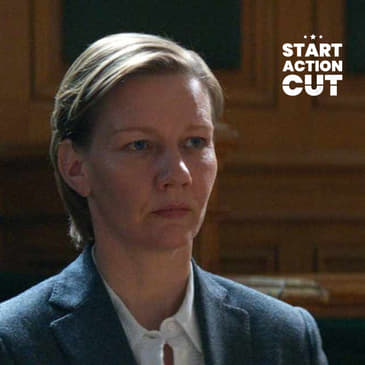
In this episode of Start Action Cut, Swathi and Padmakumar are analysing the French movie 'Anatomy of a Fall' directed by Justine Triet and starring Sandra Huller in the lead.
See omnystudio.com/listener for privacy information.
[00:00:00] Hi, Welcome to Onmanorama Movie Podcast, Start, Action, Cut.
[00:00:17] Today we are decoding Anatomy of a Fall, 2023 French Film, directed by Justine Trier from
[00:00:26] a screenplay she co-wrote with Arthur Harari and starring actress Sandra Huler in the lead.
[00:00:34] Today Swati is joining us to discuss the film.
[00:00:38] So what I found interesting about the film is that it evolves in a captivating fashion
[00:00:44] and it assumes a beautiful shape by the time it concludes.
[00:00:48] So it's so well crafted that your attention never diverts even for a second.
[00:00:55] The sequences flow so seamlessly that you never identify where it started and ended.
[00:01:02] Swati, could you please say in detail about the craft and the editing of the movie?
[00:01:08] What made it interesting to you?
[00:01:10] Yes, Padma Kumar.
[00:01:12] So first of all I really, really liked this movie and it's a very compelling intriguing
[00:01:18] and meticulously crafted courtroom drama.
[00:01:22] The entry has infused a sense of uncertainty throughout the plot which creates a very structured
[00:01:28] progression for the movie.
[00:01:30] I really appreciate that the audience is given ample opportunity to interpret whatever
[00:01:35] that is going on.
[00:01:37] In the film we are introduced to Sandra, a character whose guilt or innocence is
[00:01:40] constantly in question and I think Sandra brilliantly played by the amazing Sandra
[00:01:44] Huler keeps us guessing with her emotionally charged but very elusive behaviour.
[00:01:50] So the movie was torn between suspecting her and believing in her innocence.
[00:01:54] So Sandra revealed in an interview that Justin Tray had asked her to play the character as
[00:01:59] of she was innocent.
[00:02:02] So that means that even Sandra did not know whether her character was actually innocent
[00:02:07] or not from her point of view, she might have been.
[00:02:09] But I think I read somewhere that only Justin and her husband who is also the
[00:02:13] co-writer actually know whether she committed the crime or not.
[00:02:17] I think it's very brilliantly crafted.
[00:02:20] I think two grass-pressing of the movie is essential to focus on a line that March says
[00:02:24] that when you are faced with a situation, you just have to believe or you just have
[00:02:29] to make a decision.
[00:02:31] And I think if you keep that in mind, I think you'll feel that the plot is very
[00:02:37] intricately crafted which leaves our source of space to think and decide for ourselves.
[00:02:42] I think that's a very creative strategy that Justin Tray has put forward to
[00:02:47] engage the audience as well.
[00:02:48] So because from the beginning to the end, we are hooked on to the story and we wouldn't
[00:02:52] be like moving away from the story which is very important for any movie I think.
[00:02:58] Yes, Swathi, as you said, the director has been able to maintain the ambiguity of
[00:03:03] the character, Sandra Huller's character's innocence.
[00:03:06] And that's what is hooking the audience till the end.
[00:03:10] And usually the courtroom drama and the arguments in the court is actually
[00:03:15] tiresome or not that interesting.
[00:03:18] But here, even if you don't know French, you sit there and watch every minute
[00:03:24] details of their arguments so delicately and it's meticulously devised in the film.
[00:03:32] The arguments and the judgments and the judges come and so on.
[00:03:37] And I think it's a performance that the performance of the whole
[00:03:43] ensemble cast is what made the film so interesting.
[00:03:47] And each of the ensemble cast led by Sandra Huller registers a deep impression
[00:03:53] on your mind that you root for each of them.
[00:03:56] Huller as Sandra Voiter is mind-boggling and also Milo, the actor who plays
[00:04:03] the character of Daniel that's Voiter's son.
[00:04:06] He also makes a very, very, I mean, stupendous piece of acting from my new
[00:04:13] answers to vehement emotional outbursts both Sandra Huller and Milo do them all
[00:04:19] with kind of a clockwork precision.
[00:04:22] So what do you say about the performance of the actors in the movie, Swati?
[00:04:27] Yes, Patmukh Kumar, like I mentioned before,
[00:04:29] Sandra Huller truly delighted me with her performance as Sandra Voiter.
[00:04:34] I mean, she brings such complexity to the character, making it difficult for us
[00:04:38] to decipher her true intentions just as it should be in the films.
[00:04:41] Like it's very difficult to understand her as a person because, you know,
[00:04:46] I think she played her character in a really intricate way for that.
[00:04:51] As viewers, we constantly torn between seeing her as a potential culprit or not.
[00:04:56] Huller's performance is so convincing that it almost feels like we're
[00:05:00] watching a documentary than a movie.
[00:05:02] What's remarkable is how she maintains the sense of composure throughout the film,
[00:05:07] even as she grapples with grief, doubt and fear.
[00:05:11] Everything is intricately expressed through Huller's facial expressions,
[00:05:15] making her performance truly mesmerizing.
[00:05:17] And I really loved Daniel also.
[00:05:20] I think Milo, yes.
[00:05:21] I mean, what a performance from Milo.
[00:05:24] His performance had to be really layered and for a young boy
[00:05:27] to play such a complicated character.
[00:05:29] I mean, this is a 11 year old boy in the movie who has to see his father die
[00:05:33] and then talk in the and to testify in the court.
[00:05:38] It must have been a difficult performance coming from a young boy.
[00:05:42] I think he really, really pulled it off.
[00:05:44] Like you said, I think it's amazing that he was able to do all of this
[00:05:49] with such ease and I think some of the credit has to go to Justin
[00:05:54] Trier for casting Milo as Daniel because I read somewhere that
[00:05:58] she actually wanted to cast a boy who had blonde hair like Huller's.
[00:06:03] But when she saw Daniel's audition, Milo's audition piece,
[00:06:06] she really loved how he did the character and she immediately cast him.
[00:06:11] And I think that was a really wise choice.
[00:06:12] And also the other actors like the lawyer,
[00:06:16] Sandra's lawyer and even Samuel Thase who played Samuel.
[00:06:21] I think it was a creative choice that Trier decided to just name the characters
[00:06:25] as same as the actors like Sandra and Samuel.
[00:06:27] I think it's this very wonderful choice to evoke real emotions from them.
[00:06:32] Yes, I also like the performance of the prosecutor in the film
[00:06:35] who questions Sandra Huller.
[00:06:38] And actually the movie, this film, Anatomy of a Fall,
[00:06:43] actually won the best screenplay,
[00:06:46] the best original screenplay award at the Oscars.
[00:06:49] So I would say it's a visual story that we can clearly follow the plot
[00:06:55] and understand the whole story, even if we kept it mute.
[00:07:00] That is a beauty.
[00:07:01] And the heat and the intensity of the drama is perfectly portrayed.
[00:07:06] So that's a marvelous camera work.
[00:07:08] And the sound is yet another area that has been portrayed with so much of artistic excellence.
[00:07:15] You can hear the whimper, the gasps, the clicks of the mouth,
[00:07:20] which add to the intensity of the drama.
[00:07:24] The pause of Snoop, the dog, tapping the floor as it approaches the bed
[00:07:29] where Sandra lies towards the end of the film is a unique example here.
[00:07:35] So would you like to add something about the camera and the sound?
[00:07:40] I think the film utilizes sound and camera techniques with great skills,
[00:07:43] subtly conveying significant messages throughout the placement of the angles as well.
[00:07:48] So even if you believe Sandra is innocent, the angle suggests otherwise.
[00:07:52] This is something that I thought when I was watching the movie,
[00:07:54] the camera often shows Sandra from below, creating a towering image
[00:07:59] that hints at her ambiguous nature rather than implying innocence.
[00:08:03] So it's not that her behaviour suggests guilt, but rather how she is depicted.
[00:08:07] The absence of her top angles avoids portraying her as someone looked down upon
[00:08:13] by those who see her as guilty.
[00:08:15] I think the creative camera angles and the way everything is shown.
[00:08:20] And when you see Daniel's portions,
[00:08:22] you see him looking at his mother from a distance.
[00:08:25] So I think it suggests that, you know, at that point when his mother is in court
[00:08:30] and he's witnessing it, there's a certain distance between him and his mother
[00:08:33] that that's actually there.
[00:08:34] He's not close enough with his mother.
[00:08:36] And I think she never was actually before also.
[00:08:39] She's a good mother, but she was more involved with her work and things like that.
[00:08:43] So there is a certain level of distance.
[00:08:44] So that distance is captured through the angles and the sound sometimes is very loud,
[00:08:49] sometimes very quiet.
[00:08:50] I think for the scenes that are panning out or playing out,
[00:08:54] it can create a deeper meaning if you look into it.
[00:08:57] And I think also the dialogues, which were so naturalistic and realistic,
[00:09:01] whether it's powered by logical reasoning or even to the whispers,
[00:09:06] they are so impeccably crafted.
[00:09:09] So the dialogues were natural and you get involved in their conversation,
[00:09:17] in their argument, in their confusion.
[00:09:19] So deeply.
[00:09:21] So what do you say?
[00:09:23] Yes, Padmugam.
[00:09:23] So in the film, none of them are native English speakers,
[00:09:27] like not Sandra, not Samuel, nobody, but they converse in English and in French
[00:09:33] also, and in many parts of the film, it's said that Sandra is not very fluent
[00:09:38] in French, but she tries to.
[00:09:39] So I think there was a certain sense of originality in the way that
[00:09:42] the conversations were progressing, even the courtroom scenes when Sandra
[00:09:46] was talking about her life with Samuel and when she switches to English also.
[00:09:53] There is that originality, the way she speaks.
[00:09:55] I think the credit has to go to Sandra Hula who played the character
[00:09:58] because to make the lines or her lines seem very authentic or organic,
[00:10:03] it takes effort to...
[00:10:05] It has to come from yourself.
[00:10:06] So I don't know what she did.
[00:10:08] She might have researched about people like that or something like that.
[00:10:12] But everything was just so natural that it just felt like
[00:10:15] you're actually watching real people and not actors.
[00:10:18] So I think the dialogues or the lines really played a very crucial part in that.
[00:10:23] And also the music.
[00:10:24] What do you say about the music?
[00:10:26] I think the music and sound really wear integral components of the movie.
[00:10:31] From the beginning, we are immersed into a world of music.
[00:10:34] The music that Samuel plays at the beginning of the movie is PIMP by 50 cents.
[00:10:39] And I think that music itself grips into their chaotic marriage,
[00:10:43] which is at the same time very quiet also.
[00:10:47] I think it's very...
[00:10:48] When really loud music is played,
[00:10:50] it also is a way for the director to tell you that
[00:10:53] even there's a lot of chaos going on at the core,
[00:10:56] maybe these are two people who don't have much to talk to each other.
[00:10:59] And everything that comes out of their mouths is just for fighting
[00:11:03] or then it becomes an explosion.
[00:11:06] I think the loud music is ironic to the lives that they're living in the Alps.
[00:11:10] And the music covers a lot of things they said and answered.
[00:11:14] Yeah, and I think the music was an integral part of the film, the whole story.
[00:11:20] But how the whole plot progresses
[00:11:23] and then it tapers to please a situation where it was going to conclude.
[00:11:30] So what I believe is the last two minutes of silence
[00:11:35] had so much of deep meaning because
[00:11:39] till then, Sandra was having the presence of...
[00:11:44] Even though he was dead, he was present in their lives.
[00:11:48] So when she's back in a room exonerated of all the accusations,
[00:11:54] now she has to live her life.
[00:11:57] Now it's a time that which shows that she is alone.
[00:12:02] She has only her son with her to live.
[00:12:06] And from then on, there is no Samuel to play any part in their lives.
[00:12:11] So that was very, very magical scene those last few minutes of silence.
[00:12:17] So I think it's the skill of the director
[00:12:20] to leave the story almost open ended
[00:12:23] because you never know, you are never shown what had actually happened
[00:12:27] in their lives, how Samuel fell on the from such a height.
[00:12:33] So you are there left with no choice to cling to
[00:12:38] as a final answer to the whole question, whether she killed Samuel or not.
[00:12:45] So what do you say? What's your opinion about that?
[00:12:48] What is your verdict on Sandra Huller's, I mean, Sandra Voiter's character, innocence?
[00:12:54] Well, Patma Kumar, I think at least into half part of the movie.
[00:13:01] I thought that Sandra is actually innocent
[00:13:04] and it might have, Samuel might have committed suicide.
[00:13:07] I don't know if he committed suicide or he jumped or it was an accidental fall.
[00:13:12] I don't know. But I think the last 30 minutes, 40 minutes or so.
[00:13:16] I just started thinking that she might actually be behind his death.
[00:13:22] I'm not saying that she killed him,
[00:13:24] but I think that Sandra might have been responsible for her husband's death,
[00:13:28] meaning though it might seem a little far-fetched, I'll tell you why.
[00:13:32] So rather than saying she killed him, I believe it could have been an accident.
[00:13:36] The crucial point is that we need to decide what we believe.
[00:13:39] And this is what Marge tells Daniel when he pleads for her help.
[00:13:43] I think it was a disagreement that led to the physical altercation
[00:13:47] between them during which Sandra might have inadvertently pushed
[00:13:51] or pulled him causing him to fall.
[00:13:53] I don't believe she intended to kill him. It was tragic.
[00:13:56] It might have been a tragic mistake, but the consequences were severe.
[00:14:00] That's why she tells with conviction that Samuel was not somebody
[00:14:04] who would kill himself. He would not do such things.
[00:14:07] So that she is telling very honestly.
[00:14:09] And she also says that she did not kill him when the lawyer tells her
[00:14:15] when tells something she's like, stop, stop. I did not kill him.
[00:14:18] And then later in one of the scenes,
[00:14:20] she tells that she does not know if her lawyer believes her or not.
[00:14:24] That part is actually true.
[00:14:25] But then again, when you don't intend to kill someone and that it happens
[00:14:29] accidentally, you don't consider it a murder.
[00:14:32] And for maybe for Sandra, she doesn't consider it murder.
[00:14:36] But she might have just pushed him or it was just another fight
[00:14:40] that they had like the fight that they had previously.
[00:14:43] So I think it might have been Sandra who, you know,
[00:14:47] who was behind the death of Samuel.
[00:14:49] And I think we have to believe that way or even Daniel had to believe that way
[00:14:55] because if she were to go to jail, he'd be parentless.
[00:14:58] And he she's I think he had to convince himself
[00:15:01] that his mother is not capable of such a crime and whatever be the reason it is.
[00:15:07] So I personally think that she might have been the reason.
[00:15:10] But I think it's open to interpretation.
[00:15:14] Yeah, actually, everybody is free to choose their own version
[00:15:18] or their own verdict.
[00:15:20] But for me personally, I don't believe that Sandra actually was behind Samuel's death.
[00:15:27] Maybe there could be arguments like it happens between every couple, husband and wife.
[00:15:33] So on that day, that day as well,
[00:15:36] they might have had some arguments on the top floor and she must have come down.
[00:15:41] And then maybe after that, this accident
[00:15:45] or maybe suicide or whatever happened.
[00:15:48] So that's how I would like to believe.
[00:15:50] And if all the viewers are having the same opinion about this verdict
[00:15:55] or the actual incident, so then there is no point in the director's
[00:16:00] effort to make it open ended.
[00:16:03] I think it's another rare movie which has been so meticulously created
[00:16:07] with all its departments excelling superbly.
[00:16:10] So that brings us to the end of this episode.
[00:16:12] Thanks for listening to Start Action,
[00:16:14] cut produced and hosted by me Patmugamar with technical production by Idea Brew Studios.
[00:16:19] Follow www.ownmanurama.com for more podcast movies
[00:16:23] and be sure to come back for the next episode of Start Action Cut out on Monday.
[00:16:28] Thank you.