
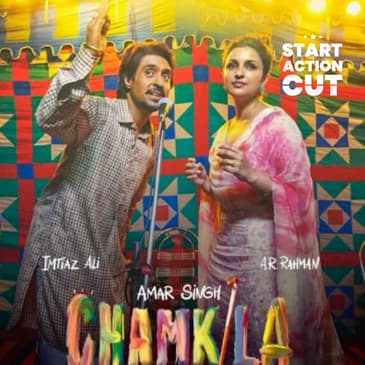

In this episode of Start Action Cut, Kannan and Padmakumar are analysing the Hindi movie Amar Singh Chamkila directed by Imtiaz Ali. The film stars Diljit Dosanjh and Parineeti Chopra in the lead.
See omnystudio.com/listener for privacy information.
[00:00:00] Hi, Welcome to Onmanorama Movie Podcast, Start, Action, Cut. Today we are decoding the movie
[00:00:20] Amasin Chamkeela. It's a Hindi movie. It's actually a biographical movie based on the
[00:00:27] real life of musician Amasin Chamkeela. The movie is directed by Imdia Zali and the film
[00:00:33] stars Diljit Dosanj and Paranithi Chopra in the lead. Today Kanan is joining us to discuss
[00:00:41] the movie. First of all Kanan, I would like to point out the narrative style. You can
[00:00:46] see the climax in the first scene itself and then you go back to view the film from
[00:00:52] the beginning in a combination of flashbacks and real time. So, do you think that it was
[00:00:57] a risky way to tell a story as you know the climax already? And don't you think it's
[00:01:03] tough to view scenes back and forth to keep it alive and engaging? What do you say?
[00:01:08] Yeah, as you mentioned, it starts with the climax. It starts with the death of the
[00:01:14] two protagonists. As one of the reviewers pointed out later, after that the story
[00:01:20] follows in a very linear narrative pattern. But I think, yes, it is a risky adventure to
[00:01:28] start a story with the ending but then why the ending was there? Why was it there? How
[00:01:35] where the makers stand are revealed through the course of the film? So, where his sympathy
[00:01:44] stands, where the film basically stands. Everything is there during the course of the
[00:01:50] film, the narrative. So, yes it is risky but has Cynthia Silly pulled that off? I think he has
[00:01:58] done an excellent job of pulling that off. I think this was one of the Hindi movies I quite
[00:02:04] absolutely loved watching. He hit it out of the park particularly considering the fact that
[00:02:10] the last Hindi movie I tried watching was Anima. So, I can't even compare that to.
[00:02:17] So, yeah absolutely loved the movie. Absolutely loved the way he narrated the movie. The intermingling
[00:02:25] of the real photos, the real performances then suddenly switching into a graphical way of saying
[00:02:34] then suddenly coming back to the real thing and using the breaking the fourth wall quite
[00:02:40] absolutely brilliantly. He has done a wonderful job. Yes, it was risky but he has successfully
[00:02:46] managed to pull it off. Yeah, yes I think even then he could keep alive the emotional depth.
[00:02:55] You know that what happened to them? Actually it's based on the real life story, real lives of
[00:03:02] the Punjabi singer Amar Singh and his wife Amar Jyoth. Yet what else do you get from the whole
[00:03:10] episode? And then you move back even though it was a steady rise for him, a person who actually
[00:03:18] did a job as a Chamar I mean a cobbler. Then from there he had that musical instincts in him
[00:03:26] and with that he was very confident and he was very ambitious about spreading his
[00:03:33] musical talent and he was successful in it. But I don't know is there any other way to
[00:03:39] narrate the story? Whether it would be as you said India's early really pulled it off.
[00:03:46] But was there any other narratives? I think this is the most memorable film that I have watched
[00:03:52] in this way. Like you see the death of the protagonist and then you go back to their past
[00:03:59] and then leave the whole film through being inside it and riding with their emotional journey.
[00:04:07] What do you say? Oh, but this is not the first time somebody has started with the
[00:04:12] climax and went back. There have been many movies including Hollywood movies. I don't remember
[00:04:17] the names but there have been many. I think seven private try and also started with the death
[00:04:23] basically of the person who saved private trying. Then it went back to the incident and then it
[00:04:28] came back to the death. Say even Titanic in one way started with that. We knew what happened
[00:04:37] to Titanic. We knew what really went through it. Then Cameron reconstructed the story.
[00:04:44] Similar way, India also did the same thing. There's nothing new to it. But what brilliant
[00:04:51] that it did, we know that somebody did it in real life too. I'm very sorry but I knew nothing
[00:04:58] about Chamkela till I saw this movie. Then I went about reading it, watched a baby scene to
[00:05:05] be with Amarjot's elder sister. Then many people recounting the stories even the grandson
[00:05:12] of Surinder Sonia. Surinder Sonia also spoke about Chamkela. I know only after watching this movie.
[00:05:20] I had no clue about such a popular singer in Punjab. From all the stories that we get is that
[00:05:28] he's such a popular guy, such an iconic figure and we know what happened to him. We don't know
[00:05:34] for the last 36 years. We don't know who killed Amarjot in Chamkela but we know somebody
[00:05:40] did. We know there are different conspiracy theories to it. As we know that, that is the end
[00:05:47] point. Then we start from the beginning and to reach a climax point where he ends it with saying
[00:05:56] Vidakar, I'm leaving this world with that brilliant song by Aramant. So I think this was
[00:06:05] one wonderful way of saying it. Why? Because I think rather than saying that a man from a very
[00:06:14] lower strata of the society, one account says that he was an electrician. The film says that he was
[00:06:20] working in a factory making socks. But then he had this inborn talent of singing and inborn
[00:06:30] talent of writing lyrics, maybe a bit lewd, maybe a bit not comfortable for a very, very
[00:06:39] puritanic society but people liked it. So that kind of a man if you were to say that story from a
[00:06:45] young age how he grew up to become a singer but I would have taken the whole soul of the whole
[00:06:52] movie, the whole story. Now starting at the end gave him the acely that poignant moment
[00:06:59] to say like people like me who didn't even know who Chamkeela was was shocked into saying that
[00:07:05] oh this happened. Now why? That curiosity he developed and sustained through the movie,
[00:07:12] that was brilliant. So I kind of like this narrative. Yes as you said Chamkeela rose up
[00:07:19] from lower strata in society and then with his own talent and basically he wrote
[00:07:25] as you said the Luyid and Lecheros lyrics. The whole thing has been shown in the film itself
[00:07:33] that the lyrics that he wrote were not agreeable to the puritan civil society but actually
[00:07:40] the crowds that gathered at his shows showed how much they loved his songs. So there was that
[00:07:48] dichotomy. I mean the people actually inside they loved the songs but outside they didn't approve them.
[00:07:56] So he had that threat from the very beginning to quit writing or saying such songs but
[00:08:03] he was actually not that an indecent fellow. He did it for the people, for his audience so that
[00:08:09] we see from the very beginning itself. So now the story hinges mainly on the protagonist
[00:08:17] that is Diljit's performance and I think that was speculous and he himself being a singer
[00:08:25] he made it very simple for himself. The way he sings, the way he plays,
[00:08:30] Tumbi the instrument and his demeanor everything was well pitched and well and I think that was
[00:08:36] very remarkable and that left me speechless watching the whole film. How was the performance
[00:08:42] of the film in this movie for you, Garnak? Yeah I quite like the performance. I quite like Diljit
[00:08:48] as well as Paranithi doing their roles and they both sing their songs. Then again going back to one
[00:08:56] part of the narrative. One big thing about the narrative is the motives. One big motive is
[00:09:03] Amitabh Bachchan. The moment he cuts his hair from a safe turban he cuts hair in the fashion
[00:09:10] of Amitabh Bachchan. Later when he goes to Toronto, Canada for a concert, he sees Amitabh Bachchan's
[00:09:18] big poster, a large poster hanging up over the sky. He is told that you're performing the same
[00:09:24] plays that Amitabh performed but he out sells Amitabh. So that kind of a narrative is there
[00:09:31] from and in one of the wonderful scenes he speaks to a journalist who said why do you
[00:09:39] write such lyrics? And he said I'm a small person and people from a small village, from a small
[00:09:45] people like us who are the majority like such songs. Now why does he write such songs? There is also
[00:09:54] wonderful in the opening montages we are given to understand that he used to listen to a lot of
[00:10:03] stories from his mother. His mother used to enjoy it. His neighbors used to have such
[00:10:09] fights about extramarital affairs. So he just went on to write such songs and one of the
[00:10:17] songs translated is that one of the songs when women sing cut a forest with a small
[00:10:23] sickle that he had. So such a very lewd references to sexuality, to sexual organs.
[00:10:32] Everybody used to sing in privates. Everybody used to sing before sangh. Everybody used to sing
[00:10:37] when they were alone in their houses. He just took that and took it to the stage and opened it up
[00:10:44] and everybody loved it. Everybody loved it in one of the again one of the scenes of militant group
[00:10:51] come to his home and before threatening him with his life they say that oh I loved your song
[00:10:59] I love this song I love that song but you should stop. So now that was a kind of time that they
[00:11:05] were living in Punjab after the death of Indira Gandhi after Operation Blue Star and after the
[00:11:12] death of Indira Gandhi. There were a lot of strife people were talking about Khalisaan again,
[00:11:18] people were talking about self-determination of Sikhs again. So the puritanical society again
[00:11:26] gained upper hand in such a talk. Yet the simple man that Chamkeela addressed to wanted such songs
[00:11:36] they didn't want him to sing the devotional songs that Chamkeela and Amarjot sang. There were three
[00:11:43] LPs later found out that they released three LPs which were again very successful but nobody
[00:11:50] wanted to listen to that song. So everybody though they in a modest way showed a very cultured manicured
[00:12:02] face for the outside world inside they wanted Chamkeela, inside they wanted his songs, inside
[00:12:08] they loved his songs. So that way we know by the songs by the narrative we know where Imtiaz Ali's
[00:12:17] sympathy is like. We also love Chamkeela by the end of it. Now one another wonderful narrative is that
[00:12:25] when he sings in Punjabi, he sings in Punjabi and the lyrics is written in English, the Hindi
[00:12:31] lyrics equivalent Hindi lyrics are written in English on screen and because we are
[00:12:37] watching on OTT or Netflix and we have the option of putting on the subtitles,
[00:12:44] we also get the meaning of that word. So in that way, lot many people are engrossed,
[00:12:50] lot many people can enjoy this film. So narrative also plays a wonderful part in
[00:12:56] bringing the Chamkeela story alive. Yeah I would like to add to what you had said earlier about
[00:13:03] Milton's first thing. I mean I appreciate Chamkeela before issuing the thread on the same
[00:13:09] lines. Towards the climax also the police inspector, I mean the police officer, the senior police officer
[00:13:17] when he goes back home he listens to what his son, I mean that's the way how people used to
[00:13:23] listen to such songs in their privacy and he knows what his son was listening to and then
[00:13:31] drops in and then he allows him and tells him that sometimes you can listen to if you feel
[00:13:38] like I mean this Chamkeela songs. Sorry there is also one more wonderful exchange between
[00:13:44] the police officer, they bring him forward the narrative is that the police officer coming in
[00:13:50] basically, coming and asking why somebody would kill a single like Chamkeela. So when they're
[00:13:56] talking his subordinates go on saying some very sweet stuff about the SP and the SP's
[00:14:05] reply is that it now is Makarna laga ho ki haath andhar khus jaoge. This is
[00:14:13] weirdest and the most lewdest way of answering your subordinate but that's very private
[00:14:20] but out well he talks about yeah he wrote that such very weird lyrics and he should get the karma
[00:14:27] just beat him back kind of stuff that he's talking to Chamkeela's followers. Those were the
[00:14:34] private things. Chamkeela just put it from the stage everybody loved it. Actually they never wanted
[00:14:40] to see it in the open maybe they might enjoy them in private but actually I personally believe that
[00:14:48] since the mystery the whole episode has not been investigated I mean cracked. I feel that it's
[00:14:56] not it may not be the militants or some others. I think it's somebody who was not at ease with his
[00:15:04] rise to stardom must have done the crime. Yeah those are the two conspiracy theory. One is that
[00:15:11] it was a contract killing that by other singers who were also popular but not as popular as
[00:15:17] Chamkeela and Amanjol. The other is that militants, violence and militants nobody knows
[00:15:24] because for the last 30 it happened in 88. The film also tells you one thing that the whole rise and
[00:15:32] the moniker that he is Elvis of Punjab, Punjab, Haryana, US and Canada and all places
[00:15:40] he attained that in 11 years and the man died at 86, 88 when he was killed he was only 26.
[00:15:48] Now that is one area where I found Diljit Doshan he's 14 now in his real life normally he looks very
[00:15:58] lean and doesn't look 14 but somehow it didn't look 26 to me so that probably is only one
[00:16:08] flaw if you want to but then that again that can be absolutely overlooked.
[00:16:14] But myself personally I could match Diljit with Chamkeela in terms of that.
[00:16:20] Definitely I'm not saying that he did a wonderful job, he did an absolutely brilliant job of that
[00:16:27] character even so does Parineti Chopra because I bought some of the clips later of the real
[00:16:35] Amanjol and Chamkeela performing she nowhere in performance Parineti always looks down
[00:16:43] as if he did not do some one of the reviews said that as if she doesn't want the world to see her
[00:16:49] sing these kind of out-of-the-box lyrics but that's not the case. Amanjol was that kind of a detached
[00:16:56] look she had every time there were times when she was bluffing but then there was that detached
[00:17:02] look to her every time and Parineti matched it to the T not just in her appearance but even
[00:17:10] even in acting even while becoming that person again I loved it so much that I'm again going back
[00:17:17] to the narrative one narrative trick that Imtiaz Ali did he I think he borrowed the film of it
[00:17:25] Sajid Ali one wonderful thing that he did was I mean we have this weird juxtaposition of
[00:17:33] this actor is becoming the real person it's like for many people they don't know who Gandhi was but
[00:17:40] they knew who Ben Kingsley was so Ben Kingsley looked like Gandhi for many people that kind of
[00:17:47] a juxtaposition what he does in film when he brings that original photos and original things
[00:17:54] come together is that he's telling you in between without looking at us he's written
[00:18:01] that forth all and telling that this is just a story we are telling as in the first title card
[00:18:07] this is based loosely based on true narrative there are many news outlets came out with 10
[00:18:15] real facts and 10 flaws of the film but then he also said that he has taken a very creative
[00:18:21] liberty about it you know but then that we also raised the fact that those were real people
[00:18:28] and telling you a story about it yes Kanan what I would like to point out next is A.R. Rahman
[00:18:34] he's no doubt enthralling but the way he treated the BGM keeping to the Punjabi tone until now
[00:18:41] he's remarkable that's one thing and what's more praiseworthy is the way the original songs
[00:18:47] that have been left untouched yet the Rahman music comes in with its unique identity and then
[00:18:55] merges with the whole canvas seamlessly so seamlessly that you forget to distinguish between
[00:19:02] the Amar Singh, Chamgila songs and Rahman songs yet they are different and each of them are
[00:19:11] unique and so melodious and so exciting in their own merit so I have never seen
[00:19:19] A.R. Rahman doing some other language songs in this spectacular manner what do you say about
[00:19:26] the music and the songs in this movie by A.R. Rahman? Yeah I totally agree with you I agree also
[00:19:33] with Imtiaz Ali in one of the interviews Imtiaz Ali said that A.R. Rahman was one of the narrator
[00:19:39] or co-writer I totally agree with that this is not done by Imtiaz Ali or Sajid Ali
[00:19:47] A.R. Rahman also put in his absolute best one of the songs I think Ishmata A had a had a very
[00:19:54] A.R. Rahman aura to it but it's wonderfully written by Irshad Kamil all the songs are brilliant
[00:20:01] you know just the original songs retain its character by retaining the character and taking
[00:20:07] it away from where Chamgila sung and into a different altogether new adding a new layer to
[00:20:14] the songs here did a wonderful job absolutely wonderful job now even in the starting montage
[00:20:22] even in the first song I think the Baja is a song how it just sets the tone not just the
[00:20:31] not just the visuals even without seeing the film just listening to it we know where the
[00:20:40] story is what the story is and what the protagonists are saying what others are saying then the narrative
[00:20:46] is also set in the first opening not just opening credits in the opening song where one says that
[00:20:53] you know in a world of strife when everything when shooting was happening they came Chamgila who
[00:21:00] shown bright as a son in the night and then other people say that he used to sing sexy
[00:21:07] guitar and that kind of lyrics then the other narrative about him is that the other singers
[00:21:16] would say that that's it underlines the whole story when when one set of people liked him so
[00:21:27] much that he called him Chamgila who used to shine bright as a son others say he was a
[00:21:33] social pariah or social dirindai everybody even Ishaad Kamil who wrote the lyrics did a wonderful
[00:21:41] job with that with all the songs too sorry I'm fawning about this movie because I really love
[00:21:47] that movie yeah it's yeah I liked it's actually a good movie as of flows you had earlier mentioned
[00:21:53] about the age that didn't conform to the real age of Chamgila but I think he looked younger than
[00:22:01] the real Amar Singh then I saw those videos I don't know if I may be wrong but other than that
[00:22:08] so there is nothing much flows into it I think this is a very very well scripted and well planned
[00:22:14] movie and one thing I felt was it runs ahead with the pace with the high speed that was
[00:22:21] unwanted not in many places but at some places it was very hastily done I felt that way otherwise
[00:22:27] it's a good movie we can enjoy thoroughly let me just add to that the pace I think it was I think
[00:22:34] it was deliberate because as I said that life is just 11 years he rose to such a fame like no one else
[00:22:41] in Punjab those years so those rise was phenomenal that the rise was absolutely skyrocketing basically
[00:22:49] so the pace I thought was very very nice and it had that beautiful pace he did not lag anywhere
[00:22:58] it just went with a swift went with a flow yeah so kind of like one more thing about the whole movie
[00:23:05] where the sympathy stand is shown in that or given out in that last song Vidakaro yeah Vidakaro
[00:23:14] is encapsulates all what Impeazily been saying in this movie where the morality morality clashed with
[00:23:22] his songs it was only 26 no one gave him that benefit of doubt that probably had he went on to
[00:23:30] become 36 so what is he probably would have turned out to be a different than a singer than what he
[00:23:35] was 26 it was a boy I mean though he was a father of two he was practically finding his life out in at
[00:23:44] 26 so at Vidakaro which is again a wonderful soulful song he looks at every other and says it
[00:23:52] manu vidakaro give me permission to go I have to go to the other side
[00:23:57] sa bhi saaf sahi goomat mehla mein tum sabhi paak magar paak ka daria mein manu vidakaro
[00:24:06] so wonderful way of concluding how the moral side clash with a person who was just 26 and he
[00:24:14] was having the time of his life yes so it was a wonderful music we don't have so many musical
[00:24:21] musicals these days but this is a wonderful musical film and we can enjoy from the beginning to end
[00:24:28] in a very engrossing manner so that brings us to the end of this episode thanks for listening
[00:24:34] to start action cut produced and hosted by me Patmukh Maar with technical production by
[00:24:39] idea brew studios follow www.onmanuraman.com for more podcasts on movies and be sure to come
[00:24:47] back for the next episode of start action cut that will be out on next monday thank you