
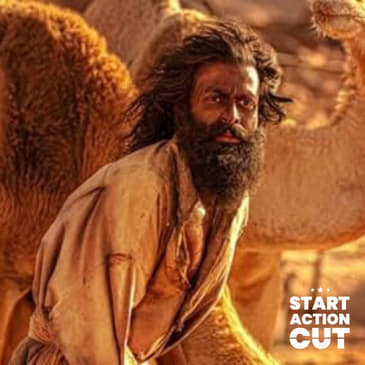
In this episode of Start Action Cut, Princy, Ayyappan and Padmakumar are analysing the Malayalam movie 'Aadujeevitham' directed by Blessy and starring Prithviraj Sukumaran in the lead.
See omnystudio.com/listener for privacy information.
[00:00:00] Hi, welcome to Onmanorama Movie Podcast, Start Action Cut. Today, Hyapen and Prince
[00:00:19] are joining us for the discussion of the movie, RGVitham, an adaptation of Father Beniam
[00:00:25] and famed novel with the same title and starring RGVitham in the lead. The film, as in
[00:00:33] the novel, explores the unimaginable travails of an ex-pat Mariali who lands in the dungeon
[00:00:40] of misfortunes in his quest for a better life in the Gulf. So now it's generally said that
[00:00:48] the universe that words create can never match any visual experience of a literary piece.
[00:00:55] There are movies which come so close to the characters, places and dramatic twists in
[00:01:01] books which have been adapted in films. So how is the canvas that the book and the movie
[00:01:08] provides? Hyapen.
[00:01:10] Patmogumar, the blueprint of both the book and the film is a same. The design is the same.
[00:01:17] The features are the same. The only difference is in the attitude. Blessings film,
[00:01:24] on to GVitham is a dark one. There is no respite from the misery. It is as if blesses
[00:01:30] he has sort of forcefully merged as in a basin of misery. Not even pulling his up
[00:01:36] to take a bout of fresh air. It is so dark. But on the other hand, Venya means art
[00:01:42] of GVitham. It is slightly light. There is a certain lightness of touch. That is basically
[00:01:49] because it is told in fresh person. Venya means let's Najibe tell his story. So Najibe
[00:01:57] has actually survived the truales of the desert is ordeal. He is now across. He is in
[00:02:03] the comfort of his home. Perhaps when he is writing this, he has got his wife and kid
[00:02:07] near him. So he can afford to crack jokes even celiacous ones. Even adopts a self-mocking
[00:02:15] tone. For instance, there is this passage in the book where Najibe meets Brahim Kadri
[00:02:22] for the first time. The moment he sees Kadri, Najibe sort of shocked. Seeing the size of
[00:02:28] the man. What is this? Oak of a man and before him, both of us Hakim and Myself, we look
[00:02:34] like Wilts and Amaranthus, Kirinachira Chidiwar. That is what he says in the book. But just
[00:02:39] imagine blesses he translating that into the book, into the film. That Shankun Shrivel
[00:02:46] Prativraj and Najibe walking up the rocks to meet Hakim and Dari sees Kadri for the first
[00:02:52] time. And just imagine this guy going straight to Najibe and just slightly whispering in his
[00:02:58] ear to say, sir, even the normal of the way, the word, in the parayana, it will take the
[00:03:05] profundity out as a film. So blesses he cannot afford to lighten the mood. Najibe's
[00:03:14] pravels his ordeal happens right before us. All we can do is that we can really look at
[00:03:19] it with all and helplessness, which shock and helplessness. Any attempt to lighten the
[00:03:25] mood would be to insult the suffering of the man. So it is in the mood, it is in the
[00:03:31] states of mind of the novel and the film that they kind of differ. And also, Bindiam
[00:03:38] has said that there is a particular passage in the film that he had liked a lot. He likes
[00:03:43] the most. And this happens when it rains in the book. It rains. And rain is a rare occurrence
[00:03:49] in the desert. And it is not a pleasant experience either because you know, every drop feels like
[00:03:54] a knife step. And but gradually you get used to it. And by the third day Najibe sees a green carpet
[00:04:02] over that body brown sand. Suddenly there is this green everywhere. And from underneath
[00:04:09] green plants, they have just erupted above the ground, flowering plants, fruit laden plants,
[00:04:16] black tie. And one of these plants, one of these cute little plants talks to Najibe. I mean
[00:04:23] Najibe imagines this plant talking to him. It is a message of hope that the plant is giving.
[00:04:29] The plant tells him Najibe, Maribu need a dattu butra. Najibe, you foster some of the desert.
[00:04:37] Protect yourself from the desert, the way we have preserved our sins. Sandstorms and heat waves
[00:04:44] will pass you by. Don't surrender to them. They will ask for your life. Refuse. Behave as if
[00:04:51] you don't exist. Behave as if you are half dead. Allah is hearing your prayer. Your time will come.
[00:04:57] This is the message of hope that the plant gives it. And Benjamin has said that these are the
[00:05:02] lines that he liked the most in his novel. But bless he had ignored these lines. Consciously,
[00:05:11] bless he had brained his film completely, fully of hope and even brains. Of course there is a bit
[00:05:18] of brain. I mean that is just the creative device to let Najibe meet Hakibe in the desert.
[00:05:25] The other part of the desert has for hope. There is none at all except towards the end.
[00:05:31] So bless he's film is a bit difficult to watch. How would you like to describe it,
[00:05:37] I read the book in English and I do not know if I lost anything of it of the essence of
[00:05:44] the book because I read it in English and not in Malayalam. But generally like what you are
[00:05:49] asked right now, there's a difference in how a book is presented and the film make has a lot of
[00:05:55] limitations. In the way he describes a certain particular scene or an emotion because in Benjamin's
[00:06:02] case in the case of his novel, he has a lot of time to describe the character. He has enough time
[00:06:09] to allow us to understand and impress ourselves into what the situation that Naji was facing.
[00:06:18] But as a filmmaker, bless he has those limitations. In what he can actually offer us is a visual
[00:06:24] imagery of what we all imagine on screen. And that is what he's done really beautifully.
[00:06:30] But what as a novelist, as a person who writes a book, he is able to give us a language of
[00:06:37] he's able to give us something in the language of our own. Well as a filmmaker,
[00:06:42] he is translating the imagery for us. You know that is the difference I felt between a book and
[00:06:48] the movie. Yes, as we discussed earlier, whether the movie lives up to the expectations,
[00:06:55] I think R.D.G. with him is a winner here because the viewers experience as arrived much closer to
[00:07:02] the reader's imagination of the main character Naji, his traumatic struggles and the boundless
[00:07:08] terrain where the campaign of the distraught man's disfigured and crippled fate is staged.
[00:07:14] So do you agree if I say that the movie could satisfy you in terms of the aesthetic experience
[00:07:23] it can raise. I open. Yeah, I fully agree with it because I thought it it met my expectations.
[00:07:30] It is clearly mapped the arc of Naji so beautifully right from the time he lands in Gulf,
[00:07:38] then he comes to the Masara, to the enclosure, to the middle of nowhere and then the way is humanity
[00:07:45] is sort of you know broken down hopelessness suicidal thoughts. Then something else is sort of you
[00:07:52] know switched off and then the escape and the entire arc is so beautifully mapped in the film
[00:07:57] except for that flashback portion which I was not particularly enthusiastic about. Even though
[00:08:02] Amla Paul whatever with a sort of you know girl in love's buckle she was good but then I was not
[00:08:08] it was slight was a slight distraction a bit of a diversion from the story otherwise I thought
[00:08:13] the arc was beautifully managed the mythical struggle of a man actually came alive on screen
[00:08:19] that's what I felt and the technical department especially the music the cinematography all of this
[00:08:26] matched blesses a mission that's what I would like to say about but but then now that all of us have
[00:08:32] read the book there could be minor cripples you know minor complaints these are not complaints at all
[00:08:38] because you know there are certain elements in the book which gives it further layers
[00:08:44] adds to the depth of the story adds to the depth of Najib's story because you know
[00:08:49] our digivism is not just about a man living with goats living with a herd of goats or transforming
[00:08:56] into a goat like person it's not just that it's also about the life of the goats paralleling
[00:09:03] the life of this man because these goats I mean these woolen goats these woolen sheep and they don't
[00:09:08] belong here they imported from somewhere they're kind of displaced this man is also displaced
[00:09:14] and in the book you have children weaned away from their mothers and then they're not
[00:09:19] love to suck the breasts of their mothers there's separation that's exactly what he's feeling
[00:09:24] and then in the book there is castration I mean any child born most of the children born are
[00:09:29] castrated and and Najib because he's far away from home and there and there being no hope that he would
[00:09:36] return he too is as good as castrated so these elements somehow then come into the film which I
[00:09:43] thought could have been included in the book but these are minus pupils I mean they've been
[00:09:48] taken away the experience from it it was a wonderful experience it was a grueling experience for
[00:09:54] now like I have been mentioned there were certain scenes that we expected to watch in this movie
[00:09:59] maybe the castration scene or maybe you know where the conversations happen between the goats
[00:10:05] and Najib who becomes far from somehow because of his long stay over there and that blessing
[00:10:13] might have deliberately avoided all these aspects to make it you know because he's got a limit time
[00:10:19] limit and also to make you know to ensure that you know there's a smooth flow to the entire
[00:10:25] progress of how he is going so maybe that is why but then because of these aspects the lack of
[00:10:31] these aspects it kind of affected my viewing experience because I expected certain of these scenes
[00:10:36] to be there in the movie yes Prince Yasu rightly said the movie the scene was able to portray
[00:10:44] the poignants of the drama of the story and also the visual brilliance is matchless and thanks to
[00:10:51] the camera by K. Sunil now coming to the protagonist that is Prithraj is I think I would say that he
[00:11:01] is the king of emotions among the new generation Malalam actors so though he cannot be strictly
[00:11:07] bracketed into that generational category I think Ayalum Nyanam Tamil was the previous instance
[00:11:14] when he took us to the peak now this is a stunner and the cast was perfect like K. R. Gokul
[00:11:21] and Jimmy Jean Louis and everyone everybody there were so many few actors in the movie but
[00:11:28] everybody was spectacular what do you say Prince yes Patma Kumar I think Prithu Raj is often
[00:11:35] being accused of not being able to internalize the characters that he's portraying on screen
[00:11:41] that is one point that I do not agree with much because like you had mentioned I also believe that
[00:11:46] he is able to perform well in emotional scenes Ayalum Nyanam Tamil is one example so is Nune Nune Moi
[00:11:53] Nune even Pavada for an if you look at it in that sense when there are emotional scenes so he
[00:11:59] has got that within him and R. D. Jeevatham offered him that scope I mean apart from I know people
[00:12:06] are celebrating his massive physical transformation but apart from that his emotional he was at the
[00:12:13] peak at certain emotional scenes you know I particularly loved how he you know when he and Hakeem
[00:12:22] Ibrahim Kadirya traveling through the desert and you know how he missed of desperation and on seeing
[00:12:27] Hakeem you know going through a tough time in the emotions that came on as the phase were phenomenal
[00:12:34] same thing you know when you see the when you look at the look at a particular scene when
[00:12:39] he is being offered a coupouz by his Arbab you know there is so much that the emotions that were
[00:12:46] portrayed in his eyes it showed I think it kind of conveyed everything that was supposed to be
[00:12:50] conveyed in the movie that desperation the hunger the loneliness everything came into on to the
[00:12:57] screen through his eyes and that was beautiful and also kudos to all the to the rest of the cast who's
[00:13:04] been able to actually pull this movie forward yes Ayapun how would you explain the performance of
[00:13:11] the protagonist I mean Rithuraj in the movie.
[00:13:14] Mahabhmumar, Rithuraj has to be effective for the film to be effective and he is Rithuraj is
[00:13:21] generally comes across as a very cocky person and and in this film yes sort of drain
[00:13:26] themselves fully in like bless you have drained this film completely of whole he has drained
[00:13:32] himself fully of cockiness so you introduce to him as a very shy yourself person he's so even with
[00:13:39] his friends and then the various stages the initial stages of you know hesitation of the first shock
[00:13:48] and then the helplessness and then the gradual stages where as humanity is sort of erodes and
[00:13:56] hopelessness sitting and then gradually suicidal thoughts and after that he becomes a sort of a dead
[00:14:03] leaf he has no feelings and then the escape and all of this he not just externalizes he's internalized
[00:14:13] so he is just like the film he too has evolved a proper a very commendable character graph
[00:14:22] for himself for his character and then that transform it to movement I mean the mythical movement
[00:14:30] when he comes towards the camera just before the escape comes before the camera he just removes his
[00:14:35] robe and reveals his nakedness instantly what brought to mind mine was that iconic World War II Vietnam
[00:14:45] War photograph the iconic photographs of that Vietnam is girl running screaming the Napa
[00:14:52] fumes in the background her tummy tattin so that was the image that instantly came to my mind it was
[00:14:58] sort of you know this is a moment that you simply cannot get over the the enormity of the man's
[00:15:04] devastation simply came alive in that scene like you see they're like humanity couldn't get over
[00:15:10] the Vietnam iconic photograph the image that was given to us I think the as viewers to
[00:15:17] will find it difficult to sort of you know brush aside this image of a brutalized man so I thought
[00:15:24] that was an achievement yes now I think AR Rahman's background score and the songs were instrumental
[00:15:33] in elevating the story and the movie to a higher level especially many people say that the
[00:15:41] Perione and the other songs were great but personally I liked Badavi the song rendered by
[00:15:49] the Palestinian singer the whole BGM score transports you to a different world of course but
[00:15:57] this song when you listen even when you are in your room it takes you quite to the dark lonely
[00:16:06] dessert so that's the effect of the music in the movie so prince what would you say about
[00:16:13] the music and the BGM in the film Patma Kumar the music definitely blend well with the movie
[00:16:19] the general theme of the movie is desperation and loneliness and all that and through these songs
[00:16:26] through AR Rahman's compositions he was able to bring about that kind of feel in the movie
[00:16:33] through all the songs and but like you mentioned it is Perione and Badavi by the Palestinian singer
[00:16:38] that also touched me more the visuals really blend you know the music when the visuals and the music
[00:16:45] come together it elevated the scenes in the movie well especially I liked one particular scene where
[00:16:51] Najib he's actually taking a dive into the river in his hometown and this is beautiful music playing
[00:16:59] in the background and that really brings a lot of beauty to the entire visuals that you're watching
[00:17:06] my only advice is where the you know whether songs I feel like there were a lot of songs being played
[00:17:11] in a very less time that the filmmaker had and you know here and there before we are able to
[00:17:17] you know actually enjoy one track the next track comes on and so I felt that these many songs were
[00:17:25] not really needed to actually tell Najib's story so the music in as such elevated the song in
[00:17:33] different scenes but when you look at it as a package I felt there were too many numbers of songs
[00:17:39] okay I happened what do you like to say that AR Rahman's music we've had a magic in this film
[00:17:45] how was it? Perione, given the kind of film that this was the relentless mystery that we
[00:17:51] are showing screen the music came across as a kind of a comfort for me it was a sound of a divine
[00:17:57] so it was as if it was like God or the only potent the omnipresent God itself was sort of shaken by
[00:18:05] the man's suffering and then the music sort of you know washes on us like soothing waves wave
[00:18:12] upon wave of comfort that's how I felt the BGM to be and then there is this Perione song Perione
[00:18:21] in Ramanesh song that is a cry to the Almighty and for me the BGM the wave upon wave of comfort that it
[00:18:29] gave that was Almighty's reply it was Almighty's I thought it was Almighty's way of saying see I can feel
[00:18:37] your suffering my child and I too can't bear it I mean it was that sort of a feel that gave that
[00:18:43] music gave me and then the the earliest scene that I've mentioned the Pratuvraj's naked movement
[00:18:49] that scene the moment he comes to the camera there is this one note string that is played in the
[00:18:56] background I mean it's it's a kind of a veil and it seems to come from a ghostly place and it's
[00:19:03] played at its lowest pitch and it's more sad and terrifying and then as he moves towards the
[00:19:10] tang where is we'll take bath the BGM placing that is where the Divine Tellsim Naji you are now in my
[00:19:17] embrace and and I love this man God do it that took place in the film it was so enchanting
[00:19:25] now as we all know it took a long time to make this film and yet it has come out well
[00:19:34] and it may not be proper on anyone's part to find the false but yet I think there are certain
[00:19:41] things that I should point out which I missed and I found as flows one is the there are shades of
[00:19:50] an inventing dilemma I've written all over his face from the very beginning itself but I think
[00:19:57] Naji the real Naji it could be joy excitement and confusion at first then the resistance
[00:20:04] and then the defeat and the final ejection and the final trauma but instead of that we
[00:20:10] feel that we all know how the story is going to evolve and Naji I mean Pratuvraj he had this sort of
[00:20:18] that he's going to lose something in his life that sort of image that sort of disposition was there
[00:20:25] from the very beginning so that's one thing and then there is the dialogues mostly when the narrative
[00:20:31] shows his previous life I mean when he wasn't in his hometown in his village the dialogues were
[00:20:38] amateurish or not realistic maybe because we are so used to the realistic tenor of dialogues
[00:20:44] and movies these days so we see it very cinematic and very much beautified then the transition
[00:20:53] of Naji he's there with the stubble and then to a certain duration and then you find Naji
[00:21:00] with a long beard and long hair so that was an instant transition maybe they say that there were so
[00:21:05] many cuts for the sake of sensor board and maybe they have removed something from in between
[00:21:13] so that couldn't bridge the cap of this transition and then the families concern could have been
[00:21:20] shorn in the meantime it plus he was keeping the movie close to the book yet he used some creative
[00:21:27] freedom in between and so he could have shorn the families concern in the meantime when he was lost
[00:21:34] to them and then I would shamelessly say that vast starlit night sky of the desert could have
[00:21:43] shorn in the movie because since it's a desert movie I was very much waiting for it so these are just
[00:21:51] a pinch of sand in the vast desert by the time the end credits start rolling up you forget all
[00:21:57] these things do you have any such points to drive home I happen I mean I'll just list out some
[00:22:04] of the points that you yourself had mentioned the one about the start from what you said last
[00:22:09] which is this starlit sky there was this wonderful wonderful image to begin with this is that's the start
[00:22:15] of the film we have this night time desert that's a starting shot and then you show the desert sky
[00:22:23] and you have a beautiful brilliant star formation it's like a cosmic fireworks that happened
[00:22:29] colorful and then we are shown a man bending down into a tank of water he's drinking
[00:22:37] and then camera gradually pulls back and when he brings and you can see the see the reflection of
[00:22:43] that star star formation on that boat and then the camera pulls back and you see this man
[00:22:49] and around him the sheep the beasts and this man in distinguishing see it was just a single line in
[00:22:56] the book where it says I'm gonna Jan Cherikim or Ardai Mari and thus I truly transformed into a
[00:23:04] god and that one line is made into one of the most unforgettable visual passage in the film
[00:23:12] so there is a starlight thing there and then there's a bit of mystery also because this
[00:23:17] the very same shot was shown in the interval time and when it was shown in the interval time
[00:23:22] that starlight that star formation is not reflected on the water so I don't know why that happened
[00:23:28] that was one and then to about the dialogues I'm not going to argue about the dialogues
[00:23:33] that happened in the village in the village portion in the flashback portion but what I really
[00:23:38] liked about the dialogues is that not not the dialogue I mean the way Prithvara initially
[00:23:44] I think it was a creative decision not to make him talk to the gods you know he's a lonely person
[00:23:51] he withdraws into himself that is a najib of blessing and then after a point after by the time he
[00:23:57] reaches the third transformation by the time he grows that or some have been like the earth
[00:24:03] he has lost his language his malayalam gets mixed up with the language he used to communicate
[00:24:09] with the with the goats and the camels it's a hybrid language it talks and the man even suspects
[00:24:15] the kind of words that is coming out of his coming out of his mouth so that is a kind of hesitance
[00:24:20] that he has about language and I thought that has come out beautifully and commendably
[00:24:25] that is a second thing and the third thing that you mentioned was about the transition
[00:24:30] and about the transition I thought there was a brilliant way in which bless here transition from one
[00:24:36] stage to the other there was his first he came in he's not buried I mean he's clean shaven he comes
[00:24:43] there he knows that he has been trapped he tries to he's desperate he wants to get out that faces over
[00:24:50] and we go into the next phase and you know how the lead all the transition scene is done
[00:24:55] the transition scene is goats being shared the rule of the goats being scissored
[00:25:01] goats may actually unbear they're being shaved and then we are shown this bearded person
[00:25:07] I thought that irony I thought was a nice creative decision
[00:25:12] and just staying with creative decisions there was another creative decision I thought was really
[00:25:17] wonderful that's towards the end I mean during the escape portion towards the end
[00:25:22] Ibrahim Kadri comes across a cola bottle it picks up the cola bottle and in it is sand he just
[00:25:31] owes it up I thought it was a cruel wish because these men were traveling the vast
[00:25:37] expands with the desert the vast sand they were covering sands with not a drop of water to be found
[00:25:43] and then finally to get a cola bottle cola which is a symbol of thirstlessness a symbol of freedom
[00:25:50] from thirst and in this bottle to get sand I thought was a sadistic wish will it sort of amplify
[00:25:56] the thirst within and this was not a random shot either because you know initially when Najib and Hakeem
[00:26:03] lands their port and as they walk through the lounge of the airport you can see this big Coca-Cola
[00:26:10] atmosphere first I think is one of the major themes that could build this film for one yeah I think
[00:26:17] there were nice creative decisions to I'll just add to what was mentioned about the dialogue
[00:26:23] for me the dialogue delivery by Prithviraj like we had already spoken about that has also been
[00:26:30] criticized in the past in this film generally I found his dialogues good but still there was
[00:26:36] that artificiality that came in his dialogues which did not match with the emotions that he was
[00:26:43] portraying on screen and that I found that mostly when he when like I append just said you know
[00:26:50] that where he lost his language and he's trying to find his words even though that sounded like
[00:26:55] gibberish it didn't sound that real and I don't know why but then I was not able to get that
[00:27:02] connect because of that dialogue delivery there but if you look at it you know probably
[00:27:06] bless me during his interviews before the movie release he had mentioned that he had approached
[00:27:11] Vikram to do to play the character of Najib in his film and I'm sure that maybe you know he must have
[00:27:17] thought that there was no one ask capable to do a film to undergo this massive body transformation
[00:27:23] that Prithviraj went through in Molyward but Prithviraj he proved himself and he was able to show
[00:27:30] that you know people in Molyward to have that caliber to bring in such a massive transformation
[00:27:36] terms of physical transformation that I'm talking about so that was one of the most beautiful
[00:27:42] things about the film and also the casting was perfect everybody everybody did their roles
[00:27:48] really well I was particularly blown away by Jimmy Jean-Lowis who played Ibrahim Kadiri he was
[00:27:55] extraordinary in the movie I just loved his the mannerisms the way he controlled his character
[00:28:02] everything was beautiful so I would give most of my marks for the casting in the film okay
[00:28:08] so now if you have complained that these days we rarely come across movies that won't you long after
[00:28:14] you have let the theaters here is this one how to live with them you will hardly spend a day without
[00:28:20] any of the scenes seizing your mind and heart for weeks maybe prompting you to watch it twice or
[00:28:27] thrice or even more so that's what I feel so that brings us to the end of this episode of
[00:28:34] start action cut thanks for listening to this episode produced and hosted by me Patmogmar
[00:28:40] with technical production by i.d. Bruce Studios follow www.onmanorama.com for more
[00:28:46] podcast from movies and be sure to come back for the next episode of start action cut that will
[00:28:52] be out on next Monday thank you