
A degree is an important achievement.
But does graduating automatically make a student career-ready?
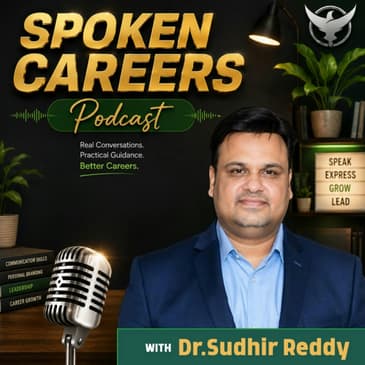
In Episode 70 of Spoken Careers, Dr. Sudhir Reddy explores the gap between qualification and capability.
A degree provides knowledge and, in many professions, essential eligibility. But professional life asks a different question:
What can you actually do with what you studied?
The episode introduces a simple progression:
Qualification → Capability → Contribution
The goal is not to diminish the value of higher education. It is to help students think beyond the certificate and deliberately build the capabilities they will need after graduation.
“Once I have the right degree, my career will take care of itself.”
“A qualification can open a door. Capability determines what you can do once you're inside.”
The degree may mark the end of your education. But it can also be the beginning of your professional story.
[00:00:19] A student spends 4 years earning a degree. They attend classes, complete assignments, write examinations. Finally, they graduate. And everyone says, congratulations, you're ready for your career. But are they? A degree can tell us that someone completed a course of study. It doesn't automatically tell us what they can actually do. And that difference matters.
[00:00:43] Welcome to Spoken Careers, home of Career Decision Intelligence. I'm Dr. Sudhir Reddy. Think about two students who graduate with the same degree. Their certificates may look almost identical. But one has built projects, communicated ideas, solved real problems, and worked with people. The other has mainly completed the academic requirements. Same qualification. Very different starting points. This is not an argument against degrees. Degrees matter. They provide knowledge, students, and students.
[00:01:13] structure, and, in many professions, essential eligibility. But the degree is often the beginning of the professional journey, not the end of it. Imagine someone completing a degree in computer science. They know programming concepts. But can they build something useful? Can they work with a team? Can they explain a technical problem clearly? Can they learn a new tool when the old one becomes outdated? That is where qualification begins to become capability.
[00:01:39] And capability is what allows knowledge to create value. A similar thing happens in almost every field. A psychology graduate needs more than knowledge of psychological theories. A business graduate needs more than knowledge of management concepts. A designer needs more than knowledge of design principles. A journalist needs more than knowledge of communication. The question gradually changes from, what did you learn from, what did you study?
[00:02:04] What did you study? To, what can you do with what you studied? And that brings us to today's career myth. The myth is, once I have the right degree, my career will take care of itself. But let's look at the career truth behind that. A qualification can open a door. Capability determines what you can do once you're inside. And contribution is the next step. Can your capability solve a problem? Can it help a customer? Can it improve a process? Can it create something useful?
[00:02:32] Can it make someone's work easier? That is when education begins to produce professional value. So let's use the next minute to make this practical. Take your degree, or the degree you're planning to pursue. Write down three things. First, what knowledge will I gain? Second, what will I be able to do? And third, where could that capability create value? If you cannot answer the second question clearly, that is something worth exploring before graduation. And if you cannot answer the second question clearly, that is something worth exploring before graduation. And if you cannot answer that,
[00:03:02] answer the third, you may need more exposure to the world of work. Because a career is not built only by accumulating qualifications. It is built by converting knowledge into capability. And capability into contribution. And before we finish, here's one question I'd like you to carry with you. When you finish your degree, what will you be able to do that you cannot do today? If you can answer that clearly, you're thinking beyond the certificate. And if you're helping a student prepare for life beyond education, visit
[00:03:32] www.spokencareers.com. Explore the career clarity hub, minute readiness check. I'm Dr. Sudhir Reddy. This is Spoken Careers. The degree may mark the end of your education. But it can also be the beginning of your professional story.