
You studied for three hours.
You watched the lecture.
You made the notes.
You understood the explanation.
But can you actually explain it, solve with it, apply it or teach it?
In this episode of Spoken Careers, we explore a simple but important distinction:
Exposure is what you consume. Learning is what you can use.
Discover how to identify learning gaps, why study hours can be a misleading measure, and a simple exercise you can use tonight to test whether learning has actually happened.
Because in an AI-rich world, information is increasingly abundant.
The valuable skill is turning information into capability.
[00:00:18] You Don't Have a Knowledge Problem. You Have a Knowing What You Don't Know Problem. Think about the last time you felt confident about a big decision. You read the syllabus, watched five videos, spoke to one senior and felt ready. But six months later, you ran into three massive obstacles you never saw coming. The dangerous part of a career decision is rarely the information you know is missing. The dangerous part is the information you didn't even know existed.
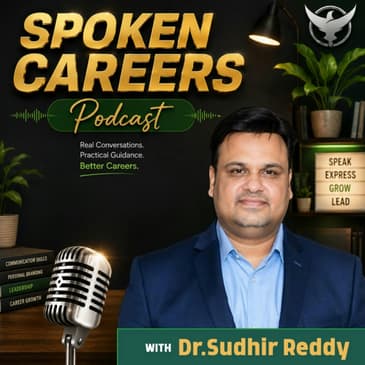
[00:00:47] Welcome to Spoken Careers, home of Career Decision Intelligence. I am Dr. Sudhir Reddy. Imagine a map from 400 years ago. When map makers reached the edge of the explored world, they didn't leave a blank white space. They drew sea monsters and wrote, here be dragons. They filled their ignorance with imagination. Students and parents do the exact same thing today. When
[00:01:13] we don't know what a career actually involves day to day, we don't leave it blank. We fill the gap with assumptions. It has great scope. It is a safe field. The salary will be high. Or artificial intelligence won't affect it. We replace missing data with comforting assumptions. In our last episode, we diagnosed the real problem behind career confusion. But once you identify the question, you hit a wall. How do you
[00:01:42] actually find out what you don't know? Here is the cognitive trap. You cannot search for something if you don't know its name. If you only search for what you already know to look for, you just confirm what you already believe. To break out of this, you need a systematic knowledge gap audit. Step 1. List your invisible assumptions. Take the career or degree you are considering. Write down three things you believe to be true about it.
[00:02:11] For example, this degree leads directly to a software role. Or this certification is recognized everywhere. Now ask, did I verify this from official data? Or did I hear it from someone's opinion? Step 2. Interrogate the ordinary Tuesday. Most research focuses on the highlights. The starting salary, the graduation ceremony, and the glamorous title. To find your
[00:02:39] blind spots, ask working professionals about their worst days. What is the most repetitive task in this job? What unexpected skill do you use every day that college never taught you? What makes people quit this field after five years? When you ask about the unglamorous middle, the invisible reality immediately appears. Step 3. Map the
[00:03:05] regulatory and skill prerequisites. Every career has hidden gates. In psychology, it might be clinical counsel licensing. In data science, it might be production code deployment. In studying abroad, it might be local language fluency. Find the gate before you pay the tuition. Let us explore today's career myth. If I read enough articles online, I will have all the facts. Here is the career truth. The internet gives you answers to
[00:03:34] common questions. It does not tell you which questions you forgot to ask. Parents, when discussing options with your child, don't ask. Do you know everything about this course? Nobody does. Instead, ask, what are three things about this career we have not investigated yet? That normalizes curiosity and protects the family from blind spots. Here is today's golden minute. The most
[00:04:01] dangerous sentence in career planning is, I already know how that field works. The moment you think you know, you stop investigating. Don't let assumptions masquerade as facts. Map your blind spots, interrogate the daily reality and verify the hidden prerequisites before you make your move. Here is today's question to carry with you. What is one major assumption you are currently making about your future that you have never independently verified?
[00:04:29] Sit with that. Because finding what you don't know is how you turn a blind guess into an intelligent decision. To explore the knowledge gap audit and practical tools, visit spokencareers.com. I am Dr. Sudhir Reddy. This is Spoken Careers. Better questions lead to better decisions. I am Dr. Sudhir Reddy. This is Spoken Careers. I am Dr. Sudhir Reddy. This is Spoken Careers. I am Dr. Sudhir Reddy. This is Spoken Careers. Thank you.