
Is a college degree enough to make you career-ready?
Education matters. Qualifications matter. But as AI, technology and the job market continue to evolve, students need to think beyond certificates and ask a deeper question:
What will I actually be capable of doing when I graduate?
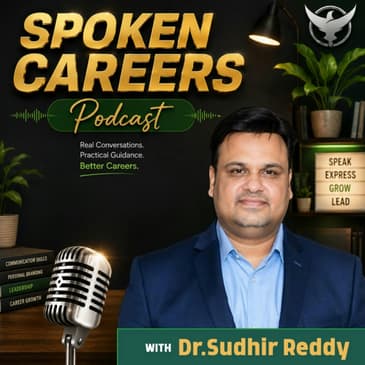
In Episode 29 of Spoken Careers, Dr. Sudhir Reddy explores the difference between qualifications and capabilities—and why academic knowledge becomes far more valuable when students learn how to apply it in the real world.
Through the story of a graduate facing his first serious interview, this episode explores career readiness, employability skills, practical experience, problem-solving, communication, internships, projects and lifelong learning.
You'll discover why:
• A degree alone doesn't guarantee career readiness
• Practical skills and real-world experience matter
• Projects and internships can turn knowledge into capability
• Communication and problem-solving remain critical career skills
• Students should build evidence of what they can actually do
• Career preparation should begin before graduation
Today's Career Myth:
“Once I earn the right degree, I'll be career-ready.”
Career Truth:
A qualification may help you enter the conversation. Capability determines what you can contribute once you're there.
One Question to Carry With You:
If your degree disappeared from your résumé tomorrow, what could you show someone that proves what you're capable of?
A degree can certify what you studied.
Your capabilities reveal what you can actually do.
Explore more career guidance and future-ready resources at www.spokencareers.com.
Spoken Careers — Home of Career Decision Intelligence.
[00:00:16] What if your degree proves you studied, but doesn't prove you're ready? Think about that. For years, we've treated education almost like a finish line. Complete school, get into college, earn the degree, collect the certificate, and then career-ready. But imagine something. You pass your driving test, you receive your driving license, you take a photograph holding it proudly, your family congratulates you. Wonderful.
[00:00:43] But now I hand you the keys, put you in the middle of a busy city, and say, drive. Suddenly, the license and the ability don't feel like exactly the same thing. Welcome to Spoken Careers, home of Career Decision Intelligence. I'm Dr. Sudhir Reddy. A degree can be extremely valuable. It can give you knowledge, structure, exposure, credibility,
[00:01:10] and access to opportunities that may otherwise remain closed. But a degree is evidence that you completed an educational journey. It isn't automatic evidence that you can navigate every situation waiting outside the classroom. That's where capability begins. Imagine a young graduate named Arjun. Arjun has done almost everything he was told to do. Good marks, good college, good degree, several certificates. His resume looks impressive.
[00:01:40] Then he enters his first serious interview. The interviewer doesn't ask him to define something from his textbook. Instead, she gives him a messy problem. The information is incomplete. There is no obvious correct answer. And she asks, what would you do? Arjun freezes. He knows the concepts, but he's never had to use them like this. Then she asks, tell me about something you built.
[00:02:06] Arjun mentions his academic project. What problem did it solve? He struggles to explain. What went wrong? He isn't sure. What did you personally contribute? Now the answer becomes even harder. Then comes another question. Tell me about a time you disagreed with someone on your team. Arjun smiles nervously. That question definitely wasn't in the syllabus. None of this means Arjun is unintelligent.
[00:02:35] He may be extremely capable of becoming excellent, but something important has happened. For years, he was preparing to complete the course. Now the world is asking him, can you use what you know? That's a different test. Think again about driving. Knowing the traffic rules matters. Understanding the signs matters. Knowing how the vehicle works matters.
[00:02:59] But eventually, you have to enter traffic. You have to judge distance. Respond to uncertainty. Notice other people. Make decisions. Correct mistakes. And remain calm when the person behind you believes the horn is a form of emotional expression. Careers work a little like that. Knowledge matters. But knowledge becomes powerful when you can use it. Now let's explore today's career myth.
[00:03:24] The myth is, once I earn the right degree, I'll be career ready. Here's the career truth. A qualification may help you enter the conversation. Capability determines what you can contribute once you're there. And capability is bigger than technical knowledge. Can you solve an unfamiliar problem? Can you explain a complicated idea simply? Can you work with someone who thinks differently from you? Can you ask a good question when you don't understand something?
[00:03:54] Can you learn something without waiting for a teacher to assign it? Can you receive feedback without treating it as a personal attack? Can you take responsibility when something goes wrong? Can you use technology intelligently instead of simply knowing the names of the latest tools? These things are difficult to print on a certificate. But employers, colleagues, clients, and eventually the people you lead will experience them. This is especially important now.
[00:04:24] Technology is changing what many jobs require. Some tasks that once demonstrated competence can increasingly be assisted or automated. So the question for students cannot only be, what degree should I get? We also need to ask, what will I be able to do by the time I graduate? That's a much more powerful question. If you're studying computer science, don't only learn programming. Build something. Break something. Fix something.
[00:04:53] Explain what you build to someone who isn't a programmer. If you're studying business, don't only learn marketing theories. Try selling something. Study a real customer. Help a small organization solve a real problem. If you're studying psychology, don't only memorize theories about human behavior. Learn to listen. Observe. Research. Communicate carefully. Understand the ethical responsibilities of working with people.
[00:05:21] Whatever you're studying, find ways to move from knowing to doing. Projects. Internships. Competitions. Research. Volunteering. Part-time work. Conversations with professionals. Small experiments. You don't need to do everything. But you do need opportunities where knowledge meets reality. And here's something parents should think about too.
[00:05:45] Sometimes we become so focused on marks that we accidentally optimize education for the scoreboard. 90%. 95%. Top rank. Prestigious college. Those achievements matter. But imagine two questions at graduation. The first is, what marks did you get? The second is, what can you now do that you couldn't do four years ago? I would want a young person to have a powerful answer to both.
[00:06:14] Before we close, here's today's golden minute. Your degree matters. Be proud of it. Work hard for it. Respect the opportunity education gives you. But don't confuse the certificate with the capability. A driving license gives you permission to enter the road. It doesn't guarantee that you know how to handle every road you'll meet. Experience does that. Practice does that. Mistakes do that. Reflection does that. Learning does that.
[00:06:43] So while you're earning your qualification, build the person who will carry it. Build judgment. Build communication. Build curiosity. Build the ability to solve problems. Build the courage to say, I don't know yet, but I know how to learn. Because a degree can certify what you studied. Your capabilities reveal what you can actually do. Before our next conversation, here's one question to carry with you.
[00:07:11] If your degree disappeared from your resume tomorrow, what could you show someone that proves what you're capable of? Some questions deserve silence before they deserve answers. If today's lesson helped you think differently about education and career readiness, share it with one young person and one parent. Because better conversations create better decisions, and better decisions create better futures. Remember, earn the degree. But don't stop there.
[00:07:40] Learn the rules. Then learn to drive. Because your career doesn't begin when someone hands you a certificate. It begins when you learn what to do with everything you've learned. To explore more insights and future-ready resources, visit www.spokencareers.com. I'm Dr. Sudhir Reddy. This is Spoken Careers. Home of Career Decision Intelligence. Keep learning. Keep growing. Walk your path with courage. Live it with purpose.
[00:08:10] And always, lead with love.