
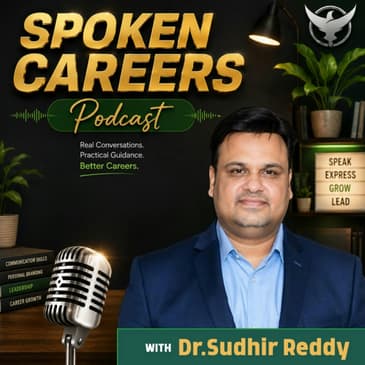

What happens when five people give you five different answers about your career? In this Decision Room episode, we examine a real discussion about rehabilitation and counselling qualifications. One person recommends IGNOU. Another suggests RCI-affiliated institutions. Someone else recommends skill-based certifications. Another suggests a distance programme from Jamia. Then someone points out that the programme isn't RCI approved. So who is right? More importantly, how should a student make the decision? This episode introduces a powerful rule: don't choose advice based on confidence — choose it based on relevance, evidence and your intended destination.
Career Myth:
“The person who sounds most confident probably knows which option is best.”
Career Truth:
Career advice should be evaluated against the student's goal, eligibility requirements, evidence, and current professional rules—not simply the authority or confidence of the person giving it.
Signature Insight:
Don't ask, “Who should I believe?” Ask, “What can I verify?”
Spoken Careers Brand Line:
Spoken Careers — Powered by Dr. Sudhir Reddy
[00:00:18] Imagine you are trying to make one of the biggest decisions of your life. You ask for advice, and within a few hours, you get five completely different answers. One person says, go with IGNO. Someone else says, IGNO should be your last option. Another says, look only at RCI-affiliated colleges. Someone else says, try a private skill-based certification.
[00:00:44] And then another person says, Jamiya has a distance learning alternative only to be told immediately. But that is not RCI approved. Now you are sitting there thinking, who is actually right? Welcome to the Decision Room, home of Career Decision Intelligence. I am Dr. Sudhir Reddy. Today's question is not simply, which course is better. It is something much more fundamental. How do I make an intelligent decision when everyone around me is giving contradictory advice?
[00:01:14] Let us unpack this through four key questions. Question 1. Why can two intelligent people give completely different advice? Sometimes, both people are right. They are just solving completely different problems. One person is prioritizing affordability. Another is prioritizing statutory professional recognition.
[00:01:39] Another is thinking about immediate employability. While another is focusing on personal convenience. One person may be saying, this qualification is academically legitimate. Another may be saying, I would not choose it if your goal is a specific licensed clinical role. Those statements can both be true. The confusion begins when a student collects opinions without understanding what question each opinion is actually answering.
[00:02:09] In the decision room, our first rule is simple. Separate the opinion from the criteria behind it. Question 2. Should you trust experience? Experience matters. But one person's experience is not a universal law. When someone says, in my experience, employers prefer this specific diploma. That is a valuable data point.
[00:02:33] But you must ask, which employers? For what exact role? In which region? And is that still true under current hiring regulations today? In professional fields, licensing rules evolve constantly. Experience is a clue. It is not the final verdict. Question 3. What should you do when people disagree? Use a simple four-part evaluation framework. The four E's
[00:02:59] First, evidence. What verifiable regulatory facts support the recommendation? Second, eligibility. Does this qualification legally qualify you for your intended role? Third, employability. Does it give you the demonstrable capability employers actually pay for? And fourth, end goal. What specific role are you ultimately trying to secure?
[00:03:25] Apply those four questions to every suggestion. You stop arguing about institution names and start comparing evidence against your destination. Question 4. What if you still feel overwhelmed by choices? Stop collecting opinions and start collecting decision evidence. When you ask 10 more people, you do not get clarity. You get 15 more conflicting perspectives.
[00:03:49] Create a direct comparison across recognition, statutory eligibility, duration, practical exposure, and fit with your personal destination. You will quickly discover that the most popular course overall may be completely wrong for your specific goal.
[00:04:08] Think about three students. All three want to enter counseling. Student 1 wants to become a licensed clinical rehabilitation professional. Student 2 wants to add counseling tools to their school teaching career. Student 3 wants a quick introductory certification for corporate HR. If all three ask, which course should I take? Should they receive the same answer? Of course not.
[00:04:34] A career decision is a personal system shaped by your prior qualifications, finances, time, and specific target role. Here is today's career myth. The person who sounds most confident probably has the best advice. Confidence is not evidence. A strong tone is not proof of regulatory compliance. The right question is never, who should I believe? The right question is always, what can I independently verify?
[00:05:02] Here is your golden minute. Whenever you receive career advice, write down three columns. What they said, what they know, and what I can verify. If someone tells you a course is accepted everywhere. Note down, what do they know? Perhaps they completed it years ago. Then ask, what can I verify? Check current statutory gazettes, actual job descriptions, and hiring eligibility criteria today.
[00:05:32] That simple exercise moves you from a passive listener to an active decision maker. And here is the question to carry with you. Am I choosing this path because it fits my destination or simply because someone sounded convincing? Listen widely, but verify ruthlessly.
[00:05:51] To explore more frameworks, visit www.spokencareers.com. I am Dr. Sudhir Reddy. This is Decision Room from Spoken Careers, home of Career Decision Intelligence. When everyone gives you a different answer, your job is not to find the loudest voice. Your job is to find the right decision. Keep learning, keep growing, and always lead with love.