
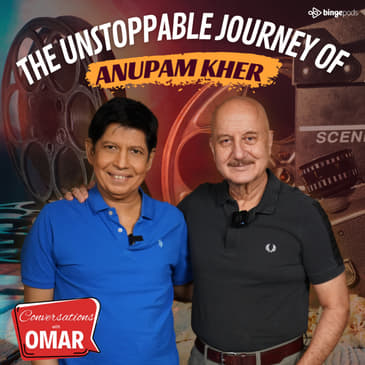
#AnupamKher In this engaging episode of Conversations with Omar, he speaks to versatile actor Anupam Kher. With a career spanning over 540 films, Anupam shares his journey from playing an elderly man in "Saaransh" at the age of 28 to his latest role in the film "Signature," which marks his 525th film. He reflects on the evolution of his craft, the importance of portraying realistic characters, and the significance of respecting senior citizens in society. Anupam also discusses his experiences working with diverse directors, the changes in the film industry over the years, and his thoughts on nepotism. Tune in to hear Anupam's insights on life, acting, and his continued passion for cinema. Follow on Instagram - https://www.instagram.com/showboxpodcast
[00:00:00] No, it's not society which has to do that. It has the children who have to do that.
[00:00:04] Parents don't need anything from you. They just need respect.
[00:00:08] That's also not to be shown constantly. But they also need some time, 10 minutes of somebody listening to you.
[00:00:15] I miss the whole system. I'm not styled. I don't want to be called by you or your younger audiences.
[00:00:23] Uncle Ji, I tell you how to do Instagram.
[00:00:27] That's why I don't tell people not to call me veteran, thespian, legend.
[00:00:31] I come from a background where people say that if you run fast and you will come first, you will get in the ball.
[00:00:37] I think that I have started this trend of ball is beautiful and I'm very happy about that.
[00:00:47] A young man was launched in 1984 to play a much older man in the now iconic Saranj.
[00:00:53] When he was older, he played a much younger flamboyant dost in Lamhe.
[00:00:57] Then, an evil mama, a sinister villain, a bad man, a good man, a comic actor, all of it emerged from the same cloth.
[00:01:06] Yes, Anupam Kher is Mr. Versatility and more.
[00:01:09] His 500 plus films and his endless awards as you can see behind me bear testimony to the fact.
[00:01:14] Today, life comes up full circle for Anupam as he plays a common man struggling to beat the system yet again in the signature.
[00:01:22] And he's had a share of ups and downs, but that's life.
[00:01:25] Meet my friend, Anupam Kher, as he joins me in conversations with me, Omar Qureshi.
[00:01:30] Today.
[00:01:31] Anupam, welcome to the show, Conversations with Omar.
[00:01:33] So, tell me about the signature, the movie you've done recently.
[00:01:36] Did it remind you of Saranj? Because it's about the common man.
[00:01:39] First of all, I'm very happy to meet you after such a long time.
[00:01:42] And I'm glad that you started this show box yourself.
[00:01:45] Thank you.
[00:01:45] Very good and congratulations.
[00:01:47] Thank you.
[00:01:47] So, signature is when I started shooting, it was my 525th film.
[00:01:52] Wow.
[00:01:52] Congratulations.
[00:01:53] Yeah, thanks.
[00:01:54] So, I'm on my 542nd film now.
[00:01:56] Wow.
[00:01:56] It's the highest.
[00:01:58] It's, yeah.
[00:02:00] It's, it's, in the last 10 years, I have moved from making my job easy to move, making my
[00:02:09] job difficult.
[00:02:10] Because having done so much work, you tend to become competent.
[00:02:14] But I also realize that if you are competent, you can never be brilliant.
[00:02:18] Because competency comes easily.
[00:02:20] And I get, I like it when some, when I get nervous, because then I will give my best.
[00:02:26] After COVID, this script came to me.
[00:02:29] Gajinder Raheer, who is the director of the film, who came with the script.
[00:02:33] It's based on a Marathi film called Anumati.
[00:02:37] And it was about a man whose wife is under ventilator.
[00:02:42] And he has to give his signature for the DNR form.
[00:02:45] Do not resititate.
[00:02:47] And, and because of COVID and pandemic, we had gone through so much.
[00:02:56] Nobody in the world was a person who had not seen or felt a sick man.
[00:03:04] And I wanted to do this very, very realistic manner.
[00:03:09] I wanted to be that man.
[00:03:11] And when you do a film where you want to be the person that people forget this is Anupam Kher.
[00:03:17] After your 524 films are done, it's difficult.
[00:03:20] When I did Saranj, I was nobody.
[00:03:24] And so everybody believed and I was 28 years old.
[00:03:27] And so everybody believed that this man is the old man and he is going through all that.
[00:03:33] But then I wanted to make it.
[00:03:35] And I'm glad that people have reacted to the film like that.
[00:03:39] And why it reminds you of Saranj because the person is real.
[00:03:45] Over there B.B. Pradhan was real.
[00:03:47] And over here, Arvind is absolutely real.
[00:03:51] And Pathos is there.
[00:03:52] He's fighting the system.
[00:03:54] I'm representing the middle class man.
[00:03:56] Yeah.
[00:03:57] But also the fact that it addresses a very important issue.
[00:04:01] Like do you think that as a society we need to do a lot more for our senior citizens?
[00:04:05] Absolutely.
[00:04:06] Absolutely.
[00:04:07] And I had raised this question 40 years back.
[00:04:10] Yes.
[00:04:11] And I was not in that category at all.
[00:04:14] No, it's not society which has to do that.
[00:04:17] It has the children who has to do that.
[00:04:19] We can't keep on blaming something like this on the society.
[00:04:23] Society is made of people, of human beings, of sons and daughters.
[00:04:30] And they need to treat their parents with a little bit of dignity and a little bit of compassion.
[00:04:36] Right.
[00:04:38] And especially more, my father went through a retirement depression for three years when he officially got retired.
[00:04:45] Okay.
[00:04:46] Because 58 years old is nothing.
[00:04:48] You're 58 years old, you just start the life.
[00:04:50] Yeah.
[00:04:51] And you're officially told, which is the system because new people have to get the jobs.
[00:04:55] He's officially told that, okay, now you are not capable of continuing the work.
[00:05:01] But in the system, he or she is not ready to accept it.
[00:05:07] So, you go through that. And then also the family members also treat them like a man who is useless now.
[00:05:15] Yeah.
[00:05:15] But that's, having said that, I still come from a joint family.
[00:05:20] I still come from a lower middle class family.
[00:05:23] But in big cities, because now you want, you have nuclear families and also because both the parents have to work.
[00:05:31] Yeah.
[00:05:32] Both of them, both the husband and wife have to do the jobs.
[00:05:35] There is nobody to look after the grandchildren. Their job is family to do that.
[00:05:40] Yeah.
[00:05:40] So, I will want through you say to people that parents are the biggest assets of your life.
[00:05:48] Absolutely.
[00:05:49] And unfortunately, you take parents maximum for granted.
[00:05:53] Parents don't need anything from you. They just need respect.
[00:05:56] That's also not to be shown constantly.
[00:05:58] But they also need some time, 10 minutes of somebody listening to you.
[00:06:04] Yeah.
[00:06:04] I think I am some product of my parents blessings.
[00:06:09] My mother still lives with us. God gave her long life.
[00:06:12] God bless.
[00:06:12] Yeah. And it's such a wonderful joy to have her.
[00:06:16] Yeah.
[00:06:17] And also there was a very wonderful story. I must share that with you that there was this guy who had kept his mother in an old people's home.
[00:06:26] And then she was on her death bed. And so the son visited her and she said,
[00:06:34] Vita, yeh, this paint is peeling, the AC is not working or the fan is not working.
[00:06:42] They put these bad bed covers over here. So get them fine, get them made properly because it's not right.
[00:06:51] Yeah.
[00:06:52] So he said, but mom, you don't, you're not going to live here for a long time.
[00:06:58] She said, no, it's, I'm saying it for you. When your son will send you to an old people's home.
[00:07:03] Okay.
[00:07:04] At least you will have a better organized place.
[00:07:06] Yeah.
[00:07:06] So I think that system which is abroad of old people's home and all the homes should not be here.
[00:07:14] We should, we should give main love and listen to them. That's what I feel.
[00:07:21] That's fantastic. Truly fantastic. That's a great thought.
[00:07:23] Yeah.
[00:07:24] Yeah.
[00:07:24] I think so.
[00:07:25] And on a lighter note, I will ask you because you were in Pardes.
[00:07:29] No, not Pardes.
[00:07:31] Yeah.
[00:07:32] I was with Mahima, I did two, three films. Hope and a little Shubha. I did one more film with her.
[00:07:39] Okay.
[00:07:40] But there's a mild flirtation because she's your classmate in the movie.
[00:07:45] Yes.
[00:07:46] Yes.
[00:07:46] There's a mild interaction between the two.
[00:07:48] Yes.
[00:07:48] So you just, you stole Charo Khan's iraq and away.
[00:07:53] No, in that sense then I've done a lot of such stuff. Not necessarily. But I think Mahima did this role when she was diagnosed with breast cancer.
[00:08:03] Yeah.
[00:08:04] And I had no idea. So she used to meet me in the aircraft, she used to meet me at the airports and we used to say, let's work together.
[00:08:15] I liked her zeal of life. I liked her. She was full of life. So one day when we were casting for this film, we are the producers of the film, I said,
[00:08:24] Yeah, Mahima ko lete hai. So I called up Mahima and I said, Mahima, I was talking to her and there was too much noise going on.
[00:08:30] I said, Mahima, move away from there. I can't hear you what you're… She said, I'm in the hospital. I said, okay, okay, I'm sorry.
[00:08:34] I thought she was there for her father or mother. I said, okay, just listen, I want you to do this role. It requires three days and come to Lucknow if you can come after 10 days.
[00:08:47] She said, no, I can't. Then she told me that she's bald and she has no hair and she's diagnosed with breast cancer.
[00:08:56] I said, all the more reason for you to do this because divert yourself, divert your attention. And she came and then she did the scene also without her wig.
[00:09:06] But that's it. This is one of her finest performances. It is. And I think the flirtatious part of it is between the two colleagues who could have been together.
[00:09:14] Yes. And who the wife was jealous of. And that's the beauty of it. We don't show something like this. We make either a very obvious old people like Shaukeen type of film where they are lusting for this young girl.
[00:09:29] But over here, they are reminiscing their past times. And it's she who is talking about it more.
[00:09:38] Anuram, you also worked with directors from different generations now over your period of your career. How have their styles differed over the years?
[00:09:49] Like, do you like, do you like, you miss the old style?
[00:09:52] I miss the old system, not style. I think we were very, very much together when there was no mobile.
[00:10:00] Yes.
[00:10:00] When there were no vanity vans, when there were no managers and PRs and bodyguards. There was a one to one connection.
[00:10:08] I think there was a relationship. Yeah.
[00:10:10] We know each other from that time. And not every time it was a great relationship. Yeah. But we still have mutual respect for each other.
[00:10:20] Because human connection was there. Yeah. Human relationships were there.
[00:10:26] We used to sit and chat. Yashji's, all the assistants, all the co-directors had great relationship. Even actors.
[00:10:35] We used to not have makeup vans, but we'll sit under a tree, get ready. And because there was no distraction, I'm not criticizing the internet revolution.
[00:10:47] That's part of growing up. That's part of becoming what we need to become. But since we, cinema is about emotions.
[00:10:57] Yeah. And if there are no emotions, means look at the friendships that we had. The friendship with Aamir, Shahru, Ajay, Mithunda, Anil, Jackie, Sridevi, everybody.
[00:11:13] Even the assistants, even the art directors. Yeah. Everybody was. But now you finish your shot and you are on to it.
[00:11:22] You finish your shot and you get into the van. Yeah. I don't think they have relationships as beautiful as we are.
[00:11:29] I remember I used to meet you at your various shootings. So, Yashji's set of Vijay in Muddle Island next to the pool. Yes.
[00:11:36] And everyone sitting and having lunch by the poolside. Yes. Yashji's set was completely different. Yes.
[00:11:41] And then Meibub Studios and Sumash Kari Ramlattar set. Yes. Of course.
[00:11:46] And used to come and sit. And there used to be a separate table for Rakhi Ji's fish curry. Absolutely. Yeah.
[00:11:50] And the rest of the pool spread out. Yeah. Means I can name the journalists from that time. You, Ashwin, Bharti, Bhavana, you know, Jyoti Venkatesh.
[00:12:01] Yeah. All this. We know that. So, the relationship was different. Relationship was different.
[00:12:06] In today's time, I missed that. You missed that. Yeah. Professional. But then professionalism is there. The assistants are now talking on walkie-talkies.
[00:12:18] Just because the scripts are written on Movie Magic app does not mean that every script that comes to you is brilliant.
[00:12:24] I, out of 540 films, I think the script that I have actually read from start to finish can't be more than 50 films. Less was all narrated.
[00:12:34] Yes.
[00:12:35] A writer used to come and narrate you the script. Yeah.
[00:12:37] And then every day on the day of the shoot, you were given a scene and you will perform it. Yeah.
[00:12:43] Yeah. We've done some great work. Yeah. Even in that system.
[00:12:45] So, as an actor who, you know, focuses on his craft so much, has your prep changed to deal with today's time?
[00:12:53] No. I was very fortunate that I come from a drama school. I am a trained actor. Yeah.
[00:12:59] So, my craft, depending on all the kind of work that I have done. That's why I opened this school, acting school.
[00:13:08] My job has, or my craft has not changed. My passion has become more deeper. Because I want to, I like to reinvent myself.
[00:13:20] Okay. I don't want to be called by you or your younger audiences.
[00:13:25] Uncle Ji, I can teach their grandchildren also how to work on this. You are a master.
[00:13:35] No. No. You have to, you have to have that kind of a situation where you, that's why I don't tell, I tell people not to call me veteran, thespian, legend.
[00:13:43] These are the things I don't, I have, there is no lifetime achievement about for next 20 years.
[00:13:49] Yeah.
[00:13:51] Yeah. I mean, it's, people like to club you. People like to put you into a mold.
[00:13:57] In a box. In a slot. Yeah. Slot you. I, and it's, and I won't let you, let that happen.
[00:14:03] Okay. And among the characters that you played Anupam, like you played every kind of character.
[00:14:09] You played a father, you played a brother, you played a friend, a dark character, an evil villain, you know, Dan Van Kesaath.
[00:14:15] Yeah.
[00:14:16] Changhezi Lala, all of those. What, what kind of role do you enjoy the most?
[00:14:21] I think human conflict. Now I like, like Vijay, my next film Vijay 69 is coming.
[00:14:31] Or Signature was there. I like, I am, I am dying to do a comedy. I have not done a comedy for a long time.
[00:14:39] Yeah. You know, we used to do so, I have done so much comedy, five times, best comic actor award I have got.
[00:14:47] Chola or Shabnam, Hasina Maan Jaegi, Ghosla Ka Ghosla was not a comedy, but it was in that genre.
[00:14:55] I would love to do a comedy and, or, yeah, I think there is so much to do. As I tell you that I'm in a phase where I would like to pick up a character and then do it in a different manner.
[00:15:07] Yeah. Yeah. Because when I was writing down, you know, what, what we're going to chat about. So I remembered the times when after every movie we used to meet you and we used to ask you to enact that character.
[00:15:21] So I remember the hum, Babi ji, Babi ji, Babi ji, kaan saara ji maara ji, talk ko in ko.
[00:15:28] No, the funniest thing was Babi ji, Babi ji, sweet Babi ji, Babi ji a bachche ji aak se kehlenga and he set her on fire.
[00:15:34] Yeah, exactly. Yeah, we had great time.
[00:15:38] That, then Beta, then Dil.
[00:15:40] Yeah, exactly. Dil ha ki maanta nahi.
[00:15:44] I don't want to get into that romanticizing the past or nostalgia. I think there are some amazing work that is happening even today.
[00:15:54] But somehow the cinema of 90s has a great recall value.
[00:16:00] That's why there's so much nostalgia for 90s right now.
[00:16:03] Yeah, I mean it's including I'll say Dilwale Dulanya le jaenge ya kuch kuch ha hota hai.
[00:16:09] They still, the romance was a completely different kind of thing.
[00:16:13] I feel that, yeah, it should be a little more fun. The fun is missing.
[00:16:20] Yeah, but there's been a complaint, you know, from certain sections of heroes.
[00:16:26] They say that you've been the coolest dad to Shah Rukh.
[00:16:28] Yes.
[00:16:28] In most movies. Yeah.
[00:16:29] And you've been the meanest dad to Aamir.
[00:16:32] Hazarila.
[00:16:33] No, to Madhuri also in Tejab.
[00:16:35] Oh yeah.
[00:16:36] Yeah, yeah. I was not a good dad to her.
[00:16:38] But yeah, I think that question should go to Aditya Chopra.
[00:16:43] He wrote that character.
[00:16:45] In fact, in other films also.
[00:16:47] Chahat also I did.
[00:16:48] I was a nice dad to him.
[00:16:50] Yeah.
[00:16:51] But I have been all kinds of dads to every actor.
[00:16:54] Yeah.
[00:16:55] I was not a very good dad to Ranbir Kapoor's Wake Up Sid.
[00:17:00] Yeah.
[00:17:02] But the funny dad, the mean dad, I was, I was, in Dil was a different kind of a dad.
[00:17:10] I was wonderful dad to Pooja Bhatt in Dil Hai Ki Mantra, or Daddy itself.
[00:17:16] Yes. Oh yes.
[00:17:17] Lovely.
[00:17:18] Yeah, it was fun.
[00:17:20] Means I have been, means that I was, I played a father to Hemamal Niji also.
[00:17:25] I played grandfather to Rishi Kapoor and so people ask me that you don't look old.
[00:17:30] I was always old, so I will never look old.
[00:17:33] No, no, you have played, you were much younger when you played dad to some people who were, I think much older than you.
[00:17:40] Yeah, yeah.
[00:17:40] All the time.
[00:17:43] Yeah.
[00:17:43] You've also been a great friend of all the journals. You've been a great voice listening to people, talking to them, you know, and everyone could call you.
[00:17:51] And everyone used to say Anupam Kher for a quote, for anything, anything that's happening.
[00:17:55] Cricket match, World Cup, Anupam Kher, Sego, Sego, Sego.
[00:17:59] Now we are.
[00:17:59] Now we are.
[00:18:00] Yeah.
[00:18:00] But there was one sour note you hit. So, do you have any regrets about, you know, hey, you know, the entire industry and I got together on one side and the media was on one side? Do you feel?
[00:18:12] I think there are some incidents which happen in life, which sort of are important at that stage of your life. But to sort of, but I always feel that I could have sort of reacted in a different manner.
[00:18:26] I'm from a small town man. I'm a small town boy. I, to me, self respect and dignity is very important. I have made it on my own. I've come from Qatar and I have gone through rigmarole of life.
[00:18:41] I have slept on the platforms. I have slept on the beaches. And then something like this happened. To me, I think at that time, self respect and dignity was much more important.
[00:18:51] But if I isolate that emotion and just look at the action, then of course, we are friends now. We are friends. You and I have attended courts together.
[00:19:01] I have been on this side of the court and you have been on the other side of the court. I remember so many times, but if we made up and I then society gave me the cover.
[00:19:14] Yes. And so I think life is what happens once you have gone through that incident.
[00:19:22] That, so if all of us, both of us are sitting together and talking about that, then I think that's what is humanity all about.
[00:19:31] That is what is change all about. That's what is compassion all about.
[00:19:35] Yeah. In the industry and the media, how much has changed today according to you? Like so much has changed. There was just print and then there was…
[00:19:43] Look, to give an interview to somebody, I… people have to go through ten channels. You did not have to go through any channel.
[00:19:53] You called me up and said, Anupam, I want to do a chat with you. I said, okay. I told my manager, I said, Omar is going to call you up. I am going to do this.
[00:20:01] Yes. But there is a system now. You see, though I, you will never see me with the… I have been given a security by the state.
[00:20:11] That's a separate person that I have a security guy. But you will never see me with people travelling with me, seven, eight people walking with me.
[00:20:22] Means I don't need a hair stylist or I don't need that. But you see a paraphernalia. It's become a kind of a need of this thing.
[00:20:31] Yeah. But I feel when this is not there, when you go through a low phase, suddenly an entourage of twelve people gets down to four people, the failure, awareness of failure will be much more visible.
[00:20:44] Visible. Visible. Aat log kam ho ga hai. Yeah. Mere ko wo tension ni nahi hai. Mena keela chalta hoon. To agar kaang mile, na mile, achcha ho, bura ho.
[00:20:54] Yeah. At least mujhe us ka aisaas nahi ho tha hai. Yeah. So, yeah, everyone has to go through agencies and you know. That's okay. That system is okay.
[00:21:05] That's fine. But actors and the people who are going through agencies should not take themselves so seriously. Yeah. You know, it's ridiculous sometimes. It's funny. It's comical.
[00:21:16] Also, Anupam, you've been everyone's best friend. Everyone's 2am friend. Kisi ko bhi problem hai. Actor, producer, director, they call you. They've always called you.
[00:21:25] So, how do you find the time? You know, you devote so much time in work and then you have the time to counsel people. Like actresses used to call you when they went through breakups and actors used to call you when they had an issue.
[00:21:37] My grandfather used to say a busy man has time for everything. I think I'm a people's person. Okay. And I don't take myself so seriously.
[00:21:47] That I have, means I'm not carrying the burden of Anupam Kira on my shoulders. I think it's the, and my father used to say the easiest thing in the world is to make somebody happy.
[00:21:57] You just have to listen to people. I come from a joint family as I told you earlier. Yeah.
[00:22:04] I come from smaller towns where people listen to each other. And I still do that.
[00:22:09] The only difference is that I also write books now on life coaching. Yeah.
[00:22:14] All the three books have done very well. And I still, I think I was born with an old soul.
[00:22:20] No, I don't think so. I think it's a lot of fun. No, I just, even when I was in drama school, even in my husband's college, I used to give advice to people.
[00:22:27] I don't know what has got to do with that. But I think now I'm becoming more and more without making it sound like a lecture.
[00:22:35] Because people, the last thing people want to hear is a lecture. Then you started the right school, an acting school where you can tell people what to do.
[00:22:42] Yeah, exactly. Yeah. No, this is my biggest achievement. My school is my biggest achievement of my career.
[00:22:48] Yeah. Because when I meet students of actor prepares in shoots and recently, just 10 days back, I was shooting for a film and there was a boy and girl.
[00:22:58] They were, one of them was playing my son and the other person was in that secretary type of thing. And the son guy did his dialogues very well. So I said that was very well delivered.
[00:23:09] He said, sir, I'm from your school. Wow. I was so moved. I was so happy. Yeah. Because sometimes, no, award has made me so happy.
[00:23:18] But I like to do that. In my school, I learn myself much more than I teach. Okay. And it also keeps me a contemporary actor because the children today, the students today, they have a different way.
[00:23:32] They may not be very, very sort of polished as actors. Yeah. But they have a very different approach of acting. So I get to learn so much from them. Yeah. But where do you derive your fun from?
[00:23:44] Who's your most fun co-star? Who's been your most fun co-star? I'm funny with myself. Yeah. And I'm not taking it away from…
[00:23:52] You and Anil Kapoor share a great… Yeah. I think we, three of us were very dear friends, me and Satish and Anil. I think I will say that in the film industry, Anil and I are close friends in the sense that I can understand his issues and he can understand.
[00:24:09] And it's a wonderful feeling to have somebody like that in your life. Yeah. Yeah. You can't, when you cross a certain age, you can't tell your problems to your contemporaries, your children, your parents because you don't want to give them grief. Yeah.
[00:24:23] But with Anil, I think I'm very honest and very straightforward. I have two other friends which are not in industry. One lives in Delhi and one near Chandigarh. And I keep talking to them. Yeah.
[00:24:35] Because you ultimately need people who don't judge you. Yeah. True.
[00:24:39] And who do not pass a judgement on your sadness or don't get carried away by something. And you can crack jokes with friends which you know that they will know that they are jokes.
[00:24:50] And you let him monopolize the mirror. Yes. Oh.
[00:24:54] He even in an elevator which is from second floor to third floor, even that time he will keep doing this. Ridiculous that. But he looks so good. Yeah.
[00:25:04] What's your take on today's hot topic, nepotism? Frankly speaking, I did not even know what is the meaning of this word. Yeah.
[00:25:11] I had to go through the dictionary and then… What are you saying? Yeah.
[00:25:14] I come from Hindi medium school. I do not know so many words. But at the end of it, what works is talent. Yeah.
[00:25:22] And if your father is a producer, if your father is a doctor and you want to be a doctor or an engineer or a director, why not?
[00:25:31] But that's not the qualification which audience will look at it. Yeah.
[00:25:37] They will give you that benefit that okay, you are so and so's son or daughter. Yeah.
[00:25:41] So they may say that okay. But at the end of it, if you're not good, it's not going to work. Yeah.
[00:25:48] And as long as you are not harming somebody else just because you want your people to promote. Yeah.
[00:25:54] Then it's fine. And I think every industry now…
[00:25:57] Every industry is there. There is a business man. A guy who is a businessman. A guy who is a businessman.
[00:26:00] A guy who is a businessman. A guy who is a dentist. This is the guy who is a dentist.
[00:26:13] Every industry and he has done a job. He can do it every week now. Yeah.
[00:26:37] film. In between, it's coming
[00:26:39] Khosla, Khosla re-releasing.
[00:26:41] But Vijay69 will talk when
[00:26:43] we are about to talk.
[00:26:46] So,
[00:26:47] after 40 years in the industry,
[00:26:49] so many decades and so many awards,
[00:26:51] we're just admiring all your awards.
[00:26:53] Do they still matter to you?
[00:26:55] Yes, I like awards.
[00:26:57] I come from a background where
[00:26:59] people said that if you run fast and you will
[00:27:01] come first, you will get an
[00:27:03] award. If you
[00:27:05] study well, you come
[00:27:07] first, second, third. I was
[00:27:08] very bad in both of them. In fact,
[00:27:11] once my PT
[00:27:13] teacher saw me running, he said, even if you
[00:27:15] run alone, you will come second.
[00:27:17] So, it was frightening.
[00:27:20] But I
[00:27:21] like awards.
[00:27:24] Now, awards
[00:27:25] have
[00:27:26] more of a social event.
[00:27:30] I'm
[00:27:31] talking about the popular awards.
[00:27:35] So,
[00:27:35] you may get an award for a film which you think in your heart that you did not deserve.
[00:27:40] It won't matter to you.
[00:27:42] It won't matter to you.
[00:27:42] But if you don't get an award for the film that you really deserve,
[00:27:46] then you don't get it. You feel hurt.
[00:27:48] I go through that phase and then I move on.
[00:27:52] Yeah.
[00:27:53] Anupam, you started off as a very shy, reserved kind of human being. Like you said, you come
[00:27:57] from, you know, like a smaller town and all. But today you become very outspoken. You
[00:28:02] don't take crap from anybody. You become a kind of voice for the people who don't have
[00:28:06] a voice. Where did that come from?
[00:28:09] No, it was always there. I think it takes a little time to discover that you can't be
[00:28:18] popular with the whole world. You need to be popular with your own self. For which I
[00:28:26] mean is that I think if you stick to the truth, you don't have to remember it. And at the end
[00:28:34] of it, it's you, your talent, your truth, which will make you feel what the kind of person that
[00:28:42] you are.
[00:28:43] Yeah.
[00:28:43] I've seen in this industry in these years that you can, you cannot be popular with everybody.
[00:28:52] There are, there is, you make need-based relationships and then you move on. I have not done a film with
[00:28:59] Haruk for so many years, but I think the kind of relationship bonding that we had, we will,
[00:29:05] whenever we meet, we'll meet very nicely. But the same things what you feel is very important.
[00:29:12] In the time of a dialogue, you should say something in your heart, you should say something
[00:29:16] more and more. What does it look like? It doesn't look good. But it looks good if you
[00:29:20] have said something in your heart. So, tell us.
[00:29:24] It's like, were you threatened that he took his hair off in Jawan?
[00:29:32] No. No, no. I think that I have started this trend of bald is beautiful and I'm very happy about that.
[00:29:42] But I went through that phase of wanting to be an actor and you're losing hair. Now everybody wants
[00:29:50] to be bald. Everybody wants to be bald. It's a bald and sexy look.
[00:29:55] Yeah. You have a Hollywood series which just came out and you have a little,
[00:30:02] you had this lovely place in New York City.
[00:30:04] I had. It was a rented apartment. It was a rented thing. But it was beautiful.
[00:30:07] I believe so. It was beautiful. It was on Hudson River. It was on 32nd floor. And New Amsterdam really
[00:30:15] gave me, I had to come back because Kiran was diagnosed with cancer. I was signed for five series,
[00:30:20] five year, five seasons. But I had to leave after two and a half seasons. But I learned this lot.
[00:30:29] It was a medical drama, New Amsterdam, which was on Netflix. And I don't think in English. I think in Hindi.
[00:30:36] So I had to learn. I was playing a doctor, a neurologist. I had to learn these tough medical terms.
[00:30:43] But it kind of gave me an education all over again as an actor. And living in New York for two and a half years was amazing.
[00:30:52] Amazing. Amazing and discovering myself. I love this. I apply that now what I learned to what I'm doing off late.
[00:31:01] If you saw me doing signature in the way that I've done it, it's thanks to my time in New York and my spend my time observing actors.
[00:31:10] And I've worked with some of the finest actors. Yeah. But it's a beautiful city. It is.
[00:31:14] It gives a lot more to you than it takes from you. Yeah. Bombay and New York are the only two cities which have that quality.
[00:31:22] Yeah. You achieve so much as an actor, Anupam. Is there anything you feel that you have left to achieve now?
[00:31:28] Of course. I've just reached my interval point. There's so much to do. There's so much to do.
[00:31:34] When a man is in his mid-50s and a lady in her mid-40s, they discover what kind of a person she or he is.
[00:31:46] Then you either like yourself for how you've dealt with your life or you don't. I like myself.
[00:31:51] I like for what I've done as a person, as a human being and also as an actor. And now there is so much to do.
[00:32:00] Yeah. Now I'm sure of what I'm acting, what I'm doing as an actor. Earlier I was wanting to prove a point to the world that look, look at me, look at me.
[00:32:08] I'm a gold medalist from drama school. Please don't take me non-seriously, etc., etc., etc. And I was also enjoying the journey of doing all kinds of things.
[00:32:17] But now I think I, earlier I was running fast nowhere. Now I think I'm going slowly somewhere.
[00:32:24] Fantastic. Yeah. Yeah, that's fantastic. Thanks so much. But before we end, I'm going to ask you for a one-line description of these four of your favorite directors that you worked with.
[00:32:37] So, Mahesh Bhatt.
[00:32:39] In my play, I say a line. If life is a battlefield of Kurukshetra and me the questioning Arjun, Mahesh Bhatt is my Krishan.
[00:32:47] Wow. Yashji, the late Yash Chopra.
[00:32:51] Yash Chopra was a family. He was my elder brother, which I did not ever have it.
[00:32:55] And the last ten years of Yashji's life, every morning when I was in Bombay, I had to spend with him having breakfast.
[00:33:03] He taught me so many things about life. He taught me so many things about giving.
[00:33:08] He taught me so many things about enjoying everything. And he used to remember millions of Shero Shari.
[00:33:16] Yeah.
[00:33:17] For any given situation, he will have Shero Shari. I would love to write a book on him because he was a great man.
[00:33:25] Yeah. Suvash Gai?
[00:33:26] Suvash Gai. Suvash was this bombastic English speaking. He carries lot of dhs with him.
[00:33:32] Yeah.
[00:33:33] You know?
[00:33:34] I know what you mean.
[00:33:35] Yeah. But I think on the whole, he gave me a stardom.
[00:33:39] Yeah.
[00:33:39] From, to give the role of Dr. Dang to an actor of Saranj, I think needed guts and needed vision.
[00:33:47] He gave me that and he pitched me against Dilip Sahib, Nasiruddin Shah, Anil Kapoor and Jackie Shroff.
[00:33:55] And alone this Dr. Dang.
[00:33:56] Yeah.
[00:33:57] And Dr. Dang is a creation of Mr. Subhash Gai completely. I have not made any contribution in that.
[00:34:03] Yeah.
[00:34:03] In the sense, whatever he told me, I just did it. And I am thankful to him.
[00:34:07] But Subhash Gai also makes everyone act like him, exactly like him.
[00:34:11] I was smart enough to sort of take something from him and add something of mine.
[00:34:16] And Suraj Brijatya?
[00:34:18] Suraj Brijatya is God's own child. He is Buddha. I tell him that you are Buddha.
[00:34:25] And right now you are asking me this question. I am so fortunate to be working with them so extensively.
[00:34:32] Suraj Brijatya is the finest human being I have ever met.
[00:34:36] In fact, I call Rajshri a temple. Whenever I feel low or whenever I feel sort of agitated, I go there.
[00:34:46] And Suraj as a director from Hum Aapke Hai, Korn to Viva to Salman's film to Unchai.
[00:34:56] What a growth. And he got the Best Director National Award this year. I was so thrilled. I was so happy.
[00:35:02] And also equally, he loves me and I think he has great concern for me.
[00:35:07] I directed a film recently which we will talk next year. But I called him to see it, to watch it.
[00:35:16] There are only two people who I called, Mr. Mahesh Bhatt and Suraj Brijatya because I knew that they will tell me honestly what they think of it.
[00:35:25] So, I am fortunate to be working with these. I have known them.
[00:35:30] And in our old tradition, you have to say one funny dialogue of yours.
[00:35:35] What are you talking about? You have to say one thing.
[00:35:38] One is a great deal.
[00:35:39] One is a great deal.
[00:35:42] In fact, except for Dr. Dang's dialogue, I did not have any dialogue.
[00:35:47] Except for people find it very funny in what I said to Pooja Bhatt.
[00:35:53] Go, son. Go.
[00:35:54] I am the only father of my husband who is the only father of my husband who is the only father of my husband.
[00:35:59] I am the only father of my husband.
[00:36:01] Stop like Lamhe where you are looking at a Mercedes car and you are telling Anil Kapoor
[00:36:07] that you can marry him with his daughter.
[00:36:09] Even that one also don't call my uncle retarded.
[00:36:13] Yeah, that's some funny feeling.
[00:36:16] Thank you.
[00:36:16] Thank you Anukam. Such an amazing conversation.
[00:36:19] Yes, wonderful. Thank you so much.
[00:36:21] Thank you very much.