
Are you constantly asking yourself “What’s next in life?” If you’re a mid-career professional feeling stuck, confused, or uncertain about your future, this video is for you. In today’s fast-changing world, career clarity, life direction, and purpose-driven growth are not luxuries—they are essentials. Whether you are facing career stagnation, burnout, job insecurity, or lack of focus, this video will guide you step-by-step to move from confusion to clarity.
In this powerful session, we break down why most people feel lost even after years of experience. The truth is—you are not stuck, you are unclear. Through a simple yet effective Clarity → Control → Action framework, you will learn how to identify your real fears, separate facts from assumptions, and create a clear, focused path forward. This is not motivational talk—this is a practical system for decision-making, focus, and personal growth.
You will discover how to overcome overthinking, self-doubt, fear of failure, and career confusion, and replace them with clarity, confidence, and consistent action. We also introduce powerful exercises like thought awareness, focus mapping, decision simplification, and daily action systems that help you stay aligned and productive. If you’ve ever felt overwhelmed by choices or unsure about your next step, this video will help you reset your thinking and take control of your journey.
This content is especially valuable for those exploring career transition, leadership growth, entrepreneurship, sustainable careers, and purpose-driven work. It aligns deeply with themes of systems thinking, circular economy mindset, personal transformation, and conscious leadership—helping you not just grow individually, but contribute meaningfully to larger systems.
If you’re ready to stop drifting and start designing your life with intention, this is your starting point. Watch till the end to gain clarity on your next step and build a system that keeps you focused, grounded, and moving forward.
👉 Remember: You don’t need to control your entire future. You only need clarity on your next step.
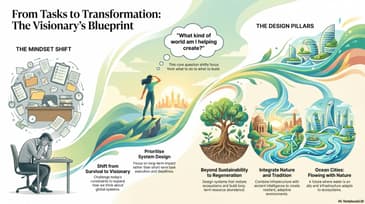
[00:02:38] Design Paradigm is about the primary focus of the executor and the architect of the future. The visionary is all placed by putting themselves on the future circumstances whereas he is focusing on regeneration and sustainability.
[00:03:06] He is very flexible about the circumstances which is presented to him. The big ideas come when big ideas are based on the past, future and present and there are earlier previous experiences which can be very overwhelming.
[00:03:32] The present circumstances might be very humble and the future looks grand. So that is the canvas with which the bigger ideas poster.
[00:03:48] And so the ocean cities and adaptive flow is the flexibility about where does one lead. The ocean cities because that is a possibility nobody has much thought about.
[00:04:08] But that is where rather than going to the mars one can settle down, inhabit that space so that they allow the people to, the animal kingdom to settle out there.
[00:04:21] Now the regenerative cause is of ecological value. Then with time it evolves into sustainability. How to survive? Sustainability is how to survive.
[00:04:39] Regeneration means how to restore ecosystems, circular resources and build long term resilience which is very much required for a warmer, cooler, greener, cleaner and richer glow. In our rush towards innovation we forget that some of the most powerful solutions already exist.
[00:05:05] Reserving wisdom is not about going backward. Traditional knowledge and local practices carry deep ecological intelligence. Through visionary design integrates these timeless insights into future systems. So the architecture of the future is ancient wisdom plus the regenerative ecosystem which is the future.
[00:05:29] But we can start by being adaptive right now with our ideas and with our habits and with our infrastructure. And the vision blueprint is the exact intersection of timeless ecological intelligence, resilient present day design and a future of engineered abundance. And the role of architect is the architect is the world.
[00:05:54] And the role of architect is you don't need to have all answers. What you do need is awareness, imagination and the courage to think beyond the obvious. Big ideas belong to those willing to step into them. The work you choose, the systems you design, the ideas you bring to life. The future will not be built by those who will execute. It will be shaped by those who dare to envision and design.
[00:06:17] So we will in our retreat day number 2 actually bring in this possibility into our mind. So that we can design better systems for a greater future where the regeneration happens. Reserving what is there and bringing out the possibilities and building a system of course.
[00:06:45] Hope this helps you and we will actually design what all we will cover in that. So there will be say 20 ways for ready kind of people. People who can be the safe players.
[00:07:13] Hrithika knows what she wants but chooses the safer version every day. She needs 10x thinking exercise. It won't work here. Thinker. Students believes ideas work elsewhere, but not in this environment. He needs remove the constraint. The small vision entrepreneur Oman runs a business but thinks only survival does.
[00:07:42] Needs scaling mindset. The fear limited dreamer Neha has ideas but stops at what if I fail. She needs fear mainly. The over realistic professional Deepak dismisses ideas too quickly as not practical. Needs impossible list exercise. The one stuck in current identity Pooja still sees herself as who she was 10 years ago.
[00:08:11] So she needs future self visualization exercise. A local thinker Kiran only thinks within her immediate environment. She needs global perspective expansion. The idea collector Rohan has many ideas but doesn't believe any will work. He needs from idea to possibility. The one who underestimates impact. Meera thinks her work is too small to matter. She needs impact more.
[00:08:41] The already too late thinker O'Neill believes he has missed his chance. He needs reframing time. The one waiting for permission Salini waits for validation before acting. Needs self authorization. The practical skeptic Arjun questions everything so much that he blocks possibility. Needs reverse thinking. The comfort zone achiever current is doing well but avoids stretching further.
[00:09:12] Needs stretch thinking. Then the single path thinker Farah believes there is only one correct path. Needs multiple possibilities thinking. The fear of visibility Nikita has ideas but doesn't want to be seen. Needs fear breakdown. The comparison trap Rahul compares his start to other success. Own path clarity. Needs the one who thinks too small for impact. Current.
[00:09:40] Tomal believes impact requires big resources. She needs small version thinking. The what if people judge. Mind. The fear. Holds back due to social perception. Needs belief breakdown. The one who can't see possibility yet. Vikram understands clarity but still cannot imagine bigger. Needs guided expansion plus exposure.
[00:10:09] How to use this in two days. Start with this line. Yesterday you saw clearly. Like they did day before you see clearly. Now in the present day. We challenge how small you are thinking. So we can have our perspective place at the end of our story. Clarity is not enough. You also need courage to see bigger.
[00:10:38] So. How does it work? Like we can also think of the what if exercise. This opens the mind beyond current limitations. It challenges the belief. That life must stay the same. It invites curiosity instead of control. It creates space for new thinking. It shifts from what is to what could be. So likewise. We will have 20 exercises.
[00:11:07] For this retreat. Day number 2. And hope. You will find. Great value in this. Even if one small thing shifts. It will create the ripple effect. So see you there. In our retreat. Thank you.