
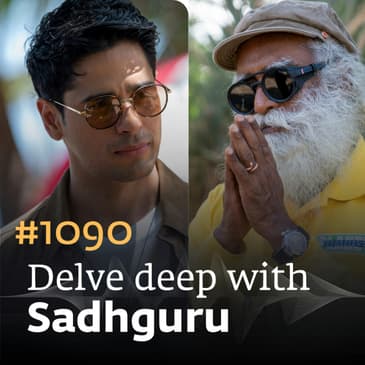

In a candid interaction at a park in Mumbai, actor Sidharth Malhotra explores a range of topics with Sadhguru including motorcycles, movies, Inner Engineering and #SaveSoil.
Conscious Planet: https://www.consciousplanet.org
Sadhguru App (Download): https://onelink.to/sadhguru__app
Official Sadhguru Website: https://isha.sadhguru.org
Sadhguru Exclusive: https://isha.sadhguru.org/in/en/sadhguru-exclusive
Inner Engineering Link: isha.co/ieo-podcast
Yogi, mystic and visionary, Sadhguru is a spiritual master with a difference. An arresting blend of profundity and pragmatism, his life and work serves as a reminder that yoga is a contemporary science, vitally relevant to our times.
See omnystudio.com/listener for privacy information
See omnystudio.com/listener for privacy information.
[00:00:01] Welcome to the podcast, Sadhguru, Of Mystics and Mistakes.
[00:00:46] Yeah, in India, I see a lot of people have this. This is on mileage, not on kilometers. Wow. Wow. This is what's getting you through. No, they're guiding me, I have a… Yeah, you need that. You need that. What's with the bumps, brother? I don't know how you manage. You got to keep your eyes on the road to see that, on Indian roads. Every moment. Every moment. One little off bump and then you… But did you pick that? I wanted to know, did you specifically… Of course.
[00:01:15] I've been riding this in US. It's my US motorcycle. You know how I got it. Oh, wow. So, you've been… When did you get introduced to that bike? See, I wanted to ride… I rode in 2020. I rode 17 Native American nations. Wow. Which was over 11,000 miles. So, at that time, I got this to ride.
[00:01:39] You picked this one. Like, what did you… Like, is this… Is this the mobility? Is it the comfort of it? Or you knew that this had the stamina to do? This definitely has the stamina. This is an inline-six engine. Six cylinder. Inline-six. 16 and that thing. Yeah. And it… You know, you can… You can ride… You can crawl at ten kilometers effortlessly on cruise. You can cruise. You can put it on cruise control. At ten kilometers. That… I'm sure.
[00:02:07] No. The distance that you're doing, I think that's an amazing feature. That's very important. Otherwise, you can't ride like a problem. But I have to say… I feel that, you know, we're working out six days a week, trying to be afraid… Yoga, freehand stuff. Somebody tells me to do 30,000 kilometers. 30,000 kilometers? I don't know how you manage… No workout. Okay, what's the secret? What's the secret to the fitness?
[00:02:32] No workout. No workout. No exercise. No nothing. No. So, what's the secret? I know… See, it's not the machine. It's the man behind the machine… Who has to ride it and 30,000 kilometers is not a… You must do some engineering. I actually am… We were discussing it with your team. Maybe we'll come… Come up to the ashram and drive. I need to know the secret ingredient of the soups that you have, that you're having. See, between this machine and this machine, I don't want to compare brand. Anji. The performance is only question of engineering, isn't it?
[00:03:02] True. True. True. The same… Correct. Same goes with us. Yes. Same goes with us. This is just a bio-machine. If you engineer it well, it will do things that you can't imagine possible. So, then you see biological age and time and practice can be negated with that, like can be overcome? There's no such thing. That's all in your mind. Ah. Because, you know, like I was in… I was in Bucharest. Anji.
[00:03:28] I was to do an interview at 7 PM and I was riding and then the weather got really bad and the roads were bad. So, we got delayed and I reached there at 11.15. But the anchor and the four TV team were still waiting. Anji. Then this is nine and a half hour ride I have done that day. And I walked straight into the interview and an hour and a half I did all kinds of questions, whatever the usual stuff. And then this anchor is saying, Sadhguru, at this age how do you do this?
[00:03:56] Over nine hours you ride and just walk into an interview and you speak about everything that we ask you without hesitation. You answer and you're still looking fine. And he repeated this thing at this age, at this age three times. I said, hey, wait man. I have lived my life so intensely. I never had the time to get old. You need time to sit down and get old. It's the inner… it's the inner engineer.
[00:04:23] If you don't have the time to get old, how do you get old? It's the script that goes inside like we do in movies, whatever script is there. Not just the script, you can write whatever script you want. But still the functioning of the physical existence in the world is just a question of engineering. Ocean has its own engineering, all right? Coconut tree has its own engineering. If it's wrongly engineered, it'll fall down. No, true, then that… The same goes for the human being and the machines.
[00:04:54] For… for the youth of the country and for all of us who think that we have… We also have a busy schedule being in acting and performance and being in the public eye. I feel… I've obviously, you know, followed and seen most of your chat and it's something that I've personally… Gained at times is something that you would say would affect the engineering and that would… You know, give that sense of energy the next day.
[00:05:18] But still I feel… Also being in the public eye, you're meeting so many people, so many energies… I'm assuming and you know, there are people around us as well. You have a search… How do you… Now, point being, how do you keep yourself balanced when maybe you can't keep say others balanced? Like what's the key? Do you ever get angry? Do you ever get angry? Do you ever get… You want me to?
[00:05:44] I need to know the secret ingredient again because I know as… Us as actors in public eyes, you know, we get… See, it's not that I'm incapable of anger or anything for that matter. I'm capable of… Why ever… Tell it. It's just that I have not given others to determine what I shall be right now. I've kept those things to myself. Right now there's a debate going on. Some journalists came in Delhi… Anji. Asking utterly idiotic questions repeatedly and intentionally.
[00:06:13] It's not like if you're stupid and ask me a stupid question, I don't mind, I'll answer that. Because it means something to you. You come with a devious intent and go on asking these devious questions. Then I said, shut off the damn camera, you know? Perfect. No. I agree. No. So now they're going ahead, oh, he teaches in our engineering, he needs in our engineering. All right? No, I think that's a damn good thing because I need in our engineering for sure, that's why I am who I am.
[00:06:39] Now they're… these people who have wild intentions, now they're advertising for inner engineering. Everybody, even Sadhguru needs inner engineering. This is great. That's a good thing, yeah. Correct. For the same medicine that you're providing and you've invented and made. Of course, I engineer inner engineer myself all the time. No, you're only human and I feel it's a learning. No, no, no, no, no. No? You need to not use it like… See, in the evolutionary scheme of things, human is the flower of evolution. It's a peak. Anja. Anja.
[00:07:09] It's a top of the world. No, never use the word human, I am only human. Say, I'm human, eh? This is a top of the world. Come on. That's… that's… yeah, that's a good change from today onwards. We'll all be saying that we are humans. I am human, yeah. So, human with pride because… With pride. Because being human is the peak of evolution on this planet. Absolutely. We don't know what your status will be if you go somewhere else, but at least on this planet you are the flower of evolution. You must have fragrance. Absolutely.
[00:07:37] Going on saying, I'm only human, what is that? That's true actually, I don't know… If you were an ant, you could say, I'm only an ant, these idiots are stepping on me. Being a human, you can't say that. Absolutely. No, that's a… that's a good change. I think for all of us who's watching today, especially the younger youth, because we always feel, you know, if you're tired, if you're busy, we always use that as an excuse, that our machinery is only capable of this, but I think none of us have experienced our peak. Depends how well engineered you are. What well engineering means?
[00:08:07] Anji. Now, I don't want to compare brands, but let's say a motorcycle. Anji. How smoothly the engine runs depends on how well aligned it is and how well engineered it is. It's all engineering, all right? Material quality is there of course, but it's engineering. Little of alignment, it'll wear out in no time. Anji. This is a great machine, but if you ride it without oil for five kilometers, it'll be finished.
[00:08:36] That means no lubrication means it's gone. So these are all aspects within you. One thing is to be well engineered, another thing is to be well lubricated within. Grace is the lubrication. Once you invite grace into your life, you're well lubricated. Now there is no friction within you. If outside some friction comes, you deal with it, the way it needs to be dealt with. But inside there is no friction. Essentially it means there may be many issues in life, but I'm never the issue in my life.
[00:09:06] You're not creating obstacles. I'm not the issue. You're not the issue. Correct. You see, you have to know that differentiation. I… I loved what you had said in one of your videos before that we are only either struggling with our memories or then with our imagination. I found that… that really beautiful piece. That all people doing all the time. Summarized, yes. And I think… They are not able to use their faculties for their benefit. They're using their intelligence, their thought process,
[00:09:34] their cerebral capabilities and their emotional capabilities all against themselves and they think there is something wrong with the world. So, that was very well put and that's exactly what even today we try to do with our… Even our movies, we're trying to build better memories or influence just the way you are doing it. No, no, I would… I know there are people who will hate me for this, but… …our movies and television acts must change to build a better society.
[00:10:02] No, for sure. I know it's… you will say it's my art, I can do what I want. Yes, you can. But at the same time, right now, the way people handle their emotions in the movies and especially I think televisions, I don't watch them. But here and there when I am switching news channels, I get to see some stuff. See, today it's become like this, whether it's Hollywood or here in India, if I disagree with you,
[00:10:29] the only way to deal with it is to smash your face or shoot you in the head. Or if you are a woman, throw a plate or food at somebody else, all right? I'm saying, is this the way ordinary people dealing with their emotions in their homes? They are not doing this. But right now you're building a culture that this is the way to do it. If you agree with your husband, disagree with your husband, throw the food plate at him.
[00:10:54] If he disagrees with you, he slaps you in the face. What is this nonsense? This doesn't happen in most homes. Yes. In very crude, drunken homes these things happen. In regular homes these things don't happen. Correct. But right now you're building a narrative that this is the way. We need to understand there is a certain responsibility. Once you have an influence for people, there is a certain responsibility which you have to exert rightly. This doesn't mean you're going to be one moralistic nonsense
[00:11:21] that you can't say anything, you can't do anything – that's not what I'm saying. But constantly projecting wrong images of a society, wrong imagery of how human beings should be. Tell me all the posters – I don't see the movies – but all the posters, especially if you go in the south, everywhere somebody is carrying a machete, blood dripping from the machete. So you are a hero only if you carry a machete and chop off somebody's head? No.
[00:11:49] What is happening to us? No, sadly I think it's become something that… that sells or something that is attracting. It's a business after all – we have become slaves of that. No, no. See, the thing is… The thing is, right now if I chop off your head, here thousand people will gather to see the chopped off head. Right now if you and me talk something sensible, there are twenty-five people, all right? It's all right. So you must get your sense upscaled in such a way. For sense also thousand people will gather.
[00:12:16] This is what I have been doing with people. Initially when I taught my programs, first program was seven people. I've even taught a program with four people. Today if I announce a program, there'll be not less than fifty thousand people. But it's taken that much time, a lifetime of dedication to build this to place. It is not that at that time I was talking less sense than now, but it takes that much time. But instead of that, if you want to be on the front page of the newspaper, chop off somebody's head.
[00:12:43] What is this? Unfortunately movies are doing this. I know nobody will like what I'm saying, but if we don't take care of these things… Right now in America everybody is talking about gun violence. Yes. Where is there one… is there at least ten percent of the movies without shooting somebody? True. Then how come you're surprised if somebody does it?
[00:13:11] You're fantasizing, but it's… it's a vicious circle, yes. Somebody has to break it to not be enslaved by business and have a more social… That's a good thing you use the word business. Yes. Because everybody is hiding behind artistic freedom. It's business. No, no, no. It is business. Yeah, business should have rules, right? You are a victim of… Correct, absolutely. Absolutely. If I… if I do a business, this guy selling chai, there is a rule for him.
[00:13:38] He can't just make tea whichever he… way he wants and serve it to me. He can't put poison in it and give it to me. Correct. All right? Correct. So, there is a rule for him. He may not have a license, he's a small chai guy, but still there is a law for him. But how come there is no law? Because when it's convenient, it's business. When it's not convenient, it's arts. It doesn't work like that. I'm saying, I'm appealing to every director, every producer, every actor.
[00:14:04] Please, it doesn't matter whether you make two hundred, five hundred movies in a year or not. If you strive to make something good, it may take more time. But believe me, long term you will be remembered forever for what you have done and it will have a good impact on the society. It's not that it's your business to shape the society. I don't agree with that. Yes, you have the freedom to do it the way you want. Correct. But when there is a whole generation of movies, just chopping off heads, bashing up people's faces,
[00:14:34] any argument, any disagreement can only be settled. If your nose bleeds, only then a debate is settled. This is not right? Yeah, absolutely. I feel, I mean, there is merit in what you're saying and before we go ahead, I think you've had a long, long ride and we can have some fresh Naryal Pani. It will need, and as I said, I was also very intrigued about your nutritional aspect. No, no, sir. Sir, sir.
[00:15:05] Sir, sir. Oh, no. That's not good. Huh? That's good. It's good. What is it? He's got something special for me. Oh, achha. He's giving you the bad one, big one. Oh, achha, achha, achha, okay. Because your Mumbai guy, he gives you big one, he gives me a good one. And he gives me without a straw. Kia farak hai? Is chee jara mitai, what light mitai. Oh, it's a light mitai. This has also become… That is what he tells you, the Tamil guy.
[00:15:33] Well, it's connected to the campaign though. Yes, and he knows I like to kiss the coconut but he gives you a straw. He gives me a straw. That introduction is… Oh, lovely. Maybe I'll drink it like that. I'll drink it like that. But I've heard, Sadhguruji, that with… From your campaign only, that even an orange what my grandparents had nutritionally like…
[00:15:59] Because again, coming back to fitness from the youth point of view, had more vitamins than an orange that I'm having today. Everything. Not just orange. Everything. On an average in United States, because that's the only place where there is some kind of measure, vegetables, the micronutrients in vegetables has come down by 90 percent. Nine… Wow. Nine-zero. So, in India… So, the nutrition that we are trying to take, we are just missing it out. See, it's possible these…
[00:16:27] These coconut trees, looking at them, they are not healthy. These are not from this one obviously. It depends where they grow. It may be different from place to place. But generally, as the microbial activity in the soil goes down, everything becomes weaker. Because this is the foundation of life. It is not just about nutrition. Life itself, the fundamentals of life itself is in the microbial life.
[00:16:57] How strong and vigorous they are, that's how vigorous life will be. People ask me, how did I become a soil scientist? How do I do… I become an ecologist or an environmentalist? I am not any of this, I am not even an activist. I am like a worm. I have crawled around for six and a half decades on this planet. I am saying I am a worm because a worm crawls on the soil and it knows exactly what's happening.
[00:17:26] It doesn't need a soil scientist or a climate activist to tell climate is changing. He knows it's changing for sure. It has that sense. No, come on, it affects his life. It's not… See, you think sense is only here, sense is all over. Right now, the human problem is they are not living on this planet. They have created their own little planet in their head and they live there. You are living in your own world, somebody living in their own world. Tell me, you and me right now are living in two different worlds.
[00:17:56] Are we in reality or hallucination? Relucinating, relucinating. Your business is movies to make people hallucinate. We are selling dreams. We are selling imaginative things. But the good thing about the movie is in the end it says the end. But if you start in your head, you can't say to the end. That's the problem. That's the problem. I've also heard one thing of the… it's a horror movie that's going on. So, you would not know when to end it. Oh, they don't know when to end the horror?
[00:18:26] Okay, we'll… should we take a stroll? Have you been to this park before, Sadhguruji? Oh, I've never been here. Never been here before? When I come to Mumbai, I'm just… From airport to conference halls, conference halls to hotel, hotel to… Airport back in. Oh, wow. That is your… That's all I do. We think our lives are hectic. Somebody has been inviting me that I must come and watch the flamingos. They organize a boat and everything two, three times, but I couldn't make it. Oh, right. In Mumbai? Somewhere around Mumbai they said… There are flamingos? Wow, that's surprising.
[00:18:56] Zero flamingos somewhere here. I feel because it's all connected, even the soil… Okay, coming back to just one question which actually I was discussing with friends of mine yesterday… And they're like, oh, we've seen this amazing camping that's happening, save soil… But what they missed out is as the youth or as a working average adult… What can we do in our daily routine, small steps that would help us contribute to this amazing cause?
[00:19:25] See, why you are a reasonably well-known guy, why do you want to take a small step, hmm? Oh, not me. Yes, not me. Correct. I would love to. I'm here. I'm here. Take some big step, hmm? Say… Correct. No, absolutely. I'm here and available for this cause that I truly genuinely believe in. So, everybody asks this, what can I do, what can I do? Anji. See, you must understand this. If you go home and fix your kitchen garden today, make it good, that's very cute.
[00:19:54] But… but it's not… it's not a solution. Because the problem… Correct, Anji. …which is nearly seventy, seventy-one percent of arable land. Anji. This is what we're talking about. And this is that piece of geography where everyday human hand is tending to it.
[00:20:24] Agricultural lands. Men and women are working on it. But that is in the most horrific condition. Not a single nation, not even one nation in the world has the minimum organic content of three percent average. Not even one nation. The highest is in Northern Europe, 1.48. Oh, that's the highest. That's the highest. And this has changed in what, fifty years you would say? I would say since 1925, 1930. Almost hundred years.
[00:20:54] Nearly ninety years or hundred years. Largely the biggest change has happened in seventy years. Most of the, you know, the loss of biodiversity is big in the last seventh years. In India, I would say it is in about forty-forty-five years that damages happened. So, is it something that our ancestors did better and then we have lost Sadhguruji for being again the next generation? Or is it… what would you attribute this? One thing is…
[00:21:22] In the beginning of twentieth century, our population was 1.6 billion people. Today it is inching towards eight billion people. By 2050, they are saying it will be 9.6 billion people, right? One thing is the population is rising. Not necessarily because of enhanced reproduction. It is because extension of human life. Correct.
[00:21:45] The life expectancy is getting better. In India, for example, in 1947, the average life expectancy of an Indian was twenty-eight years. Oh, ah? Maybe you should still be alive, not me. Ah, no, correct. Not me. Twenty-eight is nothing today. Today is in Asia. Yeah. So, today we are inching towards seventy-plus. No. I think today… It's doubled. It's doubled in India. There is some statistic in the newspaper saying some sixty-nine point three something we have reached, but generally… It's still doubled.
[00:22:15] …generally over seventy. It is… I think seventy-plus. So, that is an incredible achievement for a nation. How did we do it? One thing is various medical things are there, vaccinations and this and that, childhood vaccinations and stuff. But the important thing is we are able to provide food for everybody. We used to have famines before. We were clearing up populations earlier. So, now we don't have those things, it's a great thing.
[00:22:43] But these measures that we took to cross over, what do you say, famines… I know. To cross over famine situations, it is like a bridge. It's an emergency bridge that we built. If you get onto a bridge, somewhere you have to get down. I think we are seeing… Mumbaikers are very famous of one bridge they built. Yes. Yes. And they're very excited about it. It's helped… So, if you get onto the bridge… Yes. Somewhere you have to get off. Anji.
[00:23:10] If you stay on the bridge for good, that means you are on a bridge to nowhere . So, this is… this is what happened to us. We got onto a bridge to get over the famine situations. We did successfully. We have to appreciate and admire those decisions, hard decisions to be made. At that time they were made. And we did avoid famines for the last seventy years. It's a great achievement. But… But this is the flip side of it.
[00:23:35] Somewhere… somewhere we should have gotten down, but we did not. So, now is the time to do that. Because such a large nation to take drastic actions… I mean, some drastic situations are needed unfortunately. No, I feel the change is there because just your campaign which is always… not only Indian but global. I've… could have this conversation with my friends or even youngsters there that there is such an issue.
[00:24:00] So, I think that's… that's number one. And then be… we all have to be optimistic about the future that we would hopefully… No, no, it's not about that. Being optimistic about the future won't help. We need policies. See, for example, in Mumbai, if you have ten thousand square feet of land, am I suggesting an impopul… impossible acre size? Ten thousand square feet is a lot. You'll have to be… Okay, make it five thousand. At Mr. Ambani's level.
[00:24:30] If you had five thousand square feet of land, you can't build five thousand square feet of building. They'll allow you to build some three thousand, four thousand, whatever is the law. If you build more, they will come and demolish. But if you have ten acres of agricultural land, you can plough every inch of it. In ten years' time, you can turn it into a desert. Nobody will even ask you, why did you do it? Because there are no laws. So, what should we do?
[00:24:58] The thing is, it's not that you have to restrict agriculture. All you have to do is, it must become a norm, it must become a policy that if you want to keep agricultural land minimum, three percent organic content must be there. But how will we get the farmers there? Because in India, average is zero point six eight percent right now. You must give a substantial incentive. You must make the incentive attractive enough so that everybody will get there.
[00:25:27] We have met your chief minister and your environment minister yesterday, and he was also at the event. They are full gang-ho about this, they want to do it. So, I think that kind of enthusiasm in the chief ministers is very important. The same with Madhya Pradesh, the same with UP, and we also had very encouraging meetings with Rajasthan and Gujarat. So, if they take these steps… It's something that we have to… Definitely it will happen because you have to make the incentive attractive enough.
[00:25:57] In this, there are various ways to craft the economic aspect of it because there are small and medium farmers, which accounts for really nearly eighty-four percent of the farmers in the country. But they plough forty-seven point six percent of the land. So, that will be easy to do. That's a low-hanging fruit. They must go for the small and medium farmers because even if you give them a small incentive, they'll go for it because it matters to them.
[00:26:22] So, how a government crafts the policy is up to them. So, we have given them a technical handbook as to how it can be done. We prepared one hundred and ninety-three documents like this for hundred and ninety-three different nations. Oh, wow. Based on that… Specifically for them? Yes, yes. Based on the latitudinal position, soil type, economic conditions of a given nation, and agricultural traditions of that nation.
[00:26:46] Why agricultural traditions is… Even if you have all the signs on your side, you cannot change agricultural traditions overnight. You have to work with it. So, taking these into consideration, we made one ninety-three documents like this and presented at the top fifteen, which has reached every nation. Everybody is looking at it. Seventy-four nations are already committed. Others are examining it. So, this is the way forward. We need a policy. Incentive-based policy, you can't make a punitive policy… Anjeev.
[00:27:15] …because farm economy is so fragile. If you touch it, it will collapse. Yeah, especially we need to safeguard our farmers. But again, coming back to… I always get intrigued that… In your lifetime, was it always… in your younger days? Is it something that… Was brewing inside the seed of doing this campaign or even the previous campaign you did for… I remember when we met last, I was in Mumbai, I don't know if you remember.
[00:27:39] We… you had a chat with another, you know, Bollywood celebrity and we met backstage and you were talking about water at that time. And now this time it's solid. Yeah, about… The Alifur rivers you're talking about. Yes, 100. The Alifur rivers. But that is now… That is now the recommended parallel policy for all the twenty-eight states. Which is amazing, which… which happened… Yeah. And then we manifested that on ground in a… with a movement called Kaveri Calling. I know. Because… seeing the success of that project, the central government made detailed project reports for thirteen river basins.
[00:28:07] Yeah. Kaveri Basin covers eighty-three thousand square kilometers and five point two million farmers. Now they made detailed project reports for thirteen. Oh. These thirteen river basins cover sixty-seven percent of India's geography. Now we've been pushing for it to action. Just now when I was in the ride somewhere in Eastern Europe, I got the news they allocated nineteen thousand crores for the thirteen river basins. If that kind of budget and action goes on… It will be that change.
[00:28:35] In the next eight to twelve years time, India's soil will be above the crest. It's all connected. Yes, very connected. So, why did it start Sadhguruji? Like, did you… did you… like, is it something that struck you in the recent… No, see, this is the main thing I do know. This is just one small part of it. My real work is with human beings. Because there is only one problem on the planet – human beings. Tell me, if we are not there, what's the problem on this planet? Everything is just fine. So, it would blow finally, correct. Absolutely. Absolutely.
[00:29:04] Absolutely. So, my work is to engineer human beings in such a way that they are a solution, not a problem. Because we are the highest level of intelligence, but we have become a problem. We shouldn't be. We should have been the biggest solution. True. True. And we can become. If we… if our actions are not compulsive, but conscious, we can become. That's why this safe soil movement is under the banner of conscious planet. Without conscious action, this intelligence is a bloody dangerous thing. Correct.
[00:29:34] Only if you consciously act, this is a beautiful thing. If you are compulsive with this level of intelligence… It can be chaotic. No, we've all suffered. I think in recent age, what we suffer is more than our ancestors today. Our thoughts and our… And the pressure of society, which I was asking you before, because you can't… Who is pleasuring you, man? Come on. I mean, it's… it's… it's… it's human. I think everybody wants to know how… Who is pleasuring you? Everybody is saying what they want to say. You say what you want to say. What is the problem?
[00:30:01] One has to come with that. Correct. Correct. Correct. But then… then you… then they make you feel… People ask me, Sadhguru, how do you handle this pressure? Anji. Media, trolling, how do you handle this? Anji. What are they to handle? They are doing it. It's… That's all they know? That's all they know? Yeah. That's all they know, so they're doing that? Congratulations. What can I do about that? Right now, the important thing is because you are asking what can an ordinary person do? What he can do is raise your voice, raise your voice, raise your voice and keep it there.
[00:30:30] Because till the policies happen and action gets on the ground, you must give that mandate to the government. We are with you. If when you take long-term activities… See, when you take long-term action, make… make long-term investments, something short-term will suffer, all right? Anji. Unless people give a mandate, government will never take that because they have only five-year mandate. They're trying to do things within the five years. So give them a mandate that we are coming to the government. We are concerned about long-term well-being of life on this planet, of this country, of our children. We are concerned.
[00:31:00] If you don't give a mandate, how will a government do it? Absolutely. No, we have to take it personally and use our fingers to do something good for this time and then just tweet selfies or Instagram it, so… You have a smart friend. Yes. So, smart phone, right? Yes. So, if you have a smart guy in your pocket, you can send some silly messages, that's okay with me. But rest of the time, this is a powerhouse. You must use it right… Use it for the right, totally.
[00:31:26] I think that's a lovely note for us to… to take back and especially today's day in age of social media and kids who are, you know, on camera all the time. You think we are the only ones that are on camera? They are more used to… than us now today at a young age. The thing is, you are having things that no generation ever had. Correct. Correct. In terms of comforts, conveniences, technology, ability to reach people…
[00:31:52] Ability to reach people means… also means ability to transform the world. Absolutely. All this you have and you complain, I got too many things. But this is rubbish. When we were growing up, the only way… only way we can communicate to somebody is shout to our neighbor, all right? Correct. Singing songs or whistle. We learned to whistle so that we can… We heard little longer, that was the only communication. Today you have to just move your fingers.
[00:32:16] Yeah. So, when you have all this, you crib. So, you are a crib… a crybaby anyway, even if we put you in 22nd century or 10 centuries later, you will be crying only. If you were here 10 centuries before, you would be crying. So, crybabies need to transform themselves . Not complain about the time in which we are. True. True. True. Well, that's a lovely note and I think hopefully all of us and everybody watching will take inspiration with this, Abdulazizam. Thank you. I personally enjoyed it a lot. Thank you so much.
[00:32:45] And hopefully, good luck to your next endeavor in riding and physical fitness and nutrition. We actually missed out. I need to know what your secret ingredient. How many meals do you have? Only one meal a day. Only one meal a day? And that would consist of… Are you picky what you eat or is it… I would be. I'm… I would be if there were choices. But most of the time, what kind of food comes to me and when it comes to me… It matters. No, it… It's not in my hands. Do you… Do you have favorites? Do you have like a favorite thing that you crave?
[00:33:14] Do you crave anything? No. No, do you like the… I don't crave anything but… No, do you like the… I don't crave anything but… Like we have sweet sweets or some subzi or some fruit or… Do you… Mangoes? Do you like mangoes? No, if you eat my cooking then you will stay as my slave so I don't want to introduce you to it. I would love to. I would love to. I would really love to. Have you had your first meal today, no? It'll come. It'll come whenever. I've been on mango diet now. Mangoes? To see… Yeah, it's a great energy and lovely energy. So about schedules…
[00:33:44] You get time to… This… If we count this also as an event… Anji. This should be some 535th event… Oh, wow. …since March 25th. Wow. Since March… And you'll be correct, you'll be non-stop. Yep. Wow. So approximately eight to nine events per day plus the writing. But writing is something I've seen you… you love. That's something… Anji, nearly thirty-two years I never touched a motorcycle.
[00:34:11] But before that you did? That was something you… Yes, early on I rode a lot. But people… See, today because there are a lot of people who are motorcycle fans, they're Harley Davidson groups, what… BMW groups, young field groups like this in India. Anji. They're all thinking they're motorcyclists. I don't think… I don't think of myself like that. When I was young, that was the only thing that could take me where I wanted. Yeah. So I chose a motorcycle.
[00:34:41] And yeah, that time it was just a practical solution of freedom. Plan for freedom was motorcycle. So… How many… how many kilometers did you use in those times? Like would you… I have not counted, but on an average, you know like every four months I used to re-board my engine. Oh, wow. Yeah. That much. And do you… I'm guessing that by then you would know how to fix… I… Yeah. Largely because we couldn't afford to go to the garage most of them. Anji, tell me. Those are also more mechanical bikes which you could fix.
[00:35:11] Yeah. This you can't even open. Yeah. These you can't open. Correct. Correct. So every… I think many times I've changed tires four times in a year. Four to five times. So many years I've done fifty-five to sixty thousand kilometers per year at that time. At that time. But after that thirty-two years I never sat on a motorcycle. I was just busy doing what I did. So… Only during the rally for rivers somebody brought a motorcycle and said, Sadhguru, why don't you ride?
[00:35:37] I couldn't believe that I can even ride today after thirty-two years. Then I sat on this motorcycle and then I found I haven't lost a day. Since then I've been riding again. No, for someone who has ridden little bit, it takes a lot to be on that posture and then be alert And hats off to you Sadhguru. It's a great sense of inspiration what you said in the beginning. Thank you. Thank you so much. Thank you. Thank you. Thank you. Come. Just like a couple. Just come.
[00:36:07] No, no, no, no. That's the track. See, you got the move Sadhguruji. I think… You're just… You should make a Bollywood debut next. I've seen lot of nervous people there always.
[00:36:34] Next is your… I think next is a film featuring you. That'll be great. Save soil, you make a film on it. Manushu… You could be… You could be a parvah. That'll be a first. You've been riding. You've been talking to people, making videos and influencing it. We should… I think that's something that I'll take up now. No, no. We'll do a… There's a lot of other things to do. No, no, we'll come. We'll come and use this. A movie for a good cause and exactly what you said you would do it for. You would do it. You would do it for a good view.
[00:37:03] I would. Anji. Anji. Thank you, man. Thank you so much. Thank you. Thank you. Mr. Dabdi, you're heading back now? Come to the yoga center. No, we're going to Dharavi. I will. There is a rap show. Oh, wow. Correct. They're very good, those kids. Very good. That's lovely, brother. The way it works. I don't have to do rap. That is true. Lots of luck and more mangoes. Thank you, man. Better, better. But that is fine. Thank you, sir. Actually, I want to click a selfie with him.
[00:37:34] With my phone. No, Dharavi, we click a selfie with… We're going to click a selfie with your helmet. It's there, sir. Yeah, we're looking lovely in this. Yeah, because you can't see me. Thank you, Zadbiji. Thank you so much. Thank you for putting that one. Okay. Thank you, Zadbiji. See you. Okay. Thank you, Zadbiji. See you.