
#reputationmatters #reputationmanagement #communication
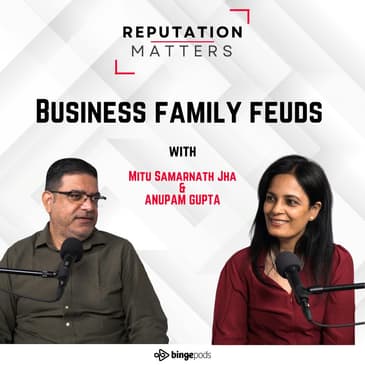
In this insightful episode of "Reputation Matters," host Anupam Gupta discusses with Mitu Samarnath Jha, founder of Eminence Strategy Consulting the intricate dynamics of corporate battles within family-owned businesses. They delve into how these feuds impact corporate reputation, particularly focusing on the recent amicable split within the Godrej group and contrasting it with more contentious family disputes like those of Bajaj and Birla. Tune in to learn valuable lessons on managing corporate reputation, controlling narratives, and the broader implications for stakeholders.
00:00 Introduction
00:57 The Importance of Family-Owned Businesses
02:23 Case Study: The Godrej Group Split
04:38 Handling Family Feuds in Public
06:54 Lessons from the Godrej Settlement
09:47 Case Study: The Bajaj and Birla Feuds
12:41 Managing Public Narratives
15:25 Key Takeaways for Business Families
19:56 Conclusion and Final Thoughts
Learn more about your ad choices. Visit megaphone.fm/adchoices
[00:00:09] Hello everyone and welcome to Reputation Matters, a show about corporate reputation, how companies where the crisis survives them, come out of it and the lessons that we have from these episodes. My guest Mitu Samar found our Eminence Consulting, a strategy consulting firm that deals in Reputation Matters.
[00:00:33] Hi Mitu. Hi Anupam. Great to have you here. Today we are going to talk about corporate battles or should I say family feuds, you know, battles between members of the same family that own and run a company.
[00:00:45] Mitu what makes this very unique, you know because business battles is something that India has seen through generations and we keep on seeing a lot of them. What makes this important from a reputation angle? It's very, very important Anupam largely because more than 80 percent, I think more
[00:01:03] than 85 percent of businesses in India, the incorporated businesses in India are family owned. Right? So family owned businesses definitely have a huge relevance for Indian economy, employment, our day to day circle, all of it and when you know these families or when these family
[00:01:27] owned companies when they become popular, they also the owners, promoters, founders, they start becoming our role models. Some of them we even worship. So then you get to that level and then you start behaving like human and start, you
[00:01:44] know, arguing and fighting and washing dirty linen in public. It doesn't get limited to your organization itself, right? It has, you know, it has emotional impact on public at large and hence it is exceedingly important.
[00:02:01] Family owned businesses are among the keystone of business in pretty much a lot of countries, developed countries and developing countries throughout the world. In India also if you just take say the Nifty or the Sensex, you'll find that the
[00:02:13] biggest market cap companies are actually family owned and beyond the money, beyond the network, beyond the valuations, what does the family have? The reputation. Meethu, today we're going to talk about two specific family feuds or settlements or episodes, whichever way you want to cut and dice them.
[00:02:31] Let's start with one that has happened more recently which is the Godrej group. It's just all of us just woke up one Friday in the morning and there, you know, we've got headlines talking about a split, a demurger or, you know, a division of assets between
[00:02:47] the various factions within the Godrej group. Tell us more. Recently towards the end of April, the newspapers in fact even I was surprised when I read one and I thought that what, what queue did I miss when I was reading that the Godrej group
[00:03:02] has amicably decided to do this family settlement and believe it or not, I actually went on Google and said that how come I missed this signals around these news for such a long time?
[00:03:14] And then it was such a delight to note that there was no communication, no conversation, no argument, none of that happening in the public space, a very amicable, very clean, very clear, you know, family settlement agreement that was shared publicly by the group.
[00:03:34] And it simply said that the group will now be divided into two entities. One will be Godrej Industries, other will be Godrej Enterprises. Adi Godrej and another Godrej family will be part of the Godrej Industries while the enterprises will go to Jamsid Godrej and Smita Godrej. Yeah.
[00:03:55] So folks, just to give some background out here what Mithu was referring to is that when you have a division of assets within a family, believe me there's a lot of drama that happens before that. Okay, a lot of, she said dirty linen being washed in the public.
[00:04:06] Now that builds up some of it comes out. And then finally at some point of time, the various factions within a family settle, which could mean a demerger division, whatever you want to call it. Remember that a family, especially one like Godrej goes back hundreds of years.
[00:04:21] So you're talking about fathers, brothers, sons, daughters all across the play that he would if you just have a look at the family tree of a lot of the large families in India, at least the older ones, you'll be amazed at how big they are.
[00:04:33] And usually when one faction fights another, it could as we'll see in the second case get a little bit dirty. Mithu, how so, you know, when, when this happened, there was no lead up to it. You just woke up one find and boom, there it was.
[00:04:46] So what was the company's response? What did they issue? You know, how did they portray this in the media? How was this carried out? So they simply issued a statement saying that this is how the group is going to go about it. And the statement was very detailed.
[00:05:03] But what was the beauty of the whole statement? I would like to really call about because it is literally like a case study, which I would say generations should follow. And I'm going to use that as a case study for all my client
[00:05:19] interactions as well, because it very, very beautifully talked about some very positive words. So they were very, so they use terms like we are mindful, respectfully, we are doing this. We are working towards long term shareholder value creation.
[00:05:39] So terms were very well thought through the positivity of the whole development clearly was reflected even in the choice of words. So it starts from as simple, basic, you know, observation is that secondly, they were very clear in terms of again, which business goes to whom?
[00:06:01] Plus what happens in case of non-compete, right? Because that's something which comes about. So they're very nicely in just simple one para, but they've covered the whole non-compete piece. They have also covered the piece around the brand Godridge, very, very respected brand again in the country, right?
[00:06:19] And how will that brand be used by both the factions? So all these aspects are covered, lots of learnings. The positivity in the messaging is something that I think we should just emphasize once more because I'm looking at the words
[00:06:32] that they use and you were right about that. They were perfect. So there's respectful, mindful, long term value creation. Believe me, I'm not saying that long term value creation is a rare phrase. It's one of the most common phrases. But in this case, it's believable. There, see?
[00:06:47] Yeah, that's what I'm talking about. He speaks volumes of the character. You know, they've done this with openness, transparency. You don't normally see him. We'll, you know, we'll go through this in the second case study that we have for our listeners today.
[00:07:00] But so this has left a very positive way, positive learnings from this episode. You would say that, right? Because A, it didn't have any baggage. B, it was done very cleanly. And C, what about transparency? You think they were like really upfront and they were, they ticked
[00:07:16] all your boxes when it came to. Yes. They were very, very clear and transparent about it. And you see the way they could shape, hence the narrative in this case, right? Pretty much in their favor, their control. You will not see any, you know, some third person's perspective,
[00:07:36] which is also again questioning their action. So pretty much in control of the narrative, which is the first and the foremost, you know, focus area. Whenever we work towards the area of reputation, we always guide our clients that please be in control of your narrative.
[00:07:55] Don't let somebody else shape it. And in this case, they were bang on. Very clearly they said that the purpose of the merger or sorry, the purpose of this whole family settlement and hence dividing the whole company into two entities was led by, you know,
[00:08:14] the agility that the group wants, the focus on innovation that the group wants. So again, like we've been talking about the choice of words, right? So it just appeared that they are very forward thinking. More importantly, of course, while they're thinking of the two families,
[00:08:31] they're also thinking of consumers. They're also thinking of minority shareholders, employees, all those factions and that is something, you know, totally remarkable. Last point I wanted to just bring up was the fact that this happened so cleanly. It happened so well.
[00:08:48] Obviously it was in the pipeline for a long time. Absolutely. And yet nobody got wind of it, right? The point that you made about how you need to control the narrative and not let rumors and stuff get into the way because once this leaks out,
[00:09:00] the press can make whatever they want of it. Yes. And that's not good for reputation. Yeah, absolutely. They've really handled this well. Correct. And later on, after April 30th, there have been multiple interviews of variety of leaders which is coming out in the market
[00:09:17] from the Godrid group itself, who's talking about with respect to their own vertical, what are they going to do? What are their plans? So again, it's all about future and it's all about forward looking
[00:09:28] and not about, you know, carrying a baggage, which brings us to the second episode. Call it crisis, call it whatever you want, because these are family feuds that weren't so clean, that weren't so smooth, that weren't, you know, that took its time in winding up.
[00:09:43] And there are many examples of this. You can go back to the 80s, 90s, even the 2000s. Me, what do you have first? I can see that, you know, there is Bajaj, Birla, all of these have had some
[00:09:53] divisions within them that did not go as smoothly as the Godrid. So please talk to us about that. Bajaj always tops my recall because it played out in the year 2000, 2003, early 2000s. Yes, exactly, which is exactly when I started working and started observing variety of corporate developments.
[00:10:14] Reputation is an area which always interested me. So, you know, I started observing what's happening and suddenly a brand that we all loved, you can't forget our Bajaj, right? So something which felt like our Bajaj suddenly was hitting headlines with brothers accusing each other, having, you know, conversations
[00:10:36] which was not definitely the most pleasant conversation to have publicly. So it suddenly made you wonder that some group that was so well respected, what went wrong? But the positive aspect of that development is the way then Mr.
[00:10:55] late Rahul Bajaj handle the next generation divide between Rajiv Bajaj and Sanjeev Bajaj, right? So that was, I think mistakes happen, episodes happen. You learn from it. You learn from them and then you don't repeat. And that's where the credibility comes. Let's go to the Birla's.
[00:11:14] Oh, that again hit headlines with news coming out that late Mrs. Birla, she had named Calcutta base CA. Someone who's outside the family. Absolutely, some 5000 crore worth of estate. So again, you know, family denied it. They didn't say they say that we have no connection with this person.
[00:11:40] All sorts of stories about the family started coming out, right? Again, a revered family. We all again use so many products in a day to day life from the group. And yet this kind of an conversation, it just leaves a very poor taste
[00:11:58] in the in the, you know, whenever anybody is reading and talking about it. So very important that it's impossible for families not to know that something like this is happening. But more important for them to know that they have a responsibility
[00:12:19] towards various stakeholders, they can be your customers, they can be your employees and minority shareholders, other shareholders, regulators, so many of them. And, you know, these episodes need to be handled in a way more matured manner. So what was the company's response?
[00:12:39] How did this play out in the public eye and how did this actually become a matter of reputation and therefore the topic of this episode? So, see, most of the time there is no response that comes from the company
[00:12:52] because it's about the family and they are two separate entities, so to say. While the family owns the company, but company doesn't issue formal statements unless their name is getting pulled into in some way or the other.
[00:13:08] So it's largely the family and the family members which, you know, talk about it in public domain usually. What's important to note here is that, you know, the two things, the faction which is more powerful and slightly more popular, they end up controlling the narrative.
[00:13:28] So another faction, even though they are right, you know, their inputs, their side of the story doesn't really get that kind of a hearing. And that's where this whole, you know, mismatched information starts coming out and that creates a challenge.
[00:13:47] An important aspect to understand, Anupam, is that many of these large corporates are actually controlling many public platforms where one can voice their opinion, voice their challenges by way of advertisement. So even these public platforms, they don't want to let go of their revenues.
[00:14:09] So sometimes they are also selective in which voice they will play up. Right? So possibly they'll give space to both the voices, but the size of space, the frequency of space, all that goes towards the more powerful segment.
[00:14:26] And hence those minority or less popular or, you know, lesser known family members, they don't get their due share of voice in public platforms. And, honestly speaking, there is no need to take your family battles public first and foremost.
[00:14:46] If at all it happens, then the challenge is that one of the voices becomes slightly subdued. Now, one needs to know that, you know, where you are playing up. So if you know that you are one of those family members who doesn't
[00:15:02] who's not engaged publicly for this long and suddenly you want to give away a message, you may or you may not get that space. Hence it's important that each of them need to invest in their public presence consciously over a long period of time.
[00:15:22] One sudden stroke will not get them any output. Let's wrap this episode now because there are a lot of learnings out here for, say someone who's watching this, who's actually part of a business family. And what would you tell that person?
[00:15:34] What are the learnings that we have from the Godrej episode and from the other three that we discussed, good and bad and ugly also in fact? Members of family owned businesses, they need to understand two very important things.
[00:15:49] Number one, that their lives are limited, but the company's life is eternal. So they cannot place their personal interests much before the company's interest. Plus, the company has a lot of other elements which are dependent on them. For example, employees, for example, shareholders, vendors, so many other aspects.
[00:16:17] So I'm not saying that don't take care of your personal interest and sacrifice for the sake of organization, not that. What I am trying to communicate is that you need to understand that you have a responsibility by way of being blessed to have been born in this family.
[00:16:39] And you need to really take care of this responsibility very, very responsibly. You cannot just simply start washing dirty linen in your personal interest. So that's the first lesson that I would want to give away. And I wanted to remind our viewers who are the stakeholders here.
[00:17:00] Yeah, just let's just repeat that because in what I sometimes think is that family members don't think beyond themselves. They fail to realize that their reputation and the company's reputation sometimes aren't the same thing. A company is a listed entity.
[00:17:14] What you just said that the company is going to outlive them. Right? So who are the stakeholders involved when a battle between and within a family goes public? Who are the stakeholders? So first and foremost, employees of the company, right?
[00:17:29] And some of them have been career employees, 35, 40 years they've given to just one organization. So, you know, they pretty much become a part of the family. So to say, at least in their own heads. So employees are the first and foremost stakeholder that one needs to be
[00:17:45] mindful of. Secondly, the investors, minority shareholders, maybe some in some cases, institutional investors. The third critical aspect of the vendors, a lot of time, there are some large scale vendors that are supplying to them. But at the same time, they're very small scale vendors as well.
[00:18:06] And 80-20 rule applies everywhere. So for somebody you may be 80 percent of their business. Right? So you do again be mindful of that fact that there is somebody's business is dependent on your business. So so many of them. Anupam, we can go on listing. Right? Consumers, customers.
[00:18:25] We can't forget them going back to the learnings. I think that communication. Let's talk about that some learnings out there owning the narrative, you know, and effective communication to the public. What about that? So learnings, couple of them.
[00:18:39] Number one, first and foremost, shaping the whole narrative and to do that, knowing first in the background that there exists a responsibility. So you cannot shape the narrative to suit your personal interest. The narrative has to be shaped in a manner which is also keeping the larger
[00:19:02] interest in mind. There are some segments of family member who are more powerful than others. The less powerful ones, particularly, they need to be aware of this and they need to know that sooner or later there will be a situation like this that they will face.
[00:19:19] They need to start preparing for it way in advance. Several cases where we recommend the clients that don't start controlling the headlines of newspapers tomorrow, that's not going to happen. And that's not even the best way to go about it.
[00:19:33] Start investing in first and foremost your online presence. Right? Because nowadays, first thing one does is Google's you. So see what Google is talking about to you. And we were referring, I refer to the Edelman Trust Barometer Report.
[00:19:49] Even there, if you read online searches are the most believed sources of information also. So instead of trying to come up with those short term quick wins by hitting headlines for first two days, three days, invest in long term way of
[00:20:06] controlling your online messaging, which is going to really help in shaping your narrative, which becomes very critical. And lastly, never ever lose sight of your stakeholders because each of them have their own stories. Your feud, your disagreement will get settled sooner or later as a family
[00:20:30] owned company, but the people will keep talking about your stories. Your generations forward will have to pay for what you've done today. So better to, you know, for at least for posterity, one should invest more in, you know, having positive conversation around families issues.
[00:20:50] Very valuable lessons there, folks, because reputation goes across generations. And that is something important for all. I mean, for all family members to be aware of before washing their dirty linen in public, folks, that is a wrap on this episode of Reputation Matters.
[00:21:05] My expert, my guest, Mithu Samar, Mithu, thank you so much for doing this. Thank you, Anton.