
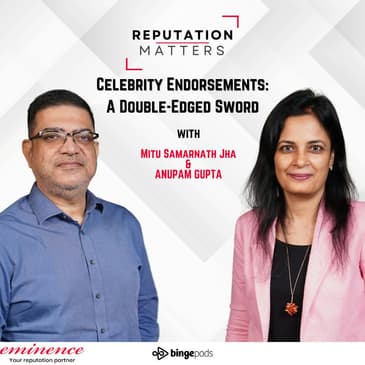

In this episode of Reputation Matters, host Anupam discusses how celebrity endorsements can impact brands during times of scandal with guest Mithu Samarnath Jha, CEO of Eminence Strategy Consulting. They delve into two case studies: Aamir Khan's remarks affecting Snapdeal in India, and Tiger Woods' infidelity scandal impacting global brands like Nike. The episode provides insights into how businesses can better prepare for such crises and maintain their reputations amid controversy.
00:00 Introduction to Reputation Matters
00:27 Celebrity Endorsements and Scandals
00:35 Case Study: Aamir Khan and Snapdeal
01:18 Impact of Aamir Khan's Statement
03:56 Snapdeal's Response and Industry Reaction
06:29 Lessons from Snapdeal's Crisis
11:28 Case Study: Tiger Woods and Nike
13:07 Nike's Decision to Stand by Tiger Woods
14:44 Impact on Tiger Woods' Career and Nike's Strategy
17:53 Comparing Indian and American Endorsement Crises
19:31 Preparing for and Managing Endorsement Crises
19:57 Key Takeaways and Conclusion
Learn more about your ad choices. Visit megaphone.fm/adchoices
[00:00:14] Hello and welcome to another episode of Reputation Matters, a show about how companies face crisis, deal with them, the learnings that we have from all of them. My guest as always, Meethu Samar, CEO, Eminent Strategy Consulting. Meethu, welcome to the show. Thank you Anupam. Today we are doing something different. We are going with celebrities. We are going with celebrities and the firms that backed them and what happened to them when the celebrity said something or did something that was scandalous or was perceived in a wrong way in the media.
[00:00:43] Our two case studies on today's episode, Indian and American, Aamir Khan, Snap Deal and Tiger Woods and Nike. Let's start with Aamir Khan. The year is 2015. It's a year after the elections were over and Aamir Khan made a statement in the press. Let's start on there. How that impacted Snap Deal for whom I think he was a brand ambassador or at least one of the bigger celebrities that were backing him?
[00:01:07] Correct. So he was the brand ambassador of Snap Deal way back in 2015, Aamir Khan. So in one of the events he was speaking, it was a Journalism Excellence Award where he was invited and he was speaking and he mentioned that he talked about the growing intolerance in the country and how his wife feels insecure about their child growing up in a country like this.
[00:01:35] So he made statement to this effect. And that backfired almost immediately. And the brand Snap Deal came under question because A, it was very retail brand, so very high on recall of people and B, its brand ambassador spoke something negatively.
[00:01:54] The people immediately picked up this trend and started using a WhatsApp trend also around that, something like App Wapsi kind of trend that started on Twitter and Facebook. Anupam, immediately around 70,000 one star ratings that were assigned to Snap Deal on Google Play Store of this, within hours of this episode happening and going viral.
[00:02:24] So, you know, a very possibly not thought through statement, possibly quoted out of context, we don't know. But yeah, it really negatively impacted the brand. The interesting part about this is that in the digital age, what happens with these apps, the outrage has a pattern. So once an outrage happens, people first will trend a certain hashtag on social media, could be Instagram, could be Twitter.
[00:02:54] Apps are uninstalled, ratings are given, which are one out of five. So there is a backlash that goes directly to the company. Yes. Okay, even though the celebrity said whatever he said in an event in his individual capacity. Correct. But the public perceives and links his statement, his personality with the brand. So the brand didn't do anything out here. Absolutely. They are just collateral damage. Absolutely. But they face the heat out of all this.
[00:03:24] This happened in 2015. Here we are in 2024. And I think the viewers and you yourself also know that every time these kind of quote unquote controversies happen, the backlash is on the brand. Brand. Whether it's, you know, a show on some streaming media, whether it's a brand ambassador, whether it's a celebrity. So the playbook is now established. Yeah, absolutely it is established. Let's go back to 2015 and let's look at what happened after that. What are the statements? I think Amir Khan himself said something and Snapdeal also issued a statement. Walk us through that, please.
[00:03:54] So the usuals happened, as I would say. So Amir Khan issued a statement saying that I was quoted out of context and so on. Snapdeal came out with a very well-thought statement saying establishing their loyalty to India, talking about how they are supporting small business owners, talking about how they are reaching out to consumers at large in India, all of that.
[00:04:19] And again, distancing themselves from what Amir Khan said in his personal capacity. So definitely that had an impact. So much so that the competitor, Mr. Bunsel from Flipkart, he issued a statement talking about how this is bizarre on people's part to not support or rather to, you know, pass on
[00:04:46] judgment on Snapdeal for something that the brand ambassador has done. So that was really heartening to note that the industry also came in support. And like I spoke about, Ab Wapsi hashtag, there was a parallel hashtag that came in. Snapdeal for India or some such hashtag which started trending. And then two schools of thought, again, became very active on social media. So all this happened.
[00:05:13] And one of the big observations now, Anupam, I have is that of armchair activists, as we call them, right, who would not even change their behavior one bit. But they are the quickest to give an opinion on social media, right? And who's going to measure that? Nobody. But opinions and perceptions get formed because of that. And organizations have to be multiple times certain about who are they partnering with
[00:05:42] because temporarily the impact is very sharp. Now, you see, in case of Snapdeal also, I mentioned earlier, they, there were 70,000 one star rating that the app got on Google Play Store immediately. Now, imagine, while it was a short term episode, people forgot about it eventually all that. But imagine now the damage that they have to do from that kind of a star rating, right? Climbing back is not easy.
[00:06:12] Yeah. People will, every time you're discussing it in your charts also, you will show, oh, this was that episode, right? So, and hence ignore it. But climbing back is not easy. While people may forget quickly, but the damage stays for a longer time. Help me out here. Where is the line? Okay. I am a company. I have paid a celebrity to endorse my brand. I can't control what the celebrity says. Okay.
[00:06:39] I don't know whether I can sign an agreement with him controlling what he says outside in his personal capacity. I don't think that's even possible. What would be your advice to a brand? Like how should he, how should a brand choose a celebrity to endorse them? Right? Because you can't control what the celebrity does in public media and you shouldn't also because that's his personal space. Where is the gray line out here? So the line definitely is blurred. So what should organizations do to protect themselves?
[00:07:08] Number one, before signing on any celebrity, there should be a good amount of research that is. That must be done on two parameters. Number one, which is what most organizations are currently doing. Number one, suitability of that celebrity for your brand. Right?
[00:07:26] So whether an Aamir Khan is suitable for ABC bank or not, or again, whether a Deepika Padukone is suitable for a particular cola drink or not, or so on. I'm just giving a random example. But first kind of research that happens is the suitability of the celebrity on with respect to the brand's business, their target audience, who are they talking to, all that.
[00:07:55] But another aspect which most brands are not paying critical attention to is also the risks associated with that celebrity. What can go wrong with him or her? And if the possibilities of things going wrong are A, very high and B, of the nature that you would definitely wouldn't want to associate, then one should stay away from that kind of a brand's ambassador.
[00:08:24] So that kind of a research on suitability and the risk quotient, so to say, one needs to look at. And it's interesting, right? Because in the last few years, we've had so many instances where platforms that show shows or movies on their apps. I'm talking about OTT out here. Yeah. And suddenly people find something objectionable in that, you know. So I just feel that a lot of this is now here to stay. Yes.
[00:08:49] Whether it's a celebrity or it's a show or it's a movie that a certain digital organization, whether it's a Snapdeal or it's an OTT streaming platform, this thing is here to stay. People take outrage and they will have a problem with something that you put out there. So that makes this even more important for our audience to understand how to face such a crisis when it happens. At least I think that one good point out of this, and help me out here, is that this binds. I mean, it goes by.
[00:09:18] There is a point of time where this happens and then hopefully after that, it's business as usual until the next crisis happens. What do you think? A, that, that people forget it goes by. All that happens, Anupam. And that is what maximum people believe. But let me give you a couple of examples. At least let me give you one interesting example. Recently, a head of a company, very, very popular Indian company.
[00:09:46] He got in touch with me, legal head, that many years ago, okay, some allegations were put on the promoters. It was a very popular news at that point in time hitting headlines. Eventually, it died its death and people forgot. And like you said, it goes by. And it was in the day and age of social media. So it was pretty active at that point. Okay. So it was a very popular news at the time. Yeah. Now that company is looking at getting private equity investment.
[00:10:16] Okay. And the investors have done their own internet search and this episode got caught. Okay. So he called us saying that, how can we remove this episode from internet? Right. So please remember, episodes may go by, but internet or information on internet never dies. Yeah.
[00:10:38] You will always page, and you know, you may not find this information in page one or two or three, but page four, five, six, seven, somewhere it'll get caught. And people who are looking for information for you will find it. Right. So prima facie, you may be able to color it, but eventually the right stakeholders will find it. And that is where you will come under challenge. And this brand is a very established brand I'm talking about. So this is one big challenge, Anupam.
[00:11:07] And we cannot just rest on the fact that memories are short. That's my, you know, humble submission to all the companies that pay attention to what is the kind of narrative that is getting shaped about you. Own it. Very critical to do that. Let's go to the second case study on today's episode. Yes. Much bigger star, much bigger company, global. We're talking about Tiger Woods and Nike. We are now in 2008, 2009, I think.
[00:11:37] Yes. When the entire Tiger Woods, I mean, the whole episode happened about him, his infidelity, mistresses, taped phone calls getting leaked to the media. Let's first start with what happened then. And important to note, now this was a not a very active social world. Yeah. And B, it was not a tech company. It was a regular shoe company. Right? So what happened is Tiger Woods got under this controversy of infidelity.
[00:12:05] So the pristine image that he carried of a family man, a role model, a star golfer, all that came under question at that point in time. And episodes after episodes kept getting leaked out. That time he used to endorse multiple brands like AT&T, Gatorade, Nike, Accenture, you know, so variety of brands like that.
[00:12:28] And there was a research that I was reading by UC Davis, which brought about the fact that, which estimated that around 5 billion to 12 billion dollar market cap impact that these companies faced. Okay. You know, after this episode unfolded. So that was the, you know, kind of impact crisis can have on your brand and you have to be very careful about it.
[00:12:57] So immediately, most of the brands broke ties with Tiger Woods and they, you know, closed the contract. Yeah. However, Nike chose to continue the contract with Tiger Woods and which is the differentiator in this particular episode. Very knowingly that my brand ambassador is in a controversy and yet I will go ahead with him.
[00:13:23] So slightly different take than the previous one where Snapdeal actually broke, I don't know if they discontinued the contract in Feb 16 because it was anyway due for expiry. So they did not renew the contract. Sure. Now renewal didn't happen because of the crisis or not, we don't know. Or not, we don't know. Yeah. But it didn't happen.
[00:13:44] In this case, in the heat of crisis, knowing very well that Tiger Woods is going through something like this, Phil Knight, who is the founder of Nike, looked at it as a blip in his career and chose to stay with Nike, with Tiger Woods as a brand ambassador. And I think what makes Nike very different from other brands is that some of the ad campaigns have been absolutely iconic. Yeah. Starting from the just do it, just three words to everything that they've done.
[00:14:14] Recently, they did a campaign in the Olympics. Winning is not for everyone. Yes. Again, that was like very controversial. People didn't, you know, think that that had the right messaging. So all of the ad campaigns throughout have always been provocative, inspiring. You know, people will always have an opinion on what they're doing. Yeah. And they still chose to stick with Tiger Woods at that point of time. Did they put it out in any statement or anything or they just did a business as usual or they did any messaging or ad campaigns at that point of time?
[00:14:43] So, we have to look at it in a slightly different manner in this case, Anupam, because I feel while Phil Knight stood by or Nike stood by Tiger Woods and it was really one of the most differentiated approaches that one would take. There was a lot at stake for Nike also, right? So in 1996, when Tiger Woods, you know, career started becoming, you know, the shiny bright career that he is enjoying.
[00:15:12] So that started becoming prominent. That's when they partnered and the entire range of golf sport products that Nike offers was hinging on this partnership. Right. So if you break this partnership, there is business repercussion also. So very well thought through decision, because if that happens, then already there are business challenges. Now the brand ambassador also goes away.
[00:15:39] Then that whole business itself comes under question. So I don't think it was a campaign led approach that they took. So it was a very conscious business call they took. And then eventually Tiger Woods career also came back to normalcy, right?
[00:15:56] So 2009, while this episode happened, he was badly criticized, not for, you know, the act, of course, that was condemned, but more for insincerity of his apologies. So in the 10 months running from, you know, November 2009 to August 2010, he issued eight apologies, his PR team or his team, whatever.
[00:16:24] They issued eight apologies of different times or eight statements, at least of different kinds. So, you know, eventually people had started taking it for granted.
[00:16:36] But eventually he did one press conference where he, you know, then very genuinely faced the media, accepted the act not being in sync with his, so to say, image or what is expected out of a role model. And then promised to, you know, come back with a good game eventually.
[00:17:00] And parallelly during this period, I guess, for whatever reason, but his game also suffered. He was not really winning the, you know, matches either. So it was a parallel bad time. Eventually his game started, he started coming back, game started improving, he started winning matches. Then this press conference happened and public perception also started turning positively.
[00:17:27] Though social media was not that pronounced at that point in time, but it was there. So initially in November 2009, he had become like a joke and memes were being issued. Eventually the sentiment started turning positive. So, so yeah, in a manner speaking that this whole choice of staying together in difficult times worked for Nike.
[00:17:52] Very interesting because you've got the brand, you've got the company that has built its reputation over a long period of time. And then because they chose to side with someone or, you know, use a celebrity's fame for their brand, they get dragged into this entire thing. But then it's, they joined at the hip, right? Because the celebrity and the brand both at some point of time, in a certain sense, merge. The brand benefits from the celebrity's fame, his success in both the cases.
[00:18:20] What do you think in India now, which is still new to this concept of endorsements, you know, for sports and for Bollywood. Do you think that companies will keep on occasionally facing these crises every once in a while between a celebrity's individual freedom of speech and the stance that he takes versus the brand's own identity going forward? Like something that happened in the US. It will continue. Yeah. Without doubt, right? As in there is, there is no ambiguity around it.
[00:18:49] That because of brand ambassadors, companies will come under trouble, 100%. And the reverse is also true. Because of companies act, because these brand ambassadors are personalities by themselves, they have their own, you know, reputation to protect. And the companies that they partner, if they do something, which is again, not in line with the regulatory authorities or not in line with the expected business outcomes.
[00:19:16] The brand ambassadors image also suffers. So like you said, they're joined at hip, right? Both of them are influencing each other in some way or the other. So there's no ambiguity that this problem is going to persist. What one needs to look at is like I said, preparedness.
[00:19:38] Whenever you're partnering with a brand ambassador, do enough research on how risky it is to associate with them. Then the chances are like anybody's guess, right? Anything can go wrong with anyone, but at least you're prepared for what kind of scenarios that could come in. Okay. Now that we've defined the problem, let's bring in a solution. Yes. Let's bring in the learnings from both these episodes and, you know, wrap this up for our audience.
[00:20:05] First and foremost, and very, my, my, again, one of my favorite recommendations is, brands should not start struggling on creating their narrative when crisis hits, right? Because then you have very limited opportunity to control the kind of outputs that will come out when anyone does a Google search on you or any kind of platform search on you.
[00:20:32] And it's become very, very natural nowadays, right? I need any information. We were having a conversation just a while ago and we had a doubt Google, right? So, so Googling is become, it's become a verb. So, it is very important for brands to pay attention to building, establishing or strengthening and then protecting their narrative on social media. Oh, sorry. Oh, sorry.
[00:21:00] On the digital media altogether, not just social, particularly on search engine platforms like Google. So, that needs to be done pretty consciously and in a structured manner. The second point, we are known by the company that we keep, right? So, whenever you're partnering with a brand ambassador, be very aware of what is the kind of personality you're partnering with.
[00:21:28] And like I mentioned earlier, reverse is also true. So, brand ambassadors, my strong recommendation to them that they should also do their own due diligence before running into partnerships. Nowadays, so many celebrities, we just saw Olympics and then we read how everybody is running behind the winners and signing deals for them. The winners should be conscious of who they are partner.
[00:21:54] You would recall the challenge Dhani, MS Dhoni had with Amrapali. You remember that they went back on their promises and they had sold. That was the construction company that he had associated himself with and the construction company did not deliver on the flats and Dhani took the heat for that. Precisely, right? For what fault of his, right? So, we have to be very conscious. The reverse is also true that the brand can do something wrong and it can impact the ambassador.
[00:22:22] So, these two things in this case needs to be paid attention to and that's the big learning for today. Sure. Number one, shape your narrative and build and protect it. And secondly, be mindful of the company that you get into. Like I always say, whatever matters must get measured and then regularly monitored. If you are paying attention to these three M's, you will be sorted for all your crisis going forward.
[00:22:51] And with that short and sharp bite, that is a wrap on today's episode of Reputation Matters. My guest as always Meetu Samar, CEO of Eminent Strategy Consulting. Meetu, thank you so much for doing this for our audience. Pleasure. Thank you. Thank you.