
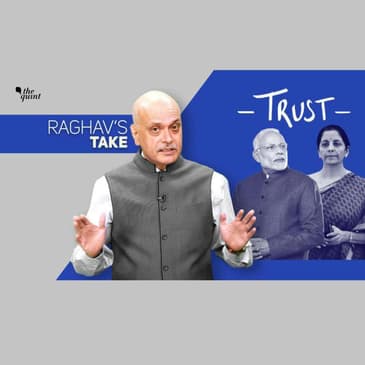
Frankly, the time for budget quick-fixes is over. If PM Modi genuinely wants to rejuvenate, he’s got to create ‘TRUST’ for India’s private enterprise which accounts for 90% of the economy.
India’s bureaucracy has always been deeply suspicious of well-regulated markets. Which is why they love to micro-manage outcomes. But this time, their quest has become maniacal. If you create truly competitive markets, ‘super profits’ will vanish on their own — when will our policy-makers understand that?
We should have learned from Ben Bernanke, who authored TARP (Troubled Assets Reconstruction Program) and saved America’s economy in 2008.
The ‘criminalisation’ of business has now become quite outrageous.
Therefore, it has also had the most harmful impact on India’s economy.
Host: Raghav Bahl
Editor: Mohammad Ibrahim
Producer: Sonal Gupta
Read the story on The Quint
Learn more about your ad choices. Visit megaphone.fm/adchoices
[00:00:00] You are listening to The Quint's podcast. Rise Above the Din, Unbox the News with me, Raghav Behal. Now it is a very familiar sort of cacophony that happens around any union budget. People say have you cut taxes? Will you invert the inverted duty structure?
[00:00:24] Now how will you control the fiscal deficit? Or you must step up the government expenditure just damn the fiscal, don't worry about it. You must bring back that old idea, bring back investment allowance. But you know what?
[00:00:38] This time the funk is deeper, it's sort of elemental, it's virtually gotten into the soul of India's economy and therefore if Prime Minister Modi genuinely wants to rejuvenate our economy he's got to create trust. TRUST for India's private enterprise which accounts for 90% of the economy. So why?
[00:01:04] Why have I put TRUST in all caps? Because it's an acronym and you know that's something our very popular Prime Minister, he loves to coin all the time doesn't he? So let's go. Tea, tea is for trusting market forces.
[00:01:22] You know India's bureaucracy has always been very deeply suspicious of well regulated markets which is why they always love to micromanage, they love to try and get the outcomes that they want. I'll just give you some of these beauties, some of these examples.
[00:01:39] You know there is a monstrosity called the anti-profit hearing authority. Now this authority is supposed to ensure that super profits, I'm putting that in court mark super profits because that's exactly what this is. Super profits created by the new GST regime are disgorged from corporations.
[00:01:59] Now can you believe that? What? How do you calculate these super profits? What for instance is the interest rate to be charged on consumer credit to calculate these super profits? How much of brand advertising is for current sales?
[00:02:14] Now that is clearly an expense and how much to create future customers because that's strictly an investment. Now there are literally a million such questions which are irresolvable, irresolvable ab initio. But you know what the consequences are when you let inspectors free with these irresolvable contradictions or questions?
[00:02:38] The consequences are very predictable. There are going to be strange penalties on companies who will have exorbitant legal fees to try and defend themselves. They'll be extortion followed by corruption. On the other hand, if you truly create competitive markets then these so called super profits
[00:02:59] will sort of vanish on their own. So when? When will our policy makers understand this axiom? Now I'll give you another example. Now see the mess they've created in our e-commerce policy. You know our bureaucrats have invented a fiction that is grandly called the marketplace model.
[00:03:21] Now under that foreign players like Amazon and Walmart can't, can you get it? Can't sell directly to consumers but they can only provide a trading platform for third parties in which they are allowed a maximum equity stake of 26% you know it gets more and more complicated.
[00:03:41] But in the same breath, in the same breath we create very favorable policies for big Indian capital which can come in and you know virtually annihilate the foreigners and the locals alike. Somehow that is you know fine, fine and noble.
[00:04:00] I'll give you another example which is literally my favorite. You know we've allowed free pricing of energy, something as critical as energy including oil is freely priced in India but you know what? We control entertainment tariffs and of course we can't make up our minds on whether
[00:04:18] pharma prices should be free, should be controlled, should be capped or there should be some mishmash of all of this even as you know critical drugs are therefore held back by global producers because we can't make up our minds.
[00:04:33] Also we, we means our policy makers they just love to zigzag between banning, rebanning and re-rebanning. Now I'll give you an example in the 1990s unlisted Indian companies could not float overseas in the early 2000s they were allowed to do that.
[00:04:49] Then in the mid 2000s they were banned again. Now how? Now I understand they are going to be allowed again. You know likewise with put and call options for overseas investors and with dividend distribution taxes and with long term capital gains taxes on listed equity shares.
[00:05:08] I can again give you a million more examples which could prove how, how and I hate to say this but how consistently ludicrous our policy makers are. Now to the, to the second letter R. R is for recapitalizing, recapitalizing not destroying
[00:05:28] assets but you know we've allowed one systematically important asset after another to go bankrupt when we should have rescued each one of them it began with ILFS but then it spiraled into DHFL, into other real estate companies, into jet airways, into PMC and what not.
[00:05:51] Now I've been writing and I've been shouting until I've literally gone blue in the face. We must reclaim the asset. We must protect the asset. We must clobber the wrongdoer but we must reclaim and protect the asset.
[00:06:07] Now if only, if only we had injected a critical amount of cash you know not too much a critical amount of cash maybe you know maybe 1 lakh crore rupees if we had done that
[00:06:17] via a superior via a very protected sort of debt instrument we could have almost avoided note this we could have avoided with a with an infusion of 1 lakh crores we would have avoided an asset destruction of virtually 20 lakh crore rupees.
[00:06:36] Let me now turn to the third letter you, you and this is for uncriminalizing, uncriminalizing business. You know the sort of criminalization of business has had the most harmful impact on India's economy here are just a tiny number of illustrative examples from you know what actually actually
[00:06:57] if we start digging into the details is actually an embarrassment of riches there's been so much criminalization of business but here are some of these handful of these examples. Rakesh Shah you know Rakesh is a much celebrated first generation entrepreneur he's a former
[00:07:12] president of Fikki but he is publicly hauled in an enforcement directorate summons which could be entirely you know entirely misconstrued should not perhaps a discrete inquiry have happened before before his fair name was starred in such a public manner.
[00:07:32] Now look at what happened to Ravi Narayan and to Chitra Ramakrishna both of them very pedigree professionals who virtually created the national stock exchange but they were virtually treated like common criminals in you know case which is a very highly technical case regarding alleged stock market manipulation.
[00:07:53] Now look at the case of Jagdish Khatter now Jagdish Khatter is an ex IAS officer he's also the very much fated former CEO of Maruti now he he encountered a business failure in his post retirement venture instead of being given the benefit of the doubt he is
[00:08:12] thrown before the CBI in a corruption case. One more example two auditors of an E and Y affiliated firm you know are arrested in a six year old case they are arrested after six years six year old case after their firm
[00:08:29] and I believe they themselves have made nearly fifty appearances before the police recording evidence. And here we come to the fourth letter S and this S stands for the sovereign not the Supreme Court making economic policy.
[00:08:46] Now just I will give you one more very critical example just look at the Supreme Court's order on AGR which is the adjusted gross revenue these AGR penalties on telecom licenses. Now first the government frames and what I would call an inherently ambiguous rule you
[00:09:03] know which could include such non-operating income like rent on buildings and foreign exchange gains and losses now these are non-operating income they create that definition in calculating the shareable operating revenue look at that word operating revenue of a telco but that includes such non-operating items.
[00:09:25] Now when the Supreme Court upholds that ambiguous definition and this ends up inflicting a 1.5 lakh crore levy this almost threatens the viability of critical telcos the government the government instead of exercising its sovereign duty to clean up these policy mistakes the government just goes quiet.
[00:09:48] Now what is worse is when an unintended impact of nearly 3 lakh crores get this right unintended impact of nearly 3 lakh crore rupees is inflicted on non-telcos you know that is like oil and gas companies and television cable operator companies you know these people hold telecom
[00:10:06] licenses but even when they are threatened with a 3 lakh crore levy it is unintended the government you know sort of instead of quickly dousing this what is clearly an egregious error the government simply fiddles while you know to use that old phrase fiddles while
[00:10:24] New Delhi of course not Rome New Delhi burns. Now there are numerous examples of a similar abdication by the sovereign before very devastating court orders now the Modi government needs to buckle up and take ownership of
[00:10:39] its policy mistakes correcting them in time rather than you know watching unmoved from the sidelines. And the last letter T again T this is for tax terrorism just one little phrase just kill it kill tax terrorism so to repeat if we want to revive India's economy budget
[00:11:02] or no budget we need to create trust that's T for trusting market forces are for recapitalizing and saving assets rather than destroying them you for uncriminalizing business S for the sovereign proactively correcting its policy mistakes rather than leaning on the supreme
[00:11:24] court and finally T for tax terrorism just kill it thanks for listening tune in next week for another episode of Raghav's tick.