
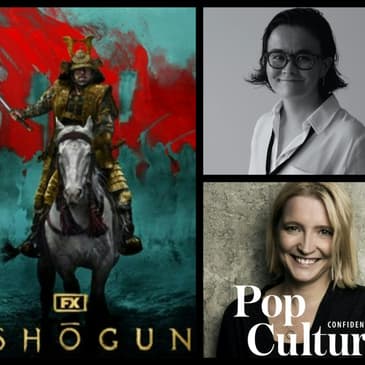

We have reached the finale of one of the best TV shows of the season! We're thrilled to have director Hiromi Kamata ('Let the Right One In', 'Monarch: Legacy of Monsters') join us to talk about 'Shōgun' & her incredible episode 'Ladies of the Willow World'. Ms. Kamata and Christina talk about the power of the women of 'Shōgun', why she showed the actors Bergman's 'Persona' & Wong Kar-wai's 'In the Mood For Love', and how 'Shōgun' was a personal journey for the director who is of Japanese and Mexican heritage. And much more!
Listen now!
Learn more about your ad choices. Visit megaphone.fm/adchoices
[00:00:00] Shopify grows with your business no matter how far or big you grow. From the launch your online shop stage to the first real-life store stage, all the way to the did we just hit a million order stage? Shopify is there to help you grow.
[00:00:19] Whether you're selling your fans next favorite shirt or an exclusive piece of podcast merch, Shopify helps you sell everywhere from their all-in-one e-commerce platform to their in-person POS system, wherever and whatever you're selling. Shopify's got you covered.
[00:00:39] Sign up for a $1 per month trial period at Shopify.com slash income, all lowercase. Go to Shopify.com slash income to grow your business no matter what stage you're in. This is Pop Culture Confidential and I'm Christina Jirling-Biro. Hey everyone, welcome to the show.
[00:01:19] This week marks the finale of Shōgun, the mini series created by Rachel Kondo and Justin Marks based on the 1975 novel. I'm so happy to talk to talented director Hiromi Kamata about the stunning work that went into the series. Historical accuracy, thrilling storylines and powerful representation.
[00:01:40] There were so many incredible details. Over a hundred people from the costume department were on set the day that Ms. Kamata filmed that incredible no theater scene in her episode Ladies of the Willow World.
[00:01:54] She talks about how she showed the actors Ingmar Bergman's persona and Wong Kar-Wai is in the mood for love to prepare for maybe one of the sexiest scenes on a TV show this season but that hardly includes a touch.
[00:02:08] Hiromi Kamata, whose directorial credits include TV series like Selena Let the Right One In and Monarch Legacy of Monsters was born in Mexico City to a Mexican mother and Japanese father, a cinematographer.
[00:02:23] As you'll hear, working on Shōgun was a meaningful and powerful connection to her own background. I was particularly happy to talk to Hiromi Kamata about the episode she directed which very much centers on the powerful women of the show.
[00:02:38] One of our main characters, Mariko, played by Anna Sawai, Lady Ochiba, mother to the heir, played by Fumi Nikaito and Yukikuri's Kiku, a renowned courtesan. John Blackthorn is played by Cosmo Jarvis and Lord Tokonaga by Hiroyuki Sanada.
[00:02:56] The time has come for us to turn towards Toranaga as an ally. Hiromi Kamata, welcome to the show. Thank you so much for joining me. Thank you so much. I am very very excited to be joining you. Thank you for inviting me on. Yeah, let's take it away.
[00:03:32] Congratulations on this incredible show. I have to say that first Shōgun is absolutely spellbinding such an epic show. I want to dig into the work that you did specifically on Ladies of the Willow World and other things.
[00:03:45] But first I want to know a little bit about background. So I'm speaking to you from Mexico City. You're half Mexican and your father is Japanese and a cinematographer, I understand. How did this mixture of rich culture affect you as an artist, as a director?
[00:04:03] Yes, I was born and raised in Mexico City. This is where all my love stories are. So this is where I try to live but also wherever good story or character takes me. So my father, he was born and raised in Japan.
[00:04:24] He worked a lot for Mr. Toshiro Mifune. He worked at Mifune Productions. So he came to... He started as a focus puller but then became a cinematographer. And early on in the 60s, he came to Mexico to shoot some footage for Japan.
[00:04:46] And he fell in love with the country. So he came back and asked Mr. Mifune to write a recommendation letter, which Mr. Mifune wrote very kindly in Spanish. Oh wow! I have the letter. I have it. And it's kind of museum material.
[00:05:08] And so he came here in 1969, met my mom. They fell in love. They had my sister, they had me. And he started working as a DP since two weeks later after she came. So I basically grew up on set.
[00:05:31] And I was running around stages and being a pain in the butt to my father. And I told him maybe I was, I guess, like 14 when I said, I want to be a director like Spielberg. And my dad was like, oh god no! So... It worked out!
[00:05:52] Yeah it worked out. When Rachel Condo and Justin Marks were the creators of this show, when you started with them, what was the sort of approach that they wanted to do with Shogun? Well, I think the most attractive approach to me was,
[00:06:09] you know, being the daughter of a Japanese man. Growing up watching Karate Ki, growing up watching Steven Seagal movies because I was also obsessed with Steven Seagal, don't ask me why. Obviously the representation of Japanese in cinema, Western cinema,
[00:06:30] wasn't something that my father felt proud of at all. My dad used to play for me, he used to make me watch Kurosawa films. He made me watch Misoguchi films. So obviously the misrepresentation, and I'm going to call it like that,
[00:06:51] of Japanese culture in Western cinema was kind of embarrassing to him. Like maybe the way I feel when I see a Mexican in a burro with a sombrero in 2024, you know, it's like... So when Justin and Rachel and Ed McDonnell approach to me,
[00:07:14] they said, you know, this is not a show about East and West. You know, this is a show that goes for the psychological. This is a show that wants to be accurate, that wants to honor the Japanese culture, that wants to capture the Japanese soul.
[00:07:31] This is a show about the dual relationship between entrapment and freedom. You know, this is a show about agency then, that became a whole other concept. That became a very engaging and wonderful project that I wanted to be a part of.
[00:07:51] And particularly the women in this series very much show in your episode. There's an incredible line where Mariko says, women are simply at war. Talk to me a little bit about the women, their historical counterparts and what you wanted to bring in terms of the women of Shogun.
[00:08:14] Well, women in this Ego-Ko period, I mean, of the statue, obviously that women we are witnessing, they did have agents, you know, but they had agency through their husbands. They had agency through, you know, men had to be on the way for them,
[00:08:33] you know, to be able to complete a task, to be able to have a purpose. They served a Lord. We can see it very clear in Mariko. To me, the fact of capturing and approaching, you know, the different sides of being a woman in that Japanese food period
[00:08:53] was very interesting. You know, you just said something that is very important for the episode, which is that line that Mariko says to Todanara, a woman is simply at war, right? That is to me what unlocks the title of the episode, Ladies of the Willow,
[00:09:11] because every woman in the show is a lady in the Willow world and every woman is having their own war, you know? Mariko is at war because she's determined to accomplish her mission, you know, with Todanara. Her father is a following hero, you know?
[00:09:29] This mission wasn't finished, so she has to finish it for him. No matter what her feelings, her impulses towards, you know, Blackburn, whatever, anything that's outside that has to be left outside, no, she has to make a choice, you know?
[00:09:45] She has to keep her feelings and impulses under control, you know, because she has a bigger purpose. In the case of Kochiba, you know, she's trying to get revenge. There's an incredible scene you built, the No Theatre. Talk about the research for this
[00:10:03] and how you worked to get this scene to life. Look, I'm gonna give it, I'm gonna give the credit to Kaling Puente, an associate producer on the show who was the writer on set with me. Kaling was the research coordinator. So by the time I got to Shogun,
[00:10:24] there was this, you know, a lot of information that was kind of already packed for me. You know, because we're talking about centuries and centuries and where No Theatre comes from and, you know, the region where No Theatre comes and how it evolved with time
[00:10:41] and how it started, you know, and how it became a traveling thing and then how it became a representation for Lords, you know, it changes a lot. So I must say that if I had to, you know, as an episodic director,
[00:10:53] I had to go into the research on my own. I would have been probably stuck for five years, you know, researching for the scene. So I got to give the credit to my friend and the very talented Kaling Puente who when I got into the show,
[00:11:09] she already had, you know, all this information ready for me and also we had, or historian and we had three different advisors, right? So by the time I got to the show, everything was kind of just built for me, not to worry about the historic accuracy
[00:11:29] because it was, everything was, you know, on point. What I had to worry about was, you know, how are we gonna tell the story? How are we gonna capture the behavior of all the characters that are around the play and what this play and watching this play,
[00:11:46] what does it mean for Lady Ochiba? What does it mean for her? She said, what does it mean for Tidama? That was a hard part of the scene, you know, because obviously the play was, you know, written by this wonderful, you know, company theater for the show.
[00:12:01] But to me, the challenge was trying to accomplish both. You know, shooting the play in the most beautiful way, honoring it, you know, having, you know, this amount of time on, you know, international TV to give the world a glimpse of the beauty
[00:12:20] of the death of North theater, but also not forgetting that there's a reason for that play. That's the story that history we're watching, right? And as all these characters are plotting because in the end they're hostages inside the castle. There's also Lady Ochiba who's watching her past.
[00:12:40] And you were talking about the research. What about in terms of costume and set design? The women's costumes in particular and the clothing seems so much to be part of the story itself. Yeah, the production design, you know, Helen Jarvis or production designer, she's just a genius.
[00:13:00] But also North theater has a very specific, you know, it has a background that it is what it is and it has, you know, measures. So we just have to be very accurate with, you know, with what North theater does inside the castle obviously.
[00:13:17] But in terms of costumes, I gotta give it to Carlos Rosario who is a brilliant, brilliant, brilliant costume designer. My fiancé is a costume designer and I must tell you I respect, you know, a costume and I am very, very, I work very close
[00:13:34] with my costume designers and I must say what Carlos did is just something out of this planet. Oh, it's amazing. So many and just the wealth of the costumes in this series. Are you looking for a podcast where you can learn about the juiciest historical events in people
[00:13:49] but it really feels like you're just gossiping with your girlfriends over a glass of wine or two? Well, that's why we created Right Answers Mostly for what you didn't learn in history class but you really wanted to. I'm your host Claire Donald And I'm Tess Belomo.
[00:14:00] Join us every Monday as we dive into the most iconic people and events and get ready to laugh along the way. We cover it all from Titanic to Kris Jenner, Studio 54, Marie Antoinette, even Colton Crime such as Charles Manson in Jonestown
[00:14:13] every Monday wherever you listen to your podcast because history is just gossip. Follow us at Right Answers Mostly for more. For my episode, he started designing the costumes probably around four months before five months before we started for one episode, you know? We shot in February, yeah.
[00:14:32] And he probably started designing in November, you know? Every single costume that you see on the Northeastern was built from scratch. I used to laugh a lot because he used to tell me this is kind of my version of the Met Gala.
[00:14:47] Yeah, and in terms of narrative tool which cost to me to me probably one of the closest tools for narrative in terms of character and actors it's a power display, you know? In the way they're dressed. It's probably every, the higher your rank
[00:15:07] the more layers you wear as a lady for example, you know? So I don't remember how many layers Fumini Gala was wearing but I do remember that walking for one meter it took her, you know, it was very heavy, very, very, very heavy. Probably, yeah, probably,
[00:15:23] I'm trying out of the back of my mind talking to Gala is probably more than 125 people from his team were on set that they were working in home. All the pieces that there were built, they were built in Vancouver but all the fabrics if I remember correctly
[00:15:37] were brought from Japan. And I wanna talk to you about cause you managed to make one of the sexiest scenes I've seen on television without any physical contact at all. And I understand that you made your actors research for this, tell me about that.
[00:15:57] They had to watch some stuff. Yeah, they did. They had to watch some stuff, you know? Talking with Justin, you know? Justin and Rachel, we both spoke about the remains of the day, you know? As one, I made Cosmo watch, rewatch because he already loved it.
[00:16:14] He's a huge fan of Anthony Hopkins and a big fan of Emma Thompson. So he rewatched it. Anna for example, she's 32. She's never seen, you know, persona, Bergman. So I made her watch that as well. Also, that was spoken previously with Rachel, both Rachel and Justin.
[00:16:31] And I'm a huge fan of Wonka-R-Wai. So obviously in the mood for love, Chunking Express, you know, they meant a lot. It was probably the most challenging scene. I guess the North Theater scene and, you know, the Tea House scene particularly were the most challenging ones
[00:16:47] because talking about Bergman, for example, I knew that no matter what I could shoot or we could shoot, nothing could be sexier than whatever was happening, you know, what's happening in the mind of Mariko and Blackthorn at that moment. And that was to me the challenge.
[00:17:04] That was to me the objective. I mean, if I could capture that, then, you know, hopefully people wouldn't engage. People would, you know, would care, would connect with that. So we rehearsed it a lot of times. A lot of times because the way you block a scene
[00:17:21] in Shogun, it's entirely different from what I had worked on, Kudo Japan, the movement, the way women move, the way characters, it's a complete... Rules are other rules, let's just say. So there wasn't much leeway. So the Tea House scene, we rehearsed in every human possible way
[00:17:44] because there was a lot of blocking. We caught a lot of it, but originally if I might remember the wonderful Megan Huang who wrote this script, who wrote this wonderful scene, might correct me, but I think there was a version that was around seven pages.
[00:18:00] So we have three characters there, you know, and all these layers are happening and they're not moving except for one moment which is when Mariko stands next to Kiku and then it keeps us here, you know, and then takes over her voice to express.
[00:18:18] So we had a lot of rehearsals. We had not for movement, but for emotion, for intention, for layers, for what was happening in whose head and what we needed to engage, what reactions we could have made. There was a lot of work behind that scene.
[00:18:37] So I am very proud and grateful that people connected with it because it needed to be, in the words of Justin March, these sexist scenes. And I think there was, you know? It is and it makes it so much more powerful too.
[00:18:51] There's so much going on in that scene between every, it's like a triangle between every character and the idea of sort of why they're there, what the duty is, what they can't do, what they can do and everything is happening not only in their dialogue,
[00:19:06] but who you're watching. It's really an incredible scene. Thank you so much. And I, you know, I have to be, I have to be credit obviously to the actors, particularly Anna, you know? And the actors who plays Kiku, both Yuka and Dana were both incredible to work with
[00:19:26] and just kind of took the scene into their own hands and into their own spirit and they became one voice. Which was for me and Cosmo, it was just amazing to witness, right? You were talking about sort of being an episodic director. How does that work from,
[00:19:45] and when you're working with so many different directors, how do you keep the show on the same approach as was thought of from the beginning? Well, you know, in the case of Shogun, it was a huge, huge, huge showing in scale. And by the time I got there,
[00:20:02] it was completely established. You know, Donald and Manpulek had already established episode one and two. The rules were entirely different, but the way I see it as an episodic director is like you go into a construction building, right? It's a building. You know, the foundation is there.
[00:20:19] You're building a level, you're building a floor and you wanna make sure that the floor is solid, you know, it goes with the architecture. So that it also has your own kind of DNA, your own kind of soul, whatever it is, whatever spark you can put there,
[00:20:35] that's the challenge, you know? It's not, it's because in the end, you know, you're a little shooting star that comes and goes and comes the others. And you bring your power to it, so you can definitely see it there. You've mentioned so many women also behind the scenes
[00:20:53] that you've been working with. Did you see that reflected in the episode? Absolutely. That's what I love so much about the episode, you know, the directorial monitors, you have your monitors and you have your little tent. I had a Japanese script supervisor,
[00:21:12] Caps Loco and I had a Canadian script supervisor, Aaron. I had Cali Puente with me on set. We had our assistant director training, Elise, Elise Morter, and the five of us were there the whole time, you know, every single day.
[00:21:30] And we used to call it the five one club because all of us were very short. Anna, Anna, she might kill me for saying this, but Anna is five two and Fumi is five one. So I remember we were saying like,
[00:21:43] okay, if you're above five one, you cannot come in. You're not in the group. You're not in the five one club. This is only ladies that are below five two. So the power of that, you know, and Rachel, I mean, Rachel kind of became my therapist
[00:22:00] because her office was next door to mine. The power of Rachel, you know, the honesty of Rachel is working with her and the clarity of every single female character on the show is threaded by her. So to work with women like that,
[00:22:18] you know, women that are just incredible and generous and smart and thoughtful and talented, it's a privilege. When you jump into that pool, you know, either you step up or you drown because all of them are so strong. You keep each other floating.
[00:22:35] When this airs, our conversation airs, we will have seen the entirety of Shogun. For you, what is Mariko's storyline? How, what should we take away from it as viewers? Well, I think in the case of Mariko, I love her persistence and I love her decision, you know?
[00:22:54] I love that life has so many distractions. Life can make you change your decisions and choices. Life can shape you, but when, you know, when your soul and your character is so well built and your aim is on something and just go for it,
[00:23:11] no matter what life might, you know, no matter what the type might bring, it's something that I admire completely in Mariko. The way she dies, she finally dies for her purpose. She honors her father and to me coming from a Japanese father, that means the world, you know?
[00:23:31] Because I do, I did grow up those values, you know? It's a strange mix, but while working on Shogun, I thought a lot about my father. A lot, probably Shogun as far as now is the only work I've done that my father is completely proud of, you know?
[00:23:49] In the sense of what Mariko's storyline, as I said, she made it, you know? Everybody's gonna say, oh my God, she, you know, she died for a purpose. And for every other woman's purpose too also, so to say. Of course, of course, because in the end,
[00:24:04] that's something I love about our show and the story is that, you know, Crimson Sky is not this huge battle with thousands of soldiers, you know? Mariko is a Trojan force. That's what Doranaga sends into the castle of Osaka that changes everything. It's her.
[00:24:20] So to me that's the, Mariko by far is the most powerful character of the whole show. That scene between her and Lady Ochiba, when you know Lady Ochiba tries to change her mind. They talk about their childhood, you know? There's this beautiful, fuming guide
[00:24:35] who is a beast of an actor. She's, and a pleasure to work with. There's this moment when Lady Ochiba turns around and you can see the tears falling, you know? Because she knows that Mariko is gonna die. She knows.
[00:24:49] But Mariko stands on her ground and no matter what, it's a very heartbreaking episode. My favorite, if I must say, by far is this episode nine but also I believe that the seeds of that relationship and where that comes from, that backstory is set on episode two.
[00:25:09] The series of the book. Absolutely. Right? Yeah. And I just have to talk about Toranaga. What a character, what a, I mean, it feels like he's always with very much patience setting things up and letting them happen somehow. Yeah, I think he's a mastermind.
[00:25:26] You know, he's the best chess player that there is because he's always, he moves ahead of everybody. He's a great poker player too because he never shows what he does in a way. Episode eight directed by my friend Emmanuel Oseke
[00:25:46] for which is also one of my favorite episodes that heartbreaking scene between Hiromato and him. You know, when Hiromato commits a puku. Hmm. And legend, he's just, Hiro is just a legend. Hiroyuki Sanade is just a legend and I'm gonna say hands down,
[00:26:02] he is the most professional, talented, passionate, wonderful actor I've ever had, the privilege and honor to direct. And he's a producer on the show as well. Yes, you know, I talk him like, Hiro, you need to take, you know... No, no, no, no, no! Polyester agrees.
[00:26:20] She said, I hear a Yuki fan. Yes, exactly. But you know, when Hiro was not shooting, he was on set every day as a producer and always from a place of love and respect for the show and for his directors, you know,
[00:26:37] like the way he approached me, you know, and gave me one little note, this little note, you know, making sure that every single detail on the show was accurate with the Japanese culture, with the Japanese food, food, alcohol, cinema, peace, no?
[00:26:51] So what he did is just beyond human. He's just Hiro. And what's next for you? I'd love to do a movie, you know, having conversations here in Mexico, in the States as well. I would love to do a movie, I guess. That's where I come from, you know,
[00:27:09] I started, that's where my dad started, that's where I started. I started in cinema doing movies. I would love the possibility to do a movie. And in terms of TV, you know, just keep looking for shows that I would love to watch. Characters, we even shows that characters
[00:27:26] that are messy, that are layered, that hit all the colors of the rainbow, you know? Those are the kind of shows that I wanna definitely chase. I'm in conversations for another show that I'm really interested. Fingers crossed, I do get it.
[00:27:42] And if I do get it in a couple of months, you know? Wonderful. And that's pretty much it. Thank you so much, Hirumi, for joining me. I really thought it was some stunning direction on your episode and I was so glad
[00:27:57] you had the time to talk about it. Thank you. Thank you so much, Cristina. That means the world to me because you know, it's a very intimate character episode and that's very hard. Sometimes to me it's harder than, you know, that monsters and action and Jesus
[00:28:15] and because the tension comes from the heart and that's the hardest to pull up. Thank you to Hiromi Kamata. You can watch the entirety of Shogun on FX or Disney Plus. Thank you for listening to Pop Culture Confidential, a part of the Evergreen Podcast Network.
[00:28:37] Follow us wherever you get your podcasts. See you next time. Hi there, I'm Heather Draco. And I'm Sarah Saunders. We host the podcast That's a Hard Know about saying no and setting boundaries. So you can become that true and empowered you that this world needs.
[00:28:56] Saying no isn't just okay. It's the key to living an authentic, fulfilling life. I'm a licensed professional clinical counselor so while this podcast is in no way a replacement for one-on-one therapy, I suppose I know what I'm talking about. I'd say so.
[00:29:14] We talk about learning to say no and set healthy boundaries and how it impacts mental health, physical health, relationships, parenthood and more. Subscribe wherever you get your podcasts and visit our website, HardKnowPodcast.com. We're here to help you find your no and say it unapologetically.
[00:29:36] That's a hard no.