
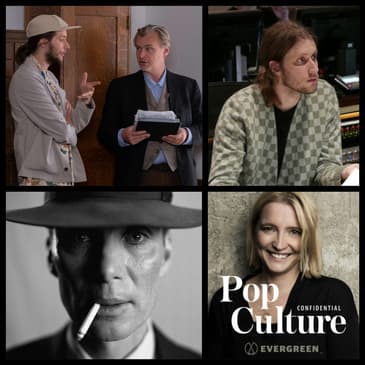

Award winning composer/producer Ludwig Göransson joins Christina to break down his journey scoring 'Oppenheimer', his process, influences and close collaboration with director Christopher Nolan.
Photo credits: Courtesy of Ludwig Göransson
Melinda Sue Gordon/Universal Pictures
Learn more about your ad choices. Visit megaphone.fm/adchoices
[00:00:02] [SPEAKER_00]: When you think about businesses that are selling through the roof, like skims or all birds, sure,
[00:00:08] [SPEAKER_00]: you think about a great product, a cool brand and great marketing.
[00:00:12] [SPEAKER_00]: But an often overlooked secret is actually the businesses behind the business, making selling
[00:00:18] [SPEAKER_00]: and for shoppers buying simple.
[00:00:20] [SPEAKER_00]: For millions of businesses, that businesses Shopify.
[00:00:24] [SPEAKER_00]: It's home of shop pay, the number one checkout in the world.
[00:00:28] [SPEAKER_00]: You can use it to boost conversions up to 50%, meaning way less cards going abandoned and way more sales
[00:00:35] [SPEAKER_00]: going through to checkout.
[00:00:37] [SPEAKER_00]: Upgrade your business and get the same checkout all birds uses.
[00:00:42] [SPEAKER_00]: Sign up for your $1 per month trial period at Shopify.com slash income all lowercase.
[00:00:49] [SPEAKER_00]: Go to shopify.com slash income to upgrade your selling today.
[00:00:55] [SPEAKER_00]: Shopify.com slash income.
[00:01:01] [SPEAKER_06]: This is Pop Culture Confidential and I'm Christina Ehrling Biro.
[00:01:17] [SPEAKER_06]: Hey everyone, welcome to Pop Culture Confidential.
[00:01:20] [SPEAKER_06]: Thanks so much for being here.
[00:01:23] [SPEAKER_06]: I'm really thrilled to have the opportunity to speak to award-winning composer producer Ludwig Göransson
[00:01:30] [SPEAKER_06]: on the occasion of the premiere of Christopher Nolan's much-awaited epic film Oppenheimer.
[00:01:36] [SPEAKER_06]: The Oppenheimer score another incredible achievement by Göransson.
[00:01:41] [SPEAKER_06]: Göransson's varied career is already iconic.
[00:01:45] [SPEAKER_06]: He scored films such as fruitville station and creed, he won the best original score Oscar for Black Panther.
[00:01:52] [SPEAKER_06]: For TV, he's worked on community and his Mandalorian score is already part of the Pop Culture landscape.
[00:01:59] [SPEAKER_06]: As a producer, he has frequently collaborated with Childish Gambino,
[00:02:03] [SPEAKER_06]: produced Candid Glamar Rihanna just to name a few.
[00:02:07] [SPEAKER_06]: Oppenheimer is his second musical collaboration with Nolan.
[00:02:12] [SPEAKER_06]: His first was Tenet, a sensation, a score that you can really feel deep down in your psyche and your bones.
[00:02:19] [SPEAKER_06]: He mirrored the film's time and version theme by reversing,
[00:02:23] [SPEAKER_06]: genaring the musical soundscape and by using Chris Nolan's own breath for that otherworldly effect.
[00:02:29] [SPEAKER_06]: Nolan's Oppenheimer is based on the biography American Prometheus about Jay Robert Oppenheimer,
[00:02:37] [SPEAKER_06]: the theoretical physicist whose work was pivotal in the development of the first nuclear weapons as part of the Manhattan project.
[00:02:45] [SPEAKER_06]: With this project, we can sense themes that Nolan seems to have been exploring through his whole body of work.
[00:02:52] [SPEAKER_06]: Science, obsessive characters and moral questions of cause and effect.
[00:02:57] [SPEAKER_06]: In my talk with Yoranso and we explored how we work with Nolan and his themes musically.
[00:03:03] [SPEAKER_06]: For Oppenheimer, Nolan suggested to Yoranso that he base the score on the violin.
[00:03:08] [SPEAKER_06]: To mirror the high-strength nature of Oppenheimer, brilliance, moral ambiguity and a momentous historical event.
[00:03:16] [SPEAKER_06]: More on that after this, here is Oppenheimer.
[00:03:26] [SPEAKER_05]: This is a national emergency.
[00:03:28] [SPEAKER_04]: We need a charge.
[00:03:57] [SPEAKER_03]: Of a 12-month-head start, 18.
[00:03:59] [SPEAKER_03]: How could you possibly know that?
[00:04:02] [SPEAKER_03]: We've got one hope.
[00:04:04] [SPEAKER_04]: All Americas industrial-minded scientific innovation connected here.
[00:04:10] [SPEAKER_04]: Secret laboratory.
[00:04:13] [SPEAKER_04]: Keep everyone there until it's dark.
[00:04:17] [SPEAKER_05]: Let's go recruit some scientists.
[00:04:22] [SPEAKER_05]: Bill of Town, Bill of Fast.
[00:04:24] [SPEAKER_05]: We don't want to sign this for your families. We'll never get the best.
[00:04:29] [SPEAKER_01]: Why would we go to the middle of nowhere for who knows how long?
[00:04:36] [SPEAKER_05]: Why?
[00:04:37] [SPEAKER_05]: Why?
[00:04:38] [SPEAKER_05]: How about because this is the most important thing that ever happened in the history of the world?
[00:04:44] [SPEAKER_03]: You're the great improviser, but this...
[00:04:49] [SPEAKER_03]: you can't do in your head.
[00:04:51] [SPEAKER_03]: Are we saying there's a chance that when we push that button,
[00:04:55] [SPEAKER_03]: we destroy the world?
[00:04:57] [SPEAKER_03]: Chances are near zero.
[00:05:00] [SPEAKER_03]: Near zero.
[00:05:01] [SPEAKER_03]: What do you want from theory of loan?
[00:05:03] [SPEAKER_03]: Zero.
[00:05:04] [SPEAKER_03]: It would be nice.
[00:05:07] [SPEAKER_06]: Ludwig, Yarramson, welcome to the show.
[00:05:09] [SPEAKER_06]: And thank you so much for this tremendous achievement that you have done again with Nolan and Oppenheimer.
[00:05:16] [SPEAKER_02]: Thank you. Nice to be here.
[00:05:18] [SPEAKER_06]: So I read an interview with Chris Nolan a while back and he said, quote,
[00:05:25] [SPEAKER_06]: people have asked if I would ever make a musical and I'm like,
[00:05:28] [SPEAKER_06]: they're all musicals and quotes.
[00:05:31] [SPEAKER_06]: And having made a couple of works with him, musically,
[00:05:34] [SPEAKER_06]: do you get what he means by that?
[00:05:36] [SPEAKER_02]: Absolutely.
[00:05:37] [SPEAKER_02]: I mean, music in his movies are...
[00:05:40] [SPEAKER_02]: It's like a character, right?
[00:05:42] [SPEAKER_02]: It's the space and the emphasis that he has with music,
[00:05:48] [SPEAKER_02]: and storytelling is very unique.
[00:05:52] [SPEAKER_02]: And I mean, I saw that from the very beginning when I grew up and watching his movies
[00:05:57] [SPEAKER_02]: and seeing what they've done with Dev Julian and Josemer and seeing...
[00:06:03] [SPEAKER_02]: Seeing those movies and getting that feel from the music,
[00:06:07] [SPEAKER_02]: it was extremely inspiring.
[00:06:09] [SPEAKER_02]: So being able to work with him and having this collaboration ship was meant to lots of me.
[00:06:16] [SPEAKER_02]: And just feels like we're discovering...
[00:06:20] [SPEAKER_02]: and everything, every time we work together, it feels like we're discovering new paths
[00:06:23] [SPEAKER_02]: and music that I haven't done before.
[00:06:28] [SPEAKER_06]: We're going to get back to talking about your work with him.
[00:06:32] [SPEAKER_06]: But describing Jay Robert Oppenheimer, he's truly a trinity to use that word.
[00:06:37] [SPEAKER_06]: A true polymath he was fascinated by philosophy, poetry, music.
[00:06:43] [SPEAKER_06]: He was also of course the physics he could see things in different dimensions
[00:06:47] [SPEAKER_06]: and he could be volatile, such an enigma.
[00:06:50] [SPEAKER_06]: How did you approach him, musically?
[00:06:54] [SPEAKER_02]: Yeah, that was a challenge because when I...
[00:06:56] [SPEAKER_02]: As soon as I read the script, I realized this is written from first person perspective.
[00:07:03] [SPEAKER_02]: You know, as a reader, as an audience member, you're experiencing the movie through his eyes.
[00:07:10] [SPEAKER_02]: So I realized pretty quickly that the music needs to feel like you're with him
[00:07:16] [SPEAKER_02]: and like you're in his emotional state at all times.
[00:07:20] [SPEAKER_02]: And this emotional state is obviously a genius, but there's a lot of complexity in there.
[00:07:26] [SPEAKER_02]: And so the musical spectrum had to be...
[00:07:30] [SPEAKER_02]: You know, there's the tonality if there's a lot of ground to cover.
[00:07:35] [SPEAKER_02]: And so that was the big challenge.
[00:07:38] [SPEAKER_06]: Since the movie is so much about morality, what does guilt sound like to you?
[00:07:45] [SPEAKER_02]: Well, in this movie, particularly the one thing Chris was mentioning early on in the process
[00:07:50] [SPEAKER_02]: was that he wanted to explore the sound of violin for portray, Oppenheimer.
[00:07:55] [SPEAKER_02]: And especially because it's a...
[00:07:57] [SPEAKER_02]: It's a fretless instrument, so you can...
[00:07:59] [SPEAKER_02]: You can just hold down a note and then depending on the strength of the...
[00:08:04] [SPEAKER_02]: and the vibrato, you can make it.
[00:08:06] [SPEAKER_02]: You can turn it from like something beautiful, romantic into something neurotic and horrific within a split of a second.
[00:08:13] [SPEAKER_02]: And I think that's state how you can go into those feelings...
[00:08:17] [SPEAKER_02]: You know, and balance those feelings in a very interesting way.
[00:08:24] [SPEAKER_02]: That's what...
[00:08:25] [SPEAKER_06]: That's interesting.
[00:08:26] [SPEAKER_06]: So the violin has this paradoxical...
[00:08:28] [SPEAKER_06]: You can go from one state of mind to another.
[00:08:30] [SPEAKER_02]: Exactly. You know, you can start to tone feeling like,
[00:08:33] [SPEAKER_02]: OK, this is about to be something beautiful...
[00:08:36] [SPEAKER_02]: and then within a second, it just ends on a completely heartbreaking, horrific note.
[00:08:43] [SPEAKER_02]: And I think that's what we was trying to embody with the emotional core of Oppenheimer.
[00:08:52] [SPEAKER_02]: And especially because we're portraying him, like, pre-trained or imposed training...
[00:08:57] [SPEAKER_02]: and him realizing the effects of what he did.
[00:09:04] [SPEAKER_06]: So musically, what was pre- and what is post-trainity?
[00:09:09] [SPEAKER_02]: I feel like there's two elements of the score.
[00:09:12] [SPEAKER_02]: There's...
[00:09:13] [SPEAKER_02]: And the first element which is the violin and the strings, we have a solo violin that feels...
[00:09:18] [SPEAKER_02]: extremely intimate.
[00:09:20] [SPEAKER_02]: And then as the movie goes on, the solo violin is joined by four violins...
[00:09:25] [SPEAKER_02]: and the solo string orchestra. So you have the dynamic range of that sound.
[00:09:32] [SPEAKER_02]: And then, on the other hand, you have...
[00:09:35] [SPEAKER_02]: And that's how I started writing the music. Everything was organic.
[00:09:37] [SPEAKER_02]: I wanted to feel the most important part of all.
[00:09:40] [SPEAKER_02]: And the beginning was to feel the emotional core.
[00:09:43] [SPEAKER_02]: So I wanted to write all the music with just live performance players and organic.
[00:09:49] [SPEAKER_02]: But then we have, throughout the whole movie, there's a feeling of the impending doom.
[00:09:55] [SPEAKER_02]: And that's where we get the electronic elements in the modern production.
[00:10:00] [SPEAKER_02]: And those kind of synths that feels like they're growing you down to the bottom of...
[00:10:05] [SPEAKER_02]: bottomless pit, and it was the juxtaposition between those two worlds that...
[00:10:13] [SPEAKER_02]: for me I thought was very interesting.
[00:10:15] [SPEAKER_06]: And in terms of sound design, I understand that you often use real world sounds...
[00:10:21] [SPEAKER_06]: In your compositions, what did you do for this one, if any?
[00:10:27] [SPEAKER_02]: Well, for this one, there was some sound design that Chris had experiment with a lot in the beginning...
[00:10:32] [SPEAKER_02]: which was the sound of footsteps.
[00:10:35] [SPEAKER_02]: And something that I realized when I was done with the movie and I was watching down the movie...
[00:10:40] [SPEAKER_02]: was like, I realized pretty quickly that, oh my god, there's two hours and forty minutes of music, but there's no percussion in it.
[00:10:48] [SPEAKER_02]: And there's something that we never really talked about it, but I realized that we have footsteps.
[00:10:57] [SPEAKER_02]: And it's such an important sound of the movie and also I think that the way those footsteps just comes out...
[00:11:06] [SPEAKER_02]: because there's no percussion, there's no other rhythmic elements, and it's just you feel the threat of that even more.
[00:11:13] [SPEAKER_06]: Yeah, correctly if my wrong, it's two very powerful moments, one with Jean Tatlok, where it's very emotional and one where he's sort of understanding...
[00:11:22] [SPEAKER_06]: I don't want to give anything the way, but he's understanding the ramifications of what had happened.
[00:11:27] [SPEAKER_06]: And these footsteps are almost like army marching and train, I mean, it's very kind of a stressful sound I would say.
[00:11:33] [SPEAKER_02]: Exactly. You know, it's...
[00:11:40] [SPEAKER_02]: I mean, it's like, you hear that sound also in the opening scene of the movie.
[00:11:45] [SPEAKER_02]: So it's almost like he knew it was coming too, right?
[00:11:48] [SPEAKER_06]: Interesting. For Tenet, you talked about that you spent the first meeting before reading the script with Nolan...
[00:11:58] [SPEAKER_06]: and he played you vinyl in CDs and you talked for a long time. Was it the same type of process here?
[00:12:05] [SPEAKER_02]: Yeah, after we finished Tenet, we still kept in contact. Then like we're hanging out and watching movies or playing music talk about art.
[00:12:16] [SPEAKER_02]: So I think that's an important part of the process and the collaboration ship of like still keeping in touch.
[00:12:24] [SPEAKER_02]: And talk about art and seeing having that discussion, I think it's very important.
[00:12:30] [SPEAKER_02]: So when we started an open-high memory, we already had that relationship.
[00:12:37] [SPEAKER_02]: And so we already knew each other.
[00:12:40] [SPEAKER_02]: But even though we knew each other, he's never like, hey, I'm working on this thing right now.
[00:12:45] [SPEAKER_02]: It's kind of it's always kind of very secretive about what he's doing.
[00:12:50] [SPEAKER_02]: And so when I got the phone call, it was like, kind of added to the blues.
[00:12:53] [SPEAKER_02]: Like, hey, you want to read the script next week or tomorrow.
[00:12:58] [SPEAKER_02]: So I didn't have any, I didn't go into reading.
[00:13:02] [SPEAKER_02]: When I sort of been scripted, I hadn't really know anything about it before I started reading it.
[00:13:07] [SPEAKER_02]: And I think that's a great way to approach things.
[00:13:11] [SPEAKER_06]: Besides the violin, did he have anything to offer up of what he wanted the soundscape to feel like?
[00:13:18] [SPEAKER_02]: Not really, no. Like we had the violin and my wife's violin is so I was able to, you know,
[00:13:23] [SPEAKER_02]: we worked a lot together in the beginning to kind of create these, you know, experiments.
[00:13:30] [SPEAKER_02]: So the first three months before Chris Chott's Christmas starts shooting a movie, he is in pre-production.
[00:13:35] [SPEAKER_02]: And I sit down with him.
[00:13:36] [SPEAKER_02]: I meet up with him once a week and a play in the music that I've written.
[00:13:40] [SPEAKER_02]: And then we analyzed him.
[00:13:41] [SPEAKER_02]: We dissected it.
[00:13:42] [SPEAKER_02]: We talk about the sounds.
[00:13:43] [SPEAKER_02]: We talk about the melodies.
[00:13:44] [SPEAKER_02]: What works? What doesn't work?
[00:13:46] [SPEAKER_02]: And then we work on that for three months over and over again.
[00:13:49] [SPEAKER_02]: So when he goes off the set, the shoot, the movie.
[00:13:54] [SPEAKER_02]: He already has three hours of music to listen to.
[00:13:57] [SPEAKER_06]: He's also very hands on.
[00:13:59] [SPEAKER_06]: I remember you telling a story about a scoring session you had with the full orchestra and you were saying something the orchestra about.
[00:14:08] [SPEAKER_06]: Do that again in bar 24 and a little voice from the back said, no, it's actually 17.
[00:14:13] [SPEAKER_06]: And it's turned around and it's Chris Nolan.
[00:14:16] [SPEAKER_06]: What's it like to have, do you like having a director who so hands on and into, you know,
[00:14:23] [SPEAKER_06]: or is it more of a difficult process?
[00:14:26] [SPEAKER_02]: No, in this case, it is a good thing.
[00:14:28] [SPEAKER_02]: I'm very, that's also because it is very inviting.
[00:14:32] [SPEAKER_02]: He's also very inviting to my opinion and to my views.
[00:14:36] [SPEAKER_02]: Even though he has a crystal clear idea of what he's trying to do and what he's doing.
[00:14:41] [SPEAKER_02]: Like he knows, you know, I'm sure he was, you know, there's a very powerful moment with silence in a movie.
[00:14:47] [SPEAKER_02]: You know, and I'm sure that was already in his head while he was writing the movie.
[00:14:53] [SPEAKER_02]: So he has this crystal clear idea, but it's also extremely open to my input and where I kind of sometimes disagree and we're having that.
[00:15:02] [SPEAKER_02]: And we're having that exchange of ideas and I think that's when when magic really can happen and we can push each other.
[00:15:10] [SPEAKER_02]: And I think for this one, you know, we ended up with something pretty special and that was because we had those moments where we pushed each other further.
[00:15:21] [SPEAKER_06]: So I just saw the movie this morning.
[00:15:24] [SPEAKER_06]: So I'm very full into it.
[00:15:27] [SPEAKER_06]: But I have three spots I wanted to talk to you about and you actually mentioned the one with tat lock and the foot stomping.
[00:15:33] [SPEAKER_06]: So we've talked about that and I felt that something very emotional happened for me.
[00:15:38] [SPEAKER_06]: One is when he's open-hymer, it's like changing from a real military uniform to sort of the open-hymer uniform.
[00:15:49] [SPEAKER_06]: He had we know the pipe and there I felt something musically happened.
[00:15:54] [SPEAKER_06]: Do you remember that scene I'm talking about?
[00:15:56] [SPEAKER_02]: Oh yeah, absolutely.
[00:15:59] [SPEAKER_02]: He's kind of becoming, you know it's almost like there's always those scenes when he gets his cape.
[00:16:07] [SPEAKER_02]: He gets his superhero, the superhero gets his weapons, whatever it is.
[00:16:14] [SPEAKER_02]: It's kind of a powerful moment in the movie and it's his team that's being played.
[00:16:20] [SPEAKER_02]: But it's also kind of a throwback to the same theme that you feel like when he's a student, he's in the university, he's a student and he's going to the museum.
[00:16:29] [SPEAKER_02]: And you see this Picasso painting hanging on the wall like in the IMAX on a huge screen.
[00:16:35] [SPEAKER_02]: And that opening montage is kind of that's a very important piece of music there too and it's a throwback to that music.
[00:16:43] [SPEAKER_02]: And I remember when I saw one of the first things that Chris showed me after I read the script was his visually effects experiments that he and Andrew Jackson was working on.
[00:16:54] [SPEAKER_02]: They were working on creating the visuals when you know the atoms are spinning around his circles and you have this beautiful, like fluorescent lights created.
[00:17:04] [SPEAKER_02]: Yeah, and I was remember sitting in that in the theater watching that and those lights hitting my face and I was such a,
[00:17:11] [SPEAKER_02]: it's such a cool way of portraying that and it's not digital and it feels timeless in a way.
[00:17:19] [SPEAKER_02]: And that's, that's how I wanted the music to sound like in those moments.
[00:17:24] [SPEAKER_02]: So yeah.
[00:17:25] [SPEAKER_06]: And then of course I want to talk to you about thinking about and creating the music for Trinity, for the bomb, for this moment that changed history and is so,
[00:17:36] [SPEAKER_06]: with so many moral implications, not just for open-himer and everyone who worked on it but also for the world of course.
[00:17:44] [SPEAKER_06]: And this was an incredible segment, both visually and more than musically talk about that and what your feelings were going to go into making that.
[00:17:53] [SPEAKER_02]: Well I think it's such a monumental part of the movie.
[00:17:57] [SPEAKER_02]: Until that scene, the bomb has always been scribbling, it's been theory, it's not a physical thing that you're actually touching it.
[00:18:09] [SPEAKER_02]: You're hoising it up in the air, it's now real in a different way.
[00:18:13] [SPEAKER_02]: So for me right there it is, is a big change in music there for that scene.
[00:18:18] [SPEAKER_02]: You're going from a big orchestra, like lush music to like the dees kind of really intimidating sounds.
[00:18:27] [SPEAKER_02]: It's almost like more like a sound design you have.
[00:18:30] [SPEAKER_02]: There's three elements like this little taking metallic sound and this like really rumbling bass, which is symbolizing the bomb.
[00:18:38] [SPEAKER_02]: And you're going and it really feels, I really wanted it to feel like this is a real threat.
[00:18:44] [SPEAKER_02]: You know this is maybe this is this is actually bigger than what you thought it was going to be.
[00:18:48] [SPEAKER_02]: You know this is this thing now you actually know that it could potentially destroy the whole world.
[00:18:54] [SPEAKER_02]: And and then obviously for the whole trend it has you know there's there's a sense of urgency there that that you haven't experienced before.
[00:19:02] [SPEAKER_02]: And these guys, these scientists I mean they're taking bets if they're going to blow up the whole world.
[00:19:08] [SPEAKER_02]: It's kind of it's kind of insane and this actually happened in reality.
[00:19:12] [SPEAKER_02]: Like imagine imagine even being there and being in the state that they were worrying at that time to take bets on the possibility of destroying the whole world.
[00:19:21] [SPEAKER_06]: Humanity.
[00:19:23] [SPEAKER_06]: Can you talk a little bit about the process itself with Chris Nolan?
[00:19:27] [SPEAKER_02]: Yeah, so most of the music like I said they're done.
[00:19:30] [SPEAKER_02]: I have three hours of music written before he starts shooting the film.
[00:19:35] [SPEAKER_02]: And then so then when he's finishing the movie he finishes shooting the movie when he starts editing.
[00:19:41] [SPEAKER_02]: He starts to cut in my music and the scenes.
[00:19:44] [SPEAKER_02]: So every part of the movie making his everything is he always sees the music and the movie in here's the music and creates it.
[00:19:55] [SPEAKER_02]: It's all an own world. The music is its own DNA it's not you know a lot of times when he's starting to move even most of the times you know people use 10 music and they take music from our existing movies and stuff.
[00:20:08] [SPEAKER_02]: But Chris doesn't work that way and he we already created a bunch of music that he cuts into the scenes and so when I have a first when he has the first cut there's already my music is already in there.
[00:20:18] [SPEAKER_02]: And then from there on we finesse it like we we have like three or four months when we finesse it.
[00:20:25] [SPEAKER_02]: I write a bunch of new music to picture he has every Friday we watched a movie we watch a movie down with Emma Thomas and Jennifer Lane that her was sitting and watching it and watched a progress and then next Friday we do the same thing and we see it just coming together and we then it's like you're creating a you know creating something.
[00:20:46] [SPEAKER_06]: And how many Fridays was this month and month it was probably like yeah it's probably for three months yeah well it was an amazing outcome.
[00:20:54] [SPEAKER_06]: I don't have a lot of time but I wanted to ask you a little bit about your influences right now what are you listening to who are composers that that if you had a young student like yourself at one time and you'd said go listen to this listen to Ludwig you're on some of listen to this also.
[00:21:13] [SPEAKER_02]: Then um personally I listen to a lot of jazz I listen to a lot of classical music and then I try to also listen to and also listen to like the the the pop radio and and try to stay up today with all the records that comes out every Friday.
[00:21:28] [SPEAKER_02]: But are you talking about like specifically film scores or.
[00:21:31] [SPEAKER_06]: Yeah tell me the last ones that you have listened to that have really affected you.
[00:21:37] [SPEAKER_02]: Well I listen to I think what Danny Pemerton did on on spider verse I think you know both those who are incredible like he's always like also pushing the you know the boundaries of sound and I think it's it's it's it's incredible.
[00:21:51] [SPEAKER_02]: I'm a composer and and also what you know I finished his access to a couple days ago and like to see that our community has played those in those seasons and how much music created for that it's astonishing.
[00:22:06] [SPEAKER_02]: And then I'm super excited to see me as a new film you know it's I think he came out yesterday and Joe Hishashi you know I love everything that he's done and.
[00:22:18] [SPEAKER_02]: He's he never sees us to amazed me.
[00:22:21] [SPEAKER_06]: Well Ludwig I've really wanted to talk to you for a long time they want me to wrap up. Thank you very much for taking your time with me of course. Thank you for having me.
[00:22:30] [SPEAKER_06]: Hey, though.
[00:22:32] [SPEAKER_06]: Thank you so much to Ludwig Yoranson.
[00:22:34] [SPEAKER_06]: Open I'm a premieres on July 21st and make sure to see it on the largest screen available.
[00:22:42] [SPEAKER_06]: And thank you so much for joining us.
[00:22:45] [SPEAKER_06]: Pop culture confidential is a part of the Evergreen podcast network find it wherever you find your podcasts see you next time.
[00:22:53] [SPEAKER_01]: Well, hey podcast listener my name is Vince and I'm the host of a show called the R our show stands for Reddit readings.
[00:22:59] [SPEAKER_01]: We're going to sit down twice a week and I'm going to bring you the most entertaining stories from all the best subreddits that exist online things like malicious compliance petty revenge.
[00:23:11] [SPEAKER_01]: Hey lady, I don't work here.
[00:23:13] [SPEAKER_01]: Oh there's so much more lots of great stories and things you won't believe like the one time.
[00:23:18] [SPEAKER_01]: This dude was caught into bathroom with his friend.
[00:23:21] [SPEAKER_01]: He was slapping them because that was the only way that he could actually legitimately help them a mall cop comes in with a taser.
[00:23:27] [SPEAKER_01]: Oh yeah the rest is history it's going to be fun.
[00:23:31] [SPEAKER_01]: There's I don't know I got like 20 seconds left so I don't got much more time to tell you another story but just join me on the R our show.
[00:23:38] [SPEAKER_01]: It's from Evergreen podcast produced in partnership with West learn media so the R our show wherever you get podcasts subscribe today and it's like an adult story time let's hang out together.
[00:23:49] [SPEAKER_01]: The R our show subscribe today wherever you get your podcasts.